sunroof BMW X5 4.8IS 2005 E53 Owner's Manual
[x] Cancel search | Manufacturer: BMW, Model Year: 2005, Model line: X5 4.8IS, Model: BMW X5 4.8IS 2005 E53Pages: 200, PDF Size: 3.55 MB
Page 4 of 200
Contents© 2004 Bayerische Motoren Werke
Aktiengesellschaft
Munich, Germany
Reprinting, including excerpts,
only with the written consent of
BMW AG, Munich.
Order No. 01 41 0 158 701
US English IX/04
Printed in Germany
Printed on environmentally friendly paper,
bleached without chlorine, suitable for recycling.Notes
Overview
Controls and features
About this Owner's Manual8
Symbols used8
Your individual vehicle8
Status at time of printing9
For your own safety9
Symbol on vehicle parts10
Service and Warranty10
Reporting safety defects11Cockpit14
Instrument cluster15
Indicator and warning lamps19
Buttons on steering wheel23
Warning triangle24
First-aid kit24
Refueling24
Fuel specifications26Locks and security systems:
Keys30
Central locking system30
Opening and closing:
from outside31
Opening and closing:
from inside34
Liftgate35
Tailgate36
Alarm system38
Windows39
Panorama glass sunroof41
Adjustments:
Sitting safely43
Seats44
Mechanical seat adjustment45
Power seat adjustment46
Head restraints47
Power rear-seat backrest
adjustment48
Safety belts49
Seat, mirror and steering wheel
memory50
Heated seats52
Steering wheel52
Steering wheel heater53
Mirrors54
Page 31 of 200
OverviewControlsMaintenanceRepairsDataIndex
31n
Opening and closing: from outsideUsing remote control When you engage/release the vehicle
locks, you also activate/deactivate the
anti-theft system, arm/disarm the alarm
system, and switch the interior lamps
on/off.
Protect the remote control against
unauthorized use by handing over
only the spare key, for example when
using hotel valet parking.<
You can find more detailed information
on the alarm system on page38.
Since passengers or animals
remaining in the vehicle might be
able to lock the doors from the inside,
take the vehicle's keys with you so that
the vehicle can be opened again from
the outside at any time.<
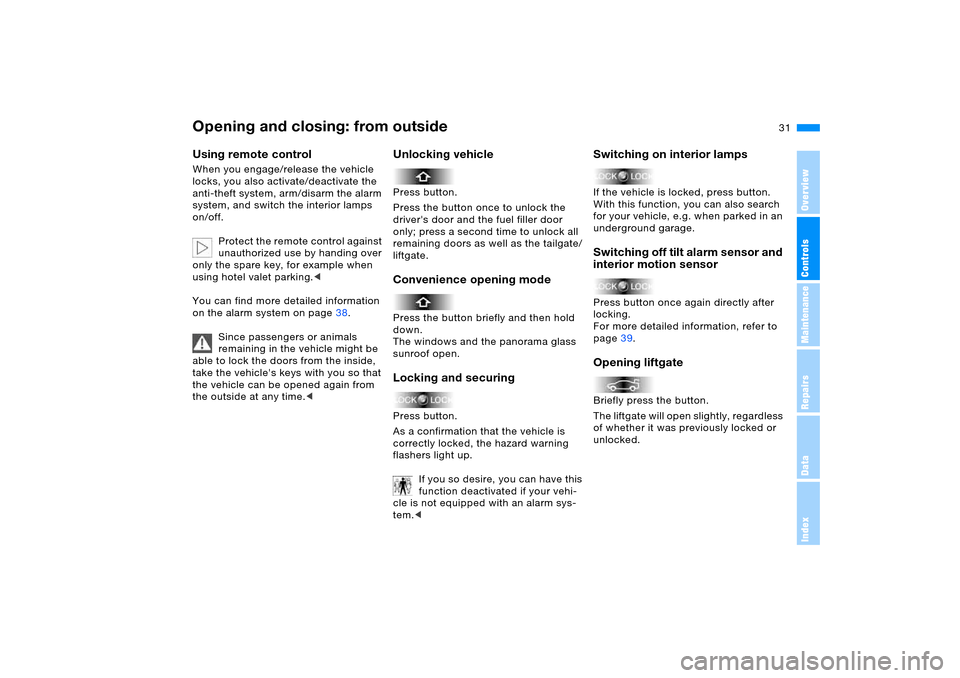
Unlocking vehiclePress button.
Press the button once to unlock the
driver's door and the fuel filler door
only; press a second time to unlock all
remaining doors as well as the tailgate/
liftgate. Convenience opening modePress the button briefly and then hold
down.
The windows and the panorama glass
sunroof open. Locking and securing Press button.
As a confirmation that the vehicle is
correctly locked, the hazard warning
flashers light up.
If you so desire, you can have this
function deactivated if your vehi-
cle is not equipped with an alarm sys-
tem.<
Switching on interior lamps If the vehicle is locked, press button.
With this function, you can also search
for your vehicle, e.g. when parked in an
underground garage.Switching off tilt alarm sensor and
interior motion sensor
Press button once again directly after
locking.
For more detailed information, refer to
page39. Opening liftgate Briefly press the button.
The liftgate will open slightly, regardless
of whether it was previously locked or
unlocked.
Page 33 of 200
OverviewControlsMaintenanceRepairsDataIndex
33n
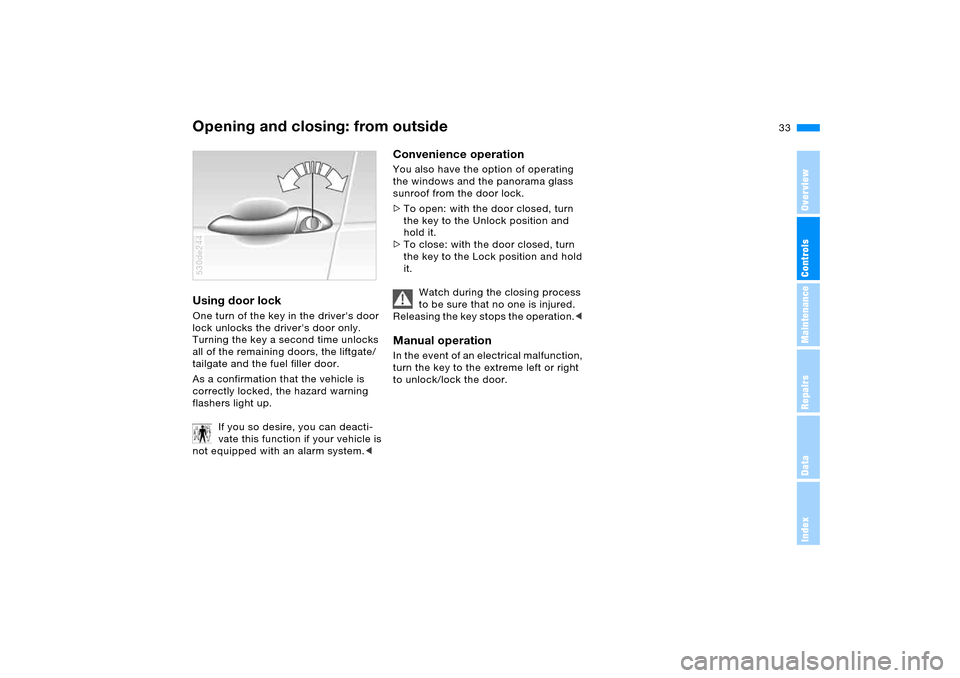
Opening and closing: from outsideUsing door lock One turn of the key in the driver's door
lock unlocks the driver's door only.
Turning the key a second time unlocks
all of the remaining doors, the liftgate/
tailgate and the fuel filler door.
As a confirmation that the vehicle is
correctly locked, the hazard warning
flashers light up.
If you so desire, you can deacti-
vate this function if your vehicle is
not equipped with an alarm system.< 530de244
Convenience operation You also have the option of operating
the windows and the panorama glass
sunroof from the door lock.
>To open: with the door closed, turn
the key to the Unlock position and
hold it.
>To close: with the door closed, turn
the key to the Lock position and hold
it.
Watch during the closing process
to be sure that no one is injured.
Releasing the key stops the operation.< Manual operation In the event of an electrical malfunction,
turn the key to the extreme left or right
to unlock/lock the door.
Page 39 of 200
OverviewControlsMaintenanceRepairsDataIndex
39n
Alarm system Windows>The indicator lamp flashes for
10 seconds after the vehicle is
unlocked: an attempted entry has
been detected in the period since the
system was armed.
Following triggering of an alarm, the
indicator lamp will flash continuously. Tilt alarm sensor and interior
motion sensor Tilt alarm sensor:
The tilt of the vehicle is monitored. The
alarm system reacts, for example, if
someone attempts to steal the wheels
or tow the vehicle.
Interior motion sensor:
In order for the interior motion sensor
to function properly, the windows and
panorama glass sunroof must be com-
pletely closed.
Avoiding unintentional alarms The tilt alarm sensor and interior motion
s en sor m ay be swi tch e d off a t t h e sam e
time. This prevents unintentional
alarms, e.g. in the following situations:
>In stacking garages
>When transporting on car-carrying
trains
>If animals are to remain in the vehicle.
Switching off the tilt alarm sensor and
interior motion sensor:
Press the button on the remote control
twice consecutively.
The indicator lamp lights up briefly and
then flashes continuously. The tilt alarm
sensor and the interior motion sensor
are switched off up to the next unlock-
ing and locking actions.
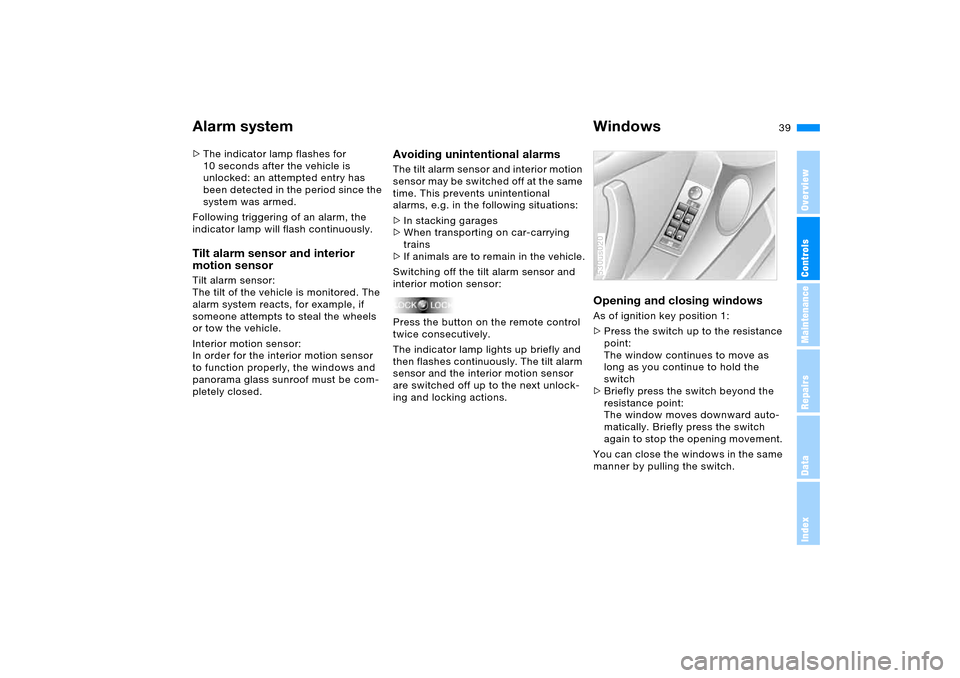
Opening and closing windows As of ignition key position 1:
>Press the switch up to the resistance
point:
The window continues to move as
long as you continue to hold the
switch
>Briefly press the switch beyond the
resistance point:
The window moves downward auto-
matically. Briefly press the switch
again to stop the opening movement.
You can close the windows in the same
manner by pulling the switch.530us020
Page 41 of 200
OverviewControlsMaintenanceRepairsDataIndex
41n
Panorama glass sunroof
*
When leaving the vehicle, always
remove the remote control and
close the doors, as otherwise children
could operate the roof and injure them-
selves etc.<
The panorama glass sunroof is opera-
tional from ignition key position 1.
After the ignition has been switched off:
You can operate the panorama glass
sunroof for up to 1 minute as long as
neither of the doors has been opened.
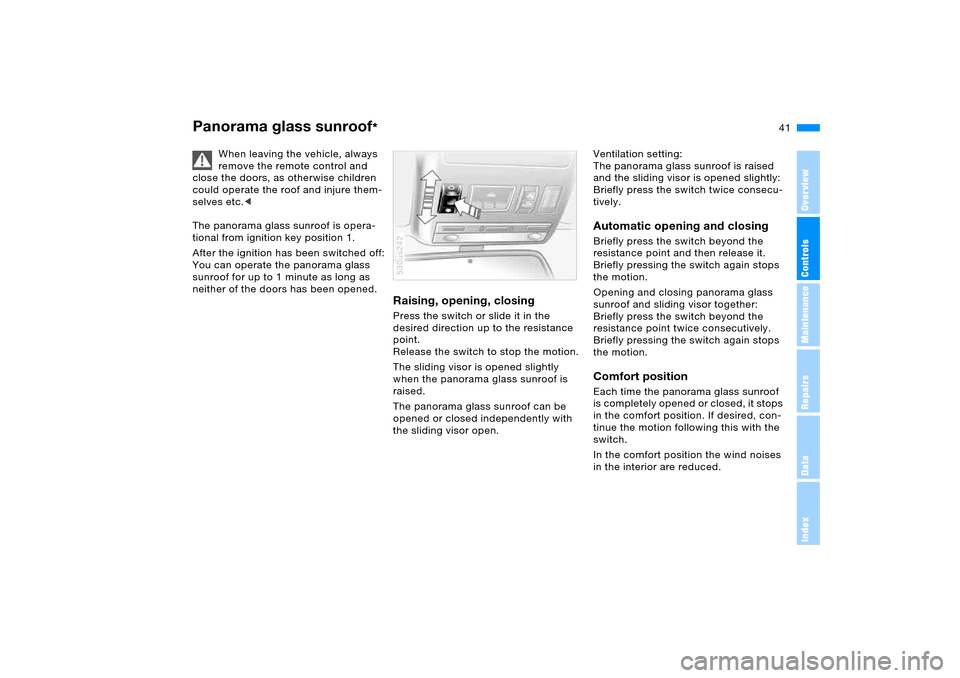
Raising, opening, closingPress the switch or slide it in the
desired direction up to the resistance
point.
Release the switch to stop the motion.
The sliding visor is opened slightly
when the panorama glass sunroof is
raised.
The panorama glass sunroof can be
opened or closed independently with
the sliding visor open.530us242
Ventilation setting:
The panorama glass sunroof is raised
and the sliding visor is opened slightly:
Briefly press the switch twice consecu-
tively.Automatic opening and closing Briefly press the switch beyond the
resistance point and then release it.
Briefly pressing the switch again stops
the motion.
Opening and closing panorama glass
sunroof and sliding visor together:
Briefly press the switch beyond the
resistance point twice consecutively.
Briefly pressing the switch again stops
the motion.Comfort position Each time the panorama glass sunroof
is completely opened or closed, it stops
in the comfort position. If desired, con-
tinue the motion following this with the
switch.
In the comfort position the wind noises
in the interior are reduced.
Page 42 of 200
42n
Panorama glass sunroof
*
Anti-trapping mechanism If the panorama glass sunroof or sliding
visor encounter resistance when clos-
ing from roughly one third of the roof
opening or when closing from the
raised position, the closing action is
interrupted and the panorama glass
sunroof and sliding visor reopen a little.
Despite the anti-trapping mecha-
nism inspect the roof's travel path
prior to closing it, as the safety system
might fail to detect certain kinds of
obstructions, such as very thin objects,
and the roof would continue closing.
The anti-trapping mechanism for clos-
ing the panorama glass sunroof is
deactivated if the switch is pressed
beyond the resistance point and held
there. The closing action is interrupted
when you release the switch.<
Following a power failure Following interruptions in electrical
power, for instance, when the battery
is disconnected, it is possible that the
panorama glass sunroof will extend to
its tilt-up position, but fail to respond to
other commands. The system must be
initialized. BMW recommends having
this work carried out by your BMW
Sports Activity Vehicle center.
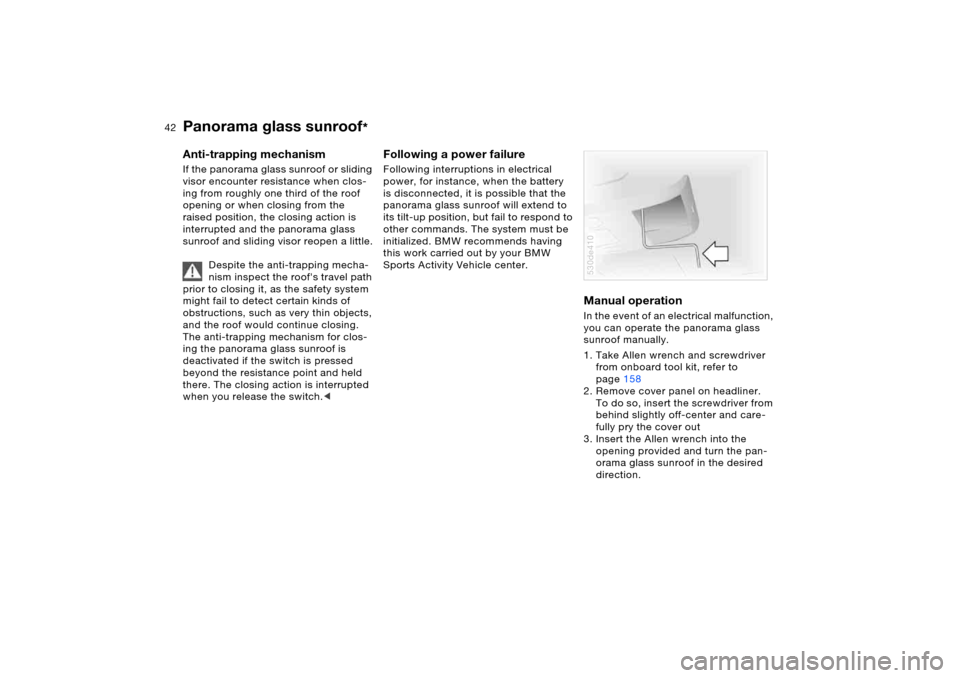
Manual operation In the event of an electrical malfunction,
you can operate the panorama glass
sunroof manually.
1. Take Allen wrench and screwdriver
from onboard tool kit, refer to
page158
2. Remove cover panel on headliner.
To do so, insert the screwdriver from
behind slightly off-center and care-
fully pry the cover out
3. Insert the Allen wrench into the
opening provided and turn the pan-
orama glass sunroof in the desired
direction.530de410
Page 133 of 200
133n
OverviewControlsMaintenanceRepairsDataIndex
Cargo loading Roof-mounted luggage rack
*
Always position and secure the
load as described above. If you do
not, it can even endanger the passen-
gers during braking or evasive maneu-
vers.
Do not exceed the permissible gross
vehicle weight and the permissible axle
loads, refer to page180. If you do, the
operating safety of the vehicle is no
longer ensured and you are in violation
of the law.
You should never transport heavy or
hard objects unsecured in the passen-
ger compartment, as they could fly
around and pose a safety hazard to the
vehicle's occupants even during abrupt
braking or evasive maneuvers.<
A special rack system is available as an
option for your BMW. Please comply
with the precautions included with the
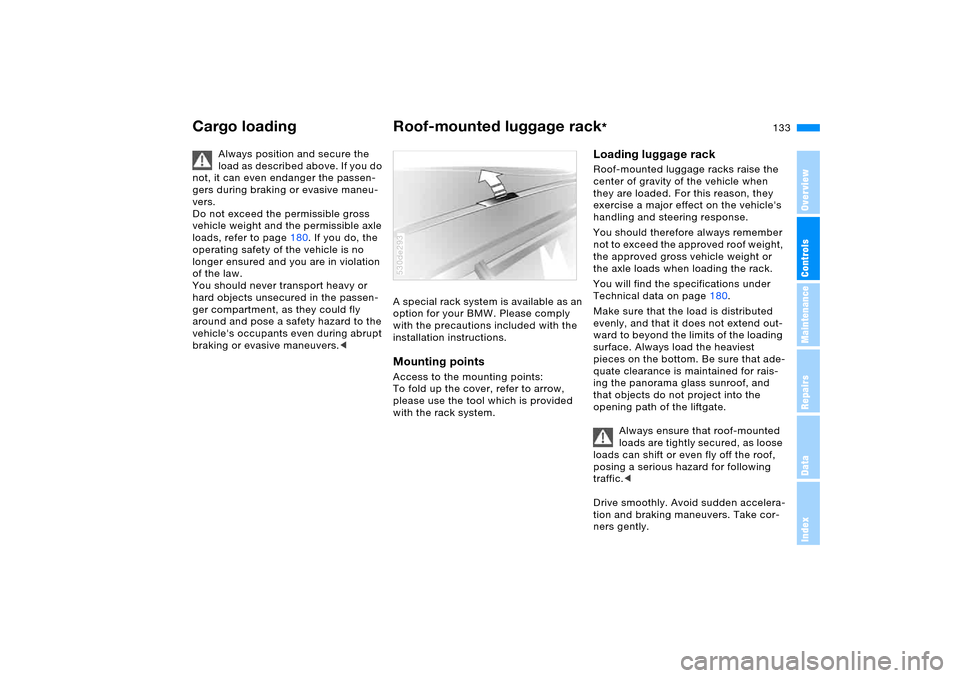
installation instructions.Mounting pointsAccess to the mounting points:
To fold up the cover, refer to arrow,
please use the tool which is provided
with the rack system.530de293
Loading luggage rackRoof-mounted luggage racks raise the
center of gravity of the vehicle when
they are loaded. For this reason, they
exercise a major effect on the vehicle's
handling and steering response.
You should therefore always remember
not to exceed the approved roof weight,
the approved gross vehicle weight or
the axle loads when loading the rack.
You will find the specifications under
Technical data on page180.
Make sure that the load is distributed
evenly, and that it does not extend out-
ward to beyond the limits of the loading
surface. Always load the heaviest
pieces on the bottom. Be sure that ade-
quate clearance is maintained for rais-
ing the panorama glass sunroof, and
that objects do not project into the
opening path of the liftgate.
Always ensure that roof-mounted
loads are tightly secured, as loose
loads can shift or even fly off the roof,
posing a serious hazard for following
traffic.<
Drive smoothly. Avoid sudden accelera-
tion and braking maneuvers. Take cor-
ners gently.
Page 137 of 200
137n
OverviewControlsMaintenanceRepairsDataIndex
General driving notesClosing liftgate/tailgate
Operate the vehicle only when the
tailgate and liftgate are completely
closed. Otherwise, exhaust fumes
could enter into the passenger com-
partment.<
However, if special circumstances
should make it absolutely necessary
to operate the vehicle with the liftgate/
tailgate open:
1. Close all windows and the panorama
glass sunroof
2. Increase the air supply for the air
conditioner or automatic climate
control to a high level, refer to
page108 or112.
Hot exhaust system
Extreme temperatures occur at
the catalytic converter on this and
every catalyst-equipped vehicle. Do not
remove the heat shields installed adja-
cent to various sections of the exhaust
system, and never apply undercoating
to them. When driving, standing at idle
and while parking take care to avoid
possible contact between a hot exhaust
system and any highly flammable mate-
rials such as hay, leaves, grass etc.
Otherwise there is a danger of ignition
and of a fire with the risk of serious inju-
ries and damage.
mobile radio devices such as por-
table phones inside the vehicle unless
they are directly connected to the
external antenna. Otherwise, it is
impossible to prevent a mutual interfer-
ence of the vehicle electronics with the
portable phone device. Also, there is no
guarantee that the radiation generated
by the transmission will be conveyed
out from the interior of the vehicle.<
When vehicle is parked Condensation forms in the air condi-
tioner system during operation, and
then exits under the vehicle. Traces of
water on the ground are therefore nor-
mal.Brakes
Do not drive with your foot resting
on the brake pedal. Even light but
consistent pedal pressure can lead to
excessively high temperatures, brake
wear and possibly even brake failure.<
Road hazards
If road hazards, obstacles or curbs
are unavoidable, only drive over
them very slowly and carefully, as oth-
erwise the wheels and suspension
parts, especially on vehicles fitted with
low profile tires, can be damaged.<
For more information on wheels and
tires, refer to page144.
Before driving into a car washFold in the exterior mirrors, refer to
page54, as otherwise they could be
damaged due to the width of the vehi-
cle.Hydroplaning
When driving on wet or slushy
roads, reduce road speed. If you
do not, a wedge of water can form
between tires and road surface. This
state can cause a partial or total loss of
contact with the road surface, of brak-
ing control and of control over the vehi-
cle.<
Page 184 of 200
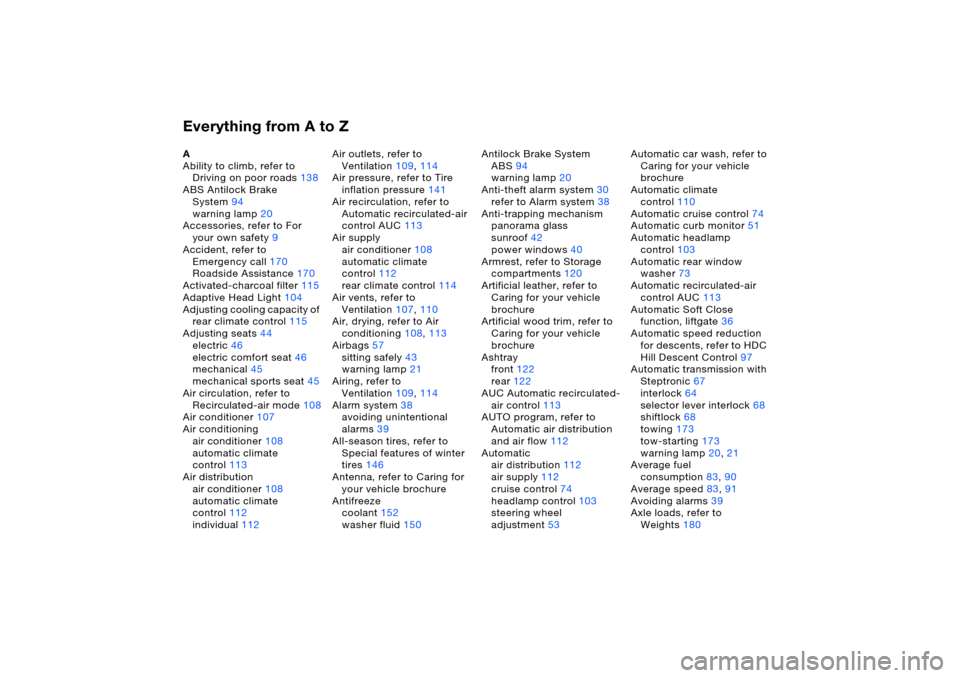
Everything from A to ZA
Ability to climb, refer to
Driving on poor roads138
ABS Antilock Brake
System94
warning lamp20
Accessories, refer to For
your own safety9
Accident, refer to
Emergency call170
Roadside Assistance170
Activated-charcoal filter115
Adaptive Head Light104
Adjusting cooling capacity of
rear climate control115
Adjusting seats44
electric46
electric comfort seat46
mechanical45
mechanical sports seat45
Air circulation, refer to
Recirculated-air mode108
Air conditioner107
Air conditioning
air conditioner108
automatic climate
control113
Air distribution
air conditioner108
automatic climate
control112
individual112Air outlets, refer to
Ventilation109,114
Air pressure, refer to Tire
inflation pressure141
Air recirculation, refer to
Automatic recirculated-air
control AUC113
Air supply
air conditioner108
automatic climate
control112
rear climate control114
Air vents, refer to
Ventilation107,110
Air, drying, refer to Air
conditioning108,113
Airbags57
sitting safely43
warning lamp21
Airing, refer to
Ventilation109,114
Alarm system38
avoiding unintentional
alarms39
All-season tires, refer to
Special features of winter
tires146
Antenna, refer to Caring for
your vehicle brochure
Antifreeze
coolant152
washer fluid150Antilock Brake System
ABS94
warning lamp20
Anti-theft alarm system30
refer to Alarm system38
Anti-trapping mechanism
panorama glass
sunroof42
power windows40
Armrest, refer to Storage
compartments120
Artificial leather, refer to
Caring for your vehicle
brochure
Artificial wood trim, refer to
Caring for your vehicle
brochure
Ashtray
front122
rear122
AUC Automatic recirculated-
air control113
AUTO program, refer to
Automatic air distribution
and air flow112
Automatic
air distribution112
air supply112
cruise control74
headlamp control103
steering wheel
adjustment53Automatic car wash, refer to
Caring for your vehicle
brochure
Automatic climate
control110
Automatic cruise control74
Automatic curb monitor51
Automatic headlamp
control103
Automatic rear window
washer73
Automatic recirculated-air
control AUC113
Automatic Soft Close
function, liftgate36
Automatic speed reduction
for descents, refer to HDC
Hill Descent Control97
Automatic transmission with
Steptronic67
interlock64
selector lever interlock68
shiftlock68
towing173
tow-starting173
warning lamp20,21
Average fuel
consumption83,90
Average speed83,91
Avoiding alarms39
Axle loads, refer to
Weights180
Page 186 of 200
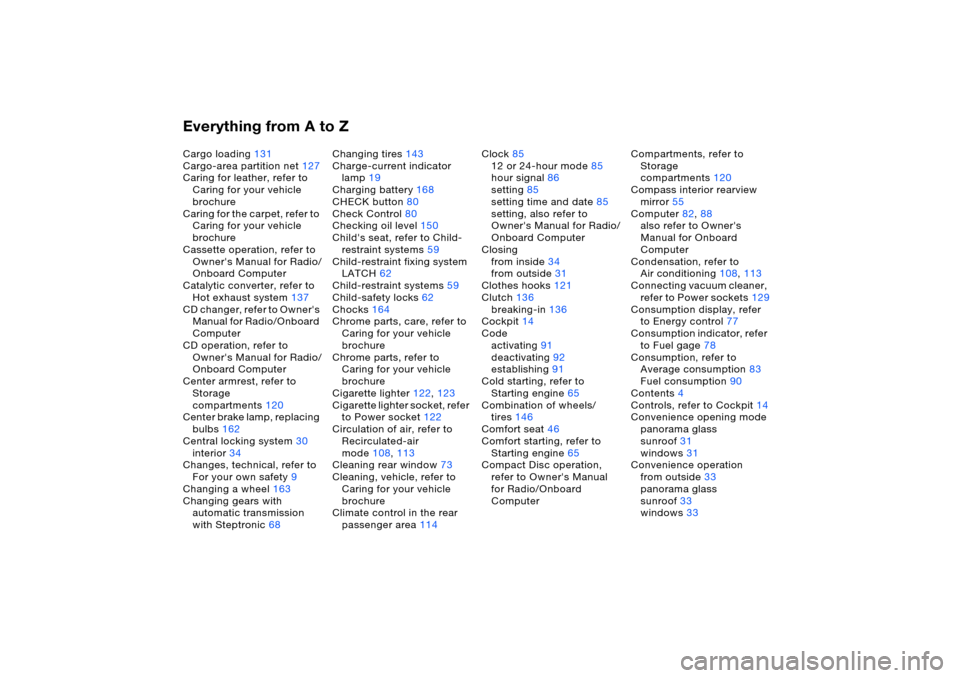
Everything from A to ZCargo loading131
Cargo-area partition net127
Caring for leather, refer to
Caring for your vehicle
brochure
Caring for the carpet, refer to
Caring for your vehicle
brochure
Cassette operation, refer to
Owner's Manual for Radio/
Onboard Computer
Catalytic converter, refer to
Hot exhaust system137
CD changer, refer to Owner's
Manual for Radio/Onboard
Computer
CD operation, refer to
Owner's Manual for Radio/
Onboard Computer
Center armrest, refer to
Storage
compartments120
Center brake lamp, replacing
bulbs162
Central locking system30
interior34
Changes, technical, refer to
For your own safety9
Changing a wheel163
Changing gears with
automatic transmission
with Steptronic68Changing tires143
Charge-current indicator
lamp19
Charging battery168
CHECK button80
Check Control80
Checking oil level150
Child's seat, refer to Child-
restraint systems59
Child-restraint fixing system
LATCH62
Child-restraint systems59
Child-safety locks62
Chocks164
Chrome parts, care, refer to
Caring for your vehicle
brochure
Chrome parts, refer to
Caring for your vehicle
brochure
Cigarette lighter122,123
Cigarette lighter socket, refer
to Power socket122
Circulation of air, refer to
Recirculated-air
mode108,113
Cleaning rear window73
Cleaning, vehicle, refer to
Caring for your vehicle
brochure
Climate control in the rear
passenger area114Clock85
12 or 24-hour mode85
hour signal86
setting85
setting time and date85
setting, also refer to
Owner's Manual for Radio/
Onboard Computer
Closing
from inside34
from outside31
Clothes hooks121
Clutch136
breaking-in136
Cockpit14
Code
activating91
deactivating92
establishing91
Cold starting, refer to
Starting engine65
Combination of wheels/
tires146
Comfort seat46
Comfort starting, refer to
Starting engine65
Compact Disc operation,
refer to Owner's Manual
for Radio/Onboard
ComputerCompartments, refer to
Storage
compartments120
Compass interior rearview
mirror55
Computer82,88
also refer to Owner's
Manual for Onboard
Computer
Condensation, refer to
Air conditioning108,113
Connecting vacuum cleaner,
refer to Power sockets129
Consumption display, refer
to Energy control77
Consumption indicator, refer
to Fuel gage78
Consumption, refer to
Average consumption83
Fuel consumption90
Contents4
Controls, refer to Cockpit14
Convenience opening mode
panorama glass
sunroof31
windows31
Convenience operation
from outside33
panorama glass
sunroof33
windows33