automatic transmission BMW X5 4.8IS 2006 E53 User Guide
[x] Cancel search | Manufacturer: BMW, Model Year: 2006, Model line: X5 4.8IS, Model: BMW X5 4.8IS 2006 E53Pages: 202, PDF Size: 4.13 MB
Page 67 of 202
OverviewControlsMaintenanceRepairsDataIndex
67n
Automatic transmission with Steptronic
*
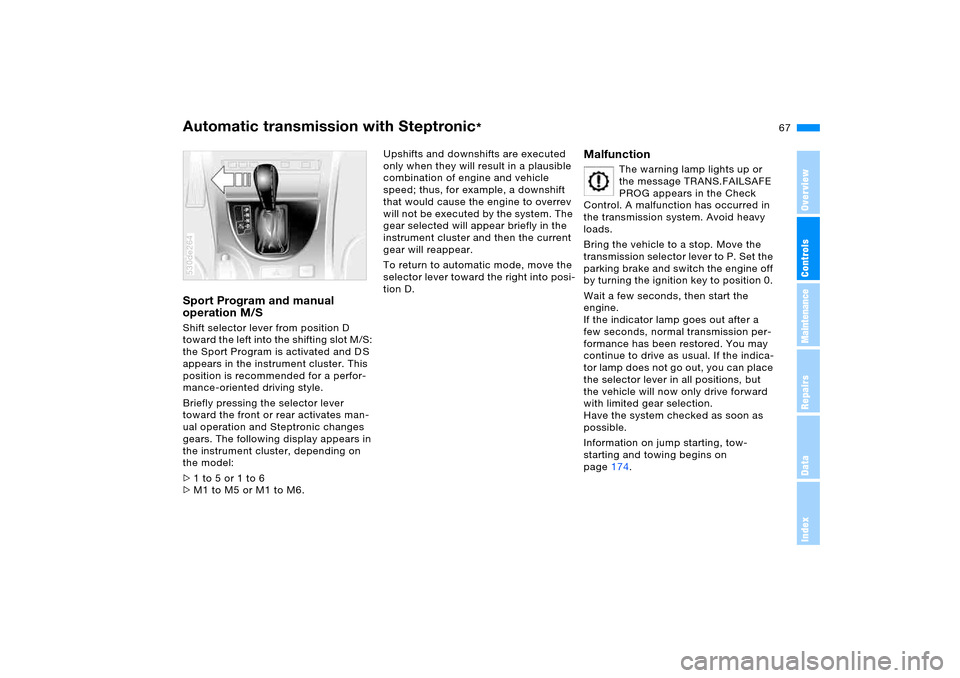
Sport Program and manual
operation M/S Shift selector lever from position D
toward the left into the shifting slot M/S:
the Sport Program is activated and D S
appears in the instrument cluster. This
position is recommended for a perfor-
mance-oriented driving style.
Briefly pressing the selector lever
toward the front or rear activates man-
ual operation and Steptronic changes
gears. The following display appears in
the instrument cluster, depending on
the model:
>1 to 5 or 1 to 6
>M1 to M5 or M1 to M6. 530de264
Upshifts and downshifts are executed
only when they will result in a plausible
combination of engine and vehicle
speed; thus, for example, a downshift
that would cause the engine to overrev
will not be executed by the system. The
gear selected will appear briefly in the
instrument cluster and then the current
gear will reappear.
To return to automatic mode, move the
selector lever toward the right into posi-
tion D.
Malfunction
The warning lamp lights up or
the message TRANS.FAILSAFE
PROG appears in the Check
Control. A malfunction has occurred in
the transmission system. Avoid heavy
loads.
Bring the vehicle to a stop. Move the
transmission selector lever to P. Set the
parking brake and switch the engine off
by turning the ignition key to position 0.
Wait a few seconds, then start the
engine.
If the indicator lamp goes out after a
few seconds, normal transmission per-
formance has been restored. You may
continue to drive as usual. If the indica-
tor lamp does not go out, you can place
the selector lever in all positions, but
the vehicle will now only drive forward
with limited gear selection.
Have the system checked as soon as
possible.
Information on jump starting, tow-
starting and towing begins on
page174.
Page 71 of 202
OverviewControlsMaintenanceRepairsDataIndex
71n
Washer/wiper system/rain sensor
*
Cruise control
*
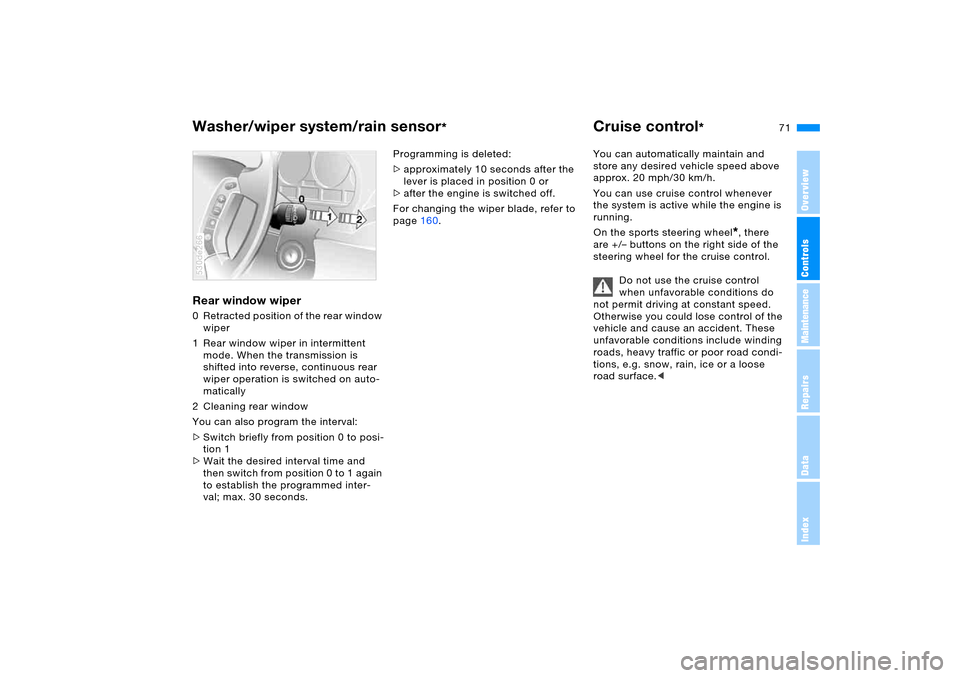
Rear window wiper 0 Retracted position of the rear window
wiper
1 Rear window wiper in intermittent
mode. When the transmission is
shifted into reverse, continuous rear
wiper operation is switched on auto-
matically
2 Cleaning rear window
You can also program the interval:
>Switch briefly from position 0 to posi-
tion 1
>Wait the desired interval time and
th en sw itc h fr om p osit ion 0 to 1 again
to establish the programmed inter-
val; max. 30 seconds. 530de266
Programming is deleted:
>approximately 10 seconds after the
lever is placed in position 0 or
>after the engine is switched off.
For changing the wiper blade, refer to
page160.You can automatically maintain and
store any desired vehicle speed above
approx. 20 mph/30 km/h.
You can use cruise control whenever
the system is active while the engine is
running.
On the sports steering wheel
*, there
are +/– buttons on the right side of the
steering wheel for the cruise control.
Do not use the cruise control
when unfavorable conditions do
not permit driving at constant speed.
Otherwise you could lose control of the
vehicle and cause an accident. These
unfavorable conditions include winding
roads, heavy traffic or poor road condi-
tions, e.g. snow, rain, ice or a loose
road surface.<
Page 72 of 202
72n
Cruise control* Activating system As of ignition key position 2:
Press the button; the indicator lamp in
the instrument cluster comes on, refer
to page22. Cruise control is ready to
use.Deactivating systemPress the button repeatedly until the
indicator lamp in the instrument cluster
goes out.
The cruise control is also deactivated
when the ignition key is turned to posi-
tion 0.
The speed stored in the memory is
deleted.Maintaining and storing speed or
accelerating Briefly press button
+:
The system maintains and stores the
current vehicle speed. Every time you
briefly press the button, the speed
increases by approx. 0.6 mph/1 km/h.
Press and hold button
+:
The vehicle accelerates without pres-
sure on the accelerator pedal. When
you release the button, the system
maintains and stores the current speed.
On downhill grades, the controlled
speed can be exceeded if the engine's
braking action is insufficient. Speed can
drop on uphill grades if the engine out-
put is insufficient.
DecelerationBriefly press button
–:
When cruise control is active, every
brief touch of the button reduces the
speed by approx. 0.6 mph/1 km/h.
Press and hold button –:
With the cruise control active, the sys-
tem automatically reduces the throttle
opening to slow the vehicle. When you
release the button, the system main-
tains and stores the current speed.
Interrupting cruise control When the system is activated, press
button 1. The indicator lamp stays on.
You can use the cruise control again
whenever required by resuming the
speed that was stored last.
In addition, cruise control is interrupted
automatically:
>When you apply pressure to the
brake pedal
>When you apply pressure to the
clutch pedal or when you move the
automatic transmission selector lever
from Drive to Neutral
>If you exceed or fall below the con-
trolled speed for an extended period,
by depressing the accelerator, for
example
>When DSC Dynamic Stability Control
is active.Resuming stored setting Press the button:
The vehicle accelerates to and main-
tains the last speed stored.
Page 95 of 202
95n
OverviewControlsMaintenanceRepairsDataIndex
HDC Hill Descent Control Self-leveling suspension
*
Using HDC With manual transmission:
Use HDC in first gear and in Reverse
since the engine's braking action is
diminished in the higher gears.
With automatic transmission:
You can use HDC in every drive posi-
tion. In case of a malfunction If the LED in the button goes out during
HDC operation or does not light up
when the HDC is activated:
HDC is temporarily unavailable due to
excessive brake temperature. The warning lamp for the self-
leveling suspension comes on,
or the message SELFLEVEL
SUSP.INACT appears in the Check
Control: there is a malfunction in the
self-leveling suspension.
Stop and inspect the vehicle. If the rear
of the vehicle is visibly lower than the
front, possibly accompanied by a tilt
noticeable when you compare the left
rear with the right rear, please respond
by immediately proceeding to the near-
est BMW Sports Activity Vehicle center.
Drive with appropriate caution in the
meantime. The vehicle has reduced
ground clearance and driving comfort
may be noticeably reduced.
Even when the position of the vehicle is
normal, have the system checked as
soon as possible when a malfunction is
indicated.
Page 114 of 202
114n
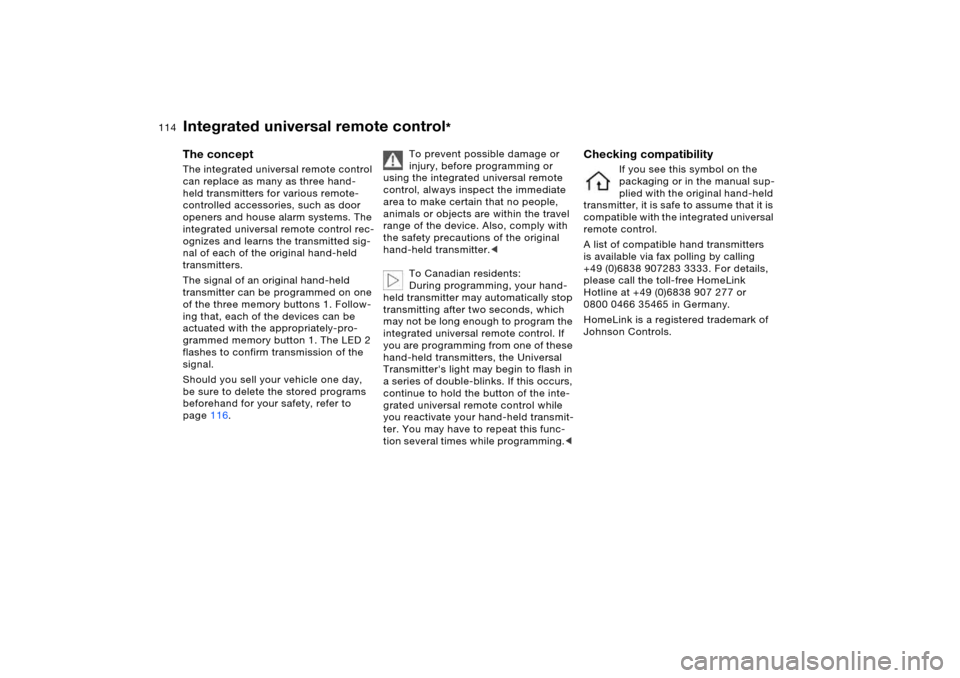
The concept The integrated universal remote control
can replace as many as three hand-
held transmitters for various remote-
controlled accessories, such as door
openers and house alarm systems. The
integrated universal remote control rec-
ognizes and learns the transmitted sig-
nal of each of the original hand-held
transmitters.
The signal of an original hand-held
transmitter can be programmed on one
of the three memory buttons 1. Follow-
ing that, each of the devices can be
actuated with the appropriately-pro-
grammed memory button 1. The LED 2
flashes to confirm transmission of the
signal.
Should you sell your vehicle one day,
be sure to delete the stored programs
beforehand for your safety, refer to
page116. To prevent possible damage or
injury, before programming or
using the integrated universal remote
control, always inspect the immediate
area to make certain that no people,
animals or objects are within the travel
range of the device. Also, comply with
the safety precautions of the original
hand-held transmitter.<
To Canadian residents:
During programming, your hand-
held transmitter may automatically stop
transmitting after two seconds, which
may not be long enough to program the
integrated universal remote control. If
you are programming from one of these
hand-held transmitters, the Universal
Transmitter's light may begin to flash in
a series of double-blinks. If this occurs,
continue to hold the button of the inte-
grated universal remote control while
you reactivate your hand-held transmit-
ter. You may have to repeat this func-
tion several times while programming.<
Checking compatibility
If you see this symbol on the
packaging or in the manual sup-
plied with the original hand-held
transmitter, it is safe to assume that it is
compatible with the integrated universal
remote control.
A list of compatible hand transmitters
is available via fax polling by calling
+49 (0)6838 907283 3333. For details,
please call the toll-free HomeLink
Hotline at +49 (0)6838 907 277 or
0800 0466 35465 in Germany.
HomeLink is a registered trademark of
Johnson Controls.
Integrated universal remote control
*
Page 137 of 202
137n
OverviewControlsMaintenanceRepairsDataIndex
General driving notesClosing liftgate/tailgate
Operate the vehicle only when the
tailgate and liftgate are completely
closed. Otherwise, exhaust fumes
could enter into the passenger com-
partment.<
However, if special circumstances
should make it absolutely necessary to
operate the vehicle with the liftgate/tail-
gate open:
1. Close all windows and the panorama
glass roof
2. Increase the air supply for the air
conditioner or automatic climate
control to a high level, refer to
page105 or109.
Hot exhaust system
Extreme temperatures occur on
the exhaust system on any vehi-
cle. Do not remove the heat shields
installed adjacent to it, and never apply
undercoating to them. When driving,
standing at idle and while parking, take
care to avoid possible contact between
a hot exhaust system and any highly
flammable materials such as hay,
leaves, grass etc. Otherwise, there is a
danger of ignition and fire, with the risk
of serious injuries and damage.<
Mobile communications devices
in vehicle
BMW advises against using
mobile communications devices
such as mobile phones inside the vehi-
cle unless they are directly connected
to the external antenna. Otherwise, it is
impossible to prevent a mutual interfer-
ence of the vehicle electronics with the
mobile phone device. Also, there is no
guarantee that the radiation generated
by the transmission will be conveyed
out from the interior of the vehicle.<
When vehicle is parked Condensation forms in the air condi-
tioner system during operation and then
exits under the vehicle. Traces of water
on the ground are therefore normal.Brakes
Do not drive with your foot resting
on the brake pedal. Even light but
consistent pedal pressure can lead to
excessively high temperatures, brake
wear and possibly even brake failure.<
Road hazards
If road hazards, obstacles or curbs
are unavoidable, only drive over
them very slowly and carefully, other-
wise the wheels and suspension parts,
especially on vehicles fitted with low
profile tires, can be damaged.<
For more information on wheels and
tires, refer to page146.
Before driving into a car washFold in the exterior mirrors, refer to
page53, otherwise they could be dam-
aged due to the width of the vehicle.Hydroplaning
When driving on wet or slushy
roads, reduce road speed. If you
do not, a wedge of water can form
between tires and road surface. This
state can cause a partial or total loss
of contact with the road surface, of
braking control and of control over the
vehicle.<
Page 138 of 202
138n
General driving notes Driving your X5 Driving through water
Do not drive through water on the
road if it is deeper than 20 in/
50 cm, and then only at walking speed
at the most. Otherwise, the vehicle's
engine, the electrical systems and the
transmission may be damaged. When
equipped with 2-axle self leveling sus-
pension
*, switch the vehicle into the
Off-Road setting before driving through,
refer to page97.<
Using handbrake on slopes
Do not hold the vehicle in place on
slopes by slipping or riding the
clutch; use the handbrake instead. Oth-
erwise, severe clutch wear will result.<
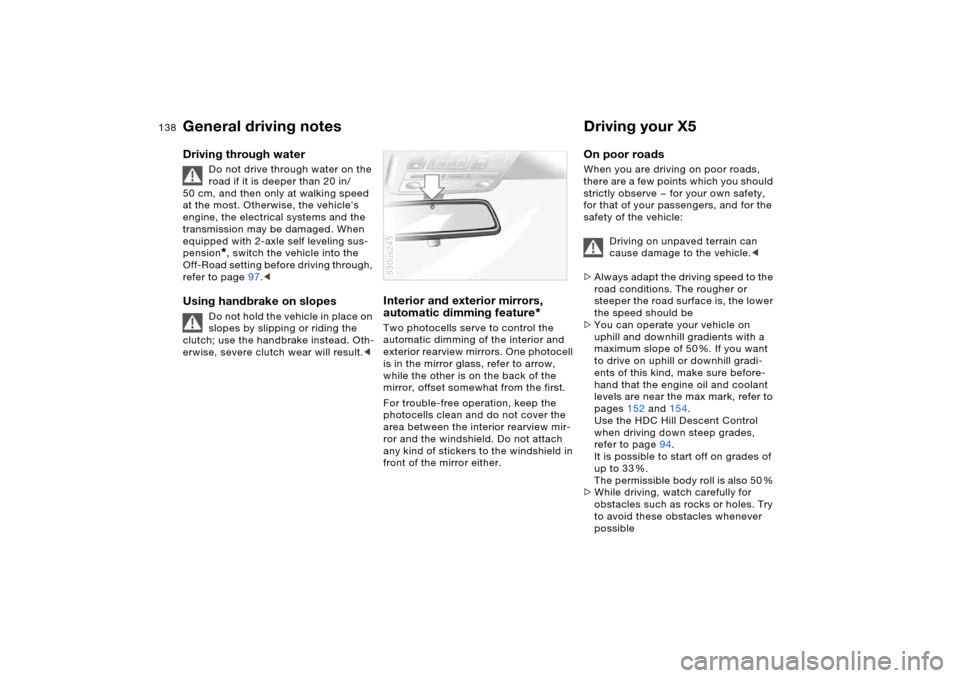
Interior and exterior mirrors,
automatic dimming feature
*
Two photocells serve to control the
automatic dimming of the interior and
exterior rearview mirrors. One photocell
is in the mirror glass, refer to arrow,
while the other is on the back of the
mirror, offset somewhat from the first.
For trouble-free operation, keep the
photocells clean and do not cover the
area between the interior rearview mir-
ror and the windshield. Do not attach
any kind of stickers to the windshield in
front of the mirror either. 530us245
On poor roads When you are driving on poor roads,
there are a few points which you should
strictly observe — for your own safety,
for that of your passengers, and for the
safety of the vehicle:
Driving on unpaved terrain can
cause damage to the vehicle.<
>Always adapt the driving speed to the
road conditions. The rougher or
steeper the road surface is, the lower
the speed should be
>You can operate your vehicle on
uphill and downhill gradients with a
maximum slope of 50 %. If you want
to drive on uphill or downhill gradi-
ents of this kind, make sure before-
hand that the engine oil and coolant
levels are near the max mark, refer to
pages152 and154.
Use the HDC Hill Descent Control
when driving down steep grades,
refer to page94.
It is possible to start off on grades of
up to 33 %.
The permissible body roll is also 50 %
>While driving, watch carefully for
obstacles such as rocks or holes. Try
to avoid these obstacles whenever
possible
Page 165 of 202
165n
OverviewControlsMaintenanceRepairsDataIndex
Lamps and bulbs Changing a wheel Light-emitting diodes LEDs Light-emitting diodes installed behind
translucent lenses serve as the light
source for many of the controls and dis-
plays in your vehicle. The concept
behind their operation is related to that
employed for lasers.
Do not remove the covers, and
never stare into the unfiltered light
several hours, as irritation of the retina
could result.<
Safety precautions to observe in
the event of a flat and during all
tire changes:
Park the vehicle as far as possible from
passing traffic. Park on a firm, flat, sur-
face. Switch on the hazard warning
flashers.
Turn the steering wheel to the straight-
ahead position, remove the key and
engage the steering lock. Shift into 1st
or reverse, selector lever in Park with
automatic transmission, and engage the
handbrake.
All passengers should be outside the
vehicle and well away from your imme-
diate working area, behind a guardrail,
for instance.
If a warning triangle or portable hazard
warning lamp is required, set it up on
the roadside at an appropriate distance
from the rear of the vehicle. Comply
with all safety guidelines and regula-
tions.
Change the wheel only on a level, firm
surface that is not slippery. The vehicle
or the jack could slip to the side if you
attempt to raise the vehicle on a soft
or slippery surface such as snow, ice,
tiles, etc.
Position the jack on a firm support sur-
face.
Do not place wooden blocks or similar
objects under the jack. If this is done,
the jack might not be able to reach its
full support capacity because of the
limited height. To avoid serious or fatal
injury: never lie under the vehicle, and
never start the engine while it is sup-
ported by the jack.<
Your BMW has either a compact wheel
for temporary use to ensure your mobil-
ity, or a spare wheel of the size 235/
65 R 17. Please observe the differences
in handling when removing the wheel
from the cargo area.
Page 176 of 202
176n
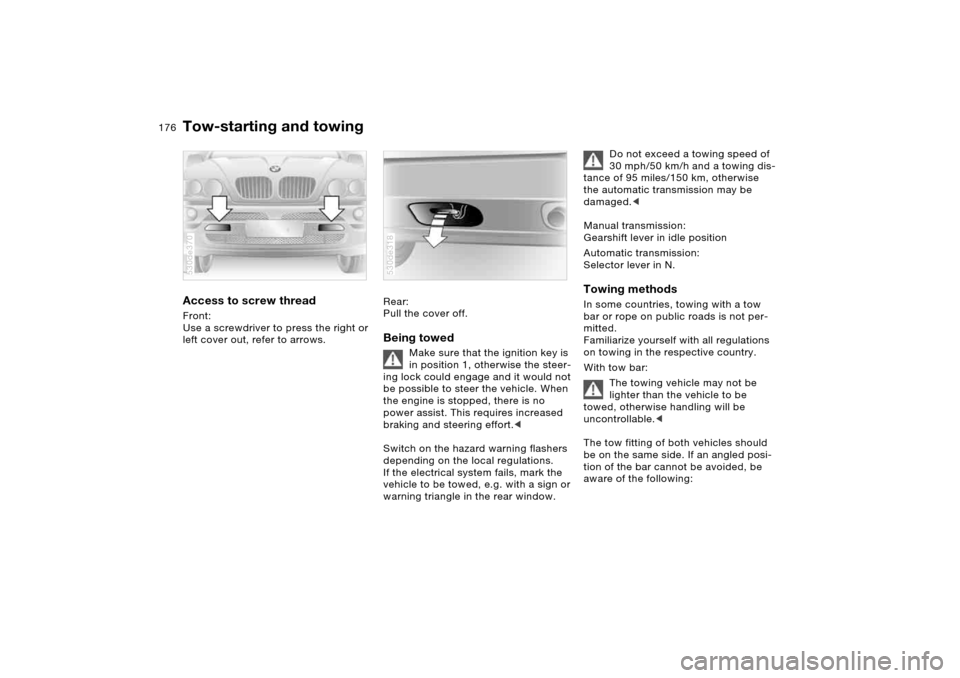
Tow-starting and towingAccess to screw thread Front:
Use a screwdriver to press the right or
left cover out, refer to arrows. 530de370
Rear:
Pull the cover off. Being towed
Make sure that the ignition key is
in position 1, otherwise the steer-
ing lock could engage and it would not
be possible to steer the vehicle. When
the engine is stopped, there is no
power assist. This requires increased
braking and steering effort.<
Switch on the hazard warning flashers
depending on the local regulations.
If the electrical system fails, mark the
vehicle to be towed, e.g. with a sign or
warning triangle in the rear window.
530de318
Do not exceed a towing speed of
30 mph/50 km/h and a towing dis-
tance of 95 miles/150 km, otherwise
the automatic transmission may be
damaged.<
Manual transmission:
Gearshift lever in idle position
Automatic transmission:
Selector lever in N.
Towing methodsIn some countries, towing with a tow
bar or rope on public roads is not per-
mitted.
Familiarize yourself with all regulations
on towing in the respective country.
With tow bar:
The towing vehicle may not be
lighter than the vehicle to be
towed, otherwise handling will be
uncontrollable.<
The tow fitting of both vehicles should
be on the same side. If an angled posi-
tion of the bar cannot be avoided, be
aware of the following:
Page 177 of 202
177n
OverviewControlsMaintenanceRepairsDataIndex
Tow-starting and towing>The freedom of movement is
restricted during cornering
>The angled position of the tow bar
creates lateral forces.
Only attach the tow bar to the tow
fittings, as attachment to other
vehicle parts can lead to damage.<
With tow-rope:
When starting off in the towing vehicle,
make sure that the tow-rope is taut.
Use nylon ropes or nylon straps
for towing, and avoid all exces-
sively sudden jerking movements. Only
attach tow ropes to the tow fittings, as
attachment to other vehicle parts can
lead to damage.<
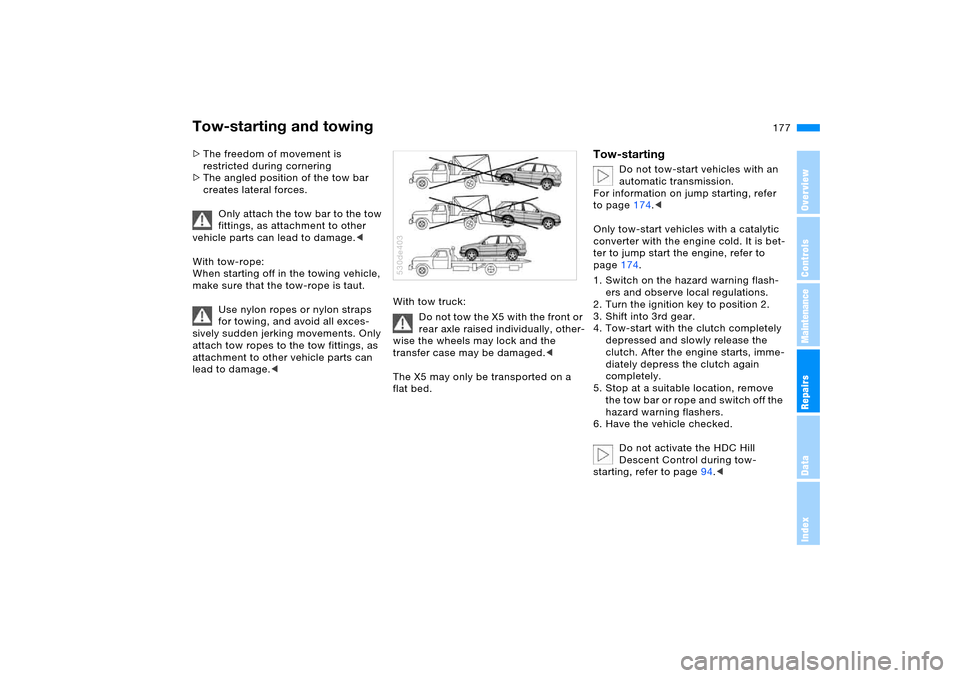
With tow truck:
Do not tow the X5 with the front or
rear axle raised individually, other-
wise the wheels may lock and the
transfer case may be damaged.<
The X5 may only be transported on a
flat bed.530de403
Tow-starting
Do not tow-start vehicles with an
automatic transmission.
For information on jump starting, refer
to page174.<
Only tow-start vehicles with a catalytic
converter with the engine cold. It is bet-
ter to jump start the engine, refer to
page174.
1. Switch on the hazard warning flash-
ers and observe local regulations.
2. Turn the ignition key to position 2.
3. Shift into 3rd gear.
4. Tow-start with the clutch completely
depressed and slowly release the
clutch. After the engine starts, imme-
diately depress the clutch again
completely.
5. Stop at a suitable location, remove
the tow bar or rope and switch off the
hazard warning flashers.
6. Have the vehicle checked.
Do not activate the HDC Hill
Descent Control during tow-
starting, refer to page94.<