light BMW X5 4.8IS 2006 E53 User Guide
[x] Cancel search | Manufacturer: BMW, Model Year: 2006, Model line: X5 4.8IS, Model: BMW X5 4.8IS 2006 E53Pages: 202, PDF Size: 4.13 MB
Page 42 of 202
42n
Panorama glass roof
*
Comfort position Each time the panorama glass roof is
completely opened or closed, it stops in
the comfort position. Use the switch to
continue the motion after this if you
wish.
In the comfort position, the wind noises
in the interior are reduced.Anti-trapping mechanism If the panorama glass roof or sliding
visor encounter resistance when clos-
ing from roughly one third of the roof
opening or when closing from the
raised position, the closing action is
interrupted and the panorama glass
roof and sliding visor reopen a little.
Despite the anti-trapping mecha-
nism, inspect the roof's travel path
prior to closing it, as the safety system
might fail to detect certain kinds of
obstructions, such as very thin objects,
and the roof would continue closing.
The anti-trapping mechanism for clos-
ing the panorama glass roof is deacti-
vated if the switch is pressed beyond
the resistance point and held there. The
closing action is interrupted when you
release the switch.<
Following a power failure Following interruptions in electrical
power, for instance when the battery is
disconnected, it is possible that the
panorama glass roof will extend to its
tilt-up position, but fail to respond to
other commands. The system must be
initialized. BMW recommends having
this work carried out by your BMW
Sports Activity Vehicle center.
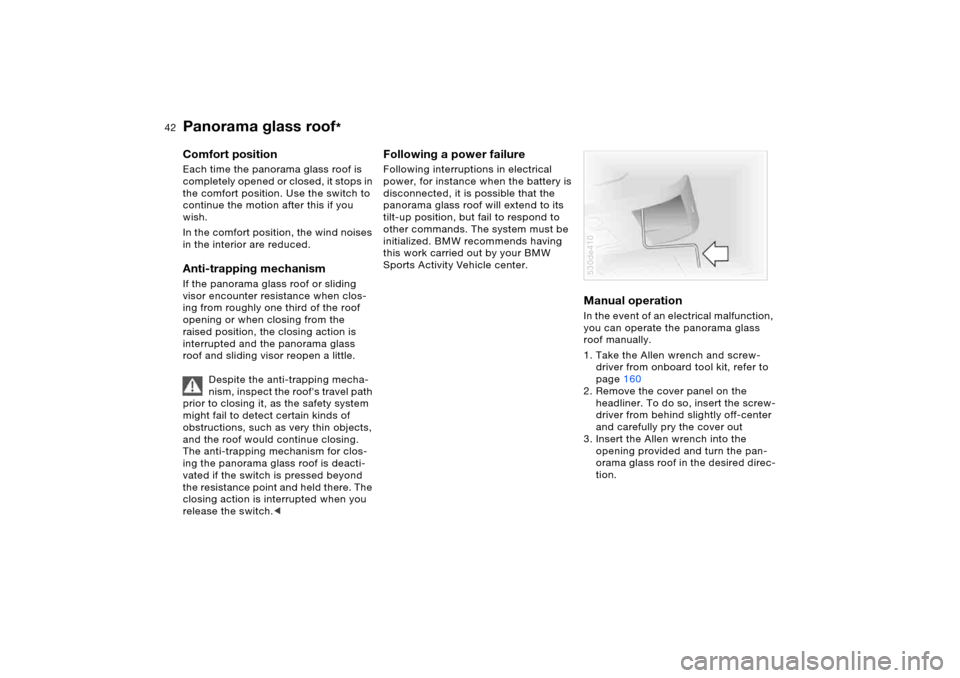
Manual operation In the event of an electrical malfunction,
you can operate the panorama glass
roof manually.
1. Take the Allen wrench and screw-
driver from onboard tool kit, refer to
page160
2. Remove the cover panel on the
headliner. To do so, insert the screw-
driver from behind slightly off-center
and carefully pry the cover out
3. Insert the Allen wrench into the
opening provided and turn the pan-
orama glass roof in the desired direc-
tion.530de410
Page 45 of 202
45n
OverviewControlsMaintenanceRepairsDataIndex
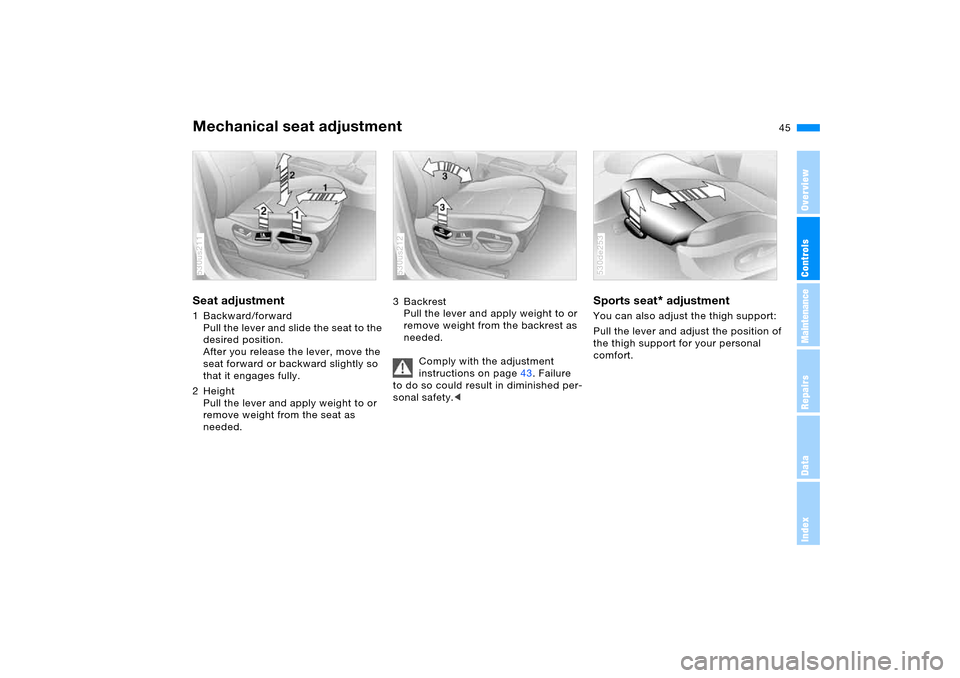
Mechanical seat adjustment Seat adjustment 1 Backward/forward
Pull the lever and slide the seat to the
desired position.
After you release the lever, move the
seat forward or backward slightly so
that it engages fully.
2Height
Pull the lever and apply weight to or
remove weight from the seat as
needed. 530us211
3Backrest
Pull the lever and apply weight to or
remove weight from the backrest as
needed.
Comply with the adjustment
instructions on page43. Failure
to do so could result in diminished per-
sonal safety.< 530us212
Sports seat
* adjustment
You can also adjust the thigh support:
Pull the lever and adjust the position of
the thigh support for your personal
comfort. 530de253
Page 47 of 202
47n
OverviewControlsMaintenanceRepairsDataIndex
Power seat adjustment
*
Head restraints
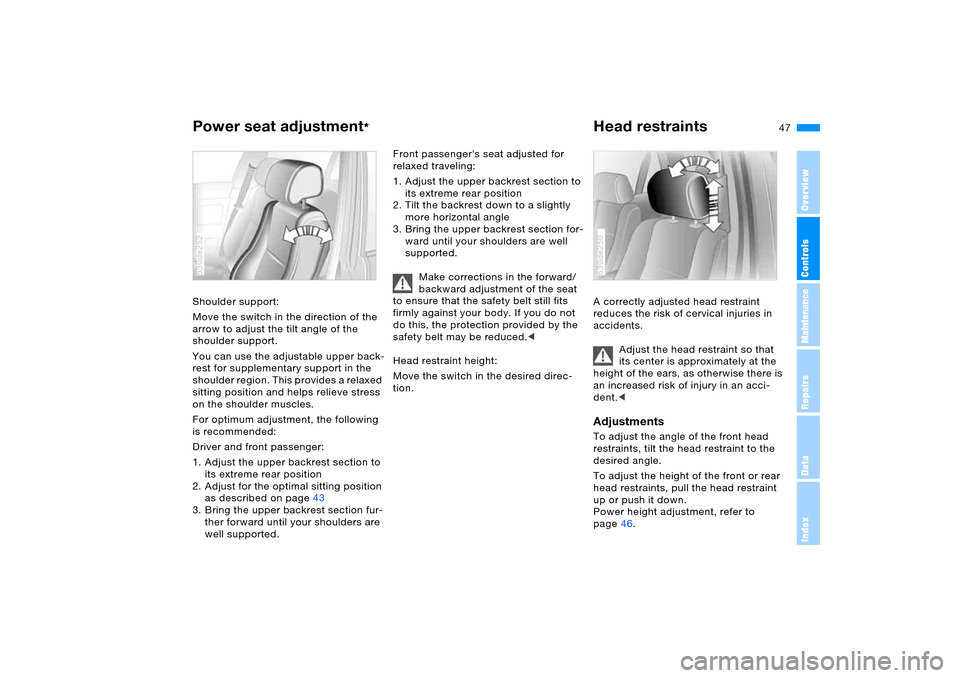
Shoulder support:
Move the switch in the direction of the
arrow to adjust the tilt angle of the
shoulder support.
You can use the adjustable upper back-
rest for supplementary support in the
shoulder region. This provides a relaxed
sitting position and helps relieve stress
on the shoulder muscles.
For optimum adjustment, the following
is recommended:
Driver and front passenger:
1. Adjust the upper backrest section to
its extreme rear position
2. Adjust for the optimal sitting position
as described on page43
3. Bring the upper backrest section fur-
ther forward until your shoulders are
well supported.530de252
Front passenger's seat adjusted for
relaxed traveling:
1. Adjust the upper backrest section to
its extreme rear position
2. Tilt the backrest down to a slightly
more horizontal angle
3. Bring the upper backrest section for-
ward until your shoulders are well
supported.
Make corrections in the forward/
backward adjustment of the seat
to ensure that the safety belt still fits
firmly against your body. If you do not
do this, the protection provided by the
safety belt may be reduced.<
Head restraint height:
Move the switch in the desired direc-
tion.
A correctly adjusted head restraint
reduces the risk of cervical injuries in
accidents.
Adjust the head restraint so that
its center is approximately at the
height of the ears, as otherwise there is
an increased risk of injury in an acci-
dent.
desired angle.
To adjust the height of the front or rear
head restraints, pull the head restraint
up or push it down.
Power height adjustment, refer to
page46.530de250
Page 49 of 202
49n
OverviewControlsMaintenanceRepairsDataIndex
Safety belts
Comply with the instructions on
page43. Failure to do so could
result in diminished personal safety.<
Use the safety belts on all occupied
seats for every trip. Airbags comple-
ment the safety belt as an additional
safety device, but they do not represent
a substitute.
Fastening Make sure you hear the latch plate
engage in the belt buckle.Releasing1. Press the red button in the belt
buckle
2. Hold the belt firmly
3. Guide the belt back into its reel.530us034
In the back, the middle safety belt
buckle is provided for use exclu-
sively by the middle passenger.
If it is not possible to extract the center
belt, this indicates that the larger back-
rest is not securely locked, refer to
page124.<
Safety belt reminder for front
seats
Indicator lamp flashes or lights
up. In addition, a signal sounds
and, depending on the equip-
ment, a message
* appears in the
Check Control. Please check to make
sure safety belts are correctly fastened.
The belt reminder is activated when the
safety belt on the driver's side has not
yet been fastened.
The belt reminder is also active at
speeds greater than approx. 5 mph/
8 km/h when the passenger belt has
not yet been fastened, heavy objects
are placed on the front passenger seat,
or passengers sitting in the front
remove their safety belts.
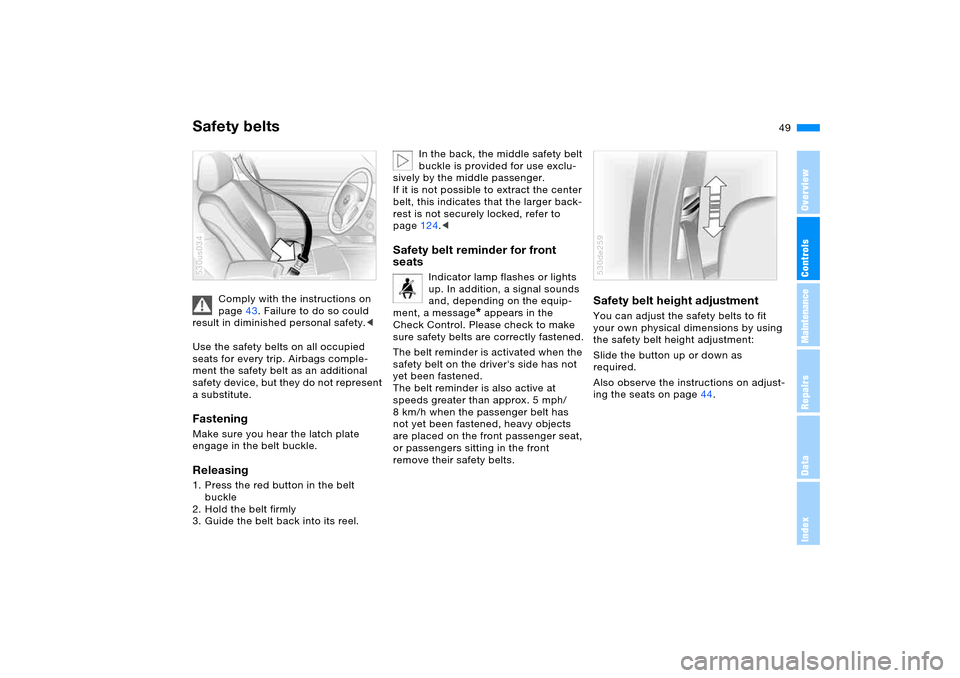
Safety belt height adjustment You can adjust the safety belts to fit
your own physical dimensions by using
the safety belt height adjustment:
Slide the button up or down as
required.
Also observe the instructions on adjust-
ing the seats on page44.530de259
Page 50 of 202
50n
Safety belts Seat, mirror and steering wheel memory
*
Damage to safety belts
If the safety belts are damaged or
stretched in an accident: have the
entire belt system, including the ten-
sioning mechanisms, replaced at your
BMW Sports Activity Vehicle center or
at a workshop that works according to
BMW repair procedures with corre-
spondingly trained personnel. Have the
belt anchorage points inspected for
damage at the same time. Failure to
observe this precaution may prevent
the safety belts from effectively provid-
ing optimal protection when needed.
If a child-restraint system was in the
vehicle during an accident, consult the
manufacturer's instructions regarding
replacement.<
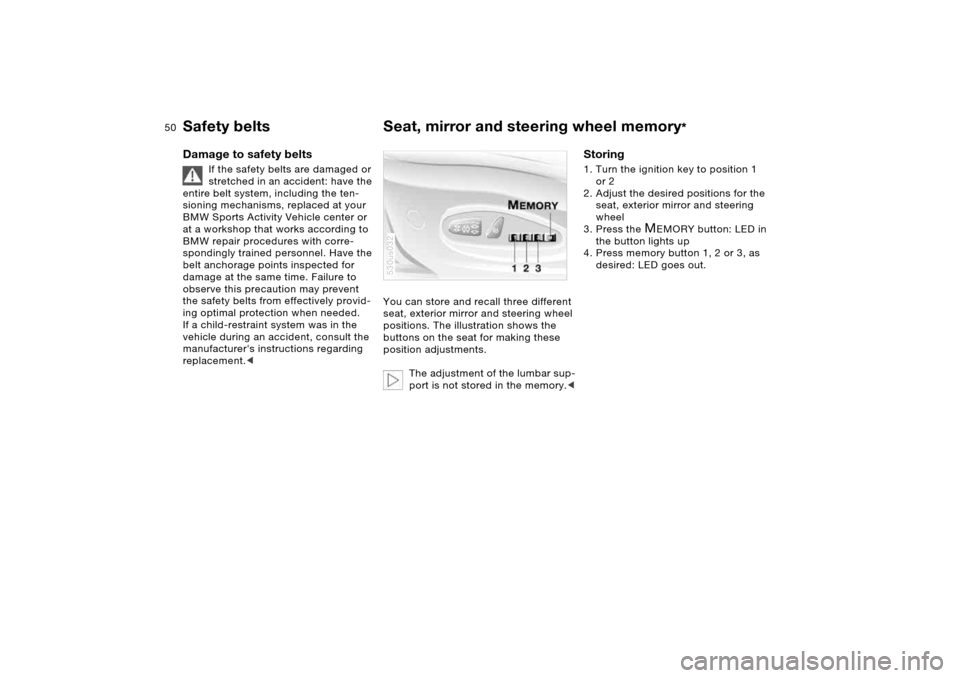
You can store and recall three different
seat, exterior mirror and steering wheel
positions. The illustration shows the
buttons on the seat for making these
position adjustments.
The adjustment of the lumbar sup-
port is not stored in the memory.<530us032
Storing 1. Turn the ignition key to position 1
or 2
2. Adjust the desired positions for the
seat, exterior mirror and steering
wheel
3. Press the
M
EMORY button: LED in
the button lights up
4. Press memory button 1, 2 or 3, as
desired: LED goes out.
Page 51 of 202
51n
OverviewControlsMaintenanceRepairsDataIndex
Seat, mirror and steering wheel memory
*
Calling up a stored setting
Do not call up a position from the
memory while the vehicle is mov-
ing. There is a risk of accident from
unexpected movement of the seat or
steering wheel.<
Convenience function:
1. Open the driver's door after unlock-
ing the vehicle or place the ignition
key in position 1
2. Briefly press memory button 1, 2
or 3, as desired.
Movement stops immediately when
one of the seat-adjustment or mem-
ory buttons is activated during the
adjustment process.
Security function:
1. With the driver's door closed and the
ignition key either removed or in
position 0 or 2
2. Maintain pressure on the desired
memory button 1, 2 or 3 until the
adjustment process is completed.
If you press the
M
EMORY button
accidentally: press the button
again – the LED goes out.<
You can have your vehicle pro-
grammed to automatically dial in
your own individual adjustment settings
for the seat, mirrors and steering wheel
whenever you use your personal
remote control to unlock the vehicle.<
If you make use of this function,
be sure that the footwell behind
the driver's seat is unobstructed before
unlocking the vehicle. If you fail to do
so, any persons or objects behind the
seat could be injured or damaged by a
rearward movement of the seat.<
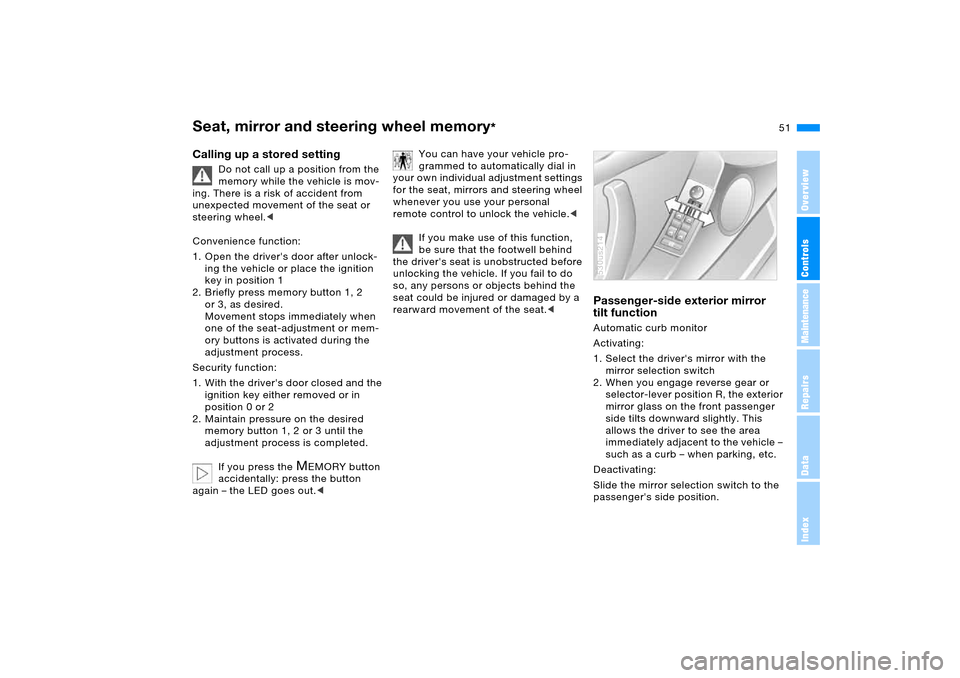
Passenger-side exterior mirror
tilt function Automatic curb monitor
Activating:
1. Select the driver's mirror with the
mirror selection switch
2. When you engage reverse gear or
selector-lever position R, the exterior
mirror glass on the front passenger
side tilts downward slightly. This
allows the driver to see the area
immediately adjacent to the vehicle –
such as a curb – when parking, etc.
Deactivating:
Slide the mirror selection switch to the
passenger's side position.530us214
Page 52 of 202
52n
Heated seats
*
Steering wheel
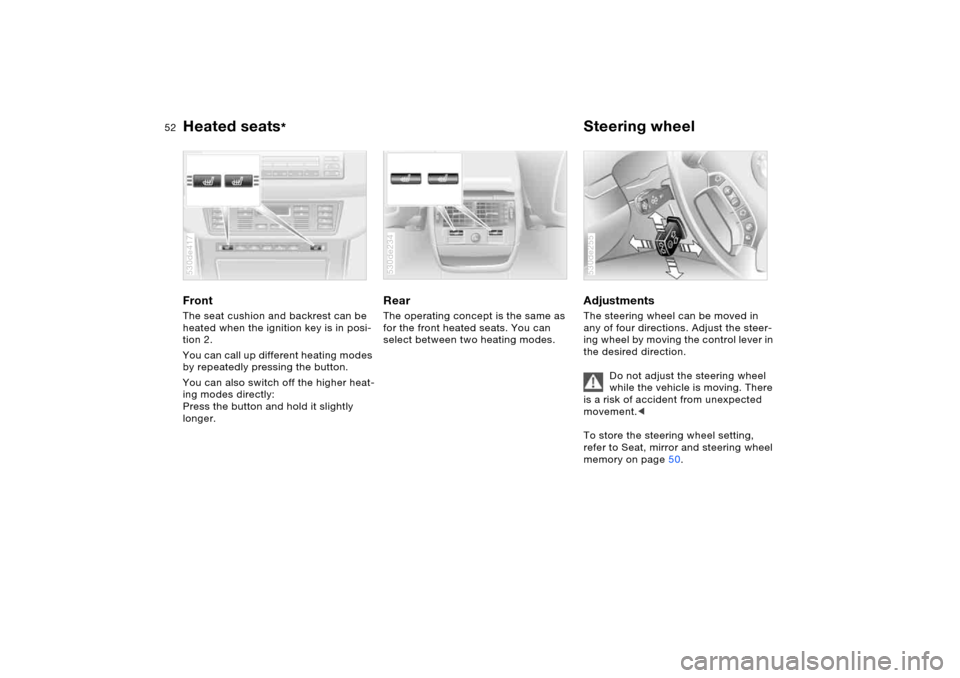
Front The seat cushion and backrest can be
heated when the ignition key is in posi-
tion 2.
You can call up different heating modes
by repeatedly pressing the button.
You can also switch off the higher heat-
ing modes directly:
Press the button and hold it slightly
longer.530de417
Rear The operating concept is the same as
for the front heated seats. You can
select between two heating modes.530de234
Adjustments The steering wheel can be moved in
any of four directions. Adjust the steer-
ing wheel by moving the control lever in
the desired direction.
Do not adjust the steering wheel
while the vehicle is moving. There
is a risk of accident from unexpected
movement.<
To store the steering wheel setting,
refer to Seat, mirror and steering wheel
memory on page50. 530de255
Page 53 of 202
53n
OverviewControlsMaintenanceRepairsDataIndex
Steering wheel Steering wheel heater
*
Mirrors
Automatic steering wheel
adjustmentonly in conjunction with seat, mirror and
steering wheel memory
In or der to m a ke it e asie r t o get in to an d
out of the vehicle, the steering wheel
automatically moves into the top posi-
tion and returns to the driving or mem-
ory position.
This automatic feature is influenced by
the position of the ignition key and by
the driver's door.
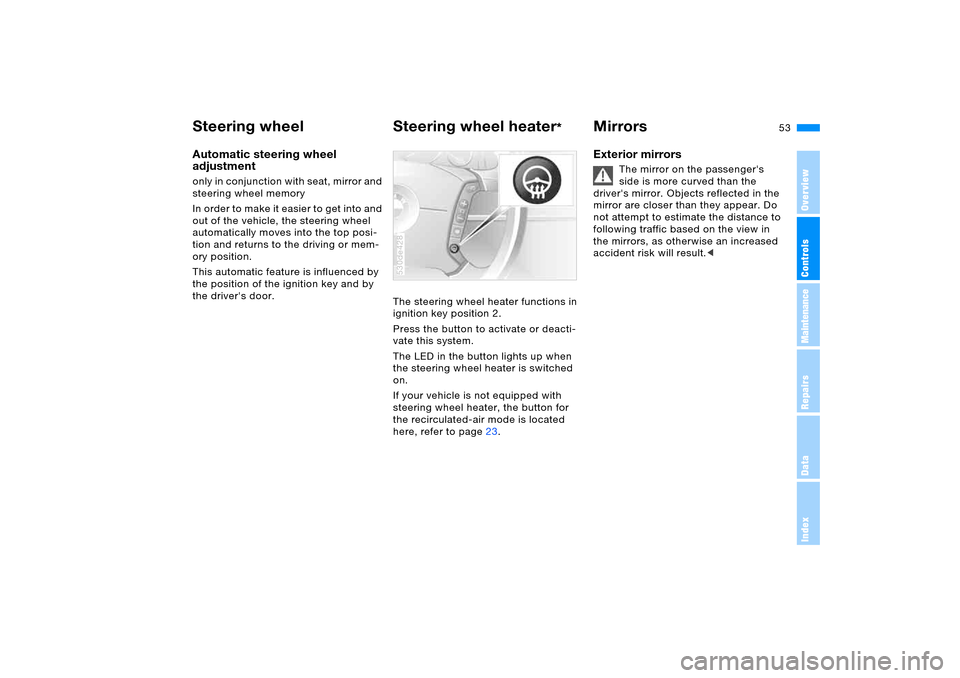
The steering wheel heater functions in
ignition key position 2.
Press the button to activate or deacti-
vate this system.
The LED in the button lights up when
the steering wheel heater is switched
on.
If your vehicle is not equipped with
steering wheel heater, the button for
the recirculated-air mode is located
here, refer to page23.
530de428
Exterior mirrors
The mirror on the passenger's
side is more curved than the
driver's mirror. Objects reflected in the
mirror are closer than they appear. Do
not attempt to estimate the distance to
following traffic based on the view in
the mirrors, as otherwise an increased
accident risk will result.<
Page 56 of 202
56n
AirbagsAutomatically deactivating front
passenger airbagsThe occupation of the seat is detected
by evaluating the imprint on the occu-
pied seat surface of the front passenger
seat. The front and side airbag on the
front passenger side are activated or
deactivated accordingly by the system.
The current status of the front
passenger airbag, i.e. deactivated
or activated, is indicated by the indica-
tor lamp over the interior rearview mir-
ror, refer to Status of front passenger
airbags in the following.<
Before transporting a child on the
front passenger seat, observe the
safety information and handling instruc-
tions under Transporting children
safely, refer to page57.
The front and side airbag on the front
passenger side can be deactivated for
teenagers and adults in certain seat
positions; then the indicator lamp for
the front passenger airbags lights up. In
these cases, change the seat position
so that the front passenger airbags are
activated and the indicator lamp goes
out. If the desired status cannot be pro-
duced by changing the seat position,
transport the corresponding person on
the rear seat. Do not install protective
covers, seat cushions, ball mats or
other objects on the front passenger
seat which are not specially recom-
mended by BMW. Do not lay objects
under the seat which could press
against the seat from below. Otherwise
a correct evaluation of the occupied
seat surface cannot be ensured.<
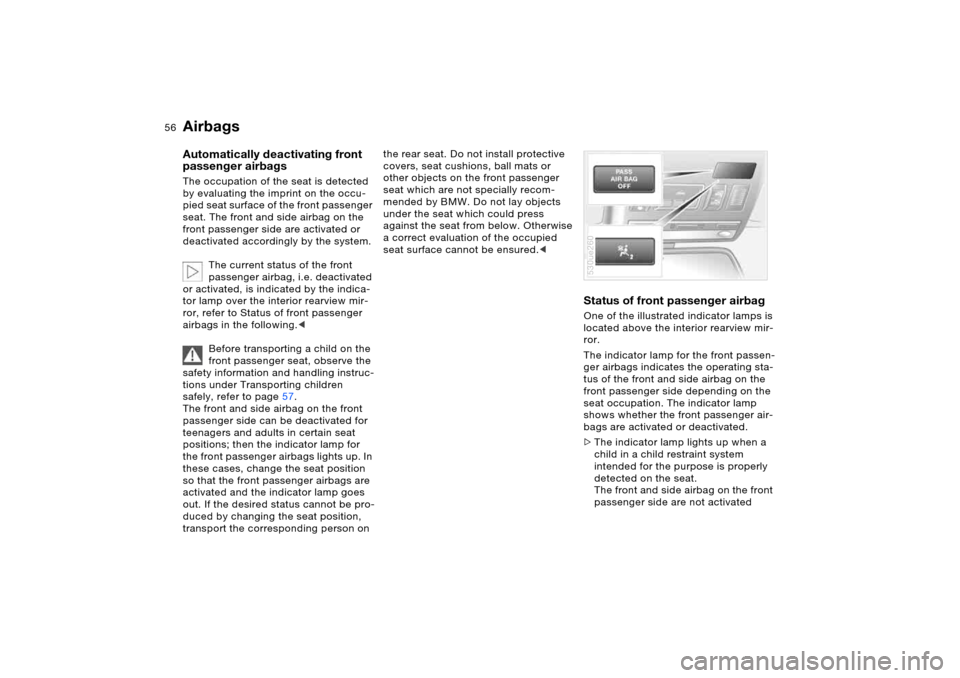
Status of front passenger airbagOne of the illustrated indicator lamps is
located above the interior rearview mir-
ror.
The indicator lamp for the front passen-
ger airbags indicates the operating sta-
tus of the front and side airbag on the
front passenger side depending on the
seat occupation. The indicator lamp
shows whether the front passenger air-
bags are activated or deactivated.
>The indicator lamp lights up when a
child in a child restraint system
intended for the purpose is properly
detected on the seat.
The front and side airbag on the front
passenger side are not activated530ue260
Page 57 of 202
57n
OverviewControlsMaintenanceRepairsDataIndex
Airbags Transporting children safely >The indicator lamp does not light up
when, for example, a correctly seated
person of sufficient height is detected
on the seat. The front and side airbag
on the front passenger side are acti-
vated
>The indicator lamp does not light up
when the seat is empty.
The front and side airbag on the front
passenger side are not activated.Operational readiness of airbag
system
As of ignition key position 1, the
warning lamp in the instrument
cluster lights up for a short time,
thus indicating the operational readi-
ness of the entire airbag system and the
safety belt tensioners.
Airbag system malfunction:
>Warning lamp does not light up as of
ignition key position 1
>Warning lamp lights up continuously.
Have the airbag system checked
immediately if a malfunction
occurs, as otherwise there is a danger
of the system failing to respond in the
expected manner in an accident of cor-
responding severity.<
The right place for children
Do not leave children unattended
in the vehicle, as otherwise they
could endanger themselves and other
persons, e.g. by opening the doors.<
In principle, all seats in your BMW
except the driver's seat are suitable for
mounting universal child restraint sys-
tems for all ages which are approved
for the respective age group.
Children always in the rear:
Accident research shows that the saf-
est place for children is on the back
seat.
Only transport children under
13 years of age or less than 5 ft/
150 cm tall in the rear in child restraint
systems intended for the respective
age, weight and height of the child.
Otherwise there is an increased danger
of injury in an accident.<
Children 13 years of age or older must
wear a safety belt as soon as a suitable
child restraint system can no longer be
used due to their age, size and weight.
All rear seat positions in your vehicle
comply with the recommendations of
the standard SAE J1819 for the safe
securing of child restraint systems in
motor vehicles.
Exception for front passenger seat:
Should it be necessary to use a
child-restraint system on the front
passenger seat, the front and side air-
bags must be deactivated. Otherwise,
there is an increased risk of injury for
the child when the airbags are trig-
gered, even with a child-restraint sys-
tem. Your BMW Sports Activity Vehicle
center will be happy to advise you.<
More information on automatic deacti-
vation of the front passenger airbags,
refer to page56.