steering BMW X5 4.8IS 2006 E53 Owner's Guide
[x] Cancel search | Manufacturer: BMW, Model Year: 2006, Model line: X5 4.8IS, Model: BMW X5 4.8IS 2006 E53Pages: 202, PDF Size: 4.13 MB
Page 105 of 202
105n
OverviewControlsMaintenanceRepairsDataIndex
Air conditioner Temperature
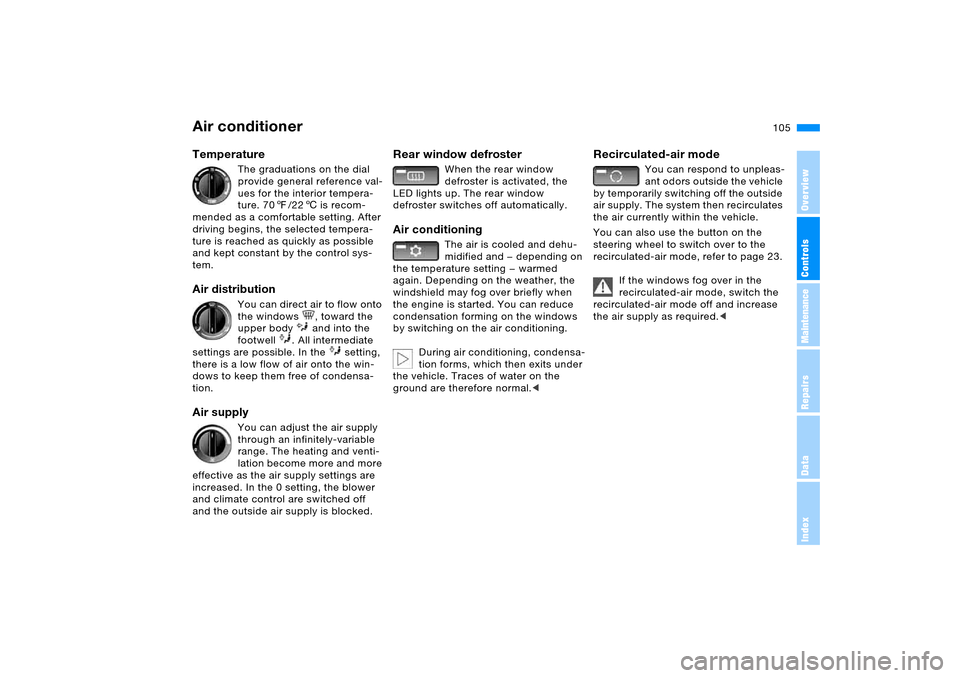
The graduations on the dial
provide general reference val-
ues for the interior tempera-
ture. 707/226 is recom-
mended as a comfortable setting. After
driving begins, the selected tempera-
ture is reached as quickly as possible
and kept constant by the control sys-
tem.
Air distribution
You can direct air to flow onto
the windows , toward the
upper body and into the
footwell . All intermediate
settings are possible. In the setting,
there is a low flow of air onto the win-
dows to keep them free of condensa-
tion.
Air supply
You can adjust the air supply
through an infinitely-variable
range. The heating and venti-
lation become more and more
effective as the air supply settings are
increased. In the 0 setting, the blower
and climate control are switched off
and the outside air supply is blocked.
Rear window defroster
When the rear window
defroster is activated, the
LED lights up. The rear window
defroster switches off automatically.
Air conditioning
The air is cooled and dehu-
midified and — depending on
the temperature setting — warmed
again. Depending on the weather, the
windshield may fog over briefly when
the engine is started. You can reduce
condensation forming on the windows
by switching on the air conditioning.
During air conditioning, condensa-
tion forms, which then exits under
the vehicle. Traces of water on the
ground are therefore normal.<
Recirculated-air mode
You can respond to unpleas-
ant odors outside the vehicle
by temporarily switching off the outside
air supply. The system then recirculates
the air currently within the vehicle.
You can also use the button on the
steering wheel to switch over to the
recirculated-air mode, refer to page 23.
If the windows fog over in the
recirculated-air mode, switch the
recirculated-air mode off and increase
the air supply as required.<
Page 110 of 202
110n
Automatic climate control
*
Air conditioning
The air is cooled and
dehumidified and —
depending on the temperature setting —
warmed again. Depending on the
weather, the windshield may fog over
briefly when the engine is started. You
can reduce condensation forming on
the windows by switching on the air
conditioning.
During air conditioning, condensa-
tion forms, which then exits under
the vehicle. That traces of water on the
ground are therefore normal.<
Maximum cooling
Maximally cooled air is
obtained as quickly as possi-
ble from an outside temperature above
327/06 and with the engine running.
The automatic climate control changes
over to the lowest temperature and
switches into the recirculated-air mode.
The maximum air quantity only flows
out of the vents for the upper body.
Therefore, open these vents for maxi-
mum cooling.
AUC Automatic recirculated-air
control
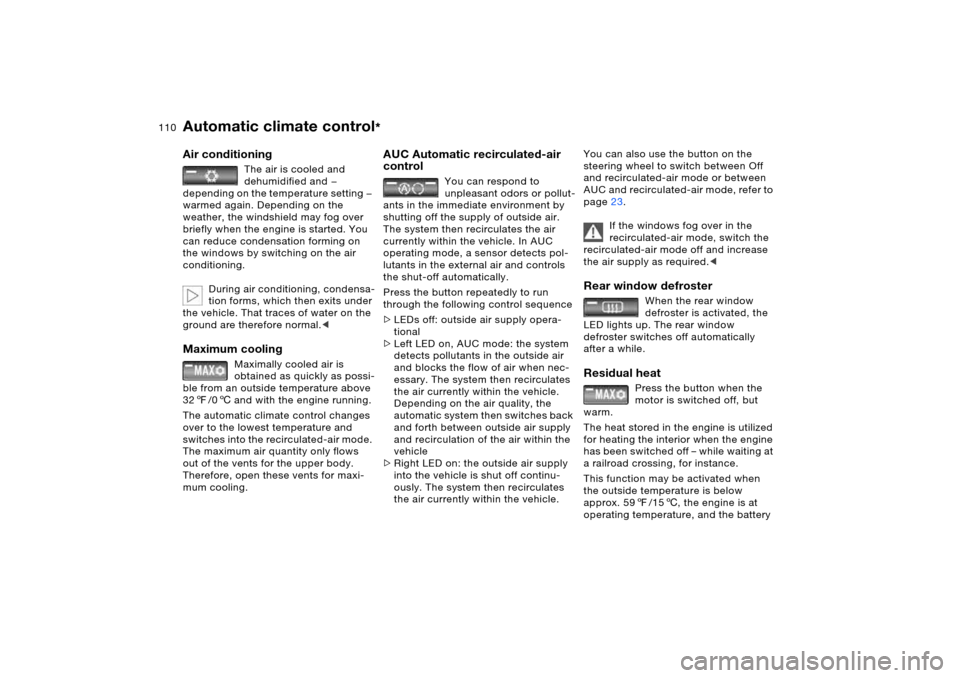
You can respond to
unpleasant odors or pollut-
ants in the immediate environment by
shutting off the supply of outside air.
The system then recirculates the air
currently within the vehicle. In AUC
operating mode, a sensor detects pol-
lutants in the external air and controls
the shut-off automatically.
Press the button repeatedly to run
through the following control sequence
>LEDs off: outside air supply opera-
tional
>Left LED on, AUC mode: the system
detects pollutants in the outside air
and blocks the flow of air when nec-
essary. The system then recirculates
the air currently within the vehicle.
Depending on the air quality, the
automatic system then switches back
and forth between outside air supply
and recirculation of the air within the
vehicle
>Right LED on: the outside air supply
into the vehicle is shut off continu-
ously. The system then recirculates
the air currently within the vehicle.
You can also use the button on the
steering wheel to switch between Off
and recirculated-air mode or between
AUC and recirculated-air mode, refer to
page23.
If the windows fog over in the
recirculated-air mode, switch the
recirculated-air mode off and increase
the air supply as required.< Rear window defroster
When the rear window
defroster is activated, the
LED lights up. The rear window
defroster switches off automatically
after a while.
Residual heat
Press the button when the
motor is switched off, but
warm.
The heat stored in the engine is utilized
for heating the interior when the engine
has been switched off – while waiting at
a railroad crossing, for instance.
This function may be activated when
the outside temperature is below
approx. 597/156, the engine is at
operating temperature, and the battery
Page 132 of 202
132n
Cargo loading Roof-mounted luggage rack
*
Always position and secure the
load as described above. If you do
not, it can endanger the passengers
during braking or evasive maneuvers.
Do not exceed the permissible gross
vehicle weight and the permissible axle
loads, refer to page182. If you do, the
operating safety of the vehicle is no
longer ensured and you are in violation
of the law.
You should never transport heavy or
hard objects unsecured in the passen-
ger compartment, as they could fly
around and pose a safety hazard to the
vehicle's occupants even during abrupt
braking or evasive maneuvers.<
A special rack system is available as an
option for your BMW. Please comply
with the precautions included with the
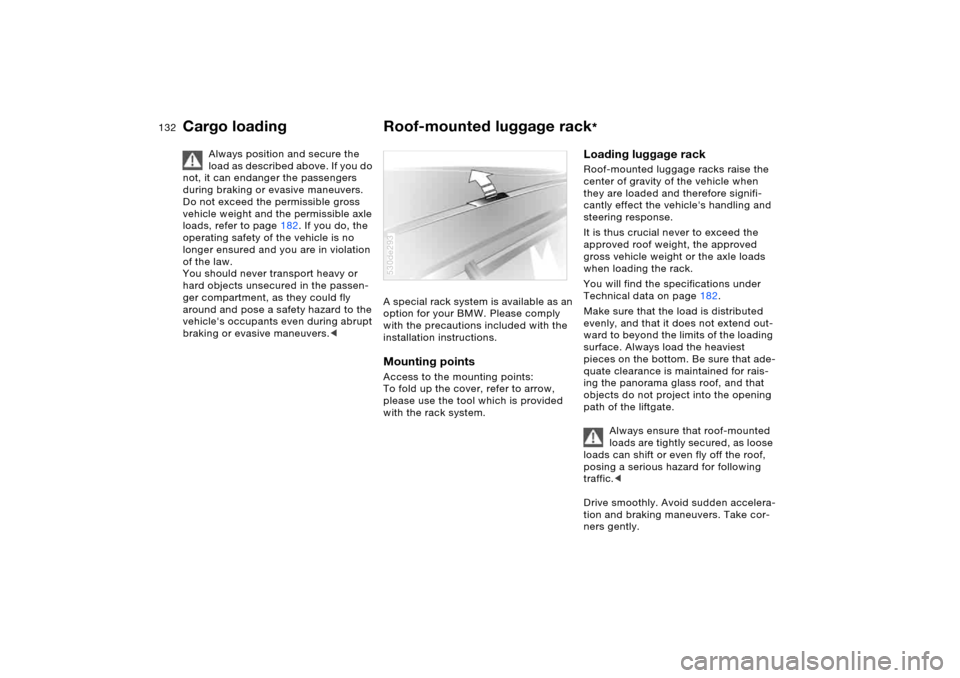
installation instructions.Mounting pointsAccess to the mounting points:
To fold up the cover, refer to arrow,
please use the tool which is provided
with the rack system.530de293
Loading luggage rackRoof-mounted luggage racks raise the
center of gravity of the vehicle when
they are loaded and therefore signifi-
cantly effect the vehicle's handling and
steering response.
It is thus crucial never to exceed the
approved roof weight, the approved
gross vehicle weight or the axle loads
when loading the rack.
You will find the specifications under
Technical data on page182.
Make sure that the load is distributed
evenly, and that it does not extend out-
ward to beyond the limits of the loading
surface. Always load the heaviest
pieces on the bottom. Be sure that ade-
quate clearance is maintained for rais-
ing the panorama glass roof, and that
objects do not project into the opening
path of the liftgate.
Always ensure that roof-mounted
loads are tightly secured, as loose
loads can shift or even fly off the roof,
posing a serious hazard for following
traffic.<
Drive smoothly. Avoid sudden accelera-
tion and braking maneuvers. Take cor-
ners gently.
Page 140 of 202
140n
Safe braking Emergency stops You brake most effectively when you
apply maximum pedal pressure in situa-
tions requiring it: emergency stops.
Since the vehicle maintains steering
responsiveness, you can nevertheless
avoid possible obstacles with a mini-
mum of steering effort.
Pulsation at the brake pedal combined
with sounds from the hydraulic circuits
indicates to the driver that ABS is in its
active mode.Brake fluid level If the brake fluid level is too low and
brake pedal travel has become longer,
there may be a malfunction in one of
the two brake system's hydraulic cir-
cuits.
Proceed to the nearest BMW
Sports Activity Vehicle center.
In so doing, increased pressure on the
brake pedal may be required, and slight
pulling to the side and longer braking
distances may result. Please remember
to adapt your driving style accord-
ingly.<
Disk brakes When the vehicle is driven only occa-
sionally, during extended periods when
the vehicle is not used at all, and in
operating conditions where brake appli-
cations are less frequent, there is an
increased tendency for corrosion to
form on rotors, while contaminants
accumulate on the brake pads. This
occurs because the minimal pressure
that the pads must exert to clean the
rotors during brake applications is not
reached.
If the brake rotors are corroded, they
will tend to respond to braking with a
pulsating effect that even extended
application will fail to cure.
When driving in wet conditions and in
heavy rain, it is advisable to apply light
pressure to the brake pedal from time
to time. Monitor traffic conditions to
ensure that this maneuver does not
endanger other road users. The heat
generated in this process helps dry the
pads and rotors to ensure that the brak-
ing force is then immediately available
when required.
Extended or steep mountain descents
should be driven in the gear in which
only minimal periodic brake application
is required. This avoids excessive strain on the brakes and possible impairment
of braking action.
Do not drive with the clutch pedal
depressed, at idle or with the
engine switched off, as otherwise there
will be no engine braking effect or
power assistance for braking and steer-
ing.
BMW recommends having brake
inspections performed at a BMW
Sports Activity Vehicle center only. If
you do not, parts of the 4-wheel drive
system could be damaged.
No floor mats, carpets or other objects
may lie in the area of pedal travel, as
otherwise pedal operation may be
impaired.<
Brake pads
For your own safety: use only
brake pads that BMW has
approved for your particular vehicle
model. BMW cannot evaluate non-
approved brake pads to determine if
they are suited for use, and therefore
cannot ensure the operating safety of
the vehicle if they are installed.<
Page 165 of 202
165n
OverviewControlsMaintenanceRepairsDataIndex
Lamps and bulbs Changing a wheel Light-emitting diodes LEDs Light-emitting diodes installed behind
translucent lenses serve as the light
source for many of the controls and dis-
plays in your vehicle. The concept
behind their operation is related to that
employed for lasers.
Do not remove the covers, and
never stare into the unfiltered light
several hours, as irritation of the retina
could result.<
Safety precautions to observe in
the event of a flat and during all
tire changes:
Park the vehicle as far as possible from
passing traffic. Park on a firm, flat, sur-
face. Switch on the hazard warning
flashers.
Turn the steering wheel to the straight-
ahead position, remove the key and
engage the steering lock. Shift into 1st
or reverse, selector lever in Park with
automatic transmission, and engage the
handbrake.
All passengers should be outside the
vehicle and well away from your imme-
diate working area, behind a guardrail,
for instance.
If a warning triangle or portable hazard
warning lamp is required, set it up on
the roadside at an appropriate distance
from the rear of the vehicle. Comply
with all safety guidelines and regula-
tions.
Change the wheel only on a level, firm
surface that is not slippery. The vehicle
or the jack could slip to the side if you
attempt to raise the vehicle on a soft
or slippery surface such as snow, ice,
tiles, etc.
Position the jack on a firm support sur-
face.
Do not place wooden blocks or similar
objects under the jack. If this is done,
the jack might not be able to reach its
full support capacity because of the
limited height. To avoid serious or fatal
injury: never lie under the vehicle, and
never start the engine while it is sup-
ported by the jack.<
Your BMW has either a compact wheel
for temporary use to ensure your mobil-
ity, or a spare wheel of the size 235/
65 R 17. Please observe the differences
in handling when removing the wheel
from the cargo area.
Page 170 of 202
170n
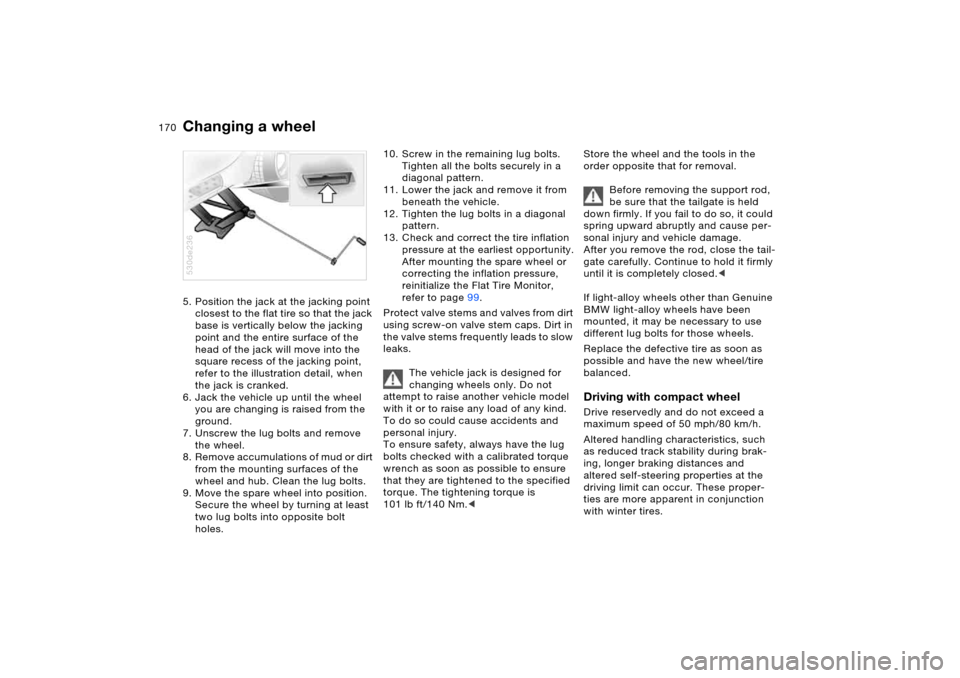
Changing a wheel5. Position the jack at the jacking point
closest to the flat tire so that the jack
base is vertically below the jacking
point and the entire surface of the
head of the jack will move into the
square recess of the jacking point,
refer to the illustration detail, when
the jack is cranked.
6. Jack the vehicle up until the wheel
you are changing is raised from the
ground.
7. Unscrew the lug bolts and remove
the wheel.
8. Remove accumulations of mud or dirt
from the mounting surfaces of the
wheel and hub. Clean the lug bolts.
9. Move the spare wheel into position.
Secure the wheel by turning at least
two lug bolts into opposite bolt
holes. 530de236
10. Screw in the remaining lug bolts.
Tighten all the bolts securely in a
diagonal pattern.
11. Lower the jack and remove it from
beneath the vehicle.
12. Tighten the lug bolts in a diagonal
pattern.
13. Check and correct the tire inflation
pressure at the earliest opportunity.
After mounting the spare wheel or
correcting the inflation pressure,
reinitialize the Flat Tire Monitor,
refer to page99.
Protect valve stems and valves from dirt
using screw-on valve stem caps. Dirt in
the valve stems frequently leads to slow
leaks.
The vehicle jack is designed for
changing wheels only. Do not
attempt to raise another vehicle model
with it or to raise any load of any kind.
To do so could cause accidents and
personal injury.
To ensure safety, always have the lug
bolts checked with a calibrated torque
wrench as soon as possible to ensure
that they are tightened to the specified
torque. The tightening torque is
101 lb ft/140 Nm.<
Store the wheel and the tools in the
order opposite that for removal.
Before removing the support rod,
be sure that the tailgate is held
down firmly. If you fail to do so, it could
spring upward abruptly and cause per-
sonal injury and vehicle damage.
After you remove the rod, close the tail-
gate carefully. Continue to hold it firmly
until it is completely closed.<
If light-alloy wheels other than Genuine
BMW light-alloy wheels have been
mounted, it may be necessary to use
different lug bolts for those wheels.
Replace the defective tire as soon as
possible and have the new wheel/tire
balanced. Driving with compact wheelDrive reservedly and do not exceed a
maximum speed of 50 mph/80 km/h.
Altered handling characteristics, such
as reduced track stability during brak-
ing, longer braking distances and
altered self-steering properties at the
driving limit can occur. These proper-
ties are more apparent in conjunction
with winter tires.
Page 171 of 202
171n
OverviewControlsMaintenanceRepairsDataIndex
Changing a wheel Vehicle battery
Only one compact wheel may be
mounted. Wheels and tires of the
original size should be mounted again
as soon as possible.<
Driving with spare wheel
*
Do not exceed a speed of
130 mph/210 km/h, otherwise tire
damage could lead to accidents.<
With certain wheel-and-tire com-
binations the size of the spare
wheel differs from that of the other
wheels. To restore the original state,
the normal wheel should be remounted
as soon as possible.<
Battery posts, terminals and
related accessories contain lead
and lead compounds. Wash hands after
handling.<
Battery care The battery is maintenance-free, that is,
the original electrolyte will normally last
for the service life of the battery under
moderate climatic conditions. Your
BMW Sports Activity Vehicle center will
be glad to advise in all matters con-
cerning the battery.Charging battery Only charge the battery in the vehicle
via the terminals in the engine compart-
ment with the engine off. For correct
connections, refer to Jump starting on
page174. Disposal
Following replacement, have old
batteries disposed of by your
BMW Sports Activity Vehicle center or
turn them over to a recycling center.
Maintain the battery in an upright posi-
tion for transport and storage. Always
restrain the battery to prevent it from
tipping over during transport.<
Power failure Following a temporary power failure,
e.g. in the case of a dead battery, some
equipment is subject to restricted use
and must be reinitialized. Individual set-
tings are also lost and must be updated
again:
>Seat, mirror and steering wheel
memory
The positions must be stored again,
refer to page50
>Time and date
Have to be updated again, refer to
page82
>Activation time for parked car
ventilation
Has to be updated again, refer to
page84.
Page 176 of 202
176n
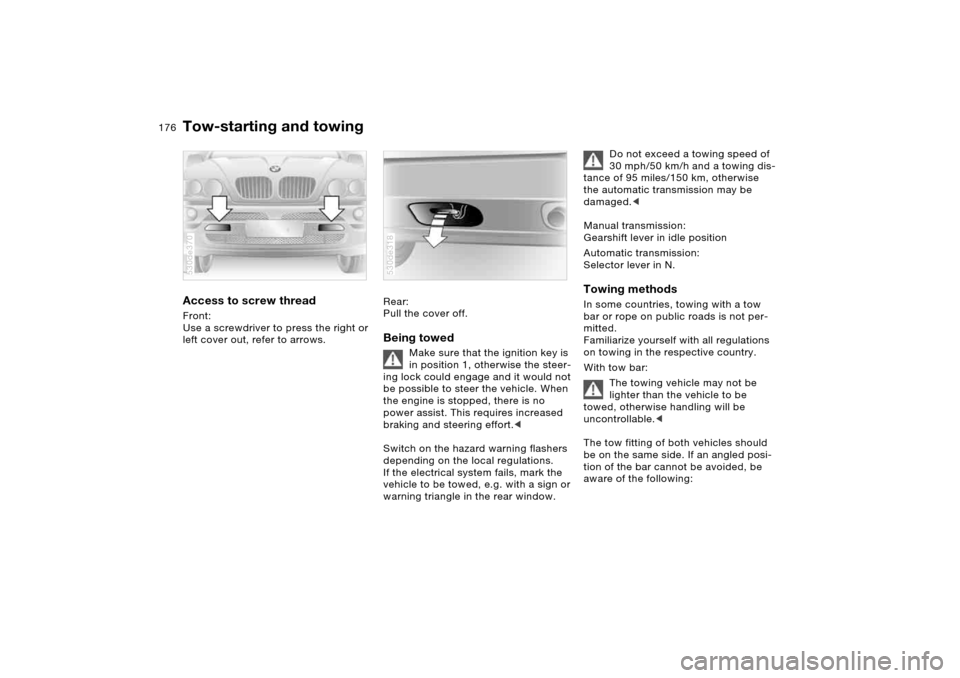
Tow-starting and towingAccess to screw thread Front:
Use a screwdriver to press the right or
left cover out, refer to arrows. 530de370
Rear:
Pull the cover off. Being towed
Make sure that the ignition key is
in position 1, otherwise the steer-
ing lock could engage and it would not
be possible to steer the vehicle. When
the engine is stopped, there is no
power assist. This requires increased
braking and steering effort.<
Switch on the hazard warning flashers
depending on the local regulations.
If the electrical system fails, mark the
vehicle to be towed, e.g. with a sign or
warning triangle in the rear window.
530de318
Do not exceed a towing speed of
30 mph/50 km/h and a towing dis-
tance of 95 miles/150 km, otherwise
the automatic transmission may be
damaged.<
Manual transmission:
Gearshift lever in idle position
Automatic transmission:
Selector lever in N.
Towing methodsIn some countries, towing with a tow
bar or rope on public roads is not per-
mitted.
Familiarize yourself with all regulations
on towing in the respective country.
With tow bar:
The towing vehicle may not be
lighter than the vehicle to be
towed, otherwise handling will be
uncontrollable.<
The tow fitting of both vehicles should
be on the same side. If an angled posi-
tion of the bar cannot be avoided, be
aware of the following:
Page 186 of 202
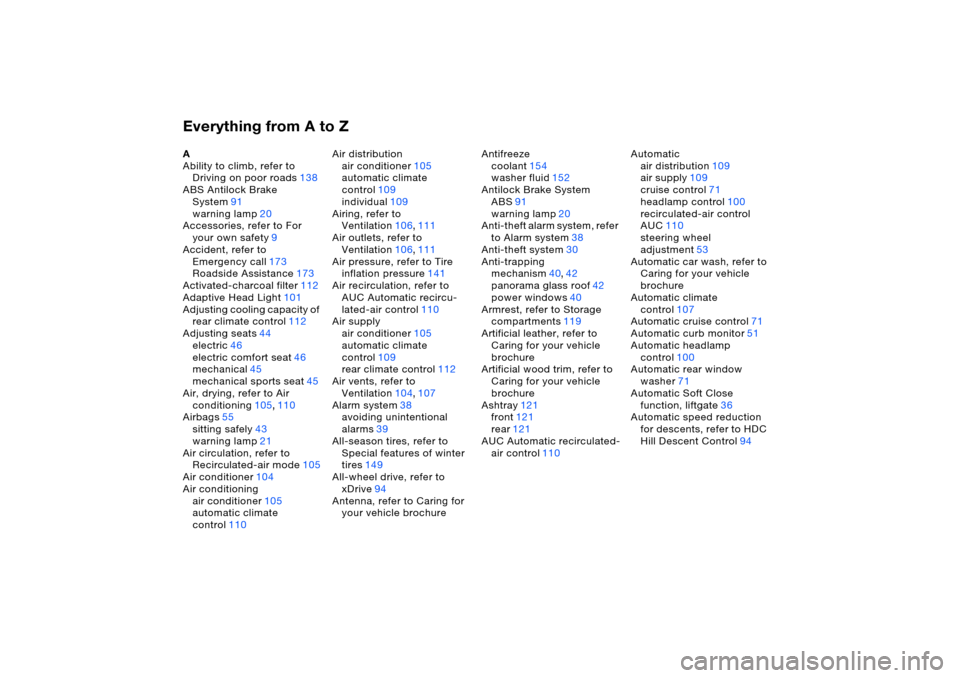
Everything from A to ZA
Ability to climb, refer to
Driving on poor roads138
ABS Antilock Brake
System91
warning lamp20
Accessories, refer to For
your own safety9
Accident, refer to
Emergency call173
Roadside Assistance173
Activated-charcoal filter112
Adaptive Head Light101
Adjusting cooling capacity of
rear climate control112
Adjusting seats44
electric46
electric comfort seat46
mechanical45
mechanical sports seat45
Air, drying, refer to Air
conditioning105,110
Airbags55
sitting safely43
warning lamp21
Air circulation, refer to
Recirculated-air mode105
Air conditioner104
Air conditioning
air conditioner105
automatic climate
control110Air distribution
air conditioner105
automatic climate
control109
individual109
Airing, refer to
Ventilation106,111
Air outlets, refer to
Ventilation106,111
Air pressure, refer to Tire
inflation pressure141
Air recirculation, refer to
AUC Automatic recircu-
lated-air control110
Air supply
air conditioner105
automatic climate
control109
rear climate control112
Air vents, refer to
Ventilation104,107
Alarm system38
avoiding unintentional
alarms39
All-season tires, refer to
Special features of winter
tires149
All-wheel drive, refer to
xDrive94
Antenna, refer to Caring for
your vehicle brochureAntifreeze
coolant154
washer fluid152
Antilock Brake System
ABS91
warning lamp20
Anti-theft alarm system, refer
to Alarm system38
Anti-theft system30
Anti-trapping
mechanism40,42
panorama glass roof42
power windows40
Armrest, refer to Storage
compartments119
Artificial leather, refer to
Caring for your vehicle
brochure
Artificial wood trim, refer to
Caring for your vehicle
brochure
Ashtray121
front121
rear121
AUC Automatic recirculated-
air control110Automatic
air distribution109
air supply109
cruise control71
headlamp control100
recirculated-air control
AUC110
steering wheel
adjustment53
Automatic car wash, refer to
Caring for your vehicle
brochure
Automatic climate
control107
Automatic cruise control71
Automatic curb monitor51
Automatic headlamp
control100
Automatic rear window
washer71
Automatic Soft Close
function, liftgate36
Automatic speed reduction
for descents, refer to HDC
Hill Descent Control94
Page 187 of 202
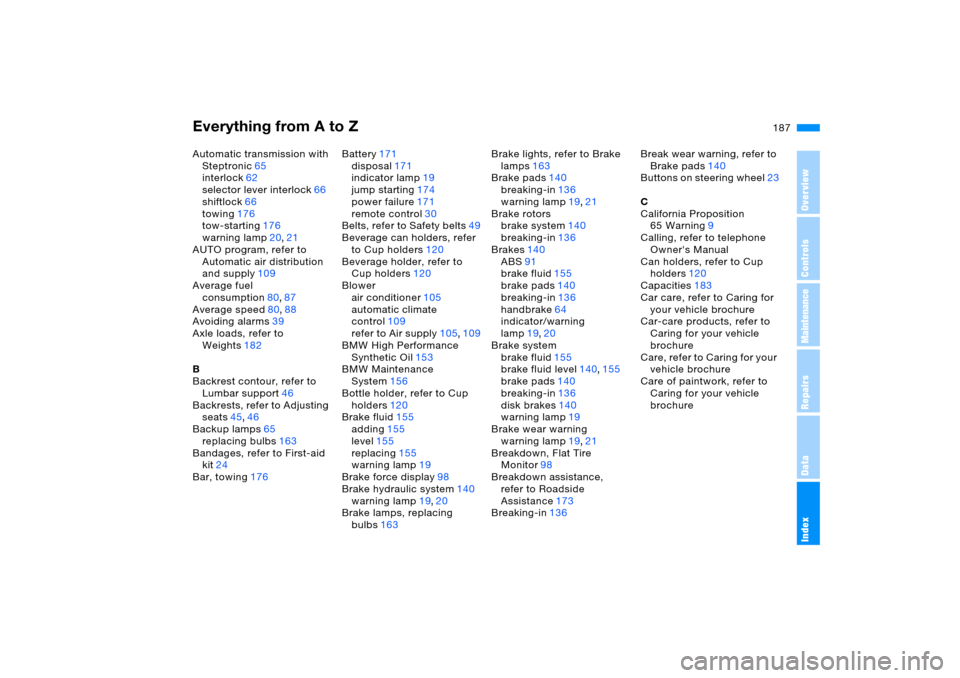
Everything from A to Z
187n
OverviewControlsMaintenanceRepairsDataIndex
Automatic transmission with
Steptronic65
interlock62
selector lever interlock66
shiftlock66
towing176
tow-starting176
warning lamp20,21
AUTO program, refer to
Automatic air distribution
and supply109
Average fuel
consumption80,87
Average speed80,88
Avoiding alarms39
Axle loads, refer to
Weights182
B
Backrest contour, refer to
Lumbar support46
Backrests, refer to Adjusting
seats45,46
Backup lamps65
replacing bulbs163
Bandages, refer to First-aid
kit24
Bar, towing176Battery171
disposal171
indicator lamp19
jump starting174
power failure171
remote control30
Belts, refer to Safety belts49
Beverage can holders, refer
to Cup holders120
Beverage holder, refer to
Cup holders120
Blower
air conditioner105
automatic climate
control109
refer to Air supply105,109
BMW High Performance
Synthetic Oil153
BMW Maintenance
System156
Bottle holder, refer to Cup
holders120
Brake fluid155
adding155
level155
replacing155
warning lamp
19
Brake force display98
Brake hydraulic system140
warning lamp19,20
Brake lamps, replacing
bulbs163Brake lights, refer to Brake
lamps163
Brake pads140
breaking-in136
warning lamp19,21
Brake rotors
brake system140
breaking-in136
Brakes140
ABS91
brake fluid155
brake pads140
breaking-in136
handbrake64
indicator/warning
lamp19,20
Brake system
brake fluid155
brake fluid level140,155
brake pads140
breaking-in136
disk brakes140
warning lamp19
Brake wear warning
warning lamp19,21
Breakdown, Flat Tire
Monitor98
Breakdown assistance,
refer to Roadside
Assistance173
Breaking-in136Break wear warning, refer to
Brake pads140
Buttons on steering wheel23
C
California Proposition
65 Warning9
Calling, refer to telephone
Owner's Manual
Can holders, refer to Cup
holders120
Capacities183
Car care, refer to Caring for
your vehicle brochure
Car-care products, refer to
Caring for your vehicle
brochure
Care, refer to Caring for your
vehicle brochure
Care of paintwork, refer to
Caring for your vehicle
brochure