tow BMW X5 4.8IS 2006 E53 Owner's Guide
[x] Cancel search | Manufacturer: BMW, Model Year: 2006, Model line: X5 4.8IS, Model: BMW X5 4.8IS 2006 E53Pages: 202, PDF Size: 4.13 MB
Page 112 of 202
112n
Automatic climate control
*
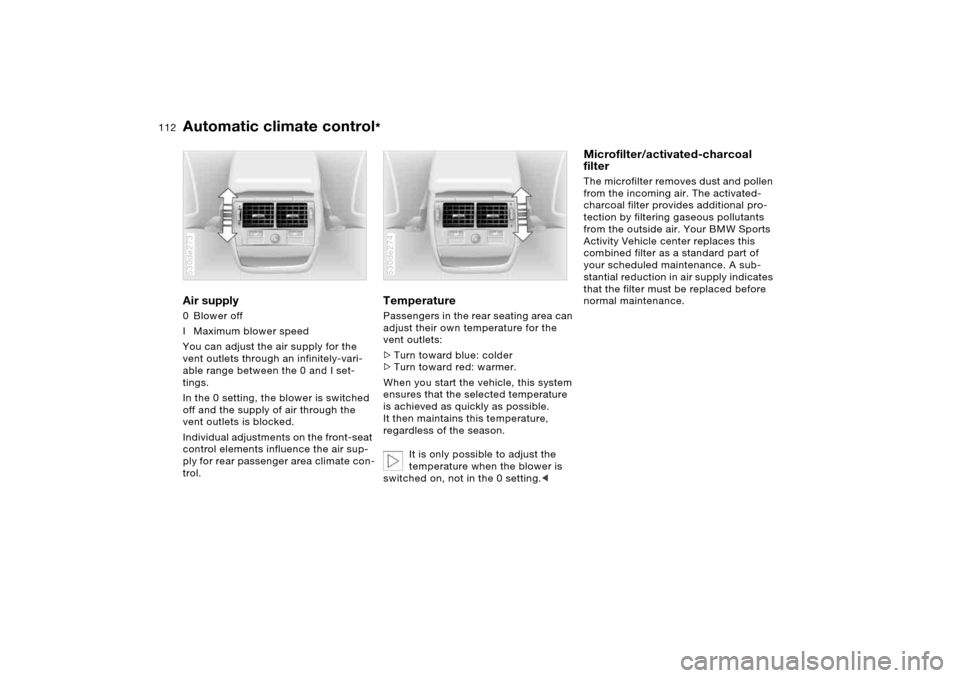
Air supply 0 Blower off
I Maximum blower speed
You can adjust the air supply for the
vent outlets through an infinitely-vari-
able range between the 0 and I set-
tings.
In the 0 setting, the blower is switched
off and the supply of air through the
vent outlets is blocked.
Individual adjustments on the front-seat
control elements influence the air sup-
ply for rear passenger area climate con-
trol. 530de273
Temperature Passengers in the rear seating area can
adjust their own temperature for the
vent outlets:
>Turn toward blue: colder
>Turn toward red: warmer.
When you start the vehicle, this system
ensures that the selected temperature
is achieved as quickly as possible.
It then maintains this temperature,
regardless of the season.
It is only possible to adjust the
temperature when the blower is
switched on, not in the 0 setting.< 530de274
Microfilter/activated-charcoal
filter The microfilter removes dust and pollen
from the incoming air. The activated-
charcoal filter provides additional pro-
tection by filtering gaseous pollutants
from the outside air. Your BMW Sports
Activity Vehicle center replaces this
combined filter as a standard part of
your scheduled maintenance. A sub-
stantial reduction in air supply indicates
that the filter must be replaced before
normal maintenance.
Page 123 of 202
123n
OverviewControlsMaintenanceRepairsDataIndex
Ski bag
*
The ski bag allows the safe and clean
transport of up to four pairs of standard
skis or up to two snowboards.
With the length of the ski bag and the
additional space in the cargo area, you
can store skis up to 6.8 ft/2.1 m length.
Because stowing skis of this maximum
length causes the ski bag to narrow, it
can only accommodate two pairs of
skis with a length of 6.8 ft/2.1 m.
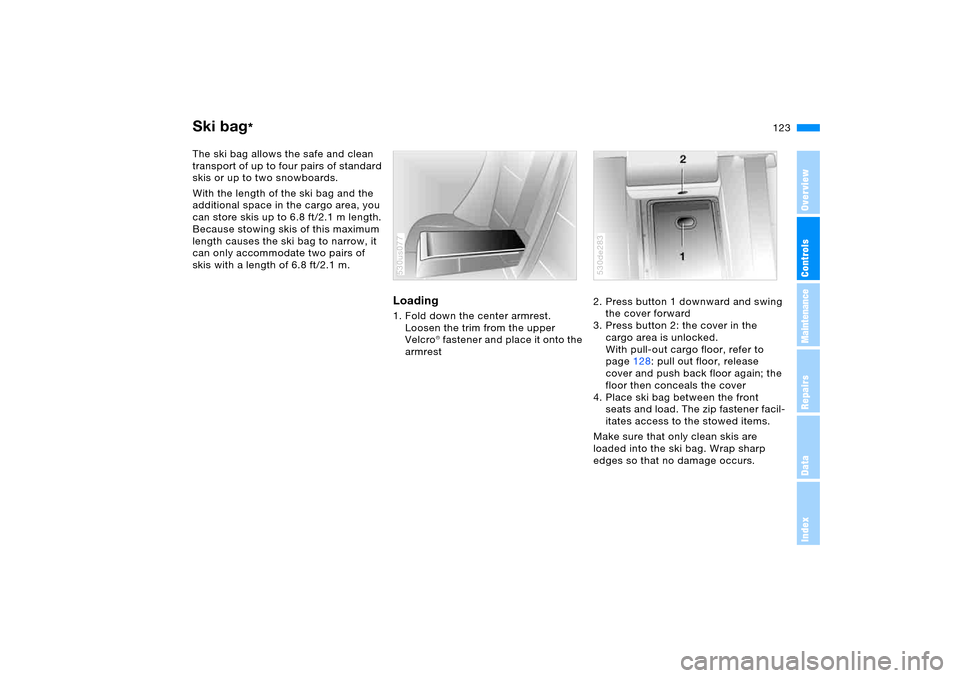
Loading 1. Fold down the center armrest.
Loosen the trim from the upper
Velcro® fastener and place it onto the
armrest 530us077
2. Press button 1 downward and swing
the cover forward
3. Press button 2: the cover in the
cargo area is unlocked.
With pull-out cargo floor, refer to
page128: pull out floor, release
cover and push back floor again; the
floor then conceals the cover
4. Place ski bag between the front
seats and load. The zip fastener facil-
itates access to the stowed items.
Make sure that only clean skis are
loaded into the ski bag. Wrap sharp
edges so that no damage occurs.530de283
Page 124 of 202
124n
Ski bag
*
Cargo area
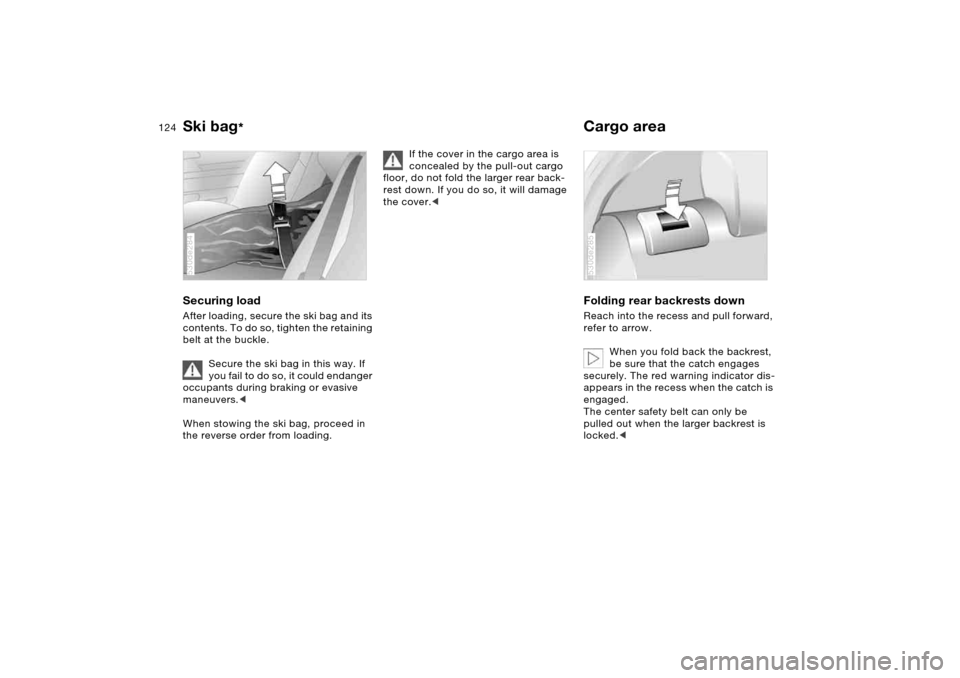
Securing load After loading, secure the ski bag and its
contents. To do so, tighten the retaining
belt at the buckle.
Secure the ski bag in this way. If
you fail to do so, it could endanger
occupants during braking or evasive
maneuvers.<
When stowing the ski bag, proceed in
the reverse order from loading.530de284
If the cover in the cargo area is
concealed by the pull-out cargo
floor, do not fold the larger rear back-
rest down. If you do so, it will damage
the cover.<
Folding rear backrests down Reach into the recess and pull forward,
refer to arrow.
When you fold back the backrest,
be sure that the catch engages
securely. The red warning indicator dis-
appears in the recess when the catch is
engaged.
The center safety belt can only be
pulled out when the larger backrest is
locked.< 530de285
Page 125 of 202
125n
OverviewControlsMaintenanceRepairsDataIndex
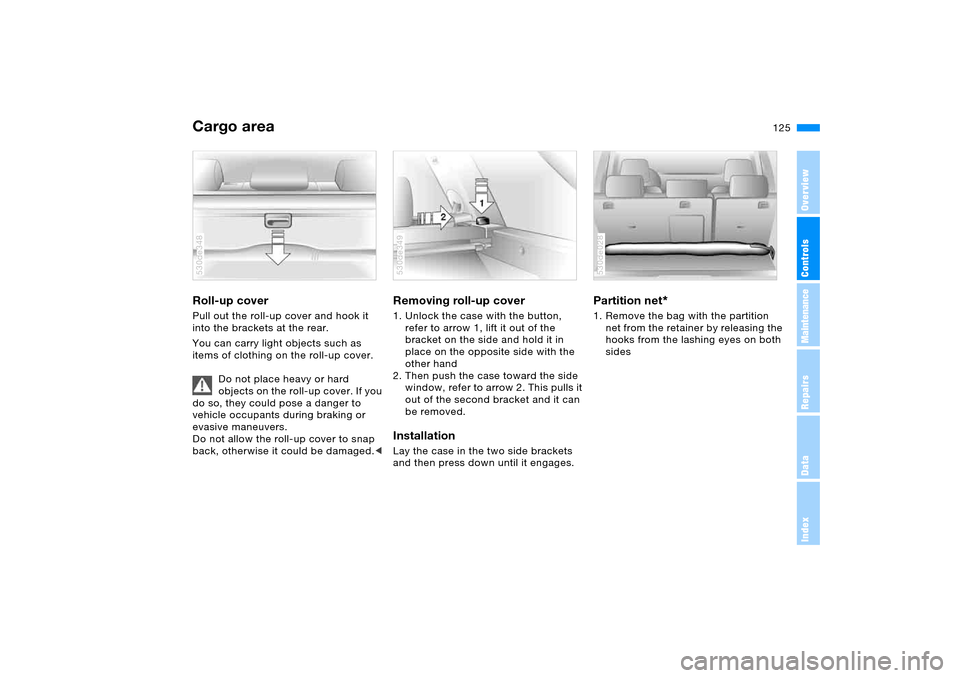
Cargo area Roll-up cover Pull out the roll-up cover and hook it
into the brackets at the rear.
You can carry light objects such as
items of clothing on the roll-up cover.
Do not place heavy or hard
objects on the roll-up cover. If you
do so, they could pose a danger to
vehicle occupants during braking or
evasive maneuvers.
Do not allow the roll-up cover to snap
back, otherwise it could be damaged.<530de348
Removing roll-up cover1. Unlock the case with the button,
refer to arrow 1, lift it out of the
bracket on the side and hold it in
place on the opposite side with the
other hand
2. Then push the case toward the side
window, refer to arrow 2. This pulls it
out of the second bracket and it can
be removed.InstallationLay the case in the two side brackets
and then press down until it engages.530de349
Partition net
*
1. Remove the bag with the partition
net from the retainer by releasing the
hooks from the lashing eyes on both
sides530de028
Page 126 of 202
126n
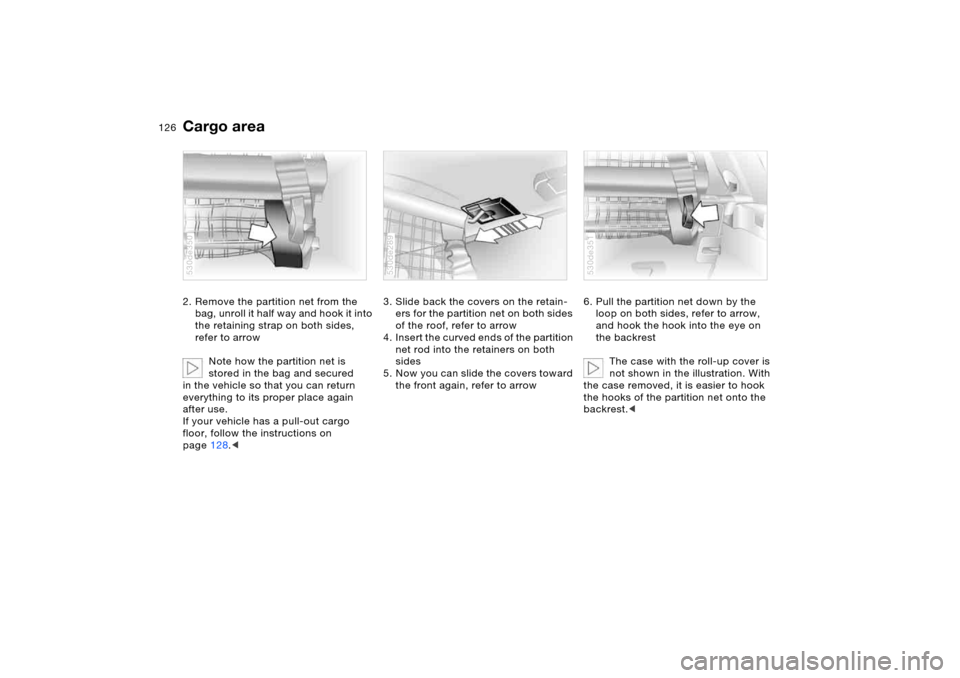
Cargo area 2. Remove the partition net from the
bag, unroll it half way and hook it into
the retaining strap on both sides,
refer to arrow
Note how the partition net is
stored in the bag and secured
in the vehicle so that you can return
everything to its proper place again
after use.
If your vehicle has a pull-out cargo
floor, follow the instructions on
page128.<530de350
3. Slide back the covers on the retain-
ers for the partition net on both sides
of the roof, refer to arrow
4. Insert the curved ends of the partition
net rod into the retainers on both
sides
5. Now you can slide the covers toward
the front again, refer to arrow530de289
6. Pull the partition net down by the
loop on both sides, refer to arrow,
and hook the hook into the eye on
the backrest
The case with the roll-up cover is
not shown in the illustration. With
the case removed, it is easier to hook
the hooks of the partition net onto the
backrest.<530de351
Page 130 of 202
130n
Cargo loading
Avoid overloading the vehicle
so that the permissible loading
capacity of the tires is not exceeded.
Overloading can lead to overheating
and increases the rate at which damage
develops inside the tires. The ultimate
result can assume the form of a sudden
air loss.<
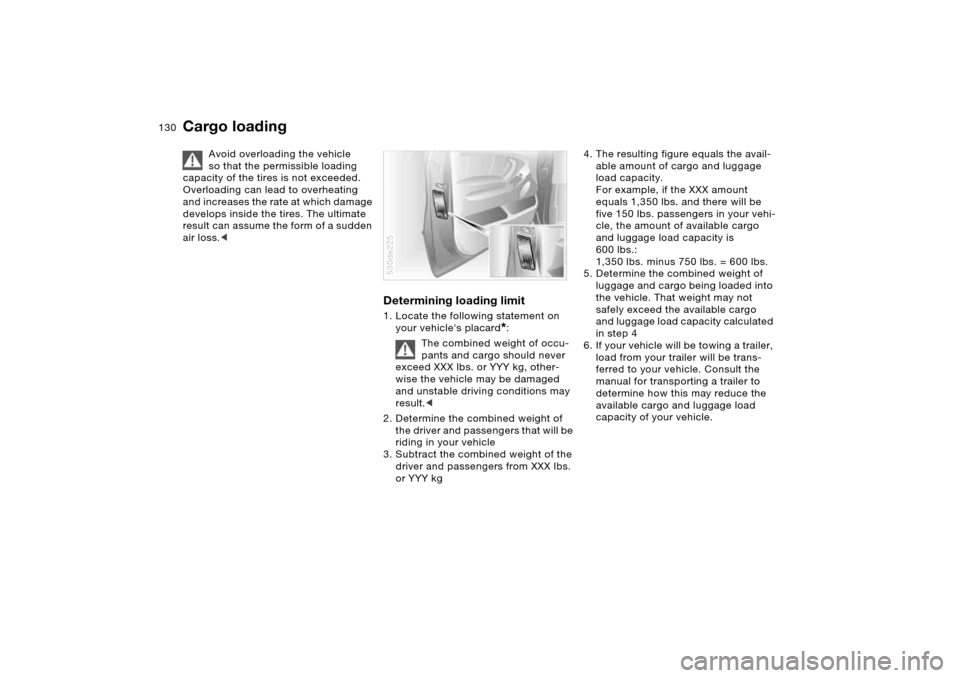
Determining loading limit1. Locate the following statement on
your vehicle's placard
*:
The combined weight of occu-
pants and cargo should never
exceed XXX lbs. or YYY kg, other-
wise the vehicle may be damaged
and unstable driving conditions may
result.<
2. Determine the combined weight of
the driver and passengers that will be
riding in your vehicle
3. Subtract the combined weight of the
driver and passengers from XXX lbs.
or YYY kg
530de225
4. The resulting figure equals the avail-
able amount of cargo and luggage
load capacity.
For example, if the XXX amount
equals 1,350 lbs. and there will be
five 150 lbs. passengers in your vehi-
cle, the amount of available cargo
and luggage load capacity is
600 lbs.:
1,350 lbs. minus 750 lbs. = 600 lbs.
5. Determine the combined weight of
luggage and cargo being loaded into
the vehicle. That weight may not
safely exceed the available cargo
and luggage load capacity calculated
in step 4
6. If your vehicle will be towing a trailer,
load from your trailer will be trans-
ferred to your vehicle. Consult the
manual for transporting a trailer to
determine how this may reduce the
available cargo and luggage load
capacity of your vehicle.
Page 131 of 202
131n
OverviewControlsMaintenanceRepairsDataIndex
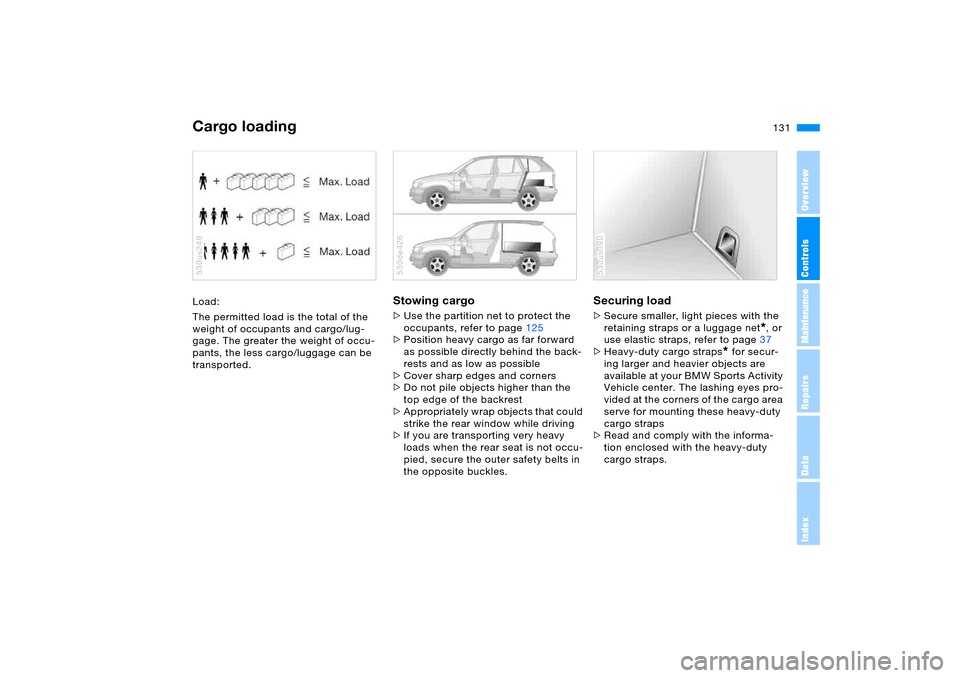
Cargo loadingLoad:
The permitted load is the total of the
weight of occupants and cargo/lug-
gage. The greater the weight of occu-
pants, the less cargo/luggage can be
transported.530us249
Stowing cargo >Use the partition net to protect the
occupants, refer to page125
>Position heavy cargo as far forward
as possible directly behind the back-
rests and as low as possible
>Cover sharp edges and corners
>Do not pile objects higher than the
top edge of the backrest
>Appropriately wrap objects that could
strike the rear window while driving
>If you are transporting very heavy
loads when the rear seat is not occu-
pied, secure the outer safety belts in
the opposite buckles. 530de426
Securing load >Secure smaller, light pieces with the
retaining straps or a luggage net
*, or
use elastic straps, refer to page37
>Heavy-duty cargo straps
* for secur-
ing larger and heavier objects are
available at your BMW Sports Activity
Vehicle center. The lashing eyes pro-
vided at the corners of the cargo area
serve for mounting these heavy-duty
cargo straps
>Read and comply with the informa-
tion enclosed with the heavy-duty
cargo straps.
530us090
Page 136 of 202
136n
Moving parts should be allowed to
break in. To ensure that your vehicle
provides maximum economy through-
out a long service life, we request that
you comply with the following instruc-
tions:
Engine and differential Obey your local and state maximum
speed limits.
Up to 1,200 miles/2,000 km:
Drive at varying engine speeds and
road speeds, but do not exceed
4,500 rpm and the following road
speeds during this initial period:
>6-cylinder engine
100 mph/160 km/h
>8-cylinder engine
106 mph/170 km/h
Avoid full-throttle operation and use of
the transmission's kick-down mode
during these initial miles.
From 1,200 miles/2,000 km:
The engine and vehicle speed can
gradually be increased.
Tires Due to technical factors associated with
their manufacture, tires do not achieve
their full traction potential until after an
initial break-in period. Therefore, drive
reservedly during the first 200 miles/
300 km.
Obey your local and state maximum
speed limits.
When the vehicle is operated on
wet or slushy roads, a wedge of
water may form between the tire and
the road surface. This phenomenon is
referred to as hydroplaning and can
lead to partial or complete loss of trac-
tion, vehicle control and braking effec-
tiveness. Reduce your speed on wet
roads.< Brake system Brakes require an initial break-in period
of approx. 300 miles/500 km to achieve
optimal contact and wear patterns
between brake pads and rotors.
To break in the separate handbrake
drums, apply the handbrake lightly
when coasting to a standstill at a traffic
signal, for instance, provided that traffic
conditions allow you to do so.
To avoid corrosion, repeat this proce-
dure from time to time.
The brake lamps do not light up
when the handbrake is applied.
Vacuum for the brake system servo unit
on your BMW is available only when the
engine is running. When you move the
vehicle with the engine switched off,
when towing, for instance, substantially
higher levels of pedal force will be
required to brake the vehicle.< ClutchThe function of the clutch is only at its
optimized level after a distance driven
of approx. 300 miles/500 km. During
this break-in period, engage the clutch
gently.Following component
replacementsObserve the break-in instructions again
if previously addressed components
must be replaced again during subse-
quent driving.
Breaking-in
Page 146 of 202
146n
Tire identification marks Wheel/tire condition Traction The traction grades, from highest to
lowest, are AA, A, B, and C.
Those grades represent the tire's ability
to stop on wet pavement as measured
under controlled conditions on speci-
fied government test surfaces of
asphalt and concrete. A tire marked C
may have poor traction performance.
The traction grade assigned to
this tire is based on straight-ahead
braking traction tests, and does not
include acceleration, cornering, hydro-
planing, or peak traction characteris-
tics.< TemperatureThe temperature grades are A, the
highest, B, and C, representing the
tire's resistance to the generation of
heat and its ability to dissipate heat
when tested under controlled condi-
tions on a specified indoor laboratory
test wheel.
Sustained high temperature can cause
the material of the tire to degenerate
and reduce tire life, and excessive tem-
perature can lead to a sudden flat tire.
The grade C corresponds to a level of
performance which all passenger car
tires must meet under the Federal
Motor Vehicle Safety Standard No. 109.
Grades B and A represent higher levels
of performance on the laboratory test
wheel than the minimum required by
law.
The temperature grade for this tire
is established for a tire that is
properly inflated and not overloaded.
Excessive speed, underinflation, or
excessive loading, either separately or
in combination, can cause heat buildup
and possible a tire failure.< M+SWinter and all-season tires.
These have better winter properties
than summer tires.
Wheel/tire damage Inspect your wheels and tires frequently
for tread wear, signs of damage and for
foreign objects lodged in the tread.
Check the tread pattern depth.
Please note that low-profile tires
make your wheels, tires and sus-
pension parts more susceptible to road
hazard and consequential damages.
Unusual vibrations encountered during
normal vehicle operation can indicate
tire failure or some other vehicle mal-
function. This can, for example, be
caused by driving over curbs. This is
also true for irregularities in the vehi-
cle's handling characteristics, such as a
pronounced tendency to pull to the left
or right. Should this occur, respond by
immediately reducing your speed.
Carefully proceed – or have your vehicle
towed – to the nearest BMW Sports
Activity Vehicle center or tire dealer to
have the wheels or tires inspected.
Tire damage, extending to sudden and
complete loss of pressure in extreme
cases, can pose a potentially lethal
safety hazard for the vehicle's occu-
pants and other road users alike.<
Page 152 of 202
152n
Washer fluid Engine oilWindshield and headlamp washer
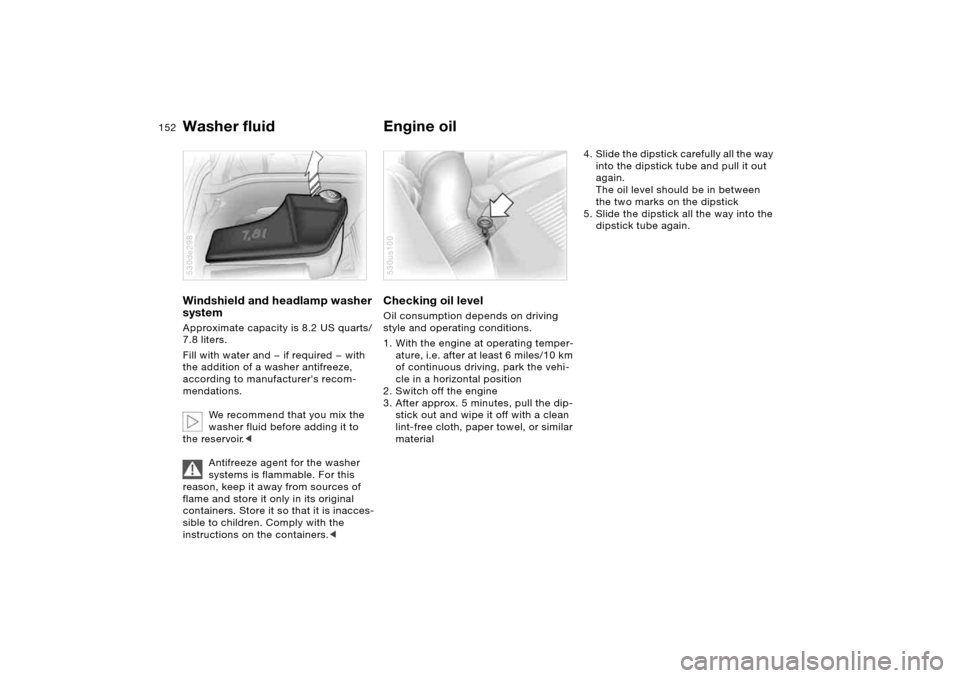
system Approximate capacity is 8.2 US quarts/
7.8 liters.
Fill with water and — if required — with
the addition of a washer antifreeze,
according to manufacturer's recom-
mendations.
We recommend that you mix the
washer fluid before adding it to
the reservoir.<
Antifreeze agent for the washer
systems is flammable. For this
reason, keep it away from sources of
flame and store it only in its original
containers. Store it so that it is inacces-
sible to children. Comply with the
instructions on the containers.< 530de298
Checking oil level Oil consumption depends on driving
style and operating conditions.
1. With the engine at operating temper-
ature, i.e. after at least 6 miles/10 km
of continuous driving, park the vehi-
cle in a horizontal position
2. Switch off the engine
3. After approx. 5 minutes, pull the dip-
stick out and wipe it off with a clean
lint-free cloth, paper towel, or similar
material 530us100
4. Slide the dipstick carefully all the way
into the dipstick tube and pull it out
again.
The oil level should be in between
the two marks on the dipstick
5. Slide the dipstick all the way into the
dipstick tube again.