wheel BMW X5 4.8IS 2006 E53 Owner's Guide
[x] Cancel search | Manufacturer: BMW, Model Year: 2006, Model line: X5 4.8IS, Model: BMW X5 4.8IS 2006 E53Pages: 202, PDF Size: 4.13 MB
Page 70 of 202
70n
Washer/wiper system/rain sensor
*
To adjust the sensitivity of the rain
sensor:
Turn the knurled wheel 7.
To deactivate the rain sensor:
Move the lever to position 0.
Deactivate the rain sensor when
passing through an automatic car
wash. Failure to do so could result in
damage caused by undesired wiper
activation.< Normal wipe The system switches automatically to
intermittent mode when the vehicle is
stationary, not on vehicles with rain
sensor. Fast wipe The wipers operate at normal speed
when the vehicle is not moving, not on
vehicles with rain sensor. Windshield washing The system sprays washer fluid against
the windshield and activates the wipers
for a brief period.
Special wash program
*
As with 5; several additional wash
cycles are carried out and the head-
lamps are cleaned
*.
This program is recommended after you
have driven on extremely dirty roads.
Headlamp washing
*
>With the special wash program 6
>At appropriate intervals, the head-
lamps will also be cleaned upon actu-
ation of the windshield washer func-
tion 5 while the vehicle's headlamps
are switched on.
Do not use the washers if there
is any danger that the fluid will
freeze on the windshield. If you do so,
your vision could be obscured. Use
antifreeze to prevent this, refer to
page152.
Do not actuate washer systems when
the fluid reservoir is empty, otherwise,
the washer pump will be damaged.<
Windshield washer nozzles The windshield washer jets are heated
automatically when the ignition key is in
position 2.
Page 71 of 202
OverviewControlsMaintenanceRepairsDataIndex
71n
Washer/wiper system/rain sensor
*
Cruise control
*
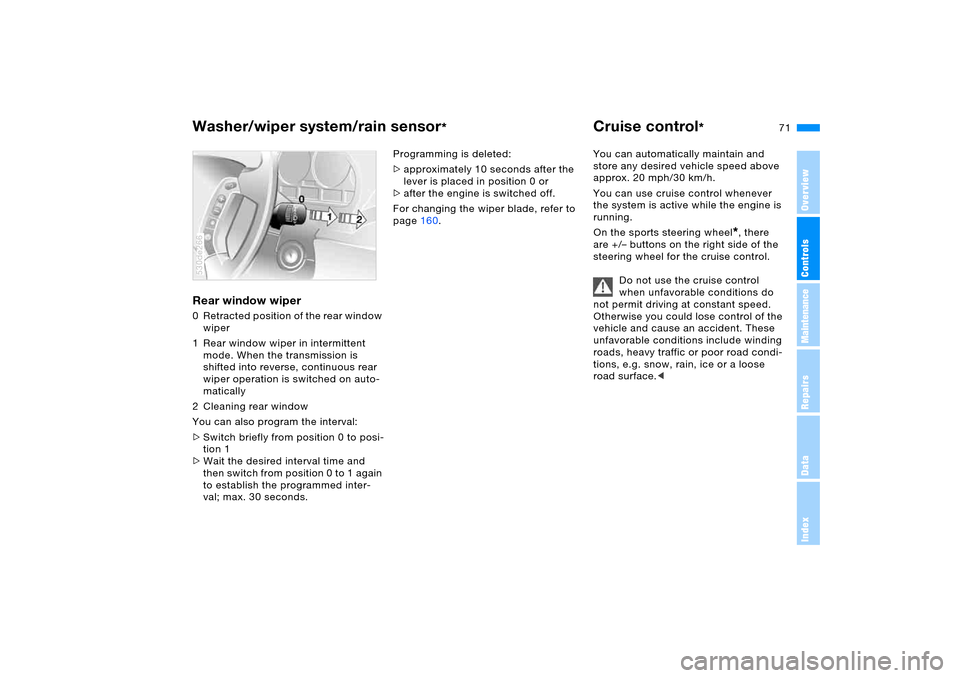
Rear window wiper 0 Retracted position of the rear window
wiper
1 Rear window wiper in intermittent
mode. When the transmission is
shifted into reverse, continuous rear
wiper operation is switched on auto-
matically
2 Cleaning rear window
You can also program the interval:
>Switch briefly from position 0 to posi-
tion 1
>Wait the desired interval time and
th en sw itc h fr om p osit ion 0 to 1 again
to establish the programmed inter-
val; max. 30 seconds. 530de266
Programming is deleted:
>approximately 10 seconds after the
lever is placed in position 0 or
>after the engine is switched off.
For changing the wiper blade, refer to
page160.You can automatically maintain and
store any desired vehicle speed above
approx. 20 mph/30 km/h.
You can use cruise control whenever
the system is active while the engine is
running.
On the sports steering wheel
*, there
are +/– buttons on the right side of the
steering wheel for the cruise control.
Do not use the cruise control
when unfavorable conditions do
not permit driving at constant speed.
Otherwise you could lose control of the
vehicle and cause an accident. These
unfavorable conditions include winding
roads, heavy traffic or poor road condi-
tions, e.g. snow, rain, ice or a loose
road surface.<
Page 78 of 202
78n
Check Control >CHECK BRAKE FLUID
Level has dropped approx. to mini-
mum. Have the brake fluid replen-
ished as soon as possible, refer to
page155. Have the reason for the
brake fluid loss eliminated by your
BMW Sports Activity Vehicle center
>DSC/4x4 INACTIVE
DSC and/or four-wheel drive system
xDrive has failed.
The stabilizing interventions of DSC
and/or the four-wheel drive system
xDrive are no longer available. Drive
may be being exerted exclusively via
the rear axle.
Have the system checked at the
nearest BMW Sports Activity Vehicle
center.
For additional information, refer to
page94
>SELFLEVEL SUSP.INACT
*
Please consult the nearest BMW
Sports Activity Vehicle center
>SELFLEVEL SUSP.INACT*
MAX. 35 MPH/MAX. 60 KM/H
*
These messages are displayed con-
secutively.
Do not exceed a maximum speed of
35 mph/60 km/h.
Please consult the nearest BMW
Sports Activity Vehicle center>TRANSMISS'N OVERHEAT
*
Reduce speed immediately and stop
at a suitable location so that the sys-
tem can cool down again. Please
contact the nearest BMW Sports
Activity Vehicle center.
>LIMIT
*
Display when the programmed road-
speed limit is exceeded, refer to
page85.
Priority 2
These displays appear for 20 seconds
as of ignition key position 2. The warn-
ing symbols remain after the message
disappears. You can open the mes-
sages again for display by pressing the
CHECK button.
>TRUNKLID OPEN
This message only appears when
starting off
>DOOR OPEN
This message appears after a minimal
defined road speed has been
exceeded
>FASTEN SEAT BELTS
*
In addition, the indicator lamp with
the belt symbol lights up and an
acoustic signal sounds
>WASHER FLUID LOW
Too low, top up at the next opportu-
nity, refer to page152>CHECK ENGINE OIL LEV
The oil level is at the absolute mini-
mum point. Therefore, have the
engine oil replenished as soon as
possible, refer to page152. Until
then, do not drive more than approx.
30 miles/50 km.
>CHECK GAS CAP
Check to see whether the fuel filler
cap has been closed properly, refer
to page25
>OUTSIDE TEMP. +237/–56
This display is only an example. The
current temperature is displayed at
outside temperatures of +37.57/
+36 and below, refer also to
page73
>CHECK BRAKE LIGHTS
A lamp has failed or the electrical
circuit has a malfunction, refer to
page163 or consult a BMW Sports
Activity Vehicle center
>CHECK LOWBEAM LIGHTS
CHECK SIDE LIGHTS
CHECK REAR LIGHTS
CHECK FRONT FOGLAMPS
CHECK LICPLATE LIGHT
CHECK HIGHBEAM LIGHT
CHECK BACK UP LIGHTS
The respective lamp may have failed
or the electrical circuit may be defec-
tive, refer to page161 or consult a
BMW Sports Activity Vehicle center
Page 91 of 202
91n
OverviewControlsMaintenanceRepairsDataIndex
PDC Park Distance Control
* Antilock Brake System
Signal tones The distance from an object is indicated
in front with a higher intermittent tone,
and at the rear with a lower intermittent
tone. As the distance between vehicle
and object decreases, the intervals
between the tones become shorter.
The signal tone becomes continuous
once the distance to the nearest object
falls to below roughly 1 ft/30 cm.
The warning signal is canceled after
approx. 3 seconds if you are moving
parallel to a wall. MalfunctionsThe LED flashes and a short steady sig-
nal tone is sounded
>if you activate PDC with the button
>when you select reverse for the first
time after switching on the ignition
>if a malfunction occurs while the PDC
system is active.
Switch the system off and have the
cause of the malfunction corrected by
your BMW Sports Activity Vehicle cen-
ter.
System limits
Even with PDC, final responsibility
for estimating the distance
between the vehicle and any obstruc-
tions always remains with the driver.
Even when sensors are involved, there
is a blind spot in which objects cannot
be detected. This applies especially in
those cases where the system
approaches the physical constraints of
ultrasonic measurement, as occurs with
tow bars and trailer couplings, and in
the vicinity of thin or wedge-shaped
objects. It is also possible that low
objects already displayed, such as curb
edges, may come into the blind spot of
the sensors before a continuous signal
sounds or that higher, protruding
objects, such as ledges, will not be
detected.
Loud sources of sound, inside and out-
side the vehicle, could drown out the
PDC signal tone.<
Keep the sensors clean and free
of ice or snow in order to ensure
that they will continue to operate effec-
tively.
When using high-pressure washers, do
not spray sensors for long periods and
keep the sprayer at least 4 in/10 cm
away from the sensors.<
The concept The ABS Antilock Brake System pre-
vents the wheel brakes from locking
during braking. Safe steering response
is maintained even during full braking.
This increases active safety.
The ABS is operational every time you
start the engine. Safe braking, refer to
page 140.EBV Electronic brake-force
distribution EBV controls the brake system's appli-
cation pressure at the rear wheels to
ensure stable deceleration.DBC Dynamic Brake Control When the brake pedal is depressed
rapidly, this system automatically gen-
erates a maximum boost of braking
force and thus aids in keeping braking
distances as short as possible during
full braking. This system exploits all of
the benefits provided by ABS.
Do not reduce the pressure on the
brake pedal for the duration of the
brake application. DBC is deactivated
when you release the brake pedal.
Page 92 of 202
92n
Antilock Brake System DSC Dynamic Stability Control MalfunctionsPlease be absolutely sure to follow
instructions regarding possible combi-
nations of indicator lights on page 20.
The concept DSC prevents the drive wheels from
slipping when starting off and acceler-
ating. DSC also identifies unstable driv-
ing conditions, such as a loss of trac-
tion at the rear of the vehicle or sliding
of the vehicle in its front wheels. Under
these circumstances, DSC helps the
vehicle maintain a safe course within
the physical limits by reducing the
engine output and by applying the
brakes in the individual wheels.
The DSC is operational every time you
start the engine.
The laws of physics cannot be
repealed, even with DSC. An
appropriate driving style always
remains the responsibility of the driver.
So please do not further limit the addi-
tional safety margin by taking unneces-
sary risks.<
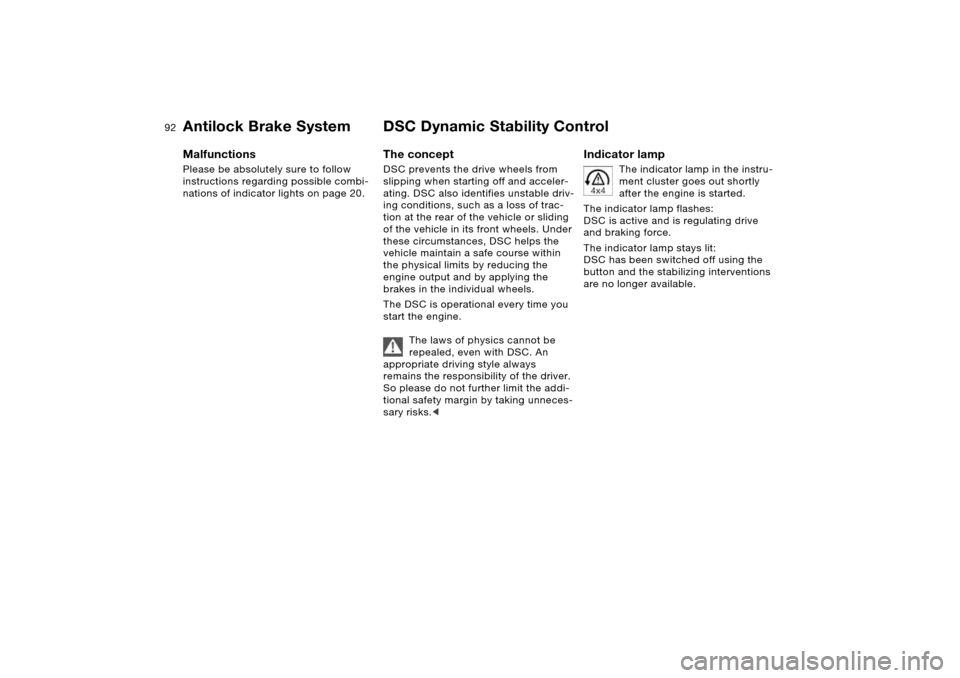
Indicator lamp
The indicator lamp in the instru-
ment cluster goes out shortly
after the engine is started.
The indicator lamp flashes:
DSC is active and is regulating drive
and braking force.
The indicator lamp stays lit:
DSC has been switched off using the
button and the stabilizing interventions
are no longer available.
Page 93 of 202
93n
OverviewControlsMaintenanceRepairsDataIndex
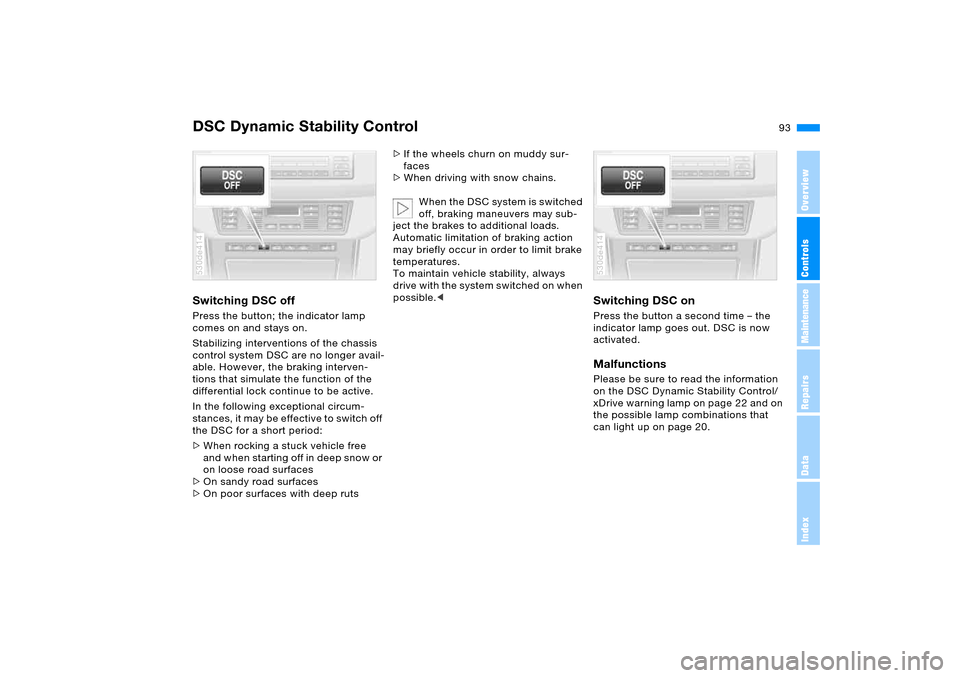
DSC Dynamic Stability ControlSwitching DSC offPress the button; the indicator lamp
comes on and stays on.
Stabilizing interventions of the chassis
control system DSC are no longer avail-
able. However, the braking interven-
tions that simulate the function of the
differential lock continue to be active.
In the following exceptional circum-
stances, it may be effective to switch off
the DSC for a short period:
>When rocking a stuck vehicle free
and when starting off in deep snow or
on loose road surfaces
>On sandy road surfaces
>On poor surfaces with deep ruts 530de414
>If the wheels churn on muddy sur-
faces
>When driving with snow chains.
When the DSC system is switched
off, braking maneuvers may sub-
ject the brakes to additional loads.
Automatic limitation of braking action
may briefly occur in order to limit brake
temperatures.
To maintain vehicle stability, always
drive with the system switched on when
possible.<
Switching DSC on Press the button a second time – the
indicator lamp goes out. DSC is now
activated.MalfunctionsPlease be sure to read the information
on the DSC Dynamic Stability Control/
xDrive warning lamp on page 22 and on
the possible lamp combinations that
can light up on page 20.530de414
Page 94 of 202
94n
xDrive HDC Hill Descent Control xDrive is the 4-wheel drive system of
your X5. The combined effects of xDrive
and DSC further optimize the traction
and dynamic driving characteristics.
The 4-wheel drive system xDrive vari-
ably distributes the drive torque to the
front and rear axle depending on the
driving situation and prevailing road
conditions.MalfunctionsPlease be sure to read the information
on the DSC Dynamic Stability Control/
xDrive warning lamp on page 22 and on
the possible lamp combinations that
can light up on page 20.
The concept HDC is a system for driving downhill in
steep terrain. This system reduces vehi-
cle speed on steep downhill gradients,
thus allowing you to maintain even bet-
ter control of your BMW under these
conditions.
The vehicle moves at slightly more than
walking speed without active interven-
tion from the driver.
HDC is available for activation at vehi-
cle speeds below approx. 20 mph/
35 km/h. When driving down steep hills
with a speed below approx. 20 mph/
35 km/h, the vehicle reduces speed
automatically down to slightly more
than walking speed, approx. 5 mph/
8 km/h, and then maintains this speed
at a constant.
You can use the accelerator or brakes
to vary this automatically controlled
speed within a range extending from
approx. 3 mph/5 km/h to 15 mph/
25 km/h.
You can specify a target speed within
the same range by using the +/– but-
tons of the cruise control.
HDC is automatically deactivated once
vehicle speed again exceeds approx.
35 mph/60 km/h.
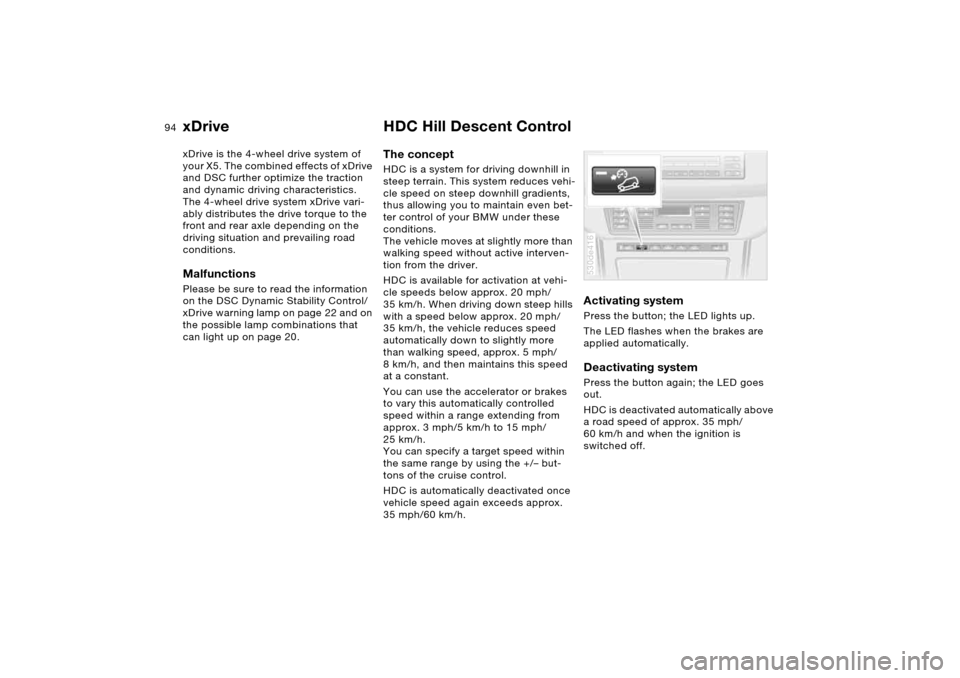
Activating system Press the button; the LED lights up.
The LED flashes when the brakes are
applied automatically. Deactivating system Press the button again; the LED goes
out.
HDC is deactivated automatically above
a road speed of approx. 35 mph/
60 km/h and when the ignition is
switched off. 530de416
Page 98 of 202
98n
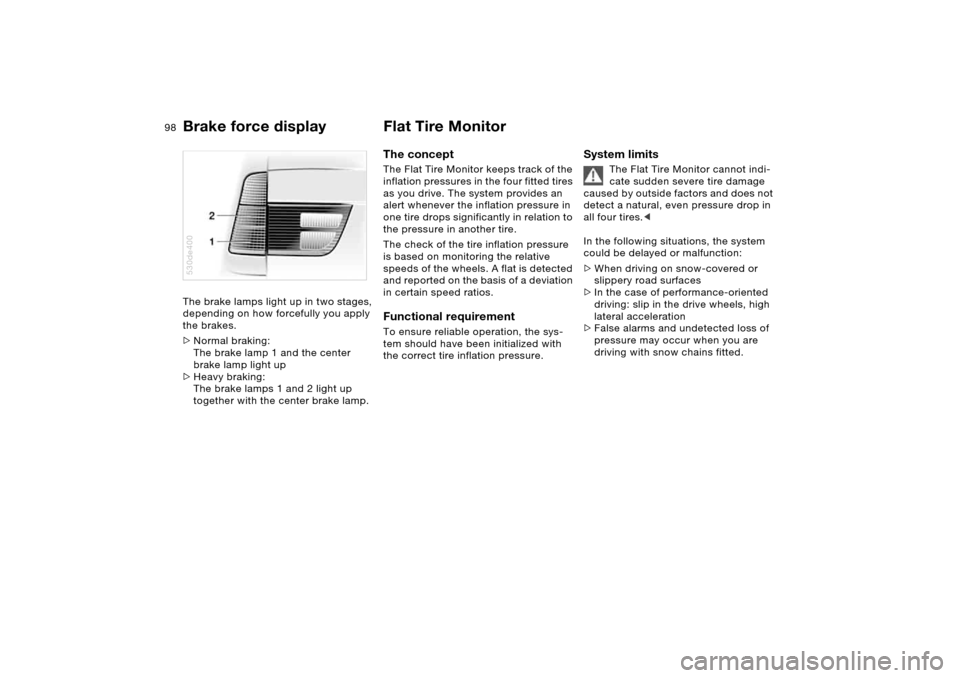
Brake force display Flat Tire MonitorThe brake lamps light up in two stages,
depending on how forcefully you apply
the brakes.
>Normal braking:
The brake lamp 1 and the center
brake lamp light up
>Heavy braking:
The brake lamps 1 and 2 light up
together with the center brake lamp.530de400
The concept The Flat Tire Monitor keeps track of the
inflation pressures in the four fitted tires
as you drive. The system provides an
alert whenever the inflation pressure in
one tire drops significantly in relation to
the pressure in another tire.
The check of the tire inflation pressure
is based on monitoring the relative
speeds of the wheels. A flat is detected
and reported on the basis of a deviation
in certain speed ratios.Functional requirementTo ensure reliable operation, the sys-
tem should have been initialized with
the correct tire inflation pressure.
System limits
The Flat Tire Monitor cannot indi-
cate sudden severe tire damage
caused by outside factors and does not
detect a natural, even pressure drop in
all four tires.<
In the following situations, the system
could be delayed or malfunction:
>When driving on snow-covered or
slippery road surfaces
>In the case of performance-oriented
driving: slip in the drive wheels, high
lateral acceleration
>False alarms and undetected loss of
pressure may occur when you are
driving with snow chains fitted.
Page 99 of 202
99n
OverviewControlsMaintenanceRepairsDataIndex
Flat Tire MonitorInitializing system
Perform the initialization immedi-
ately every time you correct the
inflation pressure, change a tire or
change a wheel or all wheels. The vehi-
cle must be driven during initialization.<
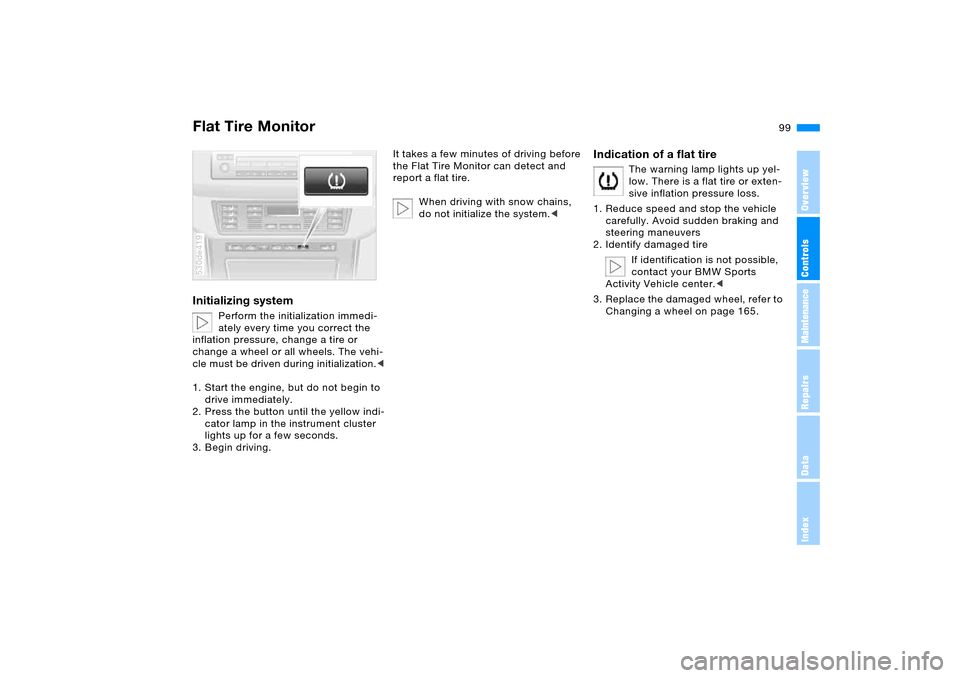
1. Start the engine, but do not begin to
drive immediately.
2. Press the button until the yellow indi-
cator lamp in the instrument cluster
lights up for a few seconds.
3. Begin driving.
530de419
It takes a few minutes of driving before
the Flat Tire Monitor can detect and
report a flat tire.
When driving with snow chains,
do not initialize the system.<
Indication of a flat tire
The warning lamp lights up yel-
low. There is a flat tire or exten-
sive inflation pressure loss.
1. Reduce speed and stop the vehicle
carefully. Avoid sudden braking and
steering maneuvers
2. Identify damaged tire
If identification is not possible,
contact your BMW Sports
Activity Vehicle center.<
3. Replace the damaged wheel, refer to
Changing a wheel on page 165.
Page 102 of 202
102n
Front fog lamps
Instrument lighting
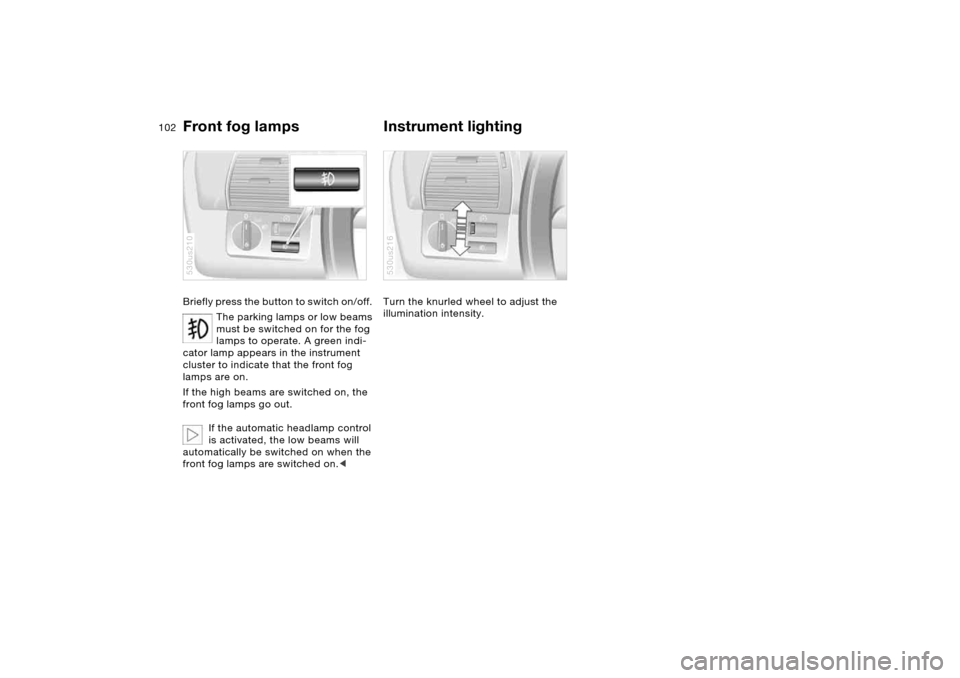
Briefly press the button to switch on/off.
The parking lamps or low beams
must be switched on for the fog
lamps to operate. A green indi-
cator lamp appears in the instrument
cluster to indicate that the front fog
lamps are on.
If the high beams are switched on, the
front fog lamps go out.
If the automatic headlamp control
is activated, the low beams will
automatically be switched on when the
front fog lamps are switched on.<530us210
Turn the knurled wheel to adjust the
illumination intensity.530us216