wheel BMW X5 SDRIVE35I 2014 Repair Manual
[x] Cancel search | Manufacturer: BMW, Model Year: 2014, Model line: X5 SDRIVE35I, Model: BMW X5 SDRIVE35I 2014Pages: 265, PDF Size: 6.2 MB
Page 170 of 265
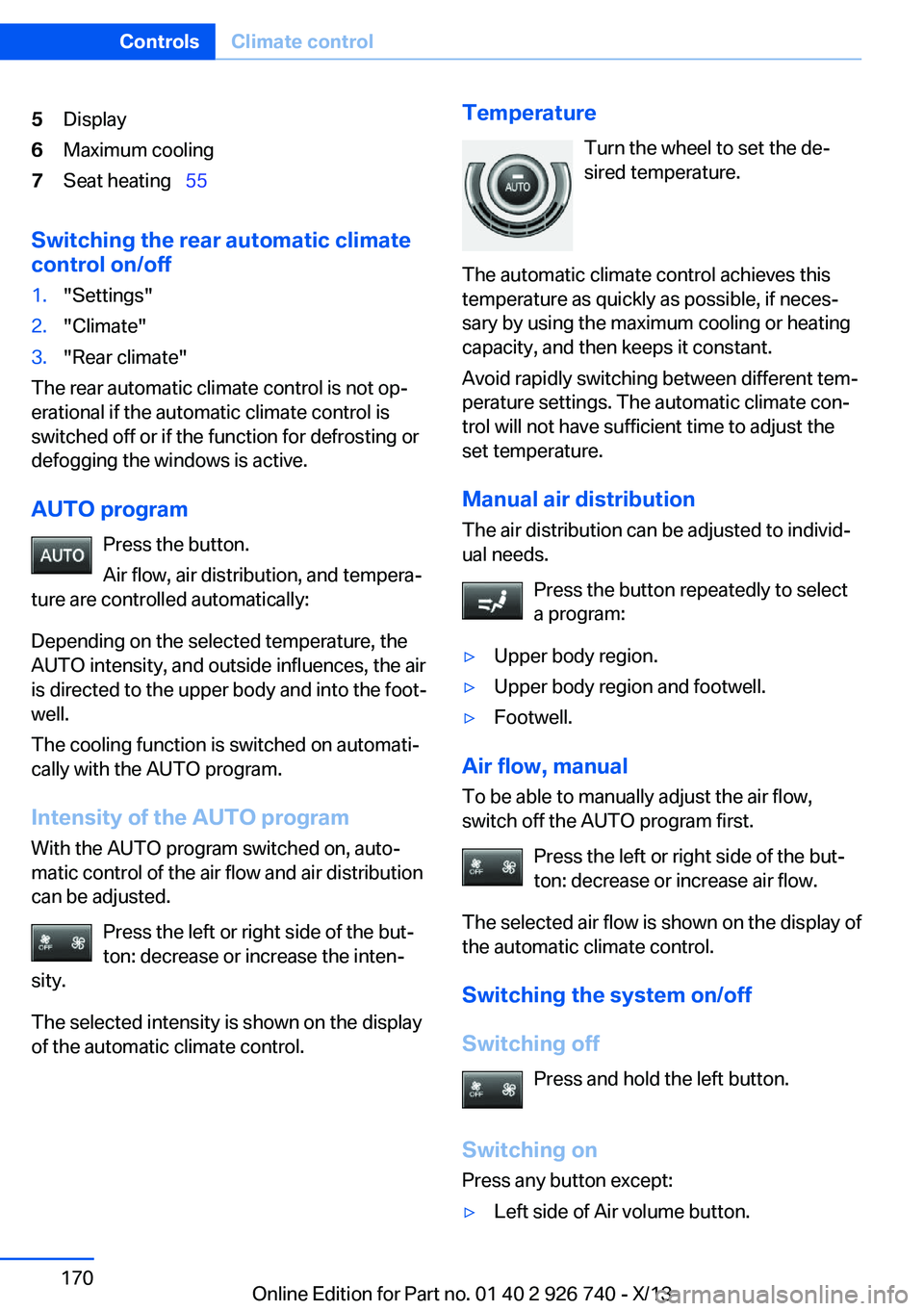
5Display6Maximum cooling7Seat heating 55
Switching the rear automatic climate
control on/off
1."Settings"2."Climate"3."Rear climate"
The rear automatic climate control is not op‐
erational if the automatic climate control is
switched off or if the function for defrosting or
defogging the windows is active.
AUTO program Press the button.
Air flow, air distribution, and tempera‐
ture are controlled automatically:
Depending on the selected temperature, the
AUTO intensity, and outside influences, the air
is directed to the upper body and into the foot‐
well.
The cooling function is switched on automati‐
cally with the AUTO program.
Intensity of the AUTO program With the AUTO program switched on, auto‐
matic control of the air flow and air distribution
can be adjusted.
Press the left or right side of the but‐
ton: decrease or increase the inten‐
sity.
The selected intensity is shown on the display
of the automatic climate control.
Temperature
Turn the wheel to set the de‐
sired temperature.
The automatic climate control achieves this
temperature as quickly as possible, if neces‐
sary by using the maximum cooling or heating
capacity, and then keeps it constant.
Avoid rapidly switching between different tem‐
perature settings. The automatic climate con‐
trol will not have sufficient time to adjust the
set temperature.
Manual air distribution
The air distribution can be adjusted to individ‐
ual needs.
Press the button repeatedly to select
a program:▷Upper body region.▷Upper body region and footwell.▷Footwell.
Air flow, manual
To be able to manually adjust the air flow,
switch off the AUTO program first.
Press the left or right side of the but‐
ton: decrease or increase air flow.
The selected air flow is shown on the display of
the automatic climate control.
Switching the system on/off
Switching off Press and hold the left button.
Switching on Press any button except:
▷Left side of Air volume button.Seite 170ControlsClimate control170
Online Edition for Part no. 01 40 2 926 740 - X/13
Page 193 of 265
Driving on poor roads
The vehicle connects four wheel drive to the
advantages of a normal truck
Do not drive on unpaved terrain
Do not drive on unpaved terrain; other‐
wise, the vehicle may be damaged.◀
For your own safety, for the safety of passen‐
gers and of the vehicle, heed the following
points:▷Become familiar with the vehicle before
starting a trip; do not take risks in driving.▷Adjust the speed to the road surface con‐
ditions. The steeper and more uneven the
road surface, the slower the speed should
be.▷When driving on steep uphill or downhill
grades: add engine oil and coolant up to
near the MAX mark. Uphill and downhill
grades can be traveled up to no more than
50 %.▷On steep downhill grades, use Hill Descent
Control HDC, refer to page 133.
Starting out is possible on uphill grades up
to 33 %. The permissible side tilt is 50 %.▷Avoid contact of the bottom of the body
with the ground.
The ground clearance is no more than 7.8
inches/20 cm and can vary according to
the loading condition.▷When wheels continue to turn, depress the
accelerator so that driving stability control
systems can distribute the driving force to
the wheels. Activate DTC Dynamic Trac‐
tion Control if available.
After a trip on poor roads
After a trip on poor roads, check wheels and
tires for damage to maintain driving safety.
Clear heavy soiling from the body.
Seite 193Things to remember when drivingDriving tips193
Online Edition for Part no. 01 40 2 926 740 - X/13
Page 203 of 265
Mobility
In order to always ensure your mobility, you will find important information on operating fluids,wheels and tires, maintenance and Roadside Assistance in the following.Online Edition for Part no. 01 40 2 926 740 - X/13
Page 211 of 265
Wheels and tiresVehicle equipment
All standard, country-specific and optional
equipment that is offered in the model series is
described in this chapter. Therefore, equip‐
ment is also described that is not available in a
vehicle, e. g., because of the selected optional
equipment or country variant. This also applies
for safety-related functions and systems.
Tire inflation pressure Safety information
The tire characteristics and tire inflation pres‐
sure influence the following:▷The service life of the tires.▷Road safety.▷Driving comfort.
Checking the pressure
Tires have a natural, consistent loss of pres‐
sure.
Check the tire inflation pressure regularly
Regularly check the tire inflation pres‐
sure, and correct it as needed: at least twice a
month and before a long trip. If you fail to ob‐
serve this precaution, you may be driving on
tires with incorrect tire pressures, a condition
that may not only compromise your vehicle's
driving stability, but also lead to tire damage
and the risk of an accident.◀
Tires heat up during driving, and the tire infla‐
tion pressure increases along with the temper‐
ature of the tire. The tire inflation pressure
specifications relate to cold tires or tires with
the ambient temperature.
Only check the tire inflation pressure when the
tires are cold. This means after driving no more
than 1.25 miles/2 km or when the vehicle has
been parked for at least 2 hours.
After correcting the tire inflation pressure:▷Reinitialize the Flat Tire Monitor.▷Reinitialize the Tire Pressure Monitor.
Pressure specifications The tire inflation pressure table, refer to
page 212, contains all pressure specifications
for the specified tire sizes at the ambient tem‐
perature. Pressure specifications apply to ap‐
proved tire sizes and recommended tire
brands. This information can be obtained from
your service center.
To identify the correct tire inflation pressure,
please note the following:
▷Tire sizes of your vehicle.▷Maximum permitted driving speed.
Tire inflation pressures up to
100 mph/160 km/h
For speeds of up to 100 mph/160 km/h and for
optimum driving comfort, note the pressure
values in the tire inflation pressure table, refer
to page 212, and adjust as necessary.
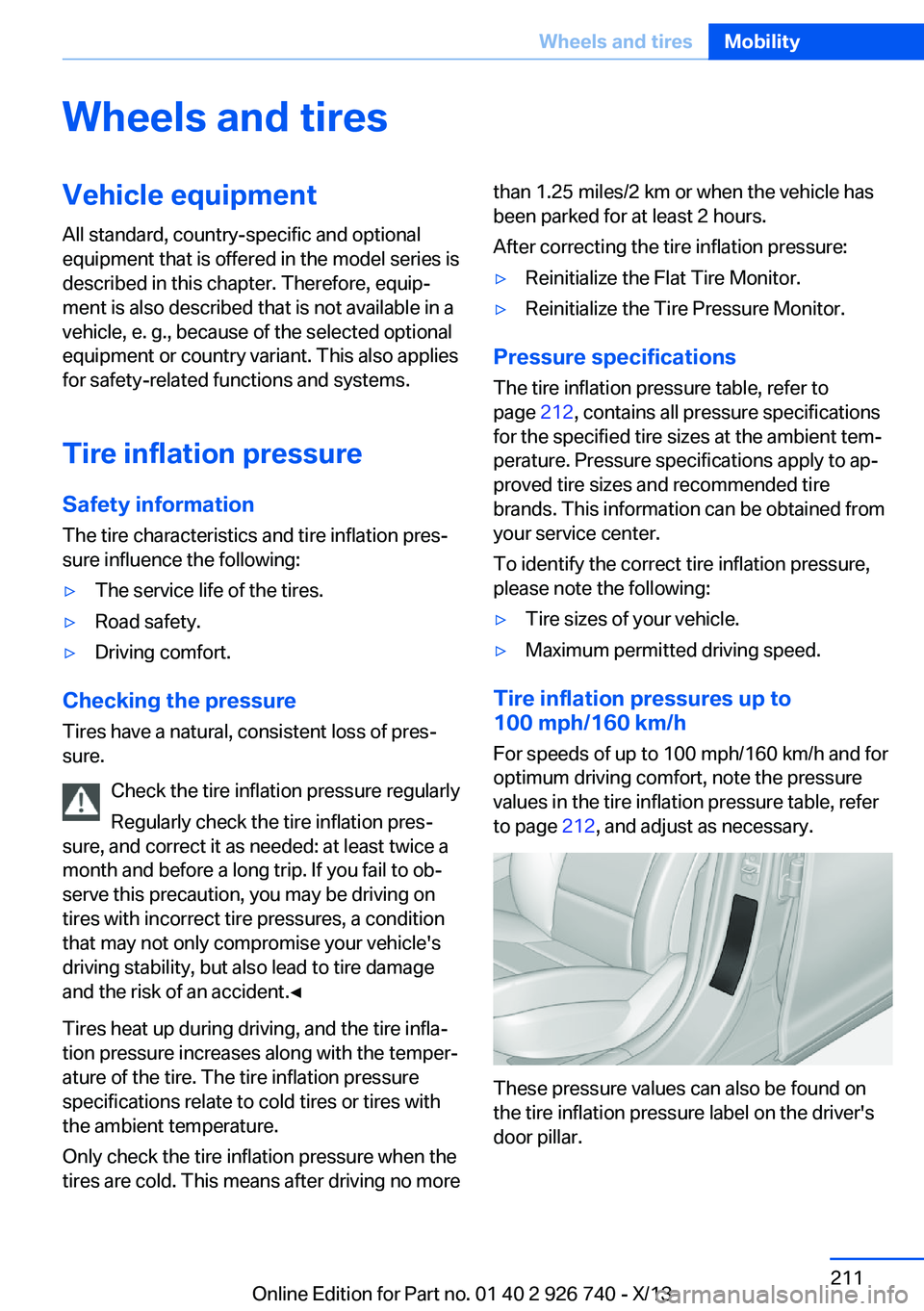
These pressure values can also be found on
the tire inflation pressure label on the driver's
door pillar.
Seite 211Wheels and tiresMobility211
Online Edition for Part no. 01 40 2 926 740 - X/13
Page 212 of 265
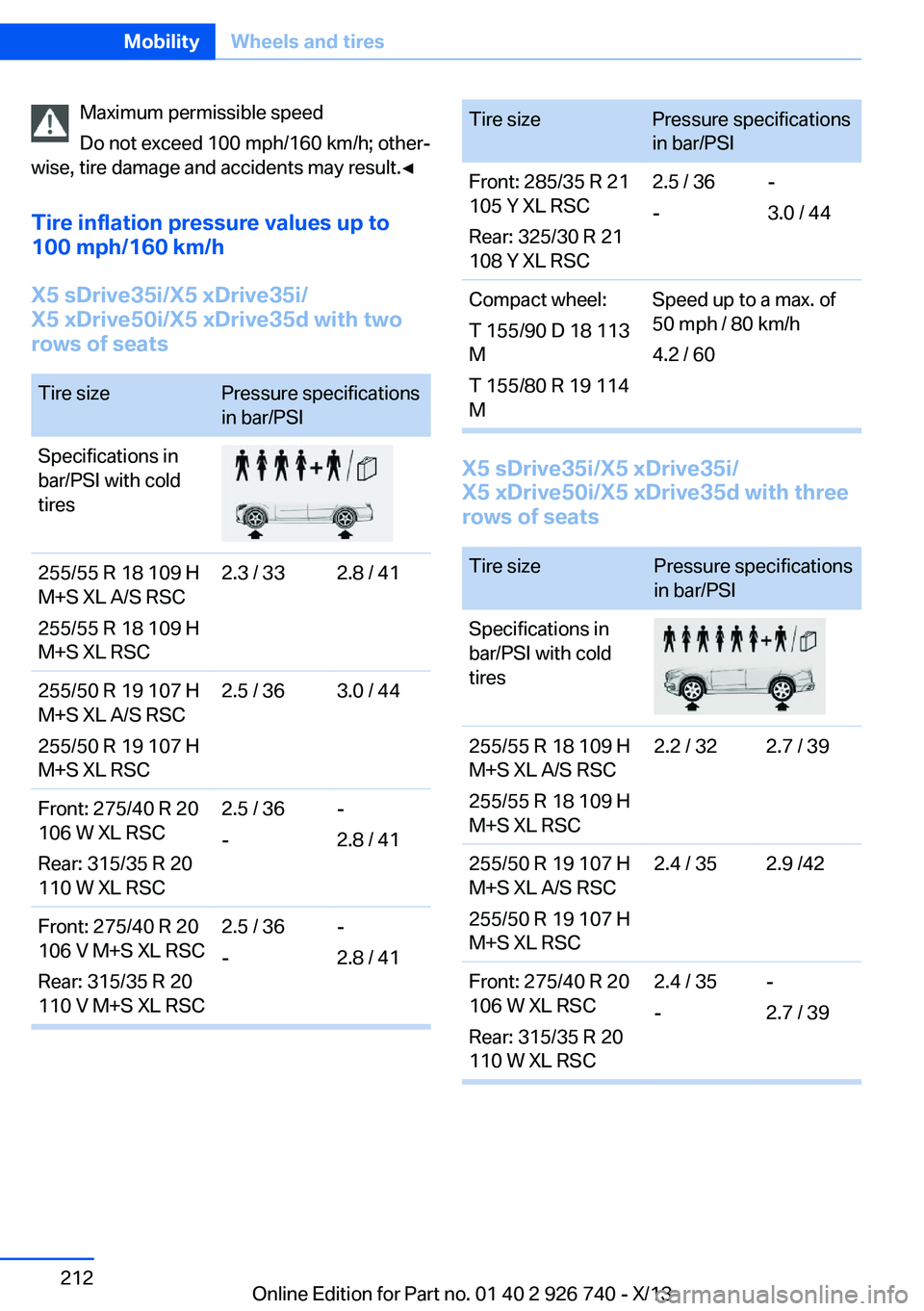
Maximum permissible speed
Do not exceed 100 mph/160 km/h; other‐
wise, tire damage and accidents may result.◀
Tire inflation pressure values up to
100 mph/160 km/h
X5 sDrive35i/X5 xDrive35i/
X5 xDrive50i/X5 xDrive35d with two
rows of seatsTire sizePressure specifications
in bar/PSISpecifications in
bar/PSI with cold
tires255/55 R 18 109 H
M+S XL A/S RSC
255/55 R 18 109 H
M+S XL RSC2.3 / 332.8 / 41255/50 R 19 107 H
M+S XL A/S RSC
255/50 R 19 107 H
M+S XL RSC2.5 / 363.0 / 44Front: 275/40 R 20
106 W XL RSC
Rear: 315/35 R 20
110 W XL RSC2.5 / 36
--
2.8 / 41Front: 275/40 R 20
106 V M+S XL RSC
Rear: 315/35 R 20
110 V M+S XL RSC2.5 / 36
--
2.8 / 41Tire sizePressure specifications
in bar/PSIFront: 285/35 R 21
105 Y XL RSC
Rear: 325/30 R 21
108 Y XL RSC2.5 / 36
--
3.0 / 44Compact wheel:
T 155/90 D 18 113
M
T 155/80 R 19 114
MSpeed up to a max. of
50 mph / 80 km/h
4.2 / 60
X5 sDrive35i/X5 xDrive35i/
X5 xDrive50i/X5 xDrive35d with three
rows of seats
Tire sizePressure specifications
in bar/PSISpecifications in
bar/PSI with cold
tires255/55 R 18 109 H
M+S XL A/S RSC
255/55 R 18 109 H
M+S XL RSC2.2 / 322.7 / 39255/50 R 19 107 H
M+S XL A/S RSC
255/50 R 19 107 H
M+S XL RSC2.4 / 352.9 /42Front: 275/40 R 20
106 W XL RSC
Rear: 315/35 R 20
110 W XL RSC2.4 / 35
--
2.7 / 39Seite 212MobilityWheels and tires212
Online Edition for Part no. 01 40 2 926 740 - X/13
Page 213 of 265
Tire sizePressure specifications
in bar/PSIFront: 275/40 R 20
106 V M+S XL RSC
Rear: 315/35 R 20
110 V M+S XL RSC2.4 / 35
--
2.7 / 39Front: 285/35 R 21
105 Y XL RSC
Rear: 325/30 R 21
108 Y XL RSC2.4 / 35
--
2.9 /42
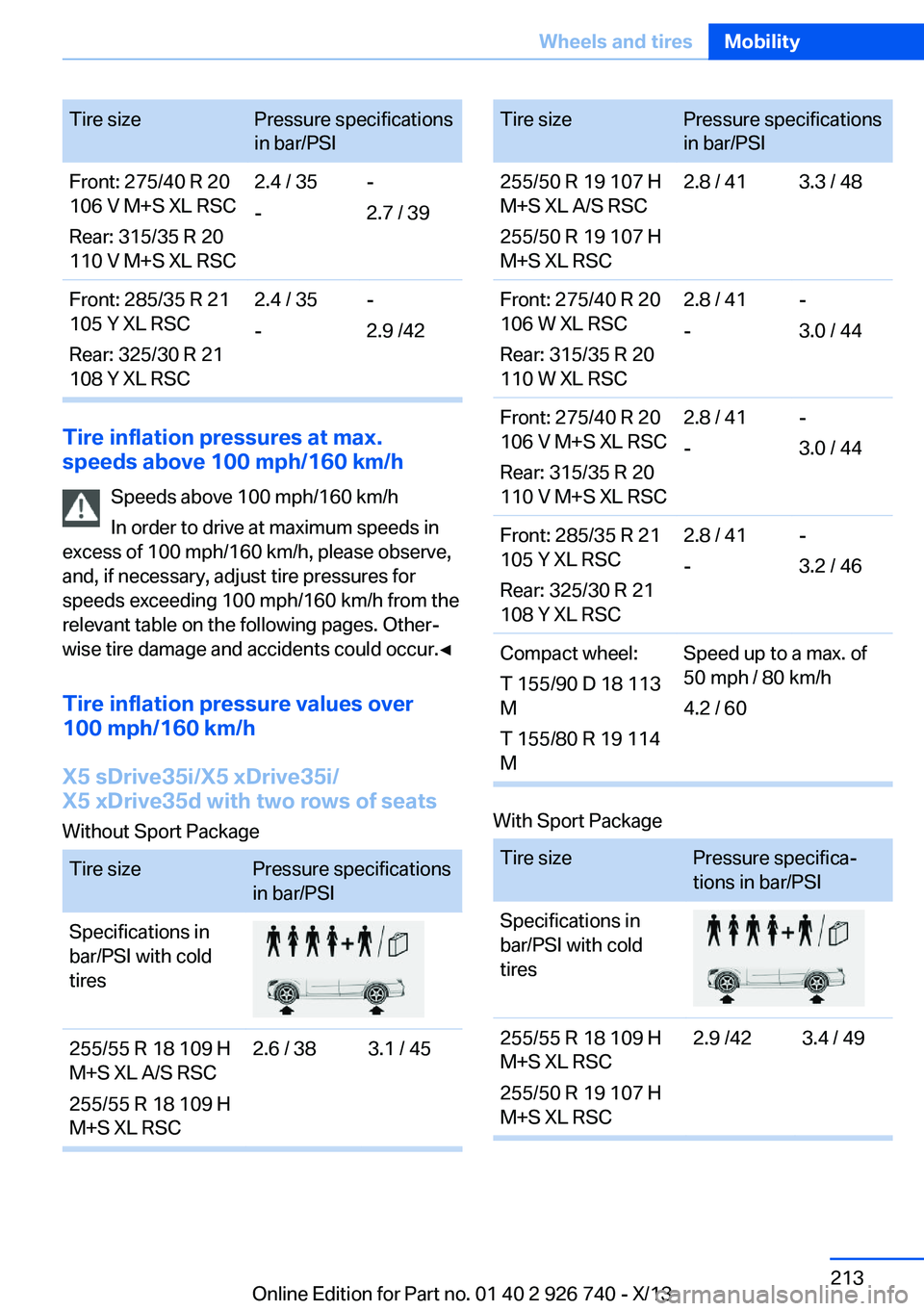
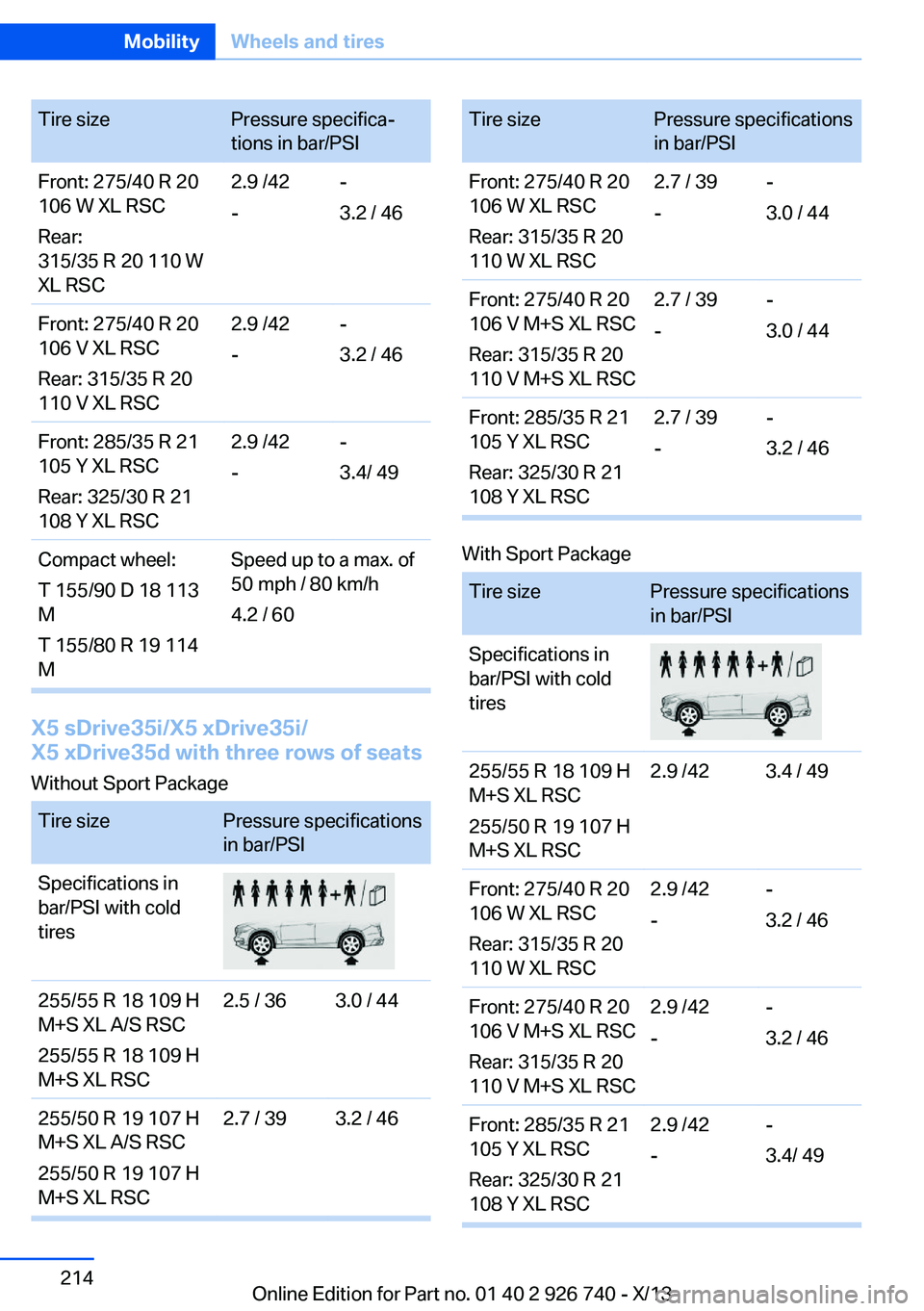
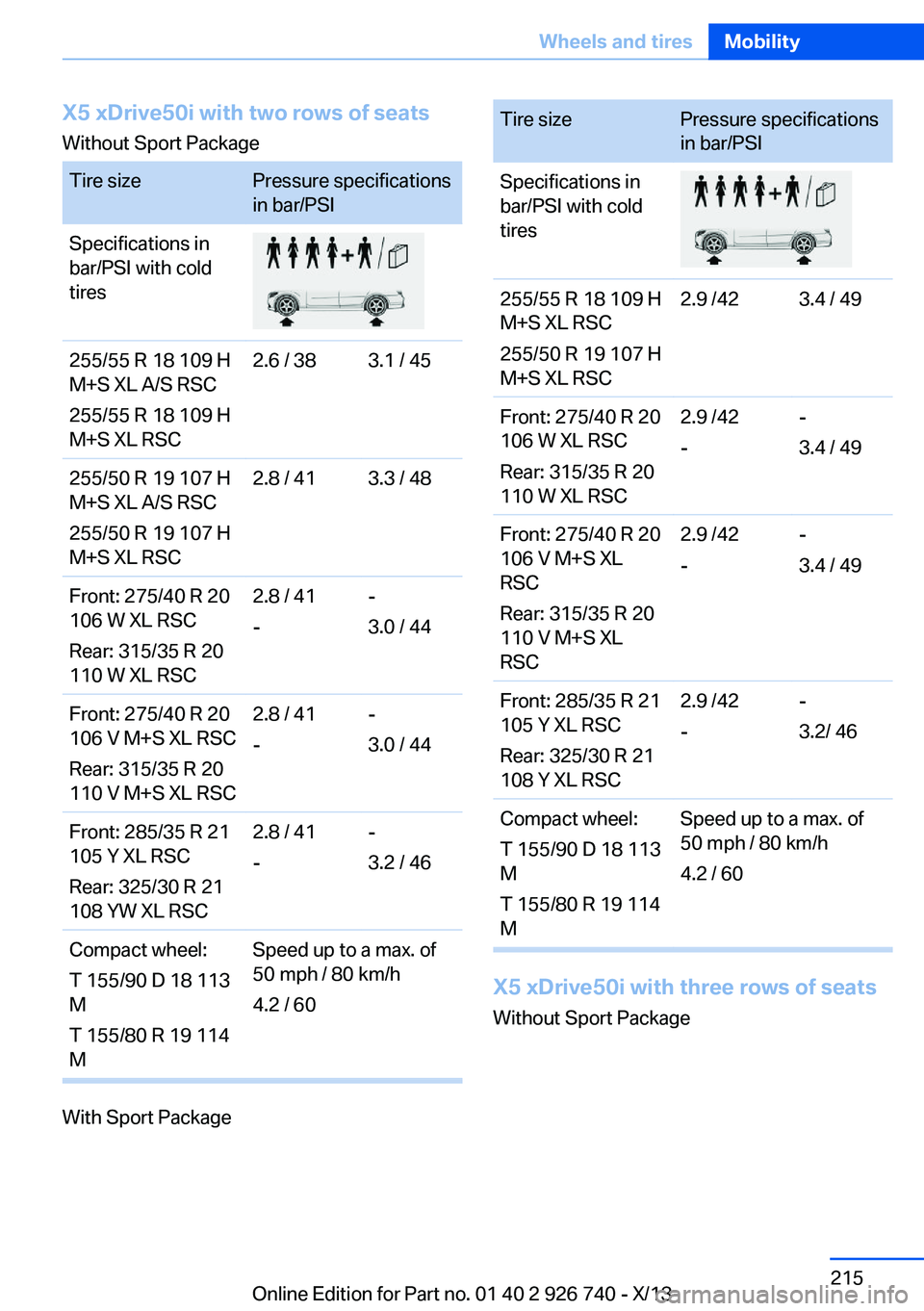
Tire inflation pressures at max.
speeds above 100 mph/160 km/h
Speeds above 100 mph/160 km/h
In order to drive at maximum speeds in
excess of 100 mph/160 km/h, please observe,
and, if necessary, adjust tire pressures for
speeds exceeding 100 mph/160 km/h from the
relevant table on the following pages. Other‐
wise tire damage and accidents could occur.◀
Tire inflation pressure values over
100 mph/160 km/h
X5 sDrive35i/X5 xDrive35i/
X5 xDrive35d with two rows of seats
Without Sport Package
Tire sizePressure specifications
in bar/PSISpecifications in
bar/PSI with cold
tires255/55 R 18 109 H
M+S XL A/S RSC
255/55 R 18 109 H
M+S XL RSC2.6 / 383.1 / 45Tire sizePressure specifications
in bar/PSI255/50 R 19 107 H
M+S XL A/S RSC
255/50 R 19 107 H
M+S XL RSC2.8 / 413.3 / 48Front: 275/40 R 20
106 W XL RSC
Rear: 315/35 R 20
110 W XL RSC2.8 / 41
--
3.0 / 44Front: 275/40 R 20
106 V M+S XL RSC
Rear: 315/35 R 20
110 V M+S XL RSC2.8 / 41
--
3.0 / 44Front: 285/35 R 21
105 Y XL RSC
Rear: 325/30 R 21
108 Y XL RSC2.8 / 41
--
3.2 / 46Compact wheel:
T 155/90 D 18 113
M
T 155/80 R 19 114
MSpeed up to a max. of
50 mph / 80 km/h
4.2 / 60
With Sport Package
Tire sizePressure specifica‐
tions in bar/PSISpecifications in
bar/PSI with cold
tires255/55 R 18 109 H
M+S XL RSC
255/50 R 19 107 H
M+S XL RSC2.9 /423.4 / 49Seite 213Wheels and tiresMobility213
Online Edition for Part no. 01 40 2 926 740 - X/13
Page 214 of 265
Tire sizePressure specifica‐
tions in bar/PSIFront: 275/40 R 20
106 W XL RSC
Rear:
315/35 R 20 110 W
XL RSC2.9 /42
--
3.2 / 46Front: 275/40 R 20
106 V XL RSC
Rear: 315/35 R 20
110 V XL RSC2.9 /42
--
3.2 / 46Front: 285/35 R 21
105 Y XL RSC
Rear: 325/30 R 21
108 Y XL RSC2.9 /42
--
3.4/ 49Compact wheel:
T 155/90 D 18 113
M
T 155/80 R 19 114
MSpeed up to a max. of
50 mph / 80 km/h
4.2 / 60
X5 sDrive35i/X5 xDrive35i/
X5 xDrive35d with three rows of seats
Without Sport Package
Tire sizePressure specifications
in bar/PSISpecifications in
bar/PSI with cold
tires255/55 R 18 109 H
M+S XL A/S RSC
255/55 R 18 109 H
M+S XL RSC2.5 / 363.0 / 44255/50 R 19 107 H
M+S XL A/S RSC
255/50 R 19 107 H
M+S XL RSC2.7 / 393.2 / 46Tire sizePressure specifications
in bar/PSIFront: 275/40 R 20
106 W XL RSC
Rear: 315/35 R 20
110 W XL RSC2.7 / 39
--
3.0 / 44Front: 275/40 R 20
106 V M+S XL RSC
Rear: 315/35 R 20
110 V M+S XL RSC2.7 / 39
--
3.0 / 44Front: 285/35 R 21
105 Y XL RSC
Rear: 325/30 R 21
108 Y XL RSC2.7 / 39
--
3.2 / 46
With Sport Package
Tire sizePressure specifications
in bar/PSISpecifications in
bar/PSI with cold
tires255/55 R 18 109 H
M+S XL RSC
255/50 R 19 107 H
M+S XL RSC2.9 /423.4 / 49Front: 275/40 R 20
106 W XL RSC
Rear: 315/35 R 20
110 W XL RSC2.9 /42
--
3.2 / 46Front: 275/40 R 20
106 V M+S XL RSC
Rear: 315/35 R 20
110 V M+S XL RSC2.9 /42
--
3.2 / 46Front: 285/35 R 21
105 Y XL RSC
Rear: 325/30 R 21
108 Y XL RSC2.9 /42
--
3.4/ 49Seite 214MobilityWheels and tires214
Online Edition for Part no. 01 40 2 926 740 - X/13
Page 215 of 265
X5 xDrive50i with two rows of seatsWithout Sport PackageTire sizePressure specifications
in bar/PSISpecifications in
bar/PSI with cold
tires255/55 R 18 109 H
M+S XL A/S RSC
255/55 R 18 109 H
M+S XL RSC2.6 / 383.1 / 45255/50 R 19 107 H
M+S XL A/S RSC
255/50 R 19 107 H
M+S XL RSC2.8 / 413.3 / 48Front: 275/40 R 20
106 W XL RSC
Rear: 315/35 R 20
110 W XL RSC2.8 / 41
--
3.0 / 44Front: 275/40 R 20
106 V M+S XL RSC
Rear: 315/35 R 20
110 V M+S XL RSC2.8 / 41
--
3.0 / 44Front: 285/35 R 21
105 Y XL RSC
Rear: 325/30 R 21
108 YW XL RSC2.8 / 41
--
3.2 / 46Compact wheel:
T 155/90 D 18 113
M
T 155/80 R 19 114
MSpeed up to a max. of
50 mph / 80 km/h
4.2 / 60
With Sport Package
Tire sizePressure specifications
in bar/PSISpecifications in
bar/PSI with cold
tires255/55 R 18 109 H
M+S XL RSC
255/50 R 19 107 H
M+S XL RSC2.9 /423.4 / 49Front: 275/40 R 20
106 W XL RSC
Rear: 315/35 R 20
110 W XL RSC2.9 /42
--
3.4 / 49Front: 275/40 R 20
106 V M+S XL
RSC
Rear: 315/35 R 20
110 V M+S XL
RSC2.9 /42
--
3.4 / 49Front: 285/35 R 21
105 Y XL RSC
Rear: 325/30 R 21
108 Y XL RSC2.9 /42
--
3.2/ 46Compact wheel:
T 155/90 D 18 113
M
T 155/80 R 19 114
MSpeed up to a max. of
50 mph / 80 km/h
4.2 / 60
X5 xDrive50i with three rows of seats
Without Sport Package
Seite 215Wheels and tiresMobility215
Online Edition for Part no. 01 40 2 926 740 - X/13
Page 216 of 265
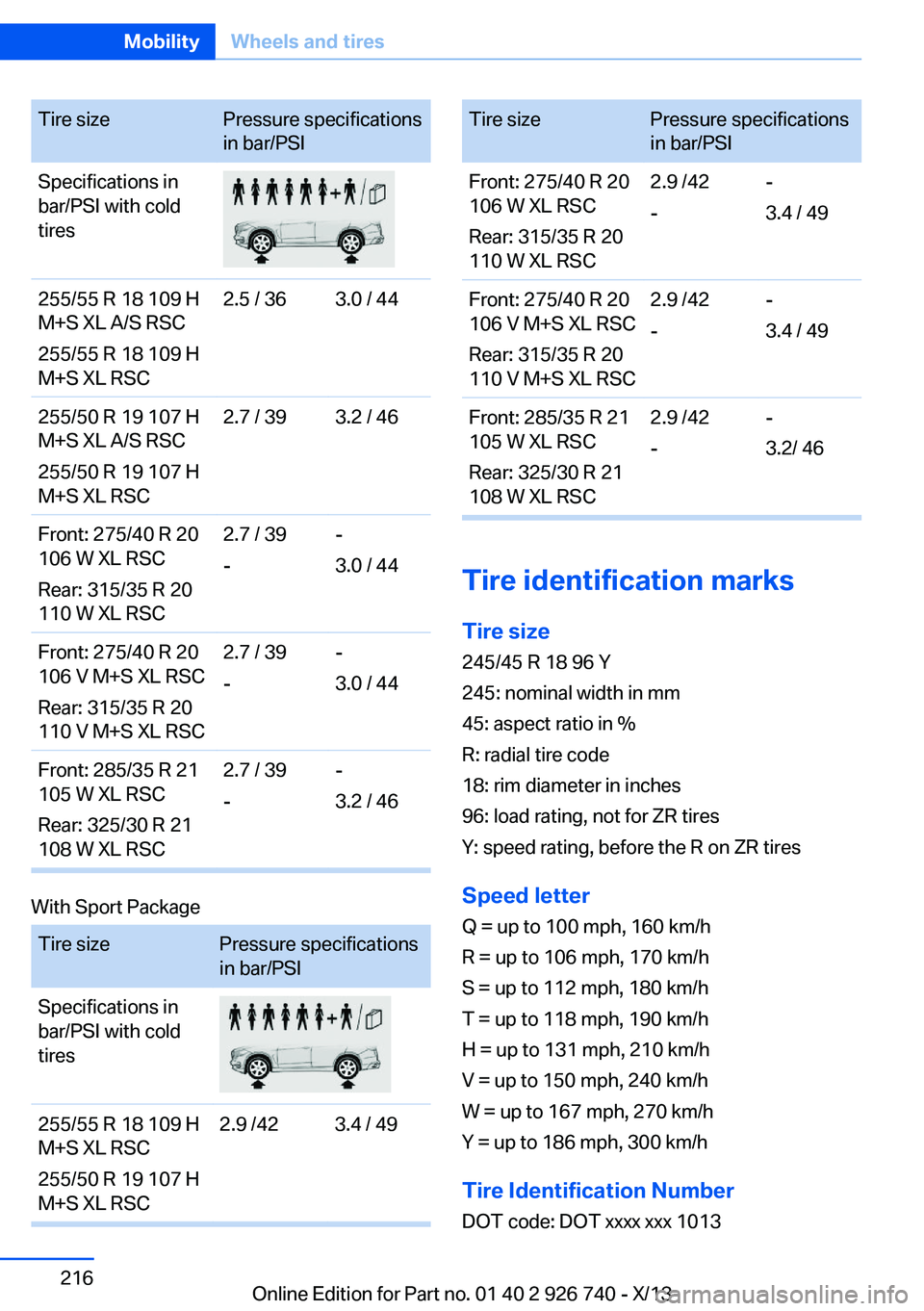
Tire sizePressure specifications
in bar/PSISpecifications in
bar/PSI with cold
tires255/55 R 18 109 H
M+S XL A/S RSC
255/55 R 18 109 H
M+S XL RSC2.5 / 363.0 / 44255/50 R 19 107 H
M+S XL A/S RSC
255/50 R 19 107 H
M+S XL RSC2.7 / 393.2 / 46Front: 275/40 R 20
106 W XL RSC
Rear: 315/35 R 20
110 W XL RSC2.7 / 39
--
3.0 / 44Front: 275/40 R 20
106 V M+S XL RSC
Rear: 315/35 R 20
110 V M+S XL RSC2.7 / 39
--
3.0 / 44Front: 285/35 R 21
105 W XL RSC
Rear: 325/30 R 21
108 W XL RSC2.7 / 39
--
3.2 / 46
With Sport Package
Tire sizePressure specifications
in bar/PSISpecifications in
bar/PSI with cold
tires255/55 R 18 109 H
M+S XL RSC
255/50 R 19 107 H
M+S XL RSC2.9 /423.4 / 49Tire sizePressure specifications
in bar/PSIFront: 275/40 R 20
106 W XL RSC
Rear: 315/35 R 20
110 W XL RSC2.9 /42
--
3.4 / 49Front: 275/40 R 20
106 V M+S XL RSC
Rear: 315/35 R 20
110 V M+S XL RSC2.9 /42
--
3.4 / 49Front: 285/35 R 21
105 W XL RSC
Rear: 325/30 R 21
108 W XL RSC2.9 /42
--
3.2/ 46
Tire identification marks
Tire size 245/45 R 18 96 Y
245: nominal width in mm
45: aspect ratio in %
R: radial tire code
18: rim diameter in inches
96: load rating, not for ZR tires
Y: speed rating, before the R on ZR tires
Speed letter
Q = up to 100 mph, 160 km/h
R = up to 106 mph, 170 km/h
S = up to 112 mph, 180 km/h
T = up to 118 mph, 190 km/h
H = up to 131 mph, 210 km/h
V = up to 150 mph, 240 km/h
W = up to 167 mph, 270 km/h
Y = up to 186 mph, 300 km/h
Tire Identification Number
DOT code: DOT xxxx xxx 1013
Seite 216MobilityWheels and tires216
Online Edition for Part no. 01 40 2 926 740 - X/13
Page 217 of 265
xxxx: manufacturer code for the tire brand
xxx: tire size and tire design
1013: tire age
Tires with DOT codes meet the guidelines of
the U.S. Department of Transportation.
Tire age DOT … 1013: the tire was manufactured in the
10th week 2013.
Recommendation
Regardless of wear, replace tires at least every
6 years.
Uniform Tire Quality Grading
Quality grades can be found where applicable
on the tire sidewall between tread shoulder
and maximum section width.
For example: Treadwear 200; Traction AA;
Temperature A
DOT Quality Grades Treadwear
Traction AA A B C
Temperature A B C
All passenger car tires must conform to Fed‐
eral Safety Requirements in addition to these
grades.
Treadwear The treadwear grade is a comparative rating
based on the wear rate of the tire when tested
under controlled conditions on a specified gov‐
ernment test course. For example, a tire graded 150 would wear one and one-half, 1 g,times as well on the government course as a
tire graded 100. The relative performance of
tires depends upon the actual conditions of
their use, however, and may depart signifi‐
cantly from the norm due to variations in driv‐
ing habits, service practices and differences in
road characteristics and climate.Traction
The traction grades, from highest to lowest,
are AA, A, B, and C.
Those grades represent the tire's ability to
stop on wet pavement as measured under
controlled conditions on specified government
test surfaces of asphalt and concrete. A tire
marked C may have poor traction performance.
The traction grade assigned to this tire is
based on straight-ahead braking traction tests,
and does not include acceleration, cornering,
hydroplaning, or peak traction characteristics.
Temperature
The temperature grades are A, the highest, B,
and C, representing the tire's resistance to the
generation of heat and its ability to dissipate
heat when tested under controlled conditions
on a specified indoor laboratory test wheel.
Sustained high temperature can cause the ma‐
terial of the tire to degenerate and reduce tire
life, and excessive temperature can lead to
sudden tire failure. The grade C corresponds
to a level of performance which all passenger
car tires must meet under the Federal Motor
Vehicle Safety Standard No. 109. Grades Band
A represent higher levels of performance on
the laboratory test wheel than the minimum re‐
quired by law.
Temperature grade for this tire
The temperature grade for this tire is es‐
tablished for a tire that is properly inflated and
not overloaded. Excessive speed, underinfla‐
tion, or excessive loading, either separately or
in combination, can cause heat buildup and
possible tire failure.
If necessary, have the vehicle towed.◀
RSC – Run-flat tires
Run-flat tires, refer to page 220, are labeled
with a circular symbol containing the letters
RSC marked on the sidewall.Seite 217Wheels and tiresMobility217
Online Edition for Part no. 01 40 2 926 740 - X/13