tires BMW X5 XDRIVE35D 2014 User Guide
[x] Cancel search | Manufacturer: BMW, Model Year: 2014, Model line: X5 XDRIVE35D, Model: BMW X5 XDRIVE35D 2014Pages: 265, PDF Size: 6.2 MB
Page 193 of 265
Driving on poor roads
The vehicle connects four wheel drive to the
advantages of a normal truck
Do not drive on unpaved terrain
Do not drive on unpaved terrain; other‐
wise, the vehicle may be damaged.◀
For your own safety, for the safety of passen‐
gers and of the vehicle, heed the following
points:▷Become familiar with the vehicle before
starting a trip; do not take risks in driving.▷Adjust the speed to the road surface con‐
ditions. The steeper and more uneven the
road surface, the slower the speed should
be.▷When driving on steep uphill or downhill
grades: add engine oil and coolant up to
near the MAX mark. Uphill and downhill
grades can be traveled up to no more than
50 %.▷On steep downhill grades, use Hill Descent
Control HDC, refer to page 133.
Starting out is possible on uphill grades up
to 33 %. The permissible side tilt is 50 %.▷Avoid contact of the bottom of the body
with the ground.
The ground clearance is no more than 7.8
inches/20 cm and can vary according to
the loading condition.▷When wheels continue to turn, depress the
accelerator so that driving stability control
systems can distribute the driving force to
the wheels. Activate DTC Dynamic Trac‐
tion Control if available.
After a trip on poor roads
After a trip on poor roads, check wheels and
tires for damage to maintain driving safety.
Clear heavy soiling from the body.
Seite 193Things to remember when drivingDriving tips193
Online Edition for Part no. 01 40 2 926 740 - X/13
Page 194 of 265
LoadingVehicle equipment
All standard, country-specific and optional
equipment that is offered in the model series is
described in this chapter. Therefore, equip‐
ment is also described that is not available in a
vehicle, e. g., because of the selected optional
equipment or country variant. This also applies
for safety-related functions and systems.
General information Overloading the vehicle
To avoid exceeding the approved carry‐
ing capacity of the tires, never overload the ve‐
hicle. Overloading can lead to overheating and
increases the rate at which damage develops
inside the tires. This could result in a sudden
loss of tire inflation pressure.◀
No fluids in the trunk
Make sure that fluids do not leak into the
trunk; otherwise, the vehicle may be dam‐
aged.◀
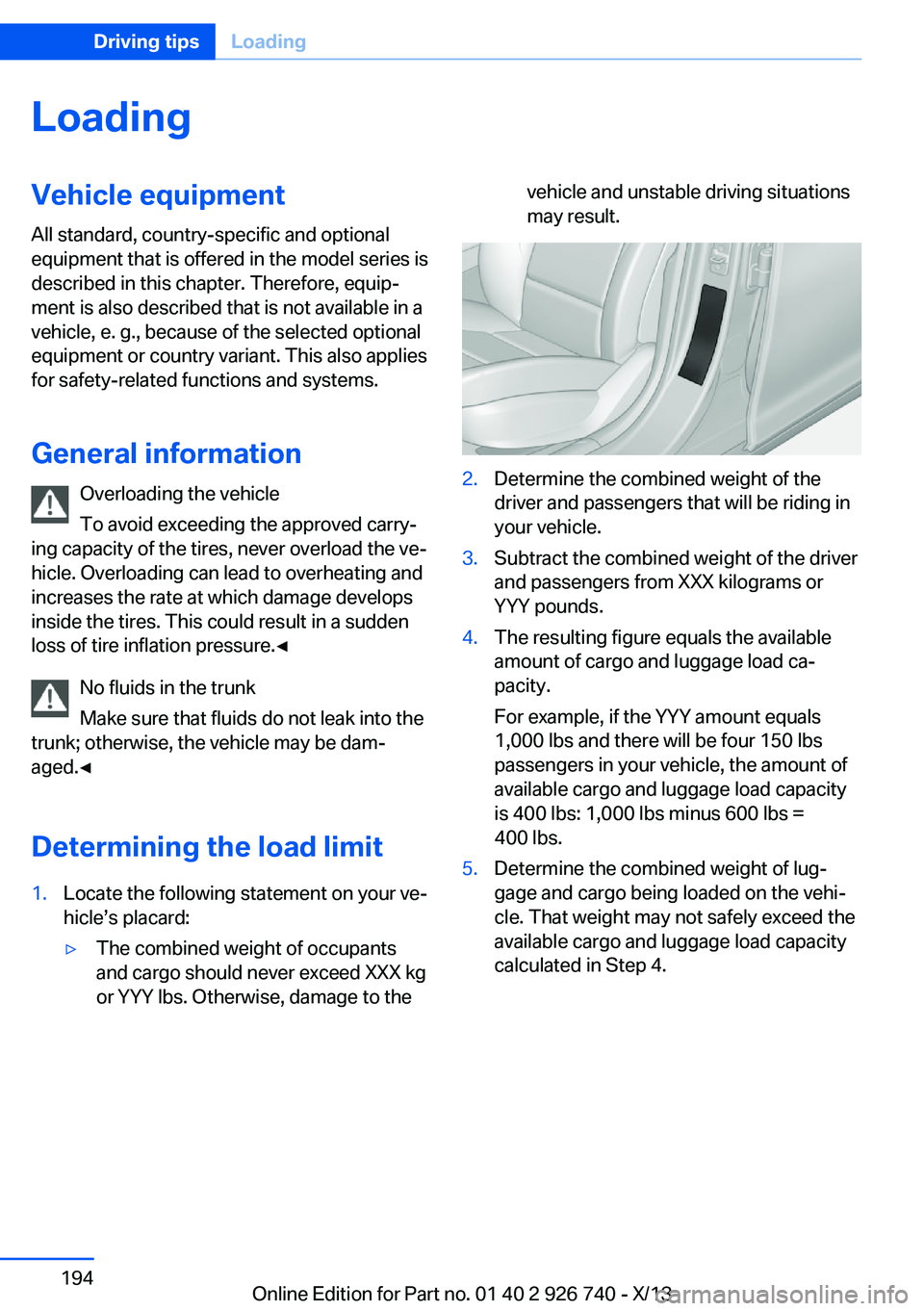
Determining the load limit1.Locate the following statement on your ve‐
hicle’s placard:▷The combined weight of occupants
and cargo should never exceed XXX kg
or YYY lbs. Otherwise, damage to thevehicle and unstable driving situations
may result.2.Determine the combined weight of the
driver and passengers that will be riding in
your vehicle.3.Subtract the combined weight of the driver
and passengers from XXX kilograms or
YYY pounds.4.The resulting figure equals the available
amount of cargo and luggage load ca‐
pacity.
For example, if the YYY amount equals
1,000 lbs and there will be four 150 lbs
passengers in your vehicle, the amount of
available cargo and luggage load capacity
is 400 lbs: 1,000 lbs minus 600 lbs =
400 lbs.5.Determine the combined weight of lug‐
gage and cargo being loaded on the vehi‐
cle. That weight may not safely exceed the
available cargo and luggage load capacity
calculated in Step 4.Seite 194Driving tipsLoading194
Online Edition for Part no. 01 40 2 926 740 - X/13
Page 197 of 265
Saving fuelVehicle equipmentAll standard, country-specific and optional
equipment that is offered in the model series is
described in this chapter. Therefore, equip‐
ment is also described that is not available in a
vehicle, e. g., because of the selected optional
equipment or country variant. This also applies
for safety-related functions and systems.
General information Fuel consumption depends on a number of dif‐
ferent factors.
The implementation of certain measures, driv‐
ing style and regular maintenance can have an
influence on fuel consumption and on the envi‐
ronmental impact.
Remove unnecessary cargoAdditional weight increases fuel consumption.
Remove attached parts
following use
Remove auxiliary mirrors, roof or rear luggage
racks which are no longer required following
use.
Attached parts on the vehicle impair the aero‐
dynamics and increase the fuel consumption.
Close the windows and glass
sunroof
Driving with the glass sunroof and windows
open results in increased air resistance and
thereby reduces the range.Tires
General information
Tires can affect fuel consumption values in
various ways, for instance fuel consumption
can be influenced by the size of the tires.
Check the tire inflation pressure
regularly
Check and, if necessary, correct the tire infla‐
tion pressure at least twice a month and before
starting on a long trip.
Low tire inflation pressure increases rolling re‐
sistance and thus raises fuel consumption and
tire wear.
Drive away immediately
Do not wait for the engine to warm-up while
the vehicle remains stationary. Start driving
right away, but at moderate engine speeds.
This is the fastest way for the cold engine to
reach its operating temperature.
Look well ahead when
driving
Avoid unnecessary acceleration and braking.
By maintaining a suitable distance to the vehi‐
cle driving ahead of you.
Driving smoothly and looking ahead reduces
fuel consumption.
Use coasting
When approaching a red light, take your foot
off the accelerator and let the vehicle coast to
a halt.Seite 197Saving fuelDriving tips197
Online Edition for Part no. 01 40 2 926 740 - X/13
Page 203 of 265
Mobility
In order to always ensure your mobility, you will find important information on operating fluids,wheels and tires, maintenance and Roadside Assistance in the following.Online Edition for Part no. 01 40 2 926 740 - X/13
Page 211 of 265
Wheels and tiresVehicle equipment
All standard, country-specific and optional
equipment that is offered in the model series is
described in this chapter. Therefore, equip‐
ment is also described that is not available in a
vehicle, e. g., because of the selected optional
equipment or country variant. This also applies
for safety-related functions and systems.
Tire inflation pressure Safety information
The tire characteristics and tire inflation pres‐
sure influence the following:▷The service life of the tires.▷Road safety.▷Driving comfort.
Checking the pressure
Tires have a natural, consistent loss of pres‐
sure.
Check the tire inflation pressure regularly
Regularly check the tire inflation pres‐
sure, and correct it as needed: at least twice a
month and before a long trip. If you fail to ob‐
serve this precaution, you may be driving on
tires with incorrect tire pressures, a condition
that may not only compromise your vehicle's
driving stability, but also lead to tire damage
and the risk of an accident.◀
Tires heat up during driving, and the tire infla‐
tion pressure increases along with the temper‐
ature of the tire. The tire inflation pressure
specifications relate to cold tires or tires with
the ambient temperature.
Only check the tire inflation pressure when the
tires are cold. This means after driving no more
than 1.25 miles/2 km or when the vehicle has
been parked for at least 2 hours.
After correcting the tire inflation pressure:▷Reinitialize the Flat Tire Monitor.▷Reinitialize the Tire Pressure Monitor.
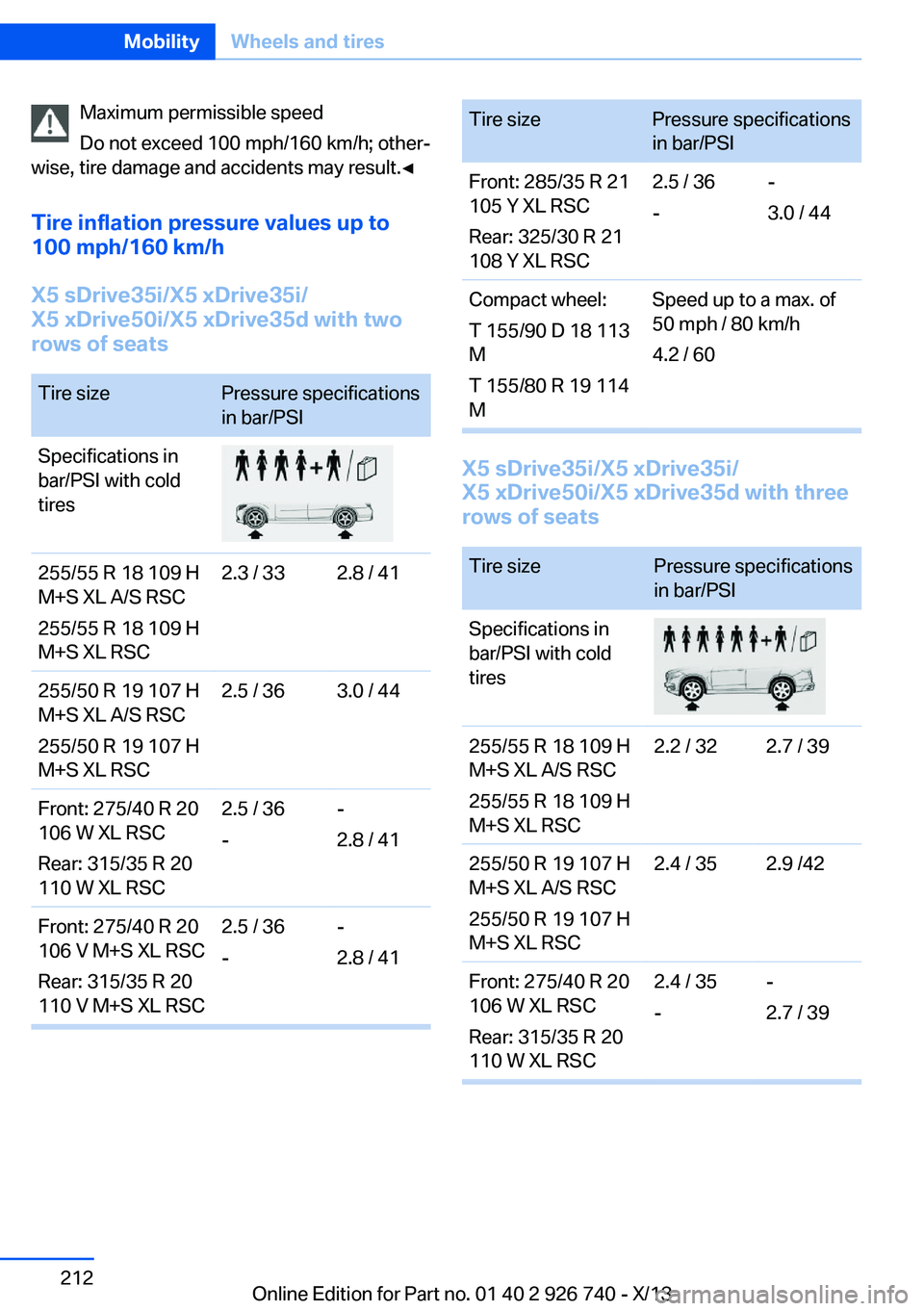
Pressure specifications The tire inflation pressure table, refer to
page 212, contains all pressure specifications
for the specified tire sizes at the ambient tem‐
perature. Pressure specifications apply to ap‐
proved tire sizes and recommended tire
brands. This information can be obtained from
your service center.
To identify the correct tire inflation pressure,
please note the following:
▷Tire sizes of your vehicle.▷Maximum permitted driving speed.
Tire inflation pressures up to
100 mph/160 km/h
For speeds of up to 100 mph/160 km/h and for
optimum driving comfort, note the pressure
values in the tire inflation pressure table, refer
to page 212, and adjust as necessary.
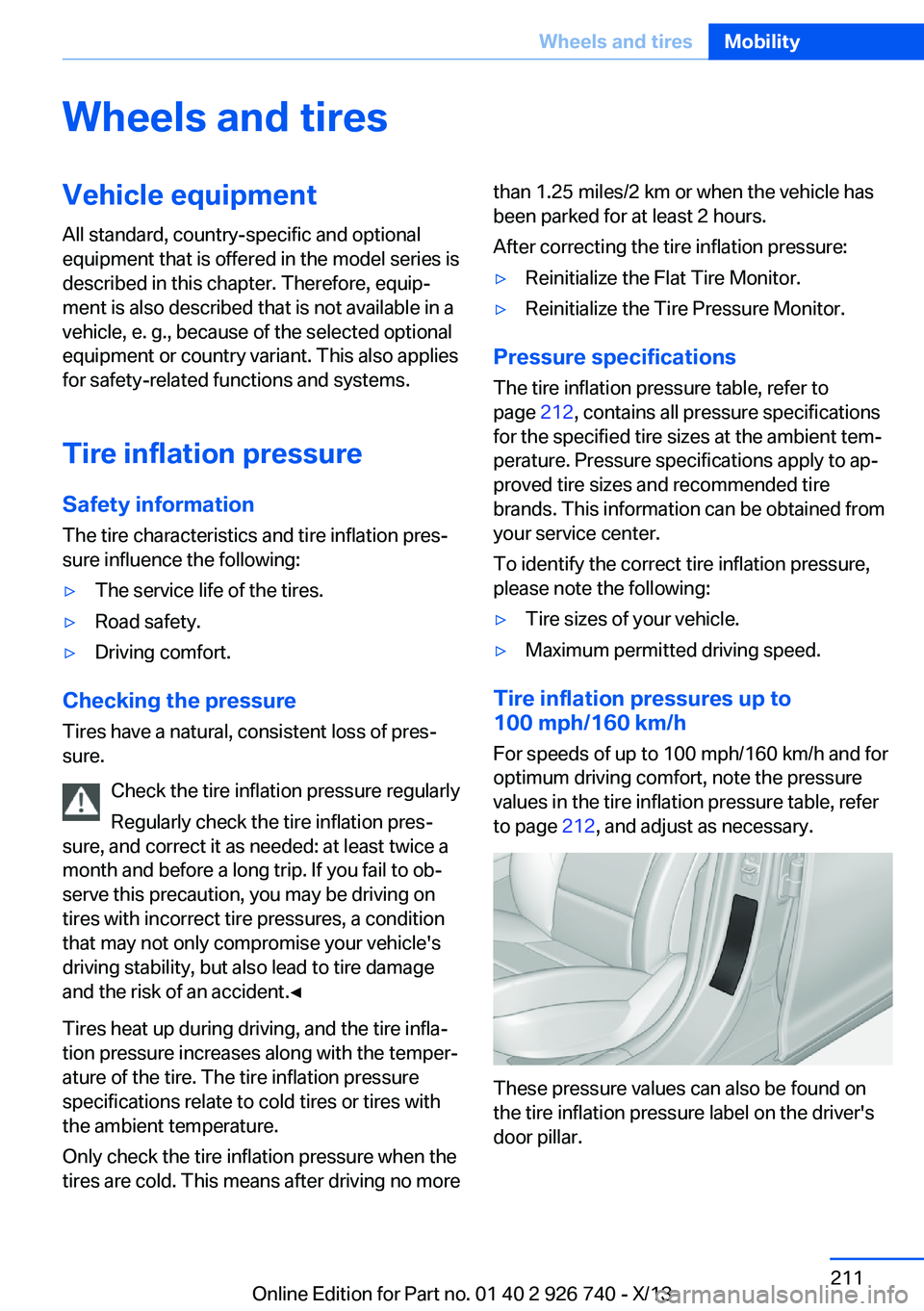
These pressure values can also be found on
the tire inflation pressure label on the driver's
door pillar.
Seite 211Wheels and tiresMobility211
Online Edition for Part no. 01 40 2 926 740 - X/13
Page 212 of 265
Maximum permissible speed
Do not exceed 100 mph/160 km/h; other‐
wise, tire damage and accidents may result.◀
Tire inflation pressure values up to
100 mph/160 km/h
X5 sDrive35i/X5 xDrive35i/
X5 xDrive50i/X5 xDrive35d with two
rows of seatsTire sizePressure specifications
in bar/PSISpecifications in
bar/PSI with cold
tires255/55 R 18 109 H
M+S XL A/S RSC
255/55 R 18 109 H
M+S XL RSC2.3 / 332.8 / 41255/50 R 19 107 H
M+S XL A/S RSC
255/50 R 19 107 H
M+S XL RSC2.5 / 363.0 / 44Front: 275/40 R 20
106 W XL RSC
Rear: 315/35 R 20
110 W XL RSC2.5 / 36
--
2.8 / 41Front: 275/40 R 20
106 V M+S XL RSC
Rear: 315/35 R 20
110 V M+S XL RSC2.5 / 36
--
2.8 / 41Tire sizePressure specifications
in bar/PSIFront: 285/35 R 21
105 Y XL RSC
Rear: 325/30 R 21
108 Y XL RSC2.5 / 36
--
3.0 / 44Compact wheel:
T 155/90 D 18 113
M
T 155/80 R 19 114
MSpeed up to a max. of
50 mph / 80 km/h
4.2 / 60
X5 sDrive35i/X5 xDrive35i/
X5 xDrive50i/X5 xDrive35d with three
rows of seats
Tire sizePressure specifications
in bar/PSISpecifications in
bar/PSI with cold
tires255/55 R 18 109 H
M+S XL A/S RSC
255/55 R 18 109 H
M+S XL RSC2.2 / 322.7 / 39255/50 R 19 107 H
M+S XL A/S RSC
255/50 R 19 107 H
M+S XL RSC2.4 / 352.9 /42Front: 275/40 R 20
106 W XL RSC
Rear: 315/35 R 20
110 W XL RSC2.4 / 35
--
2.7 / 39Seite 212MobilityWheels and tires212
Online Edition for Part no. 01 40 2 926 740 - X/13
Page 213 of 265
Tire sizePressure specifications
in bar/PSIFront: 275/40 R 20
106 V M+S XL RSC
Rear: 315/35 R 20
110 V M+S XL RSC2.4 / 35
--
2.7 / 39Front: 285/35 R 21
105 Y XL RSC
Rear: 325/30 R 21
108 Y XL RSC2.4 / 35
--
2.9 /42
Tire inflation pressures at max.
speeds above 100 mph/160 km/h
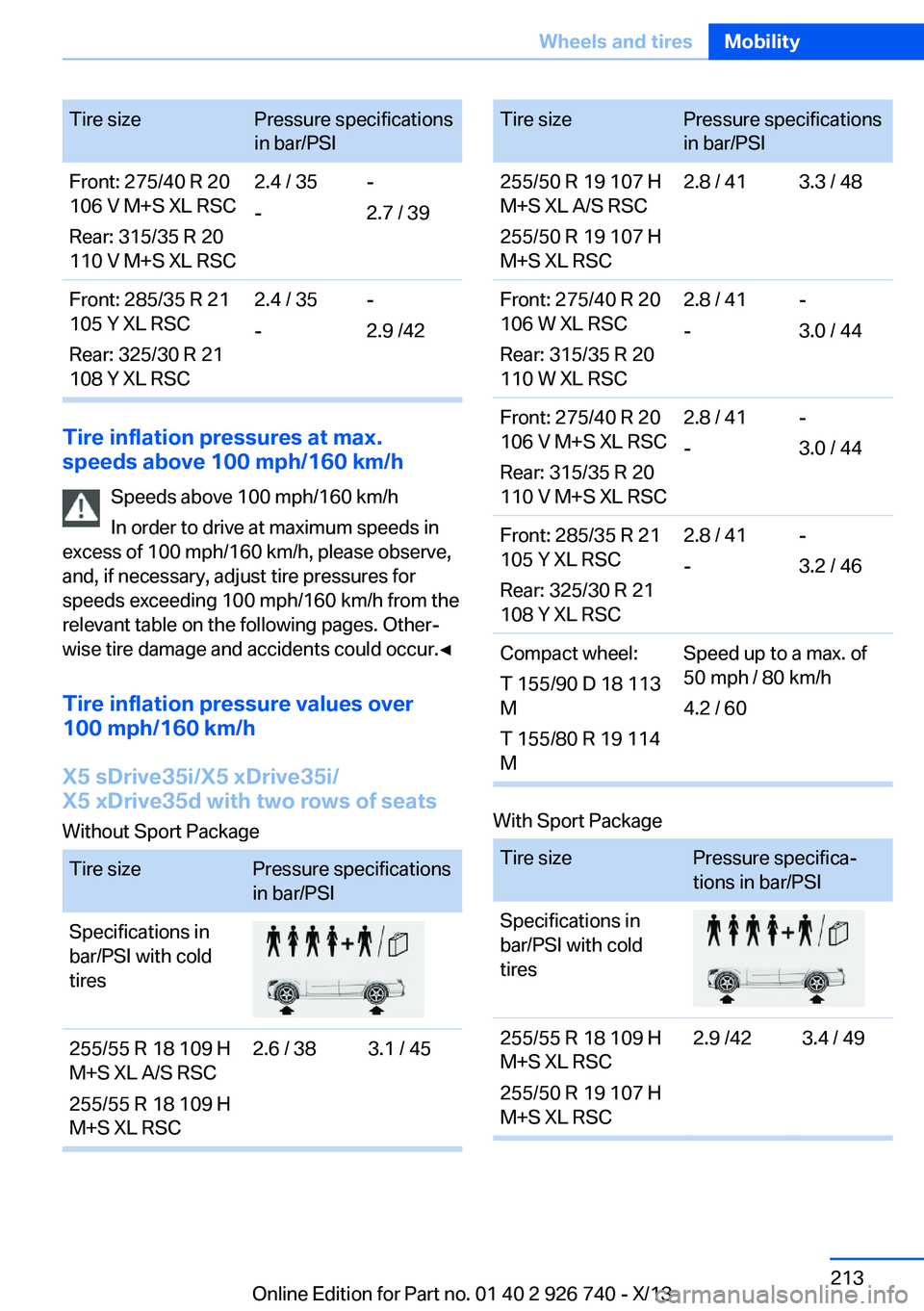
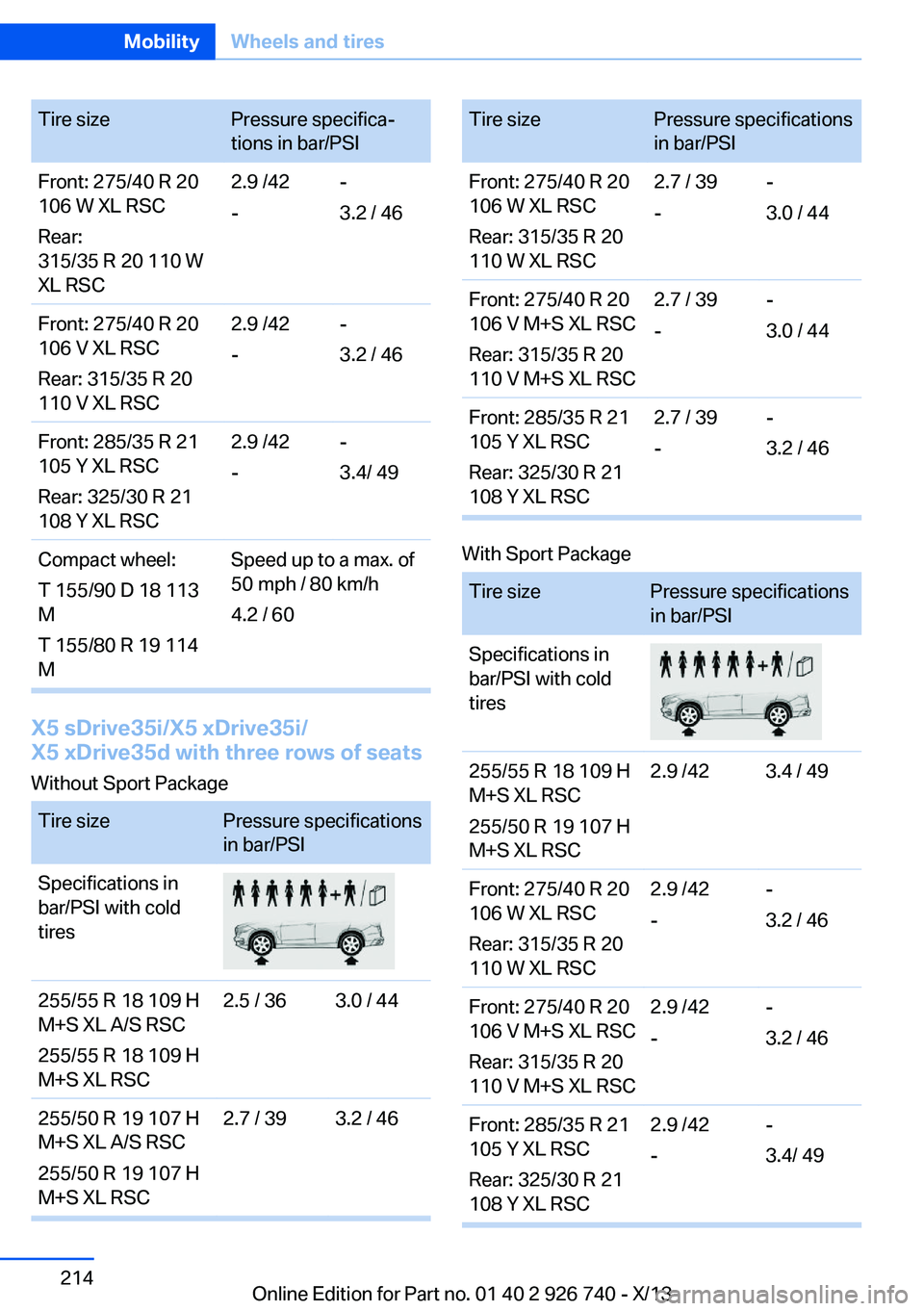
Speeds above 100 mph/160 km/h
In order to drive at maximum speeds in
excess of 100 mph/160 km/h, please observe,
and, if necessary, adjust tire pressures for
speeds exceeding 100 mph/160 km/h from the
relevant table on the following pages. Other‐
wise tire damage and accidents could occur.◀
Tire inflation pressure values over
100 mph/160 km/h
X5 sDrive35i/X5 xDrive35i/
X5 xDrive35d with two rows of seats
Without Sport Package
Tire sizePressure specifications
in bar/PSISpecifications in
bar/PSI with cold
tires255/55 R 18 109 H
M+S XL A/S RSC
255/55 R 18 109 H
M+S XL RSC2.6 / 383.1 / 45Tire sizePressure specifications
in bar/PSI255/50 R 19 107 H
M+S XL A/S RSC
255/50 R 19 107 H
M+S XL RSC2.8 / 413.3 / 48Front: 275/40 R 20
106 W XL RSC
Rear: 315/35 R 20
110 W XL RSC2.8 / 41
--
3.0 / 44Front: 275/40 R 20
106 V M+S XL RSC
Rear: 315/35 R 20
110 V M+S XL RSC2.8 / 41
--
3.0 / 44Front: 285/35 R 21
105 Y XL RSC
Rear: 325/30 R 21
108 Y XL RSC2.8 / 41
--
3.2 / 46Compact wheel:
T 155/90 D 18 113
M
T 155/80 R 19 114
MSpeed up to a max. of
50 mph / 80 km/h
4.2 / 60
With Sport Package
Tire sizePressure specifica‐
tions in bar/PSISpecifications in
bar/PSI with cold
tires255/55 R 18 109 H
M+S XL RSC
255/50 R 19 107 H
M+S XL RSC2.9 /423.4 / 49Seite 213Wheels and tiresMobility213
Online Edition for Part no. 01 40 2 926 740 - X/13
Page 214 of 265
Tire sizePressure specifica‐
tions in bar/PSIFront: 275/40 R 20
106 W XL RSC
Rear:
315/35 R 20 110 W
XL RSC2.9 /42
--
3.2 / 46Front: 275/40 R 20
106 V XL RSC
Rear: 315/35 R 20
110 V XL RSC2.9 /42
--
3.2 / 46Front: 285/35 R 21
105 Y XL RSC
Rear: 325/30 R 21
108 Y XL RSC2.9 /42
--
3.4/ 49Compact wheel:
T 155/90 D 18 113
M
T 155/80 R 19 114
MSpeed up to a max. of
50 mph / 80 km/h
4.2 / 60
X5 sDrive35i/X5 xDrive35i/
X5 xDrive35d with three rows of seats
Without Sport Package
Tire sizePressure specifications
in bar/PSISpecifications in
bar/PSI with cold
tires255/55 R 18 109 H
M+S XL A/S RSC
255/55 R 18 109 H
M+S XL RSC2.5 / 363.0 / 44255/50 R 19 107 H
M+S XL A/S RSC
255/50 R 19 107 H
M+S XL RSC2.7 / 393.2 / 46Tire sizePressure specifications
in bar/PSIFront: 275/40 R 20
106 W XL RSC
Rear: 315/35 R 20
110 W XL RSC2.7 / 39
--
3.0 / 44Front: 275/40 R 20
106 V M+S XL RSC
Rear: 315/35 R 20
110 V M+S XL RSC2.7 / 39
--
3.0 / 44Front: 285/35 R 21
105 Y XL RSC
Rear: 325/30 R 21
108 Y XL RSC2.7 / 39
--
3.2 / 46
With Sport Package
Tire sizePressure specifications
in bar/PSISpecifications in
bar/PSI with cold
tires255/55 R 18 109 H
M+S XL RSC
255/50 R 19 107 H
M+S XL RSC2.9 /423.4 / 49Front: 275/40 R 20
106 W XL RSC
Rear: 315/35 R 20
110 W XL RSC2.9 /42
--
3.2 / 46Front: 275/40 R 20
106 V M+S XL RSC
Rear: 315/35 R 20
110 V M+S XL RSC2.9 /42
--
3.2 / 46Front: 285/35 R 21
105 Y XL RSC
Rear: 325/30 R 21
108 Y XL RSC2.9 /42
--
3.4/ 49Seite 214MobilityWheels and tires214
Online Edition for Part no. 01 40 2 926 740 - X/13
Page 215 of 265
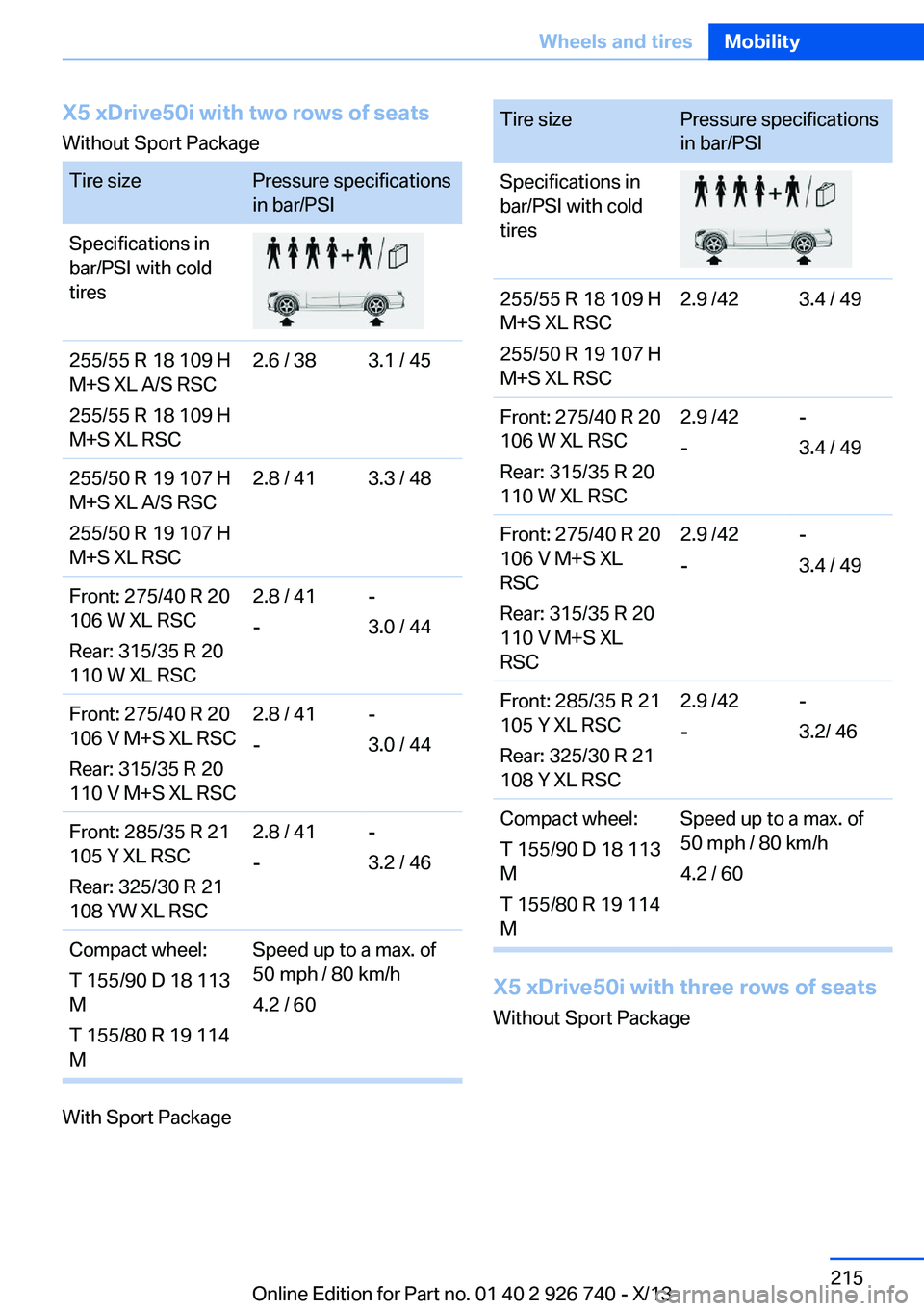
X5 xDrive50i with two rows of seatsWithout Sport PackageTire sizePressure specifications
in bar/PSISpecifications in
bar/PSI with cold
tires255/55 R 18 109 H
M+S XL A/S RSC
255/55 R 18 109 H
M+S XL RSC2.6 / 383.1 / 45255/50 R 19 107 H
M+S XL A/S RSC
255/50 R 19 107 H
M+S XL RSC2.8 / 413.3 / 48Front: 275/40 R 20
106 W XL RSC
Rear: 315/35 R 20
110 W XL RSC2.8 / 41
--
3.0 / 44Front: 275/40 R 20
106 V M+S XL RSC
Rear: 315/35 R 20
110 V M+S XL RSC2.8 / 41
--
3.0 / 44Front: 285/35 R 21
105 Y XL RSC
Rear: 325/30 R 21
108 YW XL RSC2.8 / 41
--
3.2 / 46Compact wheel:
T 155/90 D 18 113
M
T 155/80 R 19 114
MSpeed up to a max. of
50 mph / 80 km/h
4.2 / 60
With Sport Package
Tire sizePressure specifications
in bar/PSISpecifications in
bar/PSI with cold
tires255/55 R 18 109 H
M+S XL RSC
255/50 R 19 107 H
M+S XL RSC2.9 /423.4 / 49Front: 275/40 R 20
106 W XL RSC
Rear: 315/35 R 20
110 W XL RSC2.9 /42
--
3.4 / 49Front: 275/40 R 20
106 V M+S XL
RSC
Rear: 315/35 R 20
110 V M+S XL
RSC2.9 /42
--
3.4 / 49Front: 285/35 R 21
105 Y XL RSC
Rear: 325/30 R 21
108 Y XL RSC2.9 /42
--
3.2/ 46Compact wheel:
T 155/90 D 18 113
M
T 155/80 R 19 114
MSpeed up to a max. of
50 mph / 80 km/h
4.2 / 60
X5 xDrive50i with three rows of seats
Without Sport Package
Seite 215Wheels and tiresMobility215
Online Edition for Part no. 01 40 2 926 740 - X/13
Page 216 of 265
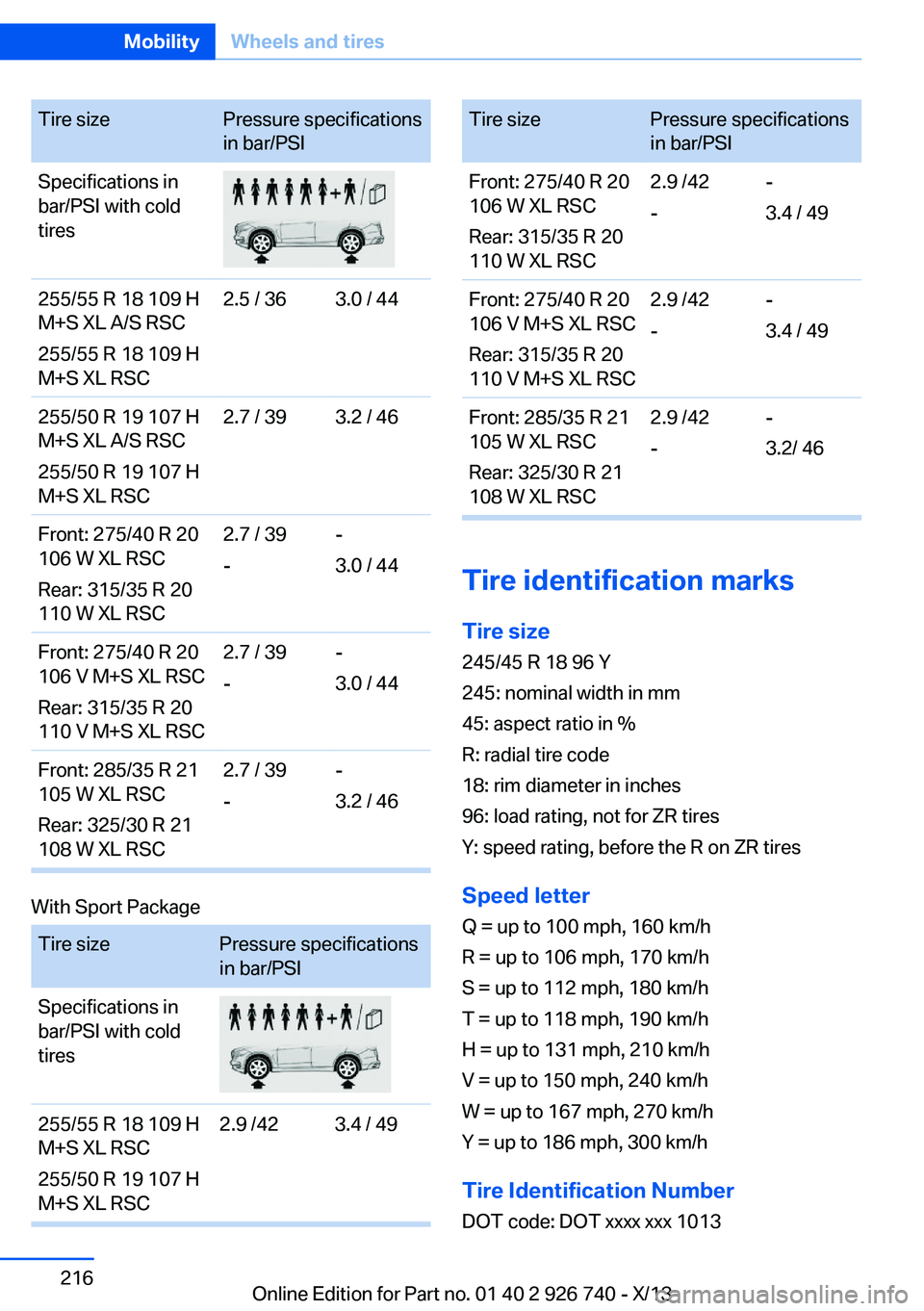
Tire sizePressure specifications
in bar/PSISpecifications in
bar/PSI with cold
tires255/55 R 18 109 H
M+S XL A/S RSC
255/55 R 18 109 H
M+S XL RSC2.5 / 363.0 / 44255/50 R 19 107 H
M+S XL A/S RSC
255/50 R 19 107 H
M+S XL RSC2.7 / 393.2 / 46Front: 275/40 R 20
106 W XL RSC
Rear: 315/35 R 20
110 W XL RSC2.7 / 39
--
3.0 / 44Front: 275/40 R 20
106 V M+S XL RSC
Rear: 315/35 R 20
110 V M+S XL RSC2.7 / 39
--
3.0 / 44Front: 285/35 R 21
105 W XL RSC
Rear: 325/30 R 21
108 W XL RSC2.7 / 39
--
3.2 / 46
With Sport Package
Tire sizePressure specifications
in bar/PSISpecifications in
bar/PSI with cold
tires255/55 R 18 109 H
M+S XL RSC
255/50 R 19 107 H
M+S XL RSC2.9 /423.4 / 49Tire sizePressure specifications
in bar/PSIFront: 275/40 R 20
106 W XL RSC
Rear: 315/35 R 20
110 W XL RSC2.9 /42
--
3.4 / 49Front: 275/40 R 20
106 V M+S XL RSC
Rear: 315/35 R 20
110 V M+S XL RSC2.9 /42
--
3.4 / 49Front: 285/35 R 21
105 W XL RSC
Rear: 325/30 R 21
108 W XL RSC2.9 /42
--
3.2/ 46
Tire identification marks
Tire size 245/45 R 18 96 Y
245: nominal width in mm
45: aspect ratio in %
R: radial tire code
18: rim diameter in inches
96: load rating, not for ZR tires
Y: speed rating, before the R on ZR tires
Speed letter
Q = up to 100 mph, 160 km/h
R = up to 106 mph, 170 km/h
S = up to 112 mph, 180 km/h
T = up to 118 mph, 190 km/h
H = up to 131 mph, 210 km/h
V = up to 150 mph, 240 km/h
W = up to 167 mph, 270 km/h
Y = up to 186 mph, 300 km/h
Tire Identification Number
DOT code: DOT xxxx xxx 1013
Seite 216MobilityWheels and tires216
Online Edition for Part no. 01 40 2 926 740 - X/13