flat tire BMW X5M 2013 User Guide
[x] Cancel search | Manufacturer: BMW, Model Year: 2013, Model line: X5M, Model: BMW X5M 2013Pages: 345, PDF Size: 9.44 MB
Page 277 of 345
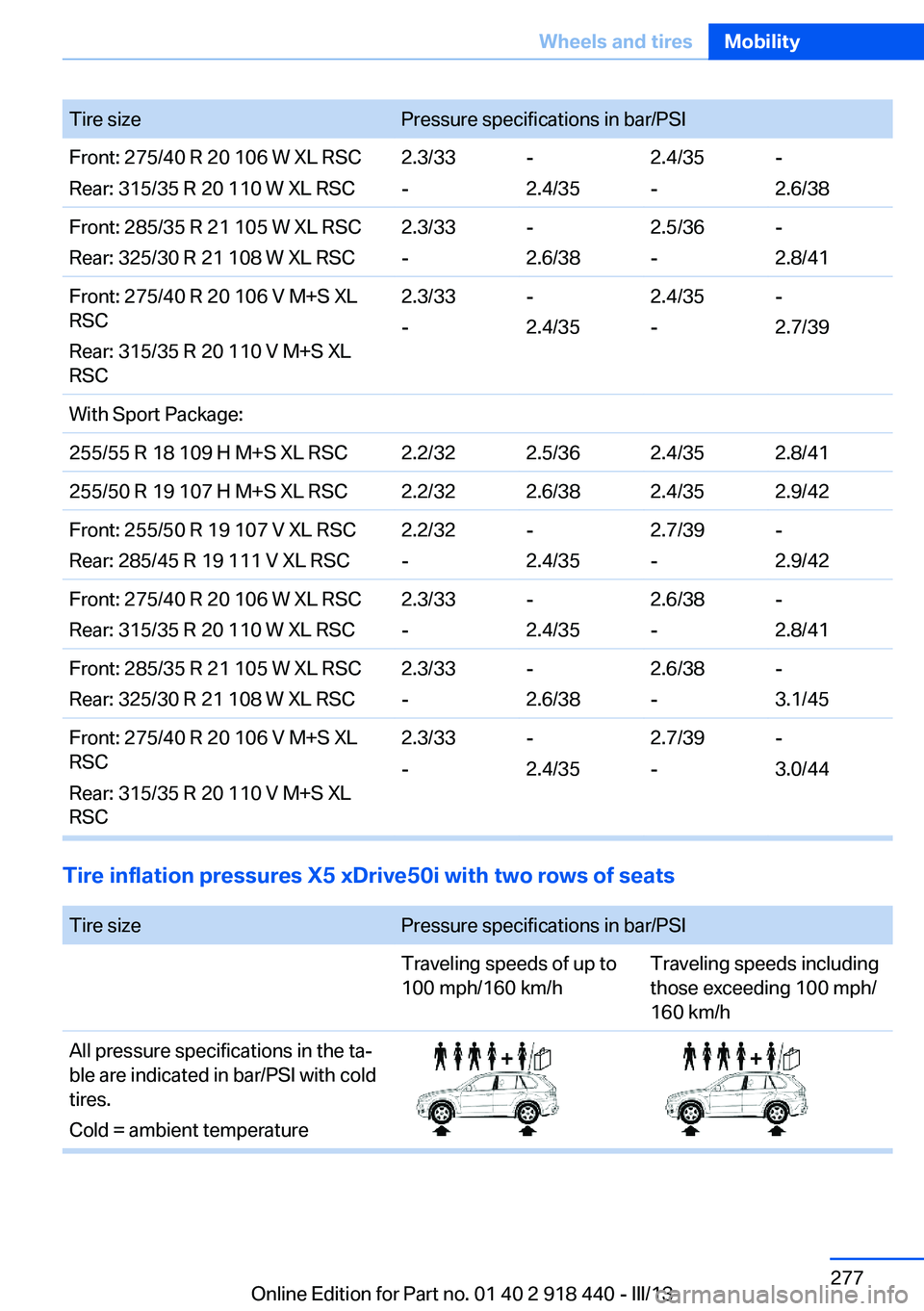
Tire sizePressure specifications in bar/PSIFront: 275/40 R 20 106 W XL RSC
Rear: 315/35 R 20 110 W XL RSC2.3/33
--
2.4/352.4/35
--
2.6/38Front: 285/35 R 21 105 W XL RSC
Rear: 325/30 R 21 108 W XL RSC2.3/33
--
2.6/382.5/36
--
2.8/41Front: 275/40 R 20 106 V M+S XL
RSC
Rear: 315/35 R 20 110 V M+S XL
RSC2.3/33
--
2.4/352.4/35
--
2.7/39With Sport Package:255/55 R 18 109 H M+S XL RSC2.2/322.5/362.4/352.8/41255/50 R 19 107 H M+S XL RSC2.2/322.6/382.4/352.9/42Front: 255/50 R 19 107 V XL RSC
Rear: 285/45 R 19 111 V XL RSC2.2/32
--
2.4/352.7/39
--
2.9/42Front: 275/40 R 20 106 W XL RSC
Rear: 315/35 R 20 110 W XL RSC2.3/33
--
2.4/352.6/38
--
2.8/41Front: 285/35 R 21 105 W XL RSC
Rear: 325/30 R 21 108 W XL RSC2.3/33
--
2.6/382.6/38
--
3.1/45Front: 275/40 R 20 106 V M+S XL
RSC
Rear: 315/35 R 20 110 V M+S XL
RSC2.3/33
--
2.4/352.7/39
--
3.0/44
Tire inflation pressures X5 xDrive50i with two rows of seats
Tire sizePressure specifications in bar/PSITraveling speeds of up to
100 mph/160 km/hTraveling speeds including
those exceeding 100 mph/
160 km/hAll pressure specifications in the ta‐
ble are indicated in bar/PSI with cold
tires.
Cold = ambient temperatureSeite 277Wheels and tiresMobility277
Online Edition for Part no. 01 40 2 918 440 - III/13
Page 279 of 345
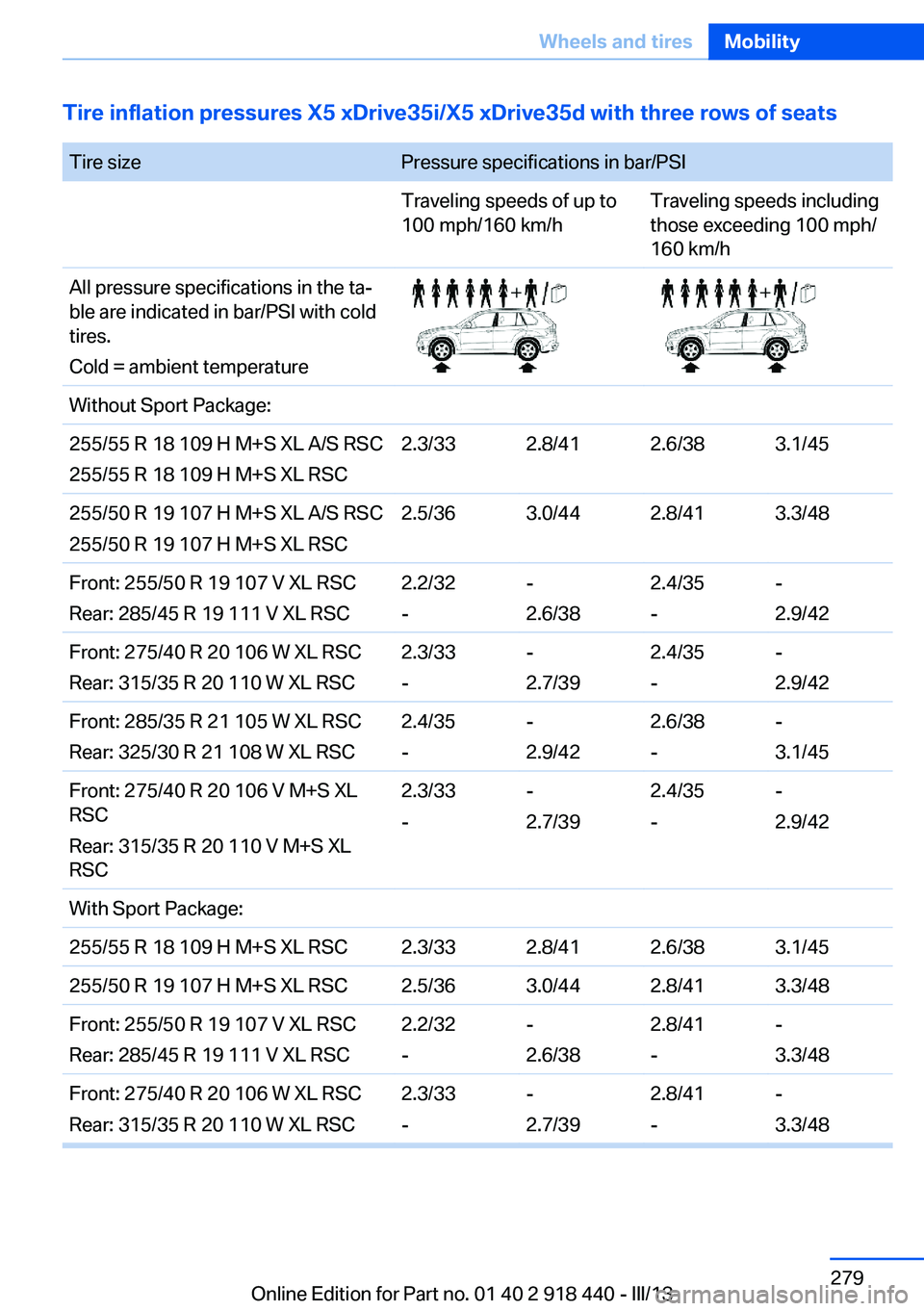
Tire inflation pressures X5 xDrive35i/X5 xDrive35d with three rows of seats
Tire sizePressure specifications in bar/PSITraveling speeds of up to
100 mph/160 km/hTraveling speeds including
those exceeding 100 mph/
160 km/hAll pressure specifications in the ta‐
ble are indicated in bar/PSI with cold
tires.
Cold = ambient temperatureWithout Sport Package:255/55 R 18 109 H M+S XL A/S RSC
255/55 R 18 109 H M+S XL RSC2.3/332.8/412.6/383.1/45255/50 R 19 107 H M+S XL A/S RSC
255/50 R 19 107 H M+S XL RSC2.5/363.0/442.8/413.3/48Front: 255/50 R 19 107 V XL RSC
Rear: 285/45 R 19 111 V XL RSC2.2/32
--
2.6/382.4/35
--
2.9/42Front: 275/40 R 20 106 W XL RSC
Rear: 315/35 R 20 110 W XL RSC2.3/33
--
2.7/392.4/35
--
2.9/42Front: 285/35 R 21 105 W XL RSC
Rear: 325/30 R 21 108 W XL RSC2.4/35
--
2.9/422.6/38
--
3.1/45Front: 275/40 R 20 106 V M+S XL
RSC
Rear: 315/35 R 20 110 V M+S XL
RSC2.3/33
--
2.7/392.4/35
--
2.9/42With Sport Package:255/55 R 18 109 H M+S XL RSC2.3/332.8/412.6/383.1/45255/50 R 19 107 H M+S XL RSC2.5/363.0/442.8/413.3/48Front: 255/50 R 19 107 V XL RSC
Rear: 285/45 R 19 111 V XL RSC2.2/32
--
2.6/382.8/41
--
3.3/48Front: 275/40 R 20 106 W XL RSC
Rear: 315/35 R 20 110 W XL RSC2.3/33
--
2.7/392.8/41
--
3.3/48Seite 279Wheels and tiresMobility279
Online Edition for Part no. 01 40 2 918 440 - III/13
Page 280 of 345
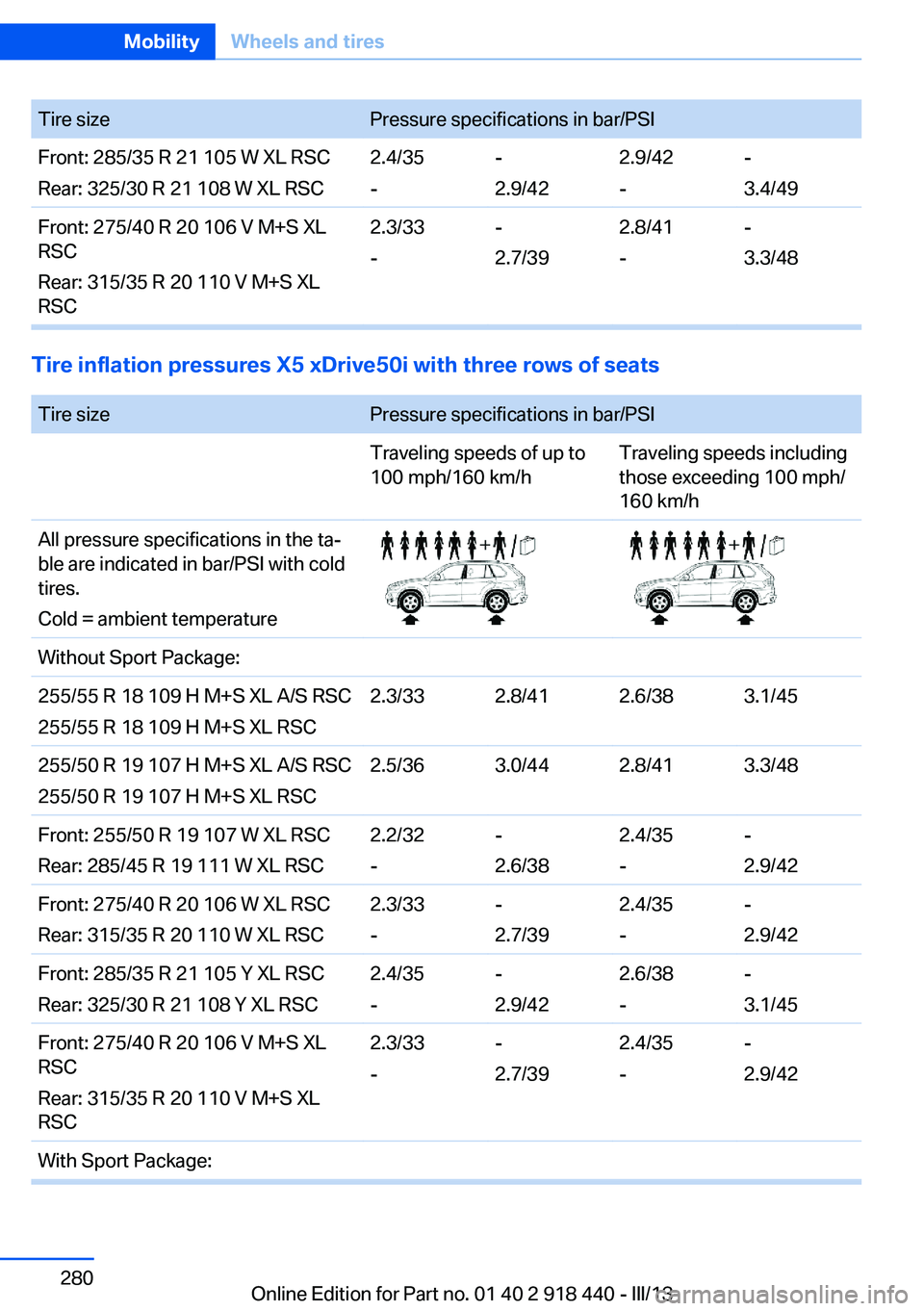
Tire sizePressure specifications in bar/PSIFront: 285/35 R 21 105 W XL RSC
Rear: 325/30 R 21 108 W XL RSC2.4/35
--
2.9/422.9/42
--
3.4/49Front: 275/40 R 20 106 V M+S XL
RSC
Rear: 315/35 R 20 110 V M+S XL
RSC2.3/33
--
2.7/392.8/41
--
3.3/48
Tire inflation pressures X5 xDrive50i with three rows of seats
Tire sizePressure specifications in bar/PSITraveling speeds of up to
100 mph/160 km/hTraveling speeds including
those exceeding 100 mph/
160 km/hAll pressure specifications in the ta‐
ble are indicated in bar/PSI with cold
tires.
Cold = ambient temperatureWithout Sport Package:255/55 R 18 109 H M+S XL A/S RSC
255/55 R 18 109 H M+S XL RSC2.3/332.8/412.6/383.1/45255/50 R 19 107 H M+S XL A/S RSC
255/50 R 19 107 H M+S XL RSC2.5/363.0/442.8/413.3/48Front: 255/50 R 19 107 W XL RSC
Rear: 285/45 R 19 111 W XL RSC2.2/32
--
2.6/382.4/35
--
2.9/42Front: 275/40 R 20 106 W XL RSC
Rear: 315/35 R 20 110 W XL RSC2.3/33
--
2.7/392.4/35
--
2.9/42Front: 285/35 R 21 105 Y XL RSC
Rear: 325/30 R 21 108 Y XL RSC2.4/35
--
2.9/422.6/38
--
3.1/45Front: 275/40 R 20 106 V M+S XL
RSC
Rear: 315/35 R 20 110 V M+S XL
RSC2.3/33
--
2.7/392.4/35
--
2.9/42With Sport Package:Seite 280MobilityWheels and tires280
Online Edition for Part no. 01 40 2 918 440 - III/13
Page 281 of 345
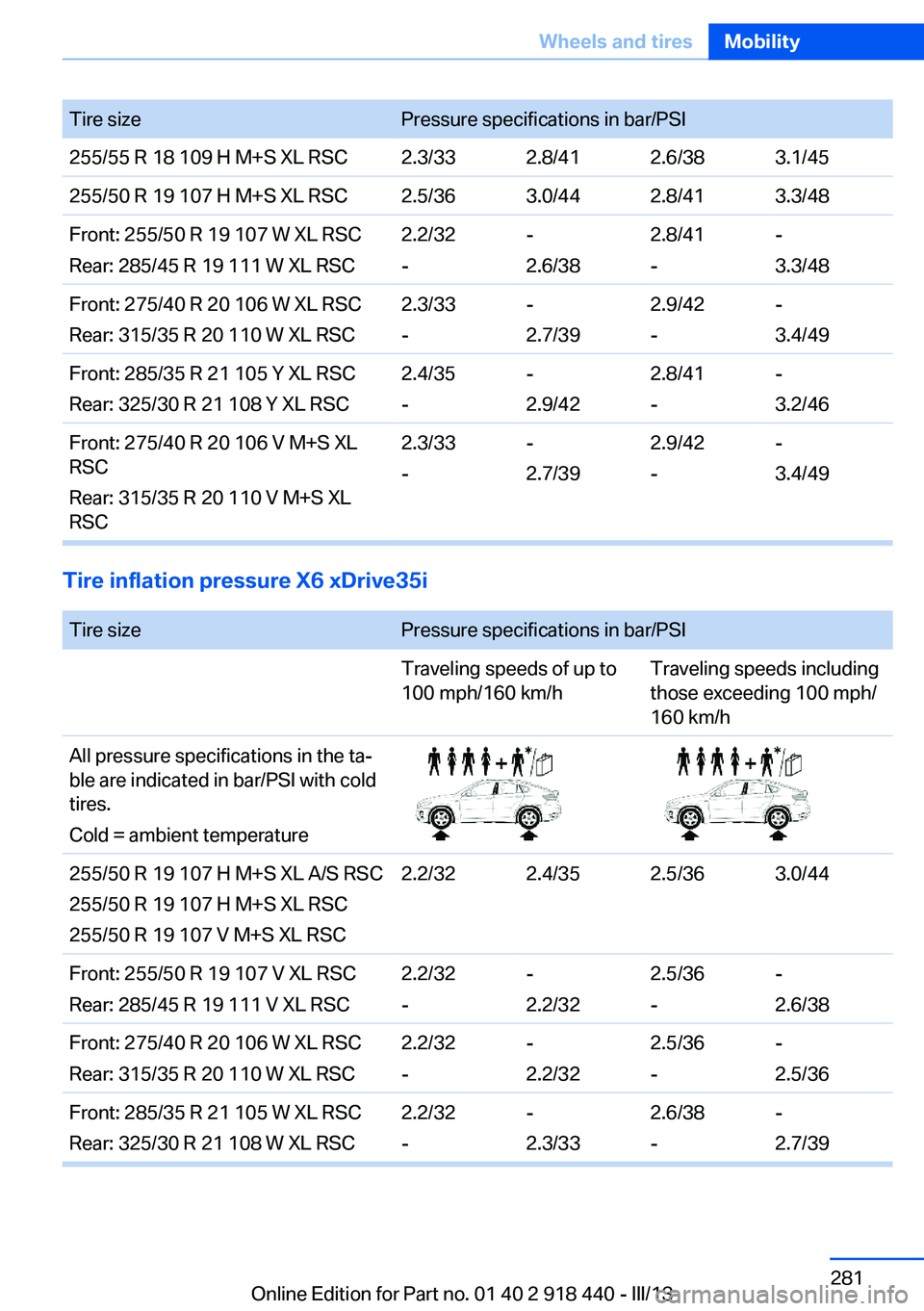
Tire sizePressure specifications in bar/PSI255/55 R 18 109 H M+S XL RSC2.3/332.8/412.6/383.1/45255/50 R 19 107 H M+S XL RSC2.5/363.0/442.8/413.3/48Front: 255/50 R 19 107 W XL RSC
Rear: 285/45 R 19 111 W XL RSC2.2/32
--
2.6/382.8/41
--
3.3/48Front: 275/40 R 20 106 W XL RSC
Rear: 315/35 R 20 110 W XL RSC2.3/33
--
2.7/392.9/42
--
3.4/49Front: 285/35 R 21 105 Y XL RSC
Rear: 325/30 R 21 108 Y XL RSC2.4/35
--
2.9/422.8/41
--
3.2/46Front: 275/40 R 20 106 V M+S XL
RSC
Rear: 315/35 R 20 110 V M+S XL
RSC2.3/33
--
2.7/392.9/42
--
3.4/49
Tire inflation pressure X6 xDrive35i
Tire sizePressure specifications in bar/PSITraveling speeds of up to
100 mph/160 km/hTraveling speeds including
those exceeding 100 mph/
160 km/hAll pressure specifications in the ta‐
ble are indicated in bar/PSI with cold
tires.
Cold = ambient temperature255/50 R 19 107 H M+S XL A/S RSC
255/50 R 19 107 H M+S XL RSC
255/50 R 19 107 V M+S XL RSC2.2/322.4/352.5/363.0/44Front: 255/50 R 19 107 V XL RSC
Rear: 285/45 R 19 111 V XL RSC2.2/32
--
2.2/322.5/36
--
2.6/38Front: 275/40 R 20 106 W XL RSC
Rear: 315/35 R 20 110 W XL RSC2.2/32
--
2.2/322.5/36
--
2.5/36Front: 285/35 R 21 105 W XL RSC
Rear: 325/30 R 21 108 W XL RSC2.2/32
--
2.3/332.6/38
--
2.7/39Seite 281Wheels and tiresMobility281
Online Edition for Part no. 01 40 2 918 440 - III/13
Page 282 of 345
Tire sizePressure specifications in bar/PSIFront: 275/40 R 20 106 V M+S XL
RSC
Rear: 315/35 R 20 110 V M+S XL
RSC2.2/32
--
2.2/322.5/36
--
2.7/39Compact wheel:
T 155/90 D 18 113 M
T 155/80 R 19 114 MSpeeds of up to 50 mph/80 km/h
4.2/60
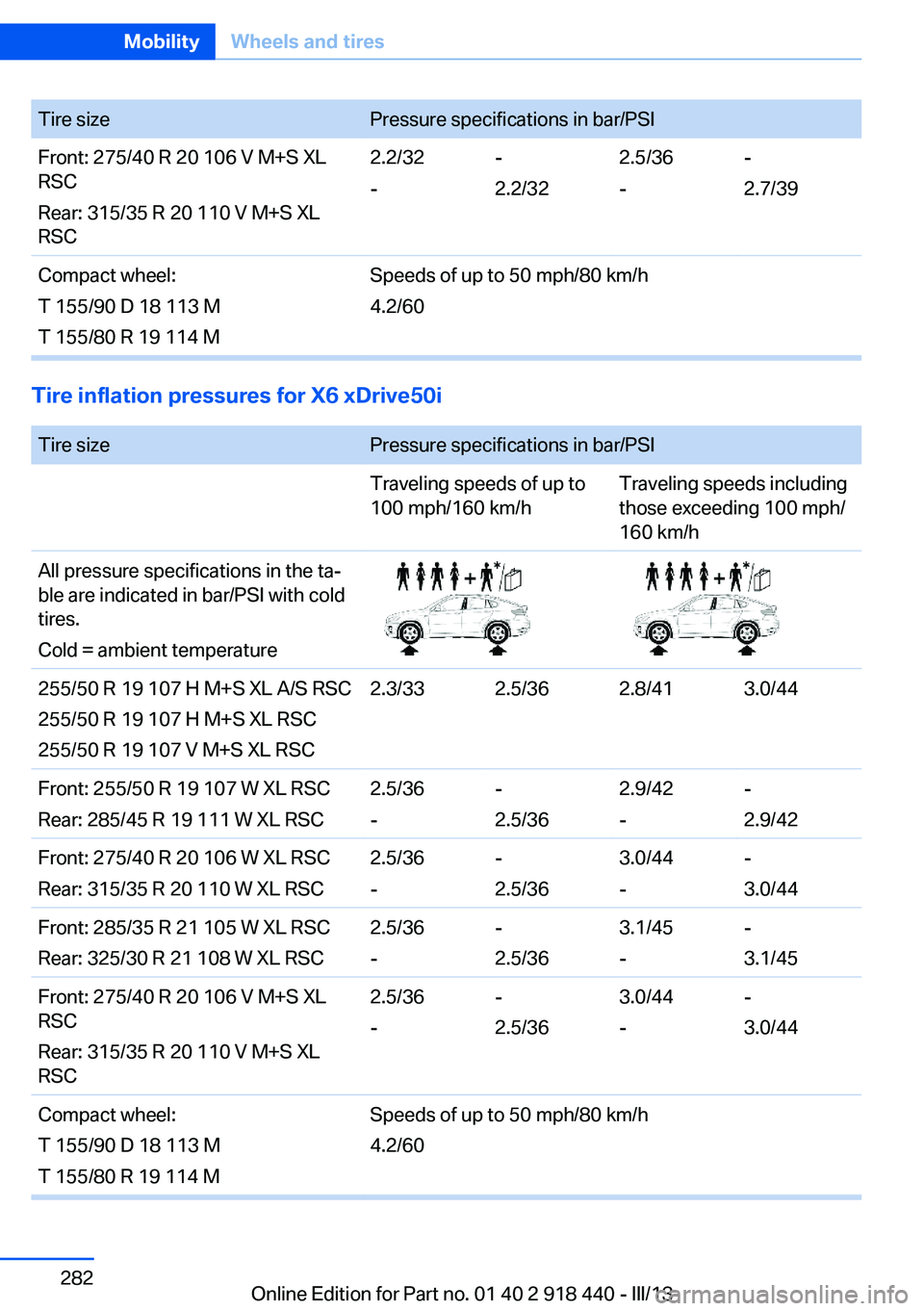
Tire inflation pressures for X6 xDrive50i
Tire sizePressure specifications in bar/PSITraveling speeds of up to
100 mph/160 km/hTraveling speeds including
those exceeding 100 mph/
160 km/hAll pressure specifications in the ta‐
ble are indicated in bar/PSI with cold
tires.
Cold = ambient temperature255/50 R 19 107 H M+S XL A/S RSC
255/50 R 19 107 H M+S XL RSC
255/50 R 19 107 V M+S XL RSC2.3/332.5/362.8/413.0/44Front: 255/50 R 19 107 W XL RSC
Rear: 285/45 R 19 111 W XL RSC2.5/36
--
2.5/362.9/42
--
2.9/42Front: 275/40 R 20 106 W XL RSC
Rear: 315/35 R 20 110 W XL RSC2.5/36
--
2.5/363.0/44
--
3.0/44Front: 285/35 R 21 105 W XL RSC
Rear: 325/30 R 21 108 W XL RSC2.5/36
--
2.5/363.1/45
--
3.1/45Front: 275/40 R 20 106 V M+S XL
RSC
Rear: 315/35 R 20 110 V M+S XL
RSC2.5/36
--
2.5/363.0/44
--
3.0/44Compact wheel:
T 155/90 D 18 113 M
T 155/80 R 19 114 MSpeeds of up to 50 mph/80 km/h
4.2/60Seite 282MobilityWheels and tires282
Online Edition for Part no. 01 40 2 918 440 - III/13
Page 284 of 345
Temperature
The temperature grades are A, the highest, B,
and C, representing the tire’s resistance to the
generation of heat and its ability to dissipate
heat when tested under controlled conditions
on a specified indoor laboratory test wheel.
Sustained high temperature can cause the ma‐
terial of the tire to degenerate and reduce tire
life, and excessive temperature can lead to
sudden tire failure. The grade C corresponds
to a level of performance which all passenger
car tires must meet under the Federal Motor
Vehicle Safety Standard No. 109. Grades B
and A represent higher levels of performance
on the laboratory test wheel than the minimum
required by law.
Temperature grade for this tire
The temperature grade for this tire is es‐
tablished for a tire that is properly inflated and
not overloaded. Excessive speed, underinfla‐
tion, or excessive loading, either separately or
in combination, can cause heat buildup and
possible tire failure.◀
RSC – Run-flat tires
The symbol identifying run-flat tires is a circle
with the letters RSC on the sidewall, refer to
page 286.
M+S
Winter and all-season tires.
These have better winter properties than
summer tires.
XL
Designation for specially reinforced tires.
Tire treadSummer tires
Do not drive with a tire tread depth of less than
0.12 in/3 mm.There is an increased danger of hydroplaning if
the tread depth is less than 0.12 in/3 mm.
Winter tires Do not drive with a tire tread depth of less than
0.16 in/4 mm.
Below a tread depth of 0.16 in/4 mm, tires are
less suitable for winter operation.
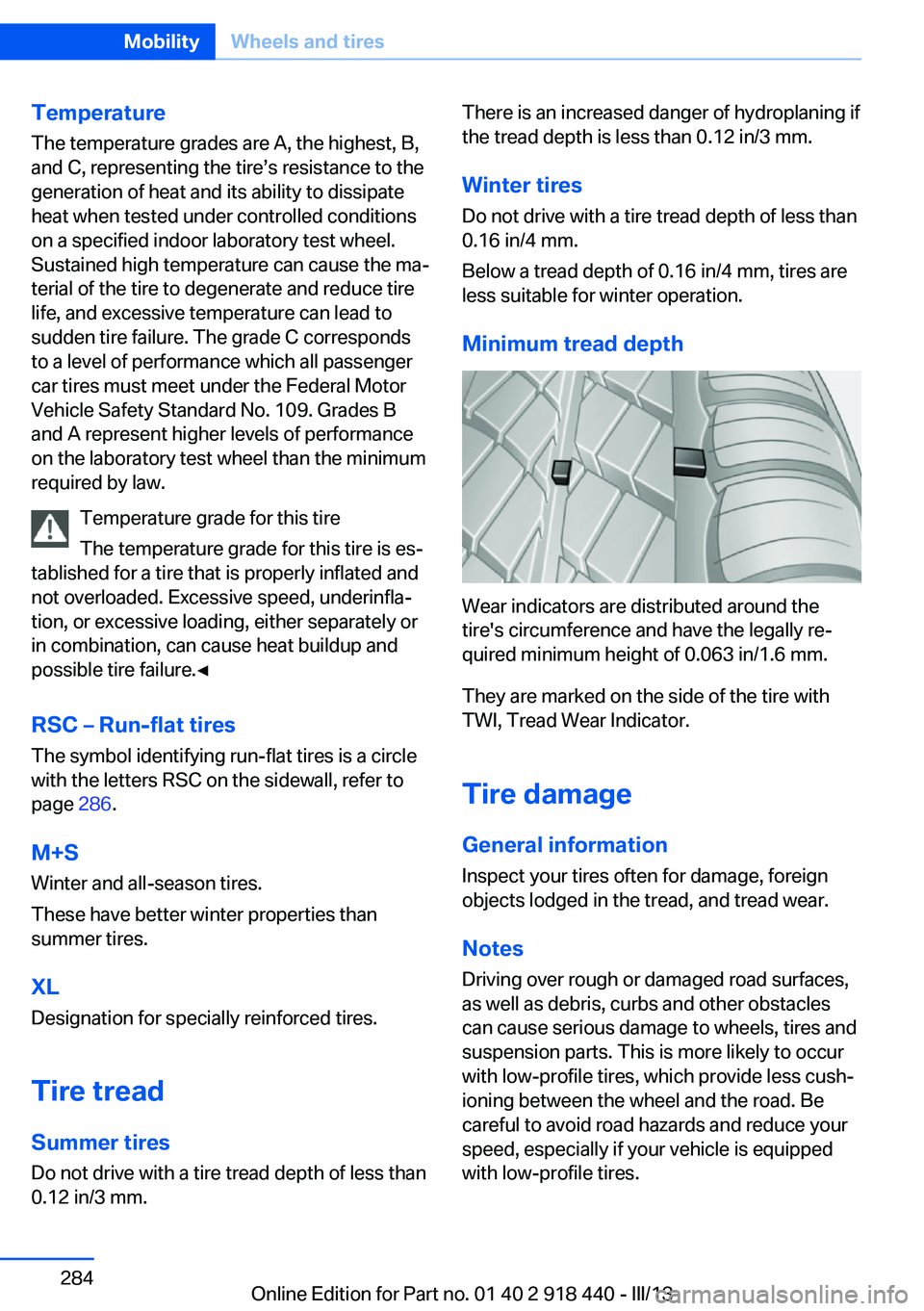
Minimum tread depth
Wear indicators are distributed around the
tire's circumference and have the legally re‐
quired minimum height of 0.063 in/1.6 mm.
They are marked on the side of the tire with
TWI, Tread Wear Indicator.
Tire damage
General information
Inspect your tires often for damage, foreign
objects lodged in the tread, and tread wear.
Notes
Driving over rough or damaged road surfaces,
as well as debris, curbs and other obstacles can cause serious damage to wheels, tires and
suspension parts. This is more likely to occur
with low-profile tires, which provide less cush‐
ioning between the wheel and the road. Be
careful to avoid road hazards and reduce your
speed, especially if your vehicle is equipped
with low-profile tires.
Seite 284MobilityWheels and tires284
Online Edition for Part no. 01 40 2 918 440 - III/13
Page 285 of 345
Indications of tire damage or other vehicle de‐
fects:▷Unusual vibrations during driving.▷Unusual handling such as a strong ten‐
dency to pull to the left or right.
Damage can be caused by driving over curbs,
road damage and similar situations.
In case of tire damage
If there are indications of tire damage, re‐
duce your speed immediately and have the
wheels and tires checked right away; other‐
wise, there is the increased risk of an accident.
Drive carefully to the next service center or tire
shop.
If necessary, have the vehicle towed.
Otherwise, tire damage can present a life-
threatening hazard to vehicle occupants and
other road users.◀
Repair of tire damage
For safety reasons, the manufacturer of
your vehicle recommends that you do not have
damaged tires repaired; they should be re‐
placed. Otherwise, damage can occur as a re‐
sult.◀
Changing wheels and tires
Mounting Information on mounting tires
Have mounting and balancing performed
only by a service center or tire specialist.
If this work is not carried out properly, there is
the danger of subsequent damage and related
safety hazards.◀
Wheel and tire combination
Information on the right wheel and tire combi‐
nation and rim version for your vehicle can be
obtained from the service center.
Incorrect wheel and tire combinations impair
the function of a variety of systems such as
ABS or DSC.
To maintain good handling and vehicle re‐
sponse, use only tires with a single tread con‐
figuration from a single manufacturer.
Following tire damage, have the original wheel
and tire combination remounted on the vehicle
as soon as possible.
Approved wheels and tires
The manufacturer of your vehicle recom‐
mends that you use only wheels and tires that
have been approved for your particular vehicle
model.
For example, despite having the same official
size ratings, variations can lead to body con‐
tact and with it, the risk of severe accidents.
The manufacturer of your vehicle cannot eval‐
uate non-approved wheels and tires to deter‐
mine if they are suited for use, and therefore
cannot ensure the operating safety of the vehi‐
cle if they are mounted.◀
Wheels with electronics for TPM Tire
Pressure Monitor
When mounting new tires or changing from
summer to winter tires or vice versa, only use
wheels with TPM electronics; otherwise, the
Tire Pressure Monitor will not be able to detect
a flat tire, refer to page 99. Your service center
will be glad to advise you.Seite 285Wheels and tiresMobility285
Online Edition for Part no. 01 40 2 918 440 - III/13
Page 286 of 345
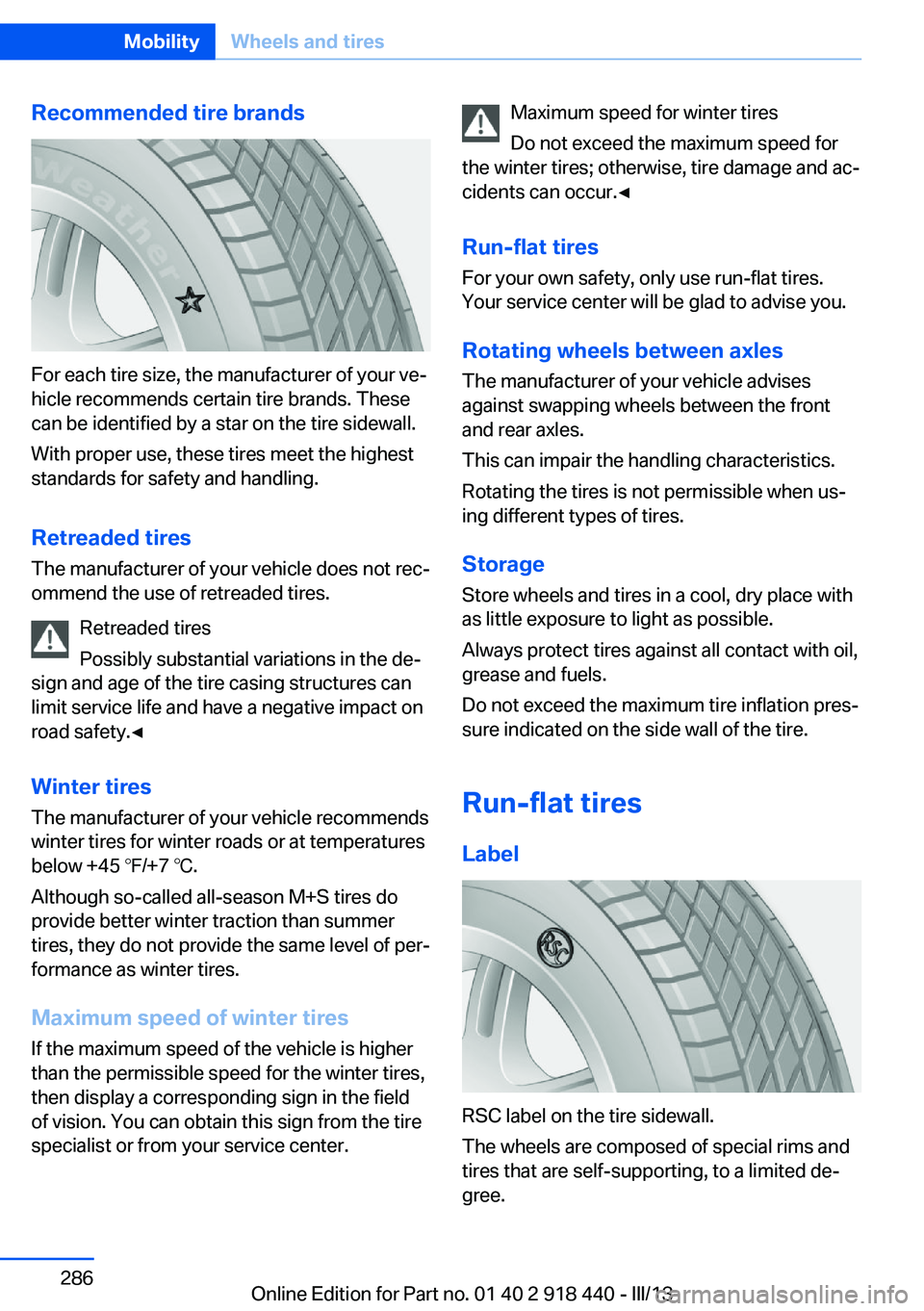
Recommended tire brands
For each tire size, the manufacturer of your ve‐
hicle recommends certain tire brands. These
can be identified by a star on the tire sidewall.
With proper use, these tires meet the highest
standards for safety and handling.
Retreaded tires The manufacturer of your vehicle does not rec‐
ommend the use of retreaded tires.
Retreaded tires
Possibly substantial variations in the de‐
sign and age of the tire casing structures can
limit service life and have a negative impact on
road safety.◀
Winter tires
The manufacturer of your vehicle recommends
winter tires for winter roads or at temperatures
below +45 ℉/+7 ℃.
Although so-called all-season M+S tires do
provide better winter traction than summer tires, they do not provide the same level of per‐
formance as winter tires.
Maximum speed of winter tires
If the maximum speed of the vehicle is higher
than the permissible speed for the winter tires,
then display a corresponding sign in the field
of vision. You can obtain this sign from the tire
specialist or from your service center.
Maximum speed for winter tires
Do not exceed the maximum speed for
the winter tires; otherwise, tire damage and ac‐
cidents can occur.◀
Run-flat tires
For your own safety, only use run-flat tires.
Your service center will be glad to advise you.
Rotating wheels between axlesThe manufacturer of your vehicle advises
against swapping wheels between the front
and rear axles.
This can impair the handling characteristics.
Rotating the tires is not permissible when us‐
ing different types of tires.
Storage
Store wheels and tires in a cool, dry place with
as little exposure to light as possible.
Always protect tires against all contact with oil,
grease and fuels.
Do not exceed the maximum tire inflation pres‐
sure indicated on the side wall of the tire.
Run-flat tires
Label
RSC label on the tire sidewall.
The wheels are composed of special rims and
tires that are self-supporting, to a limited de‐
gree.
Seite 286MobilityWheels and tires286
Online Edition for Part no. 01 40 2 918 440 - III/13
Page 287 of 345
The support of the sidewall allows the tire to
remain drivable to a restricted degree in the
event of a pressure loss.
Driving with a damaged tire:▷Flat Tire Monitor FTM, refer to page 97▷Tire Pressure Monitor TPM, refer to
page 99
Snow chains
Only certain fine-link snow chains have been
tested by BMW, classified as safe for use and
recommended. Consult your service center for
more information.
BMW X5: use only in pairs on the rear wheels,
equipped with tires of the following size:
▷255/55 R 18▷255/50 R 19
BMW X6: use only in pairs on rear wheels of
size 255/50 R 19.
Observe the manufacturer's instructions when
mounting snow chains. Do not exceed a speed
of 30 mph/50 km/h when using snow chains.
Do not initialize the Flat Tire Monitor if snow
chains are mounted; otherwise, the instrument
might issue an incorrect reading.
When driving with snow chains, it can be bene‐
ficial to temporarily activate DTC, refer to
page 106.
Seite 287Wheels and tiresMobility287
Online Edition for Part no. 01 40 2 918 440 - III/13
Page 302 of 345
This lamp uses LED technology for operation.
Contact your service center in the event of a
malfunction.
Changing wheels
Notes Your vehicle is equipped with run-flat tires, re‐
fer to page 286, as standard equipment.
They do not need to be replaced immediately
in the event of a puncture.
When mounting new tires or changing from
summer to winter tires or vice versa, use run-
flat tires for your own safety.
BMW X6: do not rotate the front wheels to the
rear or vice versa, as otherwise the handling
characteristics will be negatively affected.
Suitable tools for changing the wheels are
available from the service center as an acces‐
sory.
Jacking points for the vehicle jack
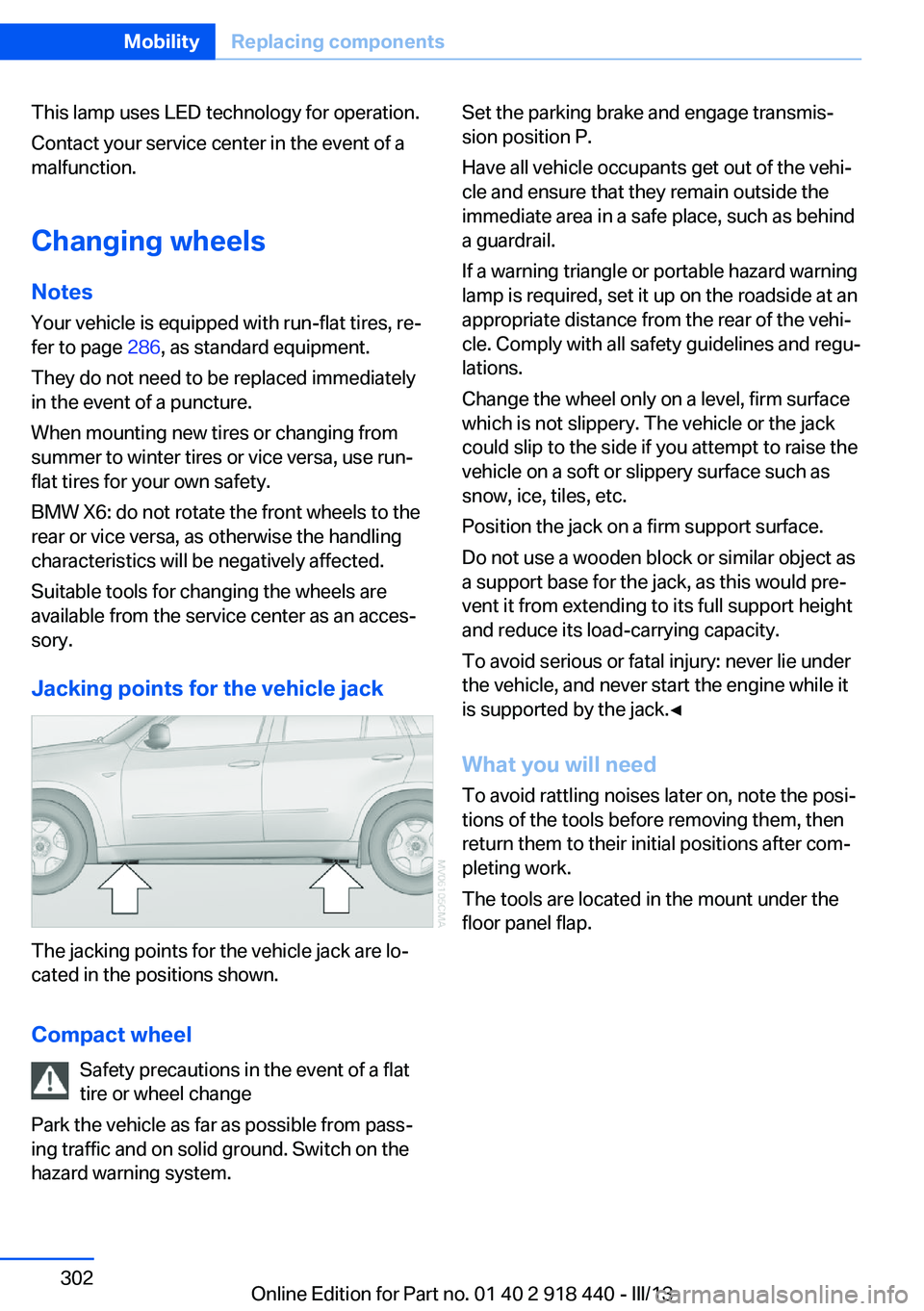
The jacking points for the vehicle jack are lo‐
cated in the positions shown.
Compact wheel Safety precautions in the event of a flat
tire or wheel change
Park the vehicle as far as possible from pass‐
ing traffic and on solid ground. Switch on the
hazard warning system.
Set the parking brake and engage transmis‐
sion position P.
Have all vehicle occupants get out of the vehi‐
cle and ensure that they remain outside the
immediate area in a safe place, such as behind
a guardrail.
If a warning triangle or portable hazard warning
lamp is required, set it up on the roadside at an
appropriate distance from the rear of the vehi‐
cle. Comply with all safety guidelines and regu‐
lations.
Change the wheel only on a level, firm surface
which is not slippery. The vehicle or the jack
could slip to the side if you attempt to raise the
vehicle on a soft or slippery surface such as
snow, ice, tiles, etc.
Position the jack on a firm support surface.
Do not use a wooden block or similar object as
a support base for the jack, as this would pre‐
vent it from extending to its full support height
and reduce its load-carrying capacity.
To avoid serious or fatal injury: never lie under
the vehicle, and never start the engine while it
is supported by the jack.◀
What you will need
To avoid rattling noises later on, note the posi‐
tions of the tools before removing them, then
return them to their initial positions after com‐
pleting work.
The tools are located in the mount under the
floor panel flap.Seite 302MobilityReplacing components302
Online Edition for Part no. 01 40 2 918 440 - III/13