ABS BMW Z3 2002 User Guide
[x] Cancel search | Manufacturer: BMW, Model Year: 2002, Model line: Z3, Model: BMW Z3 2002Pages: 187, PDF Size: 2.73 MB
Page 114 of 187
114n
Wheel and tire combinationsThe right choice
Use only wheels and tires
approved by BMW for the corre-
sponding vehicle model, as otherwise
the tires may make contact with the
body as the result of tolerances despite
the same nominal size being used,
resulting in serious accidents. If non-
approved wheels and tires are used,
BMW cannot evaluate their suitability,
and therefore cannot be held liable for
driving safety.<
For wheel and tire specifications
approved by BMW, refer to the informa-
tion beginning on page 116.
The correct wheel and tire combi-
nation affects different systems
such as ABS and ASC+T/DSC
*. The
function of these systems is impaired if
improper wheel and tire combinations
are used.
For this reason, use only tires of the
same manufacture and tread configura-
tion. In the event of a flat tire, for
example, remount the approved wheel
and tire combination as soon as
possible.<
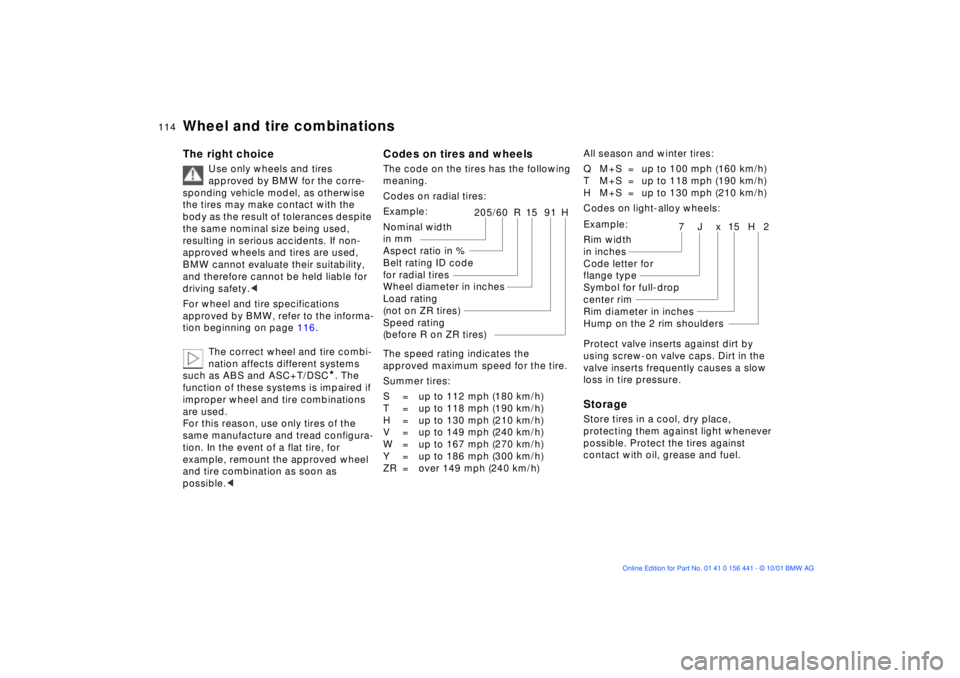
Codes on tires and wheelsThe code on the tires has the following
meaning.
Codes on radial tires:
The speed rating indicates the
approved maximum speed for the tire.
Summer tires:
S = up to 112 mph (180 km/h)
T = up to 118 mph (190 km/h)
H = up to 130 mph (210 km/h)
V = up to 149 mph (240 km/h)
W = up to 167 mph (270 km/h)
Y = up to 186 mph (300 km/h)
ZR = over 149 mph (240 km/h) Example:
Nominal width
in mm
Aspect ratio in %
Belt rating ID code
for radial tires
Wheel diameter in inches
Load rating
(not on ZR tires)
Speed rating
(before R on ZR tires)
205/60 R 15 91 H
All season and winter tires:
Q M+S = up to 100 mph (160 km/h)
T M+S = up to 118 mph (190 km/h)
H M+S = up to 130 mph (210 km/h)
Codes on light-alloy wheels:
Protect valve inserts against dirt by
using screw-on valve caps. Dirt in the
valve inserts frequently causes a slow
loss in tire pressure.Storage Store tires in a cool, dry place,
protecting them against light whenever
possible. Protect the tires against
contact with oil, grease and fuel. Example:
Rim width
in inches
Code letter for
flange type
Symbol for full-drop
center rim
Rim diameter in inches
Hump on the 2 rim shoulders
7x15H2
J
Page 126 of 187
126n
Coolant Brake fluid To add coolantWait until the engine cools before
removing the cap from the expansion
tank. The needle of the coolant gauge
in the instrument cluster must be
located in the blue field; otherwise,
there is a danger of scalding.
1. Turn the cap slightly counterclock-
wise in order to allow accumulated
pressure to escape, then open
2. If the coolant is low, slowly add
coolant until the correct level is
reached Ð do not overfill.
The coolant is a mixture of water and
extended-duty antifreeze with corrosion
inhibitor. Always maintain the
prescribed all-season 50 : 50 mixture
ratio for year-round protection against
internal corrosion. No other additives
are required.
Replace the coolant regularly. Refer to
the Service and Warranty Information
Booklet (US models) or the Warranty
and Service Guide Booklet (Canadian
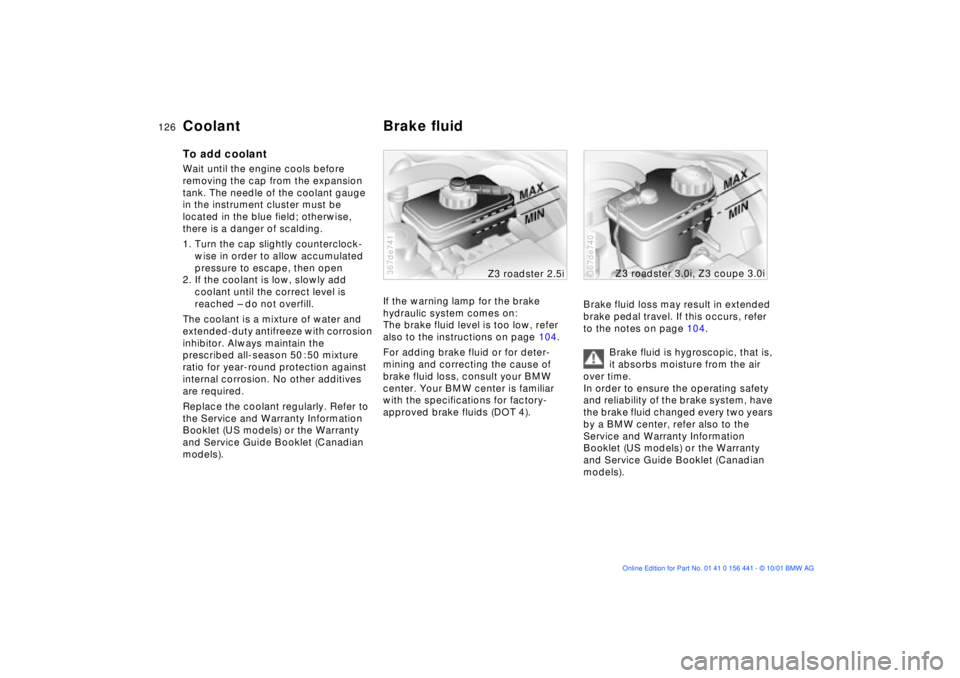
models).If the warning lamp for the brake
hydraulic system comes on:
The brake fluid level is too low, refer
also to the instructions on page 104.
For adding brake fluid or for deter-
mining and correcting the cause of
brake fluid loss, consult your BMW
center. Your BMW center is familiar
with the specifications for factory-
approved brake fluids (DOT 4).
367de741
Z3 roadster 2.5i
Brake fluid loss may result in extended
brake pedal travel. If this occurs, refer
to the notes on page 104.
Brake fluid is hygroscopic, that is,
it absorbs moisture from the air
over time.
In order to ensure the operating safety
and reliability of the brake system, have
the brake fluid changed every two years
by a BMW center, refer also to the
Service and Warranty Information
Booklet (US models) or the Warranty
and Service Guide Booklet (Canadian
models).367de740
Z3 roadster 3.0i, Z3 coupe 3.0i
Page 158 of 187
158n
Jump-startingNever use spray starter fluids to start
the engine.
When your battery is discharged you can
used two jumper cables to start your
vehicle with power from the battery in a
second vehicle. You can also use the
same method to help start another
vehicle. Always use jumper cables with
fully insulated handles on the terminal
clamps.
Do not touch components
carrying high-voltage on a running
engine. Contact with components
carrying high voltage can cause fatal
injury. Carefully observe the following
instructions to avoid personal injury
and/or damage to one or both vehi-
cles.<
1. Ensure that the battery in the support
vehicle is also rated at 12 volts. This
information is provided on the top of
the battery casing
2. Do not disconnect the battery from
your vehicle's electrical system.
Switch off all electrical accessories in
both vehicles
3. Make absolutely certain that there is
no contact between the bodywork of
the two vehicles Ð short circuit
hazard
4. Start the engine on the support
vehicle and allow it to run
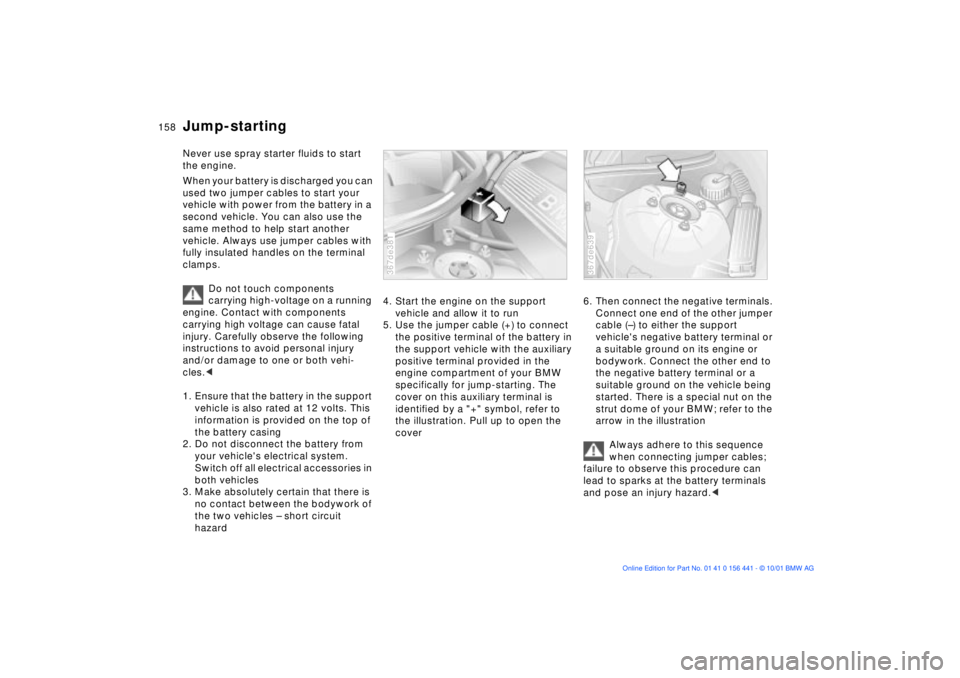
5. Use the jumper cable (+) to connect
the positive terminal of the battery in
the support vehicle with the auxiliary
positive terminal provided in the
engine compartment of your BMW
specifically for jump-starting. The
cover on this auxiliary terminal is
identified by a "+" symbol, refer to
the illustration. Pull up to open the
cover 367de381
6. Then connect the negative terminals.
Connect one end of the other jumper
cable (Ð) to either the support
vehicle's negative battery terminal or
a suitable ground on its engine or
bodywork. Connect the other end to
the negative battery terminal or a
suitable ground on the vehicle being
started. There is a special nut on the
strut dome of your BMW; refer to the
arrow in the illustration
Always adhere to this sequence
when connecting jumper cables;
failure to observe this procedure can
lead to sparks at the battery terminals
and pose an injury hazard.< 367de639
Page 160 of 187
160n
Towing the vehicle
The towed vehicle should always
be the lighter of the two vehicles.
If this is not the case, it will not be
possible to control vehicle handling.<
Tow-startingIt is not possible to start the engine of a
vehicle with an automatic transmission
by towing or pushing the vehicle.
For instructions on jump-starting, refer
to page 158.
Never attempt to use your vehicle to
push another vehicle. This could result
in damage to the energy-absorbing
bumpers.
Towing a vehicle with automatic
transmission1. Place the selector lever in
position "N"
2. Towing speed:
max. 45 mph (70 km/h)
3. Towing distance:
max. 95 miles (150 km)
4. Leave the ignition key in position 1 to
ensure that brake lamps, turn signal
indicators, horn and windshield
wipers remain operative, and to
prevent the steering lock from
engaging
5. Switch on the hazard-warning
flashers (observe applicable legal
regulations).
Find some means of identifying the
vehicle in tow. Place a sign or warning
triangle in the rear window, for
instance.
Even when the electrical system
has failed, make sure that the igni-
tion key remains in position 1 to prevent
the steering lock from engaging.
The steering and brakes are without
power assist when the engine is off.
This means that increased effort is
required for steering and braking.<
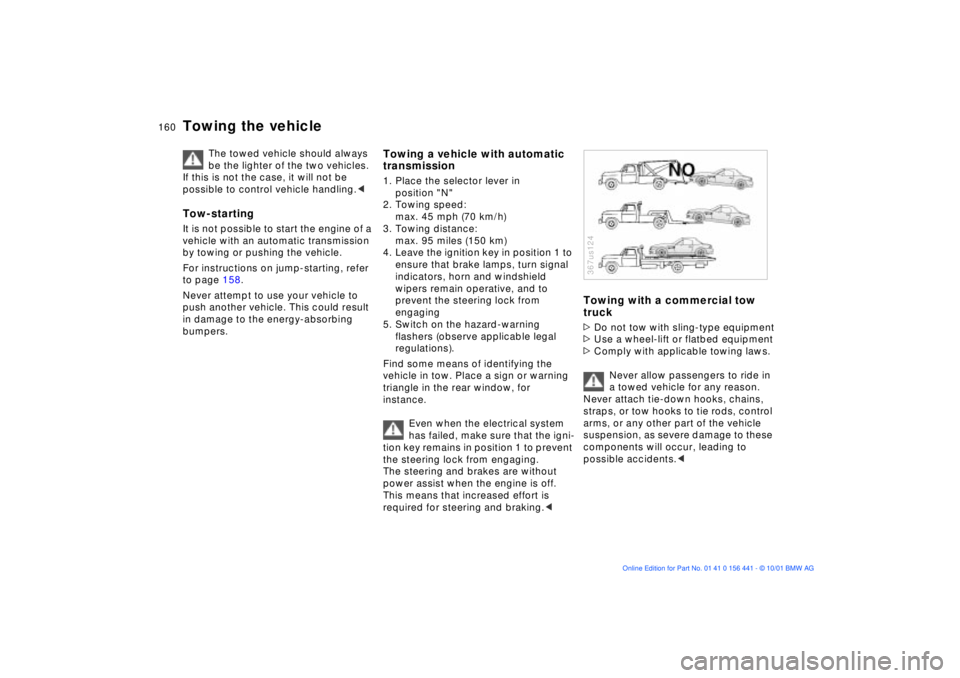
Towing with a commercial tow
truck>Do not tow with sling-type equipment
>Use a wheel-lift or flatbed equipment
>Comply with applicable towing laws.
Never allow passengers to ride in
a towed vehicle for any reason.
Never attach tie-down hooks, chains,
straps, or tow hooks to tie rods, control
arms, or any other part of the vehicle
suspension, as severe damage to these
components will occur, leading to
possible accidents.< 367us124
Page 178 of 187

Everything from A to ZAABS (Antilock Brake
System)101
Accessories6
Adaptive Transmission
Control (ATC)62, 164
ADB (Automatic Differential
Braking)74
Adding
brake fluid126t
engine coolant126t
engine oil123t
washer fluid122t
Additional storage areas90
Adjusting
backrest50
mirrors50, 51
seat49
washer nozzles122t
Air conditioner84
Air distribution82, 86
Air outlets80, 84
ventilation85
Air supply82, 86
Air vents80, 84
Airbags21, 54, 164
important safety
notices130
sitting correctly55Antenna107
Antifreeze126
Antifreeze protection,
radiator105, 125
Antilock Brake System
(ABS)101
Anti-theft system32
Approved gross vehicle
weight172
Approved wheel and tire
specifications116
Aquaplaning99, 111
ASC+T (Automatic Stability
Control plus
Traction)73, 165
Ashtray91
ATC (Adaptive Transmission
Control)62, 164
Automatic cruise control67
Automatic Differential
Braking (ADB)74
Automatic rear window
washer65
Automatic Stability Control
plus Traction
(ASC+T)73, 165
Automatic transmission with
Steptronic62
gear indicator68Automatic windshield
washer122
Average fuel
consumption72
Average speed72
BBackrest, adjusting50
Backup lamps61
bulb replace-
ment139t, 140t
Battery153, 174
capacity174
charge condition154
charging154
discharged158
disposal154t
removal and
installation155
Battery change, keys143
Battery charge indicator
lamp20
Battery safety terminal155
Beverage holder91
BMW High Performance
Synthetic Oil124
Brake fluid126
disposal127tBrake hydraulic system20
Brake lamps, bulb replace-
ment139t, 140t
Brake pads22, 104
Brake system103, 104
brake fluid126
fluid level104
winter road
conditions105
Brakes, malfunctions104
Break-in procedure98
Bulb replacement137t
CCalifornia Proposition
65 Warning132
Capacities173
Car jack146t
Car keys30
Car radio
reception107, 166
refer also to the separate
Owner's Manual
Car wash systems, refer to
the "Caring for your
vehicle" manual
From A to Z