brakes BMW Z3 2002 User Guide
[x] Cancel search | Manufacturer: BMW, Model Year: 2002, Model line: Z3, Model: BMW Z3 2002Pages: 187, PDF Size: 2.73 MB
Page 160 of 187
160n
Towing the vehicle
The towed vehicle should always
be the lighter of the two vehicles.
If this is not the case, it will not be
possible to control vehicle handling.<
Tow-startingIt is not possible to start the engine of a
vehicle with an automatic transmission
by towing or pushing the vehicle.
For instructions on jump-starting, refer
to page 158.
Never attempt to use your vehicle to
push another vehicle. This could result
in damage to the energy-absorbing
bumpers.
Towing a vehicle with automatic
transmission1. Place the selector lever in
position "N"
2. Towing speed:
max. 45 mph (70 km/h)
3. Towing distance:
max. 95 miles (150 km)
4. Leave the ignition key in position 1 to
ensure that brake lamps, turn signal
indicators, horn and windshield
wipers remain operative, and to
prevent the steering lock from
engaging
5. Switch on the hazard-warning
flashers (observe applicable legal
regulations).
Find some means of identifying the
vehicle in tow. Place a sign or warning
triangle in the rear window, for
instance.
Even when the electrical system
has failed, make sure that the igni-
tion key remains in position 1 to prevent
the steering lock from engaging.
The steering and brakes are without
power assist when the engine is off.
This means that increased effort is
required for steering and braking.<
Towing with a commercial tow
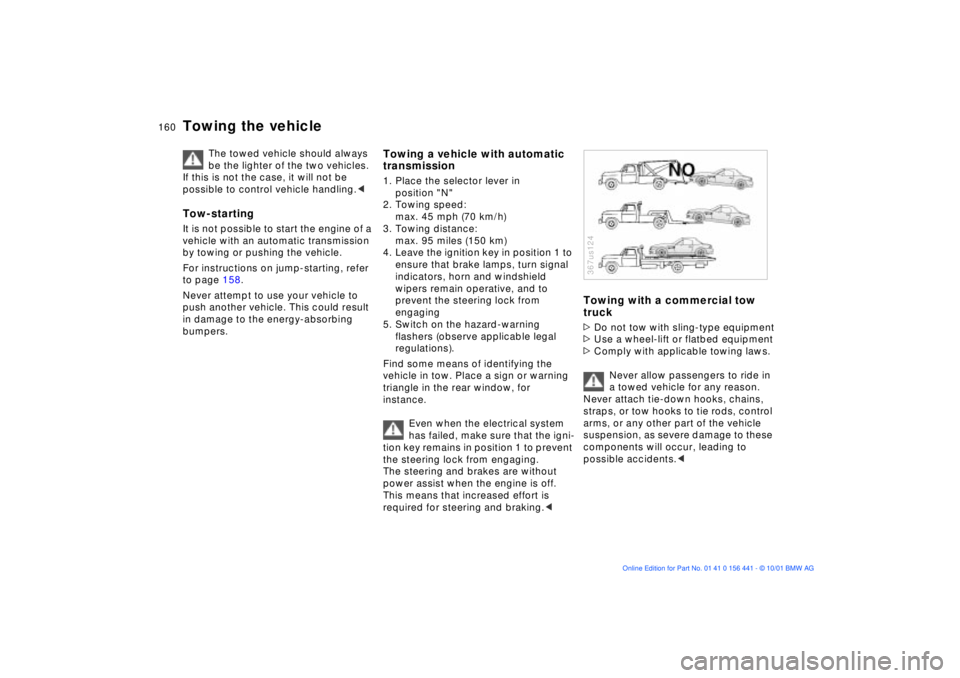
truck>Do not tow with sling-type equipment
>Use a wheel-lift or flatbed equipment
>Comply with applicable towing laws.
Never allow passengers to ride in
a towed vehicle for any reason.
Never attach tie-down hooks, chains,
straps, or tow hooks to tie rods, control
arms, or any other part of the vehicle
suspension, as severe damage to these
components will occur, leading to
possible accidents.< 367us124
Page 164 of 187
164n
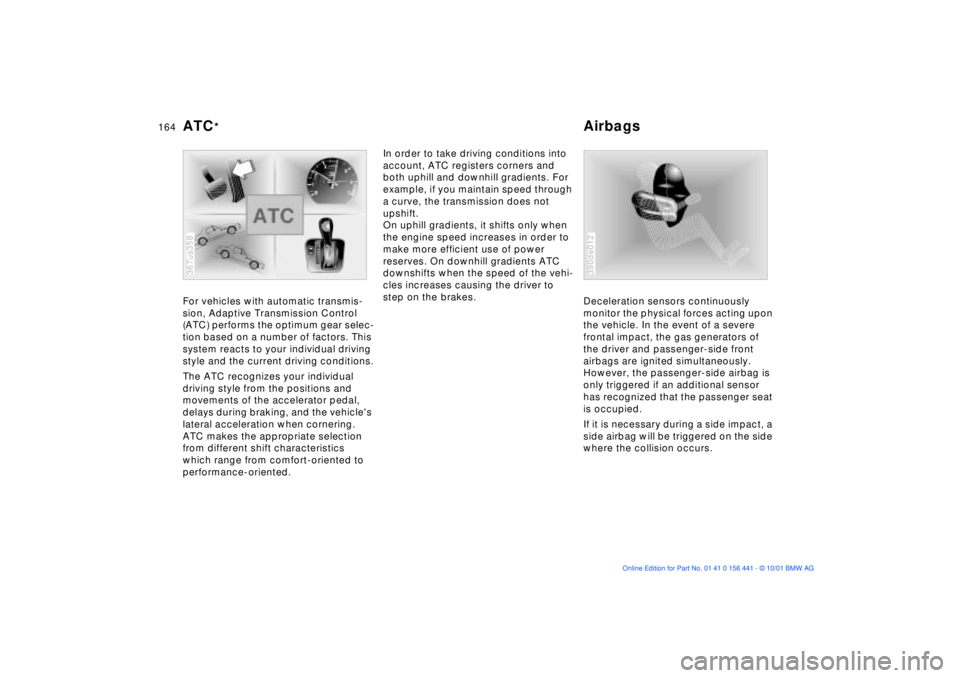
For vehicles with automatic transmis-
sion, Adaptive Transmission Control
(ATC) performs the optimum gear selec-
tion based on a number of factors. This
system reacts to your individual driving
style and the current driving conditions.
The ATC recognizes your individual
driving style from the positions and
movements of the accelerator pedal,
delays during braking, and the vehicle's
lateral acceleration when cornering.
ATC makes the appropriate selection
from different shift characteristics
which range from comfort-oriented to
performance-oriented.
367us358
In order to take driving conditions into
account, ATC registers corners and
both uphill and downhill gradients. For
example, if you maintain speed through
a curve, the transmission does not
upshift.
On uphill gradients, it shifts only when
the engine speed increases in order to
make more efficient use of power
reserves. On downhill gradients ATC
downshifts when the speed of the vehi-
cles increases causing the driver to
step on the brakes.
Deceleration sensors continuously
monitor the physical forces acting upon
the vehicle. In the event of a severe
frontal impact, the gas generators of
the driver and passenger-side front
airbags are ignited simultaneously.
However, the passenger-side airbag is
only triggered if an additional sensor
has recognized that the passenger seat
is occupied.
If it is necessary during a side impact, a
side airbag will be triggered on the side
where the collision occurs.
390de012
ATC
*
Airbags
Page 165 of 187

165n
IndexDataTechnologyRepairsMaintenanceControlsOverview
The airbags located under the marked
covers inflate and unfold in a matter of
a few milliseconds. In this process they
tear through the designed breaking
points of the upholstered covers or
press them out.
Because the inflation process must be
virtually instantaneous, it is necessarily
accompanied by a certain amount of
ignition and inflation noise. The gas
required to inflate the airbags is not
dangerous, and it dissipates together
with the associated smoke.
The entire process is completed within
fractions of a second.Precision sensors monitor the number of
revolutions of the wheels. When
equipped with DSC, they also monitor
steering angle, lateral acceleration,
brake pressure and the movement of the
vehicle around its vertical axis.
If differences in the wheel speeds occur,
ASC+T recognizes the danger of wheel-
spin and reduces the drive torque. If
necessary, the system also responds
with additional applications of the brakes
at the rear wheels.
In addition, DSC permanently monitors
the vehicle's current operating condition
and compares it with an ideal condition
that is calculated from the sensor's
signals. If deviations from this occur
(understeering or oversteering, for
instance), DSC can stabilize the vehicle
in fractions of a second by adjusting
engine output and with the assistance of
braking intervention at individual wheels.
Within physically possible limits
dangerous skids can be prevented even
as they are just beginning.You may need some time to become
accustomed to this system's interven-
tion. However, it provides optimum
propulsive force and driving stability.
The braking intervention may be accom-
panied by a certain degree of noise.Airbags ASC+T/DSC
*
Page 178 of 187

Everything from A to ZAABS (Antilock Brake
System)101
Accessories6
Adaptive Transmission
Control (ATC)62, 164
ADB (Automatic Differential
Braking)74
Adding
brake fluid126t
engine coolant126t
engine oil123t
washer fluid122t
Additional storage areas90
Adjusting
backrest50
mirrors50, 51
seat49
washer nozzles122t
Air conditioner84
Air distribution82, 86
Air outlets80, 84
ventilation85
Air supply82, 86
Air vents80, 84
Airbags21, 54, 164
important safety
notices130
sitting correctly55Antenna107
Antifreeze126
Antifreeze protection,
radiator105, 125
Antilock Brake System
(ABS)101
Anti-theft system32
Approved gross vehicle
weight172
Approved wheel and tire
specifications116
Aquaplaning99, 111
ASC+T (Automatic Stability
Control plus
Traction)73, 165
Ashtray91
ATC (Adaptive Transmission
Control)62, 164
Automatic cruise control67
Automatic Differential
Braking (ADB)74
Automatic rear window
washer65
Automatic Stability Control
plus Traction
(ASC+T)73, 165
Automatic transmission with
Steptronic62
gear indicator68Automatic windshield
washer122
Average fuel
consumption72
Average speed72
BBackrest, adjusting50
Backup lamps61
bulb replace-
ment139t, 140t
Battery153, 174
capacity174
charge condition154
charging154
discharged158
disposal154t
removal and
installation155
Battery change, keys143
Battery charge indicator
lamp20
Battery safety terminal155
Beverage holder91
BMW High Performance
Synthetic Oil124
Brake fluid126
disposal127tBrake hydraulic system20
Brake lamps, bulb replace-
ment139t, 140t
Brake pads22, 104
Brake system103, 104
brake fluid126
fluid level104
winter road
conditions105
Brakes, malfunctions104
Break-in procedure98
Bulb replacement137t
CCalifornia Proposition
65 Warning132
Capacities173
Car jack146t
Car keys30
Car radio
reception107, 166
refer also to the separate
Owner's Manual
Car wash systems, refer to
the "Caring for your
vehicle" manual
From A to Z
Page 179 of 187
Everything from A to Z
179n
IndexDataTechnologyRepairsMaintenanceControlsOverview
Care of paintwork, refer to
the "Caring for your
vehicle" manual
Care of upholstery materials,
refer to the "Caring for your
vehicle" manual
Cargo loading94
Caring for the vehicle finish,
refer to the "Caring for your
vehicle" manual
Catalytic converter100
CBC (Cornering Brake
Control)102
Cellular phone107
refer also to the separate
Owner's Manual
Center (high-mount) brake
lamp141
Central locking system32
Changing a wheel146t
Charge condition of the
battery154t
Charging the battery154t
Chassis number127
Checking oil level123t
Checking tire
pressure26t, 110
Child seat56
Child-restraint device56Child-restraint system56
installation57
Z3 coupe with tether
strap57
Cigarette lighter92
Cleaning the headlamps66
Cleaning the rear
window66
Cleaning the windshield65
Clock70
Cockpit16
Coin box91
Cold start59
Compartments90
Computer70
refer also to the "Owner's
Manual for Onboard
Computer"
Connecting a car vacuum
cleaner92
Controls, cockpit16
Convertible top
electrical
malfunction157t
manual operation157t
operation40, 44
weather protection44
Coolant105, 126Coolant temperature69
Coolant, antifreeze
protection105
Copyright4
Cornering Brake Control
(CBC)102
Cover, convertible
top41, 46
Cruise control67
Cruising range72
Cup holder, refer to
beverage holder91
Curb weight172
DDashboard16
Data link connector for
Onboard Diagnostics133
Daytime driving lamps76
DBC (Dynamic Brake
Control)103
Deep water99
Defrost windows and
remove
condensation83, 88
Defrosting
rear window66
mirrors51Difficult steering106t
Digital clock70
Dimensions171
Dipstick, engine oil123
Disc brakes103
Displacement170
Display lighting76
Displays18
Disposal
batteries154t
brake fluid127t
coolant125t
engine oil125t
Door key30
Doors
electrical
malfunction32t
manual operation32t
operating with the remote
control33
unlocking and locking32
DOT Quality Grades,
tires111
Drive belts174
Driving notes99
Driving through water99