fuel BMW Z3 2002 User Guide
[x] Cancel search | Manufacturer: BMW, Model Year: 2002, Model line: Z3, Model: BMW Z3 2002Pages: 187, PDF Size: 2.73 MB
Page 32 of 187
32n
Central locking system Opening and closing Ð from the outsideThe conceptThe central locking system becomes
operational when the doors are closed.
The system simultaneously engages
and releases the locks on the
>doors
>luggage compartment
>fuel filler door.
The central locking system can be
operated
>from outside via the door locks, the
luggage compartment lock as well as
via the remote control
*
>from inside via the safety lock
buttons (locks doors only).
The anti-theft system is automatically
activated whenever you activate the
central locking system from outside the
vehicle. It prevents the doors from
being unlocked with the lock buttons or
release handles.
The central locking system unlocks
automatically in the event of an acci-
dent. In addition, the hazard warning
flashers and interior lamps come on.
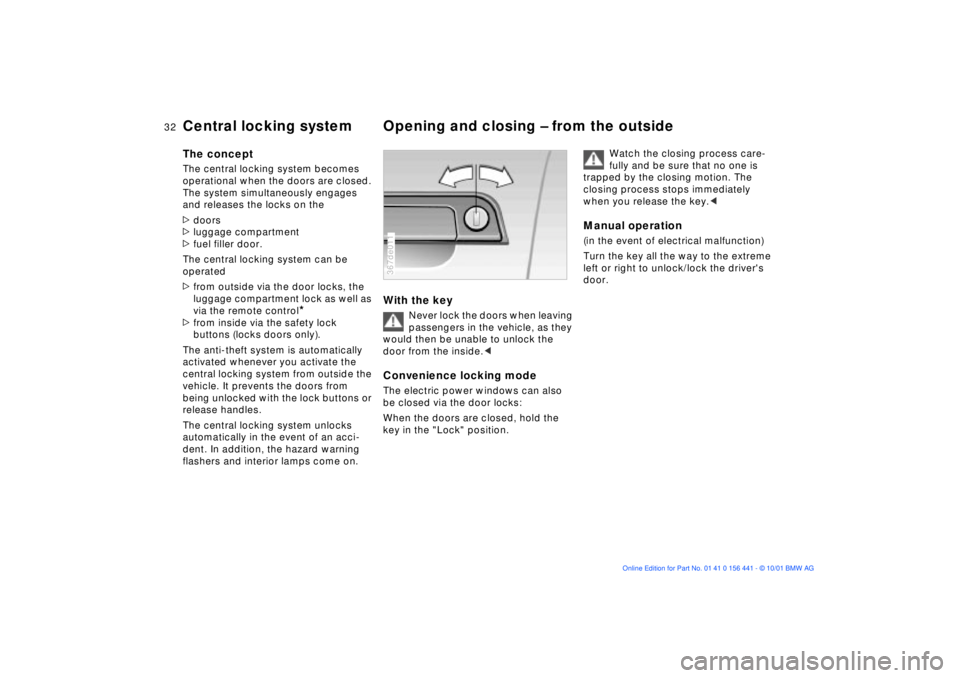
With the key
Never lock the doors when leaving
passengers in the vehicle, as they
would then be unable to unlock the
door from the inside.<
Convenience locking modeThe electric power windows can also
be closed via the door locks:
When the doors are closed, hold the
key in the "Lock" position.367de011
Watch the closing process care-
fully and be sure that no one is
trapped by the closing motion. The
closing process stops immediately
when you release the key.<
Manual operation(in the event of electrical malfunction)
Turn the key all the way to the extreme
left or right to unlock/lock the driver's
door.
Page 36 of 187
36n
Opening and closing Ð from the inside Luggage compartment lidTo unlock and open the doors>Pull the release handle of a door
twice: the initial pull unlocks the door,
and the second opens it.To lock the doorsWhen the safety lock button of any door
is pressed down, the doors and
luggage compartment are locked. The
anti-theft system is not activated.
The fuel filler door also remains
unlocked to allow refueling.
To avoid being accidentally locked out
of the vehicle:
>The vehicle cannot be locked with
the lock button when the driver's
door is open
>The lock button on the passenger's
door only operates the central
locking system if both doors are
closed.Since passengers or animals
remaining in the vehicle might be
able to lock the doors from the inside,
always take the vehicle keys with you
so that the vehicle can be opened again
from the outside at any time.<
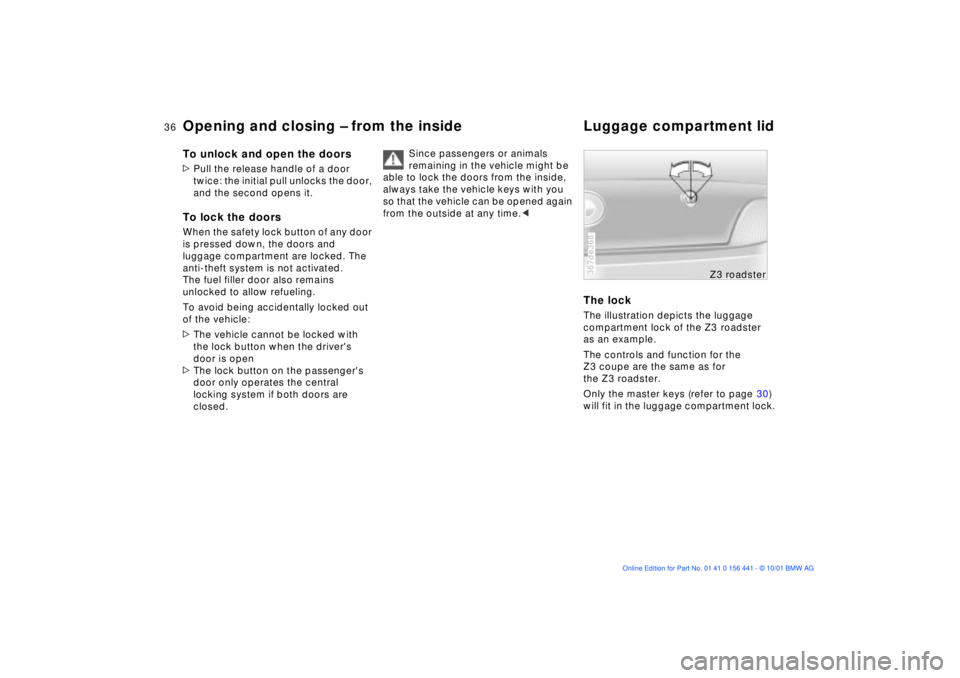
The lockThe illustration depicts the luggage
compartment lock of the Z3 roadster
as an example.
The controls and function for the
Z3 coupe are the same as for
the Z3 roadster.
Only the master keys (refer to page 30)
will fit in the luggage compartment lock.367de368
Z3 roadster
Page 68 of 187
68n
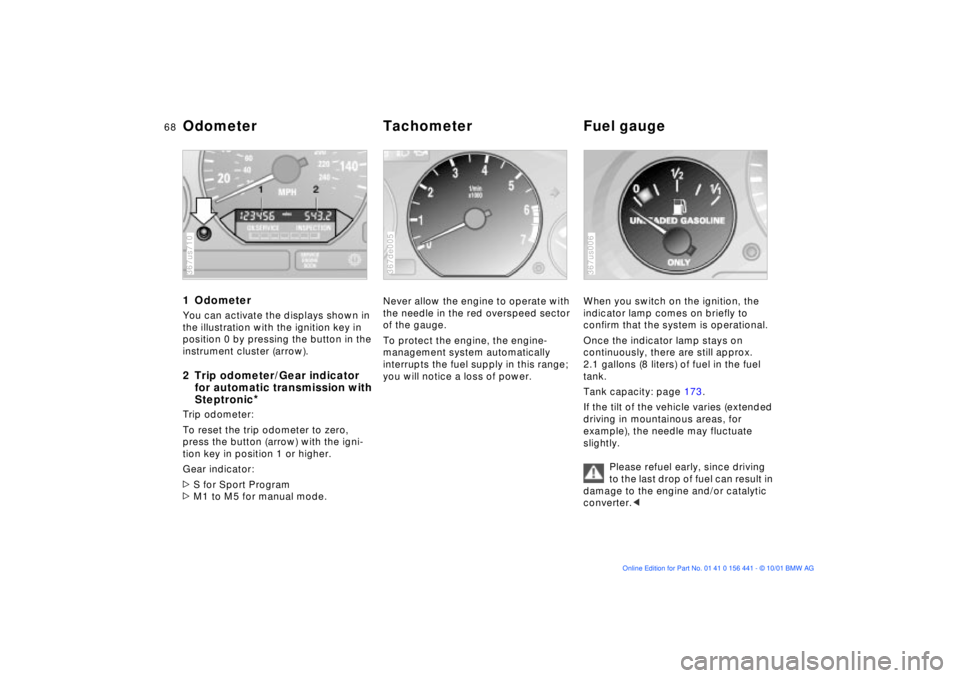
1 OdometerYou can activate the displays shown in
the illustration with the ignition key in
position 0 by pressing the button in the
instrument cluster (arrow).2 Trip odometer/Gear indicator
for automatic transmission with
Steptronic
*
Trip odometer:
To reset the trip odometer to zero,
press the button (arrow) with the igni-
tion key in position 1 or higher.
Gear indicator:
>S for Sport Program
>M1 to M5 for manual mode.367us710
Never allow the engine to operate with
the needle in the red overspeed sector
of the gauge.
To protect the engine, the engine-
management system automatically
interrupts the fuel supply in this range;
you will notice a loss of power.367de005
When you switch on the ignition, the
indicator lamp comes on briefly to
confirm that the system is operational.
Once the indicator lamp stays on
continuously, there are still approx.
2.1 gallons (8 liters) of fuel in the fuel
tank.
Tank capacity: page 173.
If the tilt of the vehicle varies (extended
driving in mountainous areas, for
example), the needle may fluctuate
slightly.
Please refuel early, since driving
to the last drop of fuel can result in
damage to the engine and/or catalytic
converter.< 367us006
Odometer Tachometer Fuel gauge
Page 70 of 187
70n
Clock Computer
*
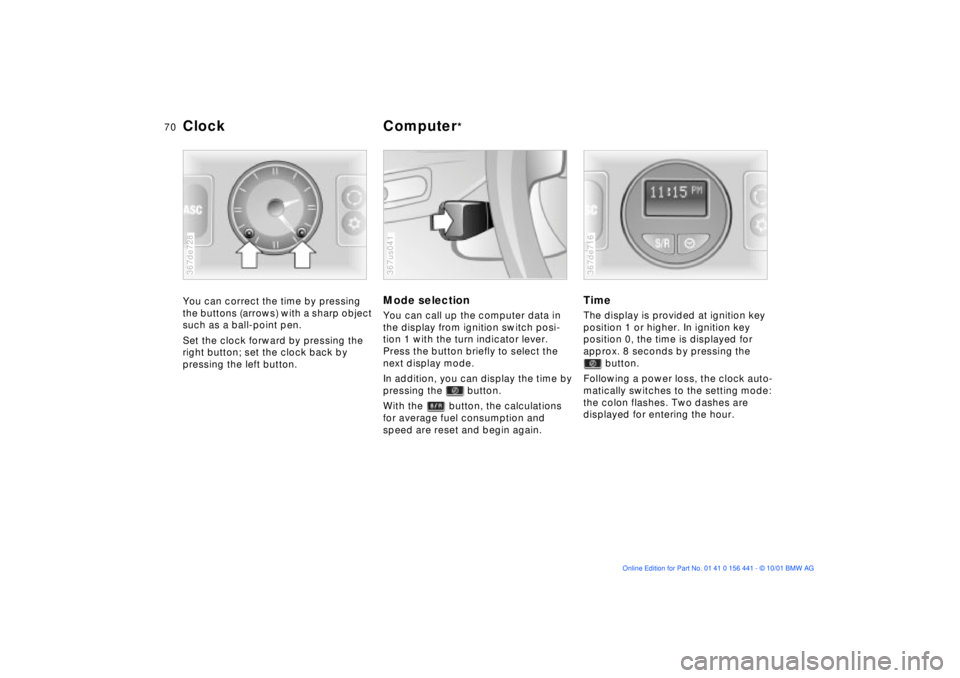
You can correct the time by pressing
the buttons (arrows) with a sharp object
such as a ball-point pen.
Set the clock forward by pressing the
right button; set the clock back by
pressing the left button.367de728
Mode selectionYou can call up the computer data in
the display from ignition switch posi-
tion 1 with the turn indicator lever.
Press the button briefly to select the
next display mode.
In addition, you can display the time by
pressing the button.
With the button, the calculations
for average fuel consumption and
speed are reset and begin again.367us041
TimeThe display is provided at ignition key
position 1 or higher. In ignition key
position 0, the time is displayed for
approx. 8 seconds by pressing the
button.
Following a power loss, the clock auto-
matically switches to the setting mode:
the colon flashes. Two dashes are
displayed for entering the hour.367de716
Page 72 of 187
72n
Computer
*
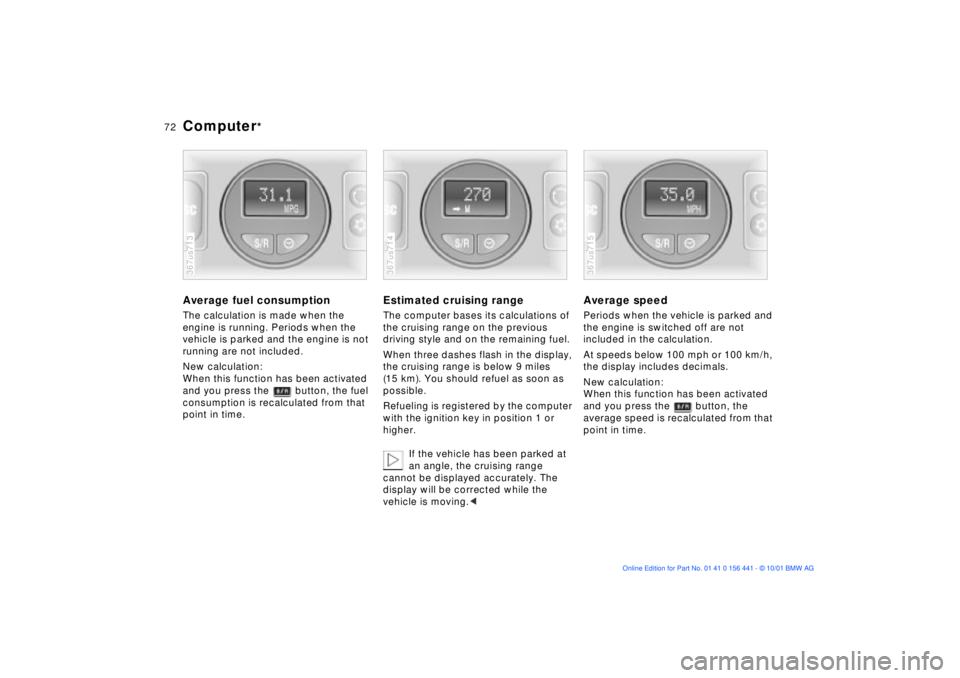
Average fuel consumptionThe calculation is made when the
engine is running. Periods when the
vehicle is parked and the engine is not
running are not included.
New calculation:
When this function has been activated
and you press the button, the fuel
consumption is recalculated from that
point in time.367us713
Estimated cruising rangeThe computer bases its calculations of
the cruising range on the previous
driving style and on the remaining fuel.
When three dashes flash in the display,
the cruising range is below 9 miles
(15 km). You should refuel as soon as
possible.
Refueling is registered by the computer
with the ignition key in position 1 or
higher.
If the vehicle has been parked at
an angle, the cruising range
cannot be displayed accurately. The
display will be corrected while the
vehicle is moving.< 367us714
Average speedPeriods when the vehicle is parked and
the engine is switched off are not
included in the calculation.
At speeds below 100 mph or 100 km/h,
the display includes decimals.
New calculation:
When this function has been activated
and you press the button, the
average speed is recalculated from that
point in time. 367us715
Page 100 of 187

100n
Catalytic converterThe catalytic converter reduces harmful
exhaust emissions.
It is designed for use with unleaded fuel
only.
Even minute quantities of lead would be
enough to permanently damage both
the catalytic converter and the system's
oxygen sensor.
To ensure efficient, trouble-free engine
operation and avoid potential damage:
>Be sure to comply with the scheduled
maintenance requirements
>Fill the fuel tank well before it is
empty
>If the engine runs roughly, shut it off
as soon as possible
>Tow-start the vehicle only when the
engine is cold. Tow-starting when the
engine is warm could cause unburned
fuel to ignite on the way to the cata-
lytic converter, resulting in significant
damage. It is better to start the vehicle
with an outside starting aid>Avoid any other situations in which
the fuel would not be (completely)
burned, for instance:
Frequent or consecutive extended
starting attempts or repeated starting
attempts when the engine fails to
start. (Shutting down and restarting
an engine which is running properly
does not present a problem.) Never
allow the engine to run with any of
the spark plug cables disconnected.Be sure to comply with the
instructions above to prevent
unburned fuel from reaching the cata-
lytic converter. Otherwise, the catalytic
converter could respond by over-
heating, leading to serious damage.
Extreme temperatures occur at the
catalytic converter on this and every
catalyst-equipped vehicle. Heat shields
are installed adjacent to some sections
of the exhaust system. Never remove
these shields; do not apply under-
coating to their surfaces.
When driving, standing while the engine
is idling, or when parking, be careful to
avoid contact between the hot exhaust
system and easily-flammable materials
(hay, dry grass, leaves, etc.). Such
contact could cause a fire, resulting in
personal injuries and property
damage.<
Page 114 of 187

114n
Wheel and tire combinationsThe right choice
Use only wheels and tires
approved by BMW for the corre-
sponding vehicle model, as otherwise
the tires may make contact with the
body as the result of tolerances despite
the same nominal size being used,
resulting in serious accidents. If non-
approved wheels and tires are used,
BMW cannot evaluate their suitability,
and therefore cannot be held liable for
driving safety.<
For wheel and tire specifications
approved by BMW, refer to the informa-
tion beginning on page 116.
The correct wheel and tire combi-
nation affects different systems
such as ABS and ASC+T/DSC
*. The
function of these systems is impaired if
improper wheel and tire combinations
are used.
For this reason, use only tires of the
same manufacture and tread configura-
tion. In the event of a flat tire, for
example, remount the approved wheel
and tire combination as soon as
possible.<
Codes on tires and wheelsThe code on the tires has the following
meaning.
Codes on radial tires:
The speed rating indicates the
approved maximum speed for the tire.
Summer tires:
S = up to 112 mph (180 km/h)
T = up to 118 mph (190 km/h)
H = up to 130 mph (210 km/h)
V = up to 149 mph (240 km/h)
W = up to 167 mph (270 km/h)
Y = up to 186 mph (300 km/h)
ZR = over 149 mph (240 km/h) Example:
Nominal width
in mm
Aspect ratio in %
Belt rating ID code
for radial tires
Wheel diameter in inches
Load rating
(not on ZR tires)
Speed rating
(before R on ZR tires)
205/60 R 15 91 H
All season and winter tires:
Q M+S = up to 100 mph (160 km/h)
T M+S = up to 118 mph (190 km/h)
H M+S = up to 130 mph (210 km/h)
Codes on light-alloy wheels:
Protect valve inserts against dirt by
using screw-on valve caps. Dirt in the
valve inserts frequently causes a slow
loss in tire pressure.Storage Store tires in a cool, dry place,
protecting them against light whenever
possible. Protect the tires against
contact with oil, grease and fuel. Example:
Rim width
in inches
Code letter for
flange type
Symbol for full-drop
center rim
Rim diameter in inches
Hump on the 2 rim shoulders
7x15H2
J
Page 123 of 187
123n
IndexDataTechnologyRepairsMaintenanceControlsOverview
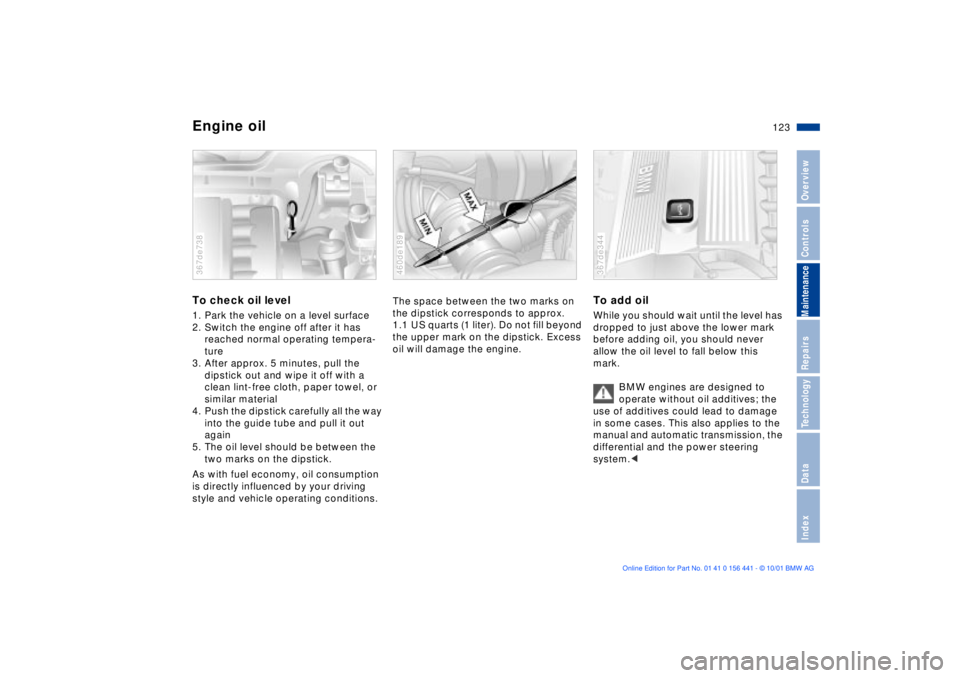
Engine oil To check oil level1. Park the vehicle on a level surface
2. Switch the engine off after it has
reached normal operating tempera-
ture
3. After approx. 5 minutes, pull the
dipstick out and wipe it off with a
clean lint-free cloth, paper towel, or
similar material
4. Push the dipstick carefully all the way
into the guide tube and pull it out
again
5. The oil level should be between the
two marks on the dipstick.
As with fuel economy, oil consumption
is directly influenced by your driving
style and vehicle operating conditions.367de738
The space between the two marks on
the dipstick corresponds to approx.
1.1 US quarts (1 liter). Do not fill beyond
the upper mark on the dipstick. Excess
oil will damage the engine.460de189
To add oilWhile you should wait until the level has
dropped to just above the lower mark
before adding oil, you should never
allow the oil level to fall below this
mark.
BMW engines are designed to
operate without oil additives; the
use of additives could lead to damage
in some cases. This also applies to the
manual and automatic transmission, the
differential and the power steering
system.< 367de344
Page 131 of 187

131n
IndexDataTechnologyRepairsMaintenanceControlsOverview
Storing your vehicle5. Fill the fuel tank completely to
prevent the formation of condensa-
tion
6. Increase the tire inflation pressure to
51 psi (350 kPa).Before parking the vehicle for
storage1. Dry the parking brake and footbrake
by brake applications to prevent the
brake rotors and drums from
corroding
2. Park the vehicle in a covered, dry,
and well-ventilated room. Place the
transmission in 1st gear or set the
selector lever to the "P" position.
Chock the wheels to prevent the
vehicle from rolling if necessary. Do
not set the parking brake
3. Remove the battery, charge it
completely and store it in a cool (but
frost-free) room
Z3 roadster:
4. Remove the hardtop
* and store it
separately, refer to page 109
5. Close the convertible top.
During storageRecharge the battery every six months.
If it is not recharged, it will not be
serviceable. Every time the battery is
discharged, especially over extended
periods, its service life is reduced.
Removing the vehicle from
storageRecharge the battery if the "Magic Eye"
turns black, refer to page 154.
Then have Inspection I performed by
your BMW center, including a brake
fluid replacement if necessary, refer to
the Service Manual.
Page 135 of 187
Overview
Controls and features
Operation, maintenance
Owner service procedures
Technical data
Index Advanced technology
135n
IndexDataTechnologyRepairsMaintenanceControlsOverview
Replacement procedures:
Onboard tool kit136
Windshield wiper blades136
Lamps and bulbs137
Master key with battery
lamp143
Remote control144
Wheel change146
Battery153
Fuses156
In case of electrical
malfunction:
Power convertible top157
Fuel filler door157
Assistance, giving and
receiving:
Jump-starting158
Towing the vehicle159
Repairs