light BMW Z3 2002 User Guide
[x] Cancel search | Manufacturer: BMW, Model Year: 2002, Model line: Z3, Model: BMW Z3 2002Pages: 187, PDF Size: 2.73 MB
Page 54 of 187
54n
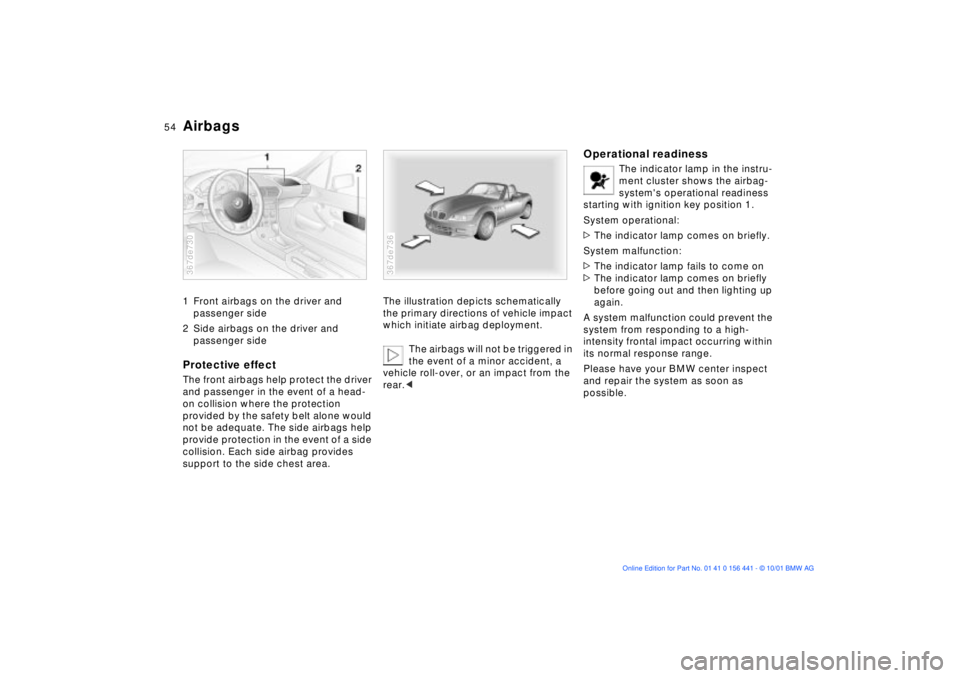
Airbags1 Front airbags on the driver and
passenger side
2 Side airbags on the driver and
passenger sideProtective effectThe front airbags help protect the driver
and passenger in the event of a head-
on collision where the protection
provided by the safety belt alone would
not be adequate. The side airbags help
provide protection in the event of a side
collision. Each side airbag provides
support to the side chest area.367de730
The illustration depicts schematically
the primary directions of vehicle impact
which initiate airbag deployment.
The airbags will not be triggered in
the event of a minor accident, a
vehicle roll-over, or an impact from the
rear.< 367de736
Operational readiness
The indicator lamp in the instru-
ment cluster shows the airbag-
system's operational readiness
starting with ignition key position 1.
System operational:
>The indicator lamp comes on briefly.
System malfunction:
>The indicator lamp fails to come on
>The indicator lamp comes on briefly
before going out and then lighting up
again.
A system malfunction could prevent the
system from responding to a high-
intensity frontal impact occurring within
its normal response range.
Please have your BMW center inspect
and repair the system as soon as
possible.
Page 58 of 187
58n
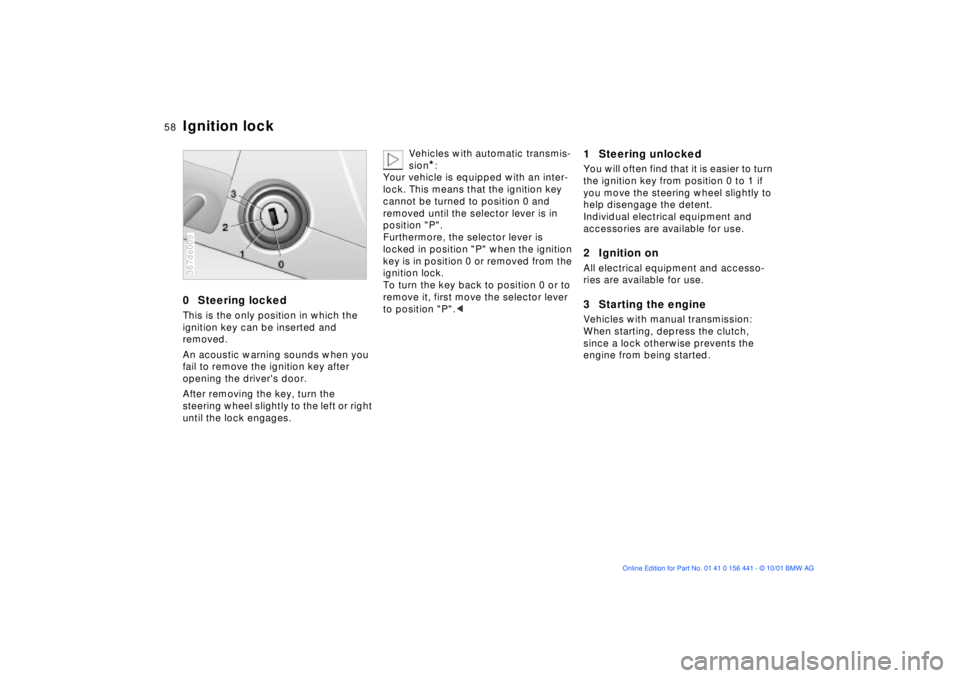
0 Steering lockedThis is the only position in which the
ignition key can be inserted and
removed.
An acoustic warning sounds when you
fail to remove the ignition key after
opening the driver's door.
After removing the key, turn the
steering wheel slightly to the left or right
until the lock engages.367de009
Vehicles with automatic transmis-
sion
*:
Your vehicle is equipped with an inter-
lock. This means that the ignition key
cannot be turned to position 0 and
removed until the selector lever is in
position "P".
Furthermore, the selector lever is
locked in position "P" when the ignition
key is in position 0 or removed from the
ignition lock.
To turn the key back to position 0 or to
remove it, first move the selector lever
to position "P".<
1 Steering unlockedYou will often find that it is easier to turn
the ignition key from position 0 to 1 if
you move the steering wheel slightly to
help disengage the detent.
Individual electrical equipment and
accessories are available for use.2 Ignition onAll electrical equipment and accesso-
ries are available for use.3 Starting the engineVehicles with manual transmission:
When starting, depress the clutch,
since a lock otherwise prevents the
engine from being started.
Ignition lock
Page 60 of 187
60n
Switching off the engine Parking brakeTurn the ignition key to position 1 or 0.
Do not remove the ignition key
while the vehicle is rolling. The
steering locks and it is impossible to
steer the vehicle.
Always remove the ignition key and
engage the steering lock before leaving
the vehicle.
Vehicles with manual transmission:
Always engage the parking brake when
parking on slopes and inclined
surfaces, since even placing the gear-
shift lever in 1st gear or reverse may not
provide adequate resistance to rolling.
Vehicles with automatic transmission:
Place the selector lever in "P".<
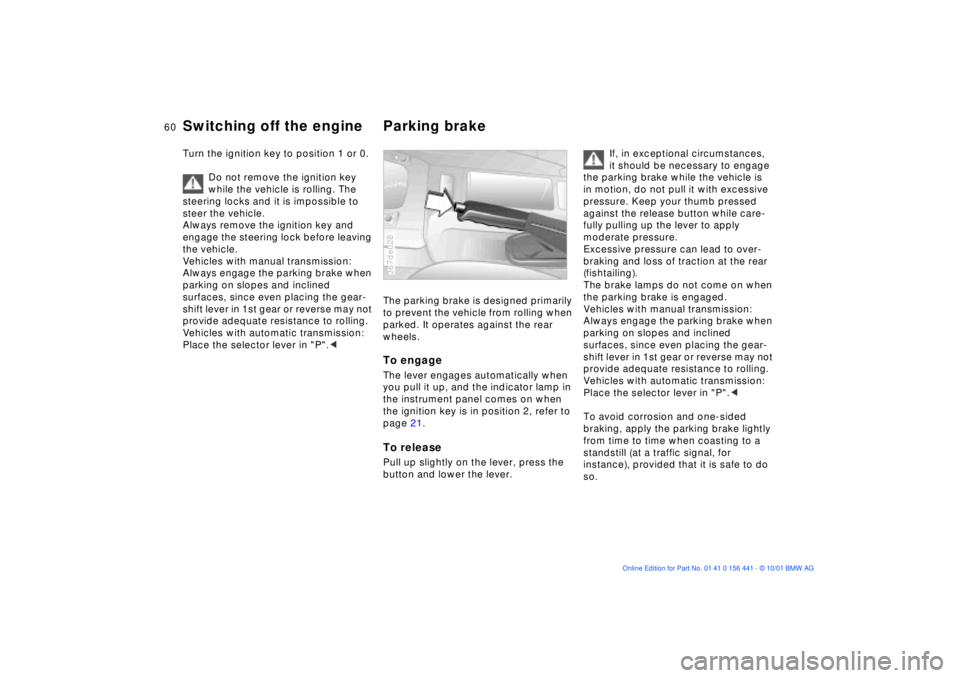
The parking brake is designed primarily
to prevent the vehicle from rolling when
parked. It operates against the rear
wheels.To engageThe lever engages automatically when
you pull it up, and the indicator lamp in
the instrument panel comes on when
the ignition key is in position 2, refer to
page 21.To releasePull up slightly on the lever, press the
button and lower the lever.367de028
If, in exceptional circumstances,
it should be necessary to engage
the parking brake while the vehicle is
in motion, do not pull it with excessive
pressure. Keep your thumb pressed
against the release button while care-
fully pulling up the lever to apply
moderate pressure.
Excessive pressure can lead to over-
braking and loss of traction at the rear
(fishtailing).
The brake lamps do not come on when
the parking brake is engaged.
Vehicles with manual transmission:
Always engage the parking brake when
parking on slopes and inclined
surfaces, since even placing the gear-
shift lever in 1st gear or reverse may not
provide adequate resistance to rolling.
Vehicles with automatic transmission:
Place the selector lever in "P".<
To avoid corrosion and one-sided
braking, apply the parking brake lightly
from time to time when coasting to a
standstill (at a traffic signal, for
instance), provided that it is safe to do
so.
Page 68 of 187
68n
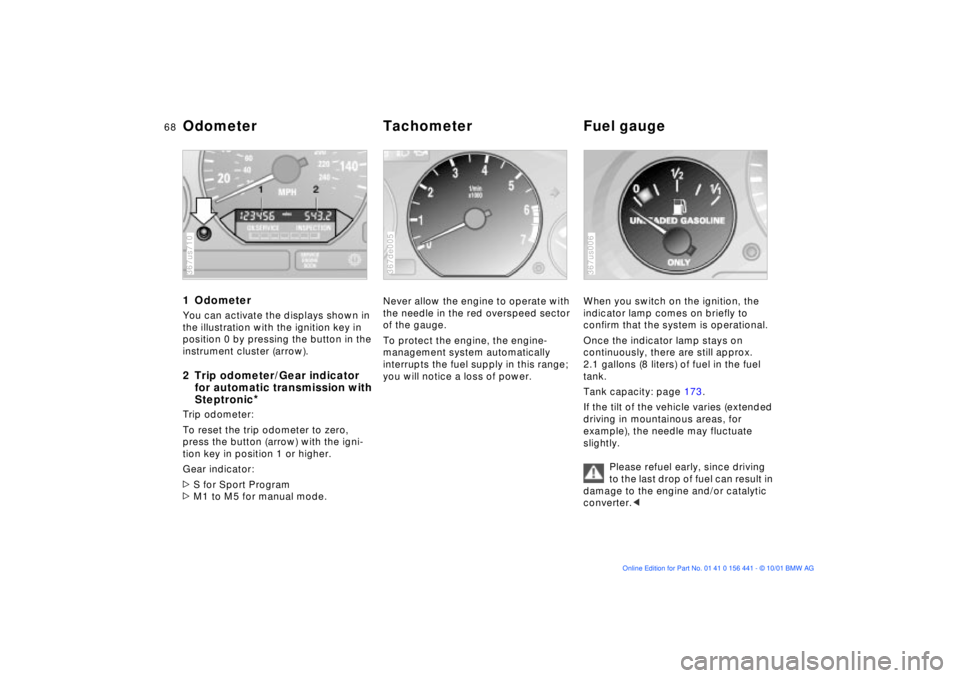
1 OdometerYou can activate the displays shown in
the illustration with the ignition key in
position 0 by pressing the button in the
instrument cluster (arrow).2 Trip odometer/Gear indicator
for automatic transmission with
Steptronic
*
Trip odometer:
To reset the trip odometer to zero,
press the button (arrow) with the igni-
tion key in position 1 or higher.
Gear indicator:
>S for Sport Program
>M1 to M5 for manual mode.367us710
Never allow the engine to operate with
the needle in the red overspeed sector
of the gauge.
To protect the engine, the engine-
management system automatically
interrupts the fuel supply in this range;
you will notice a loss of power.367de005
When you switch on the ignition, the
indicator lamp comes on briefly to
confirm that the system is operational.
Once the indicator lamp stays on
continuously, there are still approx.
2.1 gallons (8 liters) of fuel in the fuel
tank.
Tank capacity: page 173.
If the tilt of the vehicle varies (extended
driving in mountainous areas, for
example), the needle may fluctuate
slightly.
Please refuel early, since driving
to the last drop of fuel can result in
damage to the engine and/or catalytic
converter.< 367us006
Odometer Tachometer Fuel gauge
Page 76 of 187
76n
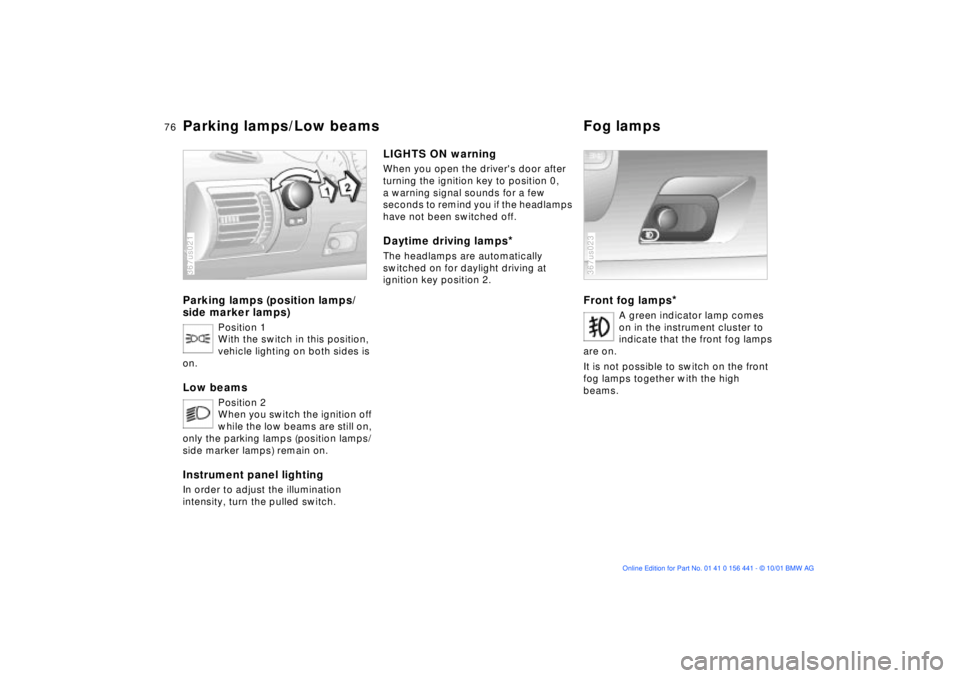
Parking lamps/Low beams Fog lampsParking lamps (position lamps/
side marker lamps)
Position 1
With the switch in this position,
vehicle lighting on both sides is
on.
Low beams
Position 2
When you switch the ignition off
while the low beams are still on,
only the parking lamps (position lamps/
side marker lamps) remain on.
Instrument panel lightingIn order to adjust the illumination
intensity, turn the pulled switch. 367us021
LIGHTS ON warningWhen you open the driver's door after
turning the ignition key to position 0,
a warning signal sounds for a few
seconds to remind you if the headlamps
have not been switched off.Daytime driving lamps
*
The headlamps are automatically
switched on for daylight driving at
ignition key position 2.
Front fog lamps
*
A green indicator lamp comes
on in the instrument cluster to
indicate that the front fog lamps
are on.
It is not possible to switch on the front
fog lamps together with the high
beams.
367us023
Page 92 of 187
92n
Cigarette lighter
*
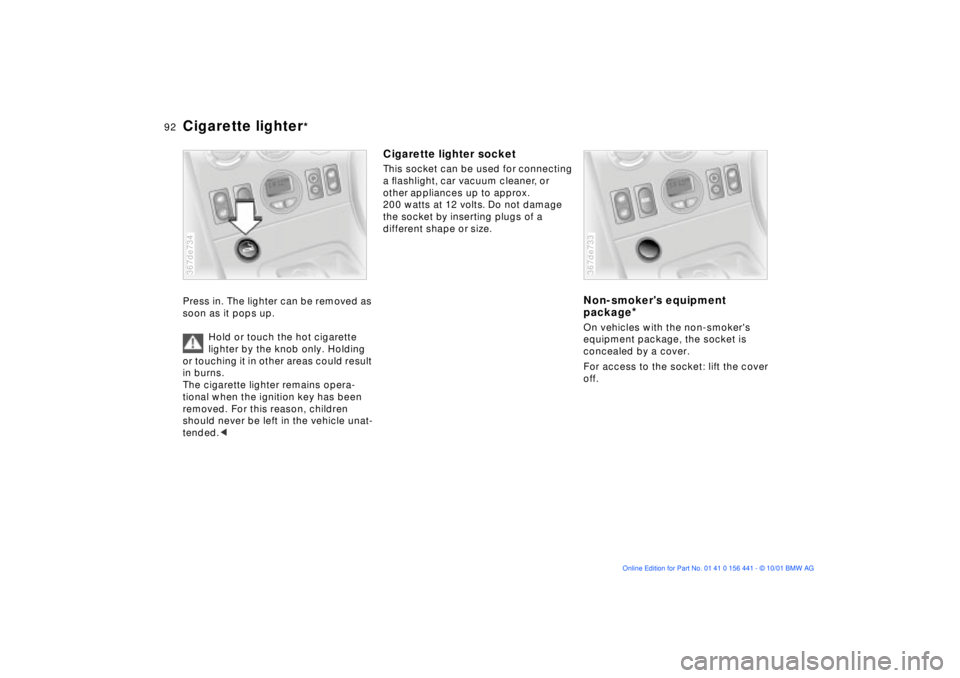
Press in. The lighter can be removed as
soon as it pops up.
Hold or touch the hot cigarette
lighter by the knob only. Holding
or touching it in other areas could result
in burns.
The cigarette lighter remains opera-
tional when the ignition key has been
removed. For this reason, children
should never be left in the vehicle unat-
tended.< 367de734
Cigarette lighter socketThis socket can be used for connecting
a ßashlight, car vacuum cleaner, or
other appliances up to approx.
200 watts at 12 volts. Do not damage
the socket by inserting plugs of a
different shape or size.
Non-smoker's equipment
package
*
On vehicles with the non-smoker's
equipment package, the socket is
concealed by a cover.
For access to the socket: lift the cover
off.367de733
Page 93 of 187
93n
IndexDataTechnologyRepairsMaintenanceControlsOverview
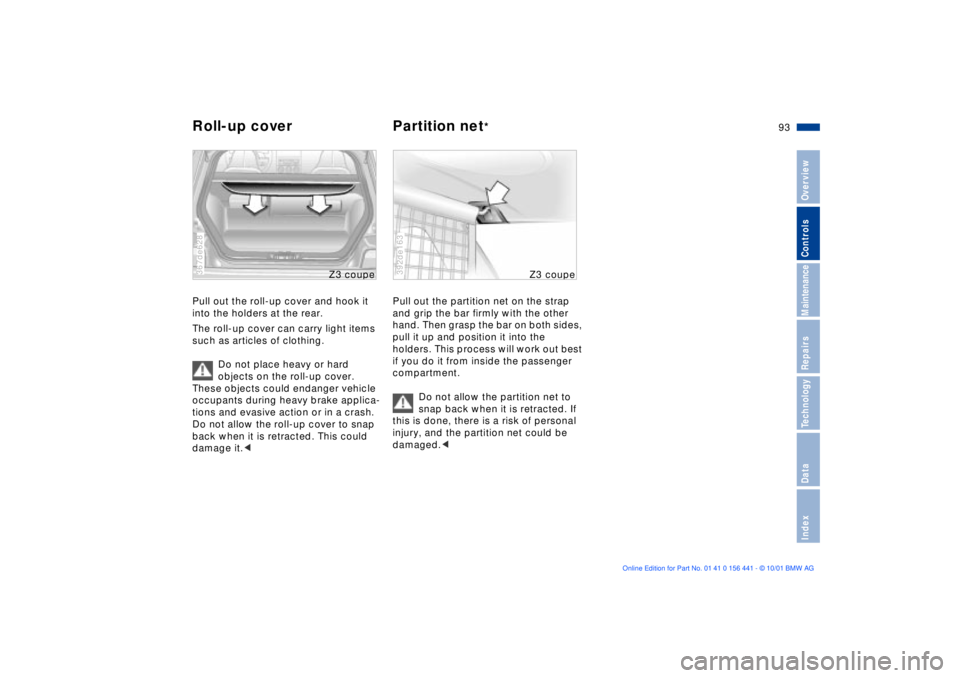
Pull out the roll-up cover and hook it
into the holders at the rear.
The roll-up cover can carry light items
such as articles of clothing.
Do not place heavy or hard
objects on the roll-up cover.
These objects could endanger vehicle
occupants during heavy brake applica-
tions and evasive action or in a crash.
Do not allow the roll-up cover to snap
back when it is retracted. This could
damage it.< 367de628
Z3 cou
pe
Pull out the partition net on the strap
and grip the bar firmly with the other
hand. Then grasp the bar on both sides,
pull it up and position it into the
holders. This process will work out best
if you do it from inside the passenger
compartment.
Do not allow the partition net to
snap back when it is retracted. If
this is done, there is a risk of personal
injury, and the partition net could be
damaged.< 392de163
Z3 cou
pe
Roll-up cover Partition net
*
Page 98 of 187

98n
To ensure that your vehicle provides
maximum economy throughout a long
service life, we request that you
observe the following:
Engine and differentialUp to 1,200 miles (2,000 km):
Drive with varying engine and road
speeds, but do not exceed 4,500 rpm
or 100 mph (150 km/h).
Comply with local and state maximum
speed limits.
Refrain from using full throttle and avoid
pressing the accelerator beyond the
kickdown point.
After you have driven 1,200 miles
(2,000 km), you can gradually increase
the engine and road speeds.
You should also comply with these
break-in procedures if the engine or
differential is replaced later in the
course of the vehicle's service life.
TiresDue to technical factors associated with
their manufacture, tires do not achieve
their full traction potential until an initial
break-in period has elapsed. You should
therefore drive with extra caution during
the initial 200 miles (300 km).
Comply with local and state maximum
speed limits.
When the vehicle is operated on
wet or slushy roads, a wedge of
water may form between the tire and
the road surface. This phenomenon is
referred to as aquaplaning or hydro-
planing, and can lead to partial or
complete loss of traction, vehicle
control and braking effectiveness.
Reduce your speed on wet roads.<
Brake systemApprox. 300 miles (500 km) must
elapse before the brake pads and
rotors achieve the optimal surface and
wear pattern.
To break-in the separate parking brake
drums, apply the parking brake lightly
when coasting to a standstill (at a traffic
signal, for instance), provided that
traffic conditions allow you to do so.
To avoid corrosion, repeat this proce-
dure from time to time.
The brake lamps do not light up
when the parking brake is applied.
Vacuum for the brake system booster
on your BMW is available only when the
engine is running. When you move the vehicle with the engine off Ð for instance
,
by towing Ð substantially higher levels
of pedal force will be required to brake
the vehicle.<
ClutchThe clutch will reach optimal function
after approx. 300 miles (500 km). Shift
gears carefully during the break-in
period.
Break-in procedure
Page 99 of 187

99n
IndexDataTechnologyRepairsMaintenanceControlsOverview
Driving notes
Brakes:
Do not drive with your foot resting
on the brake pedal. Even light but
consistent pedal pressure can lead to
high temperatures, brake wear and
possibly even brake failure.
Aquaplaning:
When driving on wet or slushy roads,
reduce vehicle speed. If you do not, a
wedge of water may form between the
tires and the road surface. This
phenomenon is referred to as aqua-
planing or hydroplaning. It is character-
ized by a partial or complete loss of
contact between the tires and the road
surface. The ultimate results are loss of
steering and braking control.
Driving through water:
When there is water on the roads, do
not drive in it if it is deeper than 1 ft
(30 cm). If the water is at that depth,
drive only at walking speed, otherwise
the vehicle can sustain damage to the
engine, the electrical systems and the
transmission.
Clothes hooks (coupe):
Hang items of clothing on the hooks in
such a manner that they do not obstruct
the driver's vision. Do not hang heavy
objects on the hooks. If you do so, they
could cause personal injury during
braking or evasive maneuvers.<
Page 103 of 187
103n
IndexDataTechnologyRepairsMaintenanceControlsOverview
ABS Disc brakesDynamic Brake Control (DBC)*DBC is included in the DSC, refer to
information beginning on page 74.
If you step on the brake rapidly, this
system automatically produces
maximum braking force boost and thus
helps to achieve the shortest possible
braking distance during "panic stops".
All of the benefits of the ABS system
are exploited under these circum-
stances.
Do not reduce the pressure on the
brake pedal for the duration of the
brake application. When the brake
pedal is released, the DBC is deacti-
vated.
In the event of a malfunction,
the brake warning lamp lights up
yellow. Normal braking effi-
ciency is still fully available.
Have the system checked and
repaired at your BMW center as
soon as possible.
Please observe the section "Infor-
mation for your safety" concerning
the ABS system, which also applies to
the DSC system.<
Disc brakes furnish optimum decelera-
tion and braking control and greater
fade resistance under heavy use.
When the vehicle is driven only occa-
sionally, during extended periods when
the vehicle is not used at all, or in oper-
ating conditions where brake applica-
tions are less frequent, there is an
increased tendency for corrosion of the
rotors and accumulation of contamina-
tion on the brake pads. This occurs
because the minimal pressure which
must be exerted by the pads to clean
the rotors by brake applications is not
reached.
If the brake rotors are corroded, they
will tend to respond to braking with a
pulsating effect which even extended
application will fail to cure.
For your own safety: use only
brake pads that BMW has
approved for your specific vehicle
model. BMW cannot evaluate non-
approved brake pads to determine if
they are suited for use, and therefore
cannot ensure the operating safety of
the vehicle in the event of their use.<
Driving notesWhile driving in wet conditions and in
heavy rain, it is advisable to apply light
pressure to the brake pedal every few
miles Ð watch traffic conditions to
ensure that this maneuver does not
endanger other road users. The heat
generated in this process helps dry the
pads and rotors.
Maximum braking force is obtained
while the wheels continue to rotate,
peaking when the wheels remain on the
verge of locking without actually doing
so. ABS maintains this state automati-
cally. If the ABS fails, you should revert
to the staggered braking technique
described on page 106.
Extended or steep mountain descents
should be driven in the gear in which
only minimal periodic brake application
is required. This avoids excessive strain
on the brakes and possible
impairment of the braking effect.
You can increase the engine's braking
effect by selecting progressively lower
gears, downshifting into first gear, if
necessary. You can also downshift into
first gear if you are using the manual
mode in a vehicle with automatic trans-
mission, refer to page 63.