steering BMW Z3 2002 User Guide
[x] Cancel search | Manufacturer: BMW, Model Year: 2002, Model line: Z3, Model: BMW Z3 2002Pages: 187, PDF Size: 2.73 MB
Page 101 of 187

101n
IndexDataTechnologyRepairsMaintenanceControlsOverview
Antilock Brake System (ABS)The conceptThe Antilock Brake System (ABS) keeps
the wheels from locking during braking,
thereby enhancing active driving safety.
The reason: locked wheels are
dangerous. When the front wheels
slide, the driver loses steering control
over the vehicle. Traction loss at the
rear wheels can cause the rear end to
break into an uncontrolled skid.
The system can achieve the shortest
braking distances possible under most
conditions (on straight-aways or in
curves, on the various road surfaces).
ABS is designed to meet two essential
requirements during every brake appli-
cation:
>To help provide vehicle stability
>Assured ability to steer and maneuver
on the various road surfaces (asphalt,
concrete, dirt, wet conditions, snow
and ice).
Braking with ABSThe system is operative once the
vehicle exceeds a speed of approx.
6 mph (10 km/h). It is inactive once
again below approx. 4 mph (6 km/h).
Therefore, the wheels could theoreti-
cally tend to lock in the final phase of a
braking action, but this is insignificant in
actual practice.
If you are in a situation which requires
full braking, you will exploit the full
benefits of the ABS system if you apply
maximum brake pressure ("panic stop").
Since the vehicle maintains steering
responsiveness, you can avoid possible
obstacles with a minimum of steering
effort, despite the full brake application.The ABS closed-loop control circuit
cycles in fractions of a second. The
pulsation at the brake pedal, together
with sounds generated by the hydraulic
control system, indicate to you that the
vehicle is approaching its maximum
braking range. It is a reminder to you
that you must adapt the vehicle's road
speed to existing road conditions.
On road surfaces that have a loose
surface layer on a firm base with good
traction (on gravel, deep sand or snow,
for example), braking distances may be
longer than with locked wheels. This
also applies for driving with snow
chains. However, ABS continues to
provide enhanced vehicle stability and
steering response under these condi-
tions.
Page 102 of 187
102n
Antilock Brake System (ABS)Information for your safetyNot even ABS can suspend the laws
of physics. ABS alone cannot prevent
accidents if the brakes are applied
without an adequate, safe distance
between vehicles or if the speed limit
has been exceeded. Nor can it prevent
the hazards of aquaplaning. Responsi-
bility for these types of situations
remains in the hands (and at the feet) of
the driver. You should never allow the
added safety of ABS to lull you into a
false sense of security, or mislead you
into taking increased risks that could
affect your own safety and that of
others.
Do not make any modifications to
the ABS system.
Service procedures on ABS are to be
performed by authorized technicians
only.< Antilock Brake System (ABS)/
Cornering Brake Control (CBC)CBC is an advanced engineering
design of the ABS. When braking while
cornering at high speed or braking
during high lateral acceleration, or
when braking during a lane change,
vehicle stability is improved and
steering response is enhanced.
In the event of a fault
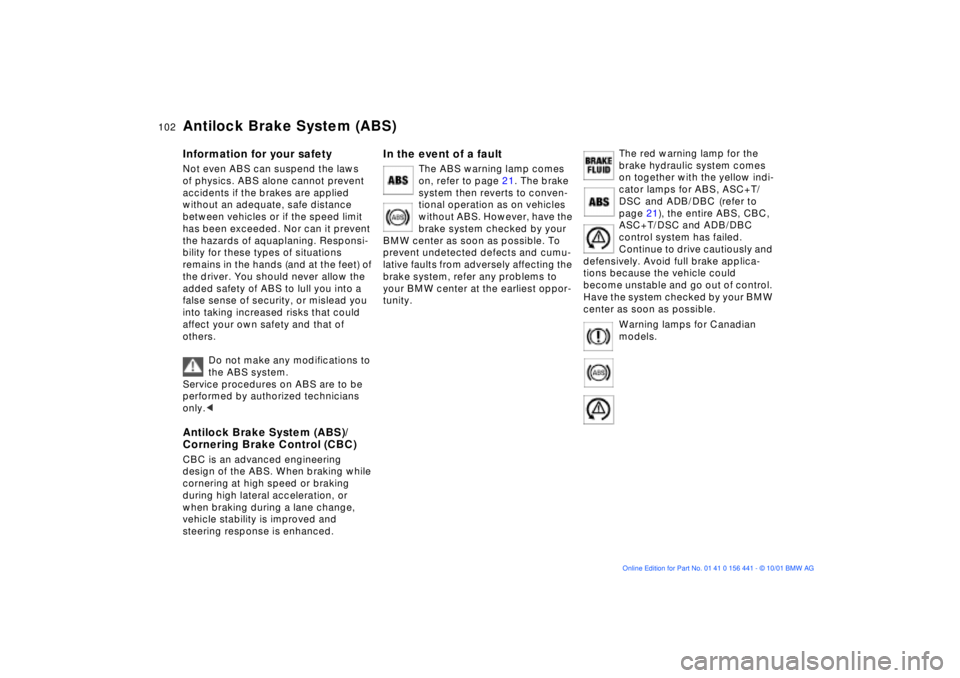
The ABS warning lamp comes
on, refer to page 21. The brake
system then reverts to conven-
tional operation as on vehicles
without ABS. However, have the
brake system checked by your
BMW center as soon as possible. To
prevent undetected defects and cumu-
lative faults from adversely affecting the
brake system, refer any problems to
your BMW center at the earliest oppor-
tunity.
The red warning lamp for the
brake hydraulic system comes
on together with the yellow indi-
cator lamps for ABS, ASC+T/
DSC
and ADB/DBC
(refer to
page 21), the entire ABS, CBC,
ASC+T/DSC and ADB/DBC
control system has failed.
Continue to drive cautiously and
defensively. Avoid full brake applica-
tions because the vehicle could
become unstable and go out of control.
Have the system checked by your BMW
center as soon as possible.
Warning lamps for Canadian
models.
Page 104 of 187
104n
Disc brakes Brake system Should engine braking prove inade-
quate, you should still avoid extended,
continuous braking. Instead, decelerate
the vehicle with increased pressure on
the brake pedal (watch for following
traffic), release the pedal and then
repeat the brake application (staggered
braking). This staggered braking tech-
nique allows the brakes to cool in the
intervals between active braking
phases, preventing overheating and
ensuring that full braking capacity
remains available at all times.
Do not coast with the clutch
depressed or with the transmis-
sion or selector lever in Neutral. Do not
coast with the engine switched off. The
engine provides no braking effect when
the clutch is depressed and there is no
power-assist for braking or steering
when the engine is not running.
Never allow floor mats, carpets or any
other objects to protrude into the area
around the accelerator, clutch and
brake pedals and obstruct their move-
ment.<
Brake fluid level
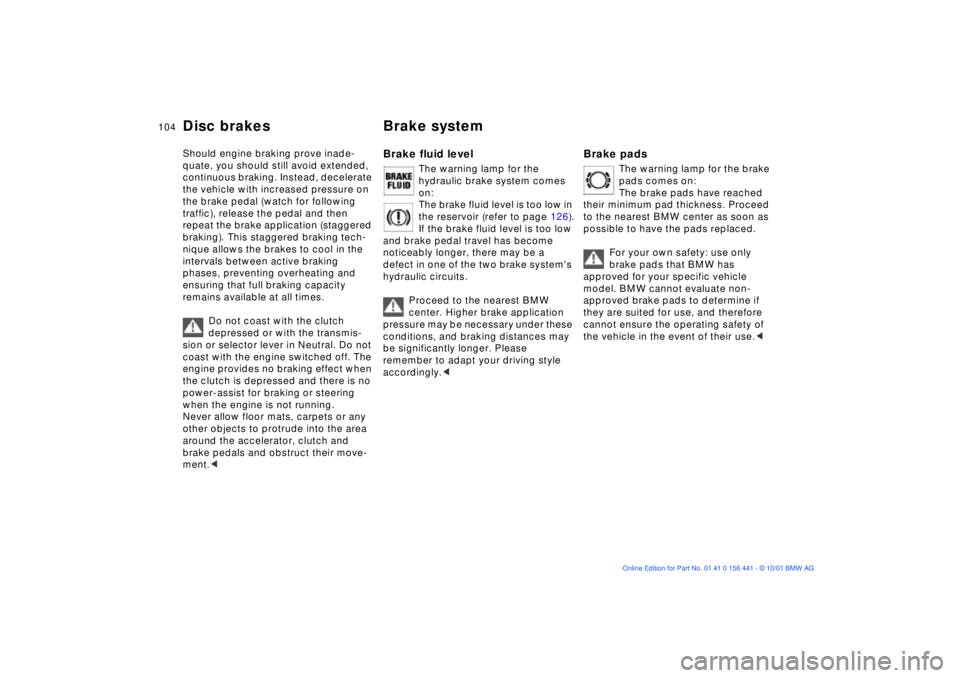
The warning lamp for the
hydraulic brake system comes
on:
The brake fluid level is too low in
the reservoir (refer to page 126).
If the brake fluid level is too low
and brake pedal travel has become
noticeably longer, there may be a
defect in one of the two brake system's
hydraulic circuits.
Proceed to the nearest BMW
center. Higher brake application
pressure may be necessary under these
conditions, and braking distances may
be significantly longer. Please
remember to adapt your driving style
accordingly.<
Brake pads
The warning lamp for the brake
pads comes on:
The brake pads have reached
their minimum pad thickness. Proceed
to the nearest BMW center as soon as
possible to have the pads replaced.
For your own safety: use only
brake pads that BMW has
approved for your specific vehicle
model. BMW cannot evaluate non-
approved brake pads to determine if
they are suited for use, and therefore
cannot ensure the operating safety of
the vehicle in the event of their use.<
Page 105 of 187

105n
IndexDataTechnologyRepairsMaintenanceControlsOverview
Winter operationThe onset of winter is often accompa-
nied by rapid changes in weather.
Adaptations in driving style should be
accompanied by preparations on the
vehicle itself to ensure that your vehicle
operation through the winter remains
safe and trouble-free.CoolantEnsure that the coolant contains the
year-round 50 : 50 ratio of water and
antifreeze with corrosion inhibitor. This
mixture provides protection against
freezing down to approx. Ð 34 7
(Ð 37 6). Replace the coolant every
three years.LocksBMW door lock deicer can be used to
free the doors if they are frozen. This
deicer also contains lubricant.
After using deicer, treatment with BMW
lock cylinder grease is recommended.
Rubber seals and components In order to prevent freezing, apply BMW
rubber treatment to weather-stripping
on the doors, hood, luggage compart-
ment and to convertible top seals.
A full range of car-care products is
available from your BMW center.< Snow chainsBMW snow chains
* can be mounted on
both summer and winter tires. Mount
them in pairs on the rear wheels only.
Comply with the manufacturer's safety
precautions. Do not exceed a speed
limit of 30 mph (50 km/h) when driving
with chains. As an exception in this
situation, we recommend that you
switch off the ASC+T/DSC
* system
when snow chains are mounted. Refer
to pages 73, 74.
Starting offWhen starting from a full stop or
"rocking" free in deep snow, we recom-
mend that you switch off the ASC+T/
DSC
* system, refer to pages 73, 74.
Driving on low-traction road
surfacesUse smooth, gentle pressure to control
the accelerator pedal. Avoid excessive
engine speeds and shift to the next
higher gear at an early point. Shift down
into the next lowest gear when
approaching uphill or downhill grades.
Maintain an adequate distance between
yourself and the vehicle ahead.Brakes Winter road conditions substantially
reduce the traction available between
the tires and the road surface.
Remember that Ð in every situation Ð
braking distances will be significantly
longer as a result of this.
ABS is intended to prevent the wheels
from locking during brake applications,
thus helping to maintain vehicle stability
and steering response.
Page 106 of 187

106n
Winter operation Power steeringIf it should occur that the ABS does not
respond in a critical braking situation
and the wheels lock: reduce the pres-
sure on the brake pedal until the wheels
just start to roll again while still main-
taining enough force to continue
braking. Following that, increase pedal
pressure again. Reduce the pressure as
the wheels lock, then reapply pressure.
Repeat this process.
This type of staggered braking will
shorten the braking distance, and the
vehicle still remains responsive to
steering.
You can still attempt to steer around
hazards once you have reduced the
pressure on the brake pedal.
Do not shift down on slick road
surfaces. Doing so could cause
the rear wheels to lose traction and
skid, which could result in the loss of
vehicle control.<
Declutch during hard braking on
road surfaces which provide only
poor or uneven traction.<
Skid controlDepress the clutch and release the
accelerator pedal, or place the selector
lever of the automatic transmission into
the "Neutral" position. Countersteer
carefully and attempt to regain control
of the vehicle.ParkingEngage 1st or reverse gear. If your
vehicle is equipped with an automatic
transmission, place the selector lever in
"Park". On vehicles with manual trans-
mission, also apply the parking brake
when parking on inclined surfaces. In
order to prevent the parking brake
linings from locking due to frost or
corrosion, dry them by gently applying
the parking brake as the vehicle is
coming to a stop. Make sure that
following traffic is not endangered.
The brake lamps do not light
up when the parking brake is
applied.<
If you notice a change in steering
response (high steering effort, for
example):
Consult a BMW center to have the
system checked.
If the power steering fails,
increased effort will be required
to steer the vehicle.<
Page 111 of 187

111n
IndexDataTechnologyRepairsMaintenanceControlsOverview
Tire condition Tire replacementmoderate speeds and with only small
amounts of water on the road.
Never continue driving on a
deflated (flat) tire. A flat tire greatly
impairs steering and braking response,
and can lead to complete loss of
control over the vehicle.
Avoid overloading the vehicle so that
the permitted load on the tires is not
exceeded. Overloading causes over-
heating and damage inside the tires.
The ultimate result can assume the
form of a sudden air loss.
Unusual vibrations encountered during
normal vehicle operation can indicate a
flat tire or some other vehicle malfunc-
tion. The type of problem can be
caused by contact with curbs, etc. This
is also true for irregularities in the
vehicle's handling characteristics, such
as a pronounced tendency to pull to the
left or right. Should this occur, respond
by immediately reducing your speed.
Proceed carefully to the nearest BMW
center or professional tire center, or
have the vehicle towed in to have it, its
wheels and tires inspected.
Tire damage (up to and including
sudden and complete air loss) can pose
an extreme hazard for both vehicle
occupants and other road users.< To maintain good handling and vehicle
response, use only tires of a single tread
configuration from a single manufac-
turer. BMW tests and approves wheel
and tire combinations, refer to page 116.
DOT Quality GradesTread wear
Traction AA A B C
Temperature A B C
All passenger vehicle tires must
conform to Federal Safety
Requirements in addition to these
grades.
when tested under controlled condi-
tions on a specified government test
course.
For example, a tire graded 150 would
wear one and one-half (1g) times as
well on the government course as a tire
graded 100. The relative performance
of tires depends upon the actual condi-
tions of their use, however, and may
depart significantly from the norm due
to variations in driving habits, service
practices and differences in road char-
acteristics and climate.
Page 115 of 187

115n
IndexDataTechnologyRepairsMaintenanceControlsOverview
Special features of winter tires Snow chains
*
Choosing the right tireBMW recommends winter tires (M+S
radial tires) for operation under
inclement winter driving conditions.
While so-called all season tires (M+S
designation) provide better winter trac-
tion than summer tires with the load
ratings H, V, W, Y and ZR, they gener-
ally do not achieve the performance of
winter tires.
In the interests of sure tracking and safe
steering response, mount winter tires
which are made by the same manufac-
turer and which have the same tread
configuration at all four wheels.Comply with recommended speed
Never exceed the maximum
speed for which the winter tires
are rated.
Unprofessional attempts by laymen to
service tires can lead to damage and
accidents.
Have this work performed by skilled
professionals only. Any BMW center
has the required technical knowledge
and the proper equipment and will be
happy to assist you.<
Tire condition, tire pressureOnce the tire wears to below 0.16 in
(4 mm), winter tires display a percep-
tible decrease in their ability to cope
with winter driving conditions, and
should be replaced in the interest of
safety.
Comply with the specified tire inflation
pressures Ð and be sure to have the
wheel and tire assemblies balanced
every time you change the tires.BMW narrow-link snow chains are
intended for mounting in pairs at the
rear wheels only. Comply with all manu-
facturer's safety precautions when
mounting the chains. Do not exceed a
speed of 30 mph (50 km/h) while
driving with mounted snow chains.
Page 123 of 187
123n
IndexDataTechnologyRepairsMaintenanceControlsOverview
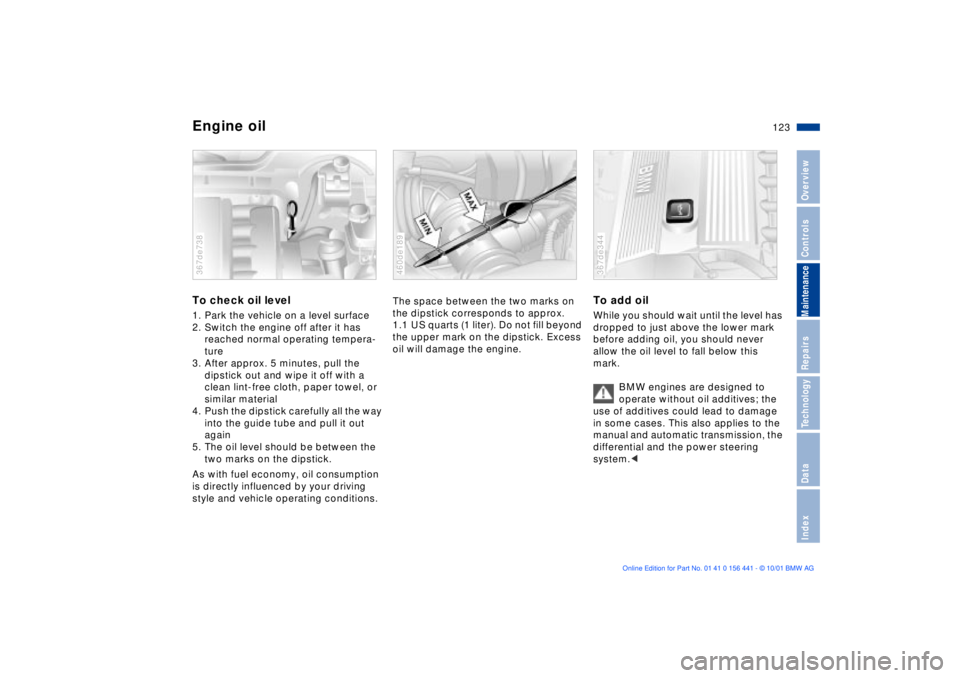
Engine oil To check oil level1. Park the vehicle on a level surface
2. Switch the engine off after it has
reached normal operating tempera-
ture
3. After approx. 5 minutes, pull the
dipstick out and wipe it off with a
clean lint-free cloth, paper towel, or
similar material
4. Push the dipstick carefully all the way
into the guide tube and pull it out
again
5. The oil level should be between the
two marks on the dipstick.
As with fuel economy, oil consumption
is directly influenced by your driving
style and vehicle operating conditions.367de738
The space between the two marks on
the dipstick corresponds to approx.
1.1 US quarts (1 liter). Do not fill beyond
the upper mark on the dipstick. Excess
oil will damage the engine.460de189
To add oilWhile you should wait until the level has
dropped to just above the lower mark
before adding oil, you should never
allow the oil level to fall below this
mark.
BMW engines are designed to
operate without oil additives; the
use of additives could lead to damage
in some cases. This also applies to the
manual and automatic transmission, the
differential and the power steering
system.< 367de344
Page 130 of 187
130n
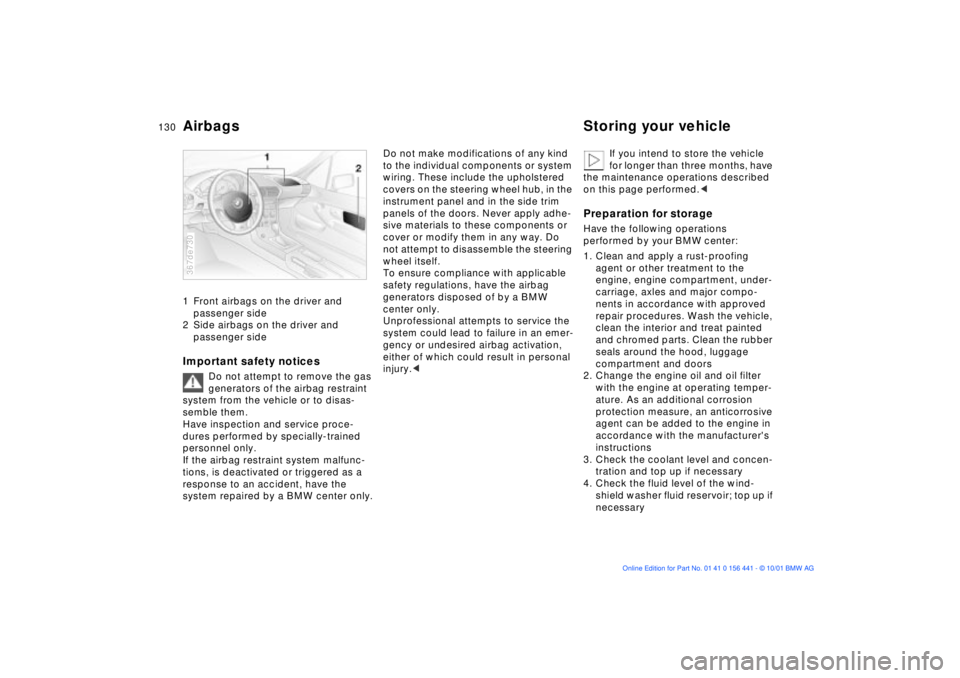
Airbags Storing your vehicle1 Front airbags on the driver and
passenger side
2 Side airbags on the driver and
passenger sideImportant safety notices
Do not attempt to remove the gas
generators of the airbag restraint
system from the vehicle or to disas-
semble them.
Have inspection and service proce-
dures performed by specially-trained
personnel only.
If the airbag restraint system malfunc-
tions, is deactivated or triggered as a
response to an accident, have the
system repaired by a BMW center only.
367de730
Do not make modifications of any kind
to the individual components or system
wiring. These include the upholstered
covers on the steering wheel hub, in the
instrument panel and in the side trim
panels of the doors. Never apply adhe-
sive materials to these components or
cover or modify them in any way. Do
not attempt to disassemble the steering
wheel itself.
To ensure compliance with applicable
safety regulations, have the airbag
generators disposed of by a BMW
center only.
Unprofessional attempts to service the
system could lead to failure in an emer-
gency or undesired airbag activation,
either of which could result in personal
injury.< If you intend to store the vehicle
for longer than three months, have
the maintenance operations described
on this page performed.<
Preparation for storageHave the following operations
performed by your BMW center:
1. Clean and apply a rust-proofing
agent or other treatment to the
engine, engine compartment, under-
carriage, axles and major compo-
nents in accordance with approved
repair procedures. Wash the vehicle,
clean the interior and treat painted
and chromed parts. Clean the rubber
seals around the hood, luggage
compartment and doors
2. Change the engine oil and oil filter
with the engine at operating temper-
ature. As an additional corrosion
protection measure, an anticorrosive
agent can be added to the engine in
accordance with the manufacturer's
instructions
3. Check the coolant level and concen-
tration and top up if necessary
4. Check the fluid level of the wind-
shield washer fluid reservoir; top up if
necessary
Page 144 of 187
144n
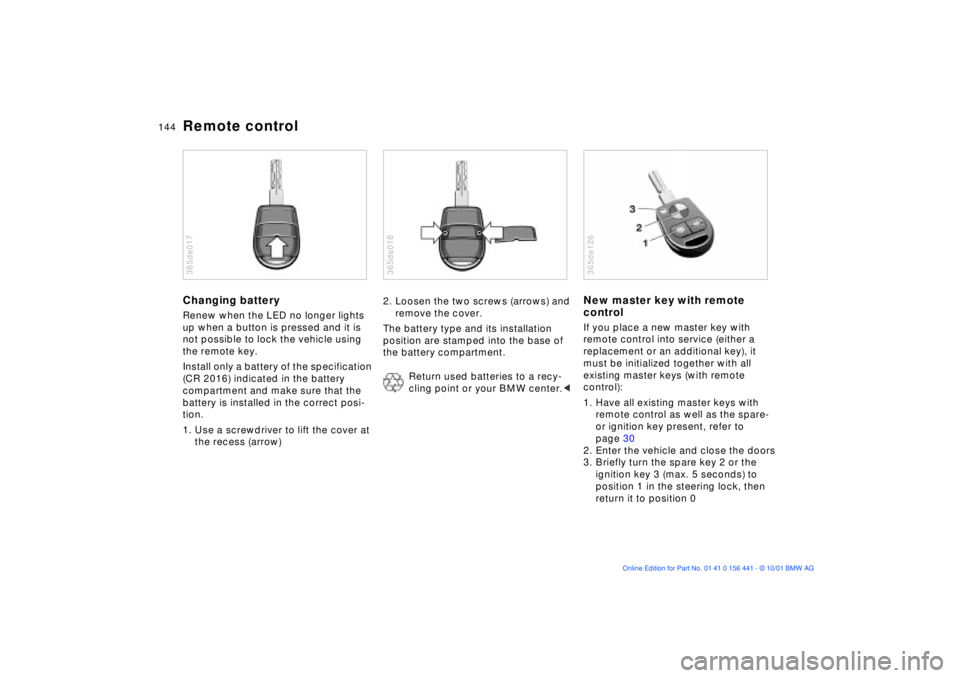
Remote controlChanging batteryRenew when the LED no longer lights
up when a button is pressed and it is
not possible to lock the vehicle using
the remote key.
Install only a battery of the specification
(CR 2016) indicated in the battery
compartment and make sure that the
battery is installed in the correct posi-
tion.
1. Use a screwdriver to lift the cover at
the recess (arrow)365de017
2. Loosen the two screws (arrows) and
remove the cover.
The battery type and its installation
position are stamped into the base of
the battery compartment.
Return used batteries to a recy-
cling point or your BMW center.< 365de018
New master key with remote
controlIf you place a new master key with
remote control into service (either a
replacement or an additional key), it
must be initialized together with all
existing master keys (with remote
control):
1. Have all existing master keys with
remote control as well as the spare-
or ignition key present, refer to
page 30
2. Enter the vehicle and close the doors
3. Briefly turn the spare key 2 or the
ignition key 3 (max. 5 seconds) to
position 1 in the steering lock, then
return it to position 0365de126