ECO mode BMW Z4 2.5I 2004 User Guide
[x] Cancel search | Manufacturer: BMW, Model Year: 2004, Model line: Z4 2.5I, Model: BMW Z4 2.5I 2004Pages: 120, PDF Size: 3.44 MB
Page 55 of 120
Reference
At a glance
Controls
Driving tips
Mobility
53
If the brake warning lamp comes on
together with the yellow indicator
lamps for the Antilock Brake Sys-
tem ABS and the Dynamic Stability
Control DSC:
The entire ABS and DSC control
system has failed. Continue driving
cautiously and defensively. Avoid
hard brake applications. Please have the
system checked by your BMW center as
soon as possible.
Indicator and warning lamps for
Antilock Brake System ABS and
Dynamic Stability Control DSC for
Canadian models.
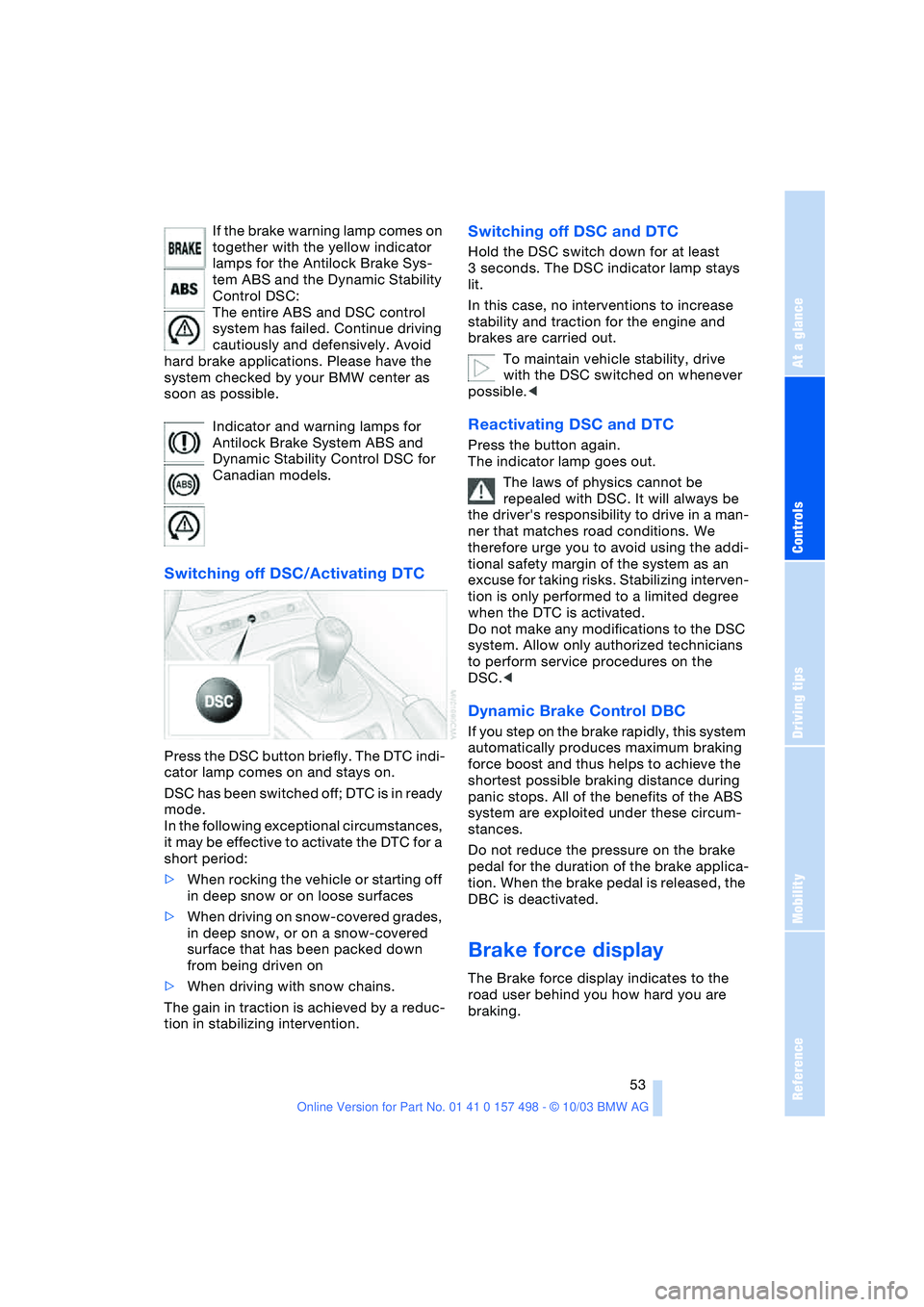
Switching off DSC/Activating DTC
Press the DSC button briefly. The DTC indi-
cator lamp comes on and stays on.
DSC has been switched off; DTC is in ready
mode.
In the following exceptional circumstances,
it may be effective to activate the DTC for a
short period:
>When rocking the vehicle or starting off
in deep snow or on loose surfaces
>When driving on snow-covered grades,
in deep snow, or on a snow-covered
surface that has been packed down
from being driven on
>When driving with snow chains.
The gain in traction is achieved by a reduc-
tion in stabilizing intervention.
Switching off DSC and DTC
Hold the DSC switch down for at least
3 seconds. The DSC indicator lamp stays
lit.
In this case, no interventions to increase
stability and traction for the engine and
brakes are carried out.
To maintain vehicle stability, drive
with the DSC switched on whenever
possible.<
Reactivating DSC and DTC
Press the button again.
The indicator lamp goes out.
The laws of physics cannot be
repealed with DSC. It will always be
the driver's responsibility to drive in a man-
ner that matches road conditions. We
therefore urge you to avoid using the addi-
tional safety margin of the system as an
excuse for taking risks. Stabilizing interven-
tion is only performed to a limited degree
when the DTC is activated.
Do not make any modifications to the DSC
system. Allow only authorized technicians
to perform service procedures on the
DSC.<
Dynamic Brake Control DBC
If you step on the brake rapidly, this system
automatically produces maximum braking
force boost and thus helps to achieve the
shortest possible braking distance during
panic stops. All of the benefits of the ABS
system are exploited under these circum-
stances.
Do not reduce the pressure on the brake
pedal for the duration of the brake applica-
tion. When the brake pedal is released, the
DBC is deactivated.
Brake force display
The Brake force display indicates to the
road user behind you how hard you are
braking.
Page 61 of 120
Reference
At a glance
Controls
Driving tips
Mobility
59
Air distribution
You can direct airflow onto the
windows , toward the upper
body and into the footwell .
All intermediate settings are pos-
sible.
Air supply/blower
You can set the blower to 8 differ-
ent levels. Both heating and ven-
tilation become more effective as
the air supply rate is increased.
Turn the rotary control toward zero:
The blower and the heating are turned off,
and the air supply is stopped.
Temperature
In order to increase the tempera-
ture of the passenger compart-
ment, turn to the right toward the
red zone.
Air conditioning
The air is cooled and dehumidi-
fied and – depending on the tem-
perature setting – rewarmed.
Depending on the weather, the
windshield may fog over briefly when the
engine is started.
Condensation forms during operation
of the air conditioning system, which
then exits under the vehicle. Traces of con-
densed water on the ground underneath
the vehicle are thus normal.<
Outside-air/recirculated-air mode
If there are unpleasant odors in
the outside air, you can tempo-
rarily block the supply of incom-
ing air. The system then recircu-
lates the air currently within the vehicle.
If the windows fog over in the recircu-
lated air mode, switch this mode off
and increase the air supply as required. Do
not use the recirculated-air mode continu-
ously over a long period of time as this
would otherwise reduce the air quality in
the interior of the vehicle.<
Rear window defroster
The indicator lamp lights up when
the rear window defroster is
active. The rear window defroster
switches off automatically.
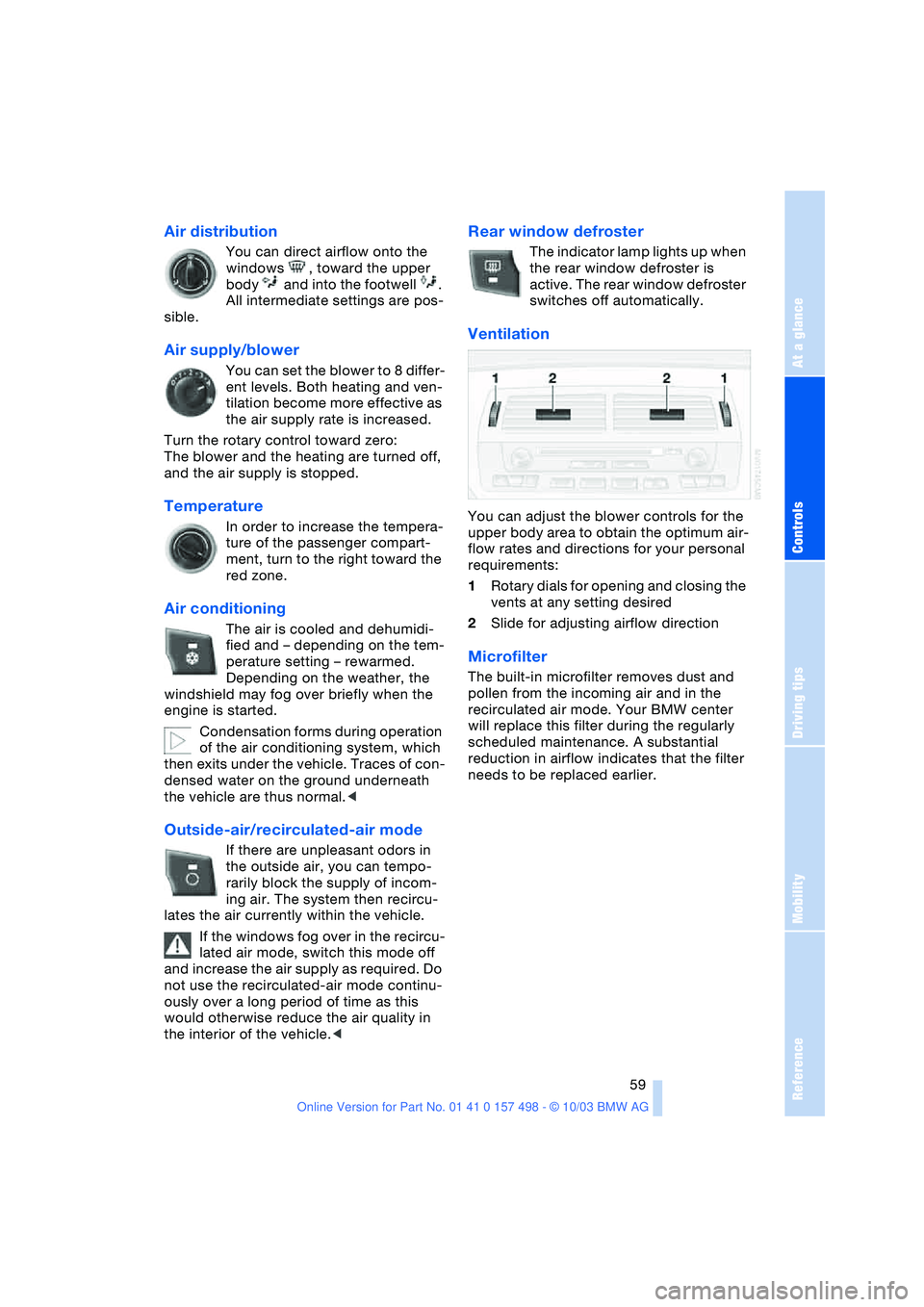
Ventilation
You can adjust the blower controls for the
upper body area to obtain the optimum air-
flow rates and directions for your personal
requirements:
1Rotary dials for opening and closing the
vents at any setting desired
2Slide for adjusting airflow direction
Microfilter
The built-in microfilter removes dust and
pollen from the incoming air and in the
recirculated air mode. Your BMW center
will replace this filter during the regularly
scheduled maintenance. A substantial
reduction in airflow indicates that the filter
needs to be replaced earlier.
Page 81 of 120
Reference
At a glance
Controls
Driving tips
Mobility
79
Wheel and tire replacement
Unprofessional attempts by laymen to
service tires can lead to damage and
accidents.
Have this work performed by skilled pro-
fessionals only. Any BMW center has the
required technical knowledge and the
proper equipment and will be happy to
assist you.<
The correct wheel and tire combination
also affects various systems that would
otherwise be impaired, for example ABS or
DSC.
Have the wheels balanced after each tire or
wheel replacement.
BMW advises against using retreaded
tires, since driving safety may be
impaired. This is due to possible variations
in casing structures and, in some cases, to
their extreme age, factors which can lead
to a decrease in their durability.<
The correct wheels and tires
BMW recommends using only wheels
and tires that have been tested and
approved by BMW for your particular vehi-
cle model, as otherwise body contact and
serious accidents can result despite the
use of the same nominal size, e.g. due to
manufacturing tolerances. If non-approved
wheels and tires are used, BMW cannot
evaluate their suitability, and therefore can-
not be held liable for driving safety.<
To maintain good handling and vehicle
response, use only tires of a single brand
and tread configuration. In the event of a
flat tire, remount the previous wheel and
tire combination as soon as possible.
Recommended tire sizes and brands
BMW tests certain tire brands for each tire
size, classifies them as road-safe and
approves them. You can best find out
about these at a specialized shop, particu-
larly your BMW center. Observe any coun-
try-specific regulations, e.g. on making a
corresponding entry in the vehicle docu-
ments.The factory-approved radial-ply tires are
matched to your vehicle and have been
selected to provide optimum safety and
driving comfort when used properly.
Run Flat tires fitted
Use only Run Flat tires, since no spare
wheel is available in the event of a flat.
Special characteristics of winter
tires
BMW recommends the use of winter tires
for operation under winter road conditions.
While all-season tires, with M+S designa-
tion, provide better winter traction than
summer tires, they generally do not achieve
the full performance of winter tires.
For mounting winter tires, refer to the
descriptions under Tire condition and
Wheel and tire replacement, pages 78, 79.
Run Flat tires fitted
Use only winter Run Flat tires, since no
spare wheel is available in the event of a
flat.
Observing speed ratings
Never exceed the maximum speed for
which the winter tires are rated.
Unprofessional attempts by laymen to ser-
vice tires can lead to damage and acci-
dents. Have this work performed by skilled
professionals only. The technicans at your
BMW center will be glad to assist you with
the required professional knowledge and
specialized equipment.<
Storage
Store tires in a cool, dry place, protecting
them against light whenever possible. Pro-
tect the tires from contact with oil, grease
and fuel. Do not exceed the maximum tire
inflation pressures specified on the tire
sidewall.
Page 87 of 120
Reference
At a glance
Controls
Driving tips
Mobility
85
allow accumulated pressure to escape,
then open completely
2.The coolant level is correct when the
upper end of the red float is at least
even with the upper edge of the filler
neck but no more than 3/4 in/2 cm
above it, that is up to the second mark
on the float. Refer also to the schematic
diagram next to the filler neck
3.If necessary, add coolant. Slowly add
coolant until the correct level is
reached; do not overfill.
Comply with the applicable environ-
mental laws regulating the disposal of
antifreeze with corrosion inhibitor.<
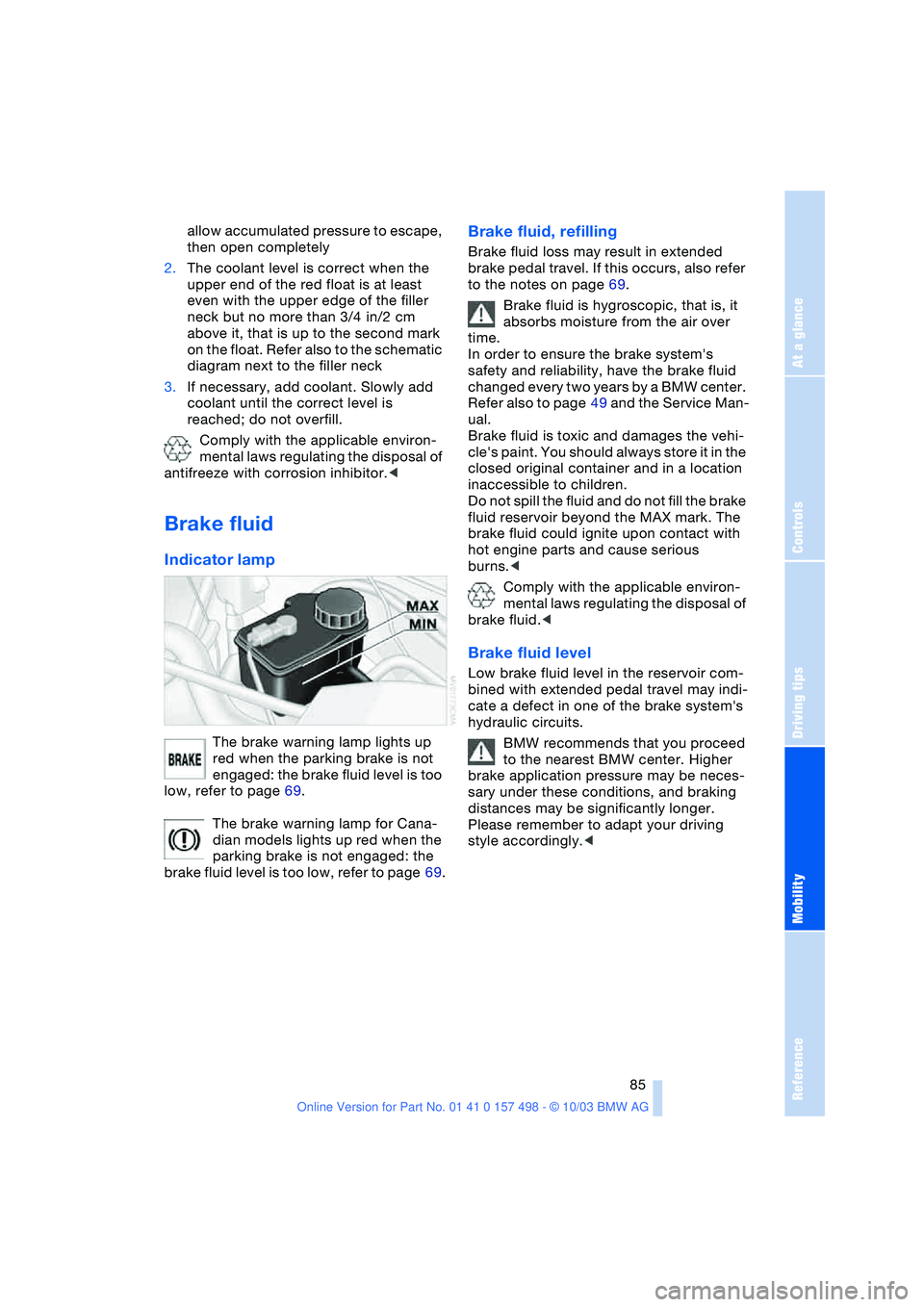
Brake fluid
Indicator lamp
The brake warning lamp lights up
red when the parking brake is not
engaged: the brake fluid level is too
low, refer to page 69.
The brake warning lamp for Cana-
dian models lights up red when the
parking brake is not engaged: the
brake fluid level is too low, refer to page 69.
Brake fluid, refilling
Brake fluid loss may result in extended
brake pedal travel. If this occurs, also refer
to the notes on page 69.
Brake fluid is hygroscopic, that is, it
absorbs moisture from the air over
time.
In order to ensure the brake system's
safety and reliability, have the brake fluid
changed every two years by a BMW center.
Refer also to page 49 and the Service Man-
ual.
Brake fluid is toxic and damages the vehi-
cle's paint. You should always store it in the
closed original container and in a location
inaccessible to children.
Do not spill the fluid and do not fill the brake
fluid reservoir beyond the MAX mark. The
brake fluid could ignite upon contact with
hot engine parts and cause serious
burns.<
Comply with the applicable environ-
mental laws regulating the disposal of
brake fluid.<
Brake fluid level
Low brake fluid level in the reservoir com-
bined with extended pedal travel may indi-
cate a defect in one of the brake system's
hydraulic circuits.
BMW recommends that you proceed
to the nearest BMW center. Higher
brake application pressure may be neces-
sary under these conditions, and braking
distances may be significantly longer.
Please remember to adapt your driving
style accordingly.<
Page 88 of 120
Maintenance
86
Maintenance
The BMW Maintenance
System
The BMW Maintenance System has been
designed as a reliable means of providing
maximum driving and operating safety, and
as cost-effectively for you as possible.
Please keep in mind that regular mainte-
nance is not only necessary for the safety
of your vehicle, but also plays a significant
role in maintaining the resale value of your
vehicle.
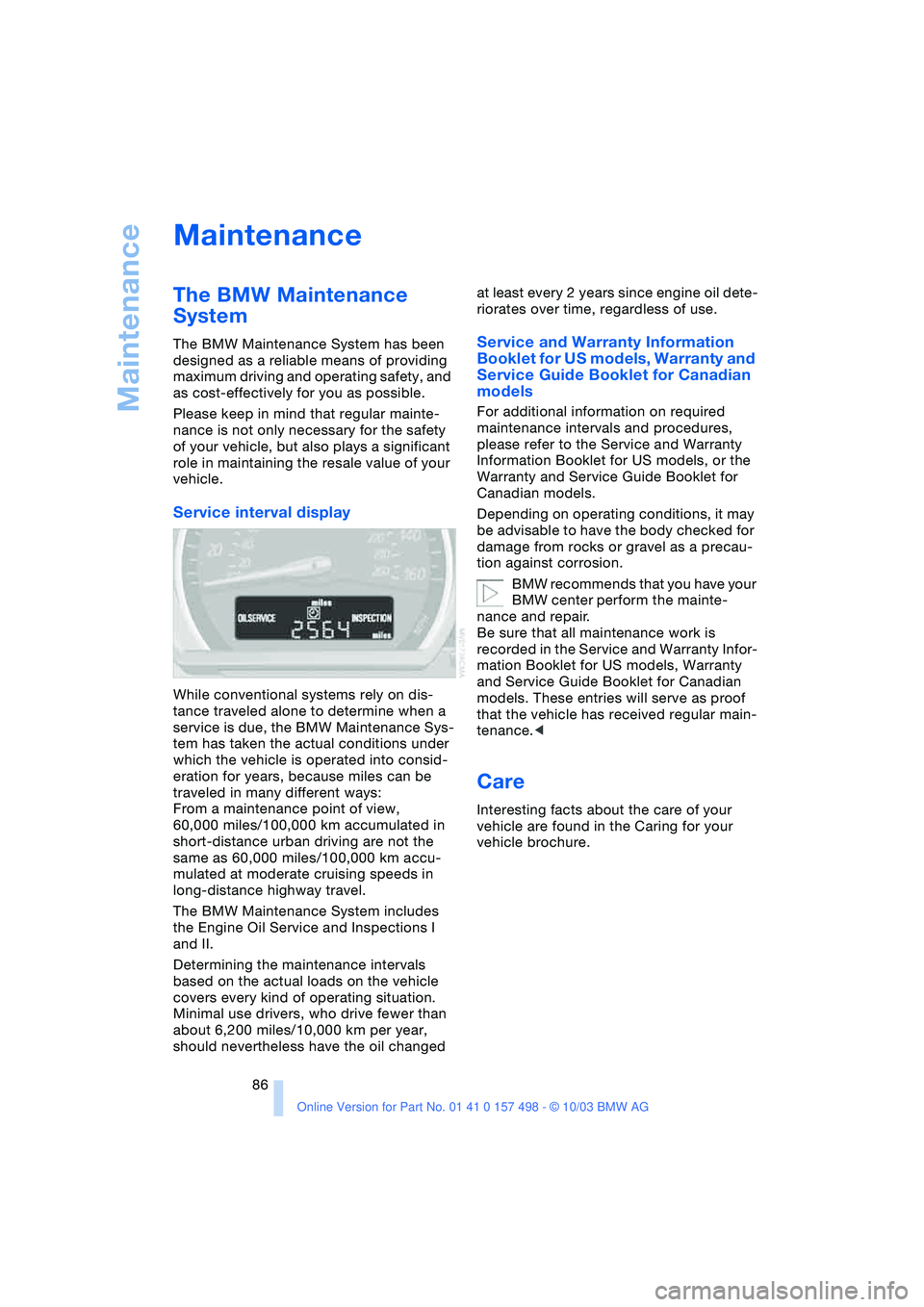
Service interval display
While conventional systems rely on dis-
tance traveled alone to determine when a
service is due, the BMW Maintenance Sys-
tem has taken the actual conditions under
which the vehicle is operated into consid-
eration for years, because miles can be
traveled in many different ways:
From a maintenance point of view,
60,000 miles/100,000 km accumulated in
short-distance urban driving are not the
same as 60,000 miles/100,000 km accu-
mulated at moderate cruising speeds in
long-distance highway travel.
The BMW Maintenance System includes
the Engine Oil Service and Inspections I
and II.
Determining the maintenance intervals
based on the actual loads on the vehicle
covers every kind of operating situation.
Minimal use drivers, who drive fewer than
about 6,200 miles/10,000 km per year,
should nevertheless have the oil changed at least every 2 years since engine oil dete-
riorates over time, regardless of use.
Service and Warranty Information
Booklet for US models, Warranty and
Service Guide Booklet for Canadian
models
For additional information on required
maintenance intervals and procedures,
please refer to the Service and Warranty
Information Booklet for US models, or the
Warranty and Service Guide Booklet for
Canadian models.
Depending on operating conditions, it may
be advisable to have the body checked for
damage from rocks or gravel as a precau-
tion against corrosion.
BMW recommends that you have your
BMW center perform the mainte-
nance and repair.
Be sure that all maintenance work is
recorded in the Service and Warranty Infor-
mation Booklet for US models, Warranty
and Service Guide Booklet for Canadian
models. These entries will serve as proof
that the vehicle has received regular main-
tenance.<
Care
Interesting facts about the care of your
vehicle are found in the Caring for your
vehicle brochure.
Page 93 of 120
Reference
At a glance
Controls
Driving tips
Mobility
91
Please contact a BMW center in case of a
malfunction.
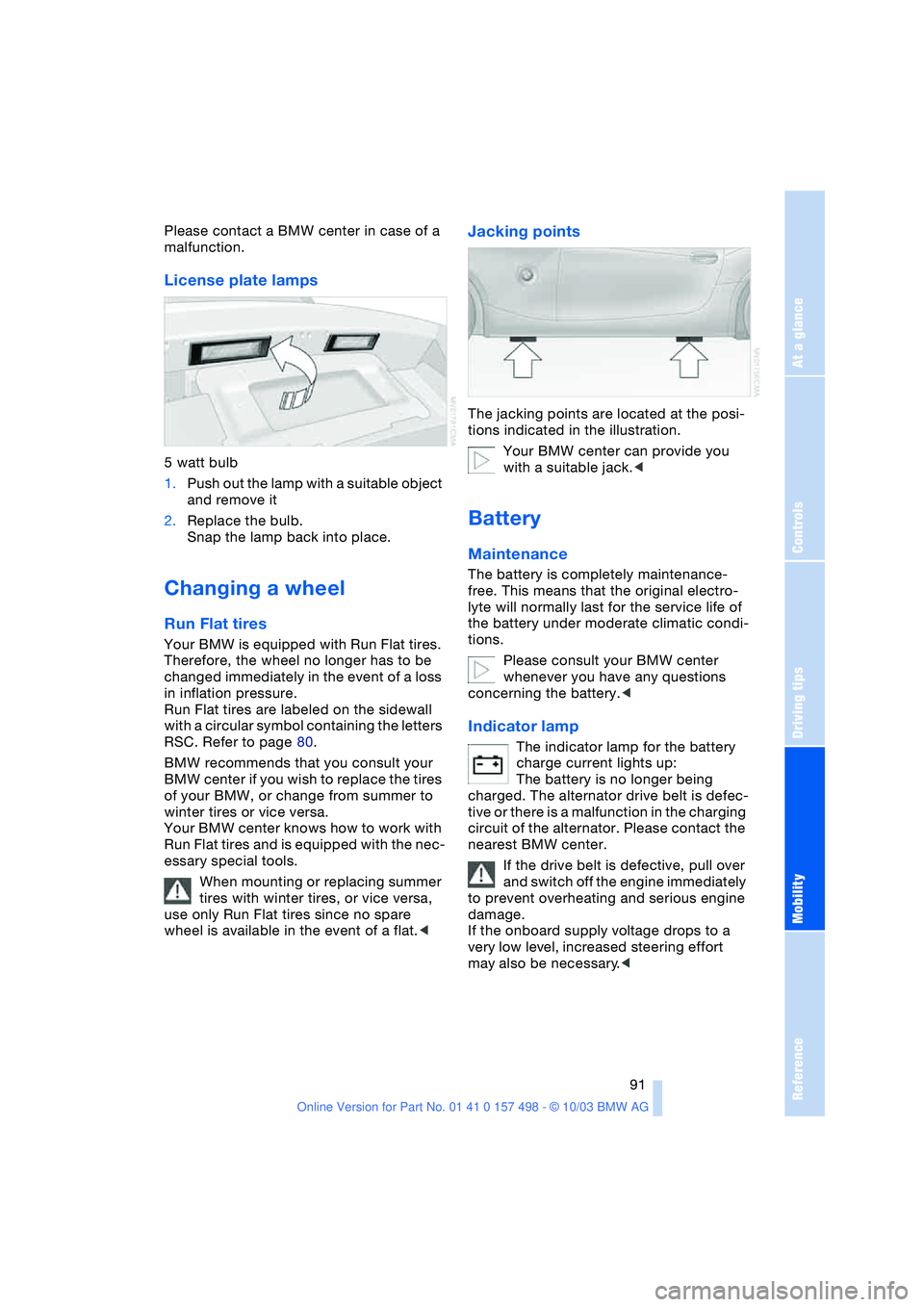
License plate lamps
5 watt bulb
1.Push out the lamp with a suitable object
and remove it
2.Replace the bulb.
Snap the lamp back into place.
Changing a wheel
Run Flat tires
Your BMW is equipped with Run Flat tires.
Therefore, the wheel no longer has to be
changed immediately in the event of a loss
in inflation pressure.
Run Flat tires are labeled on the sidewall
with a circular symbol containing the letters
RSC. Refer to page 80.
BMW recommends that you consult your
BMW center if you wish to replace the tires
of your BMW, or change from summer to
winter tires or vice versa.
Your BMW center knows how to work with
Run Flat tires and is equipped with the nec-
essary special tools.
When mounting or replacing summer
tires with winter tires, or vice versa,
use only Run Flat tires since no spare
wheel is available in the event of a flat.<
Jacking points
The jacking points are located at the posi-
tions indicated in the illustration.
Your BMW center can provide you
with a suitable jack.<
Battery
Maintenance
The battery is completely maintenance-
free. This means that the original electro-
lyte will normally last for the service life of
the battery under moderate climatic condi-
tions.
Please consult your BMW center
whenever you have any questions
concerning the battery.<
Indicator lamp
The indicator lamp for the battery
charge current lights up:
The battery is no longer being
charged. The alternator drive belt is defec-
tive or there is a malfunction in the charging
circuit of the alternator. Please contact the
nearest BMW center.
If the drive belt is defective, pull over
and switch off the engine immediately
to prevent overheating and serious engine
damage.
If the onboard supply voltage drops to a
very low level, increased steering effort
may also be necessary.<
Page 114 of 120
Everything from A to Z
112 Tire inflation pressure
– checking 75
– restoring 75
Tire pressure monitoring,
refer to Flat Tire
Monitor 54
Tires
– age 77
– break-in procedures 68
– changing 79
– condition 78
– damage 78
– DOT quality grades 77
– inflation pressure 75
– replacement 79
– Run Flat tires 80
– size 75
– storage 79
– temperature 78
– traction 77
– tread 78
– tread depth indicator,
refer to Tire tread, Tire
damage 78
– tread wear 77
– Uniform Tire Quality
Grading 77
Tool kit, refer to Onboard
tool kit 88
Torque, refer to Engine
data 100
To unlock
– from inside 18
– from outside 17
Towing 96
– eyelet 96
Towing the vehicle 96
– with the front axle
raised 96
Tow sockets for towing
eyelet 96
Track width, refer to
Dimensions 102
Transmission
– automatic transmission
with Steptronic 39
– manual transmission 38
Transmission interlock,
refer to Changing selector
lever positions 39Transmission
malfunction 40
Transporting children
safely 33
Tread depth, refer to Tire
tread 78
Tread wear indicators in the
tires, refer to
Tire tread, Tire
damage 78
Trip distance recorder,
refer to Trip odometer 48
Trip meter, refer to Trip
odometer 48
Trip odometer 48
Trunk, refer to Luggage
compartment 20
Trunk lid
– opening via remote
control 17
Trunk lid, refer to Luggage
compartment lid 19
Trunk volume, refer to
Luggage compartment
capacity 101
Turning circle, refer to
Dimensions 102
Turn signal indicators 43
– indicator lamp 13
TV function, refer to
Owner's Manual
for Onboard Computer
U
Undercoating, refer to the
Caring for your vehicle
brochure
Unintentional alarm 26
Units
– average
consumption 50
– average
speed 50
– temperature 50
Used batteries, refer to
Battery disposal 92
V
Vehicle
– battery 91
– break-in procedures 68
– care, refer to the Caring
for your vehicle brochure
– cargo loading 70
– measurements, refer to
Dimensions 102
– storage, refer to the
Caring for your vehicle
brochure
– switching off the
engine 69
– washing, refer to the
Caring for your vehicle
brochure
– weight 101
Vehicle Memory 31
Vehicle vacuum cleaner,
refer to Cigarette lighter
socket 65
Ventilation 59, 63
– air conditioning 59
– automatic climate
control 63
Vents, refer to
Ventilation 59, 63
Volume
– fuel tank, refer to
Capacities 103
W
Warning and indicator
lamps 12
Warning triangle 94
Warranty, see Service and
Warranty Information
Booklet for US models,
Warranty and Service
Guide Booklet for
Canadian models 86
Warranty and service 6
Washer/wiper system 43
Washer fluid reservoir, refer
to Capacities 103