service BMW Z4 2.5I 2004 User Guide
[x] Cancel search | Manufacturer: BMW, Model Year: 2004, Model line: Z4 2.5I, Model: BMW Z4 2.5I 2004Pages: 120, PDF Size: 3.44 MB
Page 77 of 120
Reference
At a glance
Controls
Driving tips
Mobility
75
Wheels and tires
Tire inflation pressure
Information for your safety
It is not merely the tire's service life, but
also driving comfort and driving safety that
largely depend on the condition of the tires
and the maintenance of the specified tire
pressure.
Check tire inflation pressures regu-
larly and correct them if necessary: at
least every two weeks and before every
extended journey. If this is not done, incor-
rect tire pressures can cause driving insta-
bility or tire damage, ultimately resulting in
accidents.
Do not drive with a deflated, i.e. flat, tire
unless your vehicle is equipped with Run
Flat tires. A flat tire greatly impairs steering
and braking response, and can lead to
complete loss of control over the vehicle.<
Checking tire pressures
Check the tire inflation pressures only
when the tires are cold. This means after a
maximum driving distance of 1.25 miles/
2 km or if the vehicle has been parked for at
least 2 hours. Warm tires have higher infla-
tion pressures.
Reinitialize the Flat Tire Monitor after cor-
recting the tire inflation pressure. Refer to
page 55.
Inflation pressures for original tires
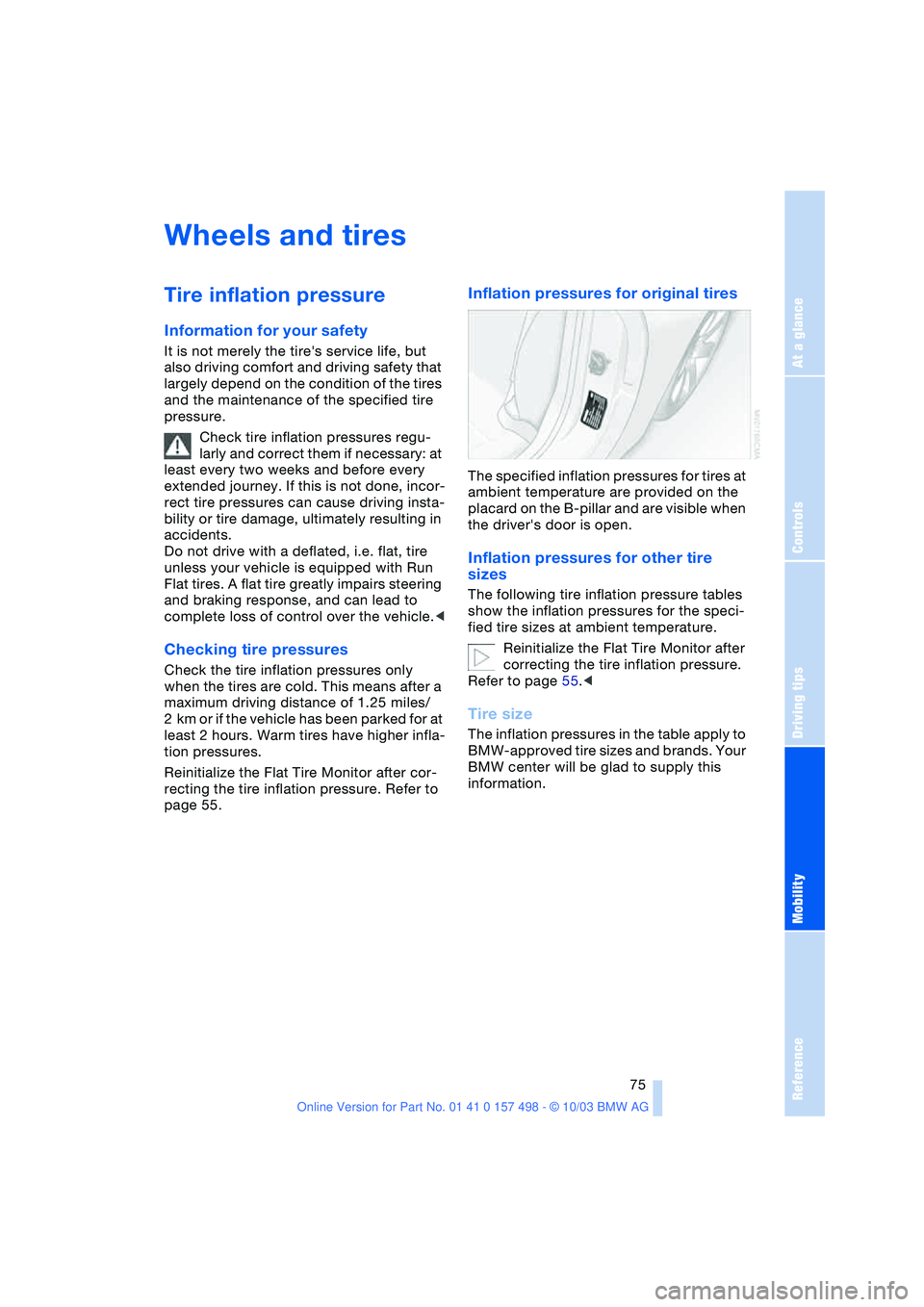
The specified inflation pressures for tires at
ambient temperature are provided on the
placard on the B-pillar and are visible when
the driver's door is open.
Inflation pressures for other tire
sizes
The following tire inflation pressure tables
show the inflation pressures for the speci-
fied tire sizes at ambient temperature.
Reinitialize the Flat Tire Monitor after
correcting the tire inflation pressure.
Refer to page 55.<
Tire size
The inflation pressures in the table apply to
BMW-approved tire sizes and brands. Your
BMW center will be glad to supply this
information.
Page 79 of 120
Reference
At a glance
Controls
Driving tips
Mobility
77
Tire coding
Understanding the lettering on the tire
sidewall makes it easier to identify and
choose the correct tires.
Tire size
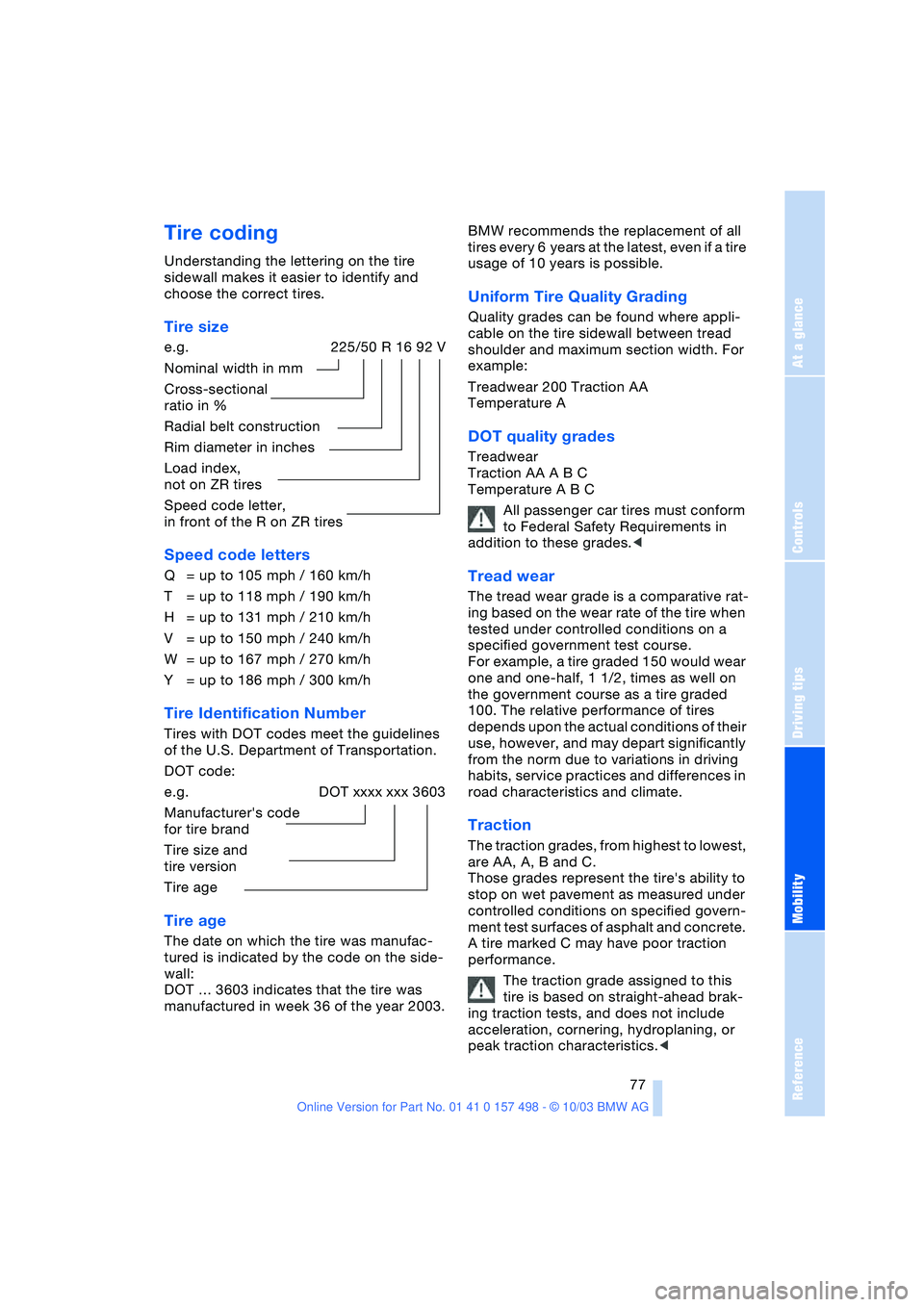
e.g. 225/50 R 16 92 V
Nominal width in mm
Cross-sectional
ratio in %
Radial belt construction
Rim diameter in inches
Load index,
not on ZR tires
Speed code letter,
in front of the R on ZR tires
Speed code letters
Q= up to 105 mph / 160 km/h
T= up to 118 mph / 190 km/h
H= up to 131 mph / 210 km/h
V= up to 150 mph / 240 km/h
W= up to 167 mph / 270 km/h
Y= up to 186 mph / 300 km/h
Tire Identification Number
Tires with DOT codes meet the guidelines
of the U.S. Department of Transportation.
DOT code:
e.g. DOT xxxx xxx 3603
Manufacturer's code
for tire brand
Tire size and
tire version
Tire age
Tire age
The date on which the tire was manufac-
tured is indicated by the code on the side-
wall:
DOT … 3603 indicates that the tire was
manufactured in week 36 of the year 2003.BMW recommends the replacement of all
tires every 6 years at the latest, even if a tire
usage of 10 years is possible.
Uniform Tire Quality Grading
Quality grades can be found where appli-
cable on the tire sidewall between tread
shoulder and maximum section width. For
example:
Treadwear 200 Traction AA
Temperature A
DOT quality grades
Treadwear
Traction AA A B C
Temperature A B C
All passenger car tires must conform
to Federal Safety Requirements in
addition to these grades.<
Tread wear
The tread wear grade is a comparative rat-
ing based on the wear rate of the tire when
tested under controlled conditions on a
specified government test course.
For example, a tire graded 150 would wear
one and one-half, 1 1/2, times as well on
the government course as a tire graded
100. The relative performance of tires
depends upon the actual conditions of their
use, however, and may depart significantly
from the norm due to variations in driving
habits, service practices and differences in
road characteristics and climate.
Traction
The traction grades, from highest to lowest,
are AA, A, B and C.
Those grades represent the tire's ability to
stop on wet pavement as measured under
controlled conditions on specified govern-
ment test surfaces of asphalt and concrete.
A tire marked C may have poor traction
performance.
The traction grade assigned to this
tire is based on straight-ahead brak-
ing traction tests, and does not include
acceleration, cornering, hydroplaning, or
peak traction characteristics.<
Page 81 of 120
Reference
At a glance
Controls
Driving tips
Mobility
79
Wheel and tire replacement
Unprofessional attempts by laymen to
service tires can lead to damage and
accidents.
Have this work performed by skilled pro-
fessionals only. Any BMW center has the
required technical knowledge and the
proper equipment and will be happy to
assist you.<
The correct wheel and tire combination
also affects various systems that would
otherwise be impaired, for example ABS or
DSC.
Have the wheels balanced after each tire or
wheel replacement.
BMW advises against using retreaded
tires, since driving safety may be
impaired. This is due to possible variations
in casing structures and, in some cases, to
their extreme age, factors which can lead
to a decrease in their durability.<
The correct wheels and tires
BMW recommends using only wheels
and tires that have been tested and
approved by BMW for your particular vehi-
cle model, as otherwise body contact and
serious accidents can result despite the
use of the same nominal size, e.g. due to
manufacturing tolerances. If non-approved
wheels and tires are used, BMW cannot
evaluate their suitability, and therefore can-
not be held liable for driving safety.<
To maintain good handling and vehicle
response, use only tires of a single brand
and tread configuration. In the event of a
flat tire, remount the previous wheel and
tire combination as soon as possible.
Recommended tire sizes and brands
BMW tests certain tire brands for each tire
size, classifies them as road-safe and
approves them. You can best find out
about these at a specialized shop, particu-
larly your BMW center. Observe any coun-
try-specific regulations, e.g. on making a
corresponding entry in the vehicle docu-
ments.The factory-approved radial-ply tires are
matched to your vehicle and have been
selected to provide optimum safety and
driving comfort when used properly.
Run Flat tires fitted
Use only Run Flat tires, since no spare
wheel is available in the event of a flat.
Special characteristics of winter
tires
BMW recommends the use of winter tires
for operation under winter road conditions.
While all-season tires, with M+S designa-
tion, provide better winter traction than
summer tires, they generally do not achieve
the full performance of winter tires.
For mounting winter tires, refer to the
descriptions under Tire condition and
Wheel and tire replacement, pages 78, 79.
Run Flat tires fitted
Use only winter Run Flat tires, since no
spare wheel is available in the event of a
flat.
Observing speed ratings
Never exceed the maximum speed for
which the winter tires are rated.
Unprofessional attempts by laymen to ser-
vice tires can lead to damage and acci-
dents. Have this work performed by skilled
professionals only. The technicans at your
BMW center will be glad to assist you with
the required professional knowledge and
specialized equipment.<
Storage
Store tires in a cool, dry place, protecting
them against light whenever possible. Pro-
tect the tires from contact with oil, grease
and fuel. Do not exceed the maximum tire
inflation pressures specified on the tire
sidewall.
Page 87 of 120
Reference
At a glance
Controls
Driving tips
Mobility
85
allow accumulated pressure to escape,
then open completely
2.The coolant level is correct when the
upper end of the red float is at least
even with the upper edge of the filler
neck but no more than 3/4 in/2 cm
above it, that is up to the second mark
on the float. Refer also to the schematic
diagram next to the filler neck
3.If necessary, add coolant. Slowly add
coolant until the correct level is
reached; do not overfill.
Comply with the applicable environ-
mental laws regulating the disposal of
antifreeze with corrosion inhibitor.<
Brake fluid
Indicator lamp
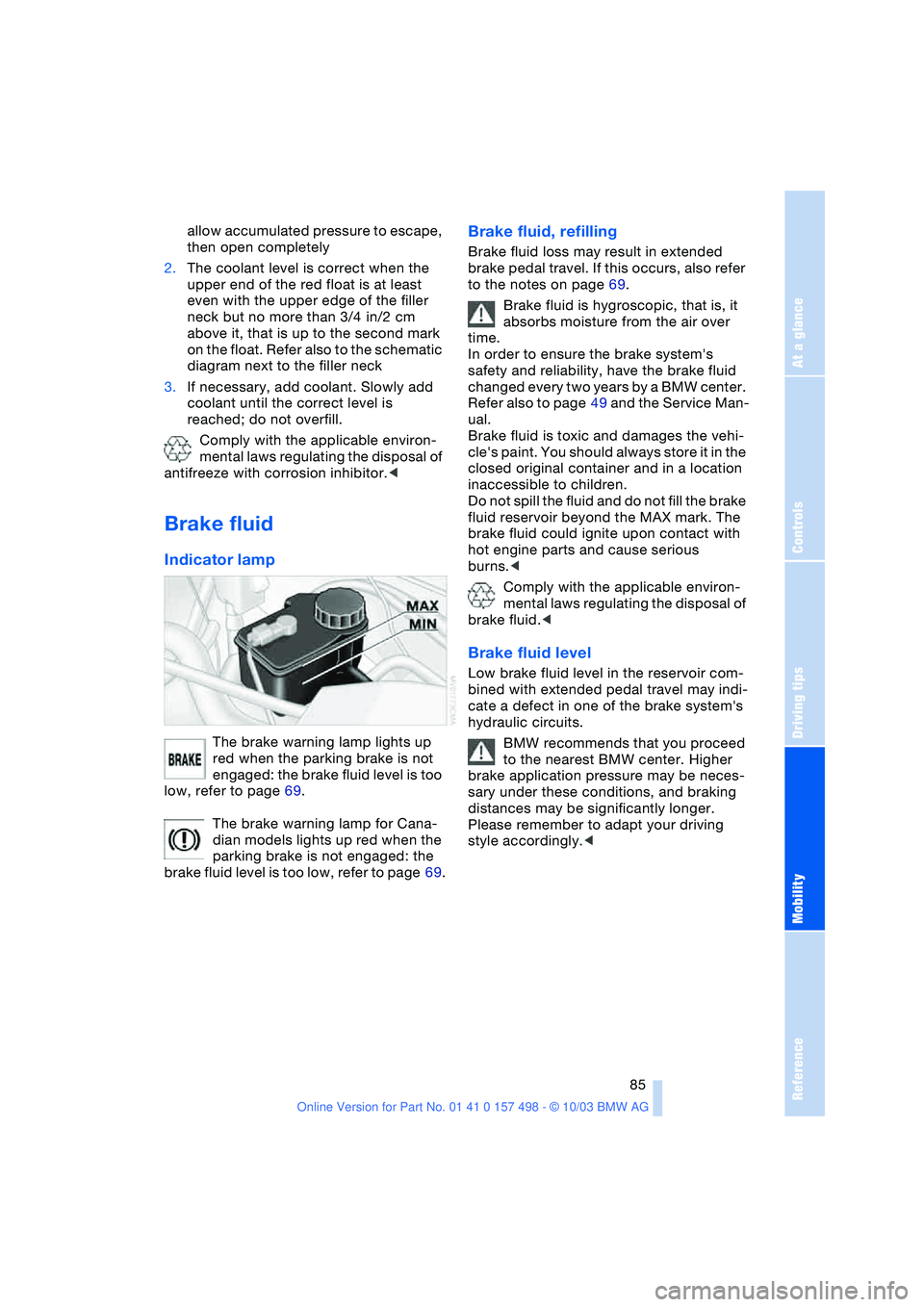
The brake warning lamp lights up
red when the parking brake is not
engaged: the brake fluid level is too
low, refer to page 69.
The brake warning lamp for Cana-
dian models lights up red when the
parking brake is not engaged: the
brake fluid level is too low, refer to page 69.
Brake fluid, refilling
Brake fluid loss may result in extended
brake pedal travel. If this occurs, also refer
to the notes on page 69.
Brake fluid is hygroscopic, that is, it
absorbs moisture from the air over
time.
In order to ensure the brake system's
safety and reliability, have the brake fluid
changed every two years by a BMW center.
Refer also to page 49 and the Service Man-
ual.
Brake fluid is toxic and damages the vehi-
cle's paint. You should always store it in the
closed original container and in a location
inaccessible to children.
Do not spill the fluid and do not fill the brake
fluid reservoir beyond the MAX mark. The
brake fluid could ignite upon contact with
hot engine parts and cause serious
burns.<
Comply with the applicable environ-
mental laws regulating the disposal of
brake fluid.<
Brake fluid level
Low brake fluid level in the reservoir com-
bined with extended pedal travel may indi-
cate a defect in one of the brake system's
hydraulic circuits.
BMW recommends that you proceed
to the nearest BMW center. Higher
brake application pressure may be neces-
sary under these conditions, and braking
distances may be significantly longer.
Please remember to adapt your driving
style accordingly.<
Page 88 of 120
Maintenance
86
Maintenance
The BMW Maintenance
System
The BMW Maintenance System has been
designed as a reliable means of providing
maximum driving and operating safety, and
as cost-effectively for you as possible.
Please keep in mind that regular mainte-
nance is not only necessary for the safety
of your vehicle, but also plays a significant
role in maintaining the resale value of your
vehicle.
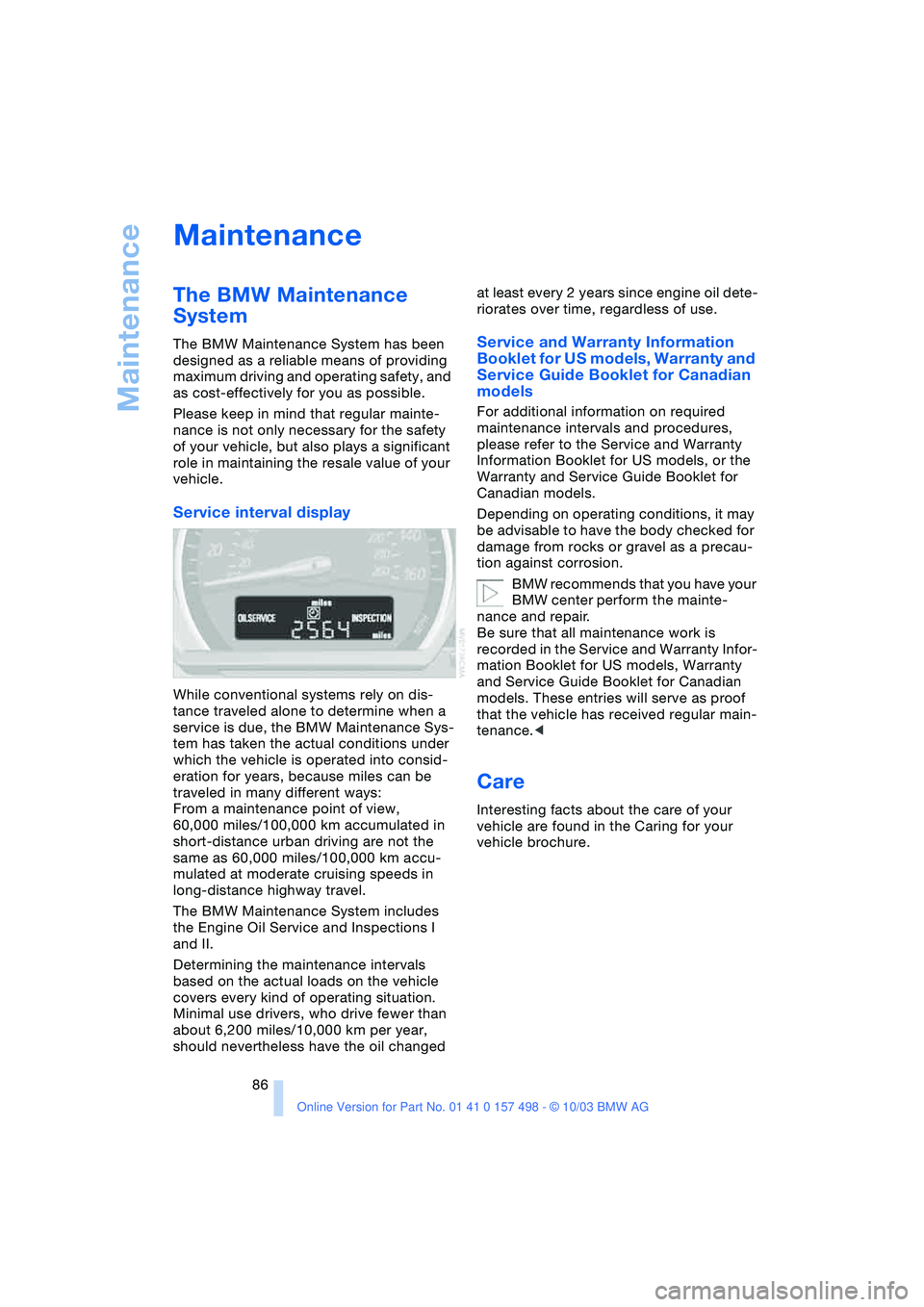
Service interval display
While conventional systems rely on dis-
tance traveled alone to determine when a
service is due, the BMW Maintenance Sys-
tem has taken the actual conditions under
which the vehicle is operated into consid-
eration for years, because miles can be
traveled in many different ways:
From a maintenance point of view,
60,000 miles/100,000 km accumulated in
short-distance urban driving are not the
same as 60,000 miles/100,000 km accu-
mulated at moderate cruising speeds in
long-distance highway travel.
The BMW Maintenance System includes
the Engine Oil Service and Inspections I
and II.
Determining the maintenance intervals
based on the actual loads on the vehicle
covers every kind of operating situation.
Minimal use drivers, who drive fewer than
about 6,200 miles/10,000 km per year,
should nevertheless have the oil changed at least every 2 years since engine oil dete-
riorates over time, regardless of use.
Service and Warranty Information
Booklet for US models, Warranty and
Service Guide Booklet for Canadian
models
For additional information on required
maintenance intervals and procedures,
please refer to the Service and Warranty
Information Booklet for US models, or the
Warranty and Service Guide Booklet for
Canadian models.
Depending on operating conditions, it may
be advisable to have the body checked for
damage from rocks or gravel as a precau-
tion against corrosion.
BMW recommends that you have your
BMW center perform the mainte-
nance and repair.
Be sure that all maintenance work is
recorded in the Service and Warranty Infor-
mation Booklet for US models, Warranty
and Service Guide Booklet for Canadian
models. These entries will serve as proof
that the vehicle has received regular main-
tenance.<
Care
Interesting facts about the care of your
vehicle are found in the Caring for your
vehicle brochure.
Page 89 of 120
Reference
At a glance
Controls
Driving tips
Mobility
87
Laws and regulations
California Proposition 65
warning
California laws require us to state the fol-
lowing warning:
Engine exhaust and a wide variety of
automobile components and parts,
including components found in the interior
furnishings in a vehicle, contain or emit
chemicals known to the State of California
to cause cancer and birth defects and
reproductive harm. In addition, certain flu-
ids contained in vehicles and certain prod-
ucts of component wear contain or emit
chemicals known to the State of CA to
cause cancer and birth defects or other
reproductive harm. Battery posts, terminals
and related accessories contain lead and
lead compounds. Wash your hands after
handling. Used engine oil contains chemi-
cals that have caused cancer in laboratory
animals. Always protect your skin by wash-
ing thoroughly with soap and water.<
OBD interface socket
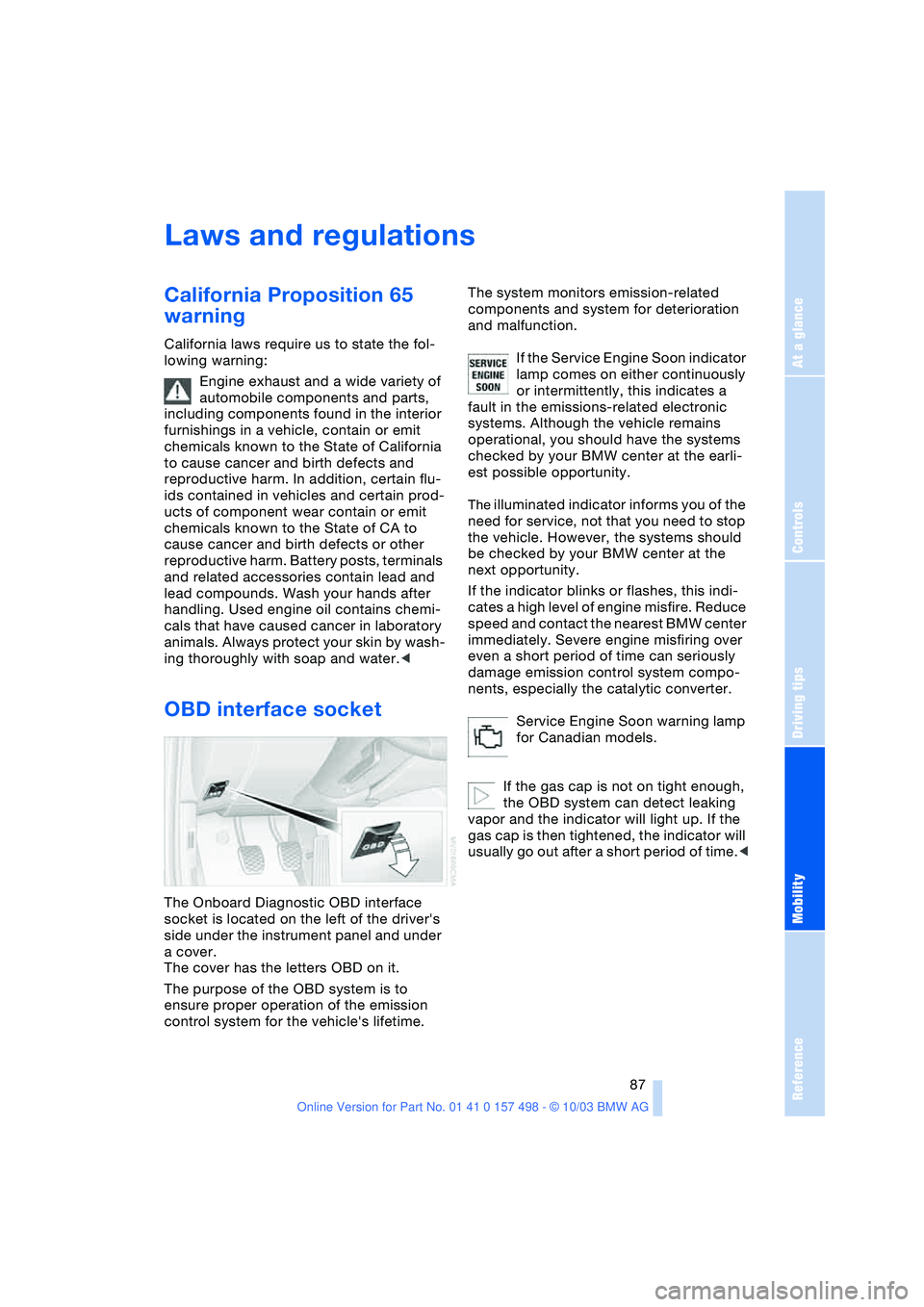
The Onboard Diagnostic OBD interface
socket is located on the left of the driver's
side under the instrument panel and under
a cover.
The cover has the letters OBD on it.
The purpose of the OBD system is to
ensure proper operation of the emission
control system for the vehicle's lifetime. The system monitors emission-related
components and system for deterioration
and malfunction.
If the Service Engine Soon indicator
lamp comes on either continuously
or intermittently, this indicates a
fault in the emissions-related electronic
systems. Although the vehicle remains
operational, you should have the systems
checked by your BMW center at the earli-
est possible opportunity.
The illuminated indicator informs you of the
need for service, not that you need to stop
the vehicle. However, the systems should
be checked by your BMW center at the
next opportunity.
If the indicator blinks or flashes, this indi-
cates a high level of engine misfire. Reduce
speed and contact the nearest BMW center
immediately. Severe engine misfiring over
even a short period of time can seriously
damage emission control system compo-
nents, especially the catalytic converter.
Service Engine Soon warning lamp
for Canadian models.
If the gas cap is not on tight enough,
the OBD system can detect leaking
vapor and the indicator will light up. If the
gas cap is then tightened, the indicator will
usually go out after a short period of time.<
Page 91 of 120
Reference
At a glance
Controls
Driving tips
Mobility
89
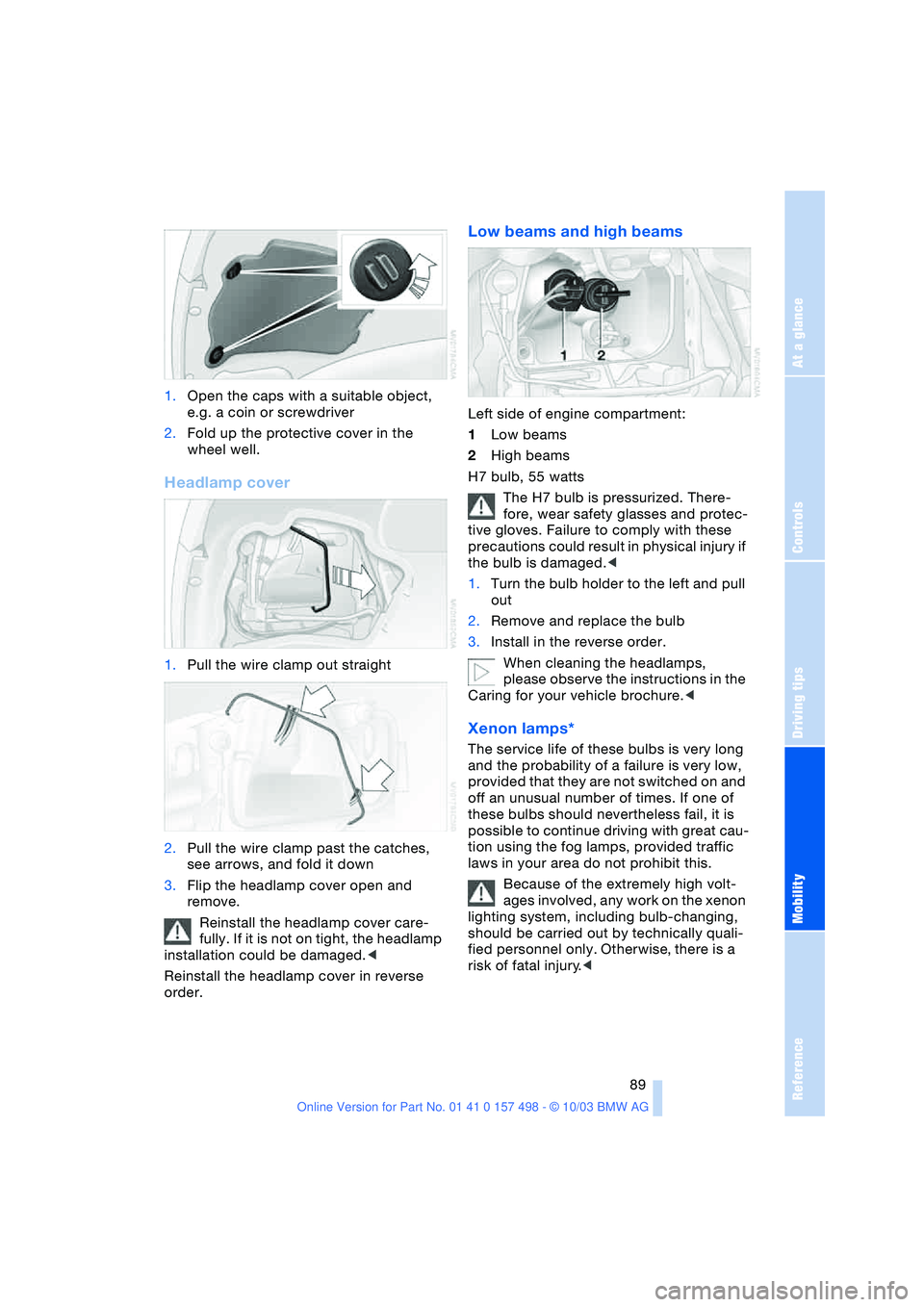
1.Open the caps with a suitable object,
e.g. a coin or screwdriver
2.Fold up the protective cover in the
wheel well.
Headlamp cover
1.Pull the wire clamp out straight
2.Pull the wire clamp past the catches,
see arrows, and fold it down
3.Flip the headlamp cover open and
remove.
Reinstall the headlamp cover care-
fully. If it is not on tight, the headlamp
installation could be damaged.<
Reinstall the headlamp cover in reverse
order.
Low beams and high beams
Left side of engine compartment:
1Low beams
2High beams
H7 bulb, 55 watts
The H7 bulb is pressurized. There-
fore, wear safety glasses and protec-
tive gloves. Failure to comply with these
precautions could result in physical injury if
the bulb is damaged.<
1.Turn the bulb holder to the left and pull
out
2.Remove and replace the bulb
3.Install in the reverse order.
When cleaning the headlamps,
please observe the instructions in the
Caring for your vehicle brochure.<
Xenon lamps*
The service life of these bulbs is very long
and the probability of a failure is very low,
provided that they are not switched on and
off an unusual number of times. If one of
these bulbs should nevertheless fail, it is
possible to continue driving with great cau-
tion using the fog lamps, provided traffic
laws in your area do not prohibit this.
Because of the extremely high volt-
ages involved, any work on the xenon
lighting system, including bulb-changing,
should be carried out by technically quali-
fied personnel only. Otherwise, there is a
risk of fatal injury.<
Page 93 of 120
Reference
At a glance
Controls
Driving tips
Mobility
91
Please contact a BMW center in case of a
malfunction.
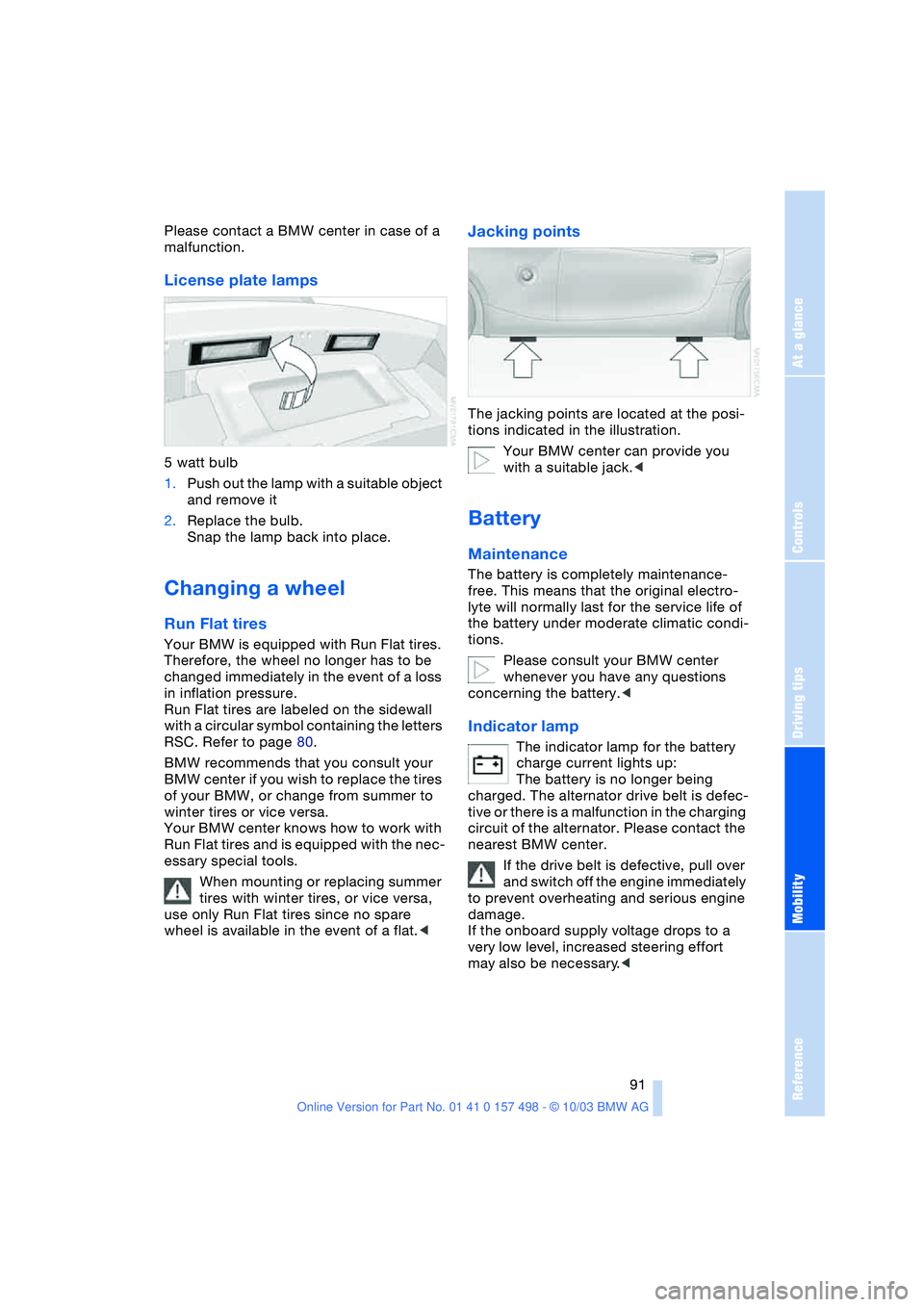
License plate lamps
5 watt bulb
1.Push out the lamp with a suitable object
and remove it
2.Replace the bulb.
Snap the lamp back into place.
Changing a wheel
Run Flat tires
Your BMW is equipped with Run Flat tires.
Therefore, the wheel no longer has to be
changed immediately in the event of a loss
in inflation pressure.
Run Flat tires are labeled on the sidewall
with a circular symbol containing the letters
RSC. Refer to page 80.
BMW recommends that you consult your
BMW center if you wish to replace the tires
of your BMW, or change from summer to
winter tires or vice versa.
Your BMW center knows how to work with
Run Flat tires and is equipped with the nec-
essary special tools.
When mounting or replacing summer
tires with winter tires, or vice versa,
use only Run Flat tires since no spare
wheel is available in the event of a flat.<
Jacking points
The jacking points are located at the posi-
tions indicated in the illustration.
Your BMW center can provide you
with a suitable jack.<
Battery
Maintenance
The battery is completely maintenance-
free. This means that the original electro-
lyte will normally last for the service life of
the battery under moderate climatic condi-
tions.
Please consult your BMW center
whenever you have any questions
concerning the battery.<
Indicator lamp
The indicator lamp for the battery
charge current lights up:
The battery is no longer being
charged. The alternator drive belt is defec-
tive or there is a malfunction in the charging
circuit of the alternator. Please contact the
nearest BMW center.
If the drive belt is defective, pull over
and switch off the engine immediately
to prevent overheating and serious engine
damage.
If the onboard supply voltage drops to a
very low level, increased steering effort
may also be necessary.<
Page 95 of 120
Reference
At a glance
Controls
Driving tips
Mobility
93
Giving and receiving assistance
Receiving assistance
The BMW Group's Mobile Service offers
you 24-hour assistance in the event of a
breakdown, even on weekends and holi-
days.
The telephone numbers of the Mobile Ser-
vice control center in your country are
listed in the BMW Dealer Directory.
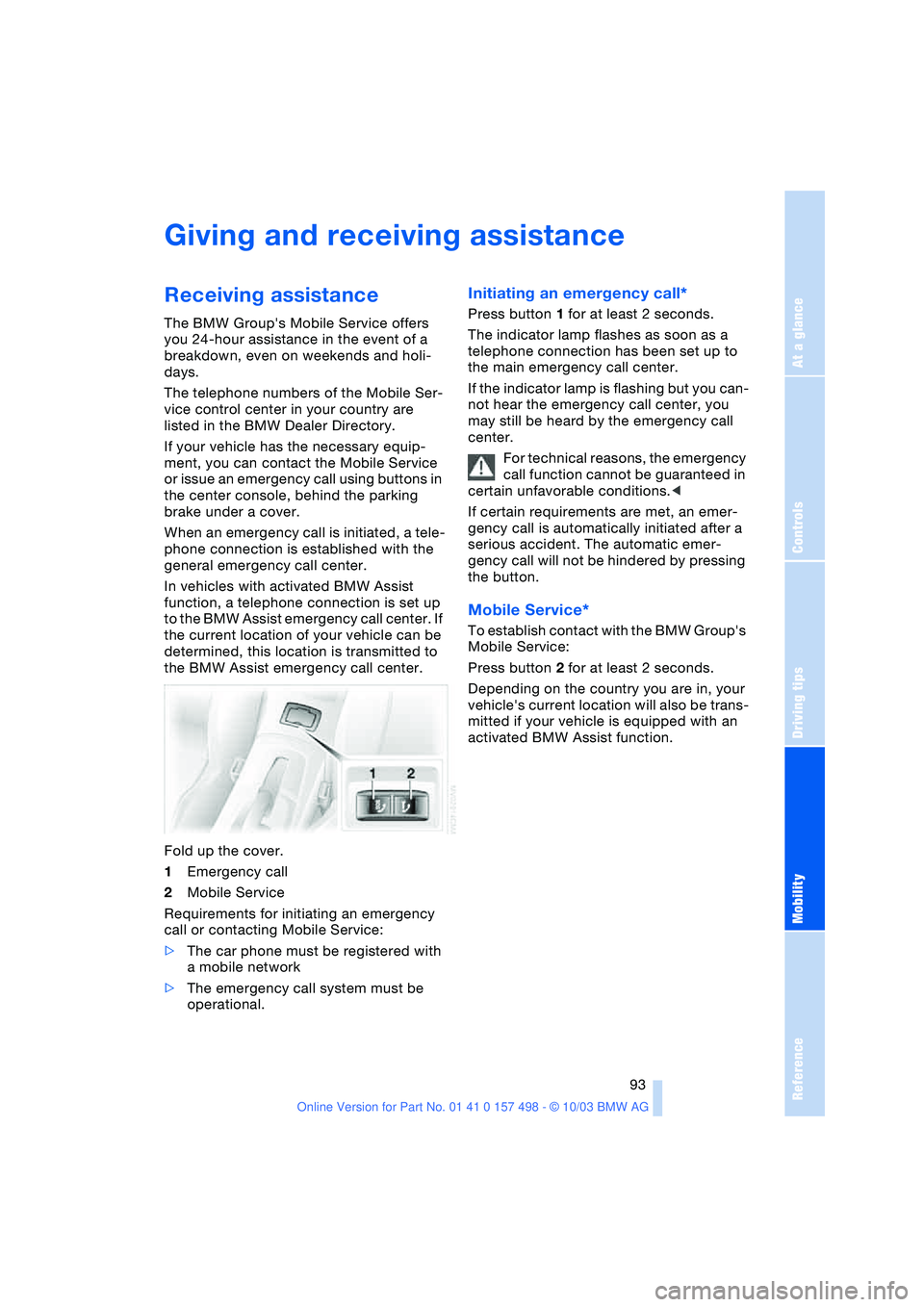
If your vehicle has the necessary equip-
ment, you can contact the Mobile Service
or issue an emergency call using buttons in
the center console, behind the parking
brake under a cover.
When an emergency call is initiated, a tele-
phone connection is established with the
general emergency call center.
In vehicles with activated BMW Assist
function, a telephone connection is set up
to the BMW Assist emergency call center. If
the current location of your vehicle can be
determined, this location is transmitted to
the BMW Assist emergency call center.
Fold up the cover.
1Emergency call
2Mobile Service
Requirements for initiating an emergency
call or contacting Mobile Service:
>The car phone must be registered with
a mobile network
>The emergency call system must be
operational.
Initiating an emergency call*
Press button 1 for at least 2 seconds.
The indicator lamp flashes as soon as a
telephone connection has been set up to
the main emergency call center.
If the indicator lamp is flashing but you can-
not hear the emergency call center, you
may still be heard by the emergency call
center.
For technical reasons, the emergency
call function cannot be guaranteed in
certain unfavorable conditions.<
If certain requirements are met, an emer-
gency call is automatically initiated after a
serious accident. The automatic emer-
gency call will not be hindered by pressing
the button.
Mobile Service*
To establish contact with the BMW Group's
Mobile Service:
Press button 2 for at least 2 seconds.
Depending on the country you are in, your
vehicle's current location will also be trans-
mitted if your vehicle is equipped with an
activated BMW Assist function.
Page 109 of 120
Reference
At a glance
Controls
Driving tips
Mobility
107
Electric Power Steering
EPS 43
– indicator lamp 13
Electric power windows 20
Electronic Stability
Program ESP, refer to
Dynamic Stability Control
DSC 52
Electronic transmission
control module 40
Emergency call 93
Emergency operation, refer
to Manual operation
– convertible top 23
– driver's door 18
– fuel filler door 74
– storage compartments 64
Engine 36
– break-in procedures 68
– data 100
– electronics 13
– indicator lamp 13
– speed 48
– starting 36
– switching off 37
Engine compartment 82
Engine coolant 84
Engine coolant
temperature gauge 48
Engine data 100
Engine oil 83
– alternative oils 84
– approved oils 84
– capacity 103
– indicator lamp 13
Engine oil level 83
– indicator lamp 13
Engine oil pressure 83
– indicator lamp 13
Engine oil sensor 83
– indicator lamp 13
Engine output, refer to
Engine data 100
Engine speed, refer to
Engine data 100
EPS Electric Power
Steering 43
Equipment range, see
Service and Warranty
Information Booklet for US models, Warranty and
Service Guide Booklet for
Canadian models
ESP Electronic Stability
Program, refer to
Dynamic Stability Control
DSC 52
Exhaust system, refer to
High temperatures 69
Exterior mirrors 31
– automatic dimming
feature 31
Eyelet, towing 96
F
False alarm, stopping
alarm 26
Fasten safety belts 30
– warning lamp 13, 30
Filter, refer to
– Microfilter 59
– Microfilter/activated-
charcoal filter 63
Fine wood, refer to the
Caring for your vehicle
brochure
First aid, refer to First-aid
kit 94
First-aid kit 94
Flat tire
– Flat Tire Monitor 54
– indicator/warning
lamp 13
Flat tire, refer to Tire
condition 78
Flat Tire Monitor 54
– indicator lamp 13, 55
– initializing 55
Flooding, refer to Driving
through water 69
Floor covers, carpets, refer
to the Caring for your
vehicle brochure
Floor mats, refer to the
Caring for your vehicle
brochure
Fluid reservoir
– washing systems 83
Fog lamps 47
– indicator lamp 13Follow me home lamps 46
Footbrake, refer to Driving
notes 69
Front airbags 56
Front turn signal indicators
– bulb replacement 90
Fuel
– average
consumption 51
– content, refer to
Capacities 103
– display 48
– preparation, refer to
Engine data 100
– quality 74
Fuel display, refer to Fuel
gauge 48
Fuel filler door 74
– unlocking in case of
electrical fault 74
Fuel gas cap 74
Fuel tank capacity, refer to
Capacities 103
Fuses 92
G
Gasoline, refer to Fuel
quality 74
Gasoline gauge, refer to
Fuel gauge 48
Gear indicator 40
Gear lever
– automatic transmission
with Steptronic 39
– manual transmission 38
Glove compartment 64
Gross weight, refer to
Weights 101
H
Handbrake, refer to Parking
brake 38
Hands-free microphone,
refer to Preparations for
the cellular phone 65
Hands-free system 65
Hardtop, refer to the
separate Owner's Manual
Hardtop preparation 71