ESP BMW Z4 2.5I 2004 Owner's Manual
[x] Cancel search | Manufacturer: BMW, Model Year: 2004, Model line: Z4 2.5I, Model: BMW Z4 2.5I 2004Pages: 120, PDF Size: 3.44 MB
Page 80 of 120
Wheels and tires
78
Temperature
The temperature grades are A, the highest,
B and C, representing the tire’s resistance
to the generation of heat and its ability to
dissipate heat when tested under con-
trolled conditions on a specified indoor lab-
oratory test wheel.
Sustained high temperature can cause the
material of the tire to degenerate and
reduce tire life, and excessive temperature
can lead to sudden tire failure. The grade C
corresponds to a level of performance
which all passenger car tires must meet
under the Federal Motor Vehicle Safety
Standard No. 109. Grades B and A repre-
sent higher levels of performance on the
laboratory test wheel than the minimum
required by law.
The temperature grade for this tire is
established for a tire that is properly
inflated and not overloaded. Excessive
speed, under-inflation, or excessive load-
ing, either separately or in combination,
can cause heat buildup and possible tire
failure.<
RSC: Run Flat tires
Run Flat tires are labeled on the sidewall
with a circular symbol containing the letters
RSC. Refer to page 80.
M+S
Winter and all-season tires.
These have better winter performance
properties than summer tires.
Tire condition
Inspect your tires frequently for tread wear,
signs of damage and for foreign objects
lodged in the tread. Check the tread depth.
Tire tread
Tread depth should not be allowed to go
below 1/8 in/3 mm even though in Europe,
for example, the legally specified minimum
tread depth is only 1/16 in/1.6 mm. Below
1/8 in/3 mm tread depth, there is a very
high risk of hydroplaning, even at relatively moderate speeds and with only small
amounts of water on the road.
At tread depths below approx. 1/6 in/
4 mm, winter tires display a perceptible
decrease in their ability to cope with winter
driving conditions, and should be replaced
in the interest of safety.
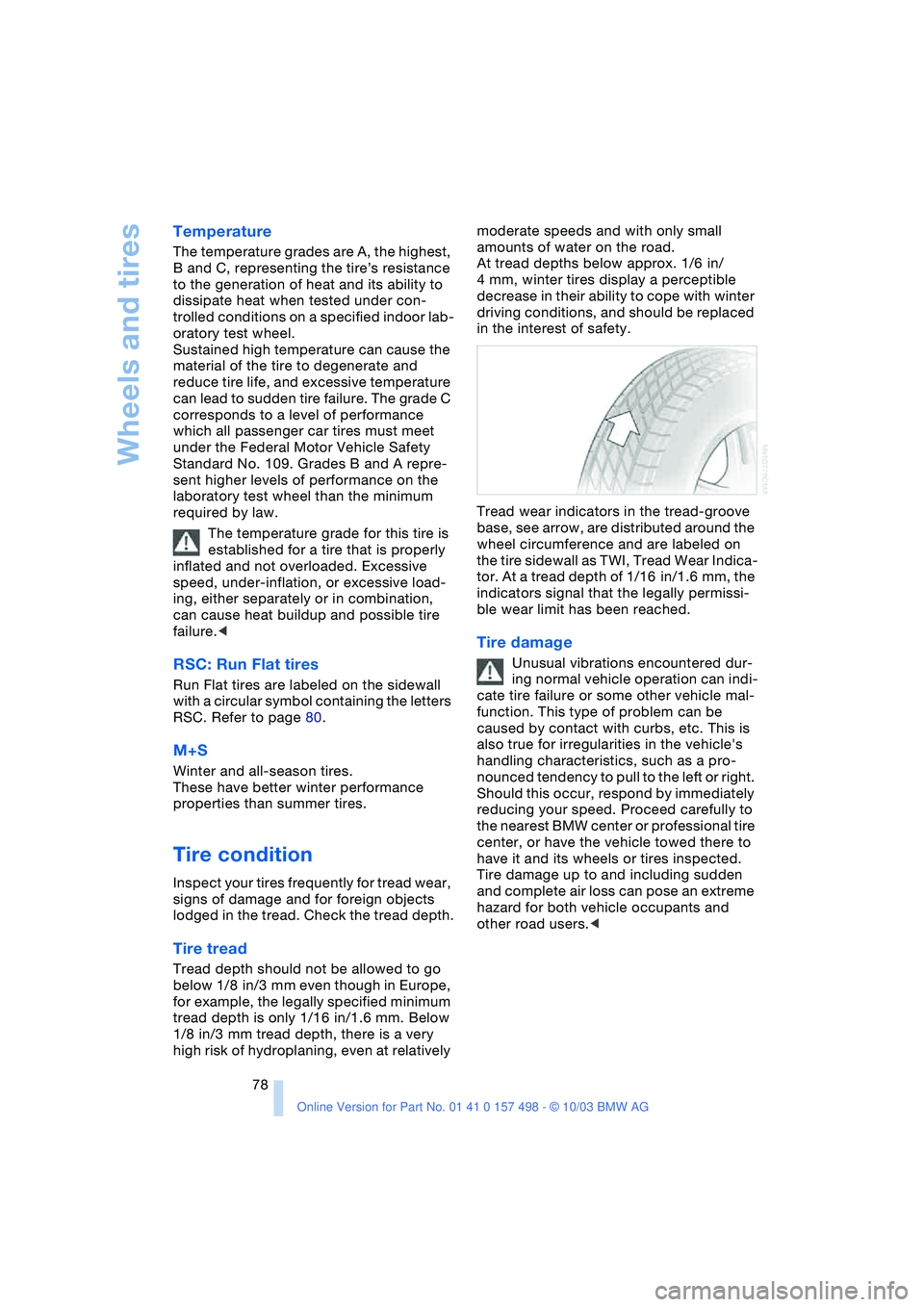
Tread wear indicators in the tread-groove
base, see arrow, are distributed around the
wheel circumference and are labeled on
the tire sidewall as TWI, Tread Wear Indica-
tor. At a tread depth of 1/16 in/1.6 mm, the
indicators signal that the legally permissi-
ble wear limit has been reached.
Tire damage
Unusual vibrations encountered dur-
ing normal vehicle operation can indi-
cate tire failure or some other vehicle mal-
function. This type of problem can be
caused by contact with curbs, etc. This is
also true for irregularities in the vehicle's
handling characteristics, such as a pro-
nounced tendency to pull to the left or right.
Should this occur, respond by immediately
reducing your speed. Proceed carefully to
the nearest BMW center or professional tire
center, or have the vehicle towed there to
have it and its wheels or tires inspected.
Tire damage up to and including sudden
and complete air loss can pose an extreme
hazard for both vehicle occupants and
other road users.<
Page 81 of 120
Reference
At a glance
Controls
Driving tips
Mobility
79
Wheel and tire replacement
Unprofessional attempts by laymen to
service tires can lead to damage and
accidents.
Have this work performed by skilled pro-
fessionals only. Any BMW center has the
required technical knowledge and the
proper equipment and will be happy to
assist you.<
The correct wheel and tire combination
also affects various systems that would
otherwise be impaired, for example ABS or
DSC.
Have the wheels balanced after each tire or
wheel replacement.
BMW advises against using retreaded
tires, since driving safety may be
impaired. This is due to possible variations
in casing structures and, in some cases, to
their extreme age, factors which can lead
to a decrease in their durability.<
The correct wheels and tires
BMW recommends using only wheels
and tires that have been tested and
approved by BMW for your particular vehi-
cle model, as otherwise body contact and
serious accidents can result despite the
use of the same nominal size, e.g. due to
manufacturing tolerances. If non-approved
wheels and tires are used, BMW cannot
evaluate their suitability, and therefore can-
not be held liable for driving safety.<
To maintain good handling and vehicle
response, use only tires of a single brand
and tread configuration. In the event of a
flat tire, remount the previous wheel and
tire combination as soon as possible.
Recommended tire sizes and brands
BMW tests certain tire brands for each tire
size, classifies them as road-safe and
approves them. You can best find out
about these at a specialized shop, particu-
larly your BMW center. Observe any coun-
try-specific regulations, e.g. on making a
corresponding entry in the vehicle docu-
ments.The factory-approved radial-ply tires are
matched to your vehicle and have been
selected to provide optimum safety and
driving comfort when used properly.
Run Flat tires fitted
Use only Run Flat tires, since no spare
wheel is available in the event of a flat.
Special characteristics of winter
tires
BMW recommends the use of winter tires
for operation under winter road conditions.
While all-season tires, with M+S designa-
tion, provide better winter traction than
summer tires, they generally do not achieve
the full performance of winter tires.
For mounting winter tires, refer to the
descriptions under Tire condition and
Wheel and tire replacement, pages 78, 79.
Run Flat tires fitted
Use only winter Run Flat tires, since no
spare wheel is available in the event of a
flat.
Observing speed ratings
Never exceed the maximum speed for
which the winter tires are rated.
Unprofessional attempts by laymen to ser-
vice tires can lead to damage and acci-
dents. Have this work performed by skilled
professionals only. The technicans at your
BMW center will be glad to assist you with
the required professional knowledge and
specialized equipment.<
Storage
Store tires in a cool, dry place, protecting
them against light whenever possible. Pro-
tect the tires from contact with oil, grease
and fuel. Do not exceed the maximum tire
inflation pressures specified on the tire
sidewall.
Page 86 of 120
In the engine compartment
84 The oil volume between the two marks on
the dipstick corresponds to approx.
1.1 quarts/1 liter. Do not fill beyond the
upper mark on the dipstick. Excess oil will
damage the engine.
Adding engine oil
While you should wait until the level has
dropped to just above the lower mark
before adding oil, you should never allow
the oil level to fall below this mark.
BMW engines are designed to oper-
ate without oil additives; the use of
additives could even lead to damage in
some cases. This also applies to manual
and automatic transmissions and to the dif-
ferential.<
Continuous exposure to used oil has
caused cancer in laboratory tests. For
this reason, thoroughly wash any areas of
skin that come into contact with oil using
soap and water.
Always store oils, grease and similar mate-
rials so that they are inaccessible to chil-
dren. Comply with warning labels and the
information on the containers.<
Comply with the applicable environ-
mental laws regulating the disposal of
used oil.<
Approved engine oils
The quality of the engine oil is extremely
important for the function and life of an
engine. Based on extensive testing, BMW
has approved certain grades of engine oil.
Use approved High Performance Synthetic
Oil.
If you are unable to obtain an approved
High Performance Synthetic Oil, you may use small volumes of other synthetic oils for
topping up between oil changes. Use only
oils with the specification API SH or higher.
Ask your BMW center for details con-
cerning the specific High Perfor-
mance Synthetic Oil or synthetic oils that
have been approved.<
You can also call BMW of North America
toll-free at 1-800-831-1117 or visit this
website: www.bmwusa.com to obtain this
information.
Coolant
The yellow coolant indicator lamp
lights up:
The coolant level is too low: top up
as soon as possible.
Do not add coolant to the cooling sys-
tem when the engine is hot. If you do,
escaping coolant can cause burns.
Antifreeze and anti-corrosion agents are
hazardous to health. You should always
store them in their original containers and
in a location inaccessible to children.
Antifreeze and anti-corrosion agents are
flammable. For this reason, do not spill
them on hot engine parts. They could ignite
and cause burns. Comply with the instruc-
tions on the containers.<
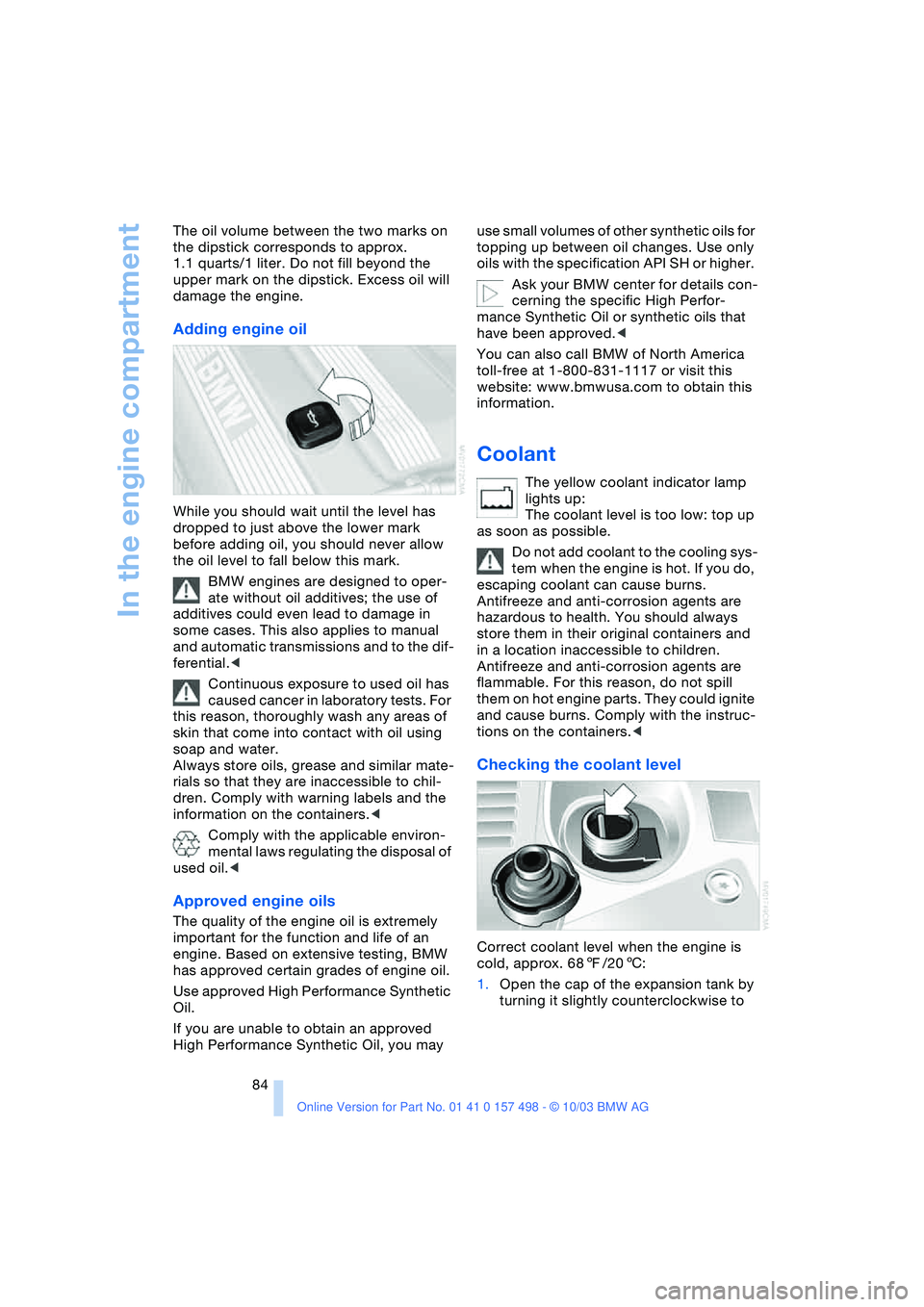
Checking the coolant level
Correct coolant level when the engine is
cold, approx. 687/206:
1.Open the cap of the expansion tank by
turning it slightly counterclockwise to
Page 89 of 120
Reference
At a glance
Controls
Driving tips
Mobility
87
Laws and regulations
California Proposition 65
warning
California laws require us to state the fol-
lowing warning:
Engine exhaust and a wide variety of
automobile components and parts,
including components found in the interior
furnishings in a vehicle, contain or emit
chemicals known to the State of California
to cause cancer and birth defects and
reproductive harm. In addition, certain flu-
ids contained in vehicles and certain prod-
ucts of component wear contain or emit
chemicals known to the State of CA to
cause cancer and birth defects or other
reproductive harm. Battery posts, terminals
and related accessories contain lead and
lead compounds. Wash your hands after
handling. Used engine oil contains chemi-
cals that have caused cancer in laboratory
animals. Always protect your skin by wash-
ing thoroughly with soap and water.<
OBD interface socket
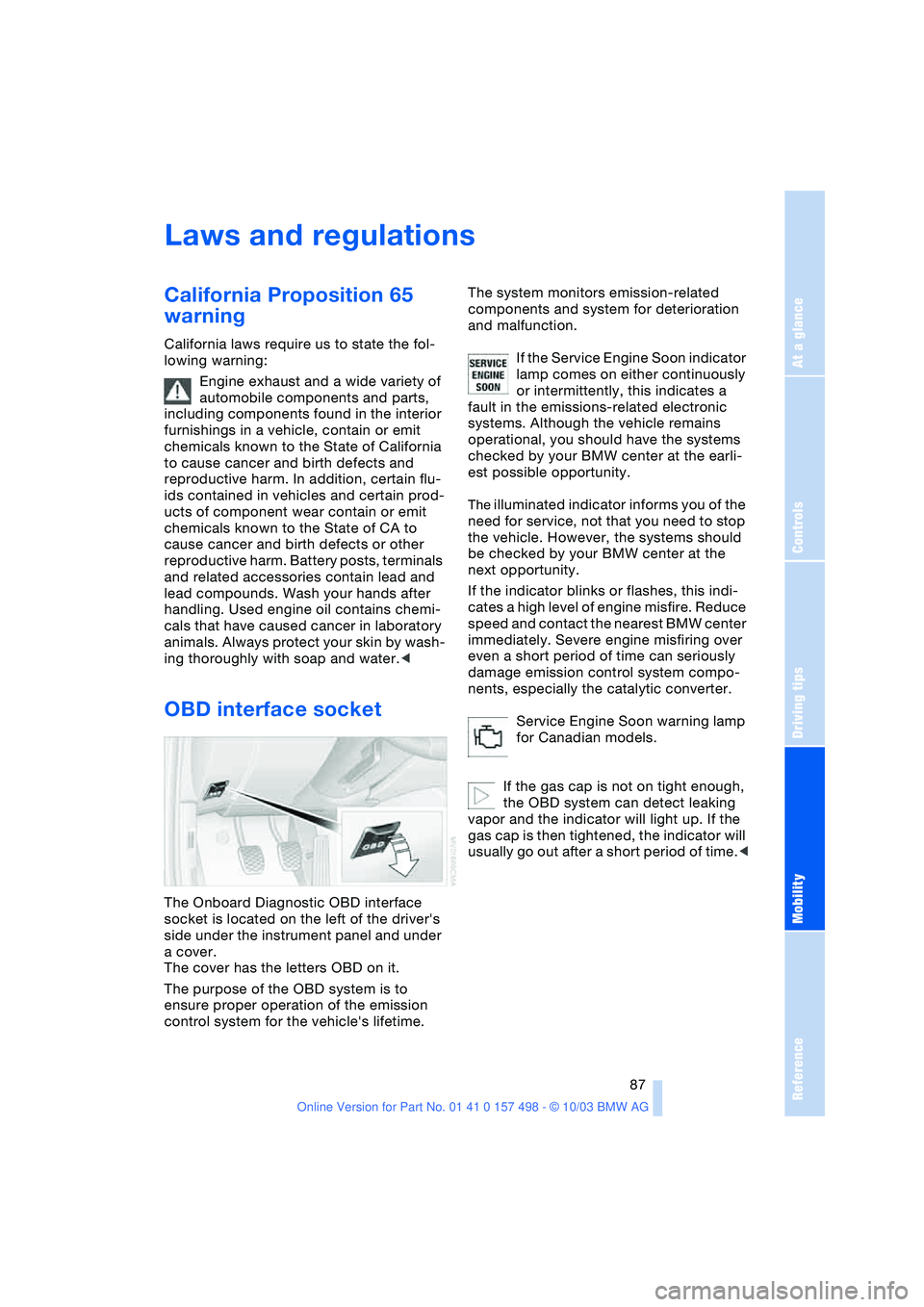
The Onboard Diagnostic OBD interface
socket is located on the left of the driver's
side under the instrument panel and under
a cover.
The cover has the letters OBD on it.
The purpose of the OBD system is to
ensure proper operation of the emission
control system for the vehicle's lifetime. The system monitors emission-related
components and system for deterioration
and malfunction.
If the Service Engine Soon indicator
lamp comes on either continuously
or intermittently, this indicates a
fault in the emissions-related electronic
systems. Although the vehicle remains
operational, you should have the systems
checked by your BMW center at the earli-
est possible opportunity.
The illuminated indicator informs you of the
need for service, not that you need to stop
the vehicle. However, the systems should
be checked by your BMW center at the
next opportunity.
If the indicator blinks or flashes, this indi-
cates a high level of engine misfire. Reduce
speed and contact the nearest BMW center
immediately. Severe engine misfiring over
even a short period of time can seriously
damage emission control system compo-
nents, especially the catalytic converter.
Service Engine Soon warning lamp
for Canadian models.
If the gas cap is not on tight enough,
the OBD system can detect leaking
vapor and the indicator will light up. If the
gas cap is then tightened, the indicator will
usually go out after a short period of time.<
Page 94 of 120
Replacement procedures
92
Charging the battery
Charge the battery in the vehicle only when
the engine is not running. For information
on connections, refer to Jump-starting on
page 94.
Battery disposal
Return used batteries to a recycling
point or to your BMW center. Maintain
the battery in an upright position for trans-
port and storage. Secure the battery
against tilting when transporting.<
Fuses
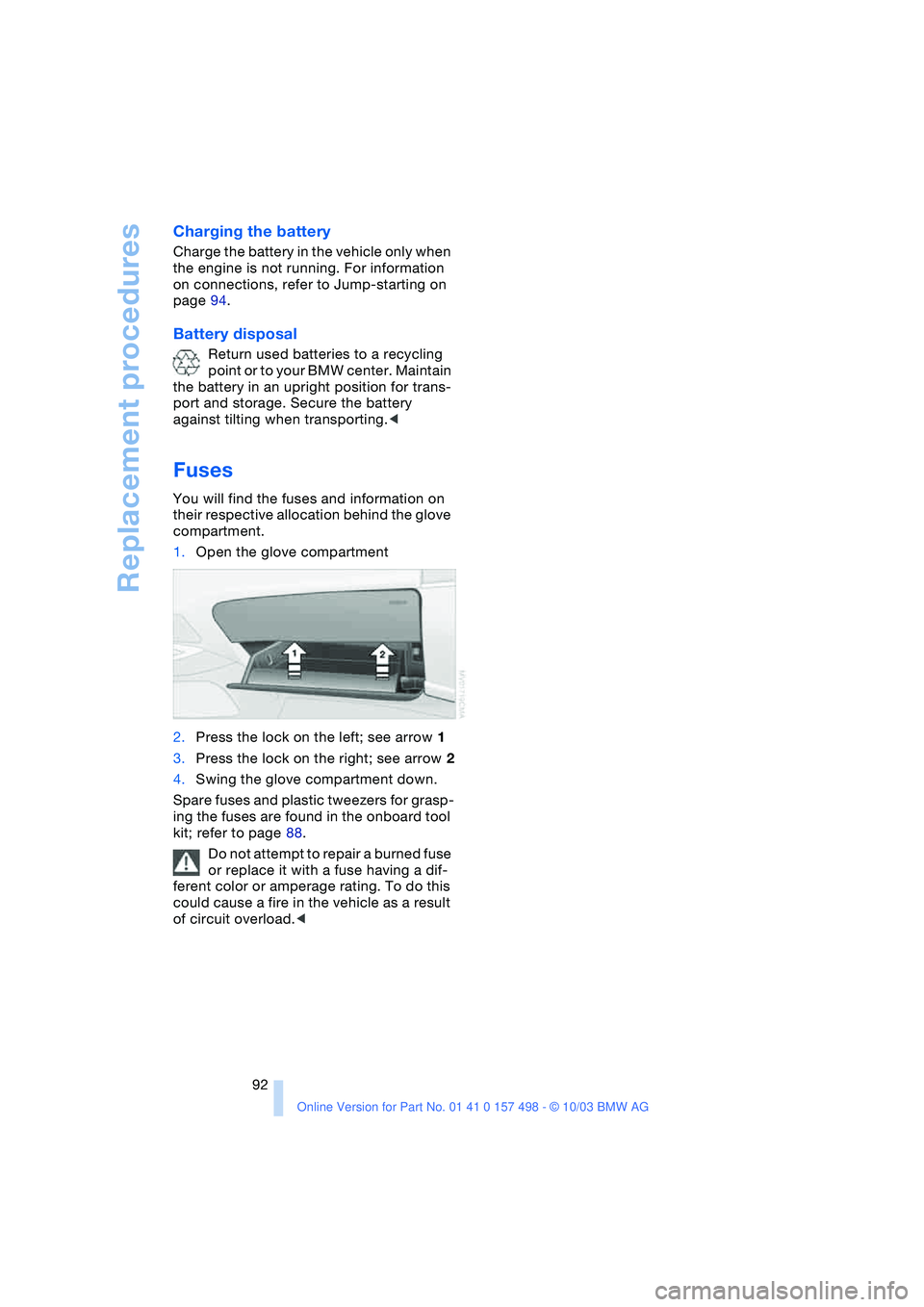
You will find the fuses and information on
their respective allocation behind the glove
compartment.
1.Open the glove compartment
2.Press the lock on the left; see arrow 1
3.Press the lock on the right; see arrow 2
4.Swing the glove compartment down.
Spare fuses and plastic tweezers for grasp-
ing the fuses are found in the onboard tool
kit; refer to page 88.
Do not attempt to repair a burned fuse
or replace it with a fuse having a dif-
ferent color or amperage rating. To do this
could cause a fire in the vehicle as a result
of circuit overload.<
Page 109 of 120
Reference
At a glance
Controls
Driving tips
Mobility
107
Electric Power Steering
EPS 43
– indicator lamp 13
Electric power windows 20
Electronic Stability
Program ESP, refer to
Dynamic Stability Control
DSC 52
Electronic transmission
control module 40
Emergency call 93
Emergency operation, refer
to Manual operation
– convertible top 23
– driver's door 18
– fuel filler door 74
– storage compartments 64
Engine 36
– break-in procedures 68
– data 100
– electronics 13
– indicator lamp 13
– speed 48
– starting 36
– switching off 37
Engine compartment 82
Engine coolant 84
Engine coolant
temperature gauge 48
Engine data 100
Engine oil 83
– alternative oils 84
– approved oils 84
– capacity 103
– indicator lamp 13
Engine oil level 83
– indicator lamp 13
Engine oil pressure 83
– indicator lamp 13
Engine oil sensor 83
– indicator lamp 13
Engine output, refer to
Engine data 100
Engine speed, refer to
Engine data 100
EPS Electric Power
Steering 43
Equipment range, see
Service and Warranty
Information Booklet for US models, Warranty and
Service Guide Booklet for
Canadian models
ESP Electronic Stability
Program, refer to
Dynamic Stability Control
DSC 52
Exhaust system, refer to
High temperatures 69
Exterior mirrors 31
– automatic dimming
feature 31
Eyelet, towing 96
F
False alarm, stopping
alarm 26
Fasten safety belts 30
– warning lamp 13, 30
Filter, refer to
– Microfilter 59
– Microfilter/activated-
charcoal filter 63
Fine wood, refer to the
Caring for your vehicle
brochure
First aid, refer to First-aid
kit 94
First-aid kit 94
Flat tire
– Flat Tire Monitor 54
– indicator/warning
lamp 13
Flat tire, refer to Tire
condition 78
Flat Tire Monitor 54
– indicator lamp 13, 55
– initializing 55
Flooding, refer to Driving
through water 69
Floor covers, carpets, refer
to the Caring for your
vehicle brochure
Floor mats, refer to the
Caring for your vehicle
brochure
Fluid reservoir
– washing systems 83
Fog lamps 47
– indicator lamp 13Follow me home lamps 46
Footbrake, refer to Driving
notes 69
Front airbags 56
Front turn signal indicators
– bulb replacement 90
Fuel
– average
consumption 51
– content, refer to
Capacities 103
– display 48
– preparation, refer to
Engine data 100
– quality 74
Fuel display, refer to Fuel
gauge 48
Fuel filler door 74
– unlocking in case of
electrical fault 74
Fuel gas cap 74
Fuel tank capacity, refer to
Capacities 103
Fuses 92
G
Gasoline, refer to Fuel
quality 74
Gasoline gauge, refer to
Fuel gauge 48
Gear indicator 40
Gear lever
– automatic transmission
with Steptronic 39
– manual transmission 38
Glove compartment 64
Gross weight, refer to
Weights 101
H
Handbrake, refer to Parking
brake 38
Hands-free microphone,
refer to Preparations for
the cellular phone 65
Hands-free system 65
Hardtop, refer to the
separate Owner's Manual
Hardtop preparation 71
Page 113 of 120
Reference
At a glance
Controls
Driving tips
Mobility
111
Securing, locking the
vehicle
– from inside 19
– from outside 17
Securing loads,
refer to Cargo loading 70
Selector lever
– automatic transmission
with Steptronic 39
Selector lever lock, refer to
Shiftlock 39
Selector lever positions
– automatic transmission
with Steptronic 39
Service, see Service and
Warranty Information
Booklet for US models,
Warranty and Service
Guide Booklet for
Canadian models 86
Service and warranty 6
Service interval
display 49, 86
Shifting gears
– automatic transmission
with Steptronic 39
– manual transmission 38
Shiftlock 39
Side airbags 56
Side turn signal indicators
– bulb replacement 90
Signal horn, refer to
Horn 10
Slipstream deflector, refer
to Wind deflector 24
Smokers' package, refer to
Ashtray 65
Snow chains 80
Socket, refer to Cigarette
lighter 65
Socket for Onboard
Diagnostics 87
SOS, refer to Emergency
call 93
Spare fuses 92
Spare key 16
Special oils, refer to
Specified engine oils 84
Special wash program,
refer to the Caring for
your vehicle brochureSpecified engine oils 84
Speed
– winter tires 79
Speedometer 12
Sport program
– automatic transmission
with Steptronic 39
– Driving Dynamic
Control 42
Sports seat 29
Stability control, refer to
– Dynamic Stability Control
DSC 52
Standing lamps 47
Starting 36
– engine 36
Starting assistance
– Dynamic Stability Control
DSC 52
Starting difficulties
– jump-starting 94
– temperature 37
Status of the Owner's
Manual 5
Steering lock 36
Steering wheel 10
– adjusting 30
Steptronic, refer to Manual
mode 39
Storage, tires 79
Storage compartments 64
– electrical fault 64
– opening manually 64
Storage nets 64
Storage space, refer to
Luggage compartment 20
Storage space, refer to
Storage
compartments 64
Storing seat position, refer
to Seat memory 29
Stroke, refer to Engine
data 100
Summer tires, refer to
Wheels and tires 75
Surface ice, refer to Ice
warning 50
Switches, refer to
Cockpit 10
Switch for passenger
airbags 33Switching gears, refer to
Automatic transmission
with Steptronic 39
Switching off
– engine 37
– vehicle 38
Symbols 4
T
Tachometer 48
Tail lamps
– bulb replacement 90
– indicator lamp, defective
lamp 13
Tail lamps, refer to Rear
lamps 90
– bulb replacement 90
Tank capacity, refer to Fuel
tank capacity 103
Tank indicator, refer to Fuel
gauge 48
Technical data 100
Technical modifications,
refer to For your own
safety 5
Telephone, refer to the
separate Owner's Manual
Telephone preparation 65
Temperature
– air conditioning 59
– automatic climate
control 62
– engine 48
Temperature display
– ice warning 50
– outside
temperature 49, 50
– setting units of
measure 50
Tempomat, refer to Cruise
control 45
The BMW Maintenance
System 86
Third brake lamp
– bulb replacement 90
Third brake lamp, refer to
Center high-mount brake
lamp 90
Three-point seat belt, refer
to Safety belts 30
Page 119 of 120
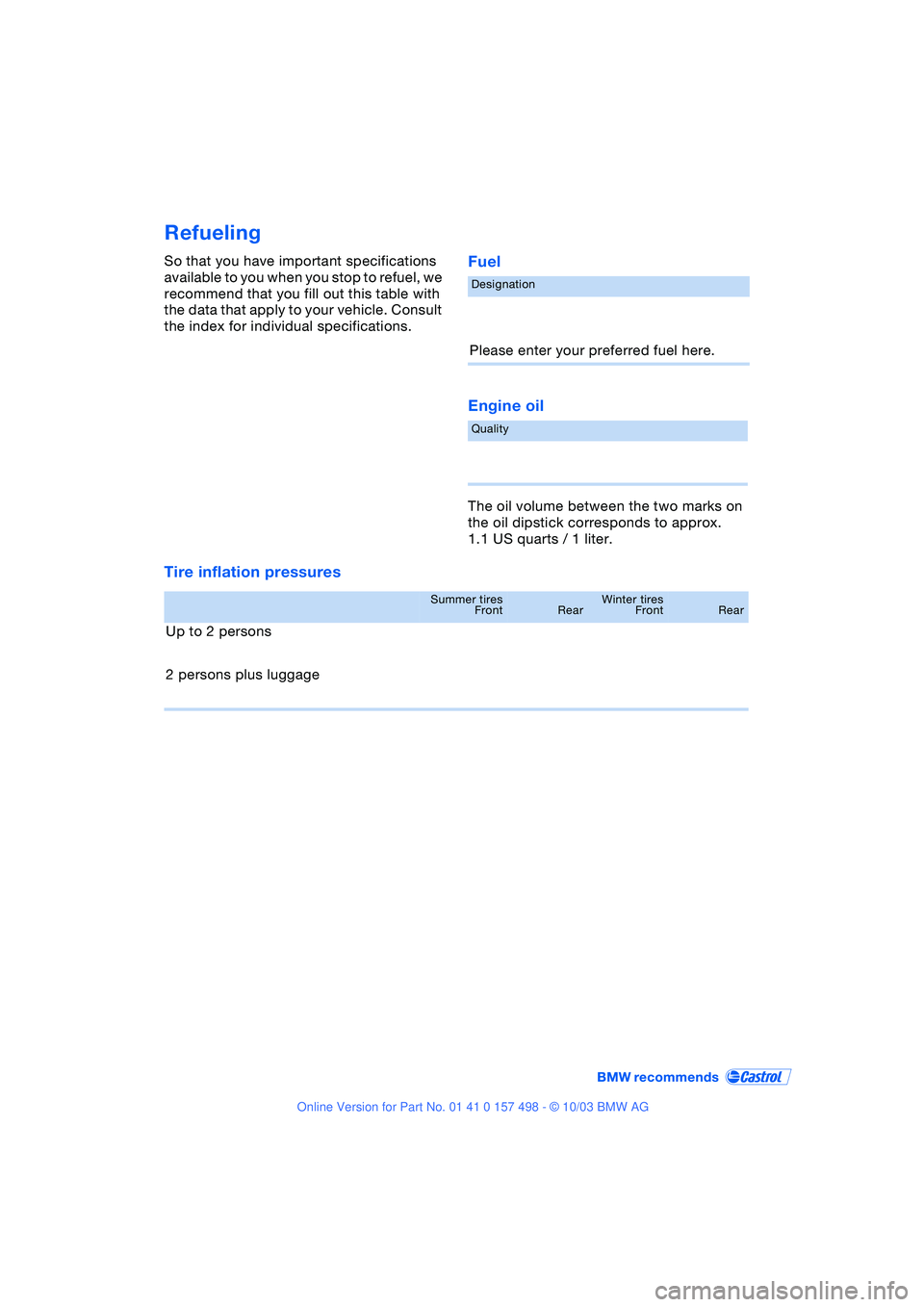
Refueling
So that you have important specifications
available to you when you stop to refuel, we
recommend that you fill out this table with
the data that apply to your vehicle. Consult
the index for individual specifications. Fuel
Engine oil
The oil volume between the two marks on
the oil dipstick corresponds to approx.
1.1 US quarts / 1 liter.
Tire inflation pressures
Designation
Please enter your preferred fuel here.
Quality
Summer tires
FrontRearWinter tires
FrontRear
Up to 2 persons
2 persons plus luggage