wheel BMW Z4 2.5I 2005 User Guide
[x] Cancel search | Manufacturer: BMW, Model Year: 2005, Model line: Z4 2.5I, Model: BMW Z4 2.5I 2005Pages: 120, PDF Size: 3.82 MB
Page 42 of 120
Driving
40
Sequential manual gearbox
SMG*
The concept
The sequential manual gearbox SMG is an
automated manual gearbox with which clutch-
ing and shifting is assumed by an electro-
hydraulic system.
The SMG is operated via two shift paddles on
the steering wheel and the selector lever in the
center console.
It offers the following functions:
>Optionally manual or automatic operation:
sequential mode or drive mode
>Ability to choose between two different
driving programs: standard or Sport, refer to
page41
>Protection against misshifting, and auto-
matic downshifting at minimum engine rpm
even in sequential mode
>Kickdown function in the drive mode
>Acceleration assistant, refer to page42.
The SMG is ready for operation when the igni-
tion key is in position 2.
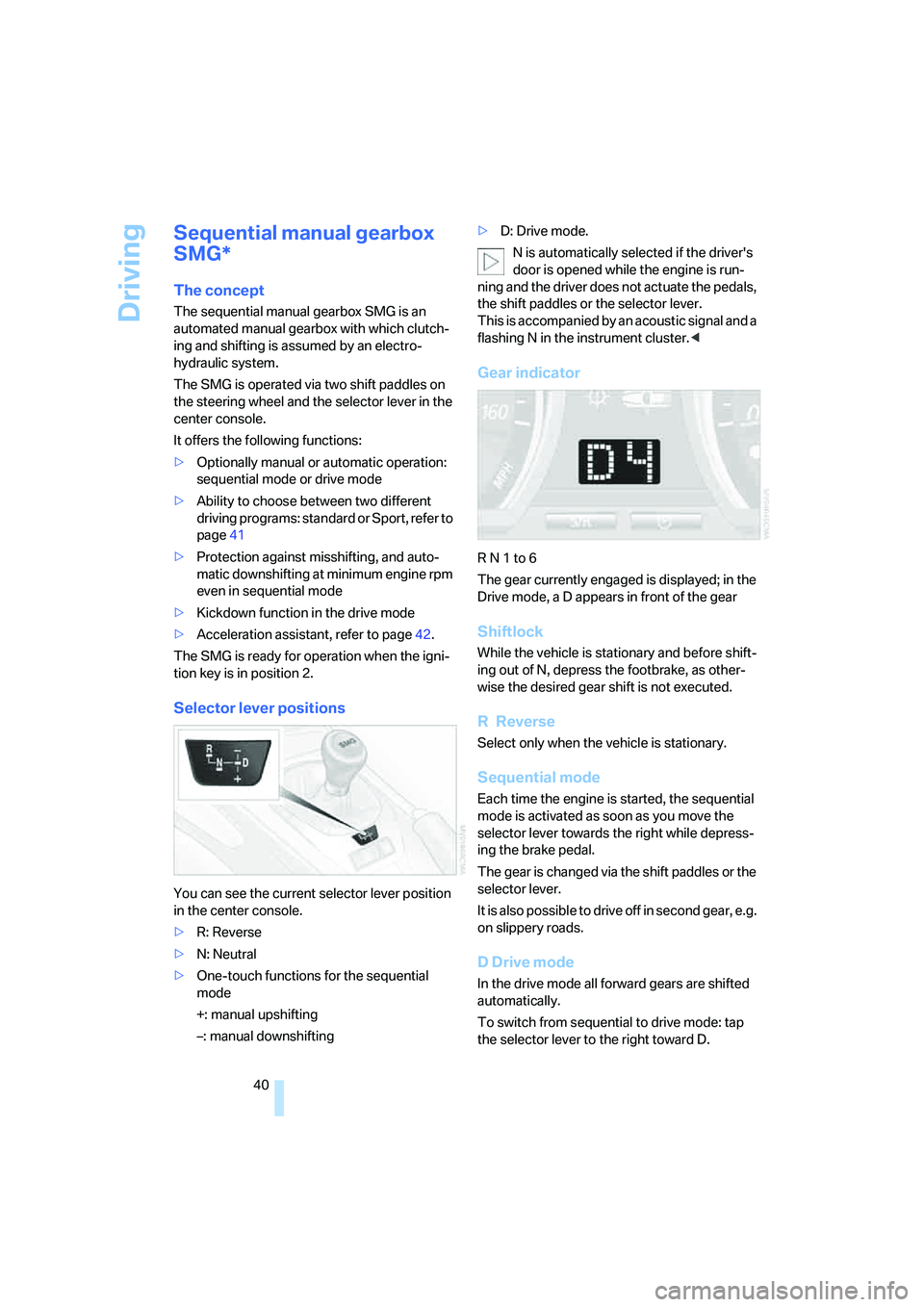
Selector lever positions
You can see the current selector lever position
in the center console.
>R: Reverse
>N: Neutral
>One-touch functions for the sequential
mode
+: manual upshifting
–: manual downshifting>D: Drive mode.
N is automatically selected if the driver's
door is opened while the engine is run-
ning and the driver does not actuate the pedals,
the shift paddles or the selector lever.
This is accompanied by an acoustic signal and a
flashing N in the instrument cluster.<
Gear indicator
R N 1 to 6
The gear currently engaged is displayed; in the
Drive mode, a D appears in front of the gear
Shiftlock
While the vehicle is stationary and before shift-
ing out of N, depress the footbrake, as other-
wise the desired gear shift is not executed.
R Reverse
Select only when the vehicle is stationary.
Sequential mode
Each time the engine is started, the sequential
mode is activated as soon as you move the
selector lever towards the right while depress-
ing the brake pedal.
The gear is changed via the shift paddles or the
selector lever.
It is also possible to drive off in second gear, e.g.
on slippery roads.
D Drive mode
In the drive mode all forward gears are shifted
automatically.
To switch from sequential to drive mode: tap
the selector lever to the right toward D.
Page 43 of 120
Reference
At a glance
Controls
Driving tips
Mobility
41
Kickdown:
For rapid acceleration, e.g. during passing,
depress the accelerator pedal completely. You
achieve maximum acceleration.
To switch back to sequential mode: tap the
selector lever again to the right toward D, or
change the current gear via the shift paddles or
the selector lever.
When driving off on inclines, drive
smoothly without pausing. Do not keep
the vehicle in place by depressing the accelera-
tor pedal; instead, apply the parking brake. Oth-
erwise, the gearbox could overheat.<
Shifting gears
With selector lever
>To upshift, tap the selector lever toward +
>To downshift, tap the lever toward –.
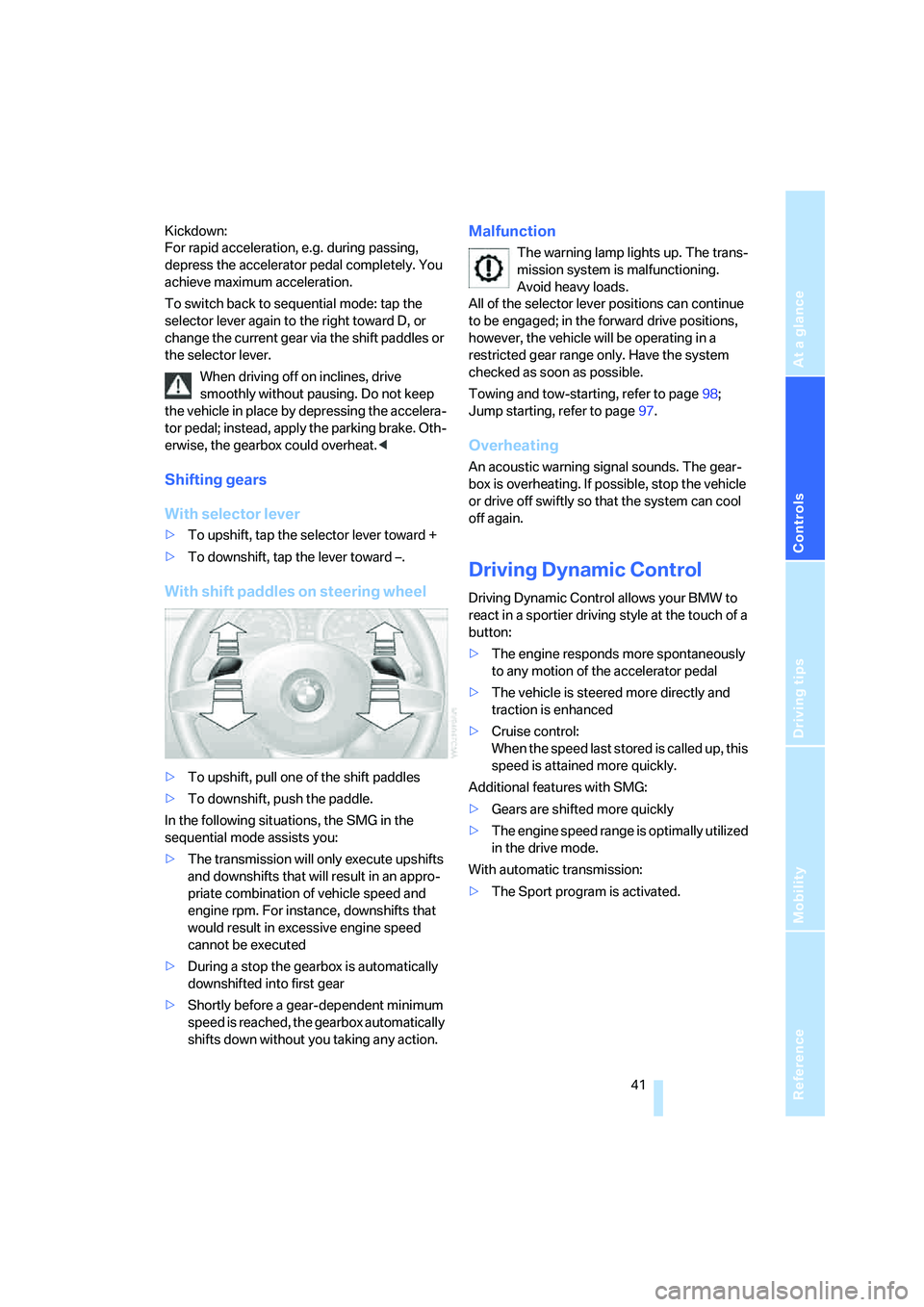
With shift paddles on steering wheel
>To upshift, pull one of the shift paddles
>To downshift, push the paddle.
In the following situations, the SMG in the
sequential mode assists you:
>The transmission will only execute upshifts
and downshifts that will result in an appro-
priate combination of vehicle speed and
engine rpm. For instance, downshifts that
would result in excessive engine speed
cannot be executed
>During a stop the gearbox is automatically
downshifted into first gear
>Shortly before a gear-dependent minimum
speed is reached, the gearbox automatically
shifts down without you taking any action.
Malfunction
The warning lamp lights up. The trans-
mission system is malfunctioning.
Avoid heavy loads.
All of the selector lever positions can continue
to be engaged; in the forward drive positions,
however, the vehicle will be operating in a
restricted gear range only. Have the system
checked as soon as possible.
Towing and tow-starting, refer to page98;
Jump starting, refer to page97.
Overheating
An acoustic warning signal sounds. The gear-
box is overheating. If possible, stop the vehicle
or drive off swiftly so that the system can cool
off again.
Driving Dynamic Control
Driving Dynamic Control allows your BMW to
react in a sportier driving style at the touch of a
button:
>The engine responds more spontaneously
to any motion of the accelerator pedal
>The vehicle is steered more directly and
traction is enhanced
>Cruise control:
When the speed last stored is called up, this
speed is attained more quickly.
Additional features with SMG:
>Gears are shifted more quickly
>The engine speed range is optimally utilized
in the drive mode.
With automatic transmission:
>The Sport program is activated.
Page 52 of 120
Technology for safety and driving convenience
50
Technology for safety and driving
convenience
Driving stability control
systems
Your BMW is equipped with a series of systems
that help maintain driving stability even in
adverse driving situations.
Antilock Brake System ABS
ABS keeps the wheels from locking during
braking. Steering stability is maintained even
during full brake applications. In this way, active
safety is enhanced.
ABS is operational each time the engine is
started. Braking safely, refer to page69.
Electronic brake-force distribution
The system controls brake-force application at
the rear wheels in order to obtain increased sta-
bility in the vehicle's braking response.
Dynamic Brake Control DBC
When the brake pedal is depressed quickly, this
system automatically supplies maximum brake-
servo boost, thereby helping to keep the vehi-
cle's braking distance as short as possible dur-
ing full brake applications. At the same time, the
benefits of the ABS are also exploited.
As long as you are braking, do not reduce pres-
sure on the brake pedal. When the brake pedal
is released, the DBC is switched off.
Dynamic Stability Control DSC
DSC prevents slip at the drive wheels while
starting off and accelerating the vehicle. DSC
also recognizes unstable vehicle conditions,
such as fishtailing or nose-diving. In these
cases, and subject to physical limits, DSC helps
to keep the vehicle on a steady course by
reducing engine speed and by applying brakes
at individual wheels.The laws of physics cannot be repealed
even with DSC. It will always be the
driver's responsibility to drive in a manner that
matches road conditions. Therefore, do not
limit the additional safety margin by practicing
risky driving.<
Dynamic Traction Control DTC
DTC is a variant of the DSC in which forward
momentum is optimized for special road condi-
tions, e.g. snow-covered roads that have not
yet been cleared. The system ensures maxi-
mum forward momentum, but driving stability is
limited. Therefore, drive carefully in accordance
with conditions.
In the following exceptional circumstances, it
may be effective to activate the DTC for a short
period:
>When driving on snow-covered grades, in
slush or on uncleared, snow-covered roads
>When rocking the vehicle or starting off in
deep snow or on loose surfaces
>When driving with snow chains.
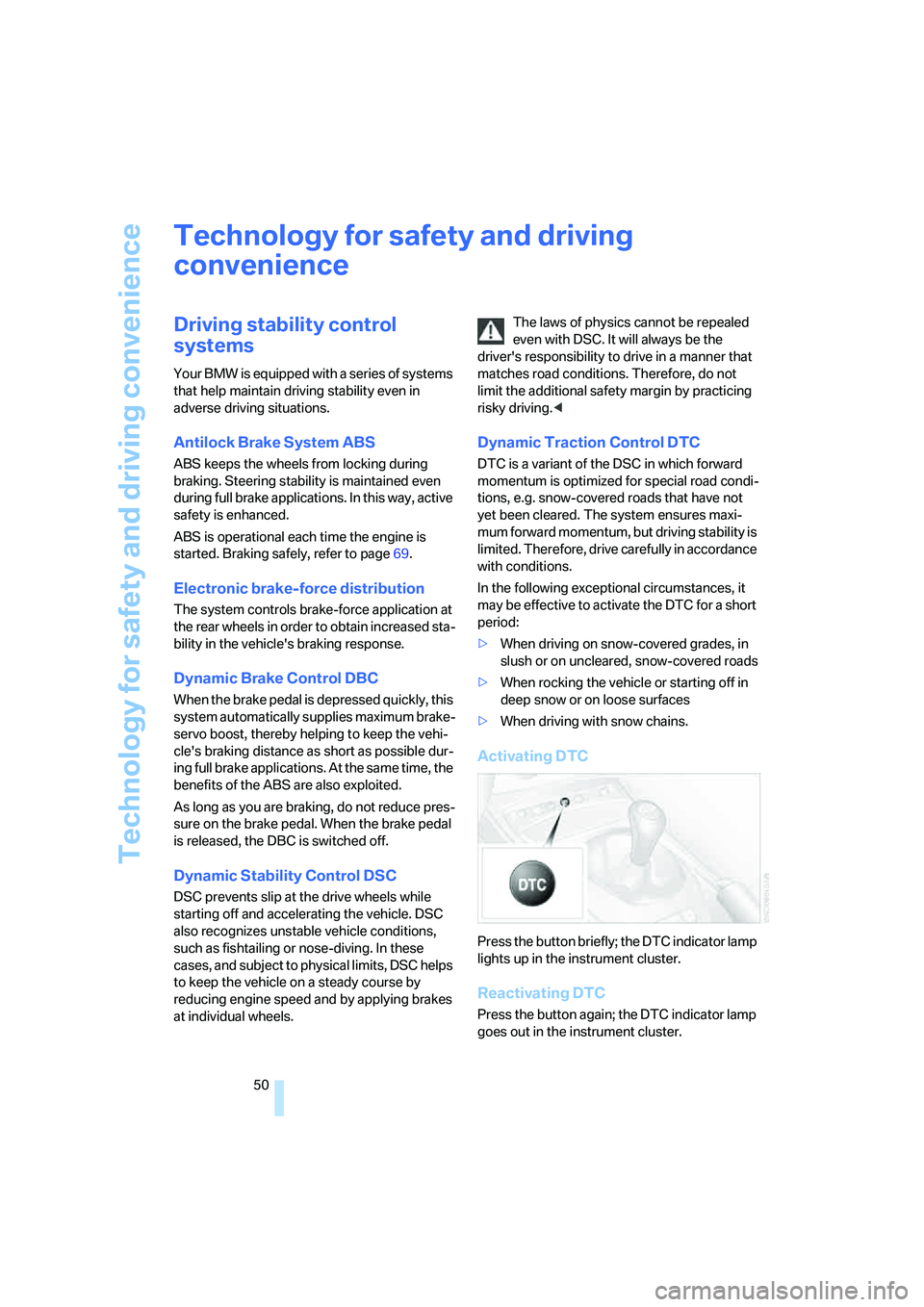
Activating DTC
Press the button briefly; the DTC indicator lamp
lights up in the instrument cluster.
Reactivating DTC
Press the button again; the DTC indicator lamp
goes out in the instrument cluster.
Page 54 of 120
Technology for safety and driving convenience
52
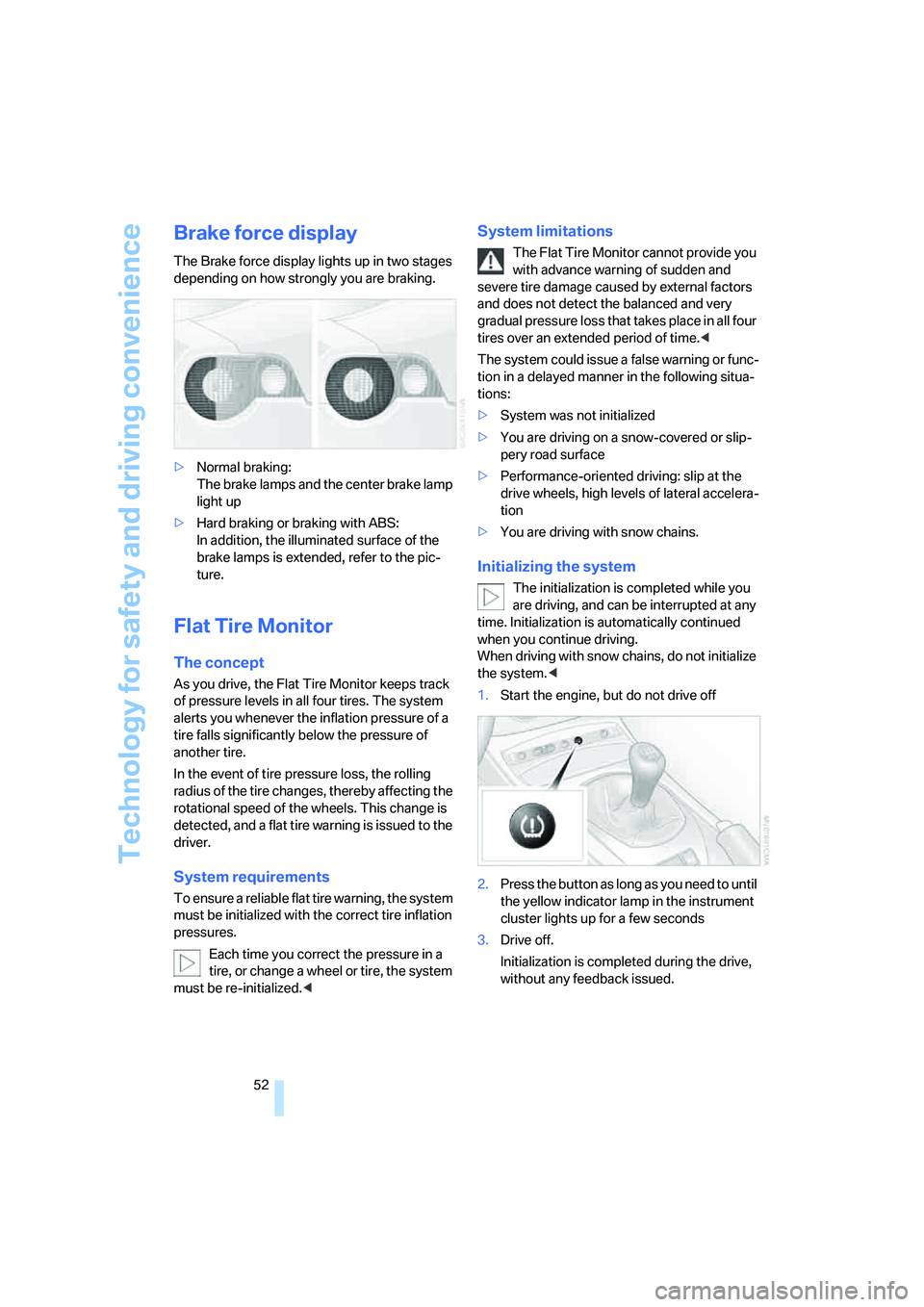
Brake force display
The Brake force display lights up in two stages
depending on how strongly you are braking.
>Normal braking:
The brake lamps and the center brake lamp
light up
>Hard braking or braking with ABS:
In addition, the illuminated surface of the
brake lamps is extended, refer to the pic-
ture.
Flat Tire Monitor
The concept
As you drive, the Flat Tire Monitor keeps track
of pressure levels in all four tires. The system
alerts you whenever the inflation pressure of a
tire falls significantly below the pressure of
another tire.
In the event of tire pressure loss, the rolling
radius of the tire changes, thereby affecting the
rotational speed of the wheels. This change is
detected, and a flat tire warning is issued to the
driver.
System requirements
To ensure a reliable flat tire warning, the system
must be initialized with the correct tire inflation
pressures.
Each time you correct the pressure in a
tire, or change a wheel or tire, the system
must be re-initialized.<
System limitations
The Flat Tire Monitor cannot provide you
with advance warning of sudden and
severe tire damage caused by external factors
and does not detect the balanced and very
gradual pressure loss that takes place in all four
tires over an extended period of time.<
The system could issue a false warning or func-
tion in a delayed manner in the following situa-
tions:
>System was not initialized
>You are driving on a snow-covered or slip-
pery road surface
>Performance-oriented driving: slip at the
drive wheels, high levels of lateral accelera-
tion
>You are driving with snow chains.
Initializing the system
The initialization is completed while you
are driving, and can be interrupted at any
time. Initialization is automatically continued
when you continue driving.
When driving with snow chains, do not initialize
the system.<
1.Start the engine, but do not drive off
2.Press the button as long as you need to until
the yellow indicator lamp in the instrument
cluster lights up for a few seconds
3.Drive off.
Initialization is completed during the drive,
without any feedback issued.
Page 56 of 120
Technology for safety and driving convenience
54 For information on the correct seating position,
refer to page27.
Do not apply adhesive materials to the
cover panels of the airbags, cover them or
modify them in any other way. Do not attempt to
remove the airbag retention system from the
vehicle. Never modify or tamper with either the
wiring or the individual components in the air-
bag system. This category includes the uphol-
stery in the center of the steering wheel, on the
instrument panel, and the side trim panels on
the doors. Do not attempt to remove or disman-
tle the steering wheel.
Do not touch the individual components
directly after the system has been triggered,
because there is a danger of burns.
If you note any indication of system malfunc-
tion, if you desire to have an airbag deactivated,
or if the airbag retention system is triggered in
response to an accident, you should always
entrust all inspection, repair and dismantling
operations to your BMW center.
Unprofessional attempts to service the system
could lead to failure in an emergency or to
undesired airbag activation, either of which
could result in personal injury.
To ensure compliance with official safety regu-
lations, please also entrust disposal of airbag
generators to a BMW center.<
Airbag warning information is also provided on
the sun visors.
Automatic deactivation of the
passenger airbags
Before transporting a child on the pas-
senger seat be sure to observe the infor-
mation/instructions under Transporting chil-
dren safely, refer to page33.<
Your BMW has a seat occupation detection
system. By evaluating the weight on the pas-
senger's seat, the system detects whether or
not the seat is occupied by a child in the child-
restraint system or an adult.
>When a child is seated in the child-restraint
system or in an empty seat, the front, side
and knee airbags are automatically deacti-
vated on the passenger's side>When an adult is traveling in the passen-
ger's seat, the front, side and knee airbags
remain active on the passenger's side.
Although not desired, it can occur in the
case of heavier children that the passen-
ger airbags remain active or, in the case of very
light adults or young persons, that the passen-
ger airbags are deactivated. The condition of
the passenger airbag system will be shown by
the indicator lamp in the central console, refer
to Passenger airbag status lamp below. If the
indicator lamp indicates that the passenger air-
bags are active and you want them to be deac-
tivated, the airbags have to be deactivated with
the vehicle ignition key and the key switch on
the outer passenger's side of the instrument
panel. Apart from passengers, do not place any
additional objects on the passenger seat. Do
not fit seat covers, seat cushion padding, ball
mats or other items to the passenger seat
unless they are specifically recommended by
BMW. Do not place any items under the seat.
Otherwise, the function of the seat occupation
detection could be impaired.<
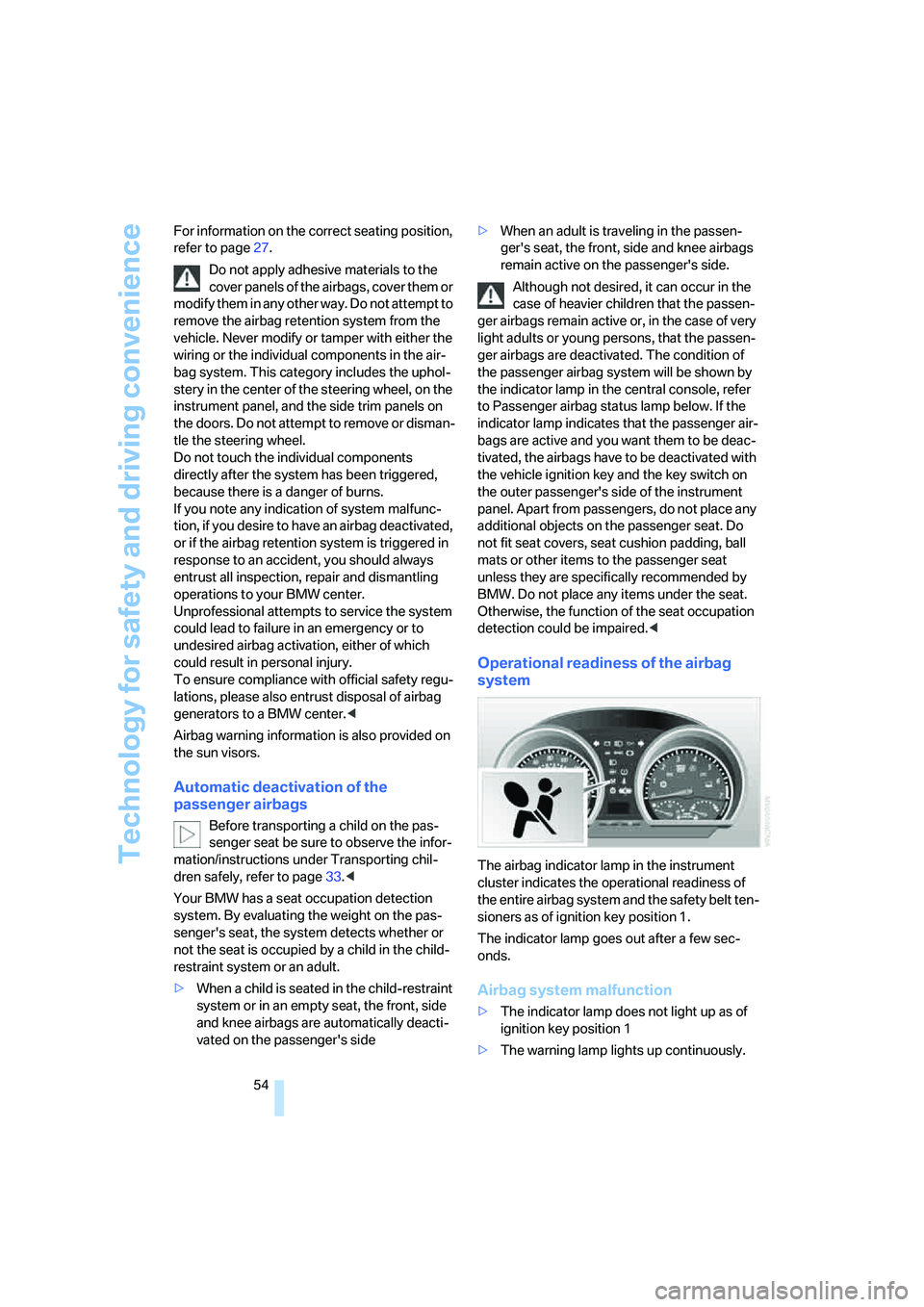
Operational readiness of the airbag
system
The airbag indicator lamp in the instrument
cluster indicates the operational readiness of
the entire airbag system and the safety belt ten-
sioners as of ignition key position 1.
The indicator lamp goes out after a few sec-
onds.
Airbag system malfunction
>The indicator lamp does not light up as of
ignition key position 1
>The warning lamp lights up continuously.
Page 77 of 120
Mobility
To ensure that you stay mobile, the following
chapter provides you with important
information on fuels and fluids, tires and
wheels, maintenance procedures and steps to
take in the event of a breakdown.
Mobility
Page 80 of 120
Wheels and tires
78
Wheels and tires
Tire inflation pressure
Information for your safety
It is not merely the tire's service life, but also
driving safety and driving comfort that largely
depend on the condition of the tires and the
maintenance of the specified tire pressure.
Checking tire pressures
Check the tire inflation pressures only when the
tires are cold. This means after a maximum driv-
ing distance of 1.25 miles/2 km or if the vehicle
has been parked for at least 2 hours. Warm tires
have higher inflation pressures.
Check tire inflation pressures regularly
and correct them if necessary: at least
every two weeks and before every extended
journey. Otherwise, incorrect tire pressures can
cause driving instability or tire damage, ulti-
mately resulting in accidents.<
Reinitialize the Flat Tire Monitor after cor-
recting the tire inflation pressure. Refer to
page52.<
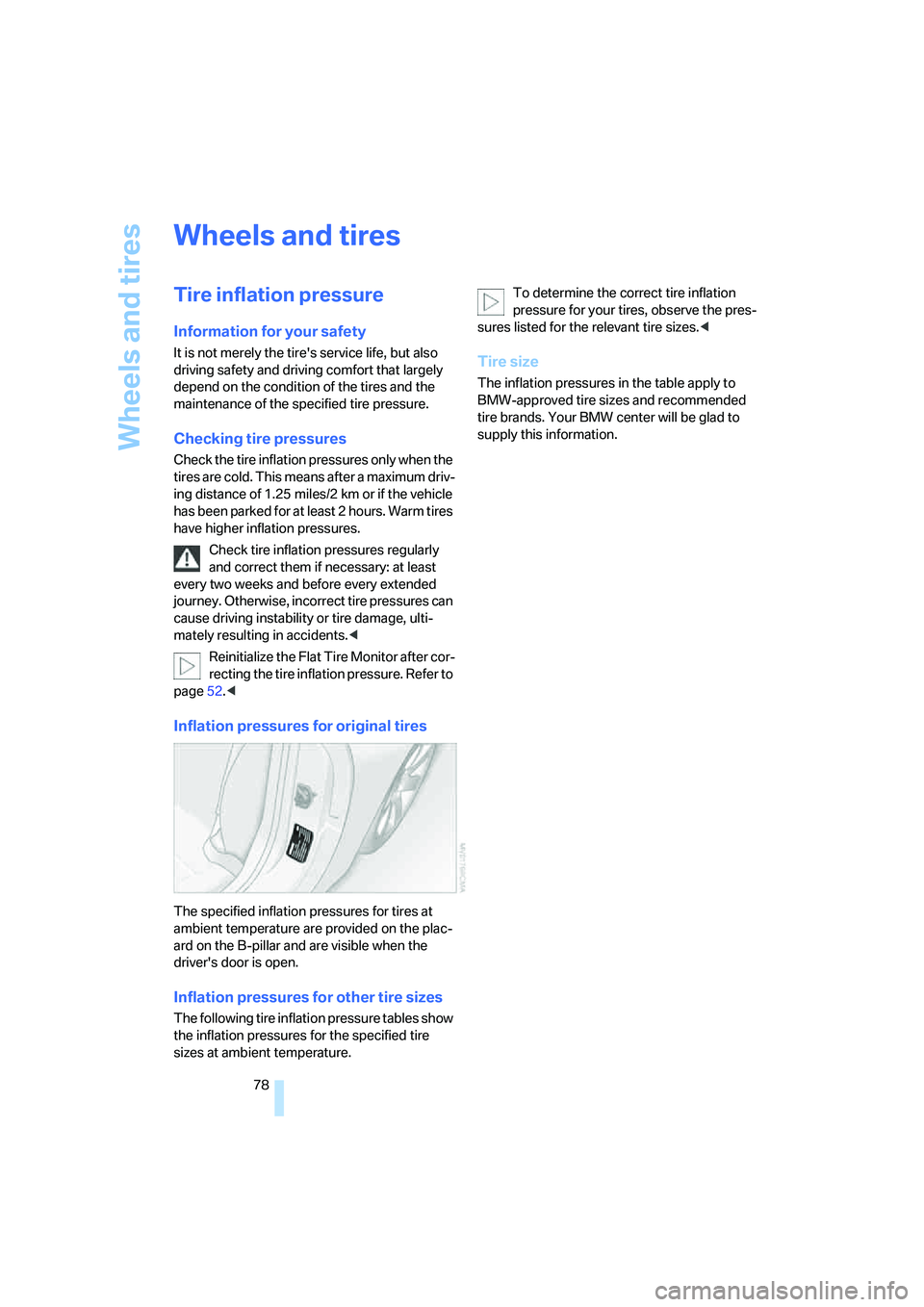
Inflation pressures for original tires
The specified inflation pressures for tires at
ambient temperature are provided on the plac-
ard on the B-pillar and are visible when the
driver's door is open.
Inflation pressures for other tire sizes
The following tire inflation pressure tables show
the inflation pressures for the specified tire
sizes at ambient temperature.To determine the correct tire inflation
pressure for your tires, observe the pres-
sures listed for the relevant tire sizes.<
Tire size
The inflation pressures in the table apply to
BMW-approved tire sizes and recommended
tire brands. Your BMW center will be glad to
supply this information.
Page 82 of 120
Wheels and tires
80
Tire coding
Understanding the lettering on the tire sidewall
makes it easier to identify and choose the cor-
rect tires.
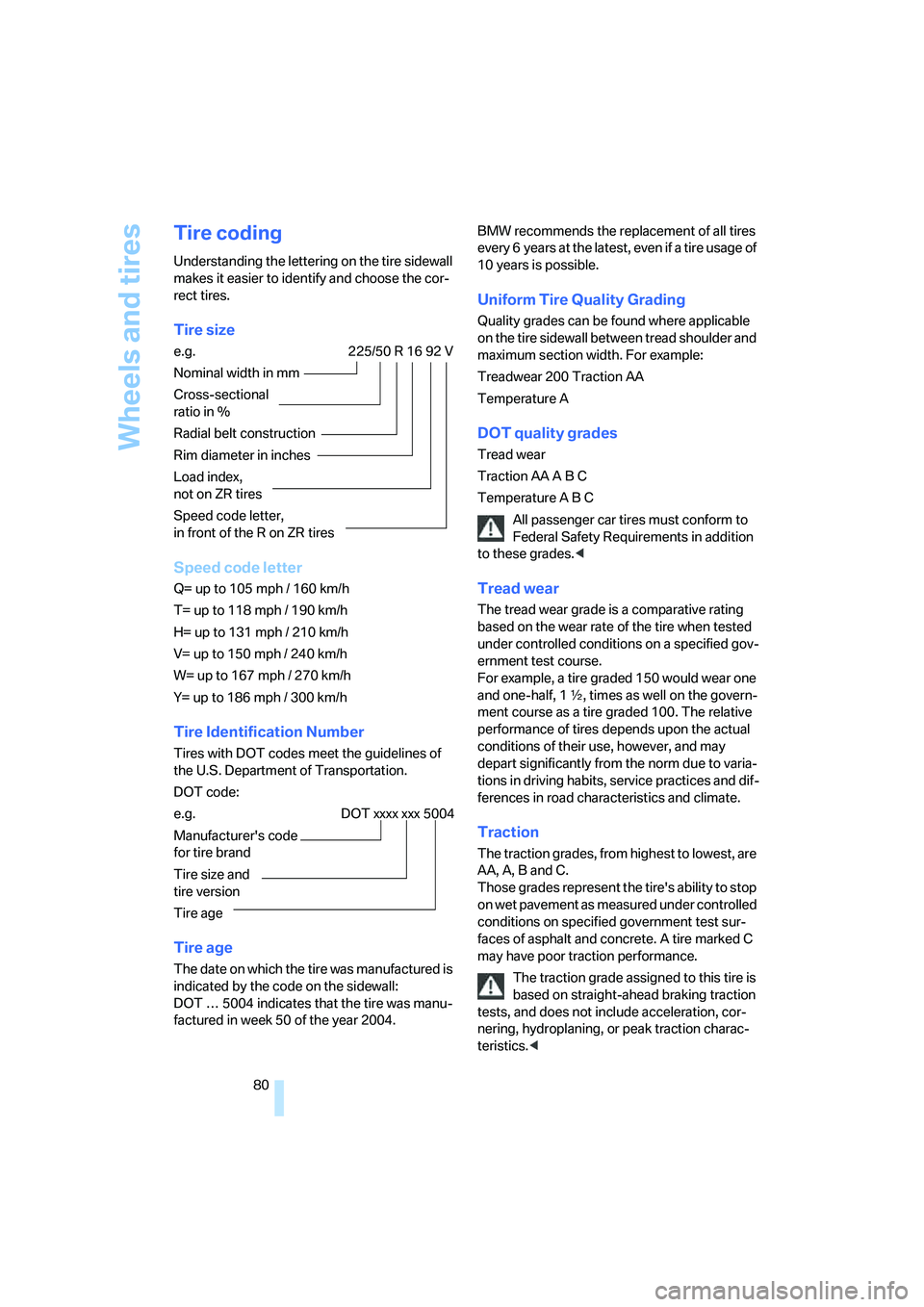
Tire size
e.g. 225/50 R 16 92 V
Nominal width in mm
Cross-sectional
ratio in %
Radial belt construction
Rim diameter in inches
Load index,
not on ZR tires
Speed code letter,
in front of the R on ZR tires
Speed code letter
Q= up to 105 mph / 160 km/h
T= up to 118 mph / 190 km/h
H= up to 131 mph / 210 km/h
V= up to 150 mph / 240 km/h
W= up to 167 mph / 270 km/h
Y= up to 186 mph / 300 km/h
Tire Identification Number
Tires with DOT codes meet the guidelines of
the U.S. Department of Transportation.
DOT code:
e.g. DOT xxxx xxx 5004
Manufacturer's code
for tire brand
Tire size and
tire version
Tire age
Tire age
The date on which the tire was manufactured is
indicated by the code on the sidewall:
DOT … 5004 indicates that the tire was manu-
factured in week 50 of the year 2004.BMW recommends the replacement of all tires
every 6 years at the latest, even if a tire usage of
10 years is possible.
Uniform Tire Quality Grading
Quality grades can be found where applicable
on the tire sidewall between tread shoulder and
maximum section width. For example:
Treadwear 200 Traction AA
Temperature A
DOT quality grades
Tread wear
Traction AA A B C
Temperature A B C
All passenger car tires must conform to
Federal Safety Requirements in addition
to these grades.<
Tread wear
The tread wear grade is a comparative rating
based on the wear rate of the tire when tested
under controlled conditions on a specified gov-
ernment test course.
For example, a tire graded 150 would wear one
and one-half, 1 γ, times as well on the govern-
ment course as a tire graded 100. The relative
performance of tires depends upon the actual
conditions of their use, however, and may
depart significantly from the norm due to varia-
tions in driving habits, service practices and dif-
ferences in road characteristics and climate.
Traction
The traction grades, from highest to lowest, are
AA, A, B and C.
Those grades represent the tire's ability to stop
on wet pavement as measured under controlled
conditions on specified government test sur-
faces of asphalt and concrete. A tire marked C
may have poor traction performance.
The traction grade assigned to this tire is
based on straight-ahead braking traction
tests, and does not include acceleration, cor-
nering, hydroplaning, or peak traction charac-
teristics.<
Page 83 of 120
Reference
At a glance
Controls
Driving tips
Mobility
81
Temperature
The temperature grades are A, the highest, B
and C, representing the tire’s resistance to the
generation of heat and its ability to dissipate
heat when tested under controlled conditions
on a specified indoor laboratory test wheel.
Sustained high temperature can cause the
material of the tire to degenerate and reduce
tire life, and excessive temperature can lead to
sudden tire failure. The grade C corresponds to
a level of performance which all passenger car
tires must meet under the Federal Motor Vehi-
cle Safety Standard No. 109. Grades B and A
represent higher levels of performance on the
laboratory test wheel than the minimum
required by law.
The temperature grade for this tire is
established for a tire that is properly
inflated and not overloaded. Excessive speed,
under-inflation, or excessive loading, either
separately or in combination, can cause heat
buildup and possible tire failure.<
RSC: Run Flat tires
Run Flat tires are labeled on the sidewall with a
circular symbol containing the letters RSC.
Refer to page82.
M+S
Winter and all-season tires.
These have better winter performance proper-
ties than summer tires.
Tire condition
Inspect your tires frequently for tread wear,
signs of damage and for foreign objects lodged
in the tread. Check the tread depth.
Tire tread
Tread depth should not be allowed to go below
1/8 in / 3 mm even though in Europe, for exam-
ple, the legally specified minimum tread depth
is only 1/16 in / 1.6 mm. Below 1/8 in / 3 mm
tread depth, there is a very high risk of hydro-
planing, even with only small amounts of water
on the road and at relatively moderate speeds.At tread depths below approx. 1/6in/ 4mm,
winter tires display a perceptible decrease in
their ability to cope with winter driving condi-
tions, and should be replaced in the interest of
safety.
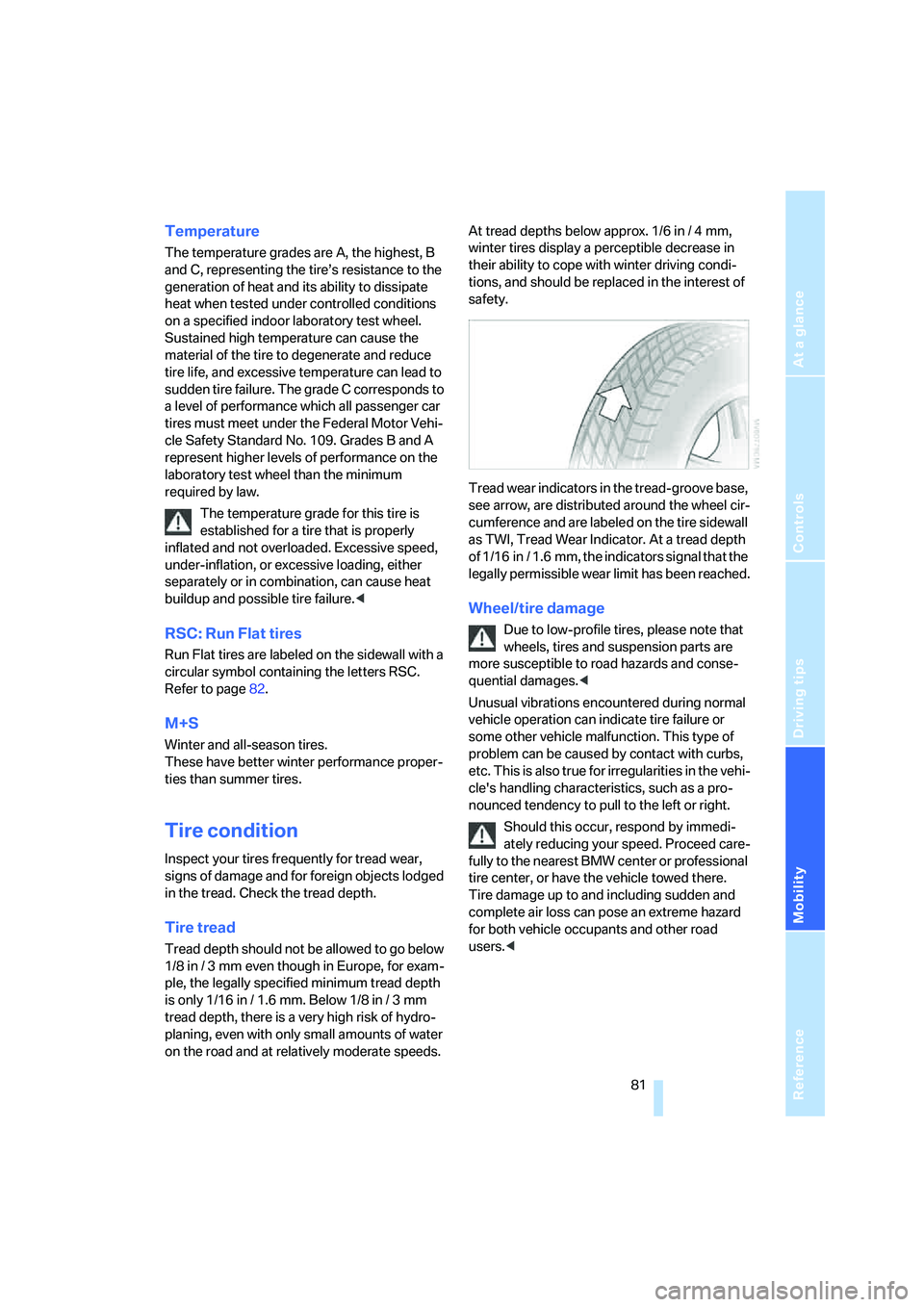
Tread wear indicators in the tread-groove base,
see arrow, are distributed around the wheel cir-
cumference and are labeled on the tire sidewall
as TWI, Tread Wear Indicator. At a tread depth
of 1/16 in / 1.6 mm, the indicators signal that the
legally permissible wear limit has been reached.
Wheel/tire damage
Due to low-profile tires, please note that
wheels, tires and suspension parts are
more susceptible to road hazards and conse-
quential damages.<
Unusual vibrations encountered during normal
vehicle operation can indicate tire failure or
some other vehicle malfunction. This type of
problem can be caused by contact with curbs,
etc. This is also true for irregularities in the vehi-
cle's handling characteristics, such as a pro-
nounced tendency to pull to the left or right.
Should this occur, respond by immedi-
ately reducing your speed. Proceed care-
fully to the nearest BMW center or professional
tire center, or have the vehicle towed there.
Tire damage up to and including sudden and
complete air loss can pose an extreme hazard
for both vehicle occupants and other road
users.<
Page 84 of 120
Wheels and tires
82
Run Flat tires fitted
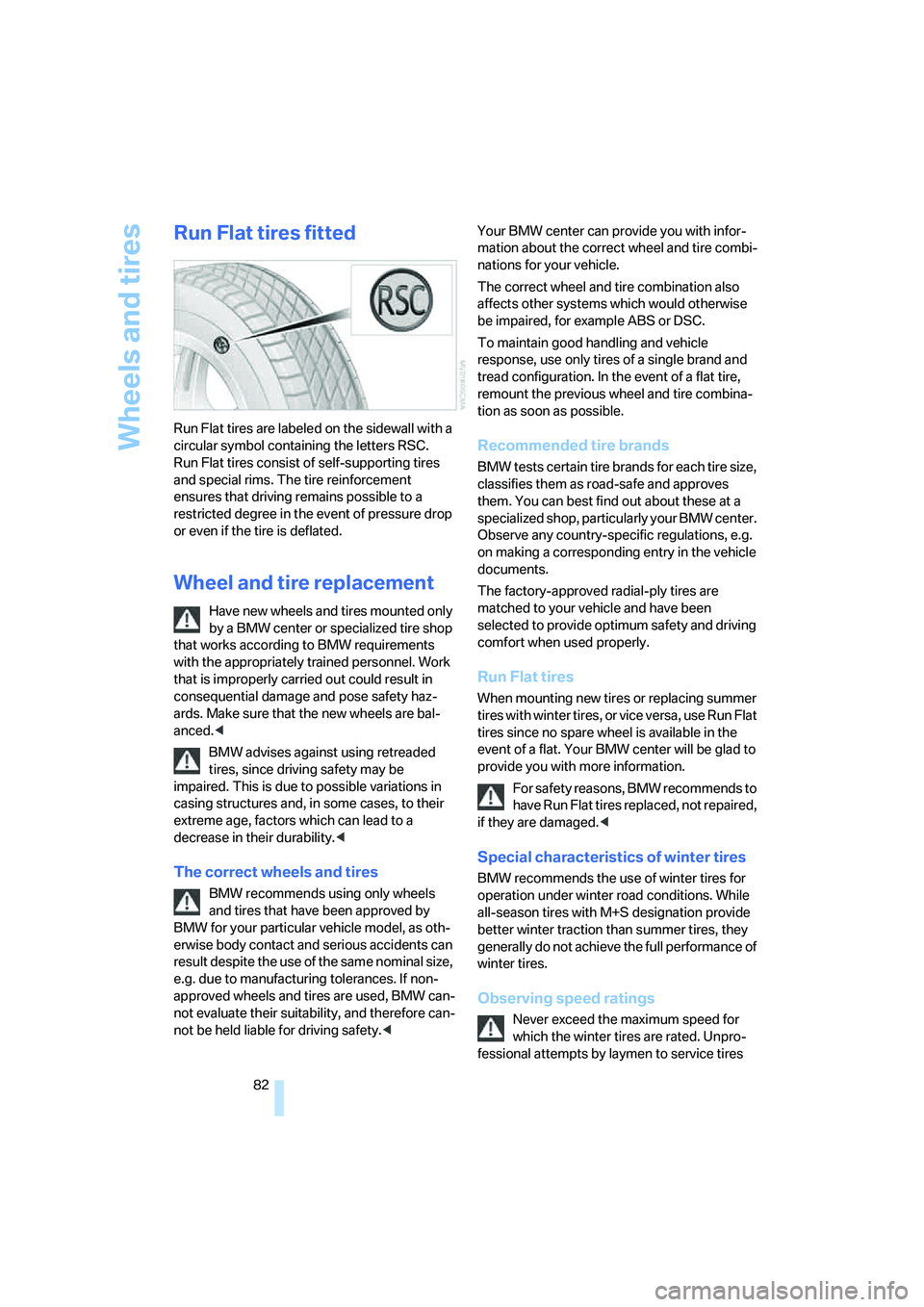
Run Flat tires are labeled on the sidewall with a
circular symbol containing the letters RSC.
Run Flat tires consist of self-supporting tires
and special rims. The tire reinforcement
ensures that driving remains possible to a
restricted degree in the event of pressure drop
or even if the tire is deflated.
Wheel and tire replacement
Have new wheels and tires mounted only
by a BMW center or specialized tire shop
that works according to BMW requirements
with the appropriately trained personnel. Work
that is improperly carried out could result in
consequential damage and pose safety haz-
ards. Make sure that the new wheels are bal-
anced.<
BMW advises against using retreaded
tires, since driving safety may be
impaired. This is due to possible variations in
casing structures and, in some cases, to their
extreme age, factors which can lead to a
decrease in their durability.<
The correct wheels and tires
BMW recommends using only wheels
and tires that have been approved by
BMW for your particular vehicle model, as oth-
erwise body contact and serious accidents can
result despite the use of the same nominal size,
e.g. due to manufacturing tolerances. If non-
approved wheels and tires are used, BMW can-
not evaluate their suitability, and therefore can-
not be held liable for driving safety.
nations for your vehicle.
The correct wheel and tire combination also
affects other systems which would otherwise
be impaired, for example ABS or DSC.
To maintain good handling and vehicle
response, use only tires of a single brand and
tread configuration. In the event of a flat tire,
remount the previous wheel and tire combina-
tion as soon as possible.
Recommended tire brands
BMW tests certain tire brands for each tire size,
classifies them as road-safe and approves
them. You can best find out about these at a
specialized shop, particularly your BMW center.
Observe any country-specific regulations, e.g.
on making a corresponding entry in the vehicle
documents.
The factory-approved radial-ply tires are
matched to your vehicle and have been
selected to provide optimum safety and driving
comfort when used properly.
Run Flat tires
When mounting new tires or replacing summer
tires with winter tires, or vice versa, use Run Flat
tires since no spare wheel is available in the
event of a flat. Your BMW center will be glad to
provide you with more information.
For safety reasons, BMW recommends to
have Run Flat tires replaced, not repaired,
if they are damaged.<
Special characteristics of winter tires
BMW recommends the use of winter tires for
operation under winter road conditions. While
all-season tires with M+S designation provide
better winter traction than summer tires, they
generally do not achieve the full performance of
winter tires.
Observing speed ratings
Never exceed the maximum speed for
which the winter tires are rated. Unpro-
fessional attempts by laymen to service tires