gearbox BMW Z4 2.5I 2005 Owners Manual
[x] Cancel search | Manufacturer: BMW, Model Year: 2005, Model line: Z4 2.5I, Model: BMW Z4 2.5I 2005Pages: 120, PDF Size: 3.82 MB
Page 14 of 120
Cockpit
12
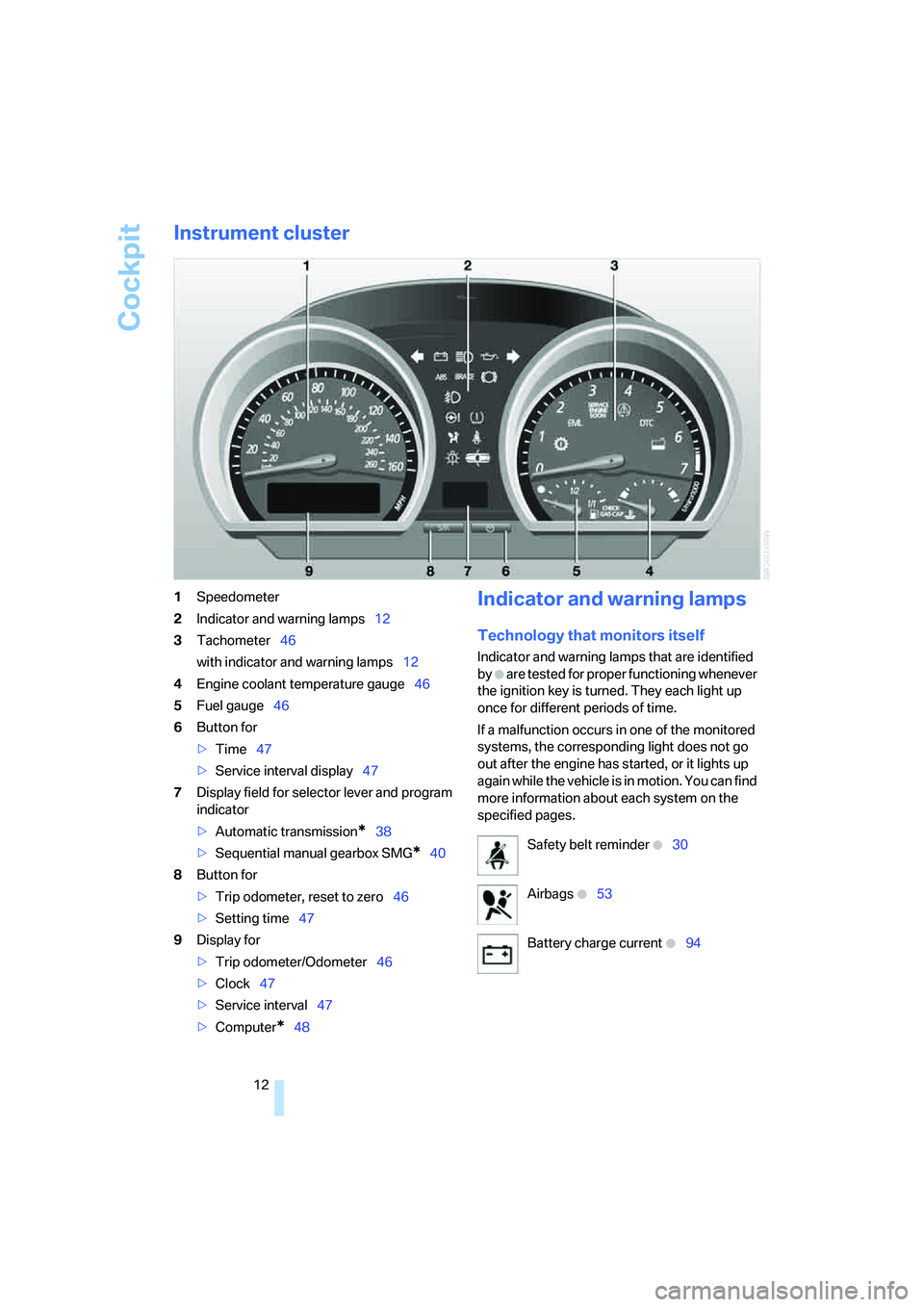
Instrument cluster
1Speedometer
2Indicator and warning lamps12
3Tachometer46
with indicator and warning lamps12
4Engine coolant temperature gauge46
5Fuel gauge46
6Button for
>Time47
>Service interval display47
7Display field for selector lever and program
indicator
>Automatic transmission
*38
>Sequential manual gearbox SMG
*40
8Button for
>Trip odometer, reset to zero46
>Setting time47
9Display for
>Trip odometer/Odometer46
>Clock47
>Service interval47
>Computer
*48
Indicator and warning lamps
Technology that monitors itself
Indicator and warning lamps that are identified
by
+ are tested for proper functioning whenever
the ignition key is turned. They each light up
once for different periods of time.
If a malfunction occurs in one of the monitored
systems, the corresponding light does not go
out after the engine has started, or it lights up
again while the vehicle is in motion. You can find
more information about each system on the
specified pages.
Safety belt reminder +30
Airbags
+53
Battery charge current
+94
Page 15 of 120
At a glance
Controls
Driving tips
Mobility Reference
13
Colors
The indicator and warning lamps can light up in
various colors and combinations.
>Red:
Stop the vehicle immediately
or
an important reminder
>Red and yellow:
Continue driving cautiously
>Yellow:
Have the system checked soon
or
for your information
>Green or blue:
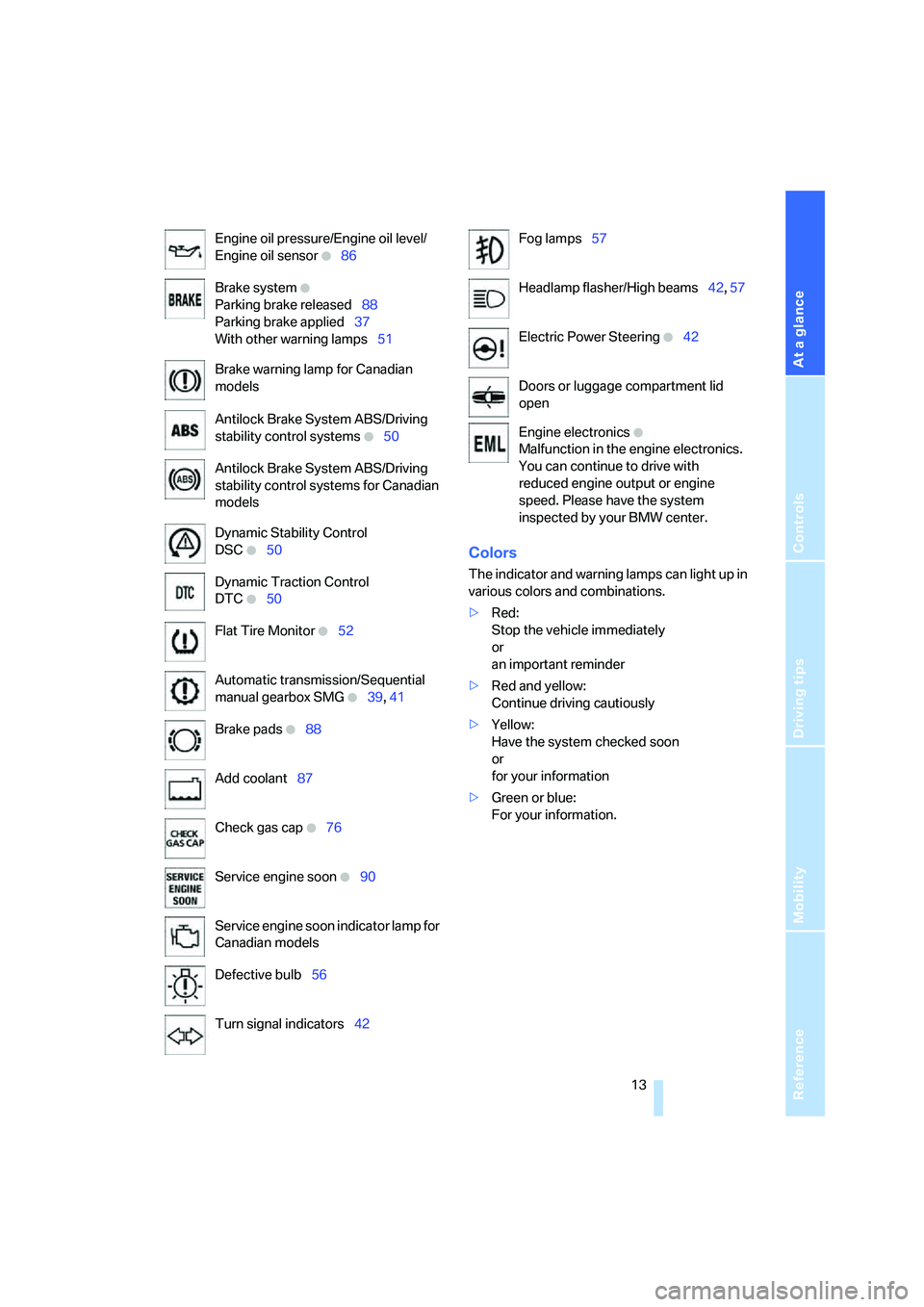
For your information. Engine oil pressure/Engine oil level/
Engine oil sensor
+86
Brake system
+
Parking brake released88
Parking brake applied37
With other warning lamps51
Brake warning lamp for Canadian
models
Antilock Brake System ABS/Driving
stability control systems
+50
Antilock Brake System ABS/Driving
stability control systems for Canadian
models
Dynamic Stability Control
DSC
+50
Dynamic Traction Control
DTC
+50
Flat Tire Monitor
+52
Automatic transmission/Sequential
manual gearbox SMG
+39, 41
Brake pads
+88
Add coolant87
Check gas cap
+76
Service engine soon
+90
Service engine soon indicator lamp for
Canadian models
Defective bulb56
Turn signal indicators42
Fog lamps57
Headlamp flasher/High beams42, 57
Electric Power Steering
+42
Doors or luggage compartment lid
open
Engine electronics
+
Malfunction in the engine electronics.
You can continue to drive with
reduced engine output or engine
speed. Please have the system
inspected by your BMW center.
Page 39 of 120
Reference
At a glance
Controls
Driving tips
Mobility
37
>On the first attempt, engage the starter for
approx. 10 seconds
>Press the accelerator pedal halfway down.
Avoid frequent starting attempts in short
succession or repeated starting attempts
during which the engine does not start. Other-
wise, uncombusted or incompletely combusted
fuel will pose a risk of the catalytic converter
overheating and being damaged.<
Manual transmission
1.Engage the parking brake
2.Gearshift lever in idling position
3.Depress the clutch pedal.
If the clutch pedal is not depressed, the
engine cannot be started
4.Start the engine.
Automatic transmission
1.Depress footbrake
2.Place selector lever in position P or N
3.Start the engine.
Sequential manual gearbox SMG
1.Depress footbrake
2.Move selector lever to neutral position N
3.Start the engine.
If the engine does not start, re-engage the
position last selected, refer to the display
in the instrument cluster, and then engage posi-
tion N again.<
Switching off the engine
Do not remove the ignition key while the
vehicle is still moving. If you did so, the
steering lock would engage when the steering
wheel is turned.
When you leave the vehicle, always remove the
ignition key and engage the steering lock.
Apply the parking brake when parking on steep
gradients, as the vehicle could otherwise start
to roll.<
You can have an acoustic signal set as a
reminder that the ignition key is still in the ignition switch after the driver's door has been
opened.<
Manual transmission
1.Turn the ignition key to position 1 or 0
2.Engage first gear or reverse gear.
Automatic transmission
1.Place the selector lever in position P
2.Turn the ignition key to position 1 or 0.
Sequential manual gearbox SMG
1.Engage a drive position
2.Turn the ignition key to position 1 or 0. An
acoustic signal sounds if the engine is
switched off while position N is engaged.
Parking brake
The parking brake is designed primarily to pre-
vent the vehicle from rolling when parked. It
operates against the rear wheels.
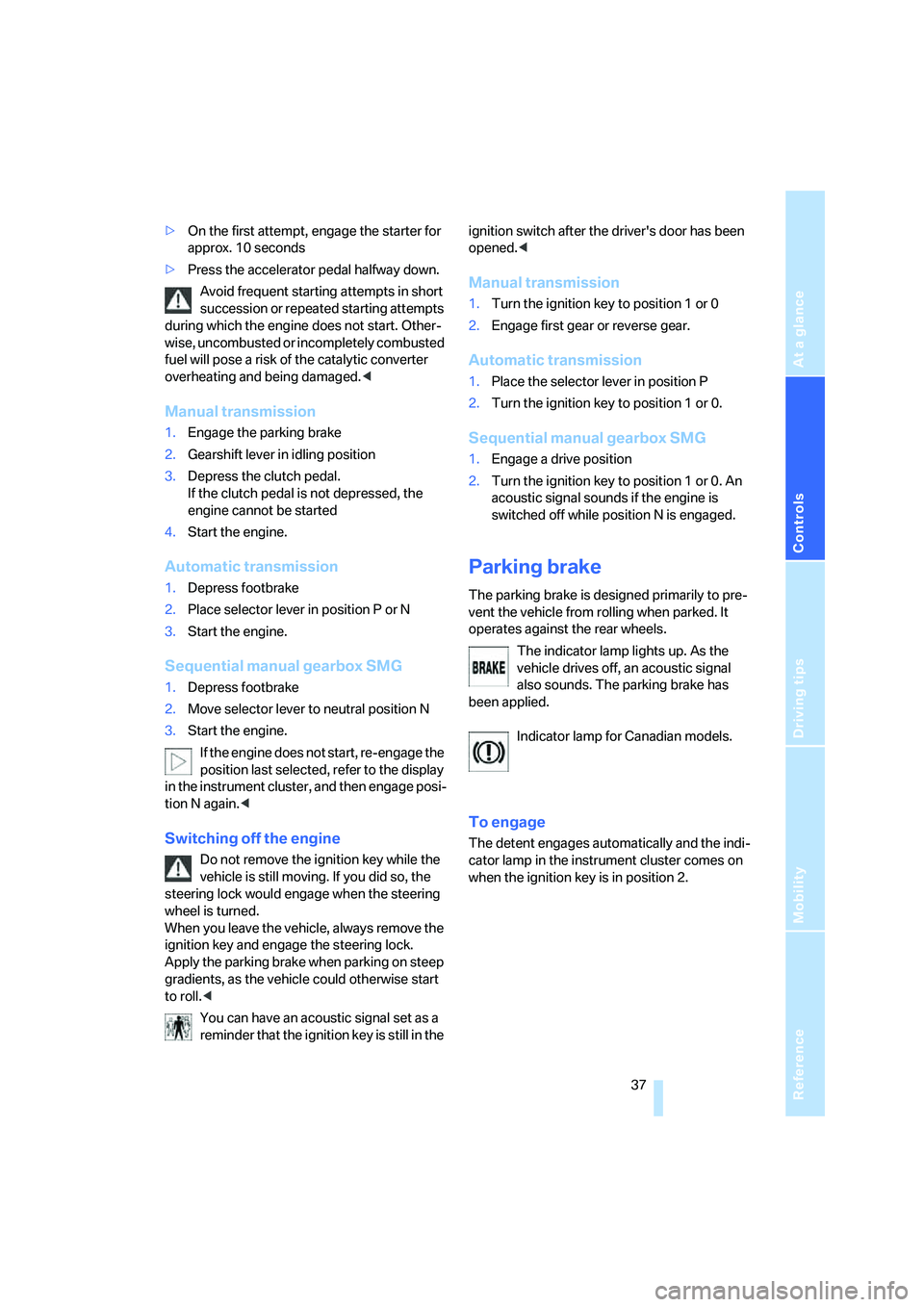
The indicator lamp lights up. As the
vehicle drives off, an acoustic signal
also sounds. The parking brake has
been applied.
Indicator lamp for Canadian models.
To engage
The detent engages automatically and the indi-
cator lamp in the instrument cluster comes on
when the ignition key is in position 2.
Page 42 of 120
Driving
40
Sequential manual gearbox
SMG*
The concept
The sequential manual gearbox SMG is an
automated manual gearbox with which clutch-
ing and shifting is assumed by an electro-
hydraulic system.
The SMG is operated via two shift paddles on
the steering wheel and the selector lever in the
center console.
It offers the following functions:
>Optionally manual or automatic operation:
sequential mode or drive mode
>Ability to choose between two different
driving programs: standard or Sport, refer to
page41
>Protection against misshifting, and auto-
matic downshifting at minimum engine rpm
even in sequential mode
>Kickdown function in the drive mode
>Acceleration assistant, refer to page42.
The SMG is ready for operation when the igni-
tion key is in position 2.
Selector lever positions
You can see the current selector lever position
in the center console.
>R: Reverse
>N: Neutral
>One-touch functions for the sequential
mode
+: manual upshifting
–: manual downshifting>D: Drive mode.
N is automatically selected if the driver's
door is opened while the engine is run-
ning and the driver does not actuate the pedals,
the shift paddles or the selector lever.
This is accompanied by an acoustic signal and a
flashing N in the instrument cluster.<
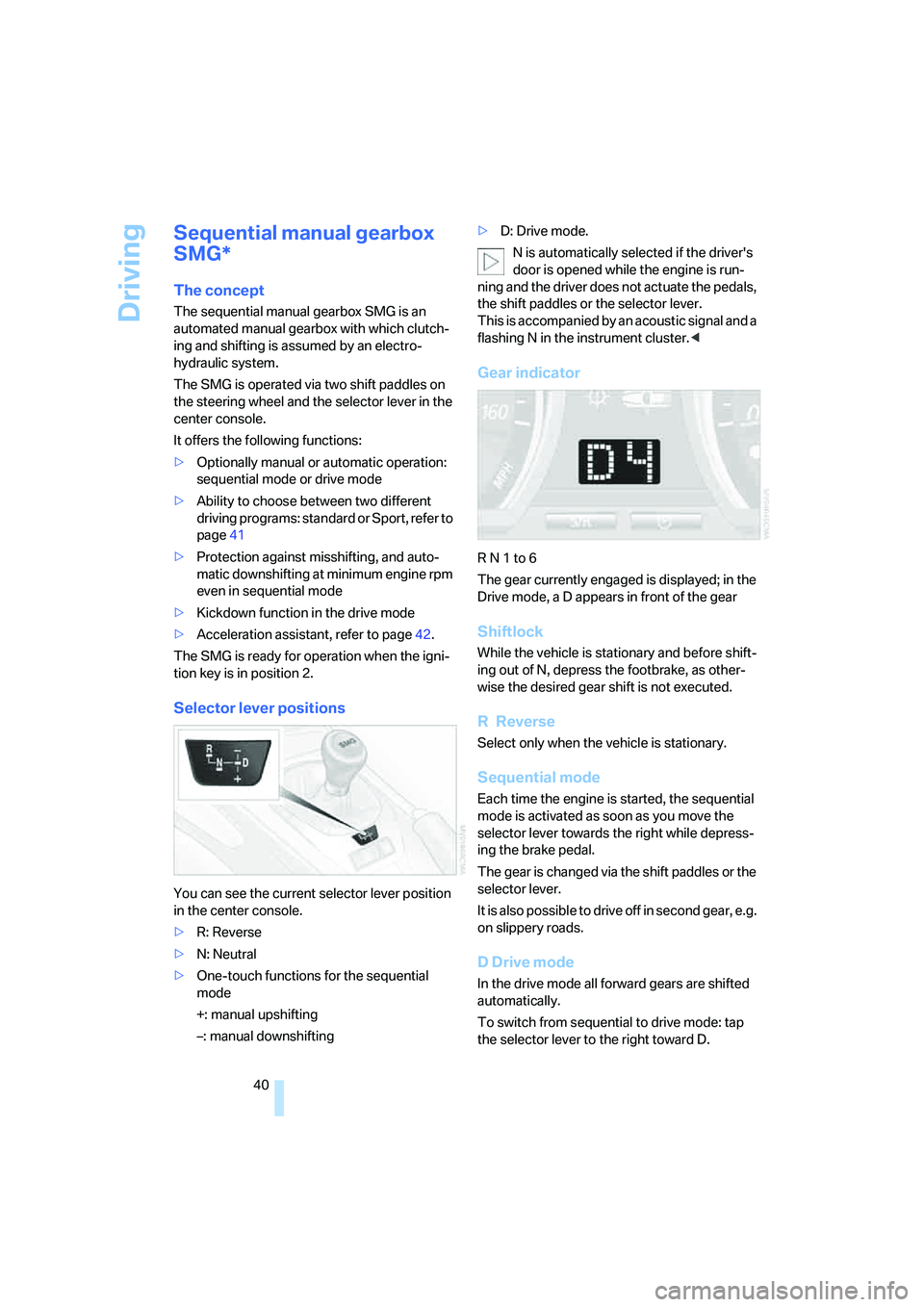
Gear indicator
R N 1 to 6
The gear currently engaged is displayed; in the
Drive mode, a D appears in front of the gear
Shiftlock
While the vehicle is stationary and before shift-
ing out of N, depress the footbrake, as other-
wise the desired gear shift is not executed.
R Reverse
Select only when the vehicle is stationary.
Sequential mode
Each time the engine is started, the sequential
mode is activated as soon as you move the
selector lever towards the right while depress-
ing the brake pedal.
The gear is changed via the shift paddles or the
selector lever.
It is also possible to drive off in second gear, e.g.
on slippery roads.
D Drive mode
In the drive mode all forward gears are shifted
automatically.
To switch from sequential to drive mode: tap
the selector lever to the right toward D.
Page 43 of 120
Reference
At a glance
Controls
Driving tips
Mobility
41
Kickdown:
For rapid acceleration, e.g. during passing,
depress the accelerator pedal completely. You
achieve maximum acceleration.
To switch back to sequential mode: tap the
selector lever again to the right toward D, or
change the current gear via the shift paddles or
the selector lever.
When driving off on inclines, drive
smoothly without pausing. Do not keep
the vehicle in place by depressing the accelera-
tor pedal; instead, apply the parking brake. Oth-
erwise, the gearbox could overheat.<
Shifting gears
With selector lever
>To upshift, tap the selector lever toward +
>To downshift, tap the lever toward –.
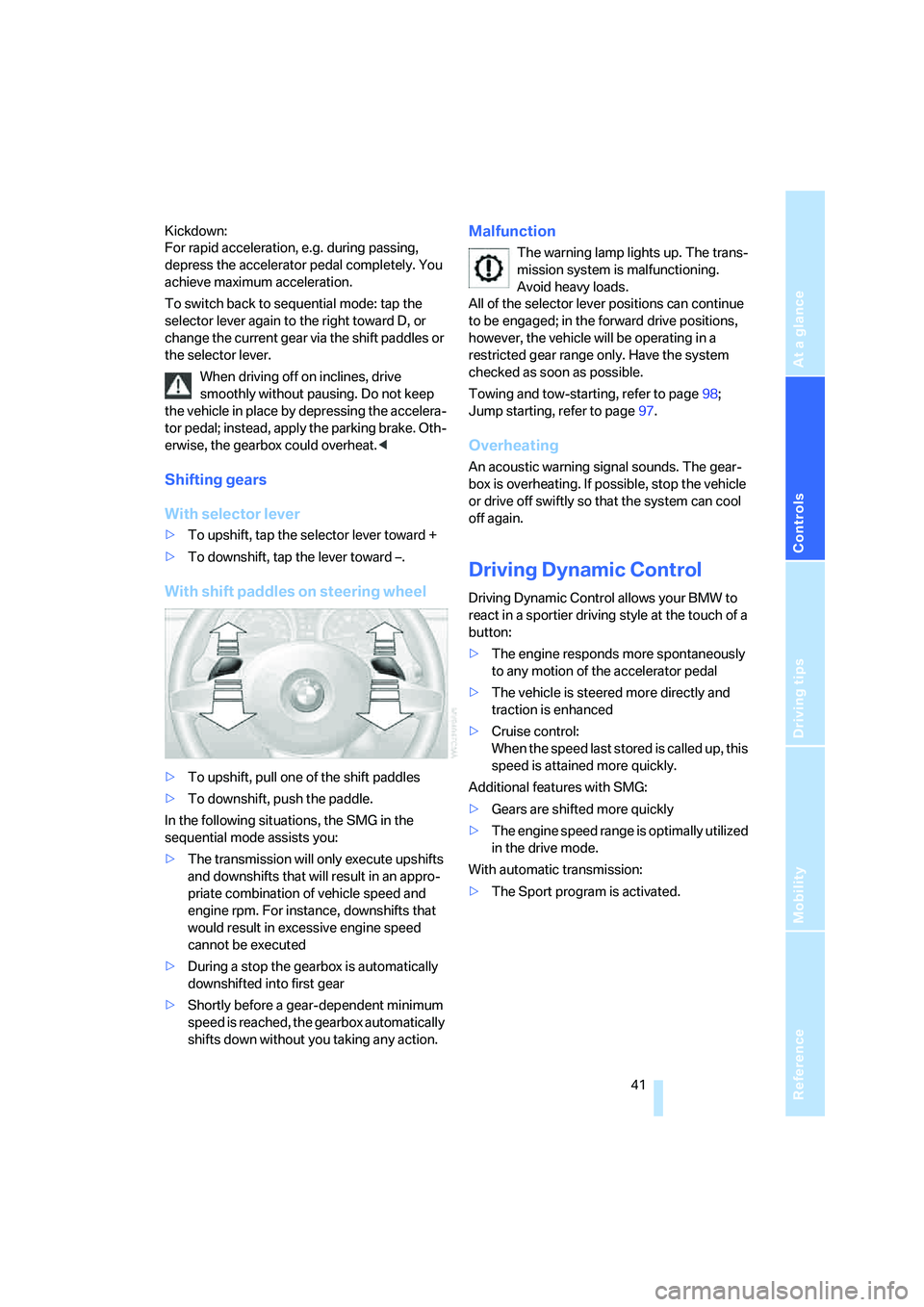
With shift paddles on steering wheel
>To upshift, pull one of the shift paddles
>To downshift, push the paddle.
In the following situations, the SMG in the
sequential mode assists you:
>The transmission will only execute upshifts
and downshifts that will result in an appro-
priate combination of vehicle speed and
engine rpm. For instance, downshifts that
would result in excessive engine speed
cannot be executed
>During a stop the gearbox is automatically
downshifted into first gear
>Shortly before a gear-dependent minimum
speed is reached, the gearbox automatically
shifts down without you taking any action.
Malfunction
The warning lamp lights up. The trans-
mission system is malfunctioning.
Avoid heavy loads.
All of the selector lever positions can continue
to be engaged; in the forward drive positions,
however, the vehicle will be operating in a
restricted gear range only. Have the system
checked as soon as possible.
Towing and tow-starting, refer to page98;
Jump starting, refer to page97.
Overheating
An acoustic warning signal sounds. The gear-
box is overheating. If possible, stop the vehicle
or drive off swiftly so that the system can cool
off again.
Driving Dynamic Control
Driving Dynamic Control allows your BMW to
react in a sportier driving style at the touch of a
button:
>The engine responds more spontaneously
to any motion of the accelerator pedal
>The vehicle is steered more directly and
traction is enhanced
>Cruise control:
When the speed last stored is called up, this
speed is attained more quickly.
Additional features with SMG:
>Gears are shifted more quickly
>The engine speed range is optimally utilized
in the drive mode.
With automatic transmission:
>The Sport program is activated.
Page 70 of 120
Special operating instructions
68
Special operating instructions
Break-in procedures
Moving parts need to be given some time until
they can interact smoothly with one another. To
ensure that your vehicle provides maximum
economy throughout a long service life, we
request that you observe the following:
Engine and differential
Up to 1,200 miles/2,000 km:
Drive at varying engine and road speeds, but do
not exceed the following engine or road speed:
4,500 rpm / 4,500/min or 100 mph / 160 km/h.
Obey your local and state maximum speed lim-
its.
Refrain from using full throttle and avoid press-
ing the accelerator beyond the kickdown point.
After you have driven 1,200 miles/2,000 km,
you can gradually increase the engine or road
speeds.
Sequential manual gearbox SMG
Up to 1,200 miles/2,000 km:
Do not use the acceleration assistant during the
break-in period.
Tires
Due to technical factors associated with their
manufacture, tires do not achieve their full trac-
tion potential until an initial break-in period has
elapsed. You should therefore drive with extra
caution during the first 200 miles/300 km.
Obey your local and state maximum speed lim-
its.
When the vehicle is operated on wet or
slushy roads, a wedge of water may form
between the tire and the road surface. This phe-
nomenon is referred to as hydroplaning and can
lead to partial or complete loss of traction, vehi-
cle control and braking effectiveness. Reduce
your speed on wet roads.<
Brake system
Approx. 300 miles/500 km must elapse before
the brake pads and rotors achieve their optimal
surface and wear pattern.
To break in the separate parking brake drums,
apply the parking brake lightly when coasting to
a standstill – at a traffic signal, for instance; use
caution to avoid posing a danger to other road
users.
To avoid corrosion, repeat this procedure from
time to time.
The brake lamps do not come on when the
parking brake is set.
Vacuum for the brake system servo unit
on your BMW is available only when the
engine is running. When you move the car with
the engine off, e.g. by towing, substantially
higher levels of pedal force will be required to
brake the vehicle.<
Clutch
The clutch will achieve its optimal functionality
after approx. 300 miles/500 km. Shift gears
carefully during the break-in period.
After replacing components
Follow the same break-in procedure again if any
of the components mentioned above have to be
replaced in the future.
Driving notes
Close the luggage compartment lid
Operate the vehicle only when the lug-
gage compartment lid is completely
closed, otherwise exhaust fumes could pene-
trate into the interior of the vehicle.<
Should it be absolutely necessary to operate
the vehicle with the luggage compartment lid
open and with the convertible top closed:
Page 101 of 120
Reference
At a glance
Controls
Driving tips
Mobility
99
Vehicles with automatic transmission
Selector lever in position N.
Do not exceed a towing speed of 45 mph /
70 km/h or a towing distance of 90 miles/
150 km. Otherwise, the automatic transmission
could be damaged.<
Vehicles with sequential manual
gearbox SMG
To push or tow the vehicle, turn on the ignition
and move the selector lever to position N, then
turn the ignition off again.
Towing methods
In some countries, it is not permitted to tow the
vehicle with a tow bar or tow rope on public
roads.
Familiarize yourself with the applicable towing
regulations for the country in which you are
driving.
With a tow bar
The towing vehicle must not be lighter
than the vehicle being towed; otherwise,
vehicle handling can no longer be controlled.<
The towing eyelets of both vehicles should be
on the same side. If the tow bar can only be
used in a diagonal position, please note the fol-
lowing:
>Clearance is restricted while you are driving
around corners
>The inclination of the tow bar produces late-
ral force.
Only attach the tow bar to the towing eye-
lets. Other parts of the vehicle could oth-
erwise be damaged.<
With a tow rope
When the towing vehicle is driving off, make
sure that the tow rope is taut.
Use nylon ropes or straps for towing
because they prevent sudden jerking
movements. Attach tow ropes only to the tow-
ing eyelet. Other parts of the vehicle could oth-
erwise be damaged.<
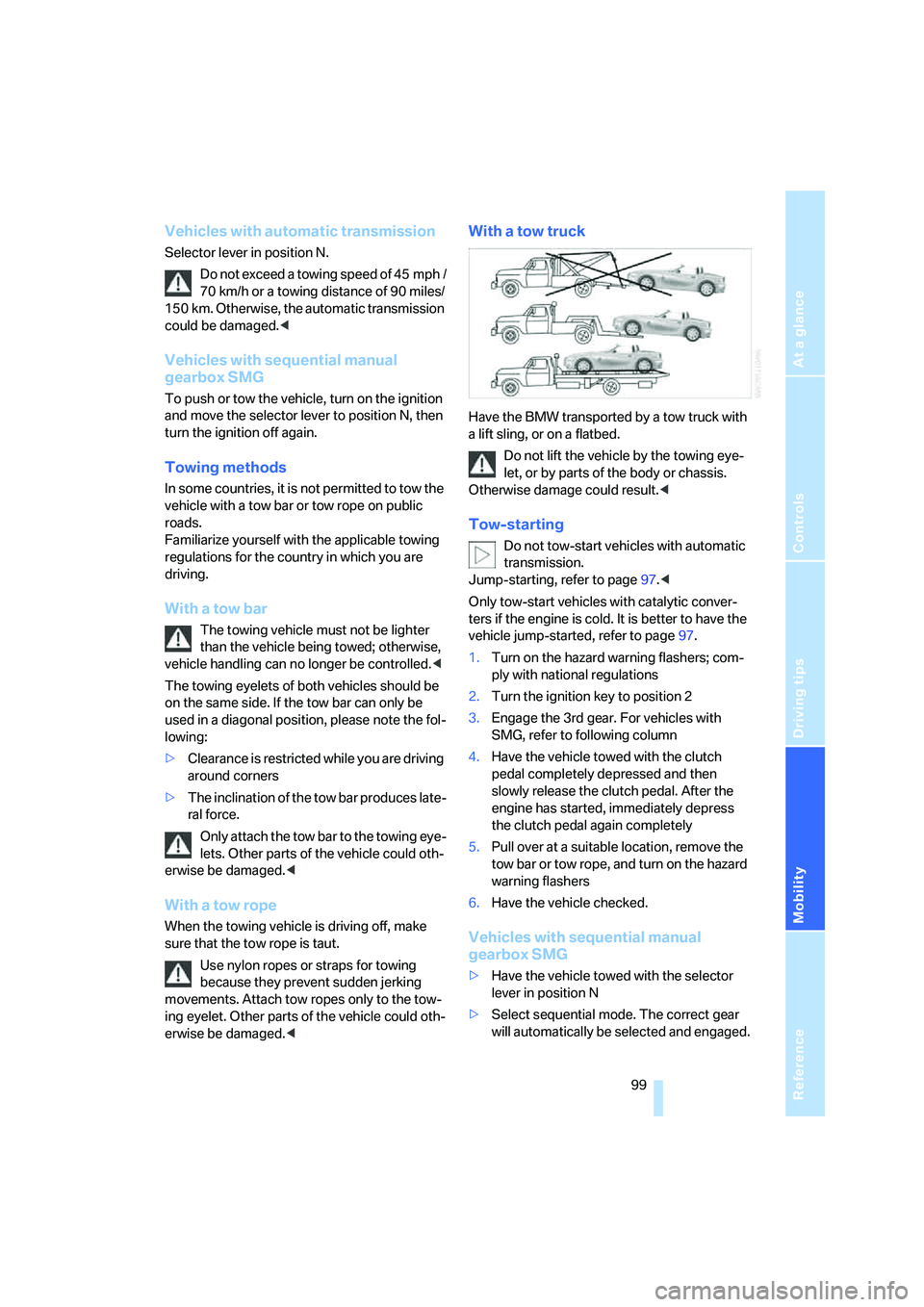
With a tow truck
Have the BMW transported by a tow truck with
a lift sling, or on a flatbed.
Do not lift the vehicle by the towing eye-
let, or by parts of the body or chassis.
Otherwise damage could result.<
Tow-starting
Do not tow-start vehicles with automatic
transmission.
Jump-starting, refer to page97.<
Only tow-start vehicles with catalytic conver-
ters if the engine is cold. It is better to have the
vehicle jump-started, refer to page97.
1.Turn on the hazard warning flashers; com-
ply with national regulations
2.Turn the ignition key to position 2
3.Engage the 3rd gear. For vehicles with
SMG, refer to following column
4.Have the vehicle towed with the clutch
pedal completely depressed and then
slowly release the clutch pedal. After the
engine has started, immediately depress
the clutch pedal again completely
5.Pull over at a suitable location, remove the
tow bar or tow rope, and turn on the hazard
warning flashers
6.Have the vehicle checked.
Vehicles with sequential manual
gearbox SMG
>Have the vehicle towed with the selector
lever in position N
>Select sequential mode. The correct gear
will automatically be selected and engaged.
Page 112 of 120
Everything from A to Z
110 Floor mats, refer to the Caring
for your vehicle brochure
Fluid reservoir, washer
systems86
Fog lamps57
– indicator lamp13
Follow me home lamps56
Footbrake, refer to Driving
notes69
Front airbags53
Fuel
– average
consumption49
– display46
– quality76
– volume, refer to
Capacities105
Fuel display, refer to Fuel
gauge46
Fuel filler door76
– unlocking in case of
electrical fault76
Fuel reserve indicator, refer to
Fuel gauge46
Fuel tank capacity, refer to
Capacities105
Fuses95
G
Gasoline, refer to Fuel
quality76
Gasoline gauge, refer to Fuel
gauge46
Gear indicator
– for automatic transmission
with Steptronic38
– for sequential manual
gearbox SMG40
Gear lever
– automatic transmission with
Steptronic38
– manual transmission38
– sequential manual gearbox
SMG40Gear shifts
– via automatic transmission
with Steptronic38
– via sequential manual
gearbox SMG41
Glove compartment64
Gross weight, refer to
Weights103
H
Handbrake, refer to Parking
brake37
Hands-free microphone,
refer to Preparations for the
cellular phone65
Hands-free system65
Hardtop, refer to the separate
Owner's Manual
Hardtop preparation72
Hazard warning flashers10
Headlamp cover, care, refer to
the Caring for your vehicle
brochure
Headlamp flasher42
– indicator lamp13
Headlamps
– bulb replacement91
– care, refer to the Caring for
your vehicle brochure
– cleaning43
Headlamps, automatic
control56
Headlamp washer
reservoir86
– volume, refer to
Capacities105
Headlamp washer
system
– cleaning the headlamps43
– washing fluids86
Head restraints28
Heated mirrors31
Heated seats30
Heating58
– exterior mirrors31
– rear window59,63
– seats30Heavy loads, refer to Stowing
cargo71
Height, refer to
Dimensions104
Height adjustment
– seats28
– steering wheel31
High beams57
– bulb replacement92
– headlamp flasher42
– indicator lamp13
High Performance
Synthetic Oil87
– alternative oils87
– approved oils87
Holders for beverages64
Hood84
Horn10
Hot exhaust system69
Hydraulic Brake Assistant,
refer to Dynamic Brake
Control DBC50
Hydraulics, brake88
Hydroplaning69
I
Ice warning48
Identification mark
– Run Flat tires82
– tire coding80
Ignition36
Ignition key16
Ignition lock36
Imprint2
Inclines69
Index106
Page 113 of 120
Reference
At a glance
Controls
Driving tips
Mobility
111
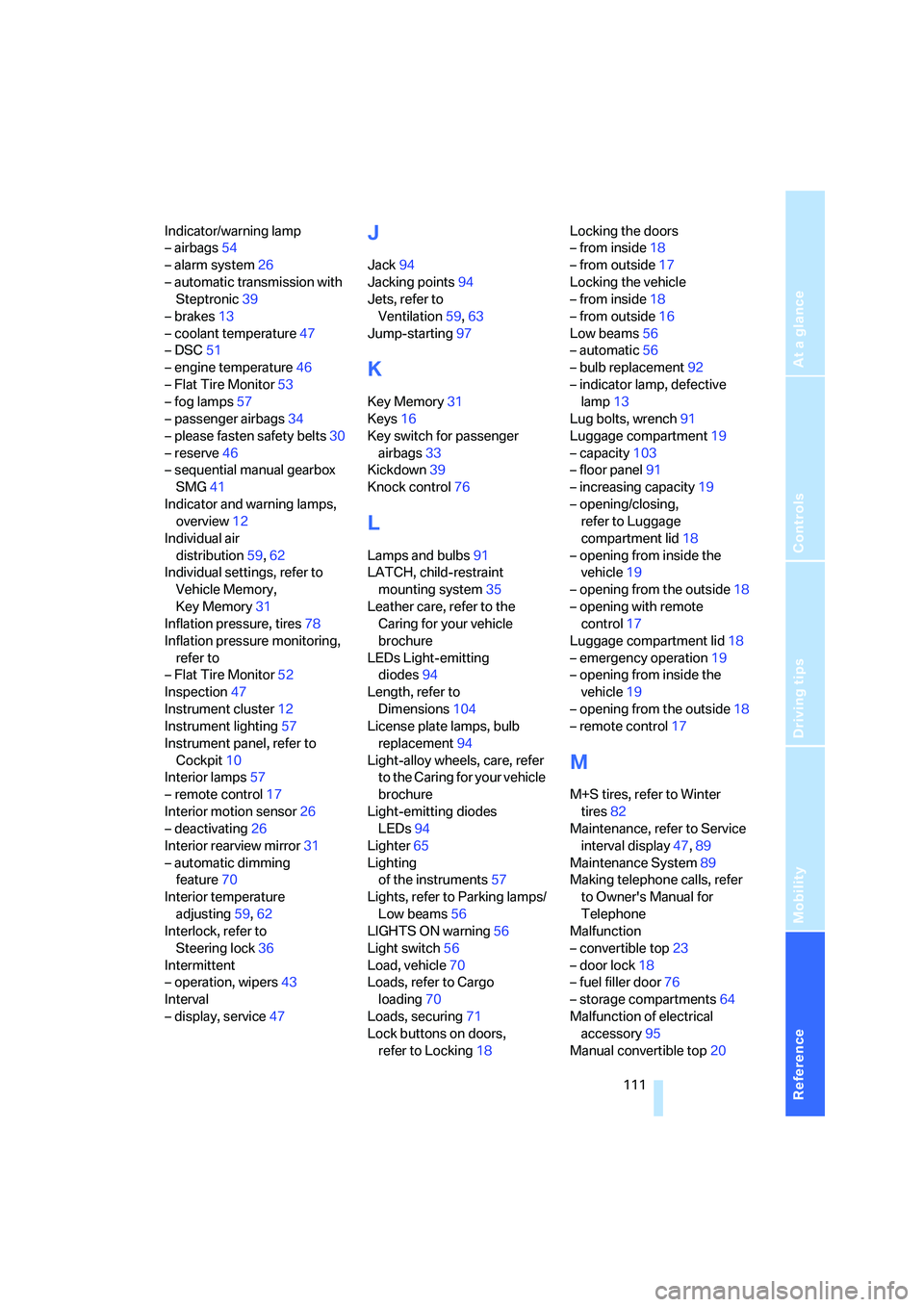
Indicator/warning lamp
– airbags54
– alarm system26
– automatic transmission with
Steptronic39
– brakes13
– coolant temperature47
– DSC51
– engine temperature46
– Flat Tire Monitor53
– fog lamps57
– passenger airbags34
– please fasten safety belts30
– reserve46
– sequential manual gearbox
SMG41
Indicator and warning lamps,
overview12
Individual air
distribution59,62
Individual settings, refer to
Vehicle Memory,
Key Memory31
Inflation pressure, tires78
Inflation pressure monitoring,
refer to
– Flat Tire Monitor52
Inspection47
Instrument cluster12
Instrument lighting57
Instrument panel, refer to
Cockpit10
Interior lamps57
– remote control17
Interior motion sensor26
– deactivating26
Interior rearview mirror31
– automatic dimming
feature70
Interior temperature
adjusting59,62
Interlock, refer to
Steering lock36
Intermittent
– operation, wipers43
Interval
– display, service47J
Jack94
Jacking points94
Jets, refer to
Ventilation59,63
Jump-starting97
K
Key Memory31
Keys16
Key switch for passenger
airbags33
Kickdown39
Knock control76
L
Lamps and bulbs91
LATCH, child-restraint
mounting system35
Leather care, refer to the
Caring for your vehicle
brochure
LEDs Light-emitting
diodes94
Length, refer to
Dimensions104
License plate lamps, bulb
replacement94
Light-alloy wheels, care, refer
to the Caring for your vehicle
brochure
Light-emitting diodes
LEDs94
Lighter65
Lighting
of the instruments57
Lights, refer to Parking lamps/
Low beams56
LIGHTS ON warning56
Light switch56
Load, vehicle70
Loads, refer to Cargo
loading70
Loads, securing71
Lock buttons on doors,
refer to Locking18Locking the doors
– from inside18
– from outside17
Locking the vehicle
– from inside18
– from outside16
Low beams56
– automatic56
– bulb replacement92
– indicator lamp, defective
lamp13
Lug bolts, wrench91
Luggage compartment19
– capacity103
– floor panel91
– increasing capacity19
– opening/closing,
refer to Luggage
compartment lid18
– opening from inside the
vehicle19
– opening from the outside18
– opening with remote
control17
Luggage compartment lid18
– emergency operation19
– opening from inside the
vehicle19
– opening from the outside18
– remote control17
M
M+S tires, refer to Winter
tires82
Maintenance, refer to Service
interval display47,89
Maintenance System89
Making telephone calls, refer
to Owner's Manual for
Telephone
Malfunction
– convertible top23
– door lock18
– fuel filler door76
– storage compartments64
Malfunction of electrical
accessory95
Manual convertible top20
Page 115 of 120
Reference
At a glance
Controls
Driving tips
Mobility
113
Plastic, refer to the Caring for
your vehicle brochure
Pollen, refer to
– Microfilter59
– Microfilter/activated-
charcoal filter63
Power convertible top21
Power loss
– electric power windows20
Power output, refer to Engine
data102
Power seat29
Power socket65
Power steering, electric42
Power supply interruption
– battery95
Power windows
– initializing20
Power windows protective
function, refer to Trap
protection20
Preparations for the cellular
phone65
Pressure, tires78
Pressure monitoring, tires,
refer to Flat Tire Monitor52
R
Radio, refer to the Owner's
Manual for Radio
Radio navigation, refer to the
separate Owner's Manual
Radio remote control key,
refer to Master keys with
remote control16
Rain sensor43
Reading lamps57
Rear lamps
– bulb replacement93
– indicator lamp, defective
lamp13
Rearview mirror31
Rear window defroster
– air conditioning59
– automatic climate control63
Recirculated air mode
– air conditioning59
– automatic climate control62Recirculating the air, refer to
Recirculated air
mode59,62
Reclining seat, refer to
Seats28
Refueling76
– fuel filler door76
Releasing
– hood84
Remaining distance, refer to
Range49
Remaining distance to next
service47
Remote control16
– luggage compartment lid17
– malfunction17
Replacement key16
Replacement key, refer to
New keys16
Replacement of tires82
– changing a wheel94
– new wheels and tires82
Replacing lamps, refer to
Lamps and bulbs91
Restraint systems
– for children35
– refer to Safety belts30
Reverse
– automatic transmission with
Steptronic39
– manual transmission38
Reverse gear
– sequential manual gearbox
SMG40
Rod antenna, refer to the
Caring for your vehicle
brochure
Rope, refer to Towing and
tow-starting98
RSC Runflat System
Component, refer to Run
Flat tires82
Rubber parts, refer to the
Caring for your vehicle
brochure
Runflat System Component
RSC, refer to Run Flat
tires
82Run Flat tires82
– changing a tire81,82
– changing a wheel94
– flat tire53
– tire inflation pressure78
– winter tires82
S
Safe seating position27
– with airbags27
– with safety belts27
Safety belts30
– care, refer to the Caring for
your vehicle brochure
– safe seating position27
– warning lamp12,30
Safety systems, refer to
– Airbags53
– Antilock Brake System
ABS50
– Dynamic Stability Control
DSC50
Safety tires, refer to Run Flat
tires82
Screwdriver, refer to Onboard
tool kit91
Seat adjustment28
– mechanical28
– M Sports seat29
– power29
Seat heating30
Seat memory29
Seat position, storing29
Seats28
– adjusting the sports seat29
– heating30
– memory, refer to Seat
memory29
– power adjustment29
– safe seating position27
– storing positions29
Securing, locking the vehicle
– from inside18
– from outside17
Securing loads,
refer to Cargo loading71