window BMW Z4 3.0SI ROADSTER 2007 E85 User Guide
[x] Cancel search | Manufacturer: BMW, Model Year: 2007, Model line: Z4 3.0SI ROADSTER, Model: BMW Z4 3.0SI ROADSTER 2007 E85Pages: 132, PDF Size: 3.14 MB
Page 65 of 132
Reference
At a glance
Controls
Driving tips
Mobility
63
Air distribution
Direct the flow of air to the windows
, to the upper body area and to
the footwell . Intermediate settings
are possible.
Switching cooling function on/off
When the cooling function is on, the
air is cooled, dehumidified, then
reheated depending on the tempera-
ture setting.
Depending on the weather, the windshield may
fog over briefly when the engine is started.
Recirculated-air mode
If the air outside the car has an
unpleasant odor or contains pollut-
ants, temporarily shut off the supply
to the interior of the car. The system
recirculates the air within the vehicle.
If the windows fog over in the recircu-
lated-air mode, you should switch it off
and, if necessary, increase the air flow rate.
The manually controlled recirculated-air mode
should not be used continuously for lengthy
periods, otherwise the quality of the air inside
the car will gradually deteriorate.<
Temperature
For a higher temperature, turn the
rotary switch clockwise towards red.
For a lower temperature, turn the
rotary switch counterclockwise
towards blue.
Air flow rate
Adjust the air flow rate. The higher
the rate, the more effective the heat-
ing or cooling will be.
Switching the system on/off
Set the air flow rate to 0. Blower and air condi-
tioning are switched off and the air supply is cut
off.
To switch on the heater or air conditioning, set
any desired air flow rate.
Rear window defroster
The defroster switches off automati-
cally after a certain time.
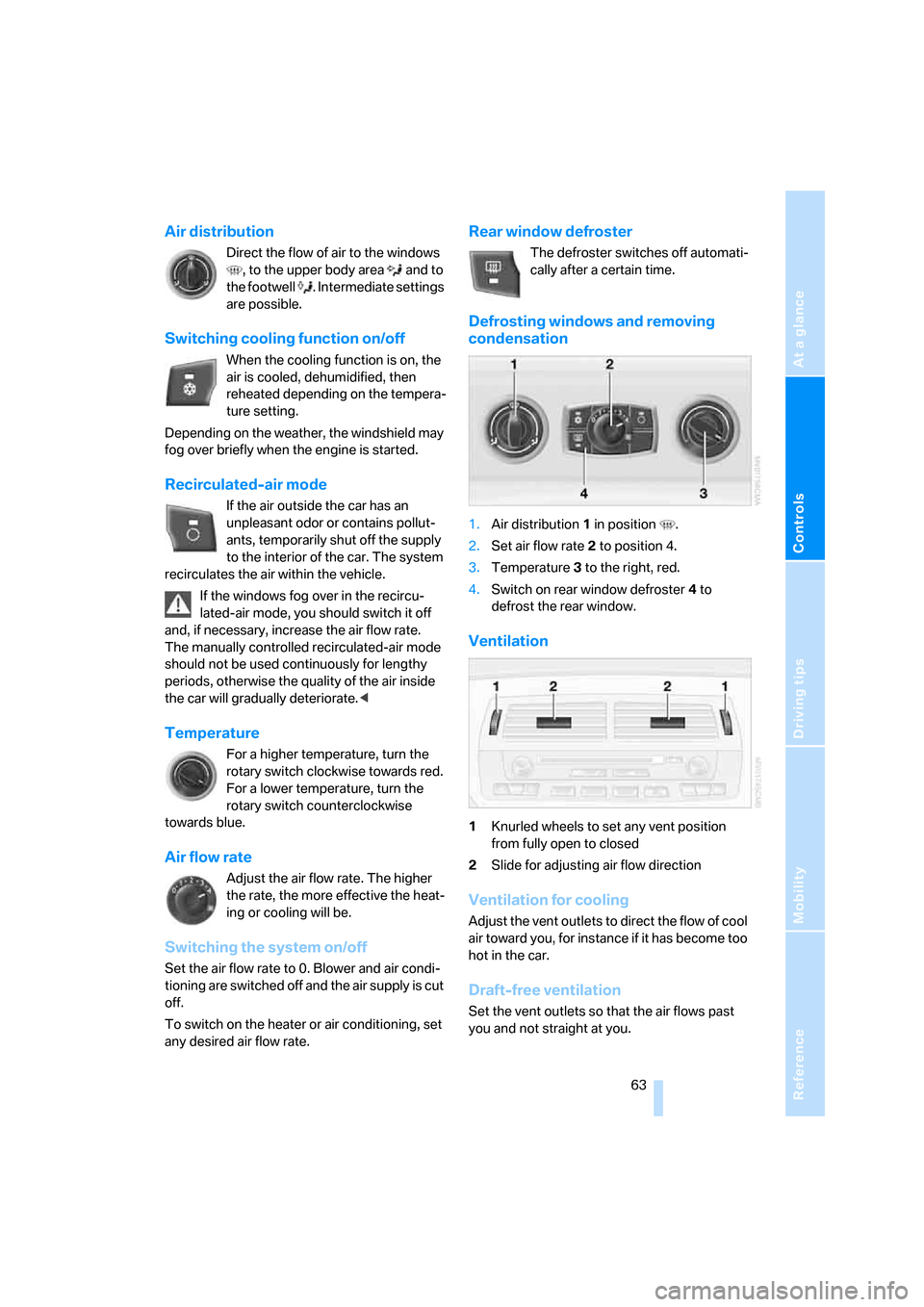
Defrosting windows and removing
condensation
1.Air distribution1 in position .
2.Set air flow rate 2 to position 4.
3.Temperature3 to the right, red.
4.Switch on rear window defroster 4 to
defrost the rear window.
Ventilation
1Knurled wheels to set any vent position
from fully open to closed
2Slide for adjusting air flow direction
Ventilation for cooling
Adjust the vent outlets to direct the flow of cool
air toward you, for instance if it has become too
hot in the car.
Draft-free ventilation
Set the vent outlets so that the air flows past
you and not straight at you.
Page 67 of 132
Reference
At a glance
Controls
Driving tips
Mobility
65
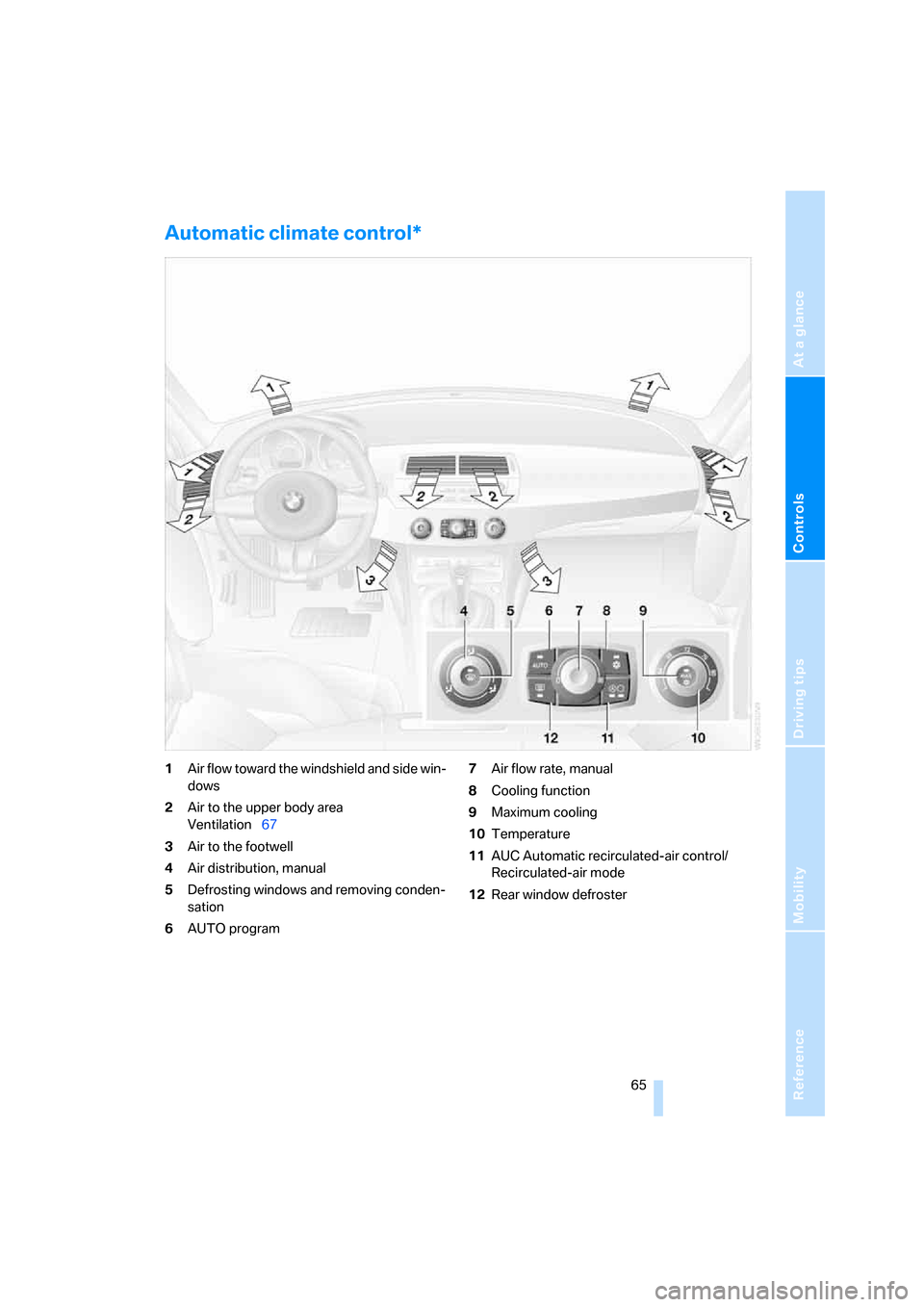
Automatic climate control*
1Air flow toward the windshield and side win-
dows
2Air to the upper body area
Ventilation67
3Air to the footwell
4Air distribution, manual
5Defrosting windows and removing conden-
sation
6AUTO program7Air flow rate, manual
8Cooling function
9Maximum cooling
10Temperature
11AUC Automatic recirculated-air control/
Recirculated-air mode
12Rear window defroster
Page 68 of 132
Climate
66
Comfortable interior climate
AUTO program 6 offers the ideal air distribution
and air flow rate for almost all conditions, refer
to AUTO program below. In addition, you can
select an interior temperature you find pleasant.
The following sections inform you in detail
about how to adjust the settings.
Air distribution, manual
Direct the flow of air to the windows
, to the upper body area and to
the footwell . Intermediate settings
are possible. The arrow lights up.
The automatic air supply remains unchanged.
You can switch the automatic air distribution
back on by pressing the AUTO button.
Defrosting windows and removing
condensation
Quickly removes ice and condensa-
tion from the windshield and side
windows.
AUTO program
The AUTO program adjusts the air
distribution to the windshield and
side windows, towards the upper
body area and into the footwell for
you. The air flow rate and your temperature
specifications will be adapted to outside influ-
ences as a result of seasonal changes, e.g. sun-
light or window condensation.
The cooling is switched on automatically with
the AUTO program.
The AUTO program functions only to a
limited extent when the convertible top is
open.<
Air flow rate, manual
Adjust the air flow rate. The arrow
lights up.
The automatic air distribution
remains unchanged. You can reactivate the
automatic mode for the air flow rate with the
AUTO button.The higher the air flow rate, the more effective
the air conditioning will be.
Switching the system on/off
Turn the rotary switch to 0. The automatic cli-
mate control is switched off and the air supply is
cut off.
To switch on the automatic climate control, set
any desired air flow rate.
Switching cooling function on/off
When the cooling function is on, the
air is cooled, dehumidified, then
reheated depending on the tempera-
ture setting.
Depending on the weather, the windshield may
fog over briefly when the engine is started.
The cooling function is automatically switched
on along with the AUTO program. The passen-
ger compartment can only be cooled while the
engine is running.
Maximum cooling
At outside temperatures above
327/06 and when the engine is
running, you obtain a maximum cool-
ing effect as soon as possible.
The automatic climate control switches to the
lowest temperature and operates in recircu-
lated-air mode. Air flows at maximum rate only
from the vents for the upper body area. You
should therefore open them for maximum cool-
ing.
Temperature
Set the desired temperature.
The values on the dial are approxima-
tions of the respective temperature
resulting in the passenger compartment.
The automatic climate control achieves this
temperature as quickly as possible regardless
of the season, using maximum cooling or heat-
ing power if necessary, and then maintains it.
If you switch between different tempera-
ture settings in quick succession, the
Page 69 of 132
Reference
At a glance
Controls
Driving tips
Mobility
67
automatic climate control does not have
enough time to achieve the set temperature.<
AUC Automatic recirculated-air
control/Recirculated-air mode
Switch on the desired operating
mode by pressing this button repeat-
edly:
>LEDs off: outside air flows in continuously.
>Left-hand LED on, AUC mode: a sensor
detects pollutants in the outside air. If nec-
essary, the system blocks the supply of out-
side air and recirculates the inside air. As
soon as the concentration of pollutants in
the outside air has decreased sufficiently,
the system automatically switches back to
outside air supply.
>Right-hand LED on, recirculated-air mode:
the inflow of outside air is shut off perma-
nently. The system recirculates the air
within the vehicle.
If the windows fog over in the recircu-
lated-air mode, you should switch it off
and, if necessary, increase the air flow rate.
The recirculated-air mode should not be used
over an extended period of time, otherwise the
air quality inside the car will deteriorate contin-
uously.<
Rear window defroster
The defroster switches off automati-
cally after a certain time.
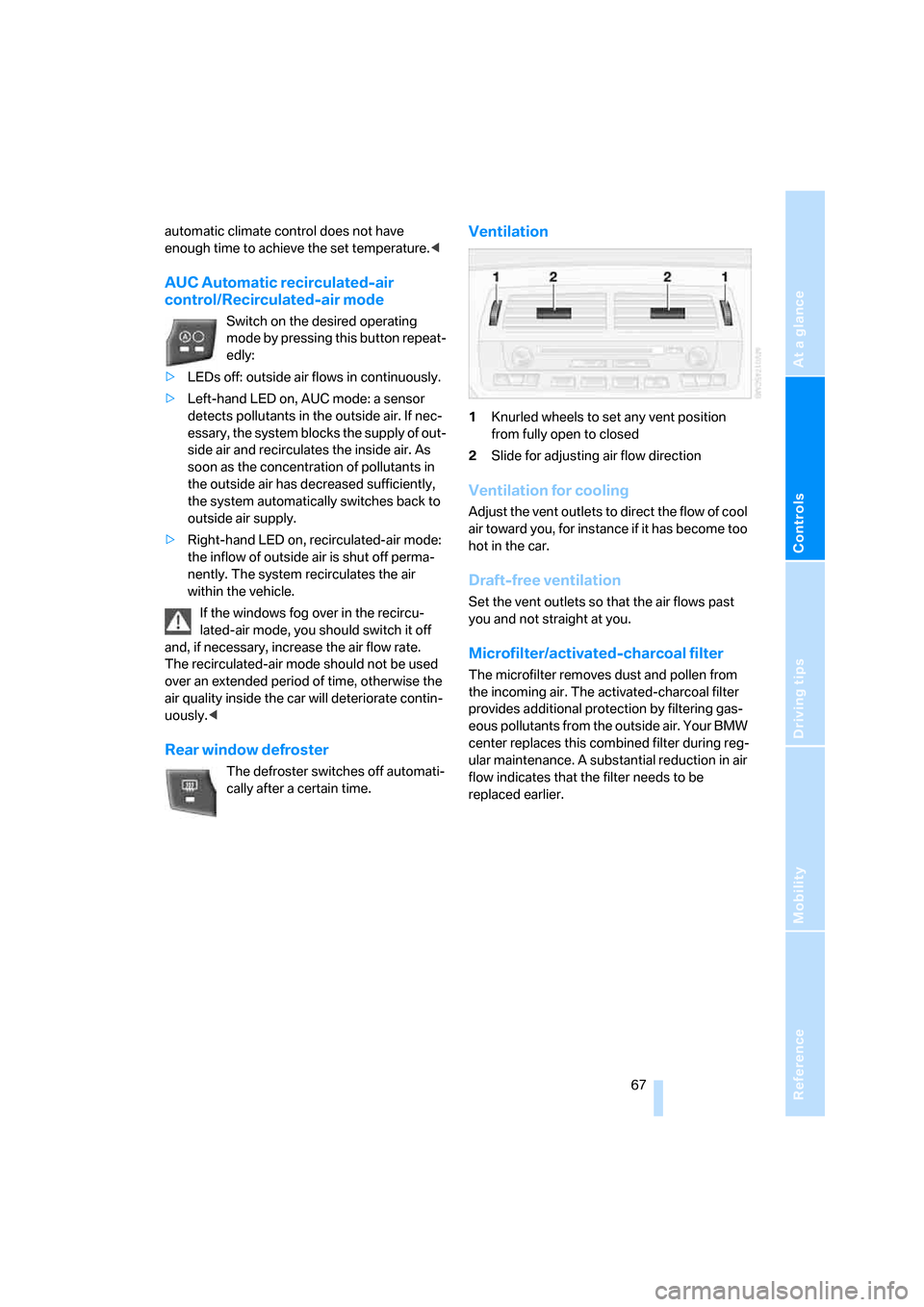
Ventilation
1Knurled wheels to set any vent position
from fully open to closed
2Slide for adjusting air flow direction
Ventilation for cooling
Adjust the vent outlets to direct the flow of cool
air toward you, for instance if it has become too
hot in the car.
Draft-free ventilation
Set the vent outlets so that the air flows past
you and not straight at you.
Microfilter/activated-charcoal filter
The microfilter removes dust and pollen from
the incoming air. The activated-charcoal filter
provides additional protection by filtering gas-
eous pollutants from the outside air. Your BMW
center replaces this combined filter during reg-
ular maintenance. A substantial reduction in air
flow indicates that the filter needs to be
replaced earlier.
Page 76 of 132
Special operating instructions
74
Special operating instructions
Break-in procedures
Moving parts need to be given some time until
they can interact smoothly with one another. To
ensure that your vehicle provides maximum
economy throughout a long service life, we
request that you observe the following:
Always obey all official speed limits.
Engine and differential
Up to 1,200 miles/2,000 km
Drive at varying engine and road speeds, but do
not exceed 4,500 rpm or 100 mph/160 km/h.
Refrain from using full throttle and avoid press-
ing the accelerator beyond the kickdown point.
After driving 1,200 miles/2,000 km
Engine and vehicle speeds can be gradually
increased.
Tires
Due to technical factors associated with their
manufacture, tires do not achieve their full trac-
tion potential until an initial break-in period has
elapsed. Therefore, drive cautiously during the
first 200 miles/300 km.
Brake system
Brakes require an initial break-in period of
approx. 300 miles/500 km to achieve optimized
contact and wear patterns between brake pads
and rotors. Drive cautiously during this break-in
period.
Clutch
The function of the clutch reaches its optimal
level only after a distance driven of approx.
300 miles/500 km. Shift gears carefully during
the break-in period.
After replacing components
The same break-in procedures should be
observed if any of the components mentioned
above have to be renewed in the course of the
vehicle's operating life.
Driving notes
Close the luggage compartment lid/
tailgate
Operate the vehicle only when the lug-
gage compartment lid/tailgate is closed.
Otherwise, exhaust fumes could enter the inte-
rior of the vehicle.<
Should it be absolutely necessary to drive with
the luggage compartment lid/tailgate open:
1.Coupe: close both windows.
Roadster: close all windows if the convert-
ible top is closed.
2.Greatly increase the air flow from the air
conditioning or automatic climate control,
refer to page62 or65.
Hot exhaust system
In all vehicles, extremely high tempera-
tures are generated in the exhaust sys-
tem. Never remove the heat shields installed in
this area, nor apply undercoating to their sur-
faces. When driving, standing at idle or parking
the vehicle, take care to avoid contact between
the hot exhaust system and flammable materi-
als, e.g. hay, leaves, grass, etc. Such contact
could lead to a fire, resulting in serious personal
injury and property damage. Do not touch the
hot exhaust pipes to avoid the risk of injury from
burns.<
Mobile communications in the vehicle
BMW advises against using mobile com-
munications devices, e.g. mobile phones,
inside the vehicle without connecting them
directly to an outside antenna. Otherwise, it
Page 94 of 132
Under the hood
92
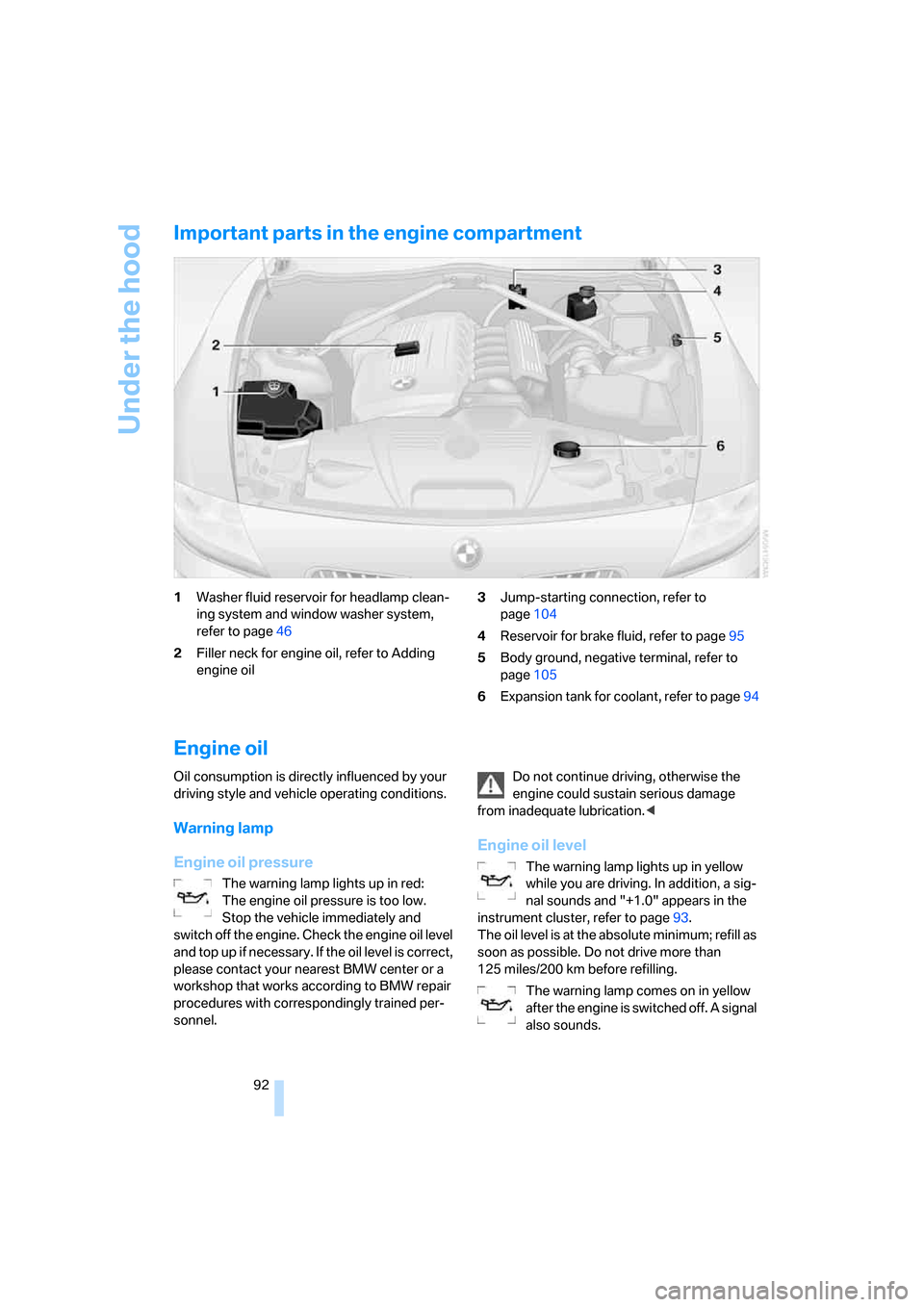
Important parts in the engine compartment
1Washer fluid reservoir for headlamp clean-
ing system and window washer system,
refer to page46
2Filler neck for engine oil, refer to Adding
engine oil3Jump-starting connection, refer to
page104
4Reservoir for brake fluid, refer to page95
5Body ground, negative terminal, refer to
page105
6Expansion tank for coolant, refer to page94
Engine oil
Oil consumption is directly influenced by your
driving style and vehicle operating conditions.
Warning lamp
Engine oil pressure
The warning lamp lights up in red:
The engine oil pressure is too low.
Stop the vehicle immediately and
switch off the engine. Check the engine oil level
and top up if necessary. If the oil level is correct,
please contact your nearest BMW center or a
workshop that works according to BMW repair
procedures with correspondingly trained per-
sonnel.Do not continue driving, otherwise the
engine could sustain serious damage
from inadequate lubrication.<
Engine oil level
The warning lamp lights up in yellow
while you are driving. In addition, a sig-
nal sounds and "+1.0" appears in the
instrument cluster, refer to page93.
The oil level is at the absolute minimum; refill as
soon as possible. Do not drive more than
125 miles/200 km before refilling.
The warning lamp comes on in yellow
after the engine is switched off. A signal
also sounds.
Page 108 of 132
Giving and receiving assistance
106
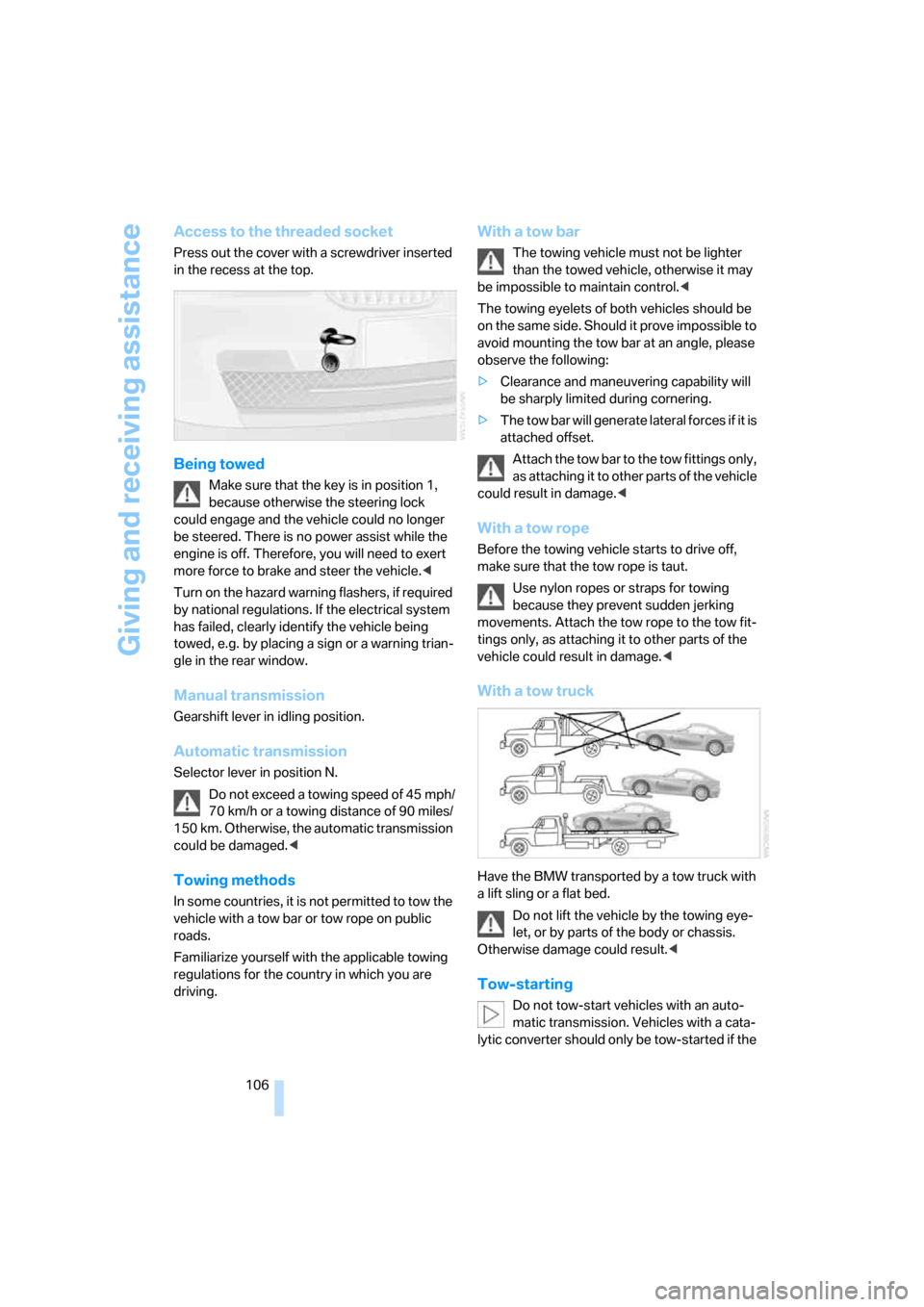
Access to the threaded socket
Press out the cover with a screwdriver inserted
in the recess at the top.
Being towed
Make sure that the key is in position 1,
because otherwise the steering lock
could engage and the vehicle could no longer
be steered. There is no power assist while the
engine is off. Therefore, you will need to exert
more force to brake and steer the vehicle.<
Turn on the hazard warning flashers, if required
by national regulations. If the electrical system
has failed, clearly identify the vehicle being
towed, e.g. by placing a sign or a warning trian-
gle in the rear window.
Manual transmission
Gearshift lever in idling position.
Automatic transmission
Selector lever in position N.
Do not exceed a towing speed of 45 mph/
70 km/h or a towing distance of 90 miles/
150 km. Otherwise, the automatic transmission
could be damaged.<
Towing methods
In some countries, it is not permitted to tow the
vehicle with a tow bar or tow rope on public
roads.
Familiarize yourself with the applicable towing
regulations for the country in which you are
driving.
With a tow bar
The towing vehicle must not be lighter
than the towed vehicle, otherwise it may
be impossible to maintain control.<
The towing eyelets of both vehicles should be
on the same side. Should it prove impossible to
avoid mounting the tow bar at an angle, please
observe the following:
>Clearance and maneuvering capability will
be sharply limited during cornering.
>The tow bar will generate lateral forces if it is
attached offset.
Attach the tow bar to the tow fittings only,
as attaching it to other parts of the vehicle
could result in damage.<
With a tow rope
Before the towing vehicle starts to drive off,
make sure that the tow rope is taut.
Use nylon ropes or straps for towing
because they prevent sudden jerking
movements. Attach the tow rope to the tow fit-
tings only, as attaching it to other parts of the
vehicle could result in damage.<
With a tow truck
Have the BMW transported by a tow truck with
a lift sling or a flat bed.
Do not lift the vehicle by the towing eye-
let, or by parts of the body or chassis.
Otherwise damage could result.<
Tow-starting
Do not tow-start vehicles with an auto-
matic transmission. Vehicles with a cata-
lytic converter should only be tow-started if the
Page 116 of 132
Technical data
114
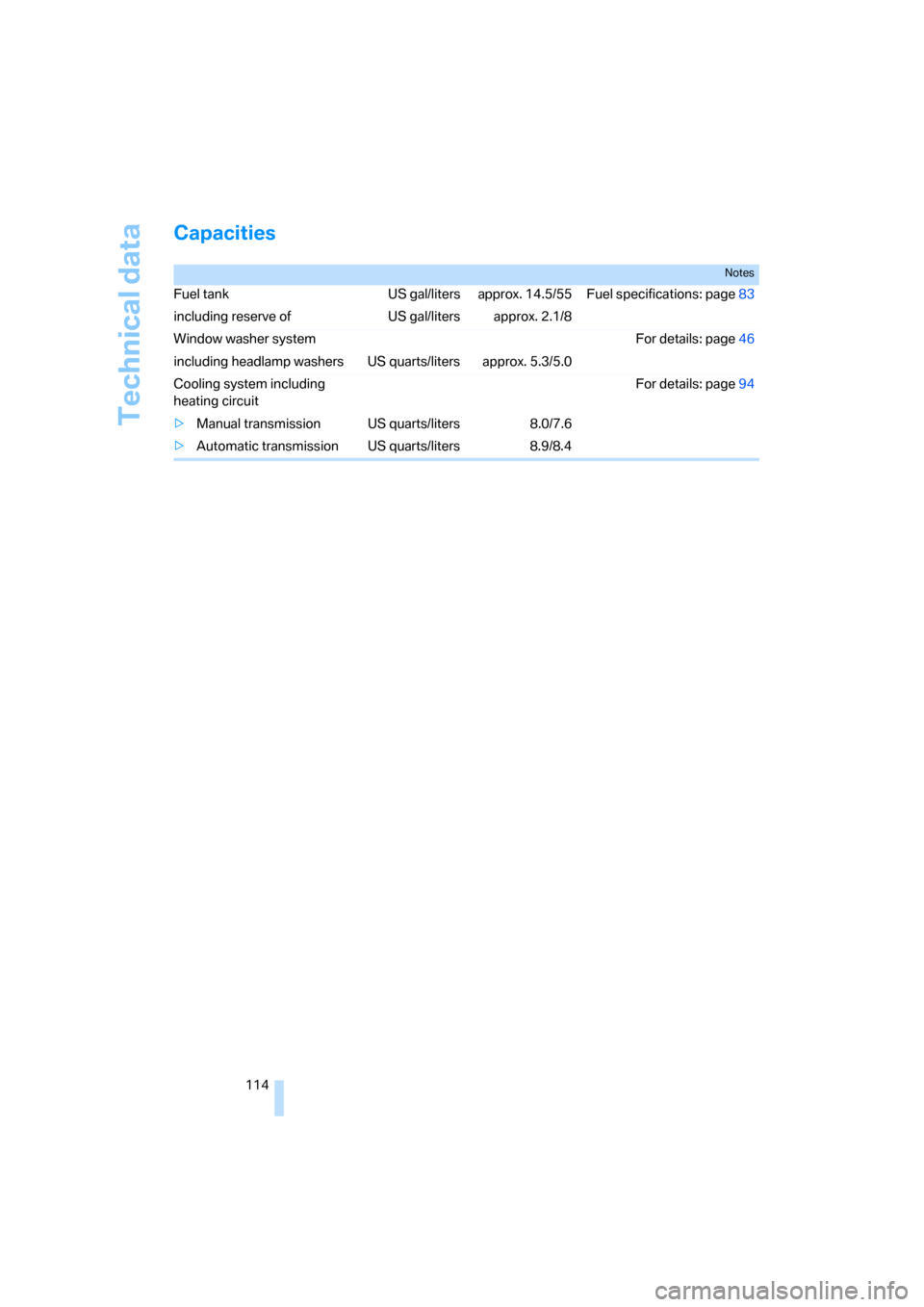
Capacities
Notes
Fuel tank US gal/liters approx. 14.5/55 Fuel specifications: page83
including reserve of US gal/liters approx. 2.1/8
Window washer system For details: page46
including headlamp washers US quarts/liters approx. 5.3/5.0
Cooling system including
heating circuitFor details: page94
>Manual transmission US quarts/liters 8.0/7.6
>Automatic transmission US quarts/liters 8.9/8.4
Page 120 of 132
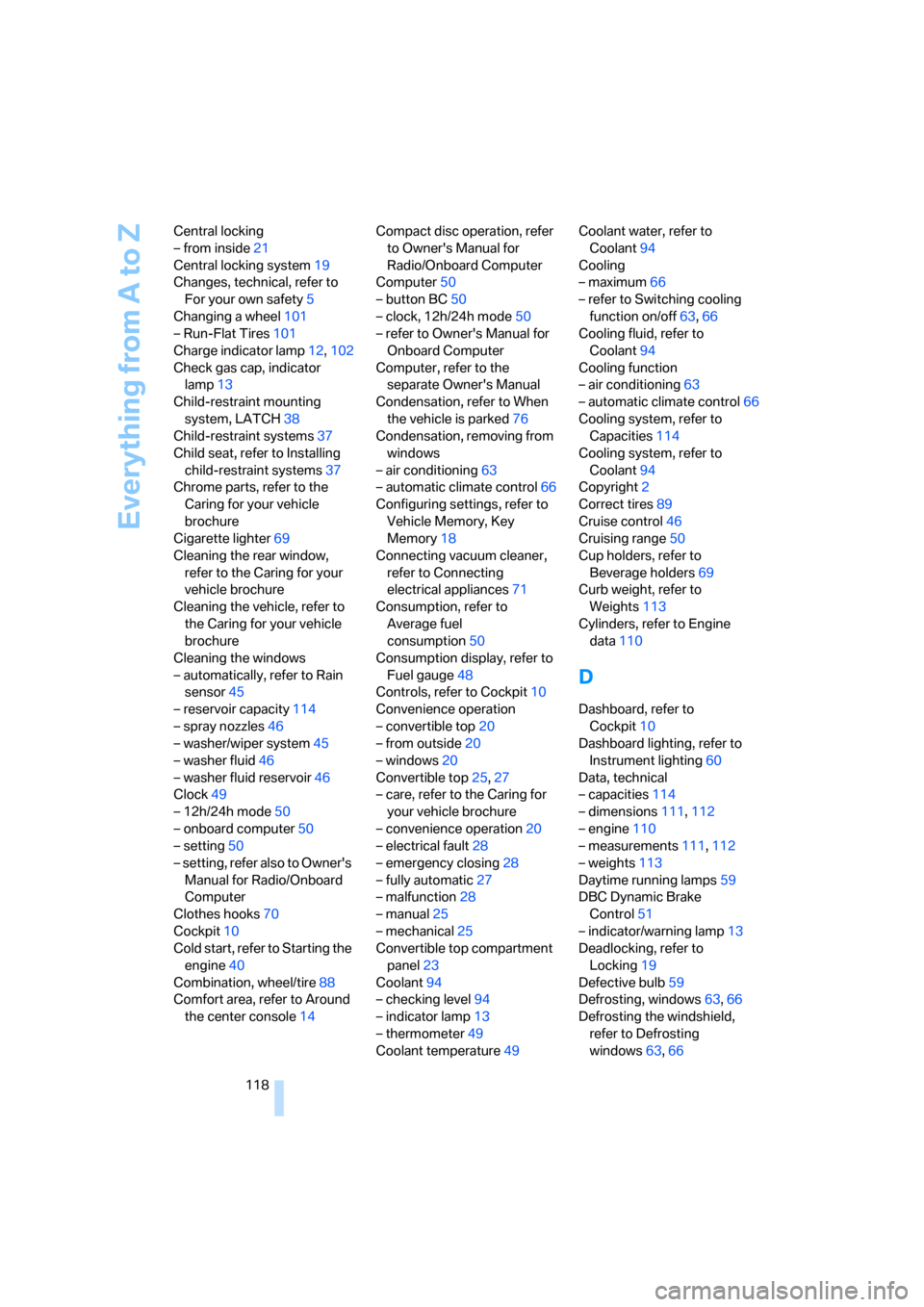
Everything from A to Z
118 Central locking
– from inside21
Central locking system19
Changes, technical, refer to
For your own safety5
Changing a wheel101
– Run-Flat Tires101
Charge indicator lamp12,102
Check gas cap, indicator
lamp13
Child-restraint mounting
system, LATCH38
Child-restraint systems37
Child seat, refer to Installing
child-restraint systems37
Chrome parts, refer to the
Caring for your vehicle
brochure
Cigarette lighter69
Cleaning the rear window,
refer to the Caring for your
vehicle brochure
Cleaning the vehicle, refer to
the Caring for your vehicle
brochure
Cleaning the windows
– automatically, refer to Rain
sensor45
– reservoir capacity114
– spray nozzles46
– washer/wiper system45
– washer fluid46
– washer fluid reservoir46
Clock49
– 12h/24h mode50
– onboard computer50
– setting50
– setting, refer also to Owner's
Manual for Radio/Onboard
Computer
Clothes hooks70
Cockpit10
Cold start, refer to Starting the
engine40
Combination, wheel/tire88
Comfort area, refer to Around
the center console14Compact disc operation, refer
to Owner's Manual for
Radio/Onboard Computer
Computer50
– button BC50
– clock, 12h/24h mode50
– refer to Owner's Manual for
Onboard Computer
Computer, refer to the
separate Owner's Manual
Condensation, refer to When
the vehicle is parked76
Condensation, removing from
windows
– air conditioning63
– automatic climate control66
Configuring settings, refer to
Vehicle Memory, Key
Memory18
Connecting vacuum cleaner,
refer to Connecting
electrical appliances71
Consumption, refer to
Average fuel
consumption50
Consumption display, refer to
Fuel gauge48
Controls, refer to Cockpit10
Convenience operation
– convertible top20
– from outside20
– windows20
Convertible top25,27
– care, refer to the Caring for
your vehicle brochure
– convenience operation20
– electrical fault28
– emergency closing28
– fully automatic27
– malfunction28
– manual25
– mechanical25
Convertible top compartment
panel23
Coolant94
– checking level94
– indicator lamp13
– thermometer49
Coolant temperature49Coolant water, refer to
Coolant94
Cooling
– maximum66
– refer to Switching cooling
function on/off63,66
Cooling fluid, refer to
Coolant94
Cooling function
– air conditioning63
– automatic climate control66
Cooling system, refer to
Capacities114
Cooling system, refer to
Coolant94
Copyright2
Correct tires89
Cruise control46
Cruising range50
Cup holders, refer to
Beverage holders69
Curb weight, refer to
Weights113
Cylinders, refer to Engine
data110
D
Dashboard, refer to
Cockpit10
Dashboard lighting, refer to
Instrument lighting60
Data, technical
– capacities114
– dimensions111,112
– engine110
– measurements111,112
– weights113
Daytime running lamps59
DBC Dynamic Brake
Control51
– indicator/warning lamp13
Deadlocking, refer to
Locking19
Defective bulb59
Defrosting, windows63,66
Defrosting the windshield,
refer to Defrosting
windows63,66
Page 121 of 132
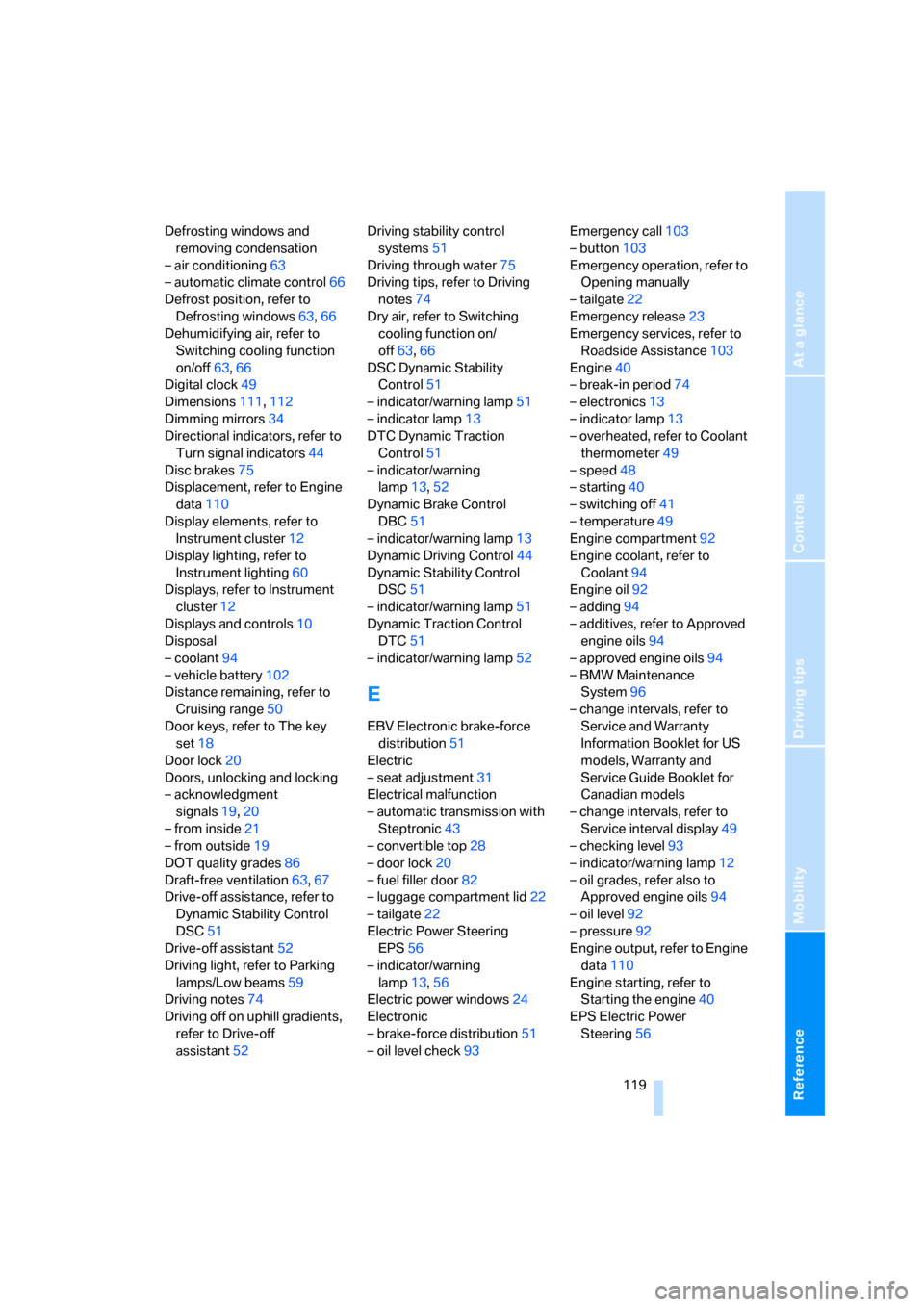
Reference
At a glance
Controls
Driving tips
Mobility
119
Defrosting windows and
removing condensation
– air conditioning63
– automatic climate control66
Defrost position, refer to
Defrosting windows63,66
Dehumidifying air, refer to
Switching cooling function
on/off63,66
Digital clock49
Dimensions111,112
Dimming mirrors34
Directional indicators, refer to
Turn signal indicators44
Disc brakes75
Displacement, refer to Engine
data110
Display elements, refer to
Instrument cluster12
Display lighting, refer to
Instrument lighting60
Displays, refer to Instrument
cluster12
Displays and controls10
Disposal
– coolant94
– vehicle battery102
Distance remaining, refer to
Cruising range50
Door keys, refer to The key
set18
Door lock20
Doors, unlocking and locking
– acknowledgment
signals19,20
– from inside21
– from outside19
DOT quality grades86
Draft-free ventilation63,67
Drive-off assistance, refer to
Dynamic Stability Control
DSC51
Drive-off assistant52
Driving light, refer to Parking
lamps/Low beams59
Driving notes74
Driving off on uphill gradients,
refer to Drive-off
assistant52Driving stability control
systems51
Driving through water75
Driving tips, refer to Driving
notes74
Dry air, refer to Switching
cooling function on/
off63,66
DSC Dynamic Stability
Control51
– indicator/warning lamp51
– indicator lamp13
DTC Dynamic Traction
Control51
– indicator/warning
lamp13,52
Dynamic Brake Control
DBC51
– indicator/warning lamp13
Dynamic Driving Control44
Dynamic Stability Control
DSC51
– indicator/warning lamp51
Dynamic Traction Control
DTC51
– indicator/warning lamp52
E
EBV Electronic brake-force
distribution51
Electric
– seat adjustment31
Electrical malfunction
– automatic transmission with
Steptronic43
– convertible top28
– door lock20
– fuel filler door82
– luggage compartment lid22
– tailgate22
Electric Power Steering
EPS56
– indicator/warning
lamp13,56
Electric power windows24
Electronic
– brake-force distribution51
– oil level check93Emergency call103
– button103
Emergency operation, refer to
Opening manually
– tailgate22
Emergency release23
Emergency services, refer to
Roadside Assistance103
Engine40
– break-in period74
– electronics13
– indicator lamp13
– overheated, refer to Coolant
thermometer49
– speed48
– starting40
– switching off41
– temperature49
Engine compartment92
Engine coolant, refer to
Coolant94
Engine oil92
– adding94
– additives, refer to Approved
engine oils94
– approved engine oils94
– BMW Maintenance
System96
– change intervals, refer to
Service and Warranty
Information Booklet for US
models, Warranty and
Service Guide Booklet for
Canadian models
– change intervals, refer to
Service interval display49
– checking level93
– indicator/warning lamp12
– oil grades, refer also to
Approved engine oils94
– oil level92
– pressure92
Engine output, refer to Engine
data110
Engine starting, refer to
Starting the engine40
EPS Electric Power
Steering56