warning light BMW Z4 COUPE 3.0SI 2008 User Guide
[x] Cancel search | Manufacturer: BMW, Model Year: 2008, Model line: Z4 COUPE 3.0SI, Model: BMW Z4 COUPE 3.0SI 2008Pages: 132, PDF Size: 3.23 MB
Page 56 of 132
Technology for driving comfort and safety
54 3.In the event of complete tire pressure loss,
0 psi/0 kilopascal, you can estimate the
possible distance for continued driving on
the basis of the following guidelines:
>With a light load:
1 person without luggage:
approx. 155 miles/250 km
>With a medium load:
1 person, cargo bay full,
or
2 persons without luggage:
approx. 90 miles/150 km
>With a full load:
2 persons, cargo bay full:
approx. 30 miles/50 km
Drive cautiously. Do not exceed a speed
of 50 mph/80 km/h. Driving characteris-
tics change if there is a loss of tire pressure.
This includes reduced tracking stability in brak-
ing, extended braking distance and altered nat-
ural steering characteristics.
If unusual vibration or loud noises occur during
the journey, this may be an indication that the
damaged tire has finally failed. Reduce your
speed and pull over to the side of the road at the
earliest opportunity. Otherwise, parts of the tire
could come loose and cause an accident. Do
not continue driving. Contact a BMW center.<
Tire Pressure Monitor TPM*
The concept
TPM monitors the tire inflation pressure in all
four mounted tires. The system reports if infla-
tion pressure has dropped significantly in one
or more of the tires.
System requirements
To ensure a reliable flat tire warning, the system
must have been reset while tire inflation pres-
sures were correct.
Always use tires with TPM electronics to
ensure that the system operates properly.The system must be reset each time a tire
inflation pressure has been corrected or a
wheel or tire has been changed.<
System limitations
TPM cannot report sudden serious tire
damage due to external causes.<
The system will not operate correctly if it was
not reset, e.g. it may report a flat tire even if the
tire inflation pressures are correct.
The system is inactive and cannot indicate a flat
tire if a wheel without TPM electronics is
mounted or if other systems or devices that use
the same radio frequency temporarily interfere
with the TPM system.
Resetting the system
The system must be reset each time a tire
inflation pressure has been corrected or a
wheel or tire has been changed.<
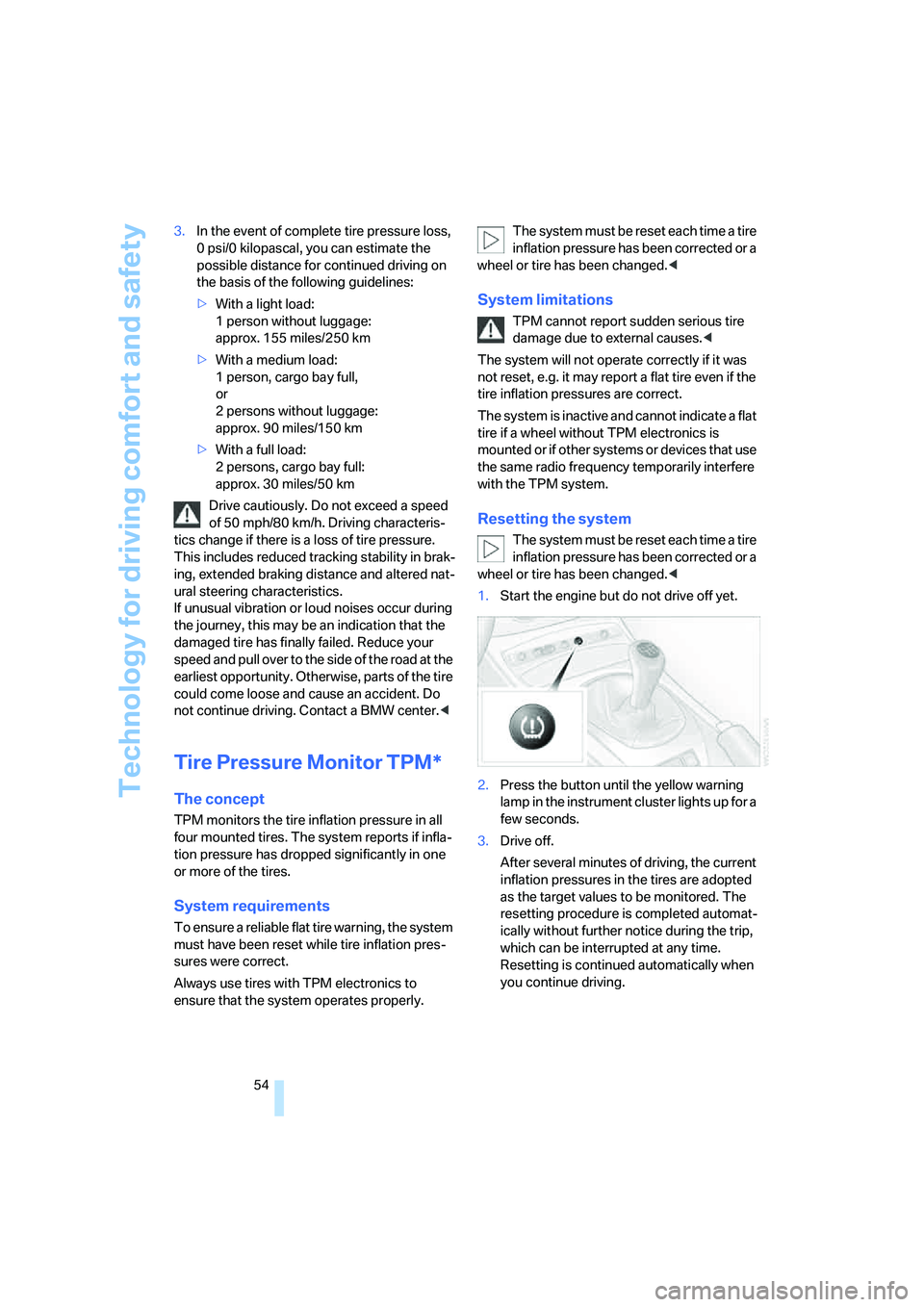
1.Start the engine but do not drive off yet.
2.Press the button until the yellow warning
lamp in the instrument cluster lights up for a
few seconds.
3.Drive off.
After several minutes of driving, the current
inflation pressures in the tires are adopted
as the target values to be monitored. The
resetting procedure is completed automat-
ically without further notice during the trip,
which can be interrupted at any time.
Resetting is continued automatically when
you continue driving.
Page 57 of 132
Reference
At a glance
Controls
Driving tips
Mobility
55
Warning of low tire inflation pressure
The warning lamp lights up in yellow. A
signal also sounds. There is a flat tire or
a significant loss of tire pressure in one
or more tires.
1.Cautiously reduce speed to 50 mph/
80 km/h or lower. Avoid strong braking and
steering maneuvers. Do not exceed a maxi-
mum speed of 50 mph/80 km/h.
If the car is not equipped with Run-
Flat Tires, which is the standard
equipment by design, refer to page88, then
do not continue driving. Doing so after a tire
puncture may result in a severe accident.<
2.In the event of complete tire pressure loss,
0 psi/0 kilopascal, you can estimate how far
you can continue driving on the basis of the
following guidelines:
>With a light load:
1 person without luggage:
approx. 155 miles/250 km
>With a medium load:
1 person, cargo bay full,
or
2 persons without luggage:
approx. 90 miles/150 km
>With a full load:
2 persons, cargo bay full:
approx. 30 miles/50 km
Drive cautiously. Do not exceed a speed
of 50 mph/80 km/h. Driving characteris-
tics change if there is a loss of tire pressure.
This includes reduced tracking stability in brak-
ing, extended braking distance and altered nat-
ural steering characteristics.
If unusual vibration or loud noises occur during
the journey, this may be an indication that the
damaged tire has finally failed. Reduce your
speed and pull over to the side of the road at a
suitable location at the earliest opportunity.
Otherwise, parts of the tire could come loose
and cause an accident. Do not continue driving.
Contact a BMW center.<
Malfunction
The yellow warning lamp flashes and
then lights up continuously. A flat tire
cannot be detected.
This warning is displayed under the following
circumstances:
>If there is a malfunction;
have the system checked.
>If a wheel without TPM electronics is
mounted.
>If other systems or devices that use the
same radio frequency temporarily interfere
with the TPM.
Declaration according to NHTSA/
FMVSS 138 Tire Pressure Monitoring
System
Each tire should be checked monthly when cold
and inflated to the inflation pressure recom-
mended by the vehicle manufacturer on the
vehicle placard or tire inflation pressure label. If
your vehicle has tires of a different size than the
size indicated on the vehicle placard or tire infla-
tion pressure label, you should determine the
proper tire inflation pressure for those tires. As
an added safety feature, your vehicle has been
equipped with a tire pressure monitoring sys-
tem, TPMS, that illuminates a low tire pressure
telltale when one or more of your tires are signif-
icantly under-inflated. Accordingly, when the
low tire pressure telltale illuminates, you should
stop and check your tires as soon as possible,
and inflate them to the proper pressure. Driving
on a significantly underinflated tire causes the
tire to overheat and can lead to tire failure.
Under-inflation also reduces fuel efficiency and
tire tread life, and may affect the vehicle's han-
dling and stopping ability. Please note that the
TPMS is not a substitute for proper tire mainte-
nance, and it is the driver's responsibility to
maintain correct tire pressure, even if under-
inflation has not reached the level to trigger illu-
mination of the TPMS low tire pressure telltale.
The TPMS malfunction indicator is combined
with the low tire pressure telltale. When the sys-
tem detects a malfunction, the telltale will flash
for approximately one minute and then remain
Page 62 of 132
Lamps
60 If necessary, switch on the parking lamps as
described in the section about parking lamps.
You can have the daytime running lamps
activated/deactivated on your vehicle.<
Pathway lighting
If you activate the headlamp flasher after park-
ing the car, with the lights switched off, the low
beams come on and remain on for a certain
time.
You can have this function activated/
deactivated as well as the duration of the
pathway lighting set.<
LIGHTS ON warning
Whenever you open the driver's door after hav-
ing turned the key to position 0, you will hear an
acoustic signal for a few seconds to remind you
that the lamps have not been switched off.
High beams/Roadside
parking lamps
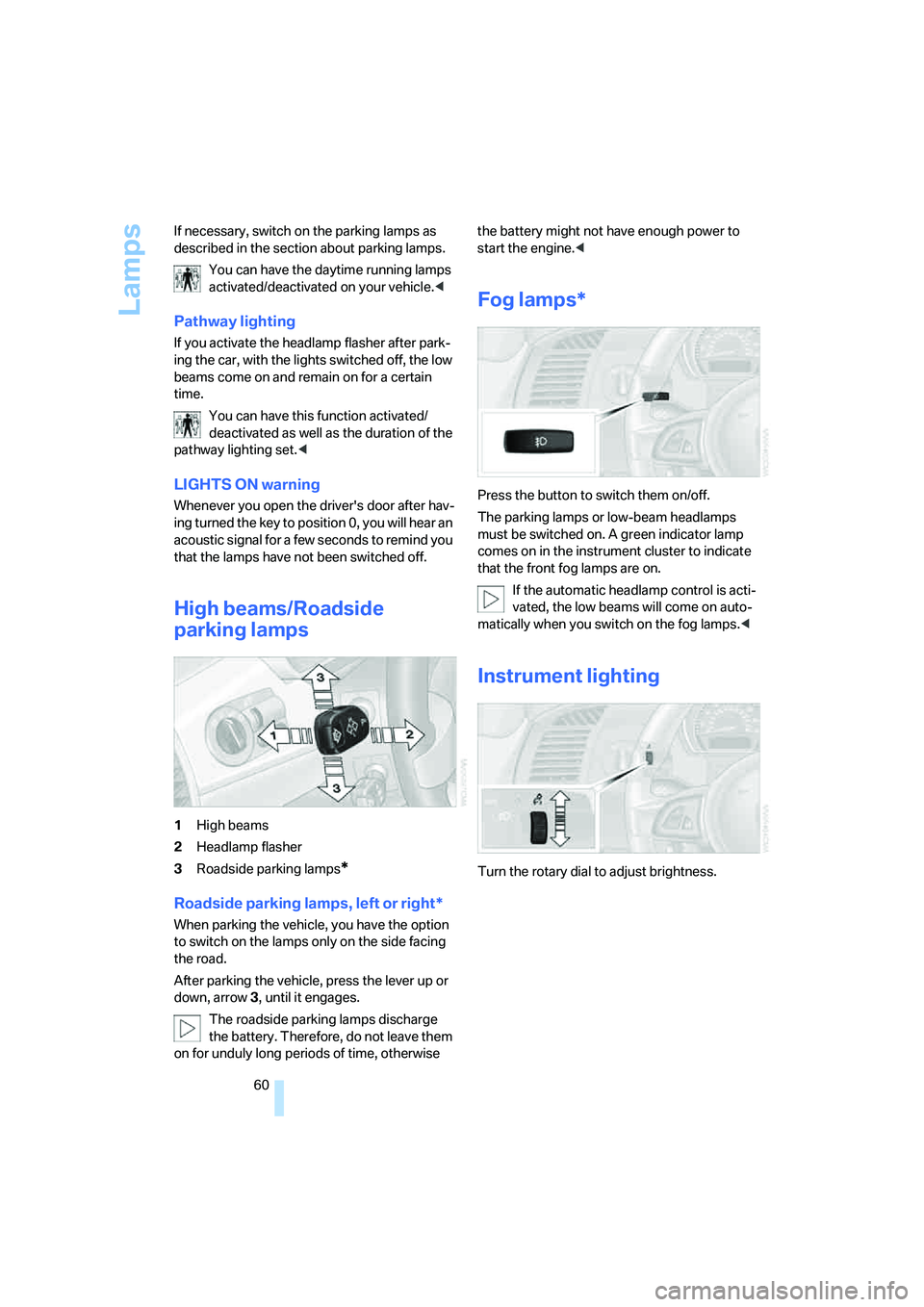
1High beams
2Headlamp flasher
3Roadside parking lamps
*
Roadside parking lamps, left or right*
When parking the vehicle, you have the option
to switch on the lamps only on the side facing
the road.
After parking the vehicle, press the lever up or
down, arrow 3, until it engages.
The roadside parking lamps discharge
the battery. Therefore, do not leave them
on for unduly long periods of time, otherwise the battery might not have enough power to
start the engine.<
Fog lamps*
Press the button to switch them on/off.
The parking lamps or low-beam headlamps
must be switched on. A green indicator lamp
comes on in the instrument cluster to indicate
that the front fog lamps are on.
If the automatic headlamp control is acti-
vated, the low beams will come on auto-
matically when you switch on the fog lamps.<
Instrument lighting
Turn the rotary dial to adjust brightness.
Page 78 of 132
Things to remember when driving
76 pletely lose contact with the road surface, so
that neither the car can be steered nor the brake
be properly applied.<
The risk of hydroplaning increases with declin-
ing tread depth on the tires, refer also to Mini-
mum tread depth on page87.
Driving through water
Drive through water on the road only if it is
not deeper than 1 ft/30 cm, and then only
at walking speed at the most. Otherwise, the
vehicle's engine, the electrical systems and the
transmission may be damaged.<
Moisture inside the vehicle
Make sure that the passenger compart-
ment does not become wet and that liq-
uids are transported in closed containers. Oth-
erwise, moisture could penetrate and damage
electronic components inside the vehicle.<
Use the parking brake on inclines
On inclines, keep the vehicle from rolling
by using the parking brake rather than by
slipping the clutch, which would lead to a high
degree of clutch wear.<
Braking safely
Your BMW is equipped with ABS as a standard
feature. Applying the brakes fully is the most
effective way of braking in situations in which
this is necessary. Since the vehicle maintains
steering responsiveness, you can still avoid
possible obstacles with a minimum of steering
effort.
Pulsation at the brake pedal combines with
sounds from the hydraulic circuits to indicate to
the driver that ABS is in its active mode.
Wet roads
When roads are wet or there is heavy rain,
briefly exert gentle pressure on the brake pedal
every few miles. Watch traffic conditions to
ensure that this maneuver does not endanger
other road users. The resulting heat dries the
brake rotors and brake pads. Immediate braking
force is then available if necessary.
Inclines
To prevent overheating and, as a result,
diminished braking effectiveness, drive
down long or steep downhill grades in the gear
that requires the least braking. Otherwise, even
light but consistent pedal pressure can lead to
high temperatures, brake wear and possibly
even brake failure.<
You can increase the engine's braking effect by
shifting down, all the way to first gear if neces-
sary. This strategy helps you avoid placing
excessive loads on the brake system. Down-
shifting in manual mode of the automatic trans-
mission, refer to page43.
Never drive with the clutch held down,
with the transmission in idle or with the
engine switched off; otherwise, engine braking
action will not be present or there will be no
power assistance to the brakes or steering.
Never allow floor mats, carpets or any other
objects to protrude into the area around the
pedals, otherwise pedal function could be
impaired.<
Corrosion on brake rotors
Limited vehicle use, extended periods with the
vehicle parked or in storage, and operating con-
ditions in which braking is restricted to gentle,
low-pressure applications will all increase the
tendency for corrosion to form on the rotors and
contamination to accumulate on the brake
pads. This occurs because the minimal pres-
sure which must be exerted by the pads to
clean the rotors by brake applications is not
reached.
If the brake rotors are corroded, they will tend to
respond to braking with a pulsating effect which
even extended application will fail to cure.
Brake pads
The warning lamp lights up. The brake
pads have worn down to the minimum
safe limit. Have the brake pads
replaced as soon as possible.
Page 84 of 132
Refueling
82
Refueling
Always switch off the engine before refu-
eling. Otherwise the tank cannot be
refilled. The Service Engine Soon warning lamp
will come on.<
Take all precautionary measures and
observe all applicable regulations when
handling fuel. Do not carry any spare fuel con-
tainers in your vehicle. They can develop a leak
and cause an explosion or cause a fire in the
event of an accident.<
Gas cap
Opening
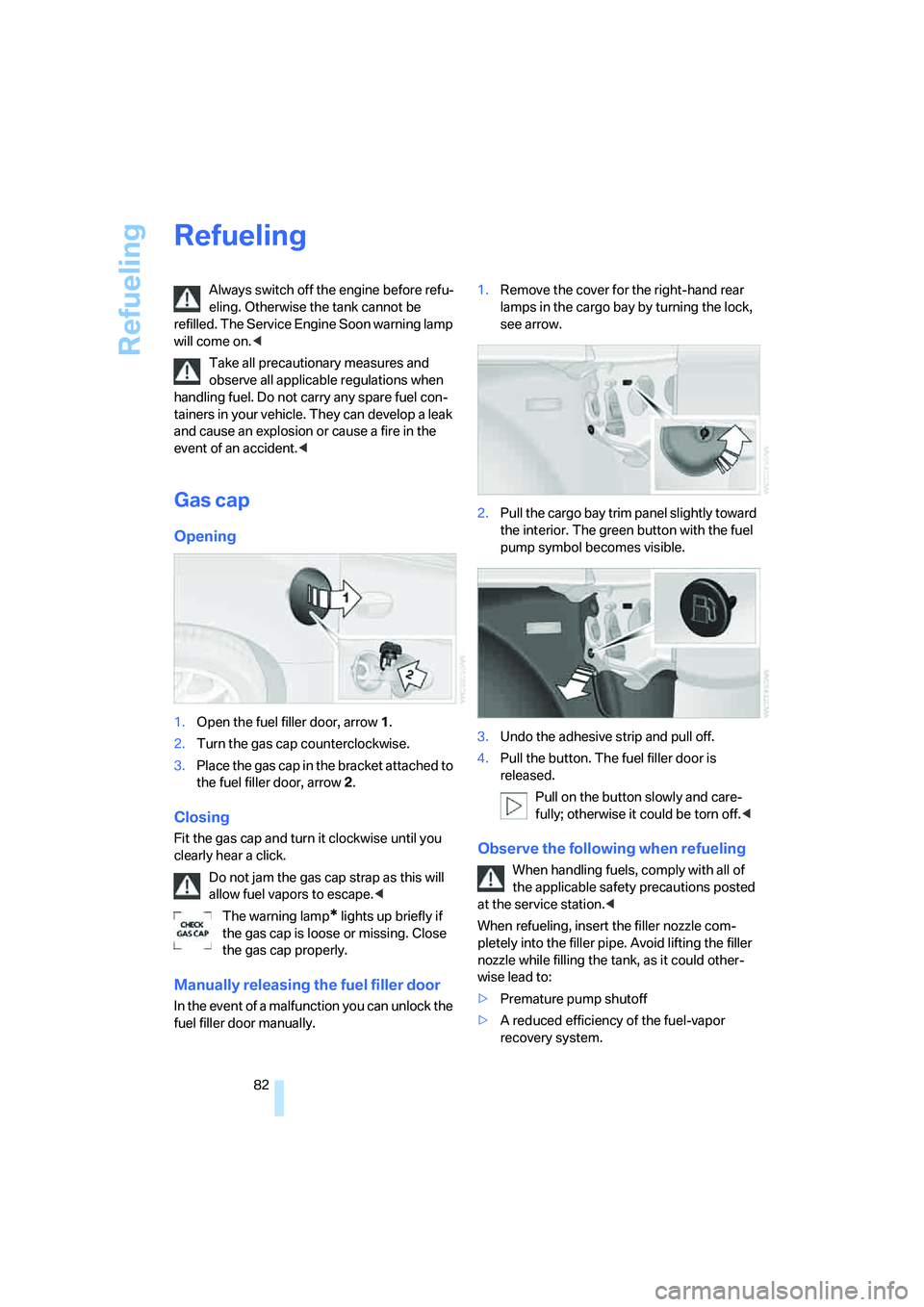
1.Open the fuel filler door, arrow 1.
2.Turn the gas cap counterclockwise.
3.Place the gas cap in the bracket attached to
the fuel filler door, arrow 2.
Closing
Fit the gas cap and turn it clockwise until you
clearly hear a click.
Do not jam the gas cap strap as this will
allow fuel vapors to escape.<
The warning lamp
* lights up briefly if
the gas cap is loose or missing. Close
the gas cap properly.
Manually releasing the fuel filler door
In the event of a malfunction you can unlock the
fuel filler door manually.1.Remove the cover for the right-hand rear
lamps in the cargo bay by turning the lock,
see arrow.
2.Pull the cargo bay trim panel slightly toward
the interior. The green button with the fuel
pump symbol becomes visible.
3.Undo the adhesive strip and pull off.
4.Pull the button. The fuel filler door is
released.
Pull on the button slowly and care-
fully; otherwise it could be torn off.<
Observe the following when refueling
When handling fuels, comply with all of
the applicable safety precautions posted
at the service station.<
When refueling, insert the filler nozzle com-
pletely into the filler pipe. Avoid lifting the filler
nozzle while filling the tank, as it could other-
wise lead to:
>Premature pump shutoff
>A reduced efficiency of the fuel-vapor
recovery system.
Page 94 of 132
Under the hood
92
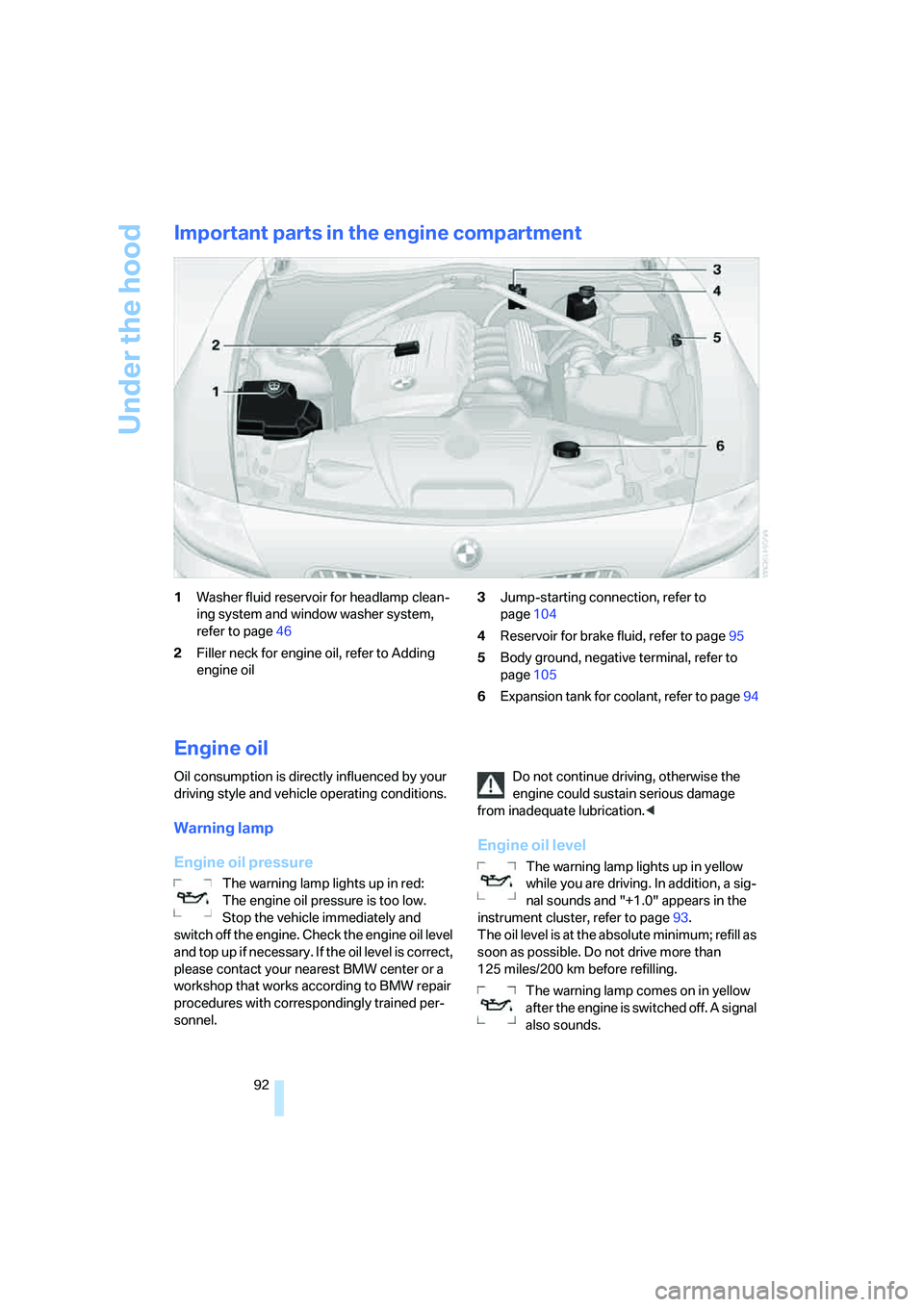
Important parts in the engine compartment
1Washer fluid reservoir for headlamp clean-
ing system and window washer system,
refer to page46
2Filler neck for engine oil, refer to Adding
engine oil3Jump-starting connection, refer to
page104
4Reservoir for brake fluid, refer to page95
5Body ground, negative terminal, refer to
page105
6Expansion tank for coolant, refer to page94
Engine oil
Oil consumption is directly influenced by your
driving style and vehicle operating conditions.
Warning lamp
Engine oil pressure
The warning lamp lights up in red:
The engine oil pressure is too low.
Stop the vehicle immediately and
switch off the engine. Check the engine oil level
and top up if necessary. If the oil level is correct,
please contact your nearest BMW center or a
workshop that works according to BMW repair
procedures with correspondingly trained per-
sonnel.Do not continue driving, otherwise the
engine could sustain serious damage
from inadequate lubrication.<
Engine oil level
The warning lamp lights up in yellow
while you are driving. In addition, a sig-
nal sounds and "+1.0" appears in the
instrument cluster, refer to page93.
The oil level is at the absolute minimum; refill as
soon as possible. Do not drive more than
125 miles/200 km before refilling.
The warning lamp comes on in yellow
after the engine is switched off. A signal
also sounds.
Page 95 of 132
Reference
At a glance
Controls
Driving tips
Mobility
93
Add engine oil at the earliest opportunity, e.g.
when you stop to refuel.
The warning lamp lights up in yellow
within 30 seconds after the engine is
started: the oil level sensor is defective.
It is not possible to issue a current or accurate
measurement. Have the system checked as
soon as possible.
Checking the oil level
Your car is equipped with an electronic oil-level
monitor.
For a precise measurement and display of the
oil level, it is necessary that the engine be at
operating temperature, i.e. after uninterrupted
driving for at least approx. 6.5 miles/10 km. You
can have the oil level displayed while you are
driving, or while the vehicle is at a standstill on a
level surface and the engine is running.
You can have the oil level reading displayed in
the instrument cluster.
Press button1. The oil level is checked and dis-
played for approx. 15 seconds.
To exit the display sooner, press button 1 again.
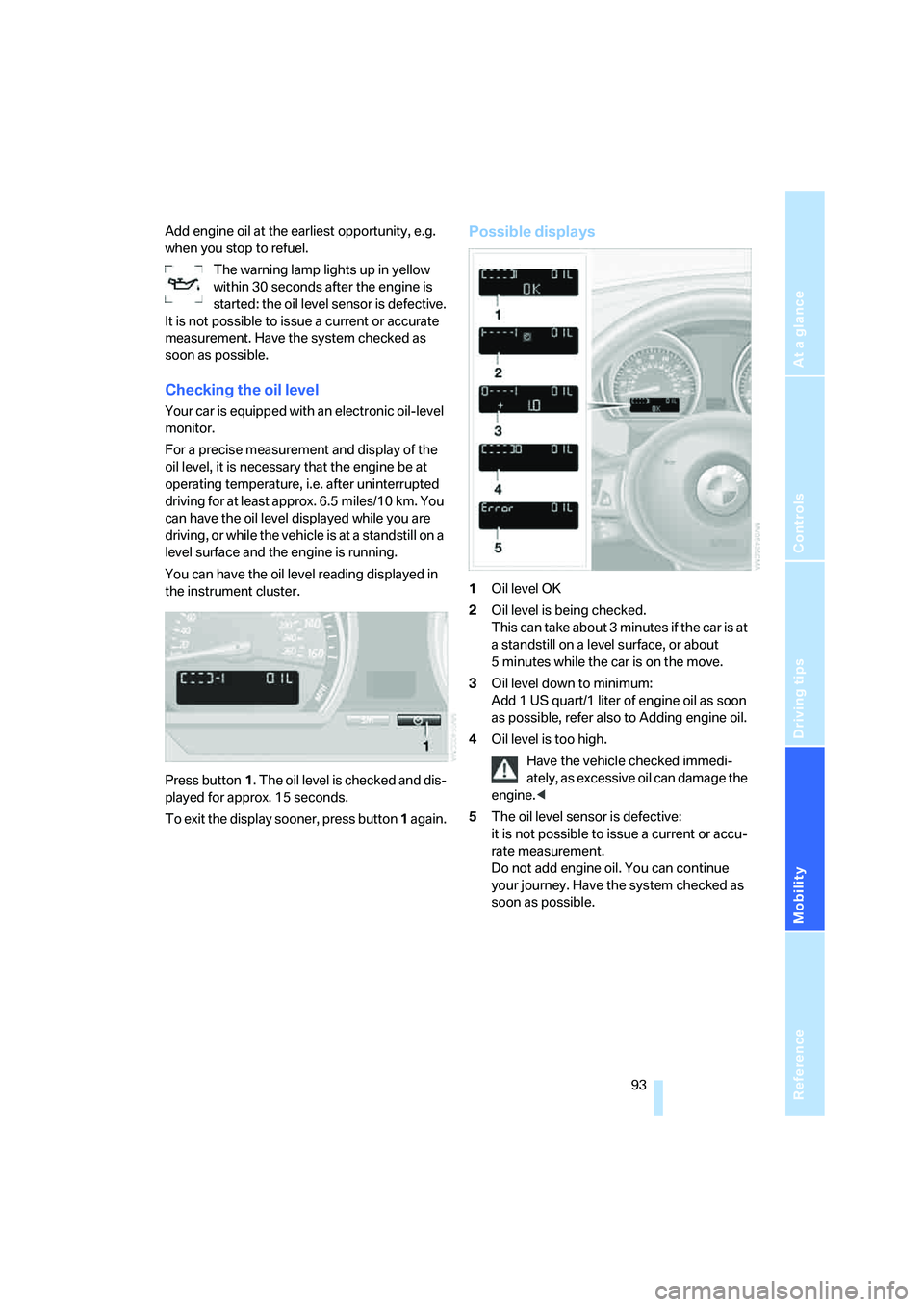
Possible displays
1Oil level OK
2Oil level is being checked.
This can take about 3 minutes if the car is at
a standstill on a level surface, or about
5 minutes while the car is on the move.
3Oil level down to minimum:
Add 1 US quart/1 liter of engine oil as soon
as possible, refer also to Adding engine oil.
4Oil level is too high.
Have the vehicle checked immedi-
ately, as excessive oil can damage the
engine.<
5The oil level sensor is defective:
it is not possible to issue a current or accu-
rate measurement.
Do not add engine oil. You can continue
your journey. Have the system checked as
soon as possible.
Page 96 of 132
Under the hood
94
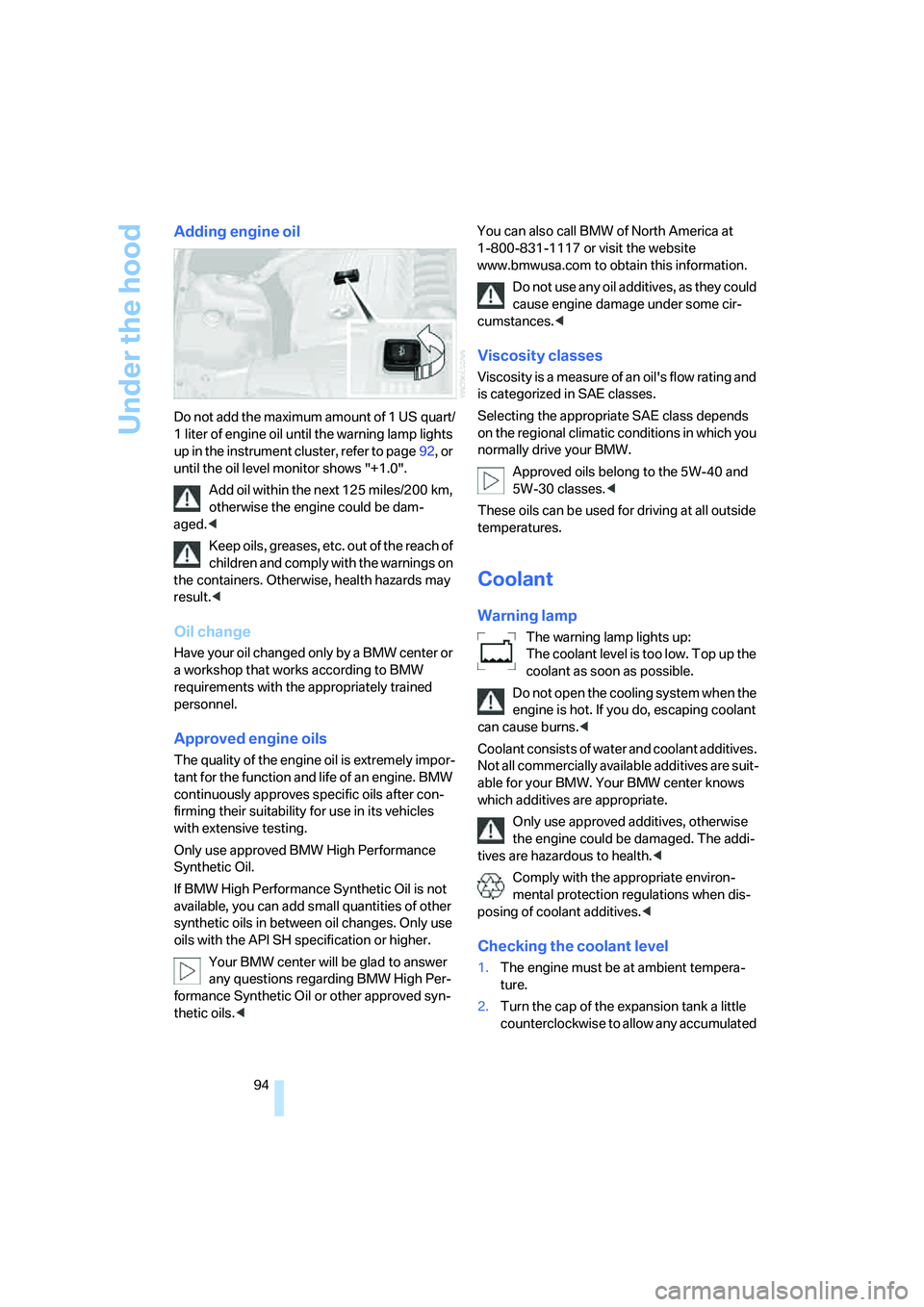
Adding engine oil
Do not add the maximum amount of 1 US quart/
1 liter of engine oil until the warning lamp lights
up in the instrument cluster, refer to page92, or
until the oil level monitor shows "+1.0".
Add oil within the next 125 miles/200 km,
otherwise the engine could be dam-
aged.<
Keep oils, greases, etc. out of the reach of
children and comply with the warnings on
the containers. Otherwise, health hazards may
result.<
Oil change
Have your oil changed only by a BMW center or
a workshop that works according to BMW
requirements with the appropriately trained
personnel.
Approved engine oils
The quality of the engine oil is extremely impor-
tant for the function and life of an engine. BMW
continuously approves specific oils after con-
firming their suitability for use in its vehicles
with extensive testing.
Only use approved BMW High Performance
Synthetic Oil.
If BMW High Performance Synthetic Oil is not
available, you can add small quantities of other
synthetic oils in between oil changes. Only use
oils with the API SH specification or higher.
Your BMW center will be glad to answer
any questions regarding BMW High Per-
formance Synthetic Oil or other approved syn-
thetic oils.
www.bmwusa.com to obtain this information.
Do not use any oil additives, as they could
cause engine damage under some cir-
cumstances.<
Viscosity classes
Viscosity is a measure of an oil's flow rating and
is categorized in SAE classes.
Selecting the appropriate SAE class depends
on the regional climatic conditions in which you
normally drive your BMW.
Approved oils belong to the 5W-40 and
5W-30 classes.<
These oils can be used for driving at all outside
temperatures.
Coolant
Warning lamp
The warning lamp lights up:
The coolant level is too low. Top up the
coolant as soon as possible.
Do not open the cooling system when the
engine is hot. If you do, escaping coolant
can cause burns.<
Coolant consists of water and coolant additives.
Not all commercially available additives are suit-
able for your BMW. Your BMW center knows
which additives are appropriate.
Only use approved additives, otherwise
the engine could be damaged. The addi-
tives are hazardous to health.<
Comply with the appropriate environ-
mental protection regulations when dis-
posing of coolant additives.<
Checking the coolant level
1.The engine must be at ambient tempera-
ture.
2.Turn the cap of the expansion tank a little
counterclockwise to allow any accumulated
Page 97 of 132
Reference
At a glance
Controls
Driving tips
Mobility
95
pressure to escape, then continue turning
to open.
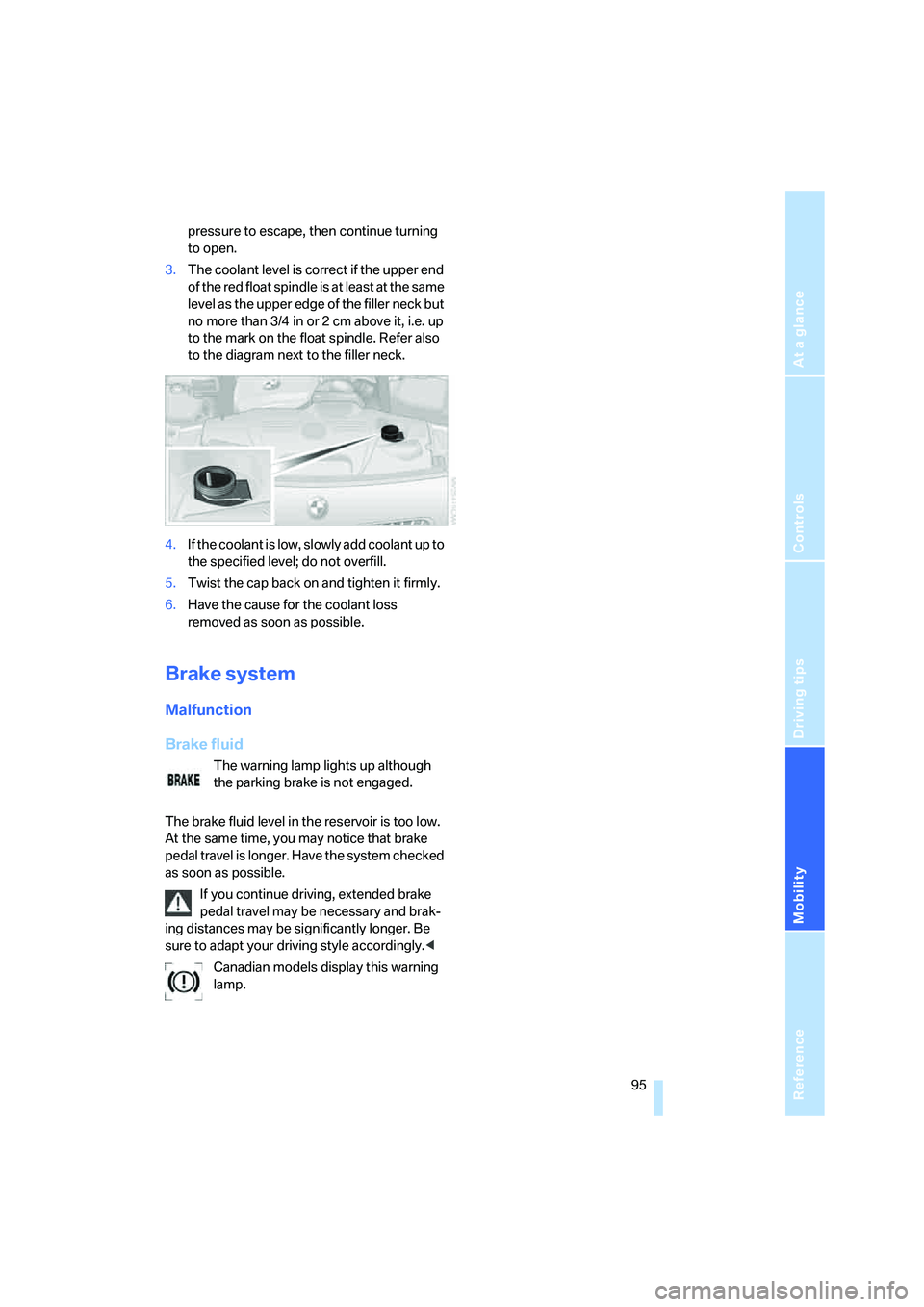
3.The coolant level is correct if the upper end
of the red float spindle is at least at the same
level as the upper edge of the filler neck but
no more than 3/4 in or 2 cm above it, i.e. up
to the mark on the float spindle. Refer also
to the diagram next to the filler neck.
4.If the coolant is low, slowly add coolant up to
the specified level; do not overfill.
5.Twist the cap back on and tighten it firmly.
6.Have the cause for the coolant loss
removed as soon as possible.
Brake system
Malfunction
Brake fluid
The warning lamp lights up although
the parking brake is not engaged.
The brake fluid level in the reservoir is too low.
At the same time, you may notice that brake
pedal travel is longer. Have the system checked
as soon as possible.
If you continue driving, extended brake
pedal travel may be necessary and brak-
ing distances may be significantly longer. Be
sure to adapt your driving style accordingly.<
Canadian models display this warning
lamp.
Page 99 of 132
Reference
At a glance
Controls
Driving tips
Mobility
97
Exhaust emission values
The warning lamp lights up: the
exhaust emission values have wors-
ened. Have the car checked as soon as
possible.
The lamps flash under certain conditions. This
indicates excessive misfiring of the engine. If
this happens, you should reduce your speed
and visit your nearest BMW center as soon as
possible. Severe engine misfiring can quickly
lead to serious damage of emissions-related
components, especially the catalytic converter.
Canadian models display this warning
lamp.
The warning lamp lights up if the gas
cap is not properly tightened and the
OBD system can assume that fuel
vapor is escaping. If the gas cap is then tight-
ened, the warning lamp should go out within a
few days.
Event Data Recorders
Your vehicle may be equipped with one or sev-
eral measuring or diagnostic modules or a
device for recording or sending certain vehicle
data or information. In addition, if you have
signed a subscription contract for BMW Assist,
certain vehicle data may be transmitted or
recorded in order to facilitate the corresponding
services.
Care
Important information on the care and mainte-
nance of your BMW is contained in the Caring
for your vehicle brochure.