lock BMW Z4 ROADSTER 2006 E85 User Guide
[x] Cancel search | Manufacturer: BMW, Model Year: 2006, Model line: Z4 ROADSTER, Model: BMW Z4 ROADSTER 2006 E85Pages: 128, PDF Size: 4.41 MB
Page 26 of 128
Opening and closing
24 >Switching on the hazard warning flashers
>Flashing the high beams
Arming and disarming
When you lock or unlock the vehicle, either with
the remote control or at the door lock, the alarm
system is armed or disarmed at the same time.
The hazard warning flashers light up once when
the alarm system has been properly armed.
You can have different acknowledgment
signals set to confirm arming and disarm-
ing.<
Even when the alarm system is armed, you can
open the luggage compartment lid/tailgate
using the button on the remote control,
refer to page19. When you subsequently close
the luggage compartment lid/tailgate, it is
locked again and monitored.
Manual operation of the luggage com-
partment lid/tailgate triggers the alarm.
Refer to page21.<
Switching off an alarm
>Unlock the car with the remote control, refer
to page19, or
>turn the master key in the ignition lock to
position 1, refer to page38
Indicator lamp displays
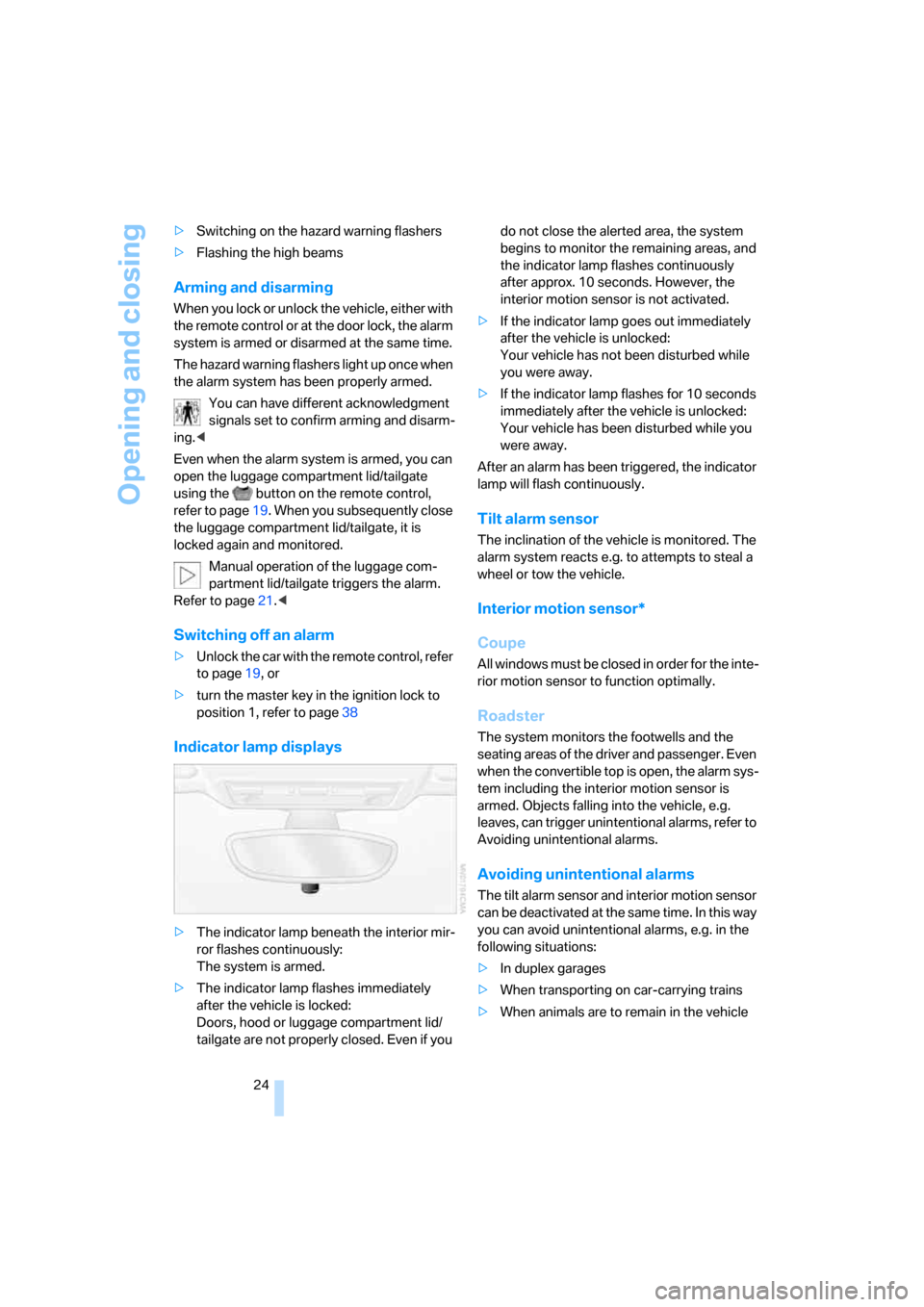
>The indicator lamp beneath the interior mir-
ror flashes continuously:
The system is armed.
>The indicator lamp flashes immediately
after the vehicle is locked:
Doors, hood or luggage compartment lid/
tailgate are not properly closed. Even if you do not close the alerted area, the system
begins to monitor the remaining areas, and
the indicator lamp flashes continuously
after approx. 10 seconds. However, the
interior motion sensor is not activated.
>If the indicator lamp goes out immediately
after the vehicle is unlocked:
Your vehicle has not been disturbed while
you were away.
>If the indicator lamp flashes for 10 seconds
immediately after the vehicle is unlocked:
Your vehicle has been disturbed while you
were away.
After an alarm has been triggered, the indicator
lamp will flash continuously.
Tilt alarm sensor
The inclination of the vehicle is monitored. The
alarm system reacts e.g. to attempts to steal a
wheel or tow the vehicle.
Interior motion sensor*
Coupe
All windows must be closed in order for the inte-
rior motion sensor to function optimally.
Roadster
The system monitors the footwells and the
seating areas of the driver and passenger. Even
when the convertible top is open, the alarm sys-
tem including the interior motion sensor is
armed. Objects falling into the vehicle, e.g.
leaves, can trigger unintentional alarms, refer to
Avoiding unintentional alarms.
Avoiding unintentional alarms
The tilt alarm sensor and interior motion sensor
can be deactivated at the same time. In this way
you can avoid unintentional alarms, e.g. in the
following situations:
>In duplex garages
>When transporting on car-carrying trains
>When animals are to remain in the vehicle
Page 27 of 128
Reference
At a glance
Controls
Driving tips
Mobility
25
Switching off tilt alarm sensor and
interior motion sensor
>Press the button on the remote
control twice in a row.
The indicator lamp lights up briefly and then
flashes continuously. The tilt alarm sensor and
the interior motion sensor are deactivated until
the vehicle is again unlocked and locked.
Windows
To prevent injuries, exercise care when
closing the windows and keep them in
your field of vision until they are shut.
Take the key with you when you leave the car,
otherwise children could operate the windows
and possibly injure themselves.<
Opening, closing
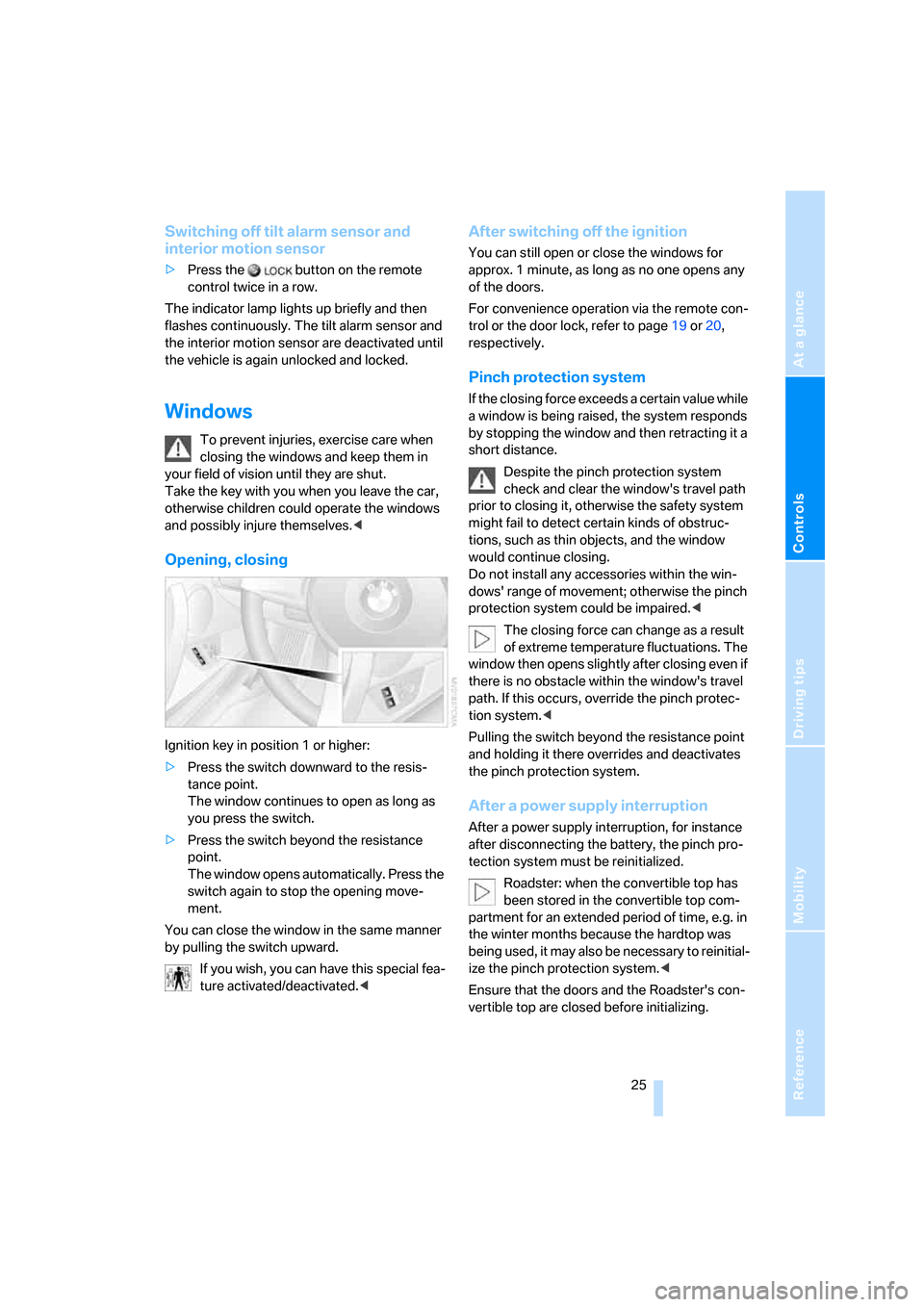
Ignition key in position 1 or higher:
>Press the switch downward to the resis-
tance point.
The window continues to open as long as
you press the switch.
>Press the switch beyond the resistance
point.
The window opens automatically. Press the
switch again to stop the opening move-
ment.
You can close the window in the same manner
by pulling the switch upward.
If you wish, you can have this special fea-
ture activated/deactivated.<
After switching off the ignition
You can still open or close the windows for
approx. 1 minute, as long as no one opens any
of the doors.
For convenience operation via the remote con-
trol or the door lock, refer to page19 or20,
respectively.
Pinch protection system
If the closing force exceeds a certain value while
a window is being raised, the system responds
by stopping the window and then retracting it a
short distance.
Despite the pinch protection system
check and clear the window's travel path
prior to closing it, otherwise the safety system
might fail to detect certain kinds of obstruc-
tions, such as thin objects, and the window
would continue closing.
Do not install any accessories within the win-
dows' range of movement; otherwise the pinch
protection system could be impaired.<
The closing force can change as a result
of extreme temperature fluctuations. The
window then opens slightly after closing even if
there is no obstacle within the window's travel
path. If this occurs, override the pinch protec-
tion system.<
Pulling the switch beyond the resistance point
and holding it there overrides and deactivates
the pinch protection system.
After a power supply interruption
After a power supply interruption, for instance
after disconnecting the battery, the pinch pro-
tection system must be reinitialized.
Roadster: when the convertible top has
been stored in the convertible top com-
partment for an extended period of time, e.g. in
the winter months because the hardtop was
being used, it may also be necessary to reinitial-
ize the pinch protection system.<
Ensure that the doors and the Roadster's con-
vertible top are closed before initializing.
Page 28 of 128
Opening and closing
26 1.Open the window completely.
2.Press the switch 4 times within approx.
10 seconds.
Afterward, perform the following procedure
twice for each window:
1.Close the window completely by pulling the
switch.
2.After the window is closed, keep pulling the
switch for approx. 2 seconds.
3.Open the window completely by pressing
the switch.
Roadster: manual convertible
top
The fabric top offers perfect protection against
the weather and can be opened easily and
quickly by one person alone.
Here are a few tips so that you get the most out
of your BMW:
>It is advisable to close the convertible top
when the vehicle is parked. When closed,
the top not only guards the passenger com-
partment from unforeseeable damage from
the weather, but also affords a degree of
protection against theft. Valuables, how-
ever, should only be kept in the locked
cargo bay, even when the convertible top is
closed.
>When the convertible top is open, the cen-
tral locking system also locks button 1 for
the convertible top, refer to page27. The
convertible top cannot be operated. This
provides better theft protection for valu-
ables stored in the cargo bay.
>Never mount a roof-mounted luggage rack
system on the convertible top.
Never keep a wet convertible top in the
convertible top compartment for longer
than one day, otherwise the moisture could
cause damage.<
Opening
Operate the convertible top only when
the vehicle is stationary.To avoid any damage when opening the con-
vertible top, make sure that the convertible top
compartment panel in the cargo bay has been
folded down, refer to page23.<
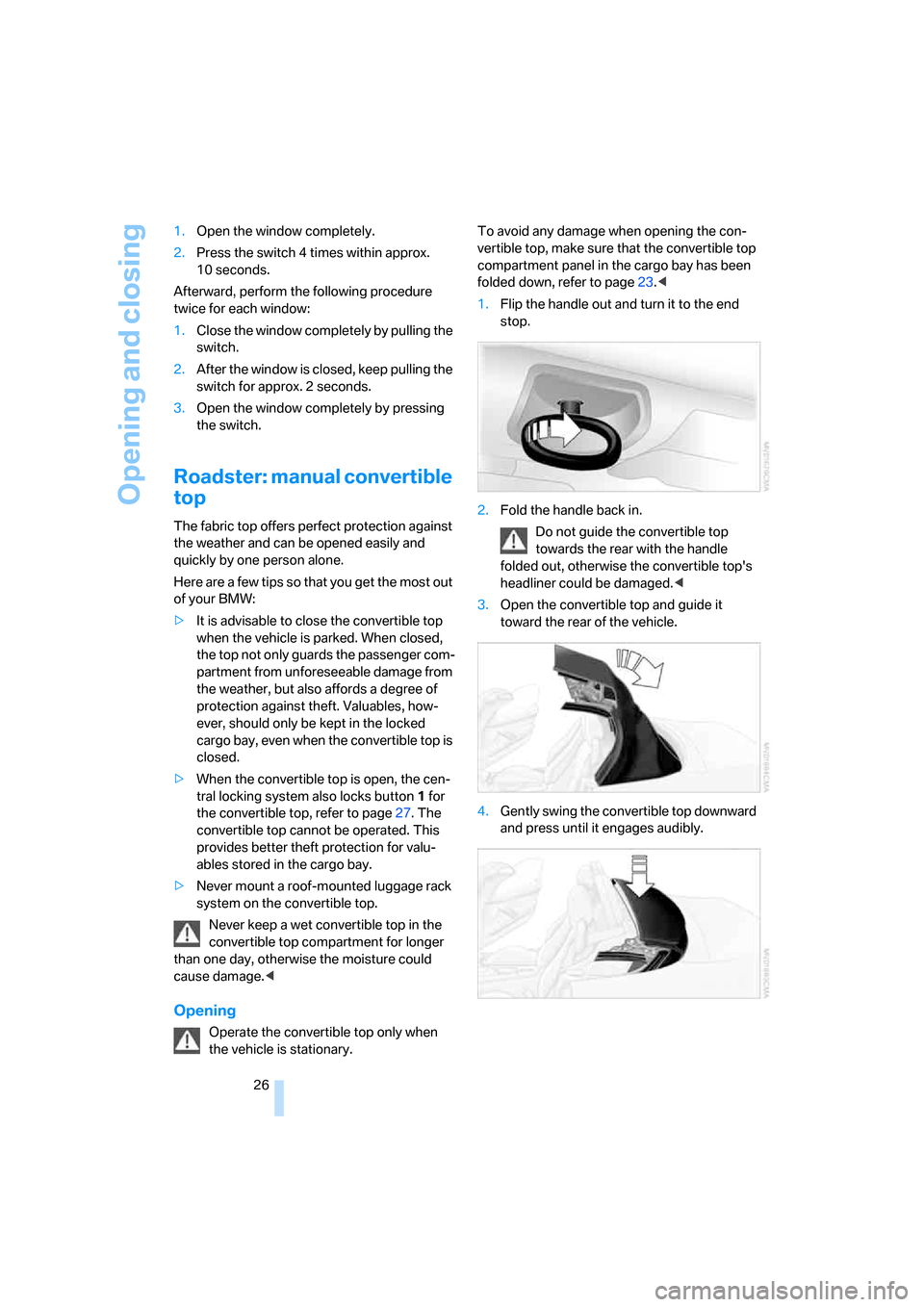
1.Flip the handle out and turn it to the end
stop.
2.Fold the handle back in.
Do not guide the convertible top
towards the rear with the handle
folded out, otherwise the convertible top's
headliner could be damaged.<
3.Open the convertible top and guide it
toward the rear of the vehicle.
4.Gently swing the convertible top downward
and press until it engages audibly.
Page 29 of 128
Reference
At a glance
Controls
Driving tips
Mobility
27
Closing
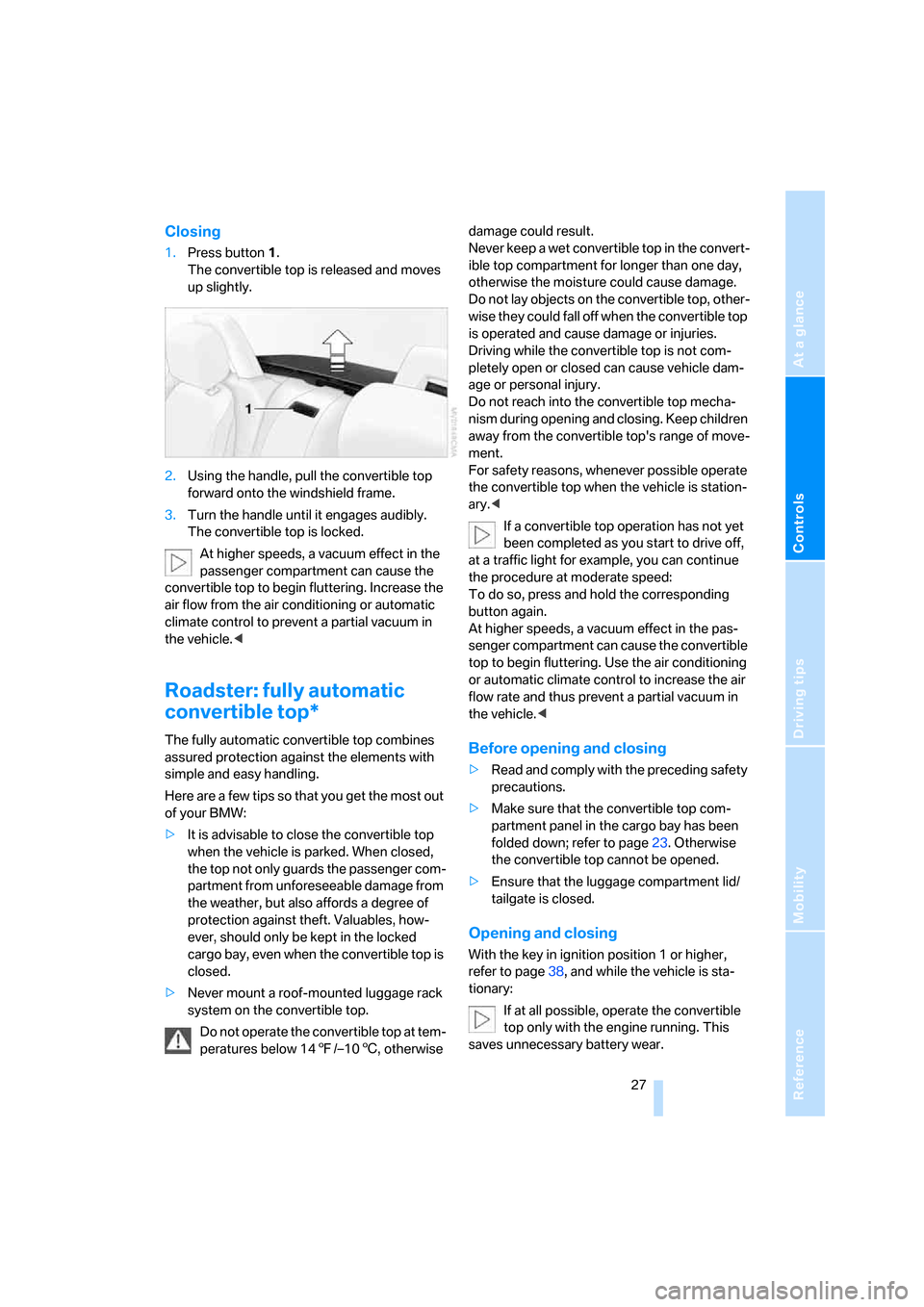
1.Press button1.
The convertible top is released and moves
up slightly.
2.Using the handle, pull the convertible top
forward onto the windshield frame.
3.Turn the handle until it engages audibly.
The convertible top is locked.
At higher speeds, a vacuum effect in the
passenger compartment can cause the
convertible top to begin fluttering. Increase the
air flow from the air conditioning or automatic
climate control to prevent a partial vacuum in
the vehicle.<
Roadster: fully automatic
convertible top*
The fully automatic convertible top combines
assured protection against the elements with
simple and easy handling.
Here are a few tips so that you get the most out
of your BMW:
>It is advisable to close the convertible top
when the vehicle is parked. When closed,
the top not only guards the passenger com-
partment from unforeseeable damage from
the weather, but also affords a degree of
protection against theft. Valuables, how-
ever, should only be kept in the locked
cargo bay, even when the convertible top is
closed.
>Never mount a roof-mounted luggage rack
system on the convertible top.
Do not operate the convertible top at tem-
peratures below 147/–106, otherwise damage could result.
Never keep a wet convertible top in the convert-
ible top compartment for longer than one day,
otherwise the moisture could cause damage.
Do not lay objects on the convertible top, other-
wise they could fall off when the convertible top
is operated and cause damage or injuries.
Driving while the convertible top is not com-
pletely open or closed can cause vehicle dam-
age or personal injury.
Do not reach into the convertible top mecha-
nism during opening and closing. Keep children
away from the convertible top's range of move-
ment.
For safety reasons, whenever possible operate
the convertible top when the vehicle is station-
ary.<
If a convertible top operation has not yet
been completed as you start to drive off,
at a traffic light for example, you can continue
the procedure at moderate speed:
To do so, press and hold the corresponding
button again.
At higher speeds, a vacuum effect in the pas-
senger compartment can cause the convertible
top to begin fluttering. Use the air conditioning
or automatic climate control to increase the air
flow rate and thus prevent a partial vacuum in
the vehicle.
precautions.
>Make sure that the convertible top com-
partment panel in the cargo bay has been
folded down; refer to page23. Otherwise
the convertible top cannot be opened.
>Ensure that the luggage compartment lid/
tailgate is closed.
Opening and closing
With the key in ignition position 1 or higher,
refer to page38, and while the vehicle is sta-
tionary:
If at all possible, operate the convertible
top only with the engine running. This
saves unnecessary battery wear.
Page 31 of 128
Reference
At a glance
Controls
Driving tips
Mobility
29
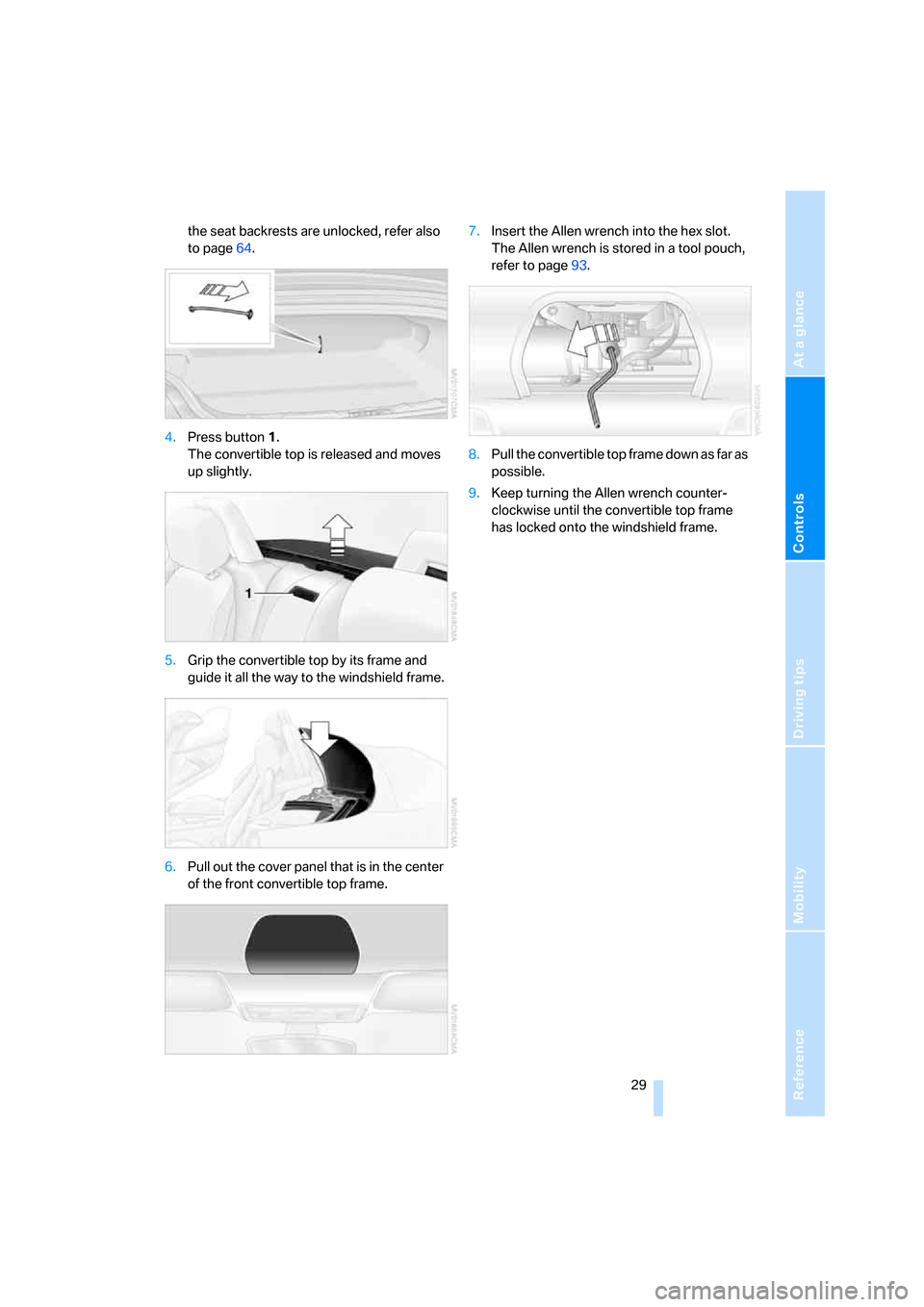
the seat backrests are unlocked, refer also
to page64.
4.Press button1.
The convertible top is released and moves
up slightly.
5.Grip the convertible top by its frame and
guide it all the way to the windshield frame.
6.Pull out the cover panel that is in the center
of the front convertible top frame.7.Insert the Allen wrench into the hex slot.
The Allen wrench is stored in a tool pouch,
refer to page93.
8.Pull the convertible top frame down as far as
possible.
9.Keep turning the Allen wrench counter-
clockwise until the convertible top frame
has locked onto the windshield frame.
Page 32 of 128
Adjustments
30
Adjustments
Safe seating position
For relaxed driving with as little fatigue as pos-
sible, you should select a seating position that
reflects your personal requirements. In combi-
nation with the safety belts, the head restraints
and the airbags, the seating position has a
major influence on your safety in the event of an
accident. To ensure that the vehicle's safety
systems provide you with optimal protection,
we request that you direct your careful attention
to the following section.
For supplementary information on transporting
children refer to page35.
Airbags
Always maintain an adequate distance
between yourself and the airbags. Always
grip the steering wheel on the rim, with your
hands in the 3 o'clock and 9 o'clock positions,
to minimize the risk of injury to the hands or
arms in the event of the airbag being triggered
off.
Never allow any objects, individuals or animals
to obstruct the areas between passengers and
airbags.
Never use the front airbag's cover as a storage
tray or support for objects of any kind. Ensure
that the passenger is correctly seated, e.g. does
not prop feet or legs against the dashboard.
Otherwise, leg injury could result if the knee air-
bag and front airbag suddenly deployed.
Make sure that the passenger does not lean his
or her head against the side airbag, otherwise
serious injuries could result if the airbags sud-
denly deployed.<
Even when all these guidelines are observed,
the risk of injury as a result of contact with the
airbags cannot entirely be ruled out in some sit-
uations. In sensitive individuals, the ignition and
inflation noise may induce a mild hearing loss
that is temporary in most cases.
For airbag locations and additional information
on airbags, refer to page52.
Head restraint
A correctly adjusted head restraint reduces the
risk of neck injury in the event of an accident.
Adjust the head restraint in such a way
that its center is at approx. ear level. Oth-
erwise, there is an increased risk of injury in the
event of an accident.<
Head restraints, refer to page32.
Safety belt
Make sure every occupant fastens his or her
safety belt. As supplemental restraint devices,
the airbags are designed to enhance the effec-
tiveness of the safety belts, and not to replace
them.
Your vehicle offers two sitting positions, each of
which is equipped with a safety belt.
Never allow more than one person to
wear a single safety belt. Never allow
infants or small children to ride in a passenger's
lap. Make sure that the belt in the lap area sits
low against the hips and does not press against
the abdomen. The safety belt must never rest
against the throat, rub against sharp edges,
pass over hard or fragile objects or be pinched.
F a s t e n t he s a f e t y b e l t a ro u n d y o u r b o d y s n u g l y,
ma king sure tha t it is pulled taut across your lap
and shoulder and that it is not twisted; other-
wise, the belt can slide over the hips in the event
of a frontal collision and injure your abdomen.
Avoid wearing bulky clothing and regularly pull
the belt in the upper-body area taut, otherwise
its restraining effect could be impaired.<
Safety belts, refer to page33.
Seats
Before adjusting your seat, always
observe the following precautions
Never try to adjust your seat while driving.
Otherwise, the seat could respond with
unexpected movement, and the ensuing loss of
Page 35 of 128
Reference
At a glance
Controls
Driving tips
Mobility
33
Convenience function
1.Unlock and open the driver's door or turn
the key to position 1, refer to page38.
2.Press memory button 1, 2 or 3 briefly.
Movement stops immediately when one of the
seat adjustment or memory buttons is operated
during the adjustment process.
You can have this feature programmed so
that after you use the remote control from
your personalized key to unlock your door, your
seat will move into your own preferred posi-
tion.<
Safety function
1.Close the driver's door and turn the key to
position 0 or 2.
2.Press the desired memory button 1, 2 or 3
until the adjustment process is completed.
If you press the M
EMORY button accidentally:
Press the button again; the LED goes out.
Before activating the programmed
adjustment feature, ensure that the space
behind the driver's seat is empty and unob-
structed. If you fail to do so, objects behind the
seat could be damaged, should the seat move
backward.<
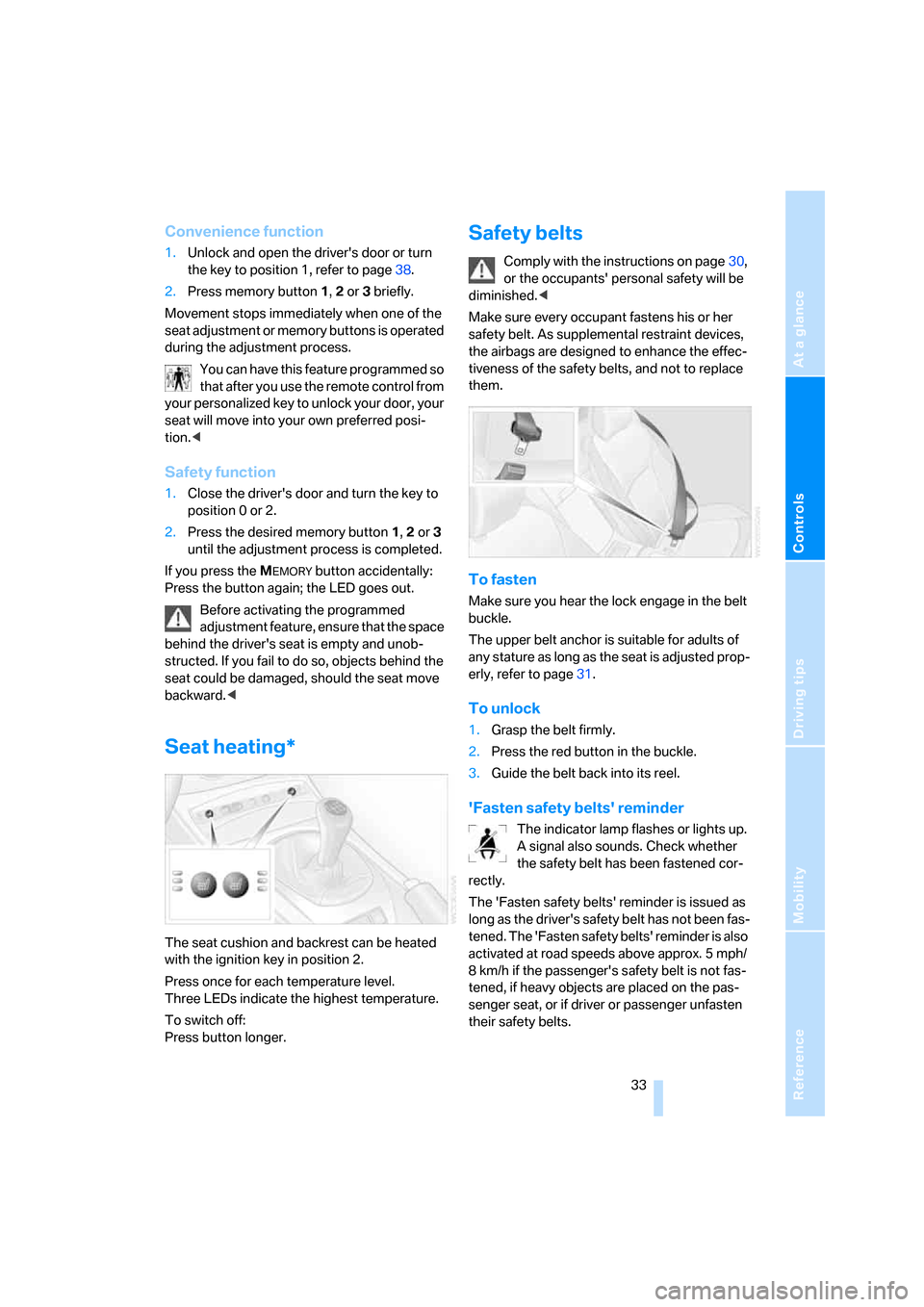
Seat heating*
The seat cushion and backrest can be heated
with the ignition key in position 2.
Press once for each temperature level.
Three LEDs indicate the highest temperature.
To switch off:
Press button longer.
Safety belts
Comply with the instructions on page30,
or the occupants' personal safety will be
diminished.<
Make sure every occupant fastens his or her
safety belt. As supplemental restraint devices,
the airbags are designed to enhance the effec-
tiveness of the safety belts, and not to replace
them.
To fasten
Make sure you hear the lock engage in the belt
buckle.
The upper belt anchor is suitable for adults of
any stature as long as the seat is adjusted prop-
erly, refer to page31.
To unlock
1.Grasp the belt firmly.
2.Press the red button in the buckle.
3.Guide the belt back into its reel.
'Fasten safety belts' reminder
The indicator lamp flashes or lights up.
A signal also sounds. Check whether
the safety belt has been fastened cor-
rectly.
The 'Fasten safety belts' reminder is issued as
long as the driver's safety belt has not been fas-
tened. The 'Fasten safety belts' reminder is also
activated at road speeds above approx. 5 mph/
8 km/h if the passenger's safety belt is not fas-
tened, if heavy objects are placed on the pas-
senger seat, or if driver or passenger unfasten
their safety belts.
Page 38 of 128
Transporting children safely
36 The passenger airbags can only be deactivated
and reactivated while the vehicle is at a stand-
still and the passenger door is open.
Deactivating
Use the key to turn the key switch to the OFF
position.
The passenger airbags are deactivated in this
position. The airbags for the driver remain
active.
Reactivate the passenger airbags as soon
as a child-restraint system is no longer
installed on the passenger seat; otherwise they
may not deploy as intended in the event of an
accident.<
Reactivating
Use the key to turn the key switch to the ON
position.
The passenger airbags in the vehicle are reacti-
vated and will be triggered in certain situations.
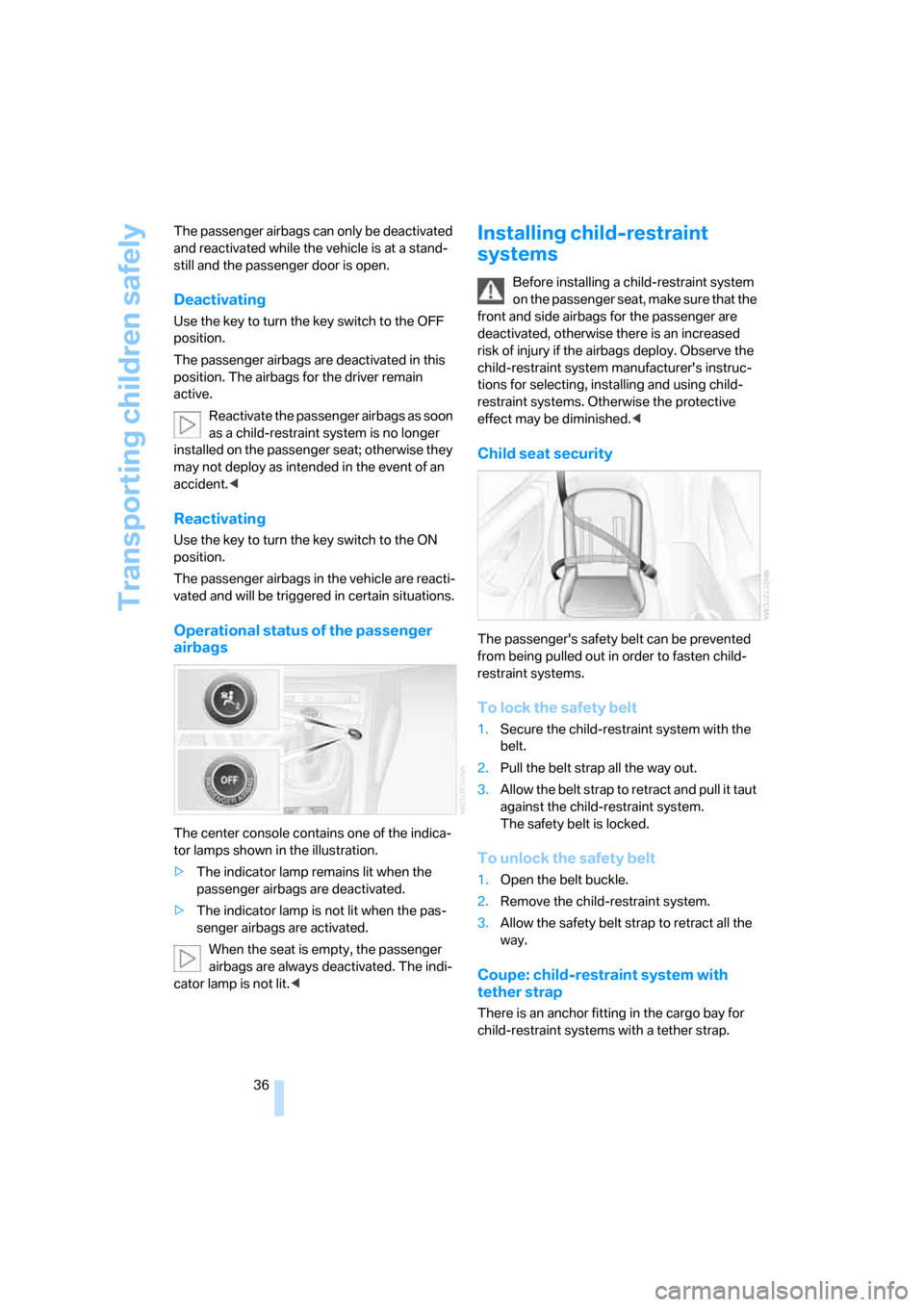
Operational status of the passenger
airbags
The center console contains one of the indica-
tor lamps shown in the illustration.
>The indicator lamp remains lit when the
passenger airbags are deactivated.
>The indicator lamp is not lit when the pas-
senger airbags are activated.
When the seat is empty, the passenger
airbags are always deactivated. The indi-
cator lamp is not lit.<
Installing child-restraint
systems
Before installing a child-restraint system
on the passenger seat, make sure that the
front and side airbags for the passenger are
deactivated, otherwise there is an increased
risk of injury if the airbags deploy. Observe the
child-restraint system manufacturer's instruc-
tions for selecting, installing and using child-
restraint systems. Otherwise the protective
effect may be diminished.<
Child seat security
The passenger's safety belt can be prevented
from being pulled out in order to fasten child-
restraint systems.
To lock the safety belt
1.Secure the child-restraint system with the
belt.
2.Pull the belt strap all the way out.
3.Allow the belt strap to retract and pull it taut
against the child-restraint system.
The safety belt is locked.
To unlock the safety belt
1.Open the belt buckle.
2.Remove the child-restraint system.
3.Allow the safety belt strap to retract all the
way.
Coupe: child-restraint system with
tether strap
There is an anchor fitting in the cargo bay for
child-restraint systems with a tether strap.
Page 40 of 128
Driving
38
Driving
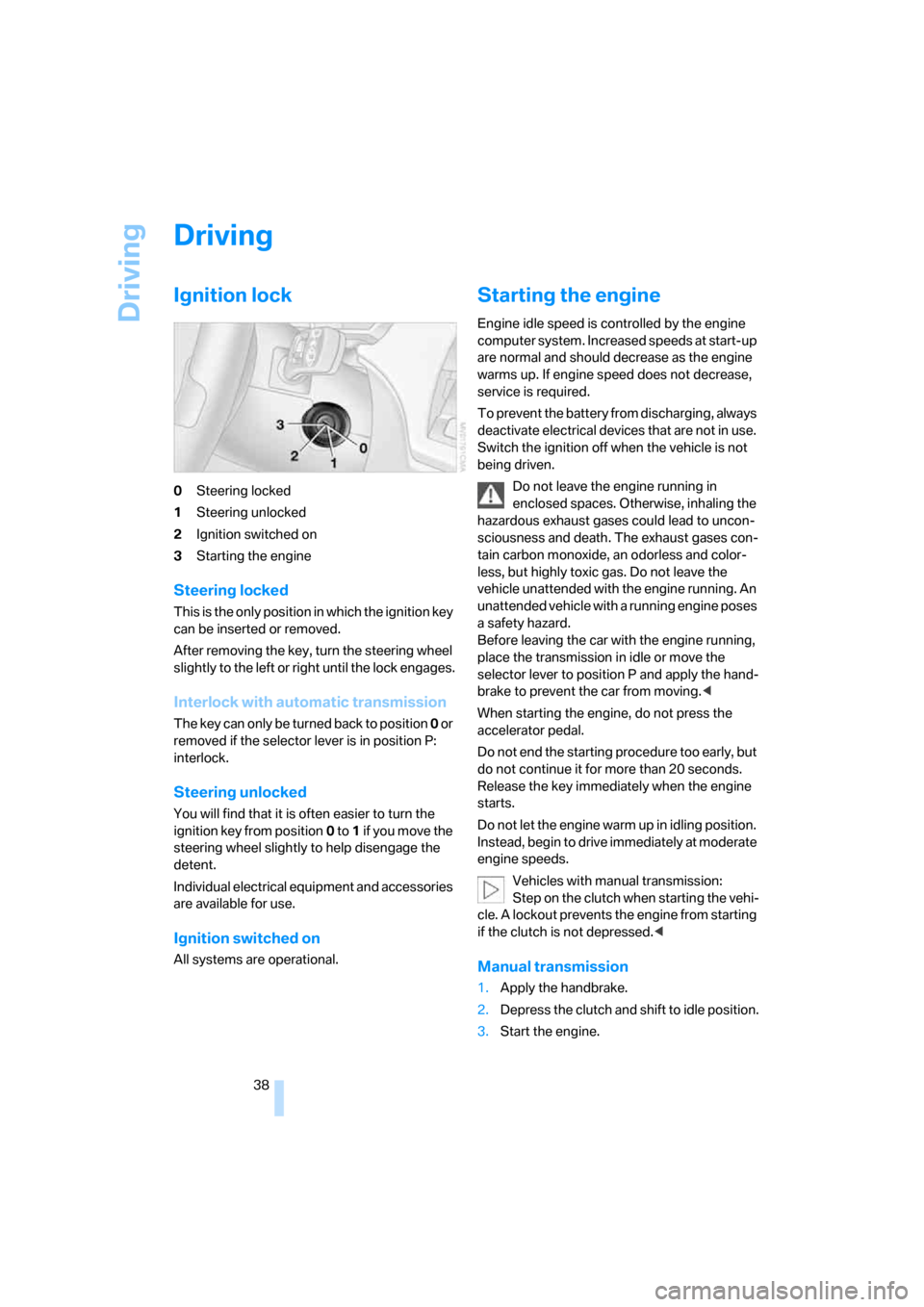
Ignition lock
0Steering locked
1Steering unlocked
2Ignition switched on
3Starting the engine
Steering locked
This is the only position in which the ignition key
can be inserted or removed.
After removing the key, turn the steering wheel
slightly to the left or right until the lock engages.
Interlock with automatic transmission
The key can only be turned back to position 0 or
removed if the selector lever is in position P:
interlock.
Steering unlocked
You will find that it is often easier to turn the
ignition key from position0 to 1 if yo u m ove the
steering wheel slightly to help disengage the
detent.
Individual electrical equipment and accessories
are available for use.
Ignition switched on
All systems are operational.
Starting the engine
Engine idle speed is controlled by the engine
computer system. Increased speeds at start-up
are normal and should decrease as the engine
warms up. If engine speed does not decrease,
service is required.
To prevent the battery from discharging, always
deactivate electrical devices that are not in use.
Switch the ignition off when the vehicle is not
being driven.
Do not leave the engine running in
enclosed spaces. Otherwise, inhaling the
hazardous exhaust gases could lead to uncon-
sciousness and death. The exhaust gases con-
tain carbon monoxide, an odorless and color-
less, but highly toxic gas. Do not leave the
vehicle unattended with the engine running. An
unattended vehicle with a running engine poses
a safety hazard.
Before leaving the car with the engine running,
place the transmission in idle or move the
selector lever to position P and apply the hand-
brake to prevent the car from moving.<
When starting the engine, do not press the
accelerator pedal.
Do not end the starting procedure too early, but
do not continue it for more than 20 seconds.
Release the key immediately when the engine
starts.
Do not let the engine warm up in idling position.
Instead, begin to drive immediately at moderate
engine speeds.
Vehicles with manual transmission:
Step on the clutch when starting the vehi-
cle. A lockout prevents the engine from starting
if the clutch is not depressed.<
Manual transmission
1.Apply the handbrake.
2.Depress the clutch and shift to idle position.
3.Start the engine.
Page 41 of 128
Reference
At a glance
Controls
Driving tips
Mobility
39
Automatic transmission
1.Depress the brake.
2.Start the engine.
Special starting conditions
In the following situations, press the accelerator
pedal halfway down when starting the engine:
>If the engine does not start on the first
attempt, for instance when it is extremely
hot or cold.
>If the engine is started at very low tempera-
tures, below approx. +57/–156, at high
altitudes above approx. 3,300 ft/1,000 m.
Avoid frequent starting attempts in quick
succession or repeated starting attempts
during which the engine does not start. Other-
wise, the fuel is not burned or inadequately
burned; there is a danger of overheating and
damaging the catalytic converter.<
Switching off the engine
Do not remove the key while the vehicle is
still moving. Otherwise, the steering lock
would engage when the steering wheel is
turned.
When you leave the vehicle, always remove the
key and engage the steering lock.
Apply the parking brake when parking on steep
gradients, otherwise the vehicle could start to
roll.<
You can have an acoustic signal set as a
reminder that the key is still in the ignition
switch after the driver's door has been
opened.<
Manual transmission
1.Turn the key to position 1 or 0.
2.Engage first gear or reverse gear.
3.Apply the handbrake.
Automatic transmission
1.With the car at a standstill, move the selec-
tor lever to position P.
2.Turn the key to position 1 or 0.
Parking brake
The parking brake is designed primarily to pre-
vent the vehicle from rolling when parked. It
operates against the rear wheels.
Indicator lamp
The indicator lamp is lit, and when you
drive off a signal sounds in addition.
The handbrake is still applied.
Indicator lamp for Canadian models.
Applying
The lever locks in position automatically.
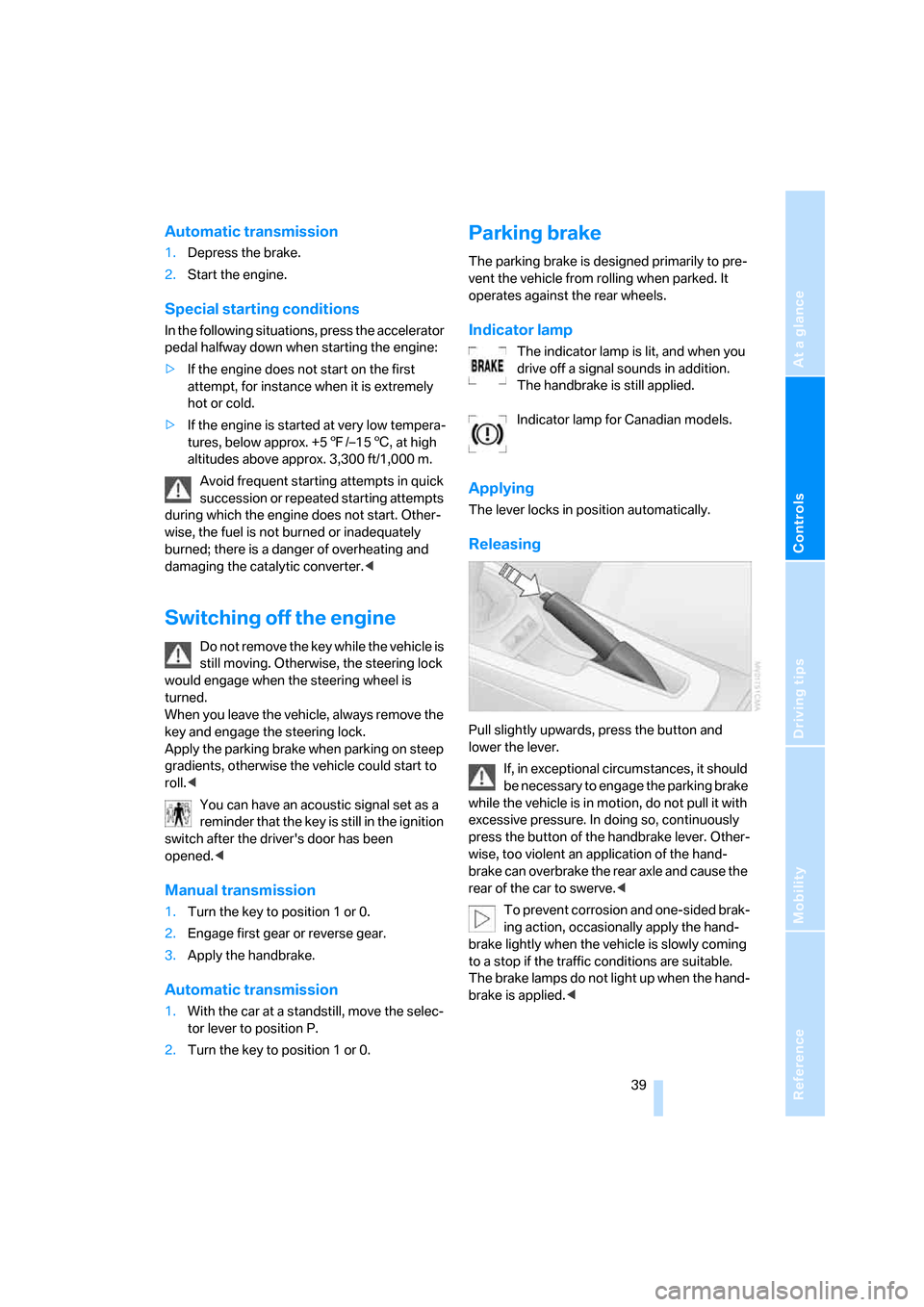
Releasing
Pull slightly upwards, press the button and
lower the lever.
If, in exceptional circumstances, it should
be necessary to engage the parking brake
while the vehicle is in motion, do not pull it with
excessive pressure. In doing so, continuously
press the button of the handbrake lever. Other-
wise, too violent an application of the hand-
brake can overbrake the rear axle and cause the
rear of the car to swerve.<
To prevent corrosion and one-sided brak-
ing action, occasionally apply the hand-
brake lightly when the vehicle is slowly coming
to a stop if the traffic conditions are suitable.
The brake lamps do not light up when the hand-
brake is applied.<