maintenance BMW Z8 2000 User Guide
[x] Cancel search | Manufacturer: BMW, Model Year: 2000, Model line: Z8, Model: BMW Z8 2000Pages: 172, PDF Size: 1.9 MB
Page 115 of 172
114n
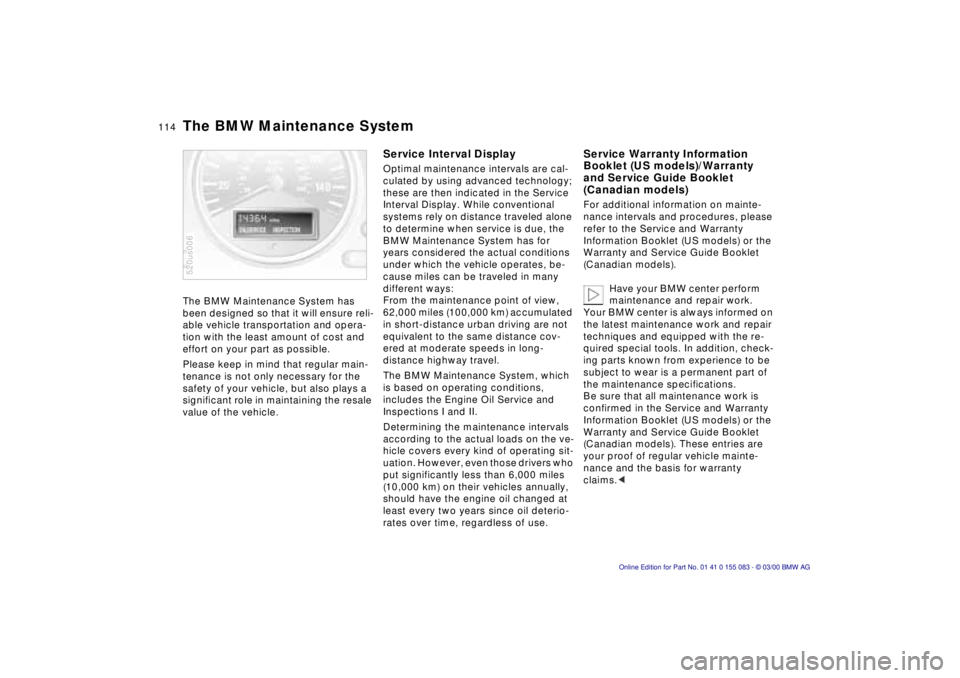
The BMW Maintenance System has
been designed so that it will ensure reli-
able vehicle transportation and opera-
tion with the least amount of cost and
effort on your part as possible.
Please keep in mind that regular main-
tenance is not only necessary for the
safety of your vehicle, but also plays a
significant role in maintaining the resale
value of the vehicle.
520us006
Service Interval DisplayOptimal maintenance intervals are cal-
culated by using advanced technology;
these are then indicated in the Service
Interval Display. While conventional
systems rely on distance traveled alone
to determine when service is due, the
BMW Maintenance System has for
years considered the actual conditions
under which the vehicle operates, be-
cause miles can be traveled in many
different ways:
From the maintenance point of view,
62,000 miles (100,000 km) accumulated
in short-distance urban driving are not
equivalent to the same distance cov-
ered at moderate speeds in long-
distance highway travel.
The BMW Maintenance System, which
is based on operating conditions,
includes the Engine Oil Service and
Inspections I and II.
Determining the maintenance intervals
according to the actual loads on the ve-
hicle covers every kind of operating sit-
uation. However, even those drivers who
put significantly less than 6,000 miles
(10,000 km) on their vehicles annually,
should have the engine oil changed at
least every two years since oil deterio-
rates over time, regardless of use.
Service Warranty Information
Booklet (US models)/Warranty
and Service Guide Booklet
(Canadian models)For additional information on mainte-
nance intervals and procedures, please
refer to the Service and Warranty
Information Booklet (US models) or the
Warranty and Service Guide Booklet
(Canadian models).
Have your BMW center perform
maintenance and repair work.
Your BMW center is always informed on
the latest maintenance work and repair
techniques and equipped with the re-
quired special tools. In addition, check-
ing parts known from experience to be
subject to wear is a permanent part of
the maintenance specifications.
Be sure that all maintenance work is
confirmed in the Service and Warranty
Information Booklet (US models) or the
Warranty and Service Guide Booklet
(Canadian models). These entries are
your proof of regular vehicle mainte-
nance and the basis for warranty
claims.<
The BMW Maintenance System
Page 118 of 172

117n
IndexDataTechnologyRepairsCar careControlsOverview
Caring for your vehicle
To remove stains from the con-
vertible top, use only BMW-ap-
proved cleaning agents. Do not use
spot removers, paint thinners, solvents,
gasoline or similar substances for re-
moving stains because these agents
destroy the rubber seals, which in turn
leads to leaks.
A full range of car-care products is
available from your BMW center.<
HardtopPlease observe and follow the instruc-
tions for caring for your vehicle starting
on page 115.
Exterior finish To provide effective protection, multi-
layer paintwork is applied at the factory.
These cataphoretic immersion priming
techniques have been carried out using
specially developed materials that have
undergone several years' worth of test-
ing.
Regular maintenance makes an impor-
tant contribution to maintaining the
safety and value of your vehicle.
Increasing awareness of the effects of
harmful environmental factors on vehi-
cle finishes have led paint and vehicle
manufacturers to initiate programs de-
signed to further improve the durability
of their finishes. Despite this, environ-
mental factors that occur locally or re-
gionally can have negative effects on
the finish of your vehicle. These should
guide you in determining the frequency
and extent of your efforts to maintain
the vehicle finish.Road dirt, tar spots, dead insects, ani-
mal droppings (strong alkali effect) and
even tree secretions (resins and pollen),
all contain substances capable of caus-
ing damage to the finish of your vehicle
if allowed to remain for any extended
period of time (such as stains, bumps,
scratches and separation of the top
coat).
In industrial areas, deposits of flue dust,
lime, oily soot, precipitation containing
sulfur-dioxide (acid rain) and other envi-
ronmental pollutants will damage the
vehicle's finish unless adequate care is
provided Ð even though this is generally
limited to the outside horizontal sur-
faces.
In tropical zones, temperatures of over
105 7 (40 6) in the shade prevail, in
addition to heavy ultraviolet radiation
and high humidity. Under those condi-
tions, light paints can reach tempera-
tures up to 175 7 (80 6) and dark
paints up to 250 7 (120 6).
Page 123 of 172

122n
Storing your vehicle
If you plan on parking the vehicle
for more than three months,
please adhere the maintenance opera-
tions described below.<
Preparations for storageHave your BMW center perform the
following procedures:
1 Clean and apply a rustproofing agent
or other treatment to the engine,
engine compartment, undercarriage,
axles and major components in accor-
dance with approved repair proce-
dures. Wash the vehicle, clean the
interior and treat painted and
chromed parts. Clean the weather-
stripping around the hood, luggage
compartment and doors
2 Change engine oil and oil filter at op-
erating temperature. As an additional
corrosion protection measure, an an-
ticorrosive agent can be added to the
engine in accordance with the manu-
facturer's instructions
3 Check the coolant level and concen-
tration and top off if necessary
4 Check the fluid level of the wind-
shield washer fluid reservoir; top off
if necessary
5 Fill the fuel tank completely to pre-
vent the formation of condensation
6 Increase the tire inflation pressure to
51 psi (350 kPa).Before parking the vehicle1 Dry the parking brake and footbrake
by brake applications to prevent the
brake discs and drums from
corroding
2 Park the vehicle in a covered, dry,
and well-ventilated area. Place the
transmission in first gear or, if neces-
sary, chock the wheels to prevent the
vehicle from rolling. Do not engage
the parking brake
3 Remove the battery, charge it com-
pletely and store it in a cool (but
frost-free) room
4 Remove the hardtop and store it
separately, refer to page 95
5 Close the convertible top.During storageRecharge a battery that has been taken
out of the car every six months. If it is
not recharged, it will not be serviceable.
Every time the battery is discharged,
especially over extended periods, its
service life is reduced.
Removing the vehicle from
storageRecharge the battery if the "Magic Eye"
turns black, refer to page 136.
Then have Inspection I performed by
your BMW center, including a brake
fluid replacement, if necessary. Refer to
the Service and Warranty Information
Booklet (US models) or the Warranty
and Service Guide Booklet (Canadian
models).
Page 128 of 172
Overview
Controls and features
Operation, care
and maintenance
Owner service procedures
Technical data
Index Advanced technology
127n
IndexDataTechnologyRepairsCar careControlsOverview
Replacement procedures:
Onboard tool kit128
Windshield wiper blades128
Lamps and bulbs129
Changing a wheel135
Battery136
Fuses138
In case of electrical
malfunction:
Fuel filler door140
Luggage compartment lid,
storage compartment140
Passenger-side door141
Closing the convertible top141
Giving and receiving
assistance:
Jump starting143
Towing144
Repairs
Page 137 of 172
136n
Battery
Battery posts, terminals, and re-
lated accessories contain lead
and lead compounds. Wash hands after
handling.<
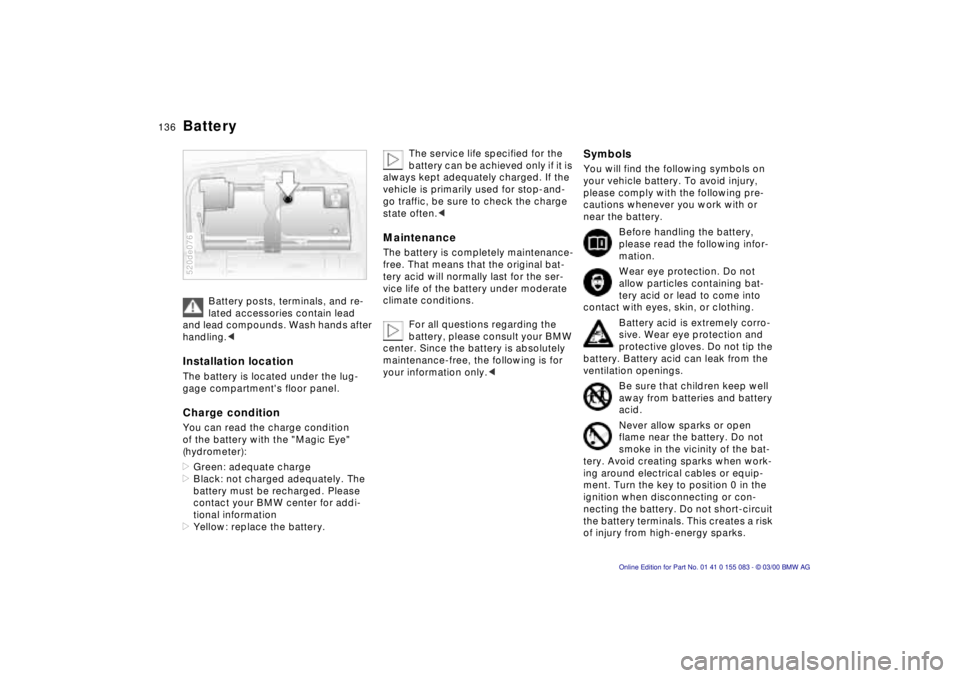
Installation location The battery is located under the lug-
gage compartment's floor panel.Charge conditionYou can read the charge condition
of the battery with the "Magic Eye"
(hydrometer):
>Green: adequate charge
>Black: not charged adequately. The
battery must be recharged. Please
contact your BMW center for addi-
tional information
>Yellow: replace the battery.520de076
The service life specified for the
battery can be achieved only if it is
always kept adequately charged. If the
vehicle is primarily used for stop-and-
go traffic, be sure to check the charge
state often.<
MaintenanceThe battery is completely maintenance-
free. That means that the original bat-
tery acid will normally last for the ser-
vice life of the battery under moderate
climate conditions.
For all questions regarding the
battery, please consult your BMW
center. Since the battery is absolutely
maintenance-free, the following is for
your information only.<
SymbolsYou will find the following symbols on
your vehicle battery. To avoid injury,
please comply with the following pre-
cautions whenever you work with or
near the battery.
Before handling the battery,
please read the following infor-
mation.
Wear eye protection. Do not
allow particles containing bat-
tery acid or lead to come into
contact with eyes, skin, or clothing.
Battery acid is extremely corro-
sive. Wear eye protection and
protective gloves. Do not tip the
battery. Battery acid can leak from the
ventilation openings.
Be sure that children keep well
away from batteries and battery
acid.
Never allow sparks or open
flame near the battery. Do not
smoke in the vicinity of the bat-
tery. Avoid creating sparks when work-
ing around electrical cables or equip-
ment. Turn the key to position 0 in the
ignition when disconnecting or con-
necting the battery. Do not short-circuit
the battery terminals. This creates a risk
of injury from high-energy sparks.
Page 148 of 172
Overview
Controls and features
Operation, care
and maintenance
Owner service procedures
Technical data
Index Advanced technology
147n
IndexDataTechnologyRepairsCar careControlsOverview
Airbags148
Radio reception148
Dynamic Stability Control
(DSC)149
Safety belt tensioner149
Interior rearview mirror with
automatic dimmer150
Xenon lamps151
Technology
Page 154 of 172
Overview
Controls and features
Operation, care
and maintenance
Technical data
Index Advanced technology
153n
IndexDataTechnologyRepairsCar careControlsOverview
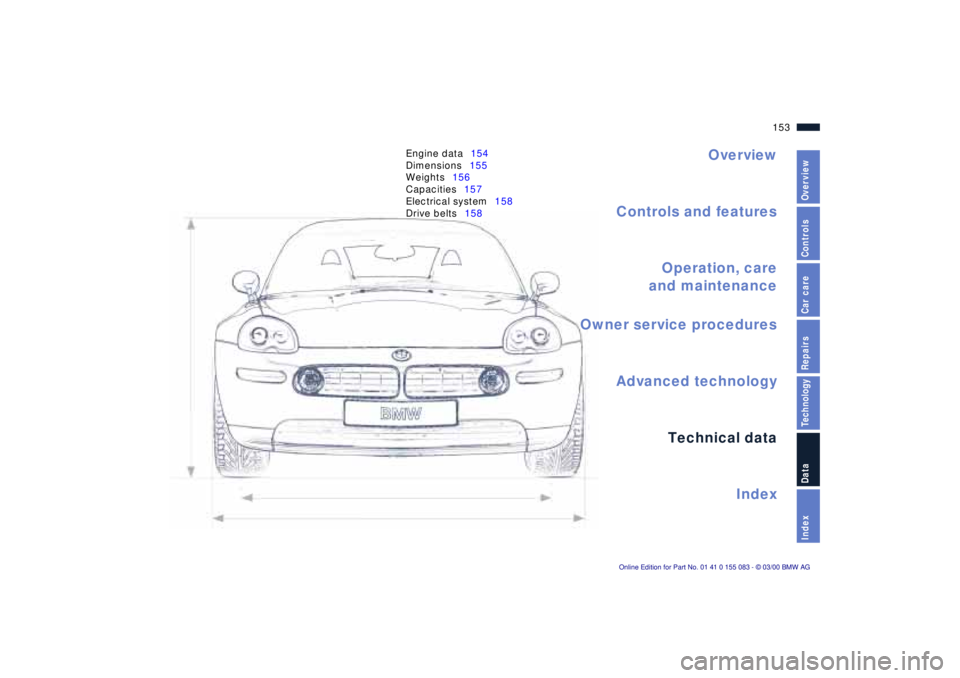
Engine data154
Dimensions155
Weights156
Capacities157
Electrical system158
Drive belts158
Data
Owner service procedures
Page 162 of 172
Overview
Controls and features
Operation, care
and maintenance
Owner service procedures
Technical data
Index Advanced technology
161n
IndexDataTechnologyRepairsCar careControlsOverview
Everything from A to Z162
Owner service procedures167
Index
Page 165 of 172

Everything from A to ZHeadlamp washer
system108,157
Headlamp washers58
Heating and ventilation70
Heating, rapid75
Heavy loads81
Height155
High beams21,56,68
Holder for beverage
cans78
Hood release104
Horn15 I
Identification, tires101
Ignition keys28
Ignition lock53
Indicator lamps18
Inflation pressure24,96
monitoring65
INSPECTION61
Instrument cluster16
Instrument lighting67
Instruments16
Interaxle tire rotation100
Interface socket for On-
Board-Diagnostics124
Interference
cellular phone92
Interior lamps32,68
bulb replacement133
remote control32 Interior motion sensor36
Interior rearview mirror
with automatic
dimmer46,150
Intermittent wipe57
J
Jump starting143 K
Key Memory46
Key with remote control28
Keys28 L
Lamps on warning67
Leather care120
Length155
License plate lamp
bulb replacement131
Light switch67
Light-alloy wheels103
Lighter80
Loading81
Louvers70
Low beam headlamps67
Low beam light inside
rearview mirror46
Low traction road
surfaces91 Luggage compartment
capacity156
emergency release35
remote control33
Luggage compartment lamp
bulb replacement134
Luggage compartment
lid35
emergency release35
M
M+S tires102
Maintenance61,114
Manual transmission56
Microfilter73
MID (Multi-Information
Radio)62
Mirrors45
Mobile cellular phones92
Modifications,
technical4,123
Multi-Information Radio
(MID)62 N
Navigation system, refer to
the radio Owner's Manual
Neckrest44 O
OBD interface socket124 Odometer60
Oil
additives109
consumption109
fill capacity157
quality110
specifications110
viscosity110
Oil change intervals, see the
Service and Warranty
Information Booklet (US
models) or the Warranty
and Service Guide Booklet
(Canadian models)
Oil dipstick109
Oil level
check109
indicator lamp19
Oil pressure
indicator lamp18
OILSERVICE61
Onboard tool kit128
Opening and closing
from inside34
from outside30
Outlets, ventilation70
Outside temperature
display62
P
Paint blemishes117
Paint, care117
Page 168 of 172

Owner service procedures
167n
IndexDataTechnologyRepairsCar careControlsOverview
A
Add brake fluid112
Add engine coolant112
Adding engine oil109
Adjust washer nozzles108
Avoiding a false alarm37
Avoiding unwanted
alarm37 B
Backup lamps
bulb replacement130
Battery
add distilled water136
charging137
Brakes, brake faults89,90 C
Changing a wheel135
Changing tires135
Checking air pressure24
Checking engine oil
level109
Convertible top
closing in event of electri-
cal malfunction140 D
Defrost position73
Defrosting the windows73 Difficult steering92
Doors
emergency actuation30
E
Electrical defect
convertible top140
Electrical equipment
failure138
Electrical failure
fuel filler door140
Emergency activation
convertible top140
Emergency actuation
doors30
Emergency release
fuel filler door140
Engine oil
add109
quality110
specifications110
viscosity110 F
Fittings, tow starting and
towing144
Flat tire135
Fuel filler door
manual release after
electrical fault140
H
Hazard warning flashers22
Hazard warning triangle22
Headlamp cover, care129
Hood release104 I
Indicator lamps18
Inflation pressure24
Interior lamps
bulb replacement133 L
License plate lamp
bulb replacement131
Luggage compartment lid,
emergency release35 M
Maintenance114 O
Oil
quality110
specifications110
viscosity110
Onboard tool kit128 P
Pressure, tires24
R
Rear foglamp
bulb replacement130
Refill washer reservoir108
Refill windshield washer
resevoir108
Removing condensation
from the windows73
Replacing fuses138
Replacing lamp bulbs129
Replacing windshield wiper
blades128
Replenish washer fluid108
Return used batteries138 S
Starting
problems54,85,144
Switching off the interior
motion sensor37
Switching off the tilt sensor
alarm system37 T
Taillamp130
Tire damage97
Tools128
Tow fittings144
Tow starting144
Towing144
Trunk, emergency
release35
Selbsthilfe