steering BMW Z8 2000 User Guide
[x] Cancel search | Manufacturer: BMW, Model Year: 2000, Model line: Z8, Model: BMW Z8 2000Pages: 172, PDF Size: 1.9 MB
Page 51 of 172
50n
AirbagsSitting correctly with airbags
Comply with the following instruc-
tions for the airbags, otherwise,
the airbags may not be able to provide
their maximum protection, with result-
ing risks to personal safety. All passen-
gers in the vehicle should be aware of
and comply with this information:
The airbags are supplemental restraint
devices designed to provide extra pro-
tection; they are not a substitute for
safety belts. Wear your safety belt at all
times. The airbags will not be triggered
in the event of a minor accident, a vehi-
cle roll-over, or collisions from the rear.
In these instances, the safety belt pro-
vides optimal protection.
Airbags are located under cover panels
in the steering wheel, in the instrument
panel and in the door side trim panels.
Assume a seating position that is com-
fortable and provides the greatest-pos-
sible distance between you and the air-
bags in your seating area. Always hold
the steering wheel by the rim Ð hands in
the "9 o'clock" and "3 o'clock" posi-
tions Ð otherwise, your hands or arms
could be injured if the airbag is trig-
gered.
Do not allow any objects to obstruct the
area between the airbag and the driver/
passenger.
Do not use the cover panel above the
front passenger airbag as a storage
area.
Do not apply adhesive materials to the
cover panels of the airbags, or cover or
modify them in any other way.
Do not use a rear-facing child seat in the
front passenger seat. If you use a child
restraint system, read carefully and
comply with the instructions on page 51.
Be sure that child seats are installed
correctly and with the greatest possible
distance between them and the side air-
bag. Do not allow children to lean out of
the child's seat in the direction of the
side trim panels. If they do so, serious
injuries can occur if the airbag is trig-
gered.<
Even when all these guidelines are ob-
served, there is still a small residual risk
of injury to the face, hands and arms
occurring from airbag deployment in
isolated instances.
The ignition and inflation noise may
cause a mild temporary hearing loss in
extremely sensitive individuals.
For additional information concerning
the airbag system, refer to pages 121
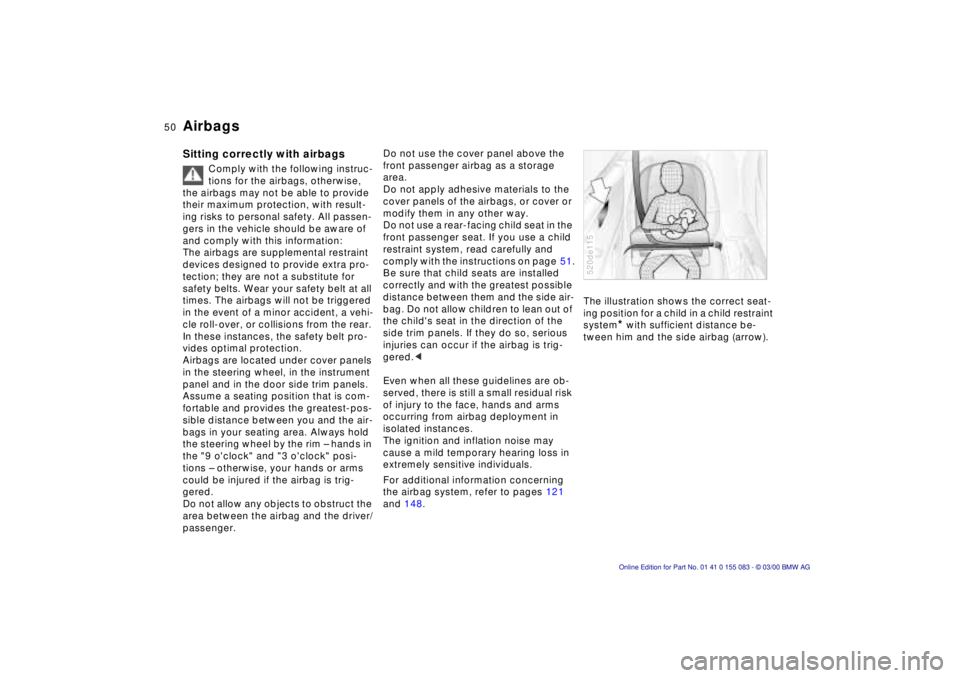
and 148.The illustration shows the correct seat-
ing position for a child in a child restraint
system
* with sufficient distance be-
tween him and the side airbag (arrow).
520de115
Page 54 of 172
53n
IndexDataTechnologyRepairsCar careControlsOverview
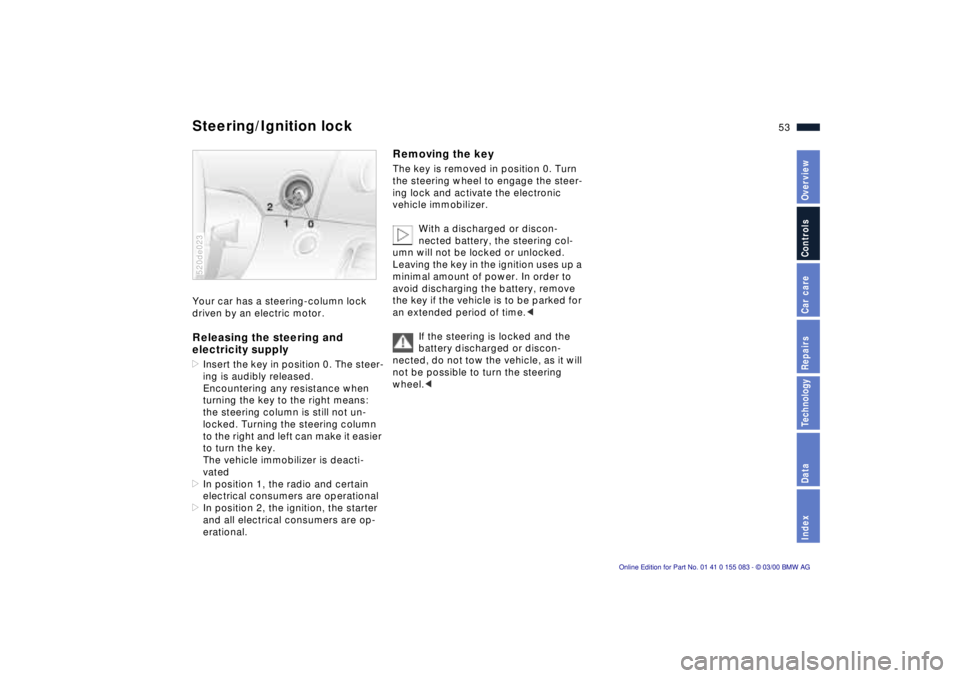
Your car has a steering-column lock
driven by an electric motor.Releasing the steering and
electricity supply>Insert the key in position 0. The steer-
ing is audibly released.
Encountering any resistance when
turning the key to the right means:
the steering column is still not un-
locked. Turning the steering column
to the right and left can make it easier
to turn the key.
The vehicle immobilizer is deacti-
vated
>In position 1, the radio and certain
electrical consumers are operational
>In position 2, the ignition, the starter
and all electrical consumers are op-
erational.520de023
Removing the keyThe key is removed in position 0. Turn
the steering wheel to engage the steer-
ing lock and activate the electronic
vehicle immobilizer.
With a discharged or discon-
nected battery, the steering col-
umn will not be locked or unlocked.
Leaving the key in the ignition uses up a
minimal amount of power. In order to
avoid discharging the battery, remove
the key if the vehicle is to be parked for
an extended period of time.<
If the steering is locked and the
battery discharged or discon-
nected, do not tow the vehicle, as it will
not be possible to turn the steering
wheel.<
Steering/Ignition lock
Page 55 of 172
54n
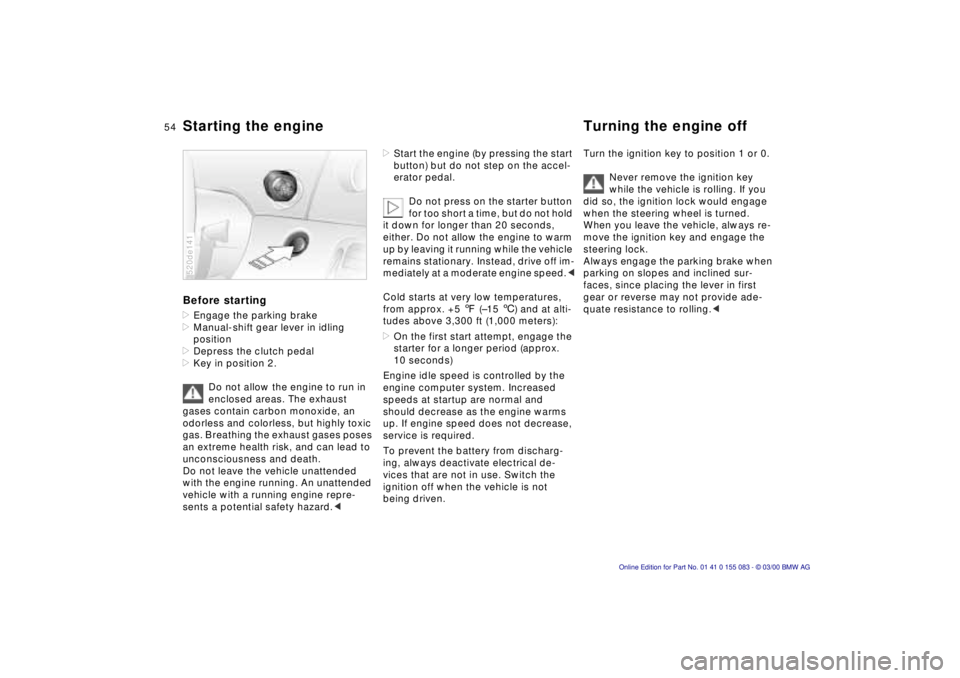
Starting the engine Turning the engine off Before starting>Engage the parking brake
>Manual-shift gear lever in idling
position
>Depress the clutch pedal
>Key in position 2.
Do not allow the engine to run in
enclosed areas. The exhaust
gases contain carbon monoxide, an
odorless and colorless, but highly toxic
gas. Breathing the exhaust gases poses
an extreme health risk, and can lead to
unconsciousness and death.
Do not leave the vehicle unattended
with the engine running. An unattended
vehicle with a running engine repre-
sents a potential safety hazard.<520de141
>Start the engine (by pressing the start
button) but do not step on the accel-
erator pedal.
Do not press on the starter button
for too short a time, but do not hold
it down for longer than 20 seconds,
either. Do not allow the engine to warm
up by leaving it running while the vehicle
remains stationary. Instead, drive off im-
mediately at a moderate engine speed.<
Cold starts at very low temperatures,
from approx. +5 7 (Ð15 6) and at alti-
tudes above 3,300 ft (1,000 meters):
>On the first start attempt, engage the
starter for a longer period (approx.
10 seconds)
Engine idle speed is controlled by the
engine computer system. Increased
speeds at startup are normal and
should decrease as the engine warms
up. If engine speed does not decrease,
service is required.
To prevent the battery from discharg-
ing, always deactivate electrical de-
vices that are not in use. Switch the
ignition off when the vehicle is not
being driven.
Turn the ignition key to position 1 or 0.
Never remove the ignition key
while the vehicle is rolling. If you
did so, the ignition lock would engage
when the steering wheel is turned.
When you leave the vehicle, always re-
move the ignition key and engage the
steering lock.
Always engage the parking brake when
parking on slopes and inclined sur-
faces, since placing the lever in first
gear or reverse may not provide ade-
quate resistance to rolling.<
Page 64 of 172
63n
IndexDataTechnologyRepairsCar careControlsOverview
The conceptDSC maintains vehicle stability even in
critical driving situations. The system
optimizes vehicle stability during accel-
eration and when starting from a full
stop, as well as optimizing traction. In
addition, the system recognizes unsta-
ble vehicle conditions (understeering or
oversteering, for example) and holds
the vehicle on a sure course by inter-
vening via the engine and by braking
intervention at the individual wheels,
within physically feasible limits.
The system starts up automatically
each time you start the engine.Indicator lamp
The indicator lamp in the instru-
ment cluster goes out shortly
after you switch on the ignition.
Refer to page 20.
Indicator lamp flashes:
The system is active and governs drive
force and braking force.
If the indicator lamp does not go out
after the engine is started, or if it comes
on during normal driving and stays on:
There is a system malfunction or the
system was deactivated with the button.
You can continue to drive the vehicle
normally, but without DSC.
Please consult your BMW center for re-
pairs.
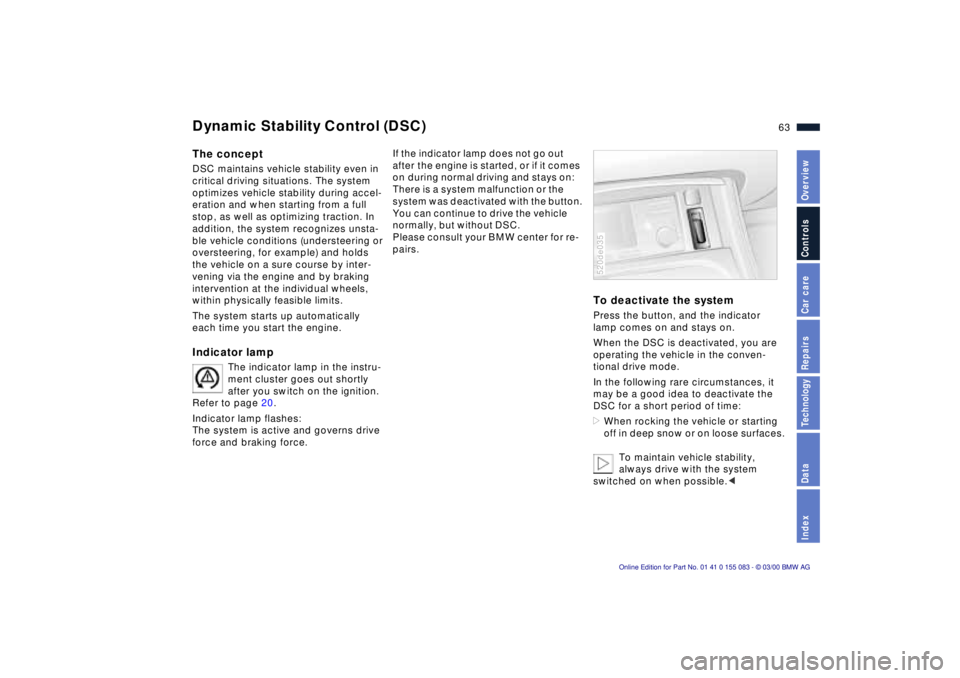
To deactivate the systemPress the button, and the indicator
lamp comes on and stays on.
When the DSC is deactivated, you are
operating the vehicle in the conven-
tional drive mode.
In the following rare circumstances, it
may be a good idea to deactivate the
DSC for a short period of time:
>When rocking the vehicle or starting
off in deep snow or on loose surfaces.
To maintain vehicle stability,
always drive with the system
switched on when possible.<520de035
Dynamic Stability Control (DSC)
Page 66 of 172
65n
IndexDataTechnologyRepairsCar careControlsOverview
Tire Pressure Warning (RDW)The conceptThe RDW monitors the tire pressure in
all four wheels while driving. The sys-
tem provides an alert whenever the in-
flation pressure drops significantly in
one of the tires.
For RDW to "learn" the correct tire infla-
tion pressure, check the inflation pres-
sure in all tires, comparing them with
the values in the inflation pressure table
(refer to page 25), and make correc-
tions as necessary. Then activate the
system.
This indicator lamp in the instru-
ment cluster will flash to inform
you if the inflation pressure in
one of the tires has dropped signifi-
cantly.
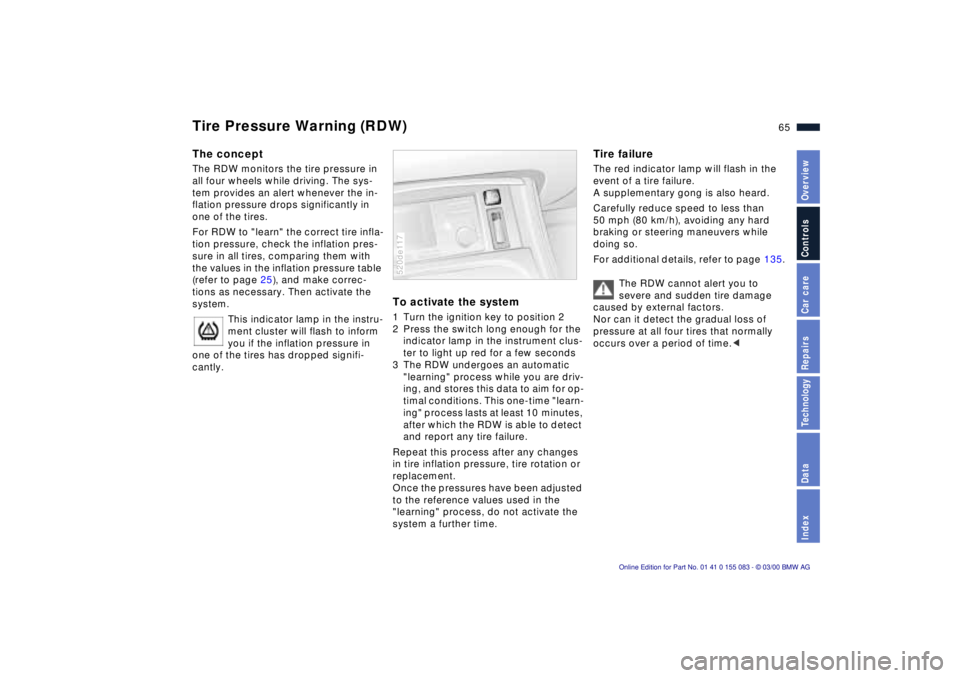
To activate the system 1 Turn the ignition key to position 2
2 Press the switch long enough for the
indicator lamp in the instrument clus-
ter to light up red for a few seconds
3 The RDW undergoes an automatic
"learning" process while you are driv-
ing, and stores this data to aim for op-
timal conditions. This one-time "learn-
ing" process lasts at least 10 minutes,
after which the RDW is able to detect
and report any tire failure.
Repeat this process after any changes
in tire inflation pressure, tire rotation or
replacement.
Once the pressures have been adjusted
to the reference values used in the
"learning" process, do not activate the
system a further time.520de117
Tire failureThe red indicator lamp will flash in the
event of a tire failure.
A supplementary gong is also heard.
Carefully reduce speed to less than
50 mph (80 km/h), avoiding any hard
braking or steering maneuvers while
doing so.
For additional details, refer to page 135.
The RDW cannot alert you to
severe and sudden tire damage
caused by external factors.
Nor can it detect the gradual loss of
pressure at all four tires that normally
occurs over a period of time.<
Page 84 of 172
Overview
Controls and features
Operation, care
and maintenance
Owner service procedures
Technical data
Index Advanced technology
83n
IndexDataTechnologyRepairsCar careControlsOverview
Car care Special operating instructions:
Break-in procedures84
Driving notes85
Catalytic converter85
Antilock Brake System (ABS)86
Dynamic Brake Control
(DBC)88
Disc brakes88
Brake system89
Winter operation90
Power steering92
Cellular phone92
Radio reception92
Wind protection93
Hardtop94
Wheels and tires:
Tire inflation pressure96
Tire condition97
Tire replacement98
Tire rotation100
Wheel and tire
combinations101
Winter tires102
Snow chains102
Approved wheel and tire
specifications103Under the hood:
Hood104
Engine compartment106
Washer fluids108
Washer nozzles108
Engine oil109
Coolant111
Brake fluid112
Vehicle Identification
Number113
Maintenance and care:
The BMW Maintenance
System114
Caring for your vehicle115
Airbags121
Storing your vehicle122
Laws and regulations:
Technical modifications123
California Proposition 65
Warning123
OBD interface socket124
Page 86 of 172

85n
IndexDataTechnologyRepairsCar careControlsOverview
Brakes:
Do not rest your foot on the brake
pedal while driving. Even light but con-
sistent pressure on the brake pedal
could lead to high temperatures, brake
wear, and possibly, to brake system
failure.
Aquaplaning:
Reduce speed while driving on wet or
slushy roads, otherwise, a wedge of
water can form between the tires and
the road surface. This phenomenon is
referred to as "aquaplaning" or "hydro-
planing." It is characterized by a partial
or complete loss of contact between
the tires and the road surface. The ulti-
mate results are loss of steering and
braking control.
Driving through water:
When there is water on the roads, do
not drive in it if it is deeper than 1 ft
(30 cm), and even then, only at walking
speed, otherwise the vehicle can sus-
tain damage to the engine, the electri-
cal systems and the transmission.<
The catalytic converter reduces harmful
exhaust emissions, and is designed for
use with unleaded fuel only. Even
minute quantities of lead would be
enough to permanently damage both
the catalytic converter and the system
oxygen sensor.To ensure efficient, trouble-free engine
operation and to avoid potential damage:>Be sure to comply with the scheduled
maintenance requirements
>Fill the fuel tank well before it is empty
>Tow-start only when the engine is
cold. If you attempt to tow-start with
a warm engine, unburned residual
fuel in the catalytic converter could
ignite and cause damage. It is better
to start the vehicle with an outside
starting aid
>Avoid other situations where the fuel
is either not burned or burns incom-
pletely, such as engaging the starter
frequently or for extended periods, or
repeated start attempts in which the
engine does not start (stopping and
restarting an engine which is running
properly does not present a prob-
lem). Never allow the engine to run
with any of the spark plug cables dis-
connected.Be sure to comply with the in-
structions above to prevent un-
burned fuel from reaching the catalytic
converter. Otherwise, there is the dan-
ger of overheating and damage to the
catalytic converter.
Extreme temperatures are present with
the catalytic converter both on this and
every catalytic converter-equipped ve-
hicle. Heat shields are installed adja-
cent to some sections of the exhaust
system. Never remove these shields;
do not apply undercoating to their sur-
faces. When driving, standing at idle,
and parking the vehicle, take care to
avoid contact between the exhaust sys-
tem and flammable materials (grass,
hay, leaves etc.). Such contact could
start a fire, resulting in serious personal
injury and property damage.<
Driving notes Catalytic converter
Page 87 of 172

86n
Antilock Brake System (ABS) The concept ABS enhances active safety by helping
to prevent the wheels from locking un-
der braking. This is because: locked
wheels are dangerous. When the front
wheels slide, the driver loses steering
control over the vehicle. Traction loss at
the rear wheels can cause the rear end
to break into an uncontrolled skid.
With ABS, you will achieve the shortest-
possible braking distances under all
given conditions (braking while driving
straight ahead or in curves, different
road surfaces).
ABS is designed to meet two essential
requirements during every brake appli-
cation:
>To help provide vehicle stability
>To help retain steering and maneu-
vering capability on all types of road
surfaces (asphalt, concrete, dirt, wet
surfaces, snow and ice).
Braking with ABSThe system is operative once the vehi-
cle exceeds a speed of approx. 6 mph
(10 km/h). The ABS is deactivated
whenever the vehicle's speed drops
back below approx. 4 mph (6 km/h).
This means that the wheels can tend
to lock in the very final phase of a panic
stop, which in actual practice is not
critical.
The ABS system works best in situa-
tions requiring maximum pressure on
the pedal (full braking). Since the vehi-
cle maintains steering responsiveness,
you can nevertheless avoid possible
obstacles with a minimum of steering
effort.
The ABS system's closed-loop control
circuit cycles in fractions of a second.
A pulsing of the brake pedal, com-
bined with the sounds associated with
the hydraulic controls, tells you that the
brake system is within its maximum
limit range and reminds you that you
should adapt your vehicle's speed to
road conditions.On road surfaces that have a loose layer
on a firm base (on gravel or snow, for in-
stance), the braking distances with ABS
may be longer than with the wheels
locked. This also applies for driving with
snow chains. However, ABS continues
to provide enhanced vehicle stability
and steering response under these
conditions.
Page 90 of 172

89n
IndexDataTechnologyRepairsCar careControlsOverview
Disc brakes Brake systemDriving notesWhen driving in wet conditions and in
heavy rain, it is effective to apply light
pressure to the brakes every few miles
or kilometers. Watch traffic conditions
to ensure that this maneuver does not
endanger other road users. The heat
which is generated by the brake appli-
cations helps to dry the brake pads and
rotors.
Maximum braking force is obtained
while the wheels are not locked, but
rather when they are still barely turning
immediately prior to locking. ABS main-
tains this state automatically. If the ABS
fails, you should revert to the staggered
braking technique (refer to page 91).
Long or steep mountain descents do
not necessarily lead to reduced braking
efficiency if you drive downhill with the
transmission in a gear requiring minimal
brake applications.
Braking effect on the engine can be
further increased by downshifting, into
first gear, if necessary.If engine braking should prove to be
inadequate, you should still avoid ex-
tended, continuous braking. Instead of
maintaining low to moderate pressure
over an extended period of time, you
should decelerate by applying more
substantial pressure to the brake pedal
(watch for following traffic), releasing
the pedal, and then repeating the appli-
cation (staggered braking). The cooling
phases between active braking inter-
vals prevent the brakes from overheat-
ing and retain full braking capacity.
Do not coast with the clutch de-
pressed, the gear-shift lever in
neutral, or, above all, with the engine
shutt off; otherwise, the engine will pro-
vide no braking effect if the transmis-
sion is in neutral, and there is no brak-
ing or steering power assist if the
engine is not running. Do not allow floor
mats, carpets or any other objects to
protrude into the area around the brake
pedal, the clutch or the accelerator
which could obstruct their freedom of
movement.<
Brake fluid level
The brake warning lamp comes
on with the parking brake
released:
The brake fluid level is too low in
the reservoir (refer to page 112).
If the brake fluid level is too low
and brake pedal travel has become no-
ticeably longer, there may be a defect
in one of the brake system's hydraulic
circuits.
Proceed to the nearest BMW cen-
ter. Higher brake application pres-
sure may be necessary under these con-
ditions, and brake pedal travel may be
significantly longer. Please remember to
adapt your driving style accordingly.<
Page 92 of 172

91n
IndexDataTechnologyRepairsCar careControlsOverview
Winter operationDriving on low-traction road
surfacesDo not activate the Sport Mode (refer to
page 64). Use smooth, gentle pressure
to control the accelerator pedal. Avoid
excessive engine speeds and shift to
the next higher gear at an early point.
Shift down into the next lowest gear
when approaching uphill or downhill
grades. Maintain an adequate distance
between yourself and the vehicle
ahead.BrakesWinter road conditions substantially
reduce the amount of traction available
between the tires and the road surface.
The resulting increases in braking dis-
tance are considerable and should be
kept in mind at all times.
ABS is intended to prevent the wheels
from locking during brake applications,
thus helping to maintain vehicle stability
and steering response.If the ABS does not respond in a critical
braking situation and the wheels lock,
reduce the pressure on the brake pedal
until the wheels just start to roll again
while still maintaining enough force to
continue braking.
Then increase the pressure, reduce the
pressure when the wheels lock, reapply
pressure etc.
This staggered braking procedure will
reduce braking distances while helping
you maintain steering control.
You can always then attempt to steer
around hazards after you have reduced
pressure on the brake pedal.
Do not shift down on slick road
surfaces if you want to decelerate.
Doing so could cause the wheels to
lose traction and skid, thus resulting in
the loss of vehicle control.<
Depress the clutch during hard
braking on road surfaces that pro-
vide only poor or uneven traction.<
Skid control Depress the clutch and release the
accelerator pedal. Countersteer care-
fully and attempt to regain control of the
vehicle.ParkingEngage first or reverse gear. Depending
on the steepness of the incline, you can
apply the parking brake as well. In order
to prevent the parking brake pads from
locking due to frost or corrosion, dry
them by gently applying the parking
brake as the vehicle is coming to a stop.
Make sure that following traffic is not
endangered.
The brake lamps do not come
on when the parking brake is
engaged.<