warning BMW Z8 2000 User Guide
[x] Cancel search | Manufacturer: BMW, Model Year: 2000, Model line: Z8, Model: BMW Z8 2000Pages: 172, PDF Size: 1.9 MB
Page 24 of 172
23n
IndexDataTechnologyRepairsCar careControlsOverview
Refueling Fuel filler door
Before filling the tank, shut off the
engine. If you do not, fuel cannot
flow into the tank and the "Service
Engine Soon" lamp may come on.<
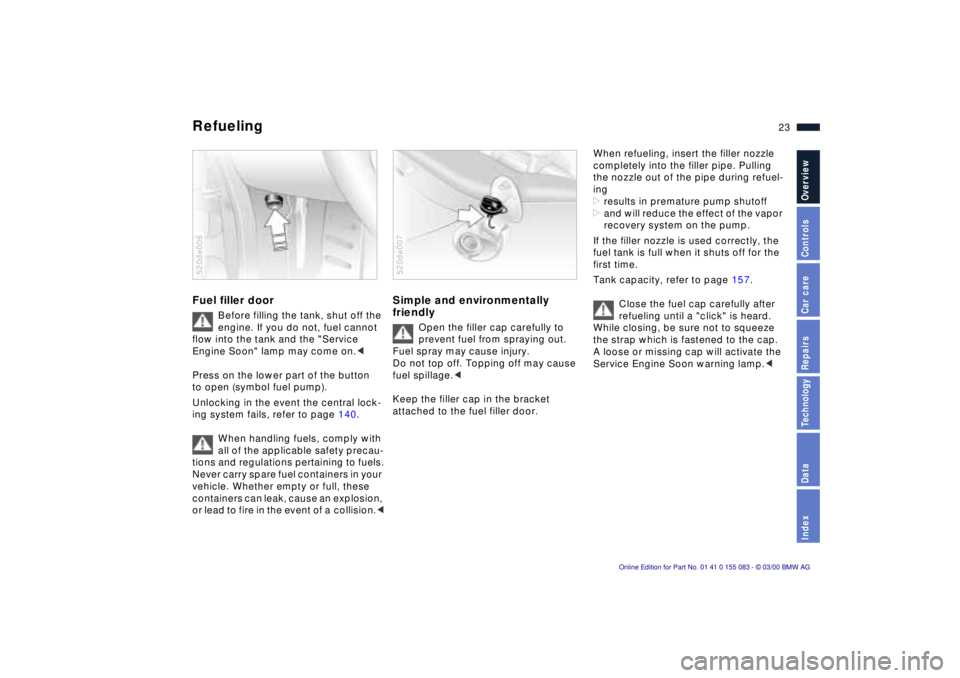
Press on the lower part of the button
to open (symbol fuel pump).
Unlocking in the event the central lock-
ing system fails, refer to page 140.
When handling fuels, comply with
all of the applicable safety precau-
tions and regulations pertaining to fuels.
Never carry spare fuel containers in your
vehicle. Whether empty or full, these
containers can leak, cause an explosion,
or lead to fire in the event of a collision.<
520de006
Simple and environmentally
friendly
Open the filler cap carefully to
prevent fuel from spraying out.
Fuel spray may cause injury.
Do not top off. Topping off may cause
fuel spillage.<
Keep the filler cap in the bracket
attached to the fuel filler door.
520de007
When refueling, insert the filler nozzle
completely into the filler pipe. Pulling
the nozzle out of the pipe during refuel-
ing
>results in premature pump shutoff
>and will reduce the effect of the vapor
recovery system on the pump.
If the filler nozzle is used correctly, the
fuel tank is full when it shuts off for the
first time.
Tank capacity, refer to page 157.
Close the fuel cap carefully after
refueling until a "click" is heard.
While closing, be sure not to squeeze
the strap which is fastened to the cap.
A loose or missing cap will activate the
Service Engine Soon warning lamp.<
Page 25 of 172
24n
Fuel quality Tire inflation pressure The engine uses lead-free gasoline
only.
Required fuel:
>Premium Unleaded Gasoline,
min. 91 AKI
AKI = Anti Knock Index
Do not use leaded fuels. The use
of leaded fuels will cause perma-
nent damage to the system's oxygen
sensor and the catalytic converter.<
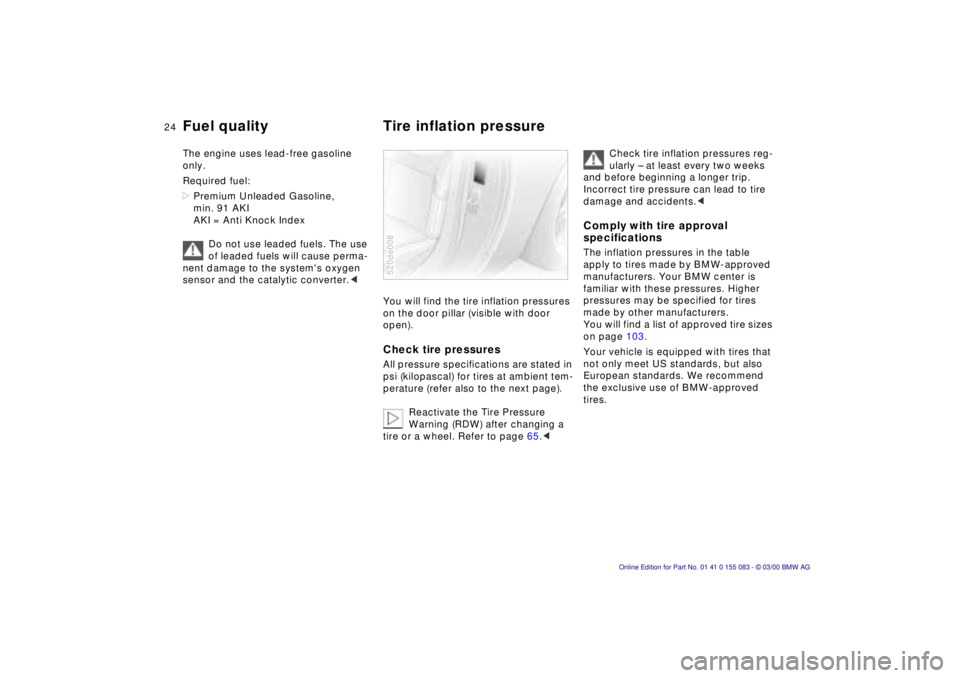
You will find the tire inflation pressures
on the door pillar (visible with door
open).Check tire pressuresAll pressure specifications are stated in
psi (kilopascal) for tires at ambient tem-
perature (refer also to the next page).
Reactivate the Tire Pressure
Warning (RDW) after changing a
tire or a wheel. Refer to page 65.<520de008
Check tire inflation pressures reg-
ularly Ð at least every two weeks
and before beginning a longer trip.
Incorrect tire pressure can lead to tire
damage and accidents.<
Comply with tire approval
specificationsThe inflation pressures in the table
apply to tires made by BMW-approved
manufacturers. Your BMW center is
familiar with these pressures. Higher
pressures may be specified for tires
made by other manufacturers.
You will find a list of approved tire sizes
on page 103.
Your vehicle is equipped with tires that
not only meet US standards, but also
European standards. We recommend
the exclusive use of BMW-approved
tires.
Page 28 of 172
Overview
Controls and features
Operation, care
and maintenance
Owner service procedures
Technical data
Index Advanced technology
27n
IndexDataTechnologyRepairsCar careControlsOverview
Driving:
Steering/Ignition lock53
Starting the engine54
Turning the engine off54
Parking brake55
Manual transmission56
Turn signal indicator/Headlamp
flasher56
Wiper/Washer system57
Rear window defroster58
Cruise control59
Everything under control:
Odometer60
Tachometer60
Fuel gauge60
Coolant temperature gauge61
Service Interval Display61
Clock62
Multi-Information Radio (MIR)62
Technology for safety and
driving convenience:
Dynamic Stability Control
(DSC)63
Dynamic Driving Control64
Tire Pressure Warning (RDW)65Lamps:
Side lamps/Low beams67
Instrument lighting67
High beams/Parking lamps68
Rear foglamp68
Interior lamps68
Reading lamps69
Controlling the climate for
pleasant driving:
Heating and ventilation/
Air conditioning70
Seat heating75
Interior conveniences:
Glove compartment76
Storage compartments76
Beverage can holder78
Cellular phone79
Ashtray79
Cigarette lighter80
Loading and transporting:
Cargo loading81
Page 31 of 172
30n
Central locking system Opening and closing Ð from outside The conceptThe central locking system is ready for
operation whenever the driver's door is
closed. The system engages and re-
leases the locks on the:
>Doors
>Luggage compartment lid
>Fuel filler door
>Glove compartment
>Storage shelf for the cellular phone.
The central locking system can be
operated:
>From outside via the driver's door
lock, or by using the remote control
>From inside by pressing a button.
If you initiate central locking from in-
side, neither the fuel filler door, glove
compartment, nor the storage shelf for
the cellular phone are locked (refer to
page 34).
If you do set it from outside, the anti-
theft alarm is automatically activated as
well. This prevents the door handles
from unlocking the doors. The alarm
system is also activated or deactivated.
If locked from inside, the central locking
system unlocks automatically in the
event of an accident. In addition, the
hazard warning flashers and interior
lamps come on.
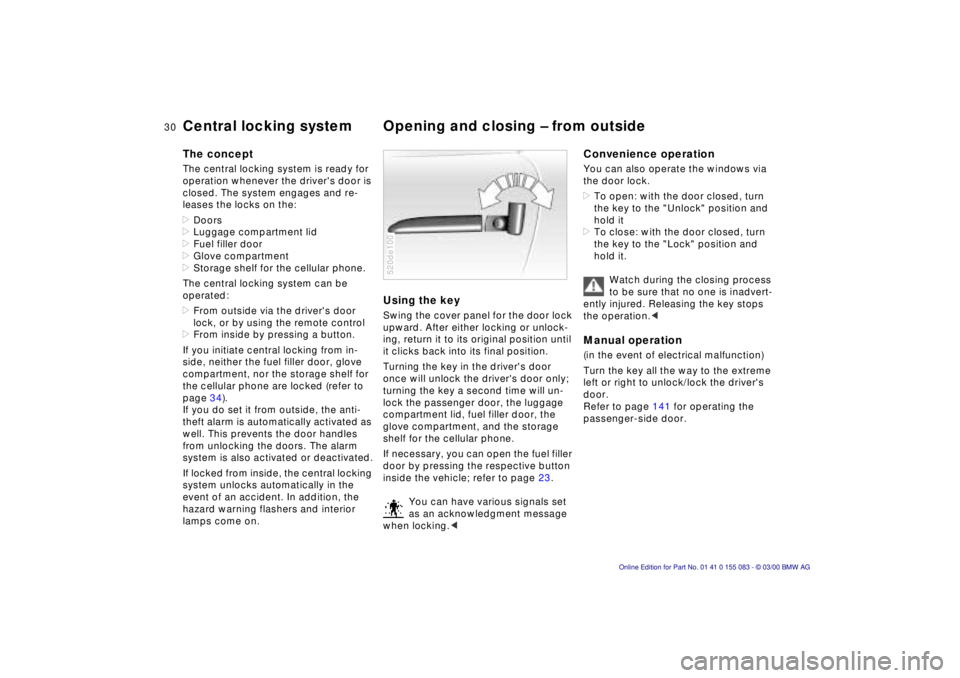
Using the keySwing the cover panel for the door lock
upward. After either locking or unlock-
ing, return it to its original position until
it clicks back into its final position.
Turning the key in the driver's door
once will unlock the driver's door only;
turning the key a second time will un-
lock the passenger door, the luggage
compartment lid, fuel filler door, the
glove compartment, and the storage
shelf for the cellular phone.
If necessary, you can open the fuel filler
door by pressing the respective button
inside the vehicle; refer to page 23.
You can have various signals set
as an acknowledgment message
when locking.<520de100
Convenience operationYou can also operate the windows via
the door lock.
>To open: with the door closed, turn
the key to the "Unlock" position and
hold it
>To close: with the door closed, turn
the key to the "Lock" position and
hold it.
Watch during the closing process
to be sure that no one is inadvert-
ently injured. Releasing the key stops
the operation.
left or right to unlock/lock the driver's
door.
Refer to page 141 for operating the
passenger-side door.
Page 37 of 172
36n
Alarm systemThe conceptThe vehicle alarm system responds:
>When a door, the hood or the lug-
gage compartment lid is opened,
>To movement inside the vehicle
(interior motion sensor)
>To variations in the vehicle tilt sensor
such as those occuring during at-
tempts to steal the wheels or tow
the vehicle
>To interruption of battery voltage.
The system responds to unauthorized
vehicle entry and attempted theft by
simultaneously activating the following:
>Sounding an acoustical alarm for
30 seconds
>Activating the hazard warning flash-
ers for approx. five minutes
>Flashing the high beams on and off in
sync with the hazard warning flashers.
To activate and deactivate the
alarm systemWhen the vehicle is locked or unlocked
via a door lock or with the remote con-
trol, the alarm system is also simulta-
neously armed or disarmed.
The interior motion sensor and tilt alarm
sensor are activated approx. 30 sec-
onds after you have finished locking the
vehicle.
The system indicates that it has been
correctly armed by switching on the haz-
ard warning flashers for a single cycle
and by emitting an acoustical signal.
You can have different signals set
as acknowledgment messages for
arming and disarming.<
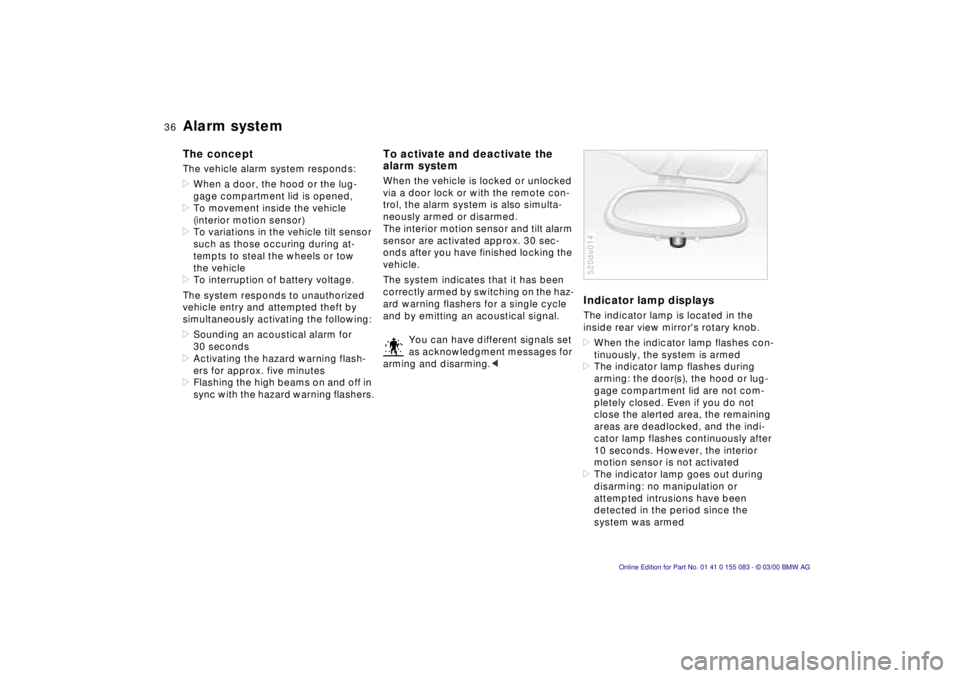
Indicator lamp displaysThe indicator lamp is located in the
inside rear view mirror's rotary knob.
>When the indicator lamp flashes con-
tinuously, the system is armed
>The indicator lamp flashes during
arming: the door(s), the hood or lug-
gage compartment lid are not com-
pletely closed. Even if you do not
close the alerted area, the remaining
areas are deadlocked, and the indi-
cator lamp flashes continuously after
10 seconds. However, the interior
motion sensor is not activated
>The indicator lamp goes out during
disarming: no manipulation or
attempted intrusions have been
detected in the period since the
system was armed520de014
Page 61 of 172
60n
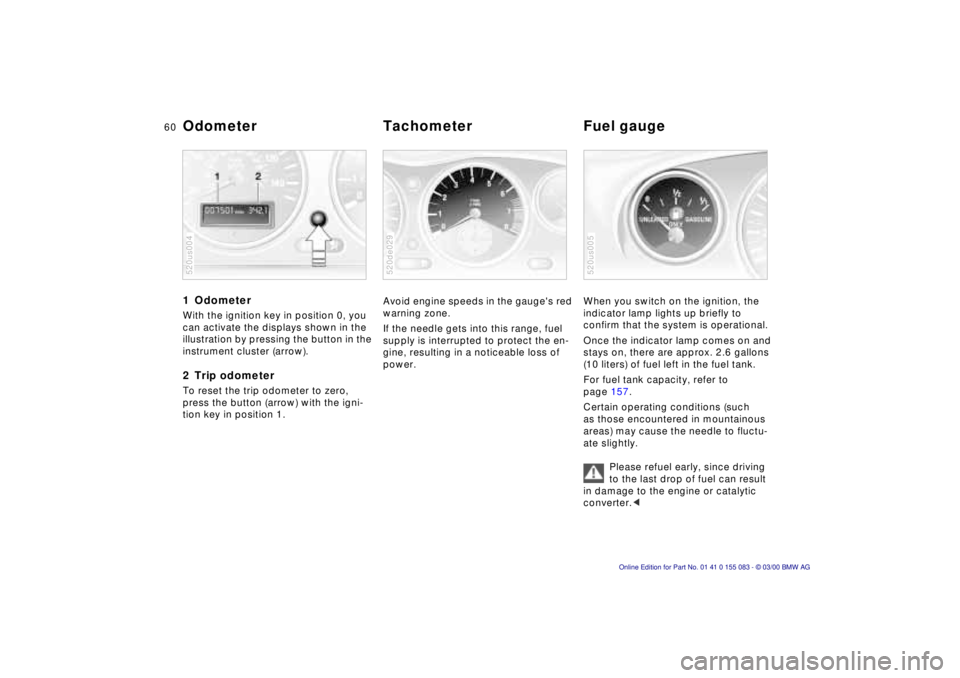
1 Odometer With the ignition key in position 0, you
can activate the displays shown in the
illustration by pressing the button in the
instrument cluster (arrow).2 Trip odometerTo reset the trip odometer to zero,
press the button (arrow) with the igni-
tion key in position 1.520us004
Avoid engine speeds in the gauge's red
warning zone.
If the needle gets into this range, fuel
supply is interrupted to protect the en-
gine, resulting in a noticeable loss of
power.520de029
When you switch on the ignition, the
indicator lamp lights up briefly to
confirm that the system is operational.
Once the indicator lamp comes on and
stays on, there are approx. 2.6 gallons
(10 liters) of fuel left in the fuel tank.
For fuel tank capacity, refer to
page 157.
Certain operating conditions (such
as those encountered in mountainous
areas) may cause the needle to fluctu-
ate slightly.
Please refuel early, since driving
to the last drop of fuel can result
in damage to the engine or catalytic
converter.<520us005
Odometer Tachometer Fuel gauge
Page 62 of 172
61n
IndexDataTechnologyRepairsCar careControlsOverview
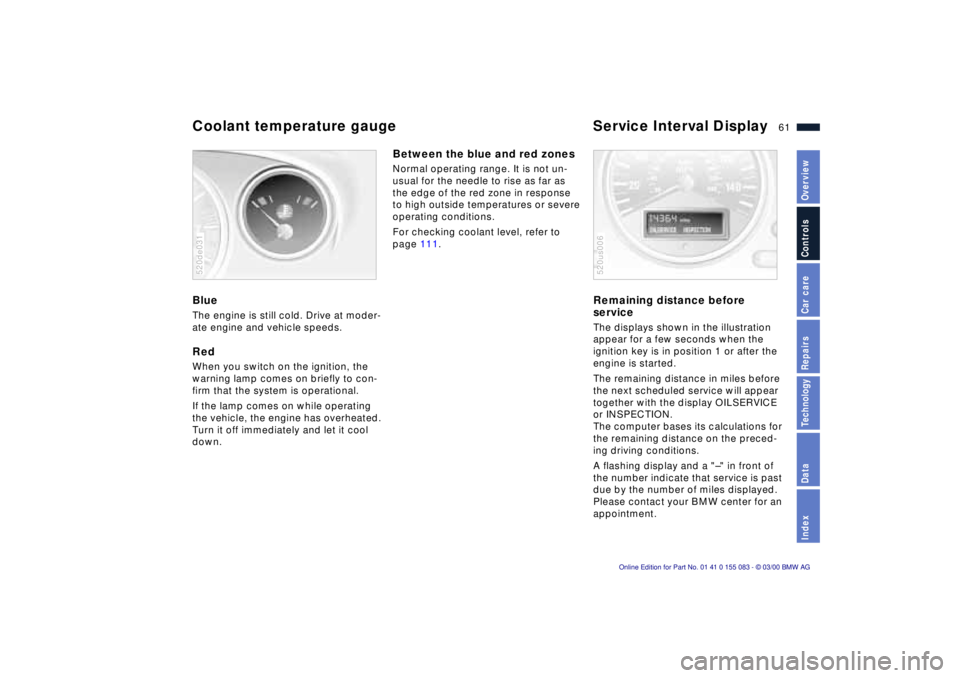
Coolant temperature gauge Service Interval Display BlueThe engine is still cold. Drive at moder-
ate engine and vehicle speeds.RedWhen you switch on the ignition, the
warning lamp comes on briefly to con-
firm that the system is operational.
If the lamp comes on while operating
the vehicle, the engine has overheated.
Turn it off immediately and let it cool
down.520de031
Between the blue and red zonesNormal operating range. It is not un-
usual for the needle to rise as far as
the edge of the red zone in response
to high outside temperatures or severe
operating conditions.
For checking coolant level, refer to
page 111.
Remaining distance before
serviceThe displays shown in the illustration
appear for a few seconds when the
ignition key is in position 1 or after the
engine is started.
The remaining distance in miles before
the next scheduled service will appear
together with the display OILSERVICE
or INSPECTION.
The computer bases its calculations for
the remaining distance on the preced-
ing driving conditions.
A flashing display and a "Ð" in front of
the number indicate that service is past
due by the number of miles displayed.
Please contact your BMW center for an
appointment.520us006
Page 66 of 172
65n
IndexDataTechnologyRepairsCar careControlsOverview
Tire Pressure Warning (RDW)The conceptThe RDW monitors the tire pressure in
all four wheels while driving. The sys-
tem provides an alert whenever the in-
flation pressure drops significantly in
one of the tires.
For RDW to "learn" the correct tire infla-
tion pressure, check the inflation pres-
sure in all tires, comparing them with
the values in the inflation pressure table
(refer to page 25), and make correc-
tions as necessary. Then activate the
system.
This indicator lamp in the instru-
ment cluster will flash to inform
you if the inflation pressure in
one of the tires has dropped signifi-
cantly.
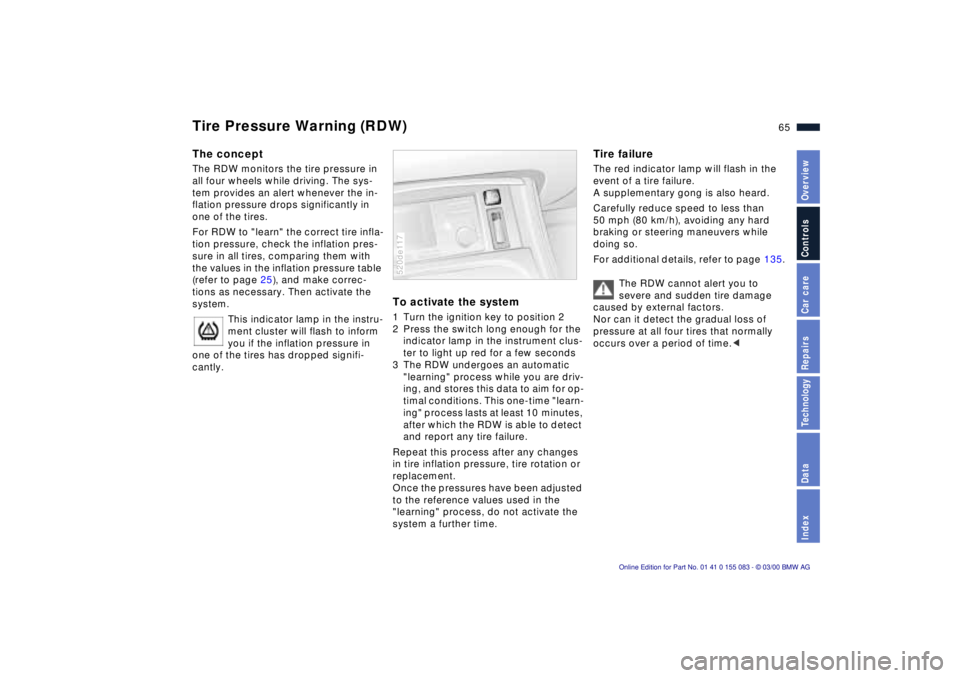
To activate the system 1 Turn the ignition key to position 2
2 Press the switch long enough for the
indicator lamp in the instrument clus-
ter to light up red for a few seconds
3 The RDW undergoes an automatic
"learning" process while you are driv-
ing, and stores this data to aim for op-
timal conditions. This one-time "learn-
ing" process lasts at least 10 minutes,
after which the RDW is able to detect
and report any tire failure.
Repeat this process after any changes
in tire inflation pressure, tire rotation or
replacement.
Once the pressures have been adjusted
to the reference values used in the
"learning" process, do not activate the
system a further time.520de117
Tire failureThe red indicator lamp will flash in the
event of a tire failure.
A supplementary gong is also heard.
Carefully reduce speed to less than
50 mph (80 km/h), avoiding any hard
braking or steering maneuvers while
doing so.
For additional details, refer to page 135.
The RDW cannot alert you to
severe and sudden tire damage
caused by external factors.
Nor can it detect the gradual loss of
pressure at all four tires that normally
occurs over a period of time.<
Page 67 of 172

66n
Tire Pressure Warning (RDW)
Check tire pressure on a regular
basis and correct it if you need to.
Refer to page 24.
Do not carry out any system activation
while driving with snow chains or while
driving on curves. Malfunction warnings
and undetected losses are possible
while driving under these types of
conditions.
In certain circumstances, there could
be a delayed detection of any loss in in-
flation pressure while driving on snow-
covered or slippery road surfaces.
A sporty driving style can also cause
delayed RDW alerts (e. g. slippage in
the drive wheels, high lateral accelera-
tion).<
System interferenceThe red indicator lamp in the instrument
cluster will stay on for as long as there
is a malfunction.
The indicator lamp will come on if the
system malfunctions.
Please contact your BMW center for
additional information.
Page 68 of 172
67n
IndexDataTechnologyRepairsCar careControlsOverview
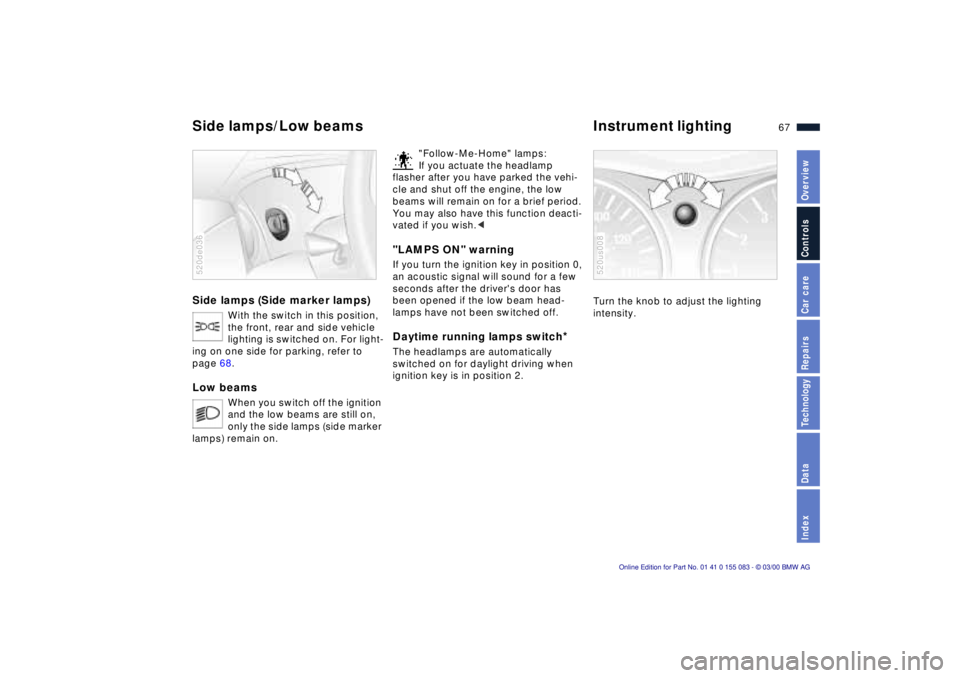
Side lamps (Side marker lamps)
With the switch in this position,
the front, rear and side vehicle
lighting is switched on. For light-
ing on one side for parking, refer to
page 68.
Low beams
When you switch off the ignition
and the low beams are still on,
only the side lamps (side marker
lamps) remain on.
520de036
"Follow-Me-Home" lamps:
If you actuate the headlamp
flasher after you have parked the vehi-
cle and shut off the engine, the low
beams will remain on for a brief period.
You may also have this function deacti-
vated if you wish.<
"LAMPS ON" warningIf you turn the ignition key in position 0,
an acoustic signal will sound for a few
seconds after the driver's door has
been opened if the low beam head-
lamps have not been switched off.Daytime running lamps switch
*
The headlamps are automatically
switched on for daylight driving when
ignition key is in position 2.
Turn the knob to adjust the lighting
intensity.520us008
Side lamps/Low beams Instrument lighting