wheel BMW Z8 2000 Owner's Manual
[x] Cancel search | Manufacturer: BMW, Model Year: 2000, Model line: Z8, Model: BMW Z8 2000Pages: 172, PDF Size: 1.9 MB
Page 91 of 172

90n
Brake system Winter operationBrake pads
The warning lamp for the brake
pads comes on:
The brake pads have reached
their minimum pad thickness. Proceed
to the nearest BMW center as soon as
possible to have the pads replaced.
For your own safety: use only
brake pads which BMW has ap-
proved for your specific vehicle model.
BMW cannot evaluate non-approved
brake pads to determine if they are
suited for use, and therefore cannot en-
sure the operating safety of the vehicle
if they are installed.<
Winter is often accompanied by rapid
changes in weather, requiring not only
a different driving style, but also certain
preparations to the vehicle itself to en-
sure that your vehicle operates safely
and trouble-free throughout the winter
months. CoolantBe sure that the coolant mixture con-
tains the year-round ratio of 50:50 water
and antifreeze/corrosion protection.
This mixture provides protection against
freezing down to approx. Ð 34 7
(Ð 37 6). LocksBMW door lock deicer can be used to
free doors if frozen. This deicer also
contains lubricant.
After using the deicer, treatment with
BMW lock cylinder grease is recom-
mended.
Rubber seals and components To prevent the weather-stripping from
freezing, apply a spray-on rubber treat-
ment or silicone spray to the door, hood
and luggage compartment lid seals.
A full range of car care products is
available from your BMW center.
on the rear wheels with approved winter
tires. Always follow the manufacturer's
safety precautions. Do not exceed a
maximum speed of 30 mph (50 km/h).
Do not activate the RDW system while
using snow chains. Malfunction warn-
ings and undetected losses in pressure
are possible when driving with snow
chains.
Starting offWhen starting off in deep snow or when
"rocking" the vehicle to free it, it may be
advisable to temporarily deactivate the
DSC system. Refer to page 63.
To maintain vehicle stability,
always drive with the system
switched on whenever possible.<
Page 92 of 172

91n
IndexDataTechnologyRepairsCar careControlsOverview
Winter operationDriving on low-traction road
surfacesDo not activate the Sport Mode (refer to
page 64). Use smooth, gentle pressure
to control the accelerator pedal. Avoid
excessive engine speeds and shift to
the next higher gear at an early point.
Shift down into the next lowest gear
when approaching uphill or downhill
grades. Maintain an adequate distance
between yourself and the vehicle
ahead.BrakesWinter road conditions substantially
reduce the amount of traction available
between the tires and the road surface.
The resulting increases in braking dis-
tance are considerable and should be
kept in mind at all times.
ABS is intended to prevent the wheels
from locking during brake applications,
thus helping to maintain vehicle stability
and steering response.If the ABS does not respond in a critical
braking situation and the wheels lock,
reduce the pressure on the brake pedal
until the wheels just start to roll again
while still maintaining enough force to
continue braking.
Then increase the pressure, reduce the
pressure when the wheels lock, reapply
pressure etc.
This staggered braking procedure will
reduce braking distances while helping
you maintain steering control.
You can always then attempt to steer
around hazards after you have reduced
pressure on the brake pedal.
Do not shift down on slick road
surfaces if you want to decelerate.
Doing so could cause the wheels to
lose traction and skid, thus resulting in
the loss of vehicle control.<
Depress the clutch during hard
braking on road surfaces that pro-
vide only poor or uneven traction.<
Skid control Depress the clutch and release the
accelerator pedal. Countersteer care-
fully and attempt to regain control of the
vehicle.ParkingEngage first or reverse gear. Depending
on the steepness of the incline, you can
apply the parking brake as well. In order
to prevent the parking brake pads from
locking due to frost or corrosion, dry
them by gently applying the parking
brake as the vehicle is coming to a stop.
Make sure that following traffic is not
endangered.
The brake lamps do not come
on when the parking brake is
engaged.<
Page 97 of 172

96n
Information for your safetyFactory-approved steel-belted radials
with emergency driving characteristics
are meant for your vehicle, offering
optimum driving safety as well as the
driving comfort you desire.
It is not merely the tire's service life, but
also driving comfort and Ð above all else
Ð driving safety that depend on the con-
dition of the tires and the maintenance
of the specified tire pressure.
Incorrect inflation pressure is a frequent
cause of tire damage. It also signifi-
cantly influences the roadholding ability
of your BMW.
Check tire inflation pressures reg-
ularly (refer to page 24), at least
every two weeks and before beginning
a longer trip. If this is not done, incor-
rect tire pressures can cause driving
instability and tire damage, ultimately
resulting in accidents.<
Safety tiresYour BMW Z8 roadster is equipped
with safety tires.
The safety tires are made of self-sup-
porting tires and customized wheel
rims. Reinforcing the tires makes sure
that they remain upright and still drive-
able to a limited degree even in the
event of loss of pressure. Your vehicle
is equipped with a tire pressure monitor
that signals you in case of a flat tire.
For further information, refer to
pages 65, 135.
Tire inflation pressure
Page 99 of 172

98n
Tire replacement To maintain good handling and vehicle
response, use only tires of a single tread
configuration from a single manufac-
turer. BMW tests and approves wheel/
tire combinations. Refer to page 103.DOT Quality GradesTread wear
Traction AA A B C
Temperature A B C
All passenger vehicle tires
must conform to Federal Safety
Requirements in addition to these
grades.
when tested under controlled condi-
tions on a specified government test
course.
For example, a tire graded 150 would
wear one and one-half (1 1/2) times as
well on the government course as a tire
graded 100. The relative performance
of tires depends upon the actual condi-
tions of their use, however, and may
depart significantly from the norm due
to variations in driving habits, service
practices and differences in road char-
acteristics and climate.
TractionThe traction grades, from highest to
lowest, are AA, A, B and C.
Those grades represent the tire's ability
to stop on wet pavement as measured
under controlled conditions on speci-
fied government test surfaces of as-
phalt and concrete. A tire marked C
may have poor traction performance.
The traction grade assigned to
this tire is based on straight-
ahead braking traction tests, and does
not include acceleration, cornering,
hydroplaning, or peak traction charac-
teristics.<
TemperatureThe temperature grades are A (the
highest), B and C, representing the
tire's resistance to the generation of
heat and its ability to dissipate heat
when tested under controlled condi-
tions on a specified indoor laboratory
test wheel.
Sustained high temperature can cause
the tire material to degenerate and re-
duce tire life, and excessive tempera-
ture can lead to sudden tire failure. The
Grade C corresponds to a level of per-
formance which all passenger vehicle
tires must meet under the Federal Mo-
tor Vehicle Safety Standard No. 109.
Grades B and A represent higher levels
of performance on the laboratory test
wheel than the minimum required by
law.
The temperature grade for this
tire is established for a tire that is
properly inflated and not overloaded.
Excessive speed, underinflation, or
excessive loading, either separately or
in combination, can cause heat buildup
and possible tire failure.<
Page 102 of 172

101n
IndexDataTechnologyRepairsCar careControlsOverview
Wheel and tire combinations The right choice Use only BMW-approved tires with
emergency driving characteristics.
Refer to page 103.
Due to the maximum speeds this vehi-
cle can reach, the use of specific brands
and sizes is mandatory. Consult any
BMW center for details. Comply with
local/national regulations.
The correct wheel/tire combinaton
affects different sytems, such as
ABS, ATC, DSC and RDW. The function
of these systems is impaired if improper
wheel/tire combinations are used.
For this reason, use only tires made by
the same manufacturer that have the
same tread configuration and possess
emergency driving characteristics. And
after a flat tire, for instance, restore the
approved wheel-tire combination as
soon as possible.<
Codes on tires and wheels The tire codes will aid you in selecting
the correct tire.
Codes on radial tires:
The speed rating indicates the approved
maximum speed for the tire.
Summer tires:
S = up to 112 mph (180 km/h)
T = up to 118 mph (190 km/h)
H = up to 130 mph (210 km/h)
V = up to 150 mph (240 km/h)
W = up to 167 mph (270 km/h)
Y = up to 186 mph (300 km/h)
ZR = over 150 mph (240 km/h) For example:
Nominal width
in mm
Aspect ratio in X
Radial tire code
Rim diameter in inches
Load rating
(not on ZR tires)
Speed rating
(before R on ZR tires)
245/45 R 18 96 W
Winter tires:
Q M+S = up to 100 mph (160 km/h)
T M+S = up to 118 mph (190 km/h)
H M+S = up to 130 mph (210 km/h)
Codes stamped on light-alloy wheels:
Protect tire valves from dirt by using
screw-on valve stem caps. Dirt in the
valves frequently leads to slow leaks.
Tires with emergency driving character-
istics also possess an additional identi-
fication mark that varies by manufac-
turer, e. g.:
Bridgestone RFT
Dunlop DSST
Goodyear EMT
Michelin ZP For example:
Rim width
in inches
Code letter for
flange type
Symbol for full-drop
center rim
Rim diameter in inches
Hump on the 2 rim shoulders
8 x 18 H 2
J
Page 103 of 172

102n
Winter tires Snow chains
*
Choosing the right tireFor winter road driving, BMW recom-
mends winter tires (M+S radial belt
tires). Although all-season M+S tires
provide better winter traction than stan-
dard summer tires with H, V, W and ZR
speed ratings, they generally fail to pro-
vide the same levels of performance as
standard snow tires in winter driving.
In the interests of safe tracking and
steering response, install radial tires
made by the same manufacturer and
with the same tread configuration on all
four wheels if you elect to mount winter
tires.
Mount only winter tires that have been
approved by BMW. Any BMW center
will be glad to provide you with informa-
tion on the best winter tires for your
particular driving conditions.
Use only winter tires with emer-
gency driving characteristics as
there is no spare tire available if you get
a flat.
For further information, refer to
page 135.<
Do not exceed specified
maximum speeds
Never exceed the maximum speed
for which winter tires are rated.
Unprofessional attempts by laymen to
service tires can lead to damage and
accidents.
Have this work performed by skilled
professionals only. Your BMW center
will be glad to assist you with both their
expertise and the proper equipment for
your vehicle.<
Tire condition, tire pressureOnce the tread depth on winter tires is
less than 0.16 in (4 mm), they are no
longer suitable for winter road driving,
and in the interest of safety should be
replaced.
Comply with the specified tire inflation
pressures Ð and be sure to have the
wheel and tire assemblies balanced
every time you change the tires.StorageAlways store tires in a cool, dry place.
Store them away from light whenever
possible. Protect the tires against con-
tact with oil, grease and fuel.
The use of narrow-link BMW snow
chains is permissible in pairs only on
the rear wheels with winter tires with
tire size 245/45 R 18 96 H. Comply with
all manufacturer's safety precautions
when mounting the chains.
Do not activate the RDW system
while using snow chains.
Malfunction warnings and undetected
losses in pressure are possible when
driving with snow chains.
For further information, refer to
page 65.<
Page 104 of 172

103n
IndexDataTechnologyRepairsCar careControlsOverview
Approved wheel and tire specifications Comply with the specifications for tires
and wheels in the vehicle's documents.
If sizes not approved by the manufac-
turer are mounted, an entry in the vehi-
cle's documents may be necessary. Tire specifications Light-alloy wheel
BMW Z8
Summer tires
Front: 245/45 R 18 96 W 8Jx18 EH2
Rear: 275/40 R 18 99 W 9Jx18 EH2
Winter tires
245/45 R 18 96 H M+S 8Jx18 EH2
Snow chains
*
It is impossible to install snow chains
when using summer tires 275/40 R 18
99 W.
Do not activate the RDW system
while using snow chains.
Malfunction warnings and undetected
losses in pressure are possible when
driving with snow chains.
For further information, refer to
page 65.<
The use of rims and wheel bolts
that do not meet the specifications
of the original factory-installed equip-
ment will affect the safe operation of
your vehicle and may cause an accident
and personal injury.
Never mix tires of different design, such
as steel-belted radials with radial bias
belted or bias-ply tires, etc. Mixing tire
types will adversely affect roadholding
and can lead to loss of vehicle control.<
Page 116 of 172

115n
IndexDataTechnologyRepairsCar careControlsOverview
Washing your vehicle You can have your new BMW washed
in an automatic car wash. Car wash
systems that do not employ brushes
are preferable.
Wipe away tough dirt and loosen and
remove dead insects before washing
the vehicle.
In order to avoid spots, do not wash the
vehicle when the hood is warm, or dur-
ing or immediately after exposure to
strong sunlight.
In order to protect your convertible top,
do not have any special waxing pro-
gram done to your vehicle. The small
amount of beading wax always used in
automatic car washes will not harm the
convertible top.
When using an automatic car wash, be
sure that:
>The car wash system is suited for the
dimensions of your vehicle
>No damage will occur on vehicles
with attached body accessories (such
as spoilers or antennas). Consult the
car wash operator if necessary >The wheels and tires of your vehicle
cannot be damaged by the convey-
ance devices of the car wash system
>The vehicle is cleaned with minimum
brush pressure, and that ample water
is available for washing and rinsing.
Parts of the vehicle which are inacces-
sible to the automatic washer Ð such as
door sills, door and hood edges, etc. Ð
should be cleaned by hand.
In the winter months, it is especially
important to ensure that the vehicle is
washed on a regular basis. Large quan-
tities of dirt and road salt are difficult to
remove, and they also cause damage to
the vehicle.
If spray wands or high-pressure
washers are used, be sure to
maintain an adequate distance between
the spray source and the vehicle's sur-
face. Inadequate distance and exces-
sive pressure can damage or weaken
the finish, making it more susceptible to
further damage. In addition, moisture
could penetrate to vehicle components,
leading to long-term damage.<
When cleaning the headlamps,
please observe the following:
>Do not clean by wiping with a dry
cloth. Never use abrasives or strong
solvents to clean the covers
>Remove dirt and contamination (such
as insects) by soaking with BMW Car
Shampoo and then rinsing with plenty
of water
>Always use a deicer spray to remove
accumulated ice and snow Ð never
use a scraper.<
After washing the vehicle, apply
the brakes briefly to dry them.
Braking efficiency might otherwise be
reduced by the moisture and the brake
rotors could also be corroded.<
Caring for your vehicle
Page 120 of 172

119n
IndexDataTechnologyRepairsCar careControlsOverview
Caring for your vehicleWindow careYou can use window and glass cleaner
to clean inside window surfaces and
mirrors without smearing and streaking.
Never use polishing pastes or abrasive
(quartz) cleansers on mirror lenses.
Clean the wiper blades with soapy
water. The wiper blades should be re-
placed twice a year Ð before and after
the cold season.
Use only wiper blades approved
by BMW.<
Caring for other vehicle
components and materials Light-alloy wheels should be treated
with alloy wheel cleaner, especially dur-
ing the winter months. However, do not
use aggressive products containing
acids, strong alkalis or abrasives. Do
not use steam cleaners operating at
temperatures above 140 7 (60 6).
Follow the manufacturer's instructions.
Carefully clean chrome parts such as
lamp socket assemblies, door handles
and similar items with an ample amount
of clean water Ð and shampoo, too, if
necessary Ð especially if there is an ac-
cumulation of road salt. Use a chrome
polish for an additional treatment.
Use water to clean plastic components,
headliners, lamp lenses, and surfaces
sprayed dull black Ð adding vinyl sham-
poo, if necessary. Do not allow mois-
ture to soak through the seats or head-
liner. Never use solvents such as lac-
quer thinner, heavy-duty grease re-
mover, fuels, or similar substances.
Use a soft, clean cloth to wipe off the
lamp covers, using methylated spirits
with distilled water as a cleaning sol-
vent, if necessary, at a mixing ratio
of 1:1.Rubber components should be cleaned
with water only; a rubber treatment or
silicone spray may also be applied.
The safety belts should be cleaned with
a mild soap and water solution without
being removed from the vehicle. Never
attempt chemical or dry cleaning, as
damage to the belt fabric could result.
After cleaning, never allow the inertia
reel to retract the belts until they are
completely dry. Dirty safety belts pre-
vent the inertia reel mechanism from
retracting the strap properly, thus
constituting a safety hazard.
Heavily soiled floor carpets and mats
*
can be cleaned with an interior cleaner.
The floor mats can be removed from
the vehicle for cleaning.
Clean the aluminum surfaces with water
and, if necessary, with a mild soap.
Never use solvents such as lacquer
thinner, heavy-duty grease remover,
fuels, or similar substances.
Use only a wet cloth to clean the painted
inner parts. Dry them afterwards with a
soft cloth.
Use the cleaning and car-care
products available at your BMW
center.<
Page 122 of 172
121n
IndexDataTechnologyRepairsCar careControlsOverview
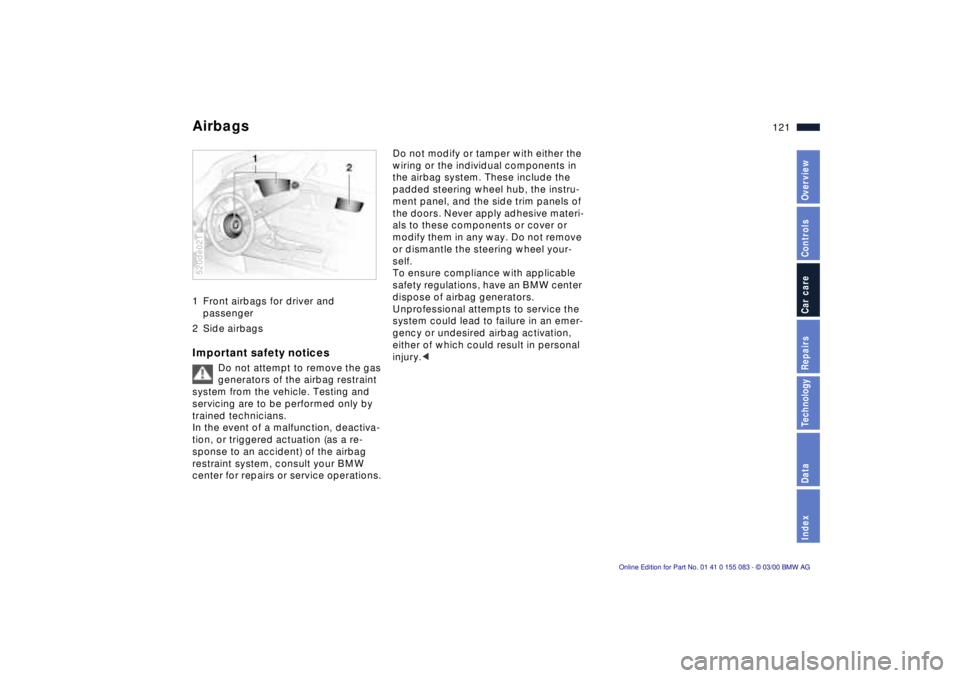
Airbags 1 Front airbags for driver and
passenger
2 Side airbags Important safety notices
Do not attempt to remove the gas
generators of the airbag restraint
system from the vehicle. Testing and
servicing are to be performed only by
trained technicians.
In the event of a malfunction, deactiva-
tion, or triggered actuation (as a re-
sponse to an accident) of the airbag
restraint system, consult your BMW
center for repairs or service operations.
520de021
Do not modify or tamper with either the
wiring or the individual components in
the airbag system. These include the
padded steering wheel hub, the instru-
ment panel, and the side trim panels of
the doors. Never apply adhesive materi-
als to these components or cover or
modify them in any way. Do not remove
or dismantle the steering wheel your-
self.
To ensure compliance with applicable
safety regulations, have an BMW center
dispose of airbag generators.
Unprofessional attempts to service the
system could lead to failure in an emer-
gency or undesired airbag activation,
either of which could result in personal
injury.<