traction control BMW Z8 2000 Owners Manual
[x] Cancel search | Manufacturer: BMW, Model Year: 2000, Model line: Z8, Model: BMW Z8 2000Pages: 172, PDF Size: 1.9 MB
Page 56 of 172
55n
IndexDataTechnologyRepairsCar careControlsOverview
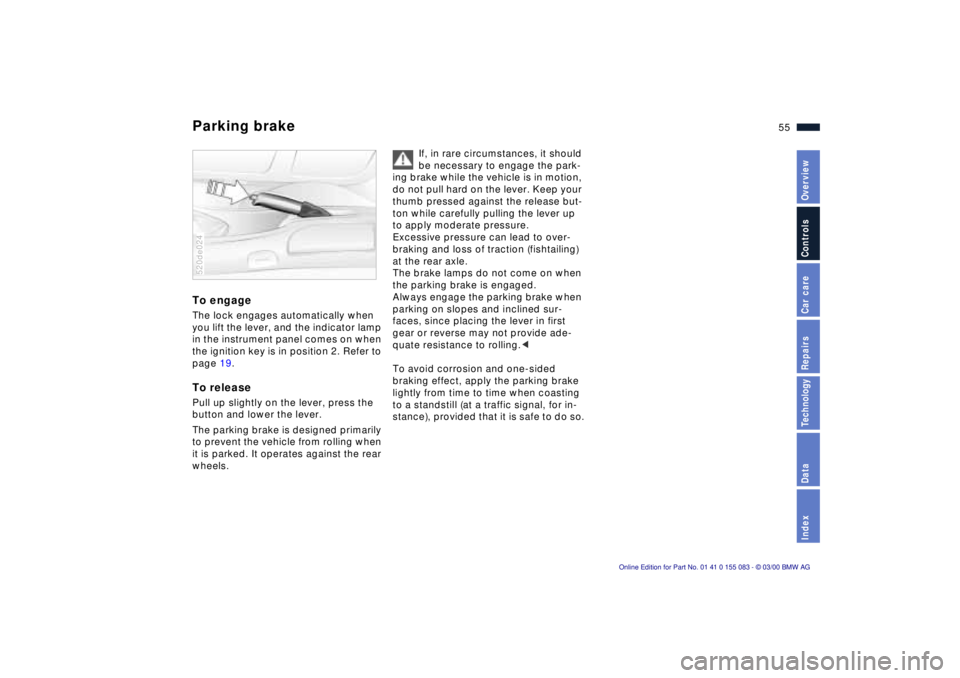
Parking brake To engageThe lock engages automatically when
you lift the lever, and the indicator lamp
in the instrument panel comes on when
the ignition key is in position 2. Refer to
page 19.To releasePull up slightly on the lever, press the
button and lower the lever.
The parking brake is designed primarily
to prevent the vehicle from rolling when
it is parked. It operates against the rear
wheels.520de024
If, in rare circumstances, it should
be necessary to engage the park-
ing brake while the vehicle is in motion,
do not pull hard on the lever. Keep your
thumb pressed against the release but-
ton while carefully pulling the lever up
to apply moderate pressure.
Excessive pressure can lead to over-
braking and loss of traction (fishtailing)
at the rear axle.
The brake lamps do not come on when
the parking brake is engaged.
Always engage the parking brake when
parking on slopes and inclined sur-
faces, since placing the lever in first
gear or reverse may not provide ade-
quate resistance to rolling.<
To avoid corrosion and one-sided
braking effect, apply the parking brake
lightly from time to time when coasting
to a standstill (at a traffic signal, for in-
stance), provided that it is safe to do so.
Page 64 of 172
63n
IndexDataTechnologyRepairsCar careControlsOverview
The conceptDSC maintains vehicle stability even in
critical driving situations. The system
optimizes vehicle stability during accel-
eration and when starting from a full
stop, as well as optimizing traction. In
addition, the system recognizes unsta-
ble vehicle conditions (understeering or
oversteering, for example) and holds
the vehicle on a sure course by inter-
vening via the engine and by braking
intervention at the individual wheels,
within physically feasible limits.
The system starts up automatically
each time you start the engine.Indicator lamp
The indicator lamp in the instru-
ment cluster goes out shortly
after you switch on the ignition.
Refer to page 20.
Indicator lamp flashes:
The system is active and governs drive
force and braking force.
If the indicator lamp does not go out
after the engine is started, or if it comes
on during normal driving and stays on:
There is a system malfunction or the
system was deactivated with the button.
You can continue to drive the vehicle
normally, but without DSC.
Please consult your BMW center for re-
pairs.
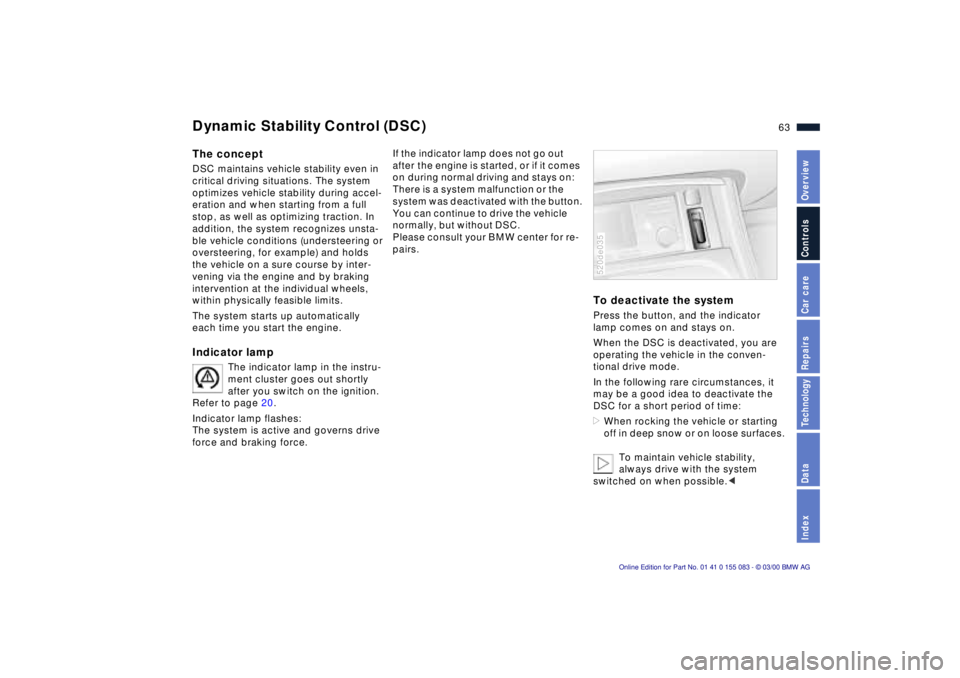
To deactivate the systemPress the button, and the indicator
lamp comes on and stays on.
When the DSC is deactivated, you are
operating the vehicle in the conven-
tional drive mode.
In the following rare circumstances, it
may be a good idea to deactivate the
DSC for a short period of time:
>When rocking the vehicle or starting
off in deep snow or on loose surfaces.
To maintain vehicle stability,
always drive with the system
switched on when possible.<520de035
Dynamic Stability Control (DSC)
Page 87 of 172

86n
Antilock Brake System (ABS) The concept ABS enhances active safety by helping
to prevent the wheels from locking un-
der braking. This is because: locked
wheels are dangerous. When the front
wheels slide, the driver loses steering
control over the vehicle. Traction loss at
the rear wheels can cause the rear end
to break into an uncontrolled skid.
With ABS, you will achieve the shortest-
possible braking distances under all
given conditions (braking while driving
straight ahead or in curves, different
road surfaces).
ABS is designed to meet two essential
requirements during every brake appli-
cation:
>To help provide vehicle stability
>To help retain steering and maneu-
vering capability on all types of road
surfaces (asphalt, concrete, dirt, wet
surfaces, snow and ice).
Braking with ABSThe system is operative once the vehi-
cle exceeds a speed of approx. 6 mph
(10 km/h). The ABS is deactivated
whenever the vehicle's speed drops
back below approx. 4 mph (6 km/h).
This means that the wheels can tend
to lock in the very final phase of a panic
stop, which in actual practice is not
critical.
The ABS system works best in situa-
tions requiring maximum pressure on
the pedal (full braking). Since the vehi-
cle maintains steering responsiveness,
you can nevertheless avoid possible
obstacles with a minimum of steering
effort.
The ABS system's closed-loop control
circuit cycles in fractions of a second.
A pulsing of the brake pedal, com-
bined with the sounds associated with
the hydraulic controls, tells you that the
brake system is within its maximum
limit range and reminds you that you
should adapt your vehicle's speed to
road conditions.On road surfaces that have a loose layer
on a firm base (on gravel or snow, for in-
stance), the braking distances with ABS
may be longer than with the wheels
locked. This also applies for driving with
snow chains. However, ABS continues
to provide enhanced vehicle stability
and steering response under these
conditions.
Page 92 of 172

91n
IndexDataTechnologyRepairsCar careControlsOverview
Winter operationDriving on low-traction road
surfacesDo not activate the Sport Mode (refer to
page 64). Use smooth, gentle pressure
to control the accelerator pedal. Avoid
excessive engine speeds and shift to
the next higher gear at an early point.
Shift down into the next lowest gear
when approaching uphill or downhill
grades. Maintain an adequate distance
between yourself and the vehicle
ahead.BrakesWinter road conditions substantially
reduce the amount of traction available
between the tires and the road surface.
The resulting increases in braking dis-
tance are considerable and should be
kept in mind at all times.
ABS is intended to prevent the wheels
from locking during brake applications,
thus helping to maintain vehicle stability
and steering response.If the ABS does not respond in a critical
braking situation and the wheels lock,
reduce the pressure on the brake pedal
until the wheels just start to roll again
while still maintaining enough force to
continue braking.
Then increase the pressure, reduce the
pressure when the wheels lock, reapply
pressure etc.
This staggered braking procedure will
reduce braking distances while helping
you maintain steering control.
You can always then attempt to steer
around hazards after you have reduced
pressure on the brake pedal.
Do not shift down on slick road
surfaces if you want to decelerate.
Doing so could cause the wheels to
lose traction and skid, thus resulting in
the loss of vehicle control.<
Depress the clutch during hard
braking on road surfaces that pro-
vide only poor or uneven traction.<
Skid control Depress the clutch and release the
accelerator pedal. Countersteer care-
fully and attempt to regain control of the
vehicle.ParkingEngage first or reverse gear. Depending
on the steepness of the incline, you can
apply the parking brake as well. In order
to prevent the parking brake pads from
locking due to frost or corrosion, dry
them by gently applying the parking
brake as the vehicle is coming to a stop.
Make sure that following traffic is not
endangered.
The brake lamps do not come
on when the parking brake is
engaged.<
Page 99 of 172

98n
Tire replacement To maintain good handling and vehicle
response, use only tires of a single tread
configuration from a single manufac-
turer. BMW tests and approves wheel/
tire combinations. Refer to page 103.DOT Quality GradesTread wear
Traction AA A B C
Temperature A B C
All passenger vehicle tires
must conform to Federal Safety
Requirements in addition to these
grades.
when tested under controlled condi-
tions on a specified government test
course.
For example, a tire graded 150 would
wear one and one-half (1 1/2) times as
well on the government course as a tire
graded 100. The relative performance
of tires depends upon the actual condi-
tions of their use, however, and may
depart significantly from the norm due
to variations in driving habits, service
practices and differences in road char-
acteristics and climate.
TractionThe traction grades, from highest to
lowest, are AA, A, B and C.
Those grades represent the tire's ability
to stop on wet pavement as measured
under controlled conditions on speci-
fied government test surfaces of as-
phalt and concrete. A tire marked C
may have poor traction performance.
The traction grade assigned to
this tire is based on straight-
ahead braking traction tests, and does
not include acceleration, cornering,
hydroplaning, or peak traction charac-
teristics.<
TemperatureThe temperature grades are A (the
highest), B and C, representing the
tire's resistance to the generation of
heat and its ability to dissipate heat
when tested under controlled condi-
tions on a specified indoor laboratory
test wheel.
Sustained high temperature can cause
the tire material to degenerate and re-
duce tire life, and excessive tempera-
ture can lead to sudden tire failure. The
Grade C corresponds to a level of per-
formance which all passenger vehicle
tires must meet under the Federal Mo-
tor Vehicle Safety Standard No. 109.
Grades B and A represent higher levels
of performance on the laboratory test
wheel than the minimum required by
law.
The temperature grade for this
tire is established for a tire that is
properly inflated and not overloaded.
Excessive speed, underinflation, or
excessive loading, either separately or
in combination, can cause heat buildup
and possible tire failure.<
Page 100 of 172

99n
IndexDataTechnologyRepairsCar careControlsOverview
Tire replacement Uniform Tire Quality GradingQuality grades can be found where
applicable on the tire sidewall between
tread shoulder and maximum section
width. For example:
Tread wear 200 Traction AA
Temperature A
Use only tires with emergency
driving characteristics as there is
no spare tire available if you get a flat.
For further information, refer to
page 135.<
Tire ageThe date on which the tire was manu-
factured is indicated by the code on the
sidewall:
DOT ... 1200 indicates that the tire was
manufactured in week 12 of 2000.
BMW recommends the replacement of
all tires when the tires are no more than
6 years old, even if a tire life of 10 years
is possible.
Page 150 of 172
149n
IndexDataTechnologyRepairsCar careControlsOverview
Highly sensitive sensors monitor the
number of revolutions of the wheels,
steering angle, lateral acceleration,
brake pressure and the movement
of the vehicle around its vertical axis.
If differences in wheel speed should
occur, the system will recognize the
danger this loss of traction causes and
reduce the drive torque going to the
wheels. The system will also apply the
brakes specifically to the rear wheels,
if necessary.
In addition, DSC permanently monitors
the vehicle's current operating condi-
tion and compares it with an ideal con-
dition that is calculated from the sen-
sor's signals. If differences such as
under- or oversteering should occur,
DSC will stabilize the vehicle in frac-
tions of a second by reducing engine
power output, applying the brakes to
individual rear wheels Ð and to specific
front wheels, too, if necessary. As a
result, dangerous skids can be pre-
vented even as they are beginning.You may need some time to become
accustomed to this system's interven-
tion. However, it provides optimum
drive force and vehicle stability.
The braking intervention may be
accompanied by sounds specific to
the system.
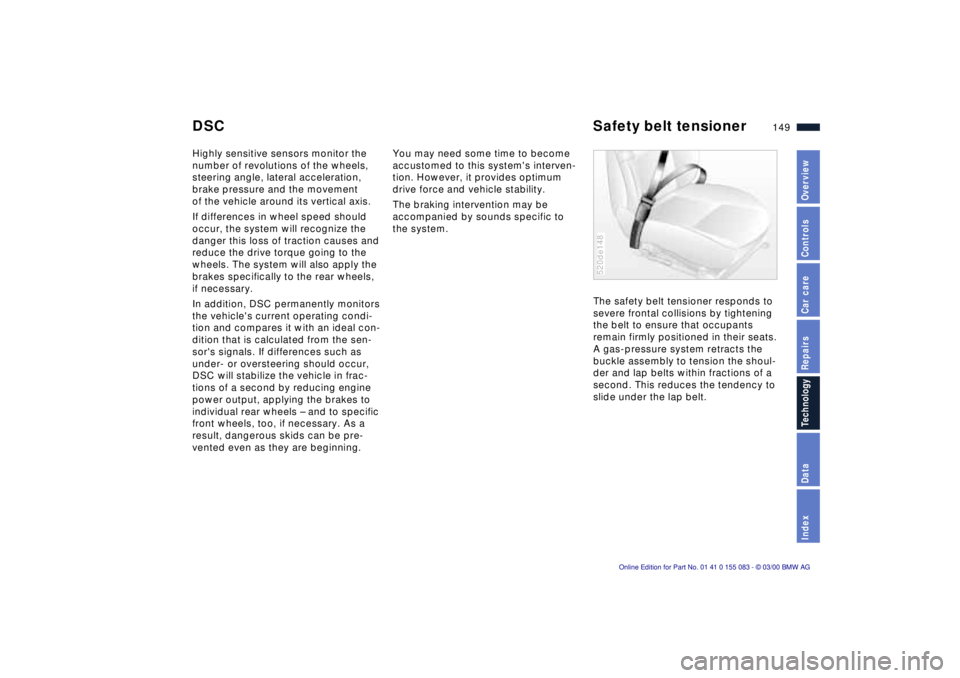
The safety belt tensioner responds to
severe frontal collisions by tightening
the belt to ensure that occupants
remain firmly positioned in their seats.
A gas-pressure system retracts the
buckle assembly to tension the shoul-
der and lap belts within fractions of a
second. This reduces the tendency to
slide under the lap belt.
520de148
DSC Safety belt tensioner
Page 165 of 172

Everything from A to ZHeadlamp washer
system108,157
Headlamp washers58
Heating and ventilation70
Heating, rapid75
Heavy loads81
Height155
High beams21,56,68
Holder for beverage
cans78
Hood release104
Horn15 I
Identification, tires101
Ignition keys28
Ignition lock53
Indicator lamps18
Inflation pressure24,96
monitoring65
INSPECTION61
Instrument cluster16
Instrument lighting67
Instruments16
Interaxle tire rotation100
Interface socket for On-
Board-Diagnostics124
Interference
cellular phone92
Interior lamps32,68
bulb replacement133
remote control32 Interior motion sensor36
Interior rearview mirror
with automatic
dimmer46,150
Intermittent wipe57
J
Jump starting143 K
Key Memory46
Key with remote control28
Keys28 L
Lamps on warning67
Leather care120
Length155
License plate lamp
bulb replacement131
Light switch67
Light-alloy wheels103
Lighter80
Loading81
Louvers70
Low beam headlamps67
Low beam light inside
rearview mirror46
Low traction road
surfaces91 Luggage compartment
capacity156
emergency release35
remote control33
Luggage compartment lamp
bulb replacement134
Luggage compartment
lid35
emergency release35
M
M+S tires102
Maintenance61,114
Manual transmission56
Microfilter73
MID (Multi-Information
Radio)62
Mirrors45
Mobile cellular phones92
Modifications,
technical4,123
Multi-Information Radio
(MID)62 N
Navigation system, refer to
the radio Owner's Manual
Neckrest44 O
OBD interface socket124 Odometer60
Oil
additives109
consumption109
fill capacity157
quality110
specifications110
viscosity110
Oil change intervals, see the
Service and Warranty
Information Booklet (US
models) or the Warranty
and Service Guide Booklet
(Canadian models)
Oil dipstick109
Oil level
check109
indicator lamp19
Oil pressure
indicator lamp18
OILSERVICE61
Onboard tool kit128
Opening and closing
from inside34
from outside30
Outlets, ventilation70
Outside temperature
display62
P
Paint blemishes117
Paint, care117
Page 166 of 172

Everything from A to Z
165n
IndexDataTechnologyRepairsCar careControlsOverview
Paintwork, minor
repairs118
Paintwork, waxing118
Parking brake55
Parking lamps68
Parking, winter91
Performance154
Pocket flashlight77
Pollen73
Power steering92
Power windows38
Pressure monitoring,
tires65
Pressure, tires24,96
Pre-warmed seats75 R
Radio62
refer also to the radio
Owner's Manual
Radio reception92,148
Radios92
RDW (Tire Pressure
Warning)65
Reading lamps69
Rear foglamps68
Rear lamp130
Rear window
defroster58,73
Rearview mirror45
Recirculated air mode72 Refueling23
Remaining fuel indicator60
Remote control31
Removing condensation
from the windows73
Removing the vehicle from
storage122
Replacement keys28
Reporting Safety Defects5
Restraint systems51
Reverse15,56
Roof load capacity156
Rotating the tires100
Rubber parts90
S
Safety belt tensioner149
Safety belts48
Safety buttons34
Seat heating75
Securing cargo81
Self-defrosting mirrors45
Service and Warranty
Information Booklet
(US models)114
Service Interval
Display61,114
Shelves76,77
Side airbags49
Side lamps67 Side marker lamps67
bulb
replacement129,130
Sliding91
Slippery roads91
Snow chains90,103
Socket80
Spare key28
Spark plugs158
Speaker79
Speed control59
Speedometer16
Starting54
Starting
problems85,143,144
Steel wheels103
Steering92
Steering wheel lock53
Stopping the vehicle54
Storage areas76,77
Storing your vehicle122
Stroke154
Summer tires101
Switching off the engine54
Symbols2,136
T
Tachometer60
Taillamps
bulb replacement130
Tank capacity157
Technical data154 Technical
modifications4,123
Telephone79
Temperature display
outside temperature62
Temperature gauge
engine coolant61
Temperature layering73
Tilt alarm32
Tilt sensor alarm sensor37
Tire codes101
Tire damage97
Tire inflation
pressure24,96
Tire pressure monitoring65
Tire Pressure Warning
(RDW)65
Tire replacement98,99
Tire rotation100
Tire specifications103
Tire tread97
Together19
Tools128
Torque154
Tow fittings144
Tow starting144
Towing144
Track155
Traction Control System
refer to DSC63
Transmission56
Transmitter key28
Tread depth, tires97