ECO mode BMW Z8 2001 User Guide
[x] Cancel search | Manufacturer: BMW, Model Year: 2001, Model line: Z8, Model: BMW Z8 2001Pages: 170, PDF Size: 1.64 MB
Page 63 of 170
63n
IndexDataTechnologyRepairsCar careControlsOverview
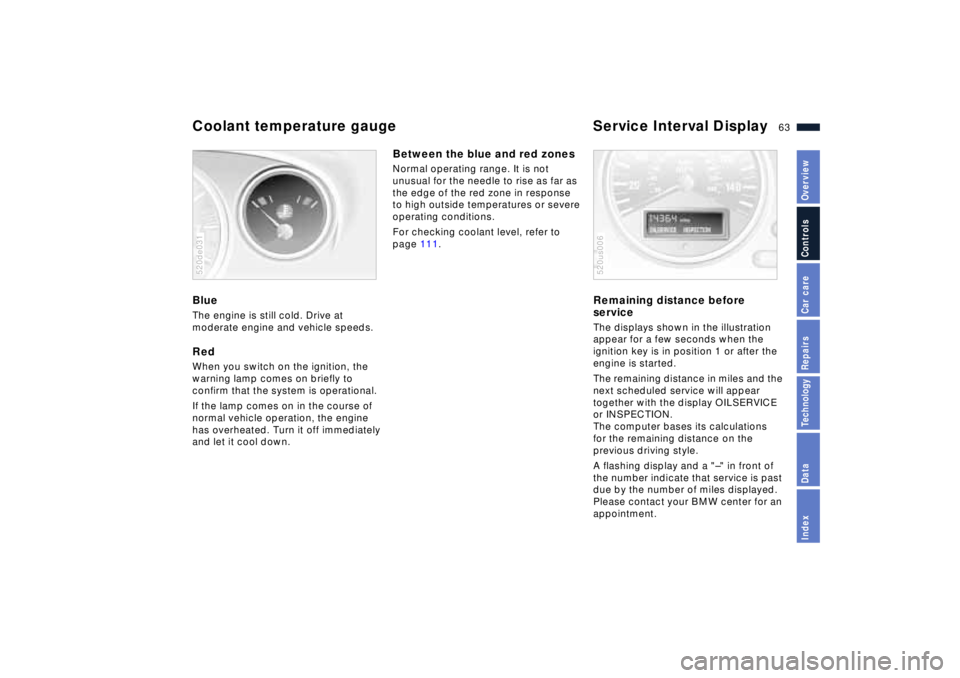
Coolant temperature gauge Service Interval Display BlueThe engine is still cold. Drive at
moderate engine and vehicle speeds.RedWhen you switch on the ignition, the
warning lamp comes on briefly to
confirm that the system is operational.
If the lamp comes on in the course of
normal vehicle operation, the engine
has overheated. Turn it off immediately
and let it cool down.520de031
Between the blue and red zonesNormal operating range. It is not
unusual for the needle to rise as far as
the edge of the red zone in response
to high outside temperatures or severe
operating conditions.
For checking coolant level, refer to
page 111.
Remaining distance before
serviceThe displays shown in the illustration
appear for a few seconds when the
ignition key is in position 1 or after the
engine is started.
The remaining distance in miles and the
next scheduled service will appear
together with the display OILSERVICE
or INSPECTION.
The computer bases its calculations
for the remaining distance on the
previous driving style.
A flashing display and a "Ð" in front of
the number indicate that service is past
due by the number of miles displayed.
Please contact your BMW center for an
appointment.520us006
Page 65 of 170
65n
IndexDataTechnologyRepairsCar careControlsOverview
The conceptDSC maintains vehicle stability even in
critical driving situations.
DSC maintains optimal, predictable re-
sponse while maximizing traction when
you accelerate from a standing start or
speed up while already underway. The
system recognizes any tendency for the
vehicle to assume an instable attitude
such as oversteer and understeer, and
counteracts this tendency with a com-
bination of graduated reductions in en-
gine torque and braking intervention at
individually selected wheels. DSC pro-
vides optimal stability Ð within the limits
defined by the laws of physics.
The system automatically assumes
operational status each time the en-
gine is started.
Indicator lamp
The indicator lamp in the in-
strument cluster goes out
shortly after you switch on the
ignition. Refer to page 22.
The indicator lamp flashes:
The system is actively regulating drive
torque.
The indicator lamp does not go out
after the engine is started, or if it comes
on during normal driving and stays on:
There is a system malfunction or the
system was deactivated with the button.
You can continue to drive the vehicle
normally, but without DSC.
Please respond to any suspected de-
fects by referring the problem to your
BMW center.
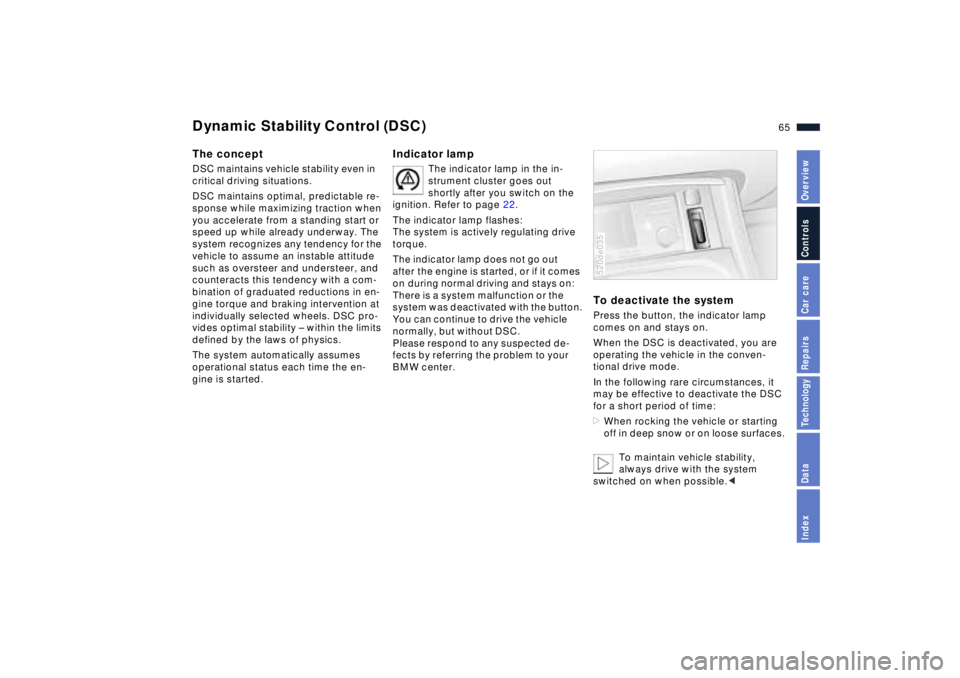
To deactivate the systemPress the button, the indicator lamp
comes on and stays on.
When the DSC is deactivated, you are
operating the vehicle in the conven-
tional drive mode.
In the following rare circumstances, it
may be effective to deactivate the DSC
for a short period of time:
>When rocking the vehicle or starting
off in deep snow or on loose surfaces.
To maintain vehicle stability,
always drive with the system
switched on when possible.<520de035
Dynamic Stability Control (DSC)
Page 66 of 170
66n
Dynamic Stability Control (DSC) Dynamic PerformanceTo reactivate the systemPress the button again; the indicator
lamp goes out.
Not even DSC can suspend the
laws of physics. Responsibility for
careless driving remains in the hands
(and feet) of the driver. Never use the
added safety afforded by DSC as an
excuse for taking unnecessary risks.
Do not make any modifications to the
DSC system. Service procedures on
the system are to be performed by
authorized technicians only.<
For additional details concerning DSC,
please refer to the chapter "Advanced
technology" on page 149.
The system reacts to current conditions
with an instantaneous recalibration. It
revises the accelerator's standard
response designed to furnish an ideal
combination of comfort and perform-
ance orientation Ð with a more perform-
ance-oriented response program. The
result is crisper, faster reaction to
throttle inputs (Sport mode).
The system resets to the standard re-
sponse mode, with its combination of
comfort and performance orientation,
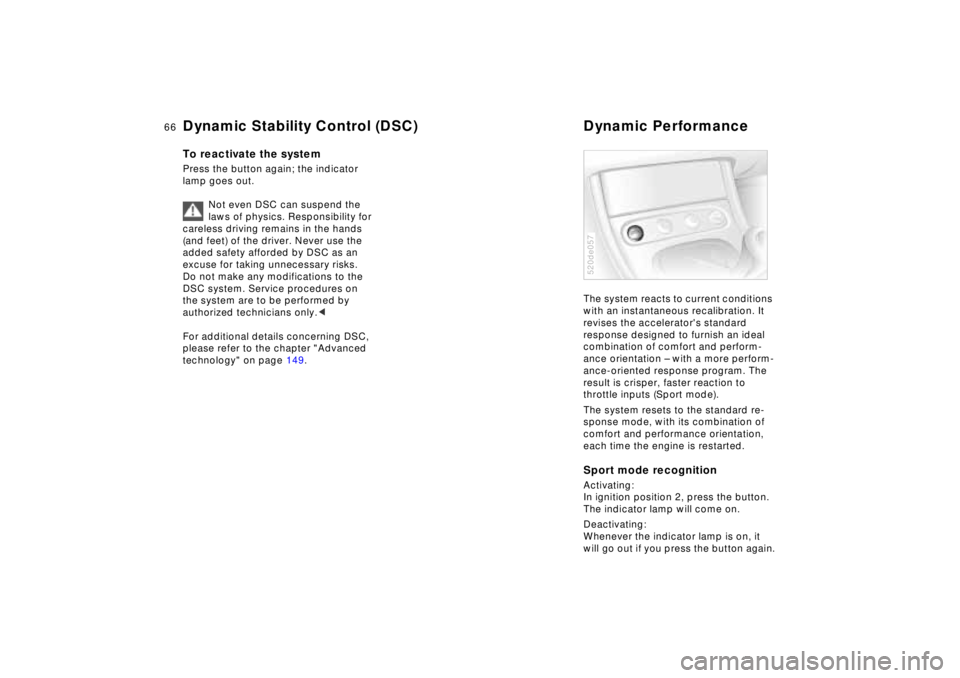
each time the engine is restarted. Sport mode recognitionActivating:
In ignition position 2, press the button.
The indicator lamp will come on.
Deactivating:
Whenever the indicator lamp is on, it
will go out if you press the button again.520de057
Page 74 of 170

74n
Heating and ventilation/Air conditionerAir supply
You can select blower speeds
from 1 to 4. The higher the
setting, the greater the
amount of heat and air supply.
In position 0, the blower, heating and air
conditioner are switched off.
Temperature
In order to increase the inte-
rior temperature, turn to the
right. For rapid heating, turn
completely to the right. Then
select an interior temperature that is
comfortable for you.
Air distribution
You can direct the airflow onto
the windows , toward the
upper body and into the
footwell . You can also make
all intermediate settings. The "6 o'clock"
setting is recommended for normal
conditions (refer also to the illustration
and overview on page 72).
Recirculated air mode
If there are unpleasant odors
in the incoming air, you can
temporarily block the air
supply. The system then recir-
culates the air already within the
vehicle.
If condensation starts to form on
window surfaces during opera-
tion in the recirculated-air mode, switch
it off and return the ventilation system
to the incoming air mode; turn up the
blower and select the defroster if
necessary to clear the windows.<
Incoming air mode
Recommended when driving
with the convertible top open.
The degree to which the
passenger compartment is
heated depends on temperature selec-
tion and air distribution.
Air conditioner/incoming air mode
The air is cooled and dehu-
midified and Ð depending on
the temperature setting Ð
warmed again when the air
conditioner is switched on. Depending
on the weather, the windshield may fog
over briefly when the engine is started.
Do not turn on the air conditioner if the
outside air temperature is below
approx. 41 7 (5 6). This will help to
prevent the windows from fogging.
If the windows fog over after switching
the air conditioner off, switch it back on.
Air conditioner/Recirculated air
mode
You may find it useful to acti-
vate both systems to cool the
car more rapidly after it has
been parked with the top up
on a hot day. This setting provides the
coldest possible airflow from the vent
outlets (with temperature selection
switch turned all the way to the left).
Page 75 of 170
75n
IndexDataTechnologyRepairsCar careControlsOverview
Heating and ventilation/Air conditioner
If condensation starts to form on
window surfaces during operation
in the recirculated-air mode, switch it
off and return the ventilation system to
the incoming air mode; turn up the
blower and select the defroster if
necessary to clear the windows.<
To defrost windows and remove
condensation
This operation quickly
removes ice and condensa-
tion from the windshield and
the side windows.
Rear window defroster
Whenever the hardtop is on,
the indicator lamp lights up
when the rear window
defroster is turned on. The rear window
defroster switches off automatically.
Refer to page 60.
The indicator lamp is always
active, however the rear window
defroster will not work if the hardtop is
not in place.<
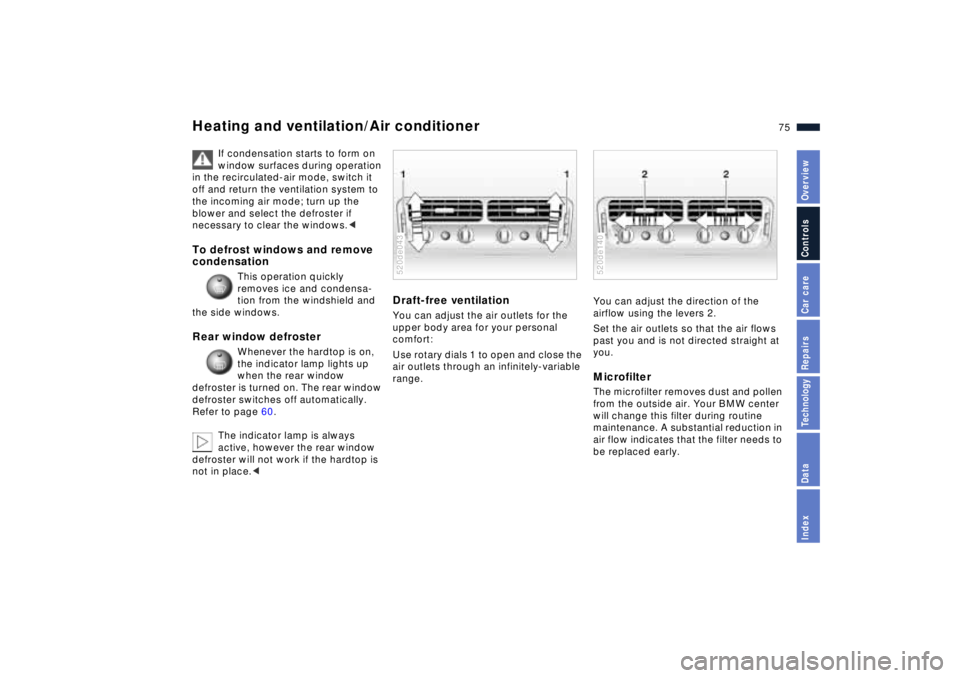
Draft-free ventilation You can adjust the air outlets for the
upper body area for your personal
comfort:
Use rotary dials 1 to open and close the
air outlets through an infinitely-variable
range.520de043
You can adjust the direction of the
airflow using the levers 2.
Set the air outlets so that the air flows
past you and is not directed straight at
you.MicrofilterThe microfilter removes dust and pollen
from the outside air. Your BMW center
will change this filter during routine
maintenance. A substantial reduction in
air flow indicates that the filter needs to
be replaced early.520de140
Page 77 of 170
77n
IndexDataTechnologyRepairsCar careControlsOverview
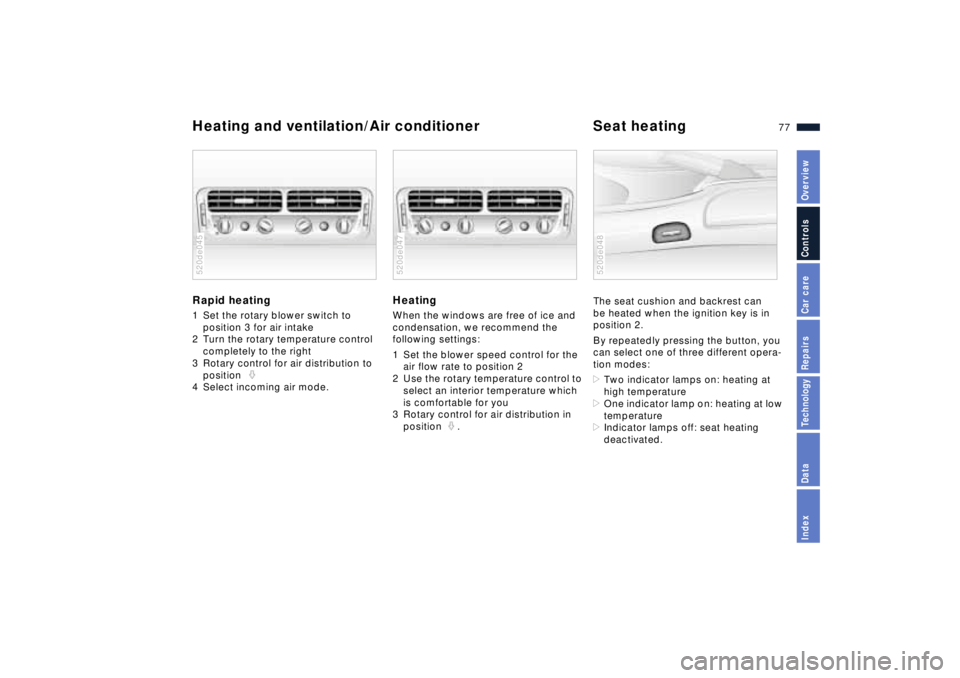
Heating and ventilation/Air conditioner Seat heatingRapid heating 1 Set the rotary blower switch to
position 3 for air intake
2 Turn the rotary temperature control
completely to the right
3 Rotary control for air distribution to
position
4 Select incoming air mode.520de045
HeatingWhen the windows are free of ice and
condensation, we recommend the
following settings:
1 Set the blower speed control for the
air flow rate to position 2
2 Use the rotary temperature control to
select an interior temperature which
is comfortable for you
3 Rotary control for air distribution in
position .520de047
The seat cushion and backrest can
be heated when the ignition key is in
position 2.
By repeatedly pressing the button, you
can select one of three different opera-
tion modes:
>Two indicator lamps on: heating at
high temperature
>One indicator lamp on: heating at low
temperature
>Indicator lamps off: seat heating
deactivated.520de048
Page 91 of 170

91n
IndexDataTechnologyRepairsCar careControlsOverview
Disc brakes Brake systemDriving notesWhen driving in heavy rain and on wet
roads it is advisable to apply light pres-
sure to the brake pedal every few miles.
Monitor traffic conditions to ensure that
this maneuver does not pose a hazard
to you or to other road users. The heat
generated in this braking process helps
dry the pads and rotors.
Maximum braking force is obtained
while the wheels are not locked, but
rather when they are still barely turning
immediately prior to locking. ABS main-
tains this state automatically. If the ABS
fails, you should revert to the staggered
braking technique (refer to page 93).
When descending steep hills and
extended grades, downshift to a gear
that will allow you to continue safely
with only a minimal amount of braking.
By minimizing the loads placed on the
brake system, this strategy helps
ensure that optimal brake system
response will remain available at all
times.
You can enhance the engine's braking
effect by engaging a lower gear, down-
shifting as far as first gear when
descending extremely steep slopes. Even if engine braking fails to slow the
vehicle sufficiently, you should still
make every effort to avoid prolonged
braking with continuous application of
low to moderate pressure at the pedal.
It is better to decelerate the vehicle by
applying a higher level of force at the
pedal (watch following traffic!) and then
subsequently pausing to allow the
brakes to cool briefly before starting on
your next braking cycle. By protecting
brake system components against
overheating, the cooling phases
afforded by this staggered, or intermit-
tent braking technique help maintain
consistent availability of optimal braking
response when it is needed.
Do not coast with the clutch
depressed, the gear-shift lever in
neutral, or, above all, with the engine
off; otherwise, the engine will provide
no braking effect if the transmission is
in neutral, and there is no braking or
steering power assist if the engine is
not running. Never allow floor mats,
carpets or any other objects to obstruct
the accelerator, clutch or brake pedals
and pose a safety hazard by reducing
their available travel range.<
Brake fluid level
The brake warning lamp comes
on with the parking brake
released:
The brake fluid level in the reser-
voir is too low, refer to page 112.
If the brake fluid level is too low
and brake pedal travel has become
noticeably longer, there may be a
defect in one of the brake system's
hydraulic circuits.
Proceed to the nearest BMW
center. Higher brake application
pressure may be necessary under these
conditions, and brake pedal travel may
be significantly longer. Please
remember to adapt your driving style
accordingly.<
Page 92 of 170

92n
Brake system Winter operationBrake pads
The warning lamp for the brake
pads comes on:
The brake pads have reached
their minimum thickness. Proceed to
the nearest BMW center as soon as
possible to have the pads replaced.
For your own safety: use only
brake pads which BMW has
approved for your specific vehicle
model. BMW cannot evaluate non-
approved brake pads to determine if
they are suited for use, and therefore
cannot ensure the operating safety of
the vehicle if they are installed.<
Winter is often accompanied by rapid
changes in weather, requiring not only
a different driving style, but also certain
preparations to the vehicle itself to
ensure that your progress through the
winter months remains safe and
trouble-free. CoolantBe sure that the coolant mixture
contains the year-round ratio of 50:50
water and antifreeze/corrosion protec-
tion. This mixture provides protection
against freezing down to approx. Ð 34 7
(Ð 37 6). LocksBMW door lock deicer can be used to
free doors if frozen. This deicer also
contains lubricant.
After using the deicer, treatment with
BMW lock cylinder grease is recom-
mended.
Rubber seals and components To prevent the weather-stripping from
freezing, apply a spray-on rubber treat-
ment or silicone spray to the door, hood
and luggage compartment lid seals.
A full range of car care products is
available from your BMW center.
on the rear wheels with approved winter
tires. Always follow the manufacturer's
safety precautions. Do not exceed a
maximum speed of 30 mph (50 km/h).
Do not activate the RDW system while
using snow chains. Malfunction warn-
ings and undetected losses in pressure
are possible when driving with snow
chains.
Starting offWhen starting off in deep snow or when
"rocking" the vehicle to free it, it may be
advisable to temporarily deactivate the
DSC system. Refer to page 65.
To maintain vehicle stability,
always drive with the system
switched on whenever possible.<
Page 93 of 170

93n
IndexDataTechnologyRepairsCar careControlsOverview
Winter operationDriving on low-traction road
surfacesDo not activate the Sport mode (refer to
page 66). Use smooth, gentle pressure
to control the accelerator pedal. Avoid
excessive engine speeds and upshift
early. Downshift well in advance when
approaching uphill or downhill
grades. Maintain an adequate distance
between yourself and the vehicle
ahead.BrakesWinter road conditions substantially
reduce the amount of traction available
between the tires and the road surface.
The resulting increases in braking
distance are considerable and should
be kept in mind at all times.
ABS is intended to prevent the wheels
from locking during brake applications,
thus helping to maintain vehicle stability
and steering response.If the ABS does not respond in a critical
braking situation and the wheels lock,
reduce the pressure on the brake pedal
until the wheels just start to roll again
while still maintaining enough force to
continue braking.
Then increase the pressure, reduce the
pressure when the wheels lock, reapply
pressure etc.
This staggered braking procedure will
reduce braking distances while helping
you maintain steering control.
You can always then attempt to steer
around hazards after you have reduced
pressure on the brake pedal.
Never downshift to exploit engine
braking when driving on slippery
road surfaces, as this could lead to a
loss of traction at the rear wheels,
impairing your ability to control the
vehicle.<
Depress the clutch during hard
braking on road surfaces that
provide only poor or uneven traction.<
Skid control Depress the clutch and release the
accelerator pedal. Countersteer care-
fully and attempt to regain control of the
vehicle.ParkingEngage first or reverse gear. Depending
on the steepness of the incline, you can
apply the parking brake as well. In order
to prevent the parking brake pads from
locking due to frost or corrosion, dry
them by gently applying the parking
brake as the vehicle is coming to a stop.
Make sure that following traffic is not
endangered.
The brake lamps do not come
on when the parking brake is
engaged.<
Page 101 of 170

101n
IndexDataTechnologyRepairsCar careControlsOverview
Wheel and tire combinations The right choice
Use only wheels and tires
approved by BMW for the corre-
sponding vehicle model, as otherwise
the tires may make contact with the
body as the result of tolerances despite
the same nominal size being used,
resulting in serious accidents. If non-
approved wheels and tires are used,
BMW cannot evaluate their suitability,
and therefore cannot be held liable for
driving safety.<
For wheel and tire specifications
approved by BMW, refer to page 103.
The correct wheel-tire combina-
tion affects different systems that
otherwise will not function properly,
e.g. ABS, DSC and RDW.
For this reason, use only tires of the
same brand and tread pattern on the
vehicle and, for example, restore the
approved wheel-tire combination
following a flat tire as soon as
possible.<
Codes on tires and wheels The code on tires has the following
meaning.
Codes on radial tires:
The speed rating indicates the approved
maximum speed for the tire.
Summer tires:
S = up to 112 mph (180 km/h)
T = up to 118 mph (190 km/h)
H = up to 130 mph (210 km/h)
V = up to 150 mph (240 km/h)
W = up to 167 mph (270 km/h)
Y = up to 186 mph (300 km/h)
ZR = over 150 mph (240 km/h) For example:
Nominal width
in mm
Aspect ratio in X
Radial tire code
Rim diameter in inches
Load rating
(not on ZR tires)
Speed rating
(before R on ZR tires)
245/45 R 18 96 W
Winter tires:
Q M+S = up to 100 mph (160 km/h)
T M+S = up to 118 mph (190 km/h)
H M+S = up to 130 mph (210 km/h)
Codes on light-alloy wheels:
Protect tire valves from dirt by using
screw-on valve stem caps. Dirt in the
valves frequently leads to slow leaks.
Tires with emergency driving character-
istics also possess an additional identi-
fication mark that varies by manufac-
turer, e. g.:
Bridgestone RFT
Dunlop DSST
Goodyear EMT
Michelin ZPStorage Store tires in a cool, dry place,
protecting them against light when-
ever possible. Protect the tires against
contact with oil, grease and fuel. For example:
Rim width
in inches
Code letter for
flange type
Symbol for full-drop
center rim
Rim diameter in inches
Hump on the 2 rim shoulders
8x18EH 2
J