battery BMW Z8 2001 User Guide
[x] Cancel search | Manufacturer: BMW, Model Year: 2001, Model line: Z8, Model: BMW Z8 2001Pages: 170, PDF Size: 1.64 MB
Page 87 of 170

87n
IndexDataTechnologyRepairsCar careControlsOverview
Brakes:
Do not rest your foot on the brake
pedal while driving. Even light but
consistent pressure on the brake pedal
could lead to high temperatures, brake
wear, and possibly, to brake system
failure.
Aquaplaning:
Reduce speed while driving on wet or
slushy roads, otherwise, a wedge of
water can form between the tires and
the road surface. This phenomenon is
referred to as "aquaplaning" or "hydro-
planing." It is characterized by a partial
or complete loss of contact between
the tires and the road surface. The ulti-
mate results are loss of steering and
braking control.
Driving through water:
When there is water on the roads, do
not drive in it if it is deeper than 1 ft
(30 cm), and even then, only at walking
speed, otherwise the vehicle can
sustain damage to the engine, the elec-
trical systems and the transmission.<
The catalytic converter reduces harmful
exhaust emissions.
It is designed for use with unleaded fuel
only. Even minute quantities of lead
would be enough to permanently
damage both the catalytic converter
and the system oxygen sensor.To ensure efficient, trouble-free engine
operation and to avoid potential damage:>Be sure to comply with the scheduled
maintenance requirements
>Fill the fuel tank well before it is empty
>Tow-start only when the engine is
cold. If you attempt to tow-start with
a warm engine, unburned residual
fuel in the catalytic converter could
ignite and cause damage. It is better
to start the vehicle with a battery
charger or assistance from another
vehicle
>Avoid other situations where the fuel
is either not burned or burns incom-
pletely, such as engaging the starter
frequently or for extended periods, or
repeated start attempts in which the
engine does not start (stopping and
restarting an engine which is running
properly does not present a pro-
blem). Never allow the engine to run
with any of the spark plug cables
disconnected.Be sure to comply with the
instructions above to prevent
unburned fuel from reaching the cata-
lytic converter. Otherwise, there is the
danger of overheating and damage to
the catalytic converter.
Extreme temperatures are present with
the catalytic converter both on this and
every catalytic converter-equipped
vehicle. Heat shields are installed adja-
cent to some sections of the exhaust
system. Never remove these shields;
do not apply undercoating to their
surfaces. When driving, standing at
idle, and parking the vehicle, take care
to avoid contact between the exhaust
system and flammable materials (grass,
hay, leaves etc.). Such contact could
start a fire, resulting in serious personal
injury and property damage.<
Driving notes Catalytic converter
Page 104 of 170
104n
Never attempt to carry out service
or repair operations on your
vehicle if you do not have the required
technical background. Always switch
off the engine and allow it to cool down
before working in the engine compart-
ment. Always disconnect the battery
before working on any electrical
systems or equipment, especially when
these are located within the engine
compartment. Comply with all appli-
cable instructions and safety precau-
tions. Failure to work in an informed,
professional manner when servicing
components and materials constitutes
a safety hazard for vehicle occupants
and other road users. If you are not
familiar with official servicing proce-
dures, please have the work performed
by your BMW center.<
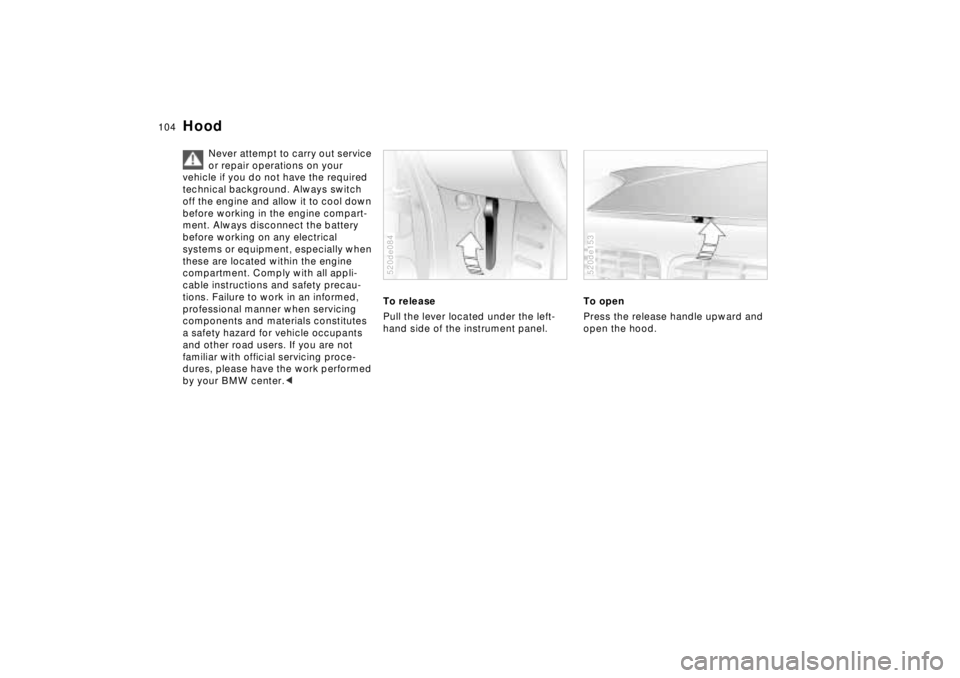
To release
Pull the lever located under the left-
hand side of the instrument panel. 520de084
To open
Press the release handle upward and
open the hood.520de153
Hood
Page 122 of 170

122n
Vehicle storage
If the vehicle is to be stored for
more than three months, ensure
that the following service operations
are carried out first.<
Preparations for storageHave your BMW center perform the
following procedures:
1 Clean and apply a rust proofing agent
or other treatment to the engine,
engine compartment, undercarriage,
axles and major components in accor-
dance with approved repair proce-
dures. Wash the vehicle, clean the
interior and treat painted and
chromed parts. Clean the weather-
stripping around the hood, luggage
compartment and doors
2 Change engine oil and oil filter at
operating temperature. As an addi-
tional corrosion protection measure,
an anticorrosive agent can be added
to the engine in accordance with the
manufacturer's instructions
3 Check the coolant level and concen-
tration and top off if necessary
4 Check the fluid level of the wind-
shield washer fluid reservoir; top off
if necessary
5 Fill the fuel tank completely to
prevent the formation of condensa-
tion
6 Increase the tire inflation pressure to
51 psi (350 kPa).Before parking the vehicle1 Dry the parking brake and footbrake
by brake applications to prevent the
brake discs and drums from
corroding
2 Park the vehicle in a covered, dry,
and well-ventilated area. Place the
transmission in first gear or, if neces-
sary, chock the wheels to prevent the
vehicle from rolling. Do not engage
the parking brake
3 Remove the battery, charge it
completely and store it in a cool (but
frost-free) room
4 Remove the hardtop and store it
separately, refer to page 96
5 Close the convertible top.
During storageRecharge a battery that has been taken
out of the car every six months. If it is
not recharged, it will not be serviceable.
Every time the battery is discharged,
especially over extended periods, its
service life is reduced.Removing the vehicle from
storageRecharge the battery if the "Magic Eye"
turns black, refer to page 136.
Then have Inspection I performed by
your BMW center, including a brake
fluid replacement, if necessary. Refer to
the Service and Warranty Information
Booklet (US models) or the Warranty
and Service Guide Booklet (Canadian
models).
Page 127 of 170
Overview
Controls and features
Operation, care
and maintenance
Owner service procedures
Technical data
Index Advanced technology
127n
IndexDataTechnologyRepairsCar careControlsOverview
Replacement procedures:
Onboard tool kit128
Windshield wiper blades128
Lamps and bulbs129
Changing a wheel135
Battery136
Fuses138
In case of electrical
malfunction:
Fuel filler door140
Luggage compartment lid,
storage compartment140
Passenger door141
Closing the convertible top141
Giving and receiving
assistance:
Jump starting143
Towing the vehicle144
Repairs
Page 129 of 170
129n
IndexDataTechnologyRepairsCar careControlsOverview
Lamps and bulbs The lamps and bulbs make essential
contributions to the safety of your
vehicle. Therefore, comply fully with the
following instructions during bulb
replacement. If you are not familiar with
any of the procedures, consult your
BMW center.
Do not touch the glass portion of
a new bulb with your bare hands
since even small amounts of impurities
burn into the surface and reduce the
service life of the bulb. Use a clean
cloth, paper napkin, or a similar material,
or hold the bulb by its metallic base.<
A replacement bulb set is available from
your BMW center.
Whenever working on the elec-
trical system, switch off the elec-
trical accessory you are working on or
disconnect the cable from the negative
terminal of the battery. Failure to do this
could result in short circuits.
To prevent injuries and damage,
comply with any instructions provided
by the bulb manufacturer.<
When cleaning the headlamps,
please observe the following:
>Do not wipe dry (scratches). Never
use abrasives or strong solvents to
clean the covers
>Remove dirt and contamination (such
as insects) by soaking with BMW Car
Shampoo and then rinsing with plenty
of water
>Always use a deicer spray to remove
accumulated ice and snow Ð never
use a scraper.<
Xenon lamps
The main headlamps for your BMW
Z8 roadster have been designed using
xenon-light technology. The service life
of these bulbs is very long and the
probability of a failure is very low,
provided that they are not switched on
and off an unusual number of times.
Should a lamp ever fail, however,
please contact your BMW center for
assistance.
The xenon light unit operates at
extremely high voltages; contact
with the unit's electrical components
can be fatal. We therefore urge you to
refer all service and repairs, including
bulb changes, to qualified professional
technicians.<
Neon lampsThe front turn signal indicators (side
marker lamps), the rear turn signal indi-
cators, the rear and brake lamps, as
well as the high-mount brake lamp, are
of neon-light technology. The service
life for these lamps is very high and the
likelihood of failure very minimal.
Should a lamp ever fail, however,
please contact your BMW center for
assistance.
Page 136 of 170
136n
Battery
Battery posts, terminals, and
related accessories contain lead
and lead compounds. Wash hands after
handling.<
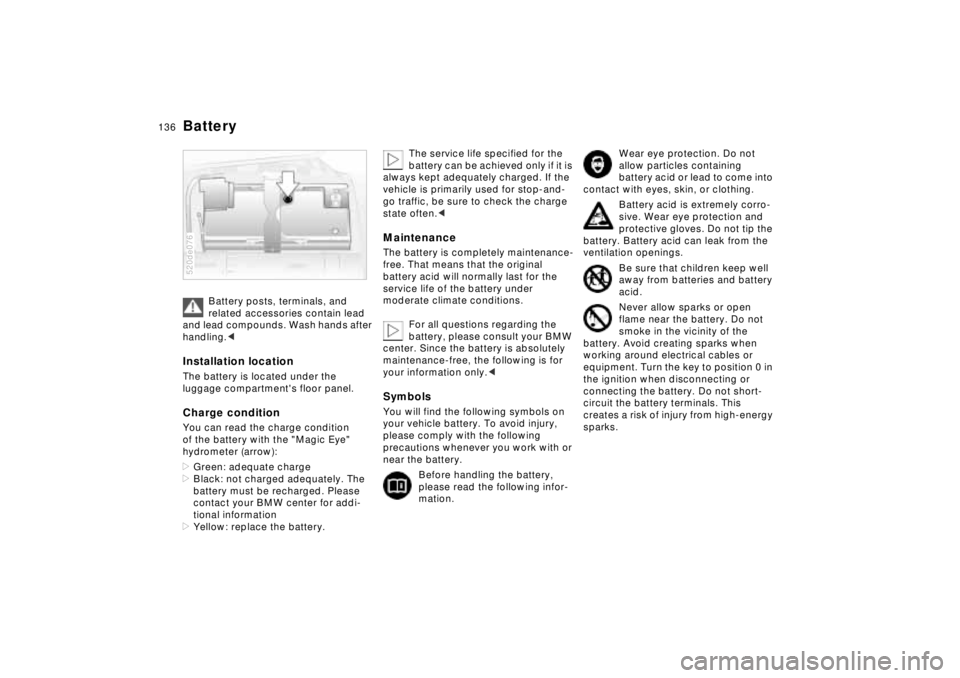
Installation location The battery is located under the
luggage compartment's floor panel.Charge conditionYou can read the charge condition
of the battery with the "Magic Eye"
hydrometer (arrow):
>Green: adequate charge
>Black: not charged adequately. The
battery must be recharged. Please
contact your BMW center for addi-
tional information
>Yellow: replace the battery.520de076
The service life specified for the
battery can be achieved only if it is
always kept adequately charged. If the
vehicle is primarily used for stop-and-
go traffic, be sure to check the charge
state often.<
MaintenanceThe battery is completely maintenance-
free. That means that the original
battery acid will normally last for the
service life of the battery under
moderate climate conditions.
For all questions regarding the
battery, please consult your BMW
center. Since the battery is absolutely
maintenance-free, the following is for
your information only.
please comply with the following
precautions whenever you work with or
near the battery.
Before handling the battery,
please read the following infor-
mation.
Wear eye protection. Do not
allow particles containing
battery acid or lead to come into
contact with eyes, skin, or clothing.
Battery acid is extremely corro-
sive. Wear eye protection and
protective gloves. Do not tip the
battery. Battery acid can leak from the
ventilation openings.
Be sure that children keep well
away from batteries and battery
acid.
Never allow sparks or open
flame near the battery. Do not
smoke in the vicinity of the
battery. Avoid creating sparks when
working around electrical cables or
equipment. Turn the key to position 0 in
the ignition when disconnecting or
connecting the battery. Do not short-
circuit the battery terminals. This
creates a risk of injury from high-energy
sparks.
Page 137 of 170
137n
IndexDataTechnologyRepairsCar careControlsOverview
Battery
A highly explosive gas is
generated when the battery is
charged.
If you happen to get acid in
your eyes, rinse thoroughly for
some minutes with clear water.
Consult a physician immediately. If you
get acid spray on your skin or clothing,
rinse with plenty of water. If acid is acci-
dentally ingested, consult a physician
immediately.
In order to protect the battery
case from ultraviolet radiation,
do not place it in direct sunlight.
A discharged battery can freeze. Store
the battery in areas where temperature
remains above freezing.
Removing and installing
Do not disconnect the battery
cable when the engine is running.
Disconnecting the battery cable when
the engine is running will cause a
voltage surge which will damage the
vehicle's onboard electronics.
Do not make any modifications in the
wires to the positive terminal. If you do
so, the protective function of the safety
battery terminal is no longer ensured.
Repairs and disposal may only be
performed by specially trained
personnel.<
When removing, first disconnect the
cable to the negative terminal, then
disconnect the cable to the positive
terminal. Loosen the center adjusting
screw for the battery's retaining strap
(use the screwdriver found in the
onboard tool kit) and remove the
bracket.
When installing, first connect the cable
for the positive terminal, then the cable
for the negative terminal.
When installing, make sure that
the battery is seated properly, and
that the battery bracket is installed with
the center adjusting screw. Failure to
observe these precautions could result
in an inadequately secured battery,
which could then shift in an accident.<
Charging the battery Charge the battery in the vehicle only
when the engine is not running. Use the
connections provided in the engine
compartment (for correct connections,
refer to "Jump starting" on page 143).
Before performing any work on
the electrical system, disconnect
the cable from the negative terminal. If
you do not, short circuits can create the
risk of fire or personal injury.<
If you plan to park the vehicle for longer
than 4 weeks, disconnect the battery
from the vehicle's electrical system by
disconnecting the cable at the negative
terminal. Then recharge the battery with
an appropriate battery charger.
If you intend to store the vehicle for
longer than 12 weeks, remove the
battery, charge it and store it in a cool
and dust-free room where there is no
danger of freezing. During storage,
have the battery recharged every six
months. Also, recharge the battery
before it is reinstalled. Failure to
observe these precautions can render
the battery unsuitable for continued
use. Every time the battery is
discharged, especially over extended
periods, its service life is reduced.
Page 138 of 170
138n
Battery Fuses
Return used batteries to a recy-
cling point or your BMW center.
Maintain the battery in an upright posi-
tion for transport and storage. Secure
the battery to prevent it from tilting
during transport.<
If an electrical accessory should fail,
switch it off and check the fuse.
The fuses, their individual ampere
ratings and the equipment in the
circuits they protect are all indicated on
the cover of the fuse box in the glove
compartment and on the inside of the
cover panel for the storage compart-
ment located behind the passenger's
seat.
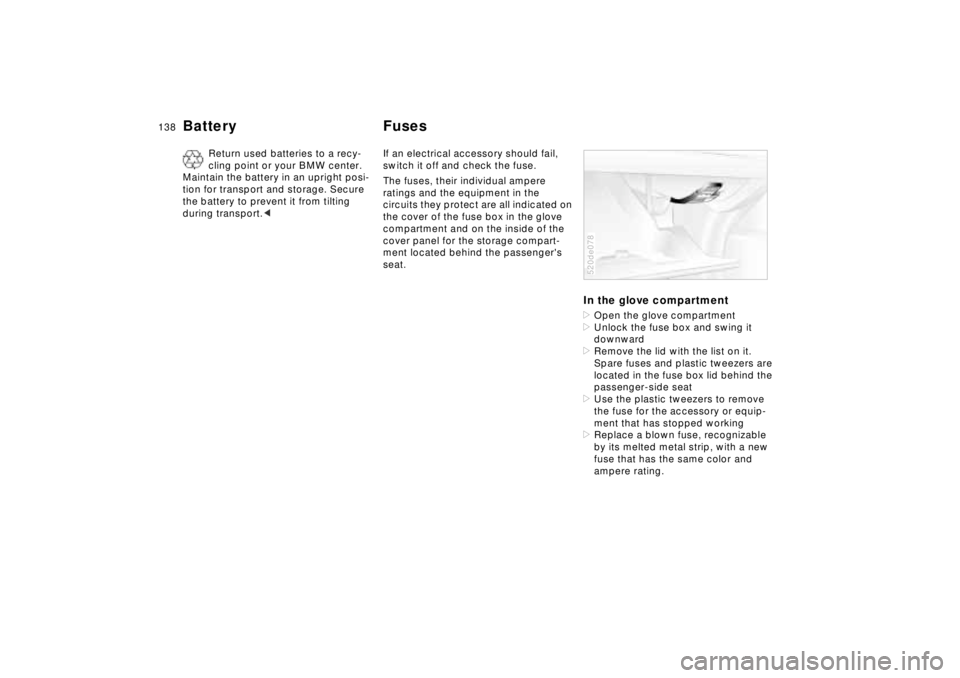
In the glove compartment>Open the glove compartment
>Unlock the fuse box and swing it
downward
>Remove the lid with the list on it.
Spare fuses and plastic tweezers are
located in the fuse box lid behind the
passenger-side seat
>Use the plastic tweezers to remove
the fuse for the accessory or equip-
ment that has stopped working
>Replace a blown fuse, recognizable
by its melted metal strip, with a new
fuse that has the same color and
ampere rating.520de078
Page 143 of 170
143n
IndexDataTechnologyRepairsCar careControlsOverview
Do not use spray starter fluids to start
the engine.
If the battery is discharged, the engine
can be started with the use of two
jumper cables and the battery of
another vehicle. Use only jumper cables
with fully insulated grips on the terminal
clamps.
Do not touch the parts conducting
current while the engine is
running. There is a risk of fatal injury if
you do this.<
Carefully comply with the following
instructions to avoid personal injury or
damage to one or both vehicles:
1 Be sure that the battery on the
support vehicle is also rated at
12 volts, and that the capacities of
the two batteries (Ah) are roughly
comparable (refer to printing on
casing)
2 Leave the discharged battery
connected to the vehicle's electrical
system
3 Make sure that there is no contact
between the bodywork of the two
vehicles Ð short circuit risk!
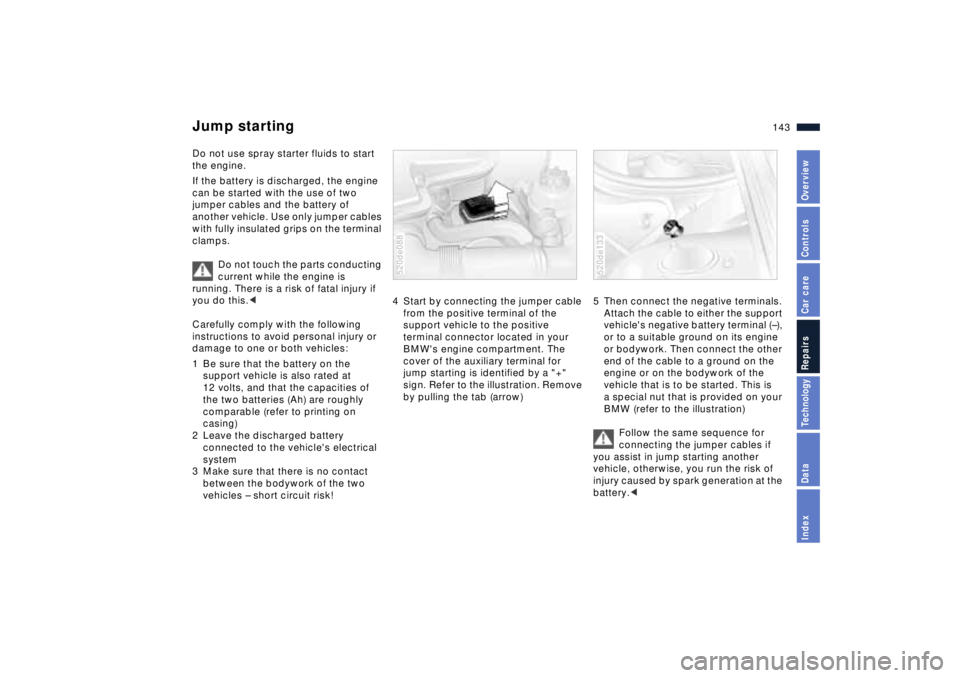
4 Start by connecting the jumper cable
from the positive terminal of the
support vehicle to the positive
terminal connector located in your
BMW's engine compartment. The
cover of the auxiliary terminal for
jump starting is identified by a "+"
sign. Refer to the illustration. Remove
by pulling the tab (arrow) 520de088
5 Then connect the negative terminals.
Attach the cable to either the support
vehicle's negative battery terminal (Ð),
or to a suitable ground on its engine
or bodywork. Then connect the other
end of the cable to a ground on the
engine or on the bodywork of the
vehicle that is to be started. This is
a special nut that is provided on your
BMW (refer to the illustration)
Follow the same sequence for
connecting the jumper cables if
you assist in jump starting another
vehicle, otherwise, you run the risk of
injury caused by spark generation at the
battery.<520de133
Jump starting
Page 144 of 170
144n
Jump starting Towing the vehicle6 Start the support vehicle's engine
and let it run
7 Start the engine on the vehicle
needing the jump start, and allow it to
run as usual. If the first start attempt
is not successful, wait a few minutes
before another attempt in order to
allow the discharged battery to
recharge
8 Before disconnecting the jumper
cables from your BMW, turn on the
lamps, set the blower to the highest
speed and allow the engine to run for
at least 10 seconds. This will prevent
a voltage surge from the voltage
regulator to the electrical accessories
9 Then disconnect the jumper cables in
reverse sequence.
Have the battery recharged if necessary.
Tow fittingThe screw-in tow fitting is stored in the
onboard tool kit; be sure that it remains
in the vehicle at all times. This fitting
is designed for installation in the tow
sockets located at the front and rear of
the vehicle. It is intended for towing on
paved road surfaces only.
It should not be used to pull a vehicle
out of deep snow, mud, sand, etc.
Always observe all applicable towing
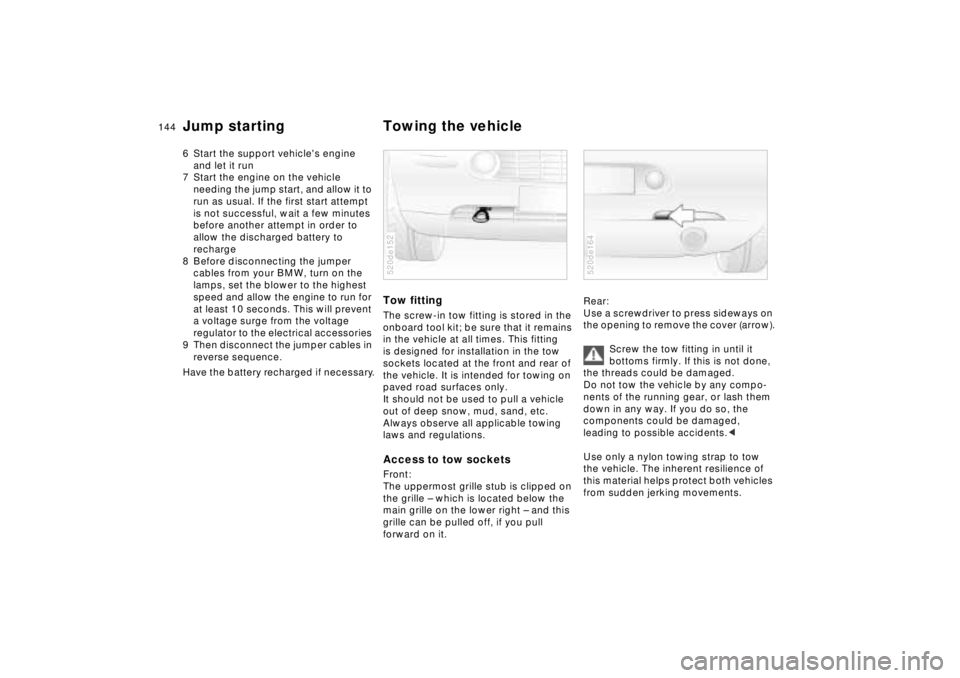
laws and regulations.Access to tow socketsFront:
The uppermost grille stub is clipped on
the grille Ð which is located below the
main grille on the lower right Ð and this
grille can be pulled off, if you pull
forward on it.520de152
Rear:
Use a screwdriver to press sideways on
the opening to remove the cover (arrow).
Screw the tow fitting in until it
bottoms firmly. If this is not done,
the threads could be damaged.
Do not tow the vehicle by any compo-
nents of the running gear, or lash them
down in any way. If you do so, the
components could be damaged,
leading to possible accidents.<
Use only a nylon towing strap to tow
the vehicle. The inherent resilience of
this material helps protect both vehicles
from sudden jerking movements.520de164