ESP BMW Z8 2001 Owner's Manual
[x] Cancel search | Manufacturer: BMW, Model Year: 2001, Model line: Z8, Model: BMW Z8 2001Pages: 170, PDF Size: 1.64 MB
Page 95 of 170
95n
IndexDataTechnologyRepairsCar careControlsOverview
Wind deflector MountingAttach the wind deflector while the
convertible top is open and its cover is
not mounted.
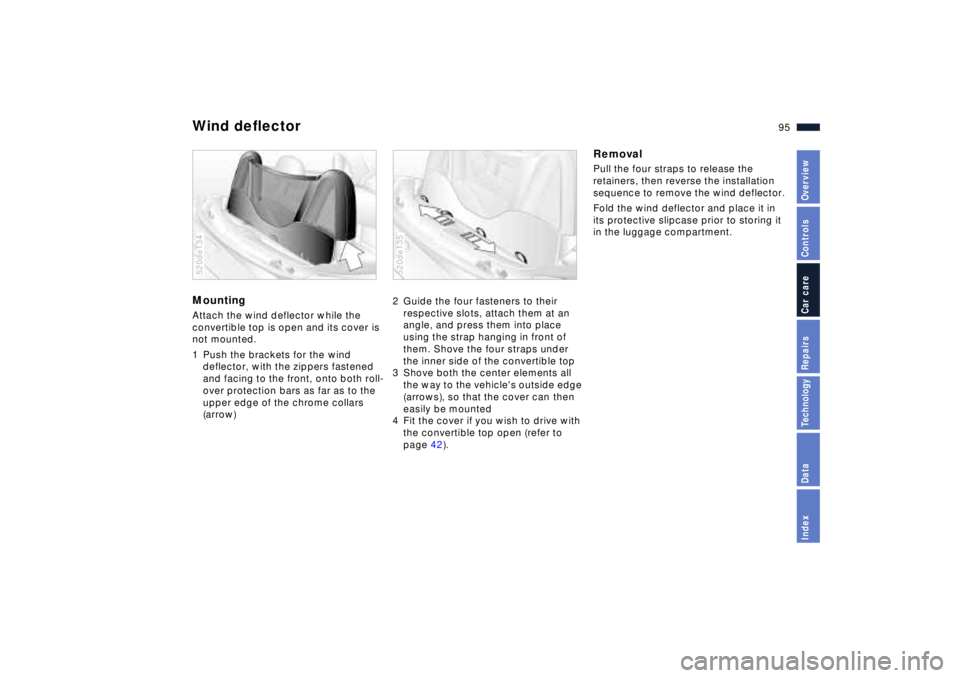
1 Push the brackets for the wind
deflector, with the zippers fastened
and facing to the front, onto both roll-
over protection bars as far as to the
upper edge of the chrome collars
(arrow) 520de134
2 Guide the four fasteners to their
respective slots, attach them at an
angle, and press them into place
using the strap hanging in front of
them. Shove the four straps under
the inner side of the convertible top
3 Shove both the center elements all
the way to the vehicle's outside edge
(arrows), so that the cover can then
easily be mounted
4 Fit the cover if you wish to drive with
the convertible top open (refer to
page 42).520de135
RemovalPull the four straps to release the
retainers, then reverse the installation
sequence to remove the wind deflector.
Fold the wind deflector and place it in
its protective slipcase prior to storing it
in the luggage compartment.
Page 99 of 170

99n
IndexDataTechnologyRepairsCar careControlsOverview
Avoid overloading the vehicle so
that the permitted load on the tires
is not exceeded. Overloading can lead
to overheating and increases the rate
at which damage develops inside the
tires. You could have a blowout as a
result.
Unusual vibrations encountered during
normal vehicle operation can indicate
tire failure or some other vehicle defect,
as can variations in normal vehicle
response, such as a pronounced
tendency to pull to the left or right.
Should this occur, respond by immedi-
ately reducing your speed. Proceed
carefully to the nearest BMW center or
professional tire center, or have the
vehicle towed in to have it and its tires
inspected.
Tire damage can endanger the lives of
both the vehicle occupants and other
road users.<
To maintain good handling and vehicle
response, use only tires of a single tread
configuration from a single manufac-
turer. BMW tests and approves wheel/
tire combinations. Refer to page 103.DOT Quality GradesTread wear
Traction AA A B C
Temperature A B C
All passenger vehicle tires
must conform to Federal Safety
Requirements in addition to these
grades.
when tested under controlled condi-
tions on a specified government test
course.
For example, a tire graded 150 would
wear one and one-half (1g) times as
well on the government course as a tire
graded 100. The relative performance
of tires depends upon the actual condi-
tions of their use, however, and may
depart significantly from the norm due
to variations in driving habits, service
practices and differences in road char-
acteristics and climate.
TractionThe traction grades, from highest to
lowest, are AA, A, B and C.
Those grades represent the tire's ability
to stop on wet pavement as measured
under controlled conditions on speci-
fied government test surfaces of
asphalt and concrete. A tire marked C
may have poor traction performance.
The traction grade assigned to
this tire is based on straight-
ahead braking traction tests, and does
not include acceleration, cornering,
aquaplaning, or peak traction charac-
teristics.<
Tire condition Tire replacement
Page 100 of 170

100n
Tire replacement Tire rotation TemperatureThe temperature grades are A (the
highest), B and C, representing the
tire's resistance to the generation of
heat and its ability to dissipate heat
when tested under controlled condi-
tions on a specified indoor laboratory
test wheel.
Sustained high temperature can cause
the tire material to degenerate and
reduce tire life, and excessive tempera-
ture can lead to sudden tire failure. The
Grade C corresponds to a level of
performance which all passenger
vehicle tires must meet under the
Federal Motor Vehicle Safety Standard
No. 109. Grades B and A represent
higher levels of performance on the
laboratory test wheel than the minimum
required by law.
The temperature grade for this
tire is established for a tire that is
properly inflated and not overloaded.
Excessive speed, underinflation, or
excessive loading, either separately or
in combination, can cause heat buildup
and possibly a flat tire.<
Uniform Tire Quality GradingQuality grades can be found where
applicable on the tire sidewall between
tread shoulder and maximum section
width. For example:
Tread wear 200 Traction AA
Temperature A
Use only tires with emergency
driving characteristics as there is
no spare tire available if you get a flat
tire. For further information, refer to
page 135.
sidewall:
DOT ... 1200 indicates that the tire was
manufactured in week 12 of 2000.
Although tires may have a theoretical
service life of up to 10 years, BMW
strongly recommends that you replace
all tires after an absolute maximum of
6 years.
Between the axles
If different tire sizes are mounted
on the front and rear axles (refer to
page 103), then the tires may not be
rotated from one axle to the other.<
The tread wear patterns at the front end
differ from those at the rear Ð the actual
patterns will vary according to indi-
vidual driving conditions. In the inter-
ests of safety and maintaining optimal
handling characteristics, tire rotation is
not recommended.
Page 101 of 170

101n
IndexDataTechnologyRepairsCar careControlsOverview
Wheel and tire combinations The right choice
Use only wheels and tires
approved by BMW for the corre-
sponding vehicle model, as otherwise
the tires may make contact with the
body as the result of tolerances despite
the same nominal size being used,
resulting in serious accidents. If non-
approved wheels and tires are used,
BMW cannot evaluate their suitability,
and therefore cannot be held liable for
driving safety.<
For wheel and tire specifications
approved by BMW, refer to page 103.
The correct wheel-tire combina-
tion affects different systems that
otherwise will not function properly,
e.g. ABS, DSC and RDW.
For this reason, use only tires of the
same brand and tread pattern on the
vehicle and, for example, restore the
approved wheel-tire combination
following a flat tire as soon as
possible.<
Codes on tires and wheels The code on tires has the following
meaning.
Codes on radial tires:
The speed rating indicates the approved
maximum speed for the tire.
Summer tires:
S = up to 112 mph (180 km/h)
T = up to 118 mph (190 km/h)
H = up to 130 mph (210 km/h)
V = up to 150 mph (240 km/h)
W = up to 167 mph (270 km/h)
Y = up to 186 mph (300 km/h)
ZR = over 150 mph (240 km/h) For example:
Nominal width
in mm
Aspect ratio in X
Radial tire code
Rim diameter in inches
Load rating
(not on ZR tires)
Speed rating
(before R on ZR tires)
245/45 R 18 96 W
Winter tires:
Q M+S = up to 100 mph (160 km/h)
T M+S = up to 118 mph (190 km/h)
H M+S = up to 130 mph (210 km/h)
Codes on light-alloy wheels:
Protect tire valves from dirt by using
screw-on valve stem caps. Dirt in the
valves frequently leads to slow leaks.
Tires with emergency driving character-
istics also possess an additional identi-
fication mark that varies by manufac-
turer, e. g.:
Bridgestone RFT
Dunlop DSST
Goodyear EMT
Michelin ZPStorage Store tires in a cool, dry place,
protecting them against light when-
ever possible. Protect the tires against
contact with oil, grease and fuel. For example:
Rim width
in inches
Code letter for
flange type
Symbol for full-drop
center rim
Rim diameter in inches
Hump on the 2 rim shoulders
8x18EH 2
J
Page 102 of 170

102n
Special features of winter tires Snow chains
*
Choosing the right tireFor winter road driving, BMW recom-
mends winter tires (M+S radial belt
tires). Although all-season M+S tires
provide better winter traction than stan-
dard summer tires with H, V, W and ZR
speed ratings, they generally fail to
provide the same levels of performance
as standard snow tires in winter driving.
In the interests of safe tracking and
steering response, install radial tires
made by the same manufacturer and
with the same tread configuration on all
four wheels if you elect to mount winter
tires.
Use only winter tires with emer-
gency driving characteristics as
there is no spare tire available if you get
a flat tire.
For further information, refer to
page 135.<
Do not exceed specified
maximum speeds
Never exceed the maximum speed
for which winter tires are rated.
Unprofessional attempts by laymen to
service tires can lead to damage and
accidents.
Have this work performed by skilled
professionals only. Your BMW center
will be glad to assist you with both their
expertise and the proper equipment for
your vehicle.<
Tire condition, tire pressureOnce the tread depth on winter tires is
less than 0.16 in (4 mm), they are no
longer suitable for winter road driving,
and in the interest of safety should be
replaced.
Comply with the specified tire inflation
pressures Ð and be sure to have the
wheel and tire assemblies balanced
every time you change the tires.
The use of narrow-link BMW snow
chains is permissible in pairs only on
the rear wheels with winter tires with
tire size 245/45 R 18 96 H. Comply with
all manufacturer's safety precautions
when mounting the chains.
Do not activate the RDW system
while using snow chains.
Malfunction warnings and undetected
losses in pressure are possible when
driving with snow chains.
For further information, refer to
page 67.<
Page 104 of 170
104n
Never attempt to carry out service
or repair operations on your
vehicle if you do not have the required
technical background. Always switch
off the engine and allow it to cool down
before working in the engine compart-
ment. Always disconnect the battery
before working on any electrical
systems or equipment, especially when
these are located within the engine
compartment. Comply with all appli-
cable instructions and safety precau-
tions. Failure to work in an informed,
professional manner when servicing
components and materials constitutes
a safety hazard for vehicle occupants
and other road users. If you are not
familiar with official servicing proce-
dures, please have the work performed
by your BMW center.<
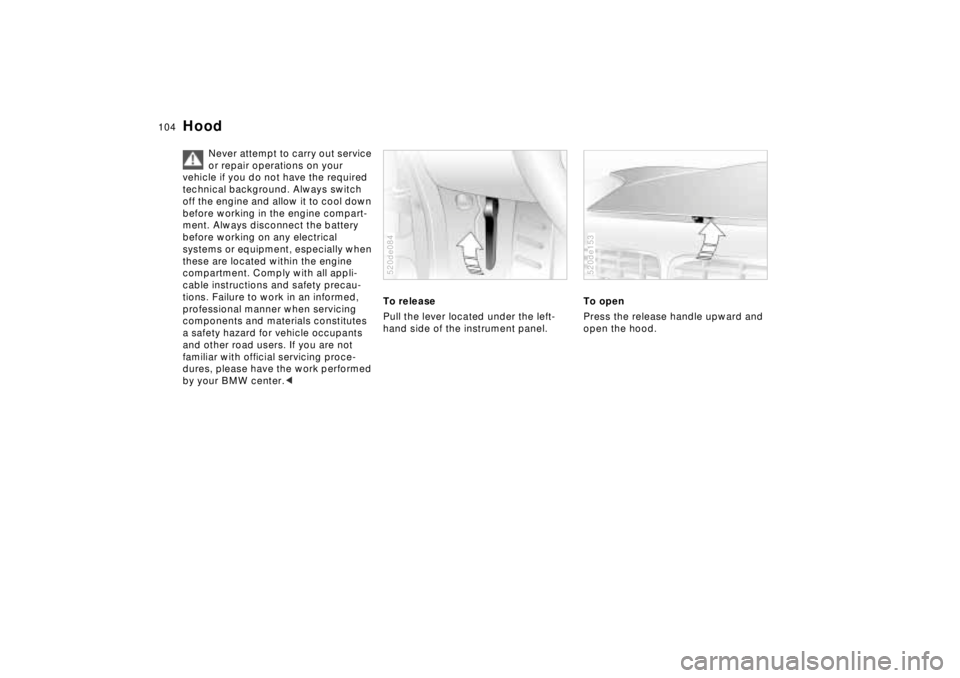
To release
Pull the lever located under the left-
hand side of the instrument panel. 520de084
To open
Press the release handle upward and
open the hood.520de153
Hood
Page 109 of 170
109n
IndexDataTechnologyRepairsCar careControlsOverview
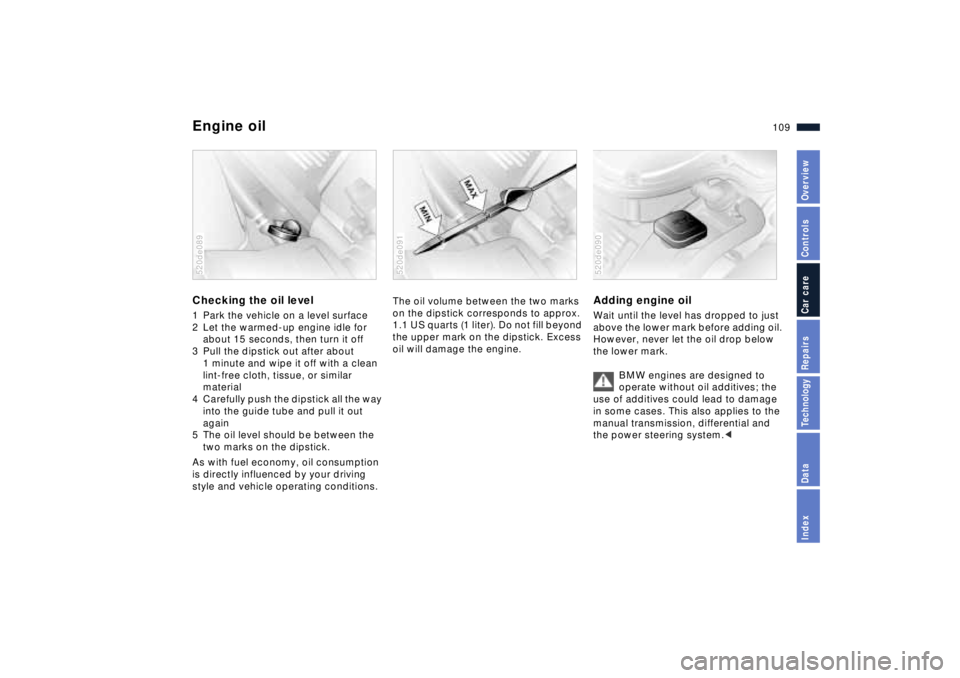
Engine oilChecking the oil level 1 Park the vehicle on a level surface
2 Let the warmed-up engine idle for
about 15 seconds, then turn it off
3 Pull the dipstick out after about
1 minute and wipe it off with a clean
lint-free cloth, tissue, or similar
material
4 Carefully push the dipstick all the way
into the guide tube and pull it out
again
5 The oil level should be between the
two marks on the dipstick.
As with fuel economy, oil consumption
is directly influenced by your driving
style and vehicle operating conditions.520de089
The oil volume between the two marks
on the dipstick corresponds to approx.
1.1 US quarts (1 liter). Do not fill beyond
the upper mark on the dipstick. Excess
oil will damage the engine.520de091
Adding engine oil Wait until the level has dropped to just
above the lower mark before adding oil.
However, never let the oil drop below
the lower mark.
BMW engines are designed to
operate without oil additives; the
use of additives could lead to damage
in some cases. This also applies to the
manual transmission, differential and
the power steering system.<520de090
Page 115 of 170

115n
IndexDataTechnologyRepairsCar careControlsOverview
Washing your vehicle You can have your new BMW washed
in an automatic car wash. Car wash
systems that do not employ brushes
are preferable.
Wipe away tough dirt and loosen and
remove dead insects before washing
the vehicle.
In order to avoid spots, do not wash the
vehicle when the hood is warm, or
during or immediately after exposure to
strong sunlight.
In order to protect your convertible top,
do not use washing programs featuring
wax application on your vehicle. The
small amount of beading wax always
used in automatic car washes will not
harm the convertible top.
When using an automatic car wash, be
sure that
>the car wash system is suited for the
dimensions of your vehicle
>no damage will occur on vehicles
with attached body accessories (such
as spoilers or antennas). Consult the
car wash operator if necessary >the wheels and tires of your vehicle
cannot be damaged by the convey-
ance devices of the car wash system
>the vehicle is cleaned with minimum
brush pressure, and that ample water
is available for washing and rinsing.
Parts of the vehicle which are inacces-
sible to the automatic washer Ð such as
door sills, door and hood edges, etc. Ð
should be cleaned by hand.
In the winter months, it is especially
important to ensure that the vehicle is
washed on a regular basis. Large quan-
tities of dirt and road salt are difficult to
remove, and they also cause damage to
the vehicle.
If spray wands or high-pressure
washers are used, be sure to
maintain an adequate distance between
the spray source and the vehicle's
surface. Inadequate distance and
excessive pressure can damage or
weaken the finish, making it more
susceptible to further damage. In addi-
tion, moisture could penetrate to
vehicle components, leading to long-
term damage.<
When cleaning the headlamps,
please observe the following:
>Do not clean by wiping with a dry
cloth. Never use abrasives or strong
solvents to clean the covers
>Remove dirt and contamination (such
as insects) by soaking with BMW Car
Shampoo and then rinsing with plenty
of water
>Always use a deicer spray to remove
accumulated ice and snow Ð never
use a scraper.<
After washing the vehicle, apply
the brakes briefly to dry them.
Braking efficiency might otherwise be
reduced by the moisture and the brake
rotors could also be corroded.<
Caring for your vehicle
Page 116 of 170

116n
Caring for your vehicleCleaning and care of the
convertible topThe appearance and life of the convert-
ible top are highly dependent on its
proper care and operation. You should
pay particular attention to the following
instructions if your vehicle has a light-
colored top.
Protect the vehicle from exposure to
intense sunlight whenever possible by
parking it in the shade. This will help
to prevent the paint, rubber and fabric-
covered parts from being attacked.
Never fold up the convertible top and
store it in the convertible top compart-
ment when it is wet, dirty or frozen, as
mildew stains and chafe spots may
result.
To prevent the formation of a crease
in the rear window and to avoid mildew
stains, do not leave the top folded in the
convertible top compartment for long
periods.
If the vehicle will be parked for lengthy
periods in an enclosed space, be sure
that the convertible top is dry and that
there is adequate ventilation.Clean off bird droppings immediately,
since they attack the convertible top
and cause the rubber seals to swell due
to their caustic characteristics.
Besides water, treat rubber seals only
with talcum powder, rubber care prod-
ucts or silicone spray, particularly when
they feel dry or tend to stick.
Eliminate noises such as squeaks with
lubricant spray.
Never use sharp-edged objects to
clean the rear window of snow or ice.
If using a deicer spray, make sure that
none of the spray comes into contact
with the convertible top. Because of the
risk of damage and discoloration, do
not apply adhesive tape, stickers, or
similar materials to the window or cover
with plastic film. Dents and discoloration may show up
on the convertible top because of
improper care, cleaning or as the result
of excessive usage. The convertible top
and its seams may also develop leaks.
These problems are not covered by the
warranty. For repairs, please consult
your BMW center.
Special wash for the topRespond to more extensive dirt, which
is especially visible on light-colored top
materials, by cleaning the top with the
BMW Convertible Cleaning Set. Please
proceed as follows:
Spray the convertible top with the
cleaning agent and then rub with a well-
dampened sponge using circular
motions until a foam develops. Then
you can finish washing the vehicle in an
automatic car wash. After three to five
washings the convertible top should be
treated with a special impregnating
spray. Please follow the instructions on
the spray can.
Page 117 of 170

117n
IndexDataTechnologyRepairsCar careControlsOverview
Caring for your vehicle
To remove stains from the
convertible top, use only BMW-
approved cleaning agents. Do not use
spot removers, paint thinners, solvents,
gasoline or similar substances for
removing stains; these agents destroy
the rubber seals, which in turn leads to
leaks.
A full range of car-care products is
available from your BMW center.<
HardtopPlease observe and follow the instruc-
tions for caring for your vehicle starting
on page 115.
Exterior finish Your vehicle is protected by a multilayer
finish applied at the factory. Protection
against corrosion is provided by
cataphoretic immersion priming using
materials that have been specially
developed over many years of
sustained research.
Regular maintenance makes an impor-
tant contribution to maintaining the
safety and value of your vehicle.
Increasing awareness of the effects of
harmful environmental factors on
vehicle finishes have led paint and
vehicle manufacturers to initiate
programs designed to further improve
the durability of their finishes. Despite
this, environmental factors that occur
locally or regionally can have negative
effects on the finish of your vehicle.
These should guide you in determining
the frequency and extent of your efforts
to maintain the vehicle finish.Road dirt, tar spots, dead insects,
animal droppings (strong alkali effect)
and even tree secretions (resins and
pollen), all contain substances capable
of causing damage to the finish of your
vehicle if allowed to remain for an
extended period of time (such as stains,
bumps, scratches and separation of the
top coat).
In industrial areas, deposits of flue dust,
lime, oily soot, precipitation containing
sulfur-dioxide (acid rain) and other envi-
ronmental pollutants will damage the
vehicle's finish unless adequate care is
provided Ð even though this is generally
limited to the outside horizontal
surfaces.
In tropical climates intense ultraviolet
radiation and high atmospheric
humidity are accompanied by tempera-
tures that can exceed 105 7 (40 6) in
the shade. Under those conditions, light
paints can reach temperatures of up
to 175 7 (80 6) while darker finishes
can heat to levels as high as 250 7
(120 6).