engine BMW Z8 2001 Service Manual
[x] Cancel search | Manufacturer: BMW, Model Year: 2001, Model line: Z8, Model: BMW Z8 2001Pages: 170, PDF Size: 1.64 MB
Page 137 of 170
137n
IndexDataTechnologyRepairsCar careControlsOverview
Battery
A highly explosive gas is
generated when the battery is
charged.
If you happen to get acid in
your eyes, rinse thoroughly for
some minutes with clear water.
Consult a physician immediately. If you
get acid spray on your skin or clothing,
rinse with plenty of water. If acid is acci-
dentally ingested, consult a physician
immediately.
In order to protect the battery
case from ultraviolet radiation,
do not place it in direct sunlight.
A discharged battery can freeze. Store
the battery in areas where temperature
remains above freezing.
Removing and installing
Do not disconnect the battery
cable when the engine is running.
Disconnecting the battery cable when
the engine is running will cause a
voltage surge which will damage the
vehicle's onboard electronics.
Do not make any modifications in the
wires to the positive terminal. If you do
so, the protective function of the safety
battery terminal is no longer ensured.
Repairs and disposal may only be
performed by specially trained
personnel.<
When removing, first disconnect the
cable to the negative terminal, then
disconnect the cable to the positive
terminal. Loosen the center adjusting
screw for the battery's retaining strap
(use the screwdriver found in the
onboard tool kit) and remove the
bracket.
When installing, first connect the cable
for the positive terminal, then the cable
for the negative terminal.
When installing, make sure that
the battery is seated properly, and
that the battery bracket is installed with
the center adjusting screw. Failure to
observe these precautions could result
in an inadequately secured battery,
which could then shift in an accident.<
Charging the battery Charge the battery in the vehicle only
when the engine is not running. Use the
connections provided in the engine
compartment (for correct connections,
refer to "Jump starting" on page 143).
Before performing any work on
the electrical system, disconnect
the cable from the negative terminal. If
you do not, short circuits can create the
risk of fire or personal injury.<
If you plan to park the vehicle for longer
than 4 weeks, disconnect the battery
from the vehicle's electrical system by
disconnecting the cable at the negative
terminal. Then recharge the battery with
an appropriate battery charger.
If you intend to store the vehicle for
longer than 12 weeks, remove the
battery, charge it and store it in a cool
and dust-free room where there is no
danger of freezing. During storage,
have the battery recharged every six
months. Also, recharge the battery
before it is reinstalled. Failure to
observe these precautions can render
the battery unsuitable for continued
use. Every time the battery is
discharged, especially over extended
periods, its service life is reduced.
Page 143 of 170
143n
IndexDataTechnologyRepairsCar careControlsOverview
Do not use spray starter fluids to start
the engine.
If the battery is discharged, the engine
can be started with the use of two
jumper cables and the battery of
another vehicle. Use only jumper cables
with fully insulated grips on the terminal
clamps.
Do not touch the parts conducting
current while the engine is
running. There is a risk of fatal injury if
you do this.<
Carefully comply with the following
instructions to avoid personal injury or
damage to one or both vehicles:
1 Be sure that the battery on the
support vehicle is also rated at
12 volts, and that the capacities of
the two batteries (Ah) are roughly
comparable (refer to printing on
casing)
2 Leave the discharged battery
connected to the vehicle's electrical
system
3 Make sure that there is no contact
between the bodywork of the two
vehicles Ð short circuit risk!
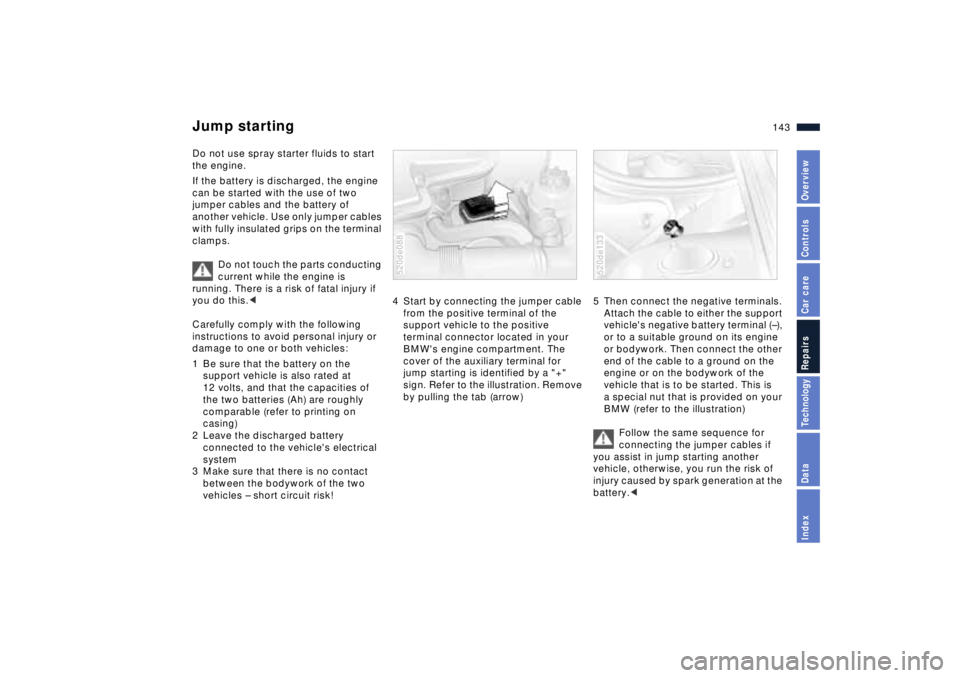
4 Start by connecting the jumper cable
from the positive terminal of the
support vehicle to the positive
terminal connector located in your
BMW's engine compartment. The
cover of the auxiliary terminal for
jump starting is identified by a "+"
sign. Refer to the illustration. Remove
by pulling the tab (arrow) 520de088
5 Then connect the negative terminals.
Attach the cable to either the support
vehicle's negative battery terminal (Ð),
or to a suitable ground on its engine
or bodywork. Then connect the other
end of the cable to a ground on the
engine or on the bodywork of the
vehicle that is to be started. This is
a special nut that is provided on your
BMW (refer to the illustration)
Follow the same sequence for
connecting the jumper cables if
you assist in jump starting another
vehicle, otherwise, you run the risk of
injury caused by spark generation at the
battery.<520de133
Jump starting
Page 144 of 170
144n
Jump starting Towing the vehicle6 Start the support vehicle's engine
and let it run
7 Start the engine on the vehicle
needing the jump start, and allow it to
run as usual. If the first start attempt
is not successful, wait a few minutes
before another attempt in order to
allow the discharged battery to
recharge
8 Before disconnecting the jumper
cables from your BMW, turn on the
lamps, set the blower to the highest
speed and allow the engine to run for
at least 10 seconds. This will prevent
a voltage surge from the voltage
regulator to the electrical accessories
9 Then disconnect the jumper cables in
reverse sequence.
Have the battery recharged if necessary.
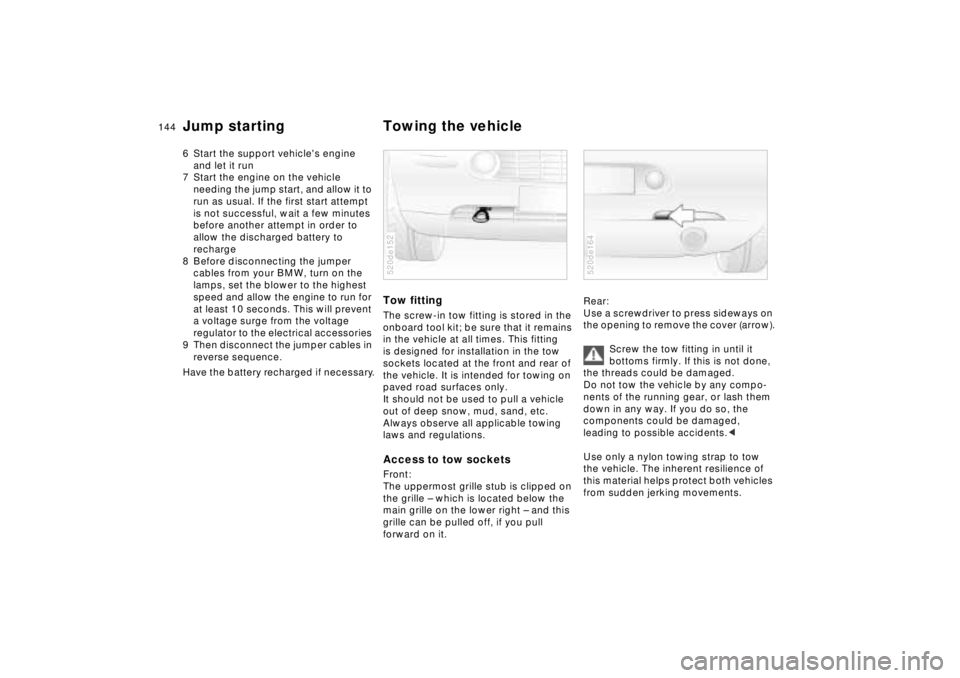
Tow fittingThe screw-in tow fitting is stored in the
onboard tool kit; be sure that it remains
in the vehicle at all times. This fitting
is designed for installation in the tow
sockets located at the front and rear of
the vehicle. It is intended for towing on
paved road surfaces only.
It should not be used to pull a vehicle
out of deep snow, mud, sand, etc.
Always observe all applicable towing
laws and regulations.Access to tow socketsFront:
The uppermost grille stub is clipped on
the grille Ð which is located below the
main grille on the lower right Ð and this
grille can be pulled off, if you pull
forward on it.520de152
Rear:
Use a screwdriver to press sideways on
the opening to remove the cover (arrow).
Screw the tow fitting in until it
bottoms firmly. If this is not done,
the threads could be damaged.
Do not tow the vehicle by any compo-
nents of the running gear, or lash them
down in any way. If you do so, the
components could be damaged,
leading to possible accidents.<
Use only a nylon towing strap to tow
the vehicle. The inherent resilience of
this material helps protect both vehicles
from sudden jerking movements.520de164
Page 145 of 170
145n
IndexDataTechnologyRepairsCar careControlsOverview
Towing the vehicle
Avoid "off-center" towing. Be sure
that the tow rope is pulled tightly
when the towing vehicle begins to
move.<
The towed vehicle should always
be the lighter of the two vehicles.
If this is not the case, it is no longer
possible to control vehicle response.<
Tow-startingFor instructions on jump starting, refer
to page 143.
Never attempt to use your vehicle to
push another vehicle, since damage to
the energy-absorbing bumpers could
result.
Towing a vehicle1 Put the manual-shift gear lever in
neutral
2 Towing speed:
Max. 45 mph (70 km/h)
3 Towing distance:
Max. 95 miles (150 km)
4 Leave the ignition key in position 1
to ensure that the brake lamps, turn
signals, horn and windshield wipers
remain operative, and to prevent the
steering lock detent from engaging
5 Switch on the hazard-warning system
(comply with country-specific regula-
tions).
Find some means of identifying the
vehicle in tow, e. g. place a sign or
warning triangle in the rear window.
Make sure that the ignition key
remains in position 1 even
when the electrical system has failed
to prevent the steering lock from
engaging. The steering and brakes are
without power assist when the engine is
not running. This means that increased
effort is required for steering and
braking.<
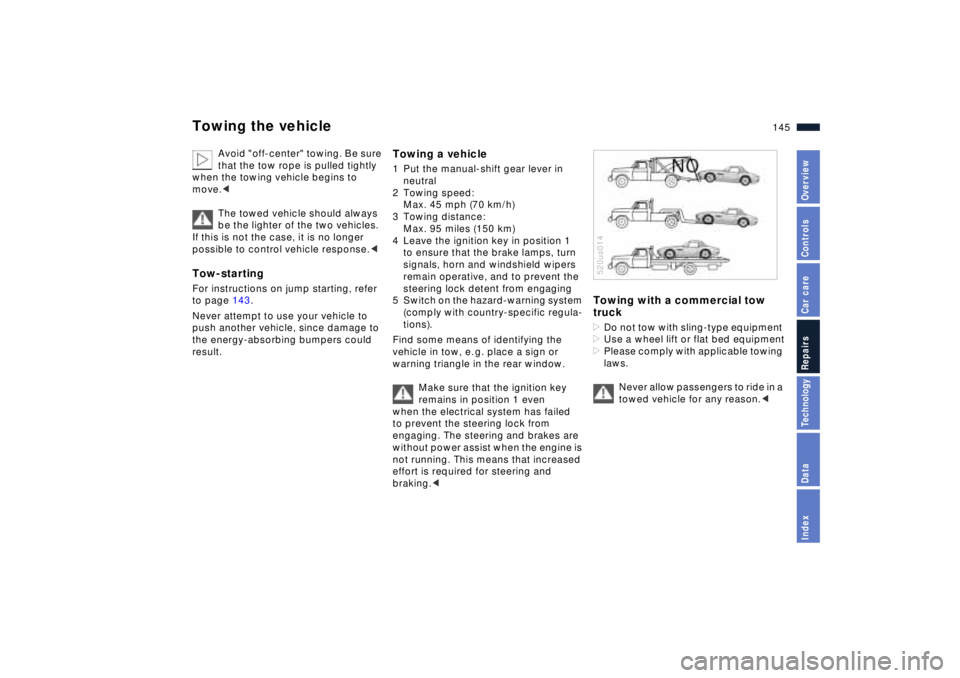
Towing with a commercial tow
truck>Do not tow with sling-type equipment
>Use a wheel lift or flat bed equipment
>Please comply with applicable towing
laws.
Never allow passengers to ride in a
towed vehicle for any reason.<520us014
Page 149 of 170
149n
IndexDataTechnologyRepairsCar careControlsOverview
tion, braking pressures and the
vehicle's yaw rate around its vertical
axis.
When the system detects substantial
differences in rotation rates between
wheels, it acts to inhibit uncontrolled
wheelspin by reducing the drive torque
transmitted to the affected wheel(s),
while also initiating selective braking
intervention as needed.
In addition, DSC permanently monitors
the vehicle's current operating condi-
tion and compares it with an ideal
status calculated based on sensor
signals. DSC reacts to deviations from
this ideal status such as incipient
understeer or oversteer by instanta-
neously reducing engine torque to
restore vehicle stability. This strategy
can be supplemented by selective
braking intervention, available at all four
wheels. DSC acts to prevent traction
loss and skids before the situation can
become critical.You may need some time to become
accustomed to this system's interven-
tion. However, it provides optimum
drive force and vehicle stability.
The braking intervention may be
accompanied by sounds specific to
the system.
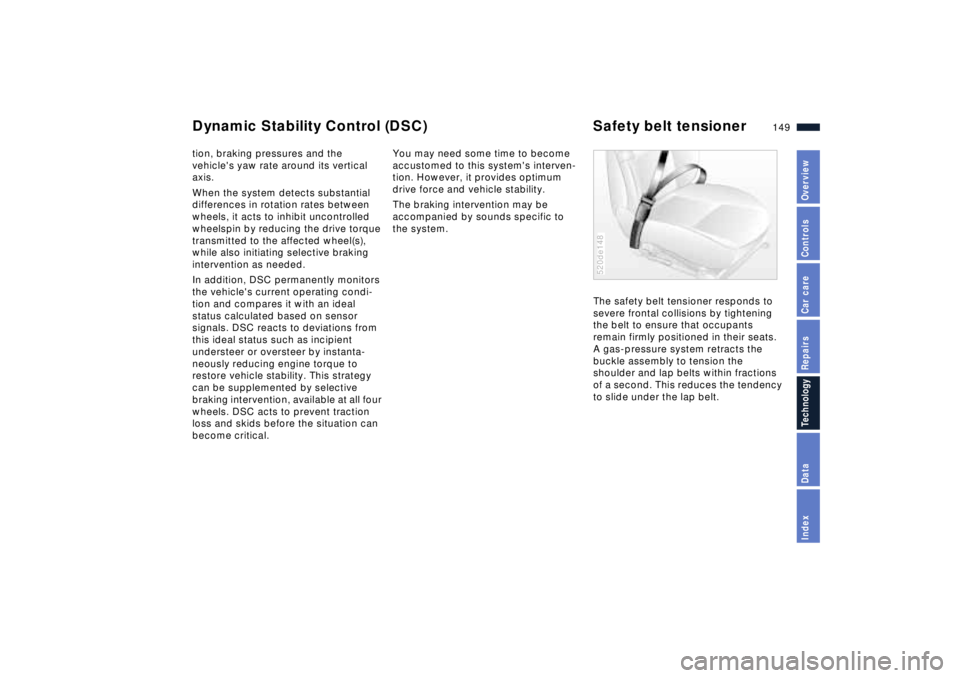
The safety belt tensioner responds to
severe frontal collisions by tightening
the belt to ensure that occupants
remain firmly positioned in their seats.
A gas-pressure system retracts the
buckle assembly to tension the
shoulder and lap belts within fractions
of a second. This reduces the tendency
to slide under the lap belt.
520de148
Dynamic Stability Control (DSC) Safety belt tensioner
Page 153 of 170
Overview
Controls and features
Operation, care
and maintenance
Technical data
Index Advanced technology
153n
IndexDataTechnologyRepairsCar careControlsOverview
Engine data154
Dimensions155
Weights156
Capacities157
Electrical system158
Drive belts158
Data
Owner service procedures
Page 154 of 170

154n
BMW Z8
Displacement
Number of cylinders cu in (ccm) 301.5 (4,941)
8
Maximum output
at engine speed hp
rpm394
6,600
Maximum torque
at engine speedft Ibs (Nm)
rpm368 (500)
3,800
Compression ratioe
11
Stroke
Borein (mm)
in (mm)3.50 (89.0)
3.70 (94.0)
Fuel-injection system Digital electronic Engine-
Management System
Engine data
Page 157 of 170

157n
IndexDataTechnologyRepairsCar careControlsOverview
Capacities
Notes
Fuel tank
Reserve gal. (liters)
gal. (liters)approx. 19.3 (approx. 73)
approx. 2.5 (approx. 10)Fuel quality: page 26
Windshield washer system/
Headlamp washer system quarts (liters) approx. 5.6 (approx 5.3)For details: page 108
Cooling system including heater
circuitquarts (liters) 12.7 (12.0) For details: page 111
Engine oil filter change quarts (liters) 7.9 (7.5) "BMW High Performance Synthetic
Oil." For details: page 110
Manual transmission quarts (liters) 2.0 (1.9) Lifetime fluid; no fluid change required
Differential quarts (liters) 1.3 (1.2) Fluid change at the
1,200-Mile Service, then lifetime fluid;
no fluid change required
Page 162 of 170

Everything from A to ZAABS (Antilock Brake
System)21, 88
Accessories6
Activated charcoal filter75
Add
brake fluid112t
engine coolant112t
engine oil109t
washer fluid108, 157
Adjust
seats45
temperature74
washer nozzles108t
Adjustment setting
configuration48
Air conditioner72
Air distribution74
Air outlets72
Air pressure98
Air supply74
Airbags21, 51, 121, 148
Alarm system38
Antenna94
Antifreeze111
radiator92
Antifreeze/corrosion
protection92
Antilock Brake System
(ABS)21, 88
Anti-theft alarm system38
Anti-theft protection32Approved gross vehicle
weight156
Aquaplaning98
Ashtray81
Attach vehicle vacuum
cleaner82
Automatic car washes115
Automatic headlamp
washers60
Automatic windshield
washer60
Avoiding a false alarm39t
Axle loads156
BBackrest
adjusting45
unlock46
Backup lamps58
bulb replacement130t
Battery136, 158
add distilled water136t
capacity158
charge current20
charging137t
discharged143
recycling138t
removing and
installing137t
Belts50
Beverage can holder80
Blower74BMW High Performance
Synthetic Oil110
Bore154
Brake hydraulic
system20, 91
Brake system91
faults91t
fluid112t
pads22, 92
refer also to ABS, DBC and
Disc brakes
Break-in procedure86
Bulbs and lamps129t
CCalifornia Proposition
65 Warning123
Can holder80
Car Memory48
Car phone81
Car radio64
reception94, 148
refer also to the radio
Owner's Manual
Car wash115
Care
exterior117
for the vehicle finish118
interior119
CBC (Cornering Brake
Control)21, 89CD player, refer to the radio
Owner's Manual
Cellular phone94
refer also to the separate
Owner's Manual
Central locking system32
key36
Changing a wheel135t
Changing the oil filter157
Changing tires135t
Checking air pressure26t
Checking engine oil
level109t
Child restraint
systems53, 54
Child seat safety54
Child seats53
Cigarette lighter82
Clean headlamps60
Clock64
Cockpit16
Code, refer to the radio
Owner's Manual
Combination switch, turn
signal indicator/headlamp
flasher58
Compartments79
for stowing items78
Compression154
Connector for On-Board-
Diagnostics124
Consumption display62
A-Z
Page 163 of 170

Everything from A to Z
163n
IndexDataTechnologyRepairsCar careControlsOverview
Controls16
Convertible top41
closing in event of
electrical
malfunction140t
manual operation141t
Coolant111, 157
Coolant temperature
gauge63
Copyright4
Cornering Brake Control
(CBC)21, 89
Curb weight156
Current check indicator20DDashboard16
Data
dimensions155
engine154
technical154
weights156
Daytime-driving lamp69
DBC (Dynamic Brake
Control)90
Deactivating the tilt sensor
alarm system and interior
motion sensor34
Deep water87
Defrosting the
windows60, 75
Difficult steering20, 94Dimensions155
Dipstick109
Disc brakes90
Displacement154
Display lighting69
Displays18
Disposal
engine oil111
used batteries138t
Door keys30
Door warning lamp, bulb
replacement132t
Doors
emergency
actuation32t
mirrors47
remote control33
unlocking and locking32
DOT Quality Grades99
Draft-free ventilation75
Drink holder78, 80
Drive belts158
Driving in winter92
Driving notes87
DSC (Dynamic Stability
Control)22, 65, 149
Dynamic Brake Control
(DBC)90
Dynamic Performance
Control66
Dynamic Stability Control
(DSC)22, 65, 149
EElectric defrosting of
mirrors47
Electric power seat45
Electric power windows40
Electrical equipment
failure138t
Electrical failure
convertible top140t
doors32t
fuel filler door140t
luggage
compartment140t
passenger-side
door141t
Electrical system158
Electronic vehicle
immobilizer31
Emergency operation
convertible top140t
doors32t
fuel filler door140t
luggage
compartment140t
passenger-side
door141t
Engine
coolant111, 157
data154
output154
speed154
starting56
switching off56Engine compartment106
Engine oil109
add109t
consumption109
filling capacity157
filter change157
pressure indicator
lamp20
quality110
specifications110
viscosity110
Engine oil level21
check109
Equipment
options and accessories5
Exit lamps, bulb
replacement132t
Exterior finish117
Exterior mirrors47
FFailure to start144t
Fault in ABS89
Filler cap cover25
Filling capacities157
Filling the washer
reservoir157
First-aid kit24
Fittings, tow starting and
towing144t
Flashlight79
Flat tire135t