flat tire BMW Z8 2001 Owners Manual
[x] Cancel search | Manufacturer: BMW, Model Year: 2001, Model line: Z8, Model: BMW Z8 2001Pages: 170, PDF Size: 1.64 MB
Page 10 of 170

Contents
Overview
Controls and features
Cockpit16
Instrument cluster18
Indicator and warning lamps20
Hazard warning flashers24
Warning triangle24
First-aid kit24
Refueling25
Fuel quality26
Tire inflation pressure26
Locks and security systems:
Keys30
Electronic vehicle
immobilizer31
Central locking system32
Opening and closing Ð from the
outside32
Using the key32
Using the remote control33
Opening and closing Ð from the
inside36
Luggage compartment lid37
Alarm system38
Electric power windows40
The automatic convertible
top41
Adjustments:
Seats45
Steering wheel47
Mirrors47
Car Memory, Key Memory48
Passenger safety systems:
Safety belts50
Airbags51
Transporting children safely53
Driving:
Ignition and steering lock55
Starting the engine56
Turning the engine off56
Parking brake57
Manual transmission58
Turn signal indicator/Headlamp
flasher58
Washer/Wiper system59
Rear window defroster60
Cruise control61
Everything under control:
Odometer62
Tachometer62
Fuel gauge62
Coolant temperature gauge63
Service Interval Display63
Clock64
Multi-Information Radio (MIR)64
Technology for safety and
driving convenience:
Dynamic Stability Control
(DSC)65
Dynamic Performance
Control66
Tire Pressure Warning (RDW)67
Contents
Page 11 of 170

11n
Controls and features
Operation, care and maintenance
Lamps:
Side lamps/low beams69
Instrument panel lighting69
High beams/parking lamps70
Rear fog lamp70
Interior lamps70
Reading lamps71
Controlling the climate for
pleasant driving:
Heating and ventilation/
Air conditioner72
Seat heating77
Interior conveniences:
Glove compartment78
Storage compartments78
Drink holder80
Cellular phone81
Ashtray81
Cigarette lighter82
Loading and transporting:
Cargo loading83
Special operating instructions:
Break-in procedures86
Driving notes87
Catalytic converter87
Antilock Brake System (ABS)88
Dynamic Brake Control
(DBC)90
Disc brakes90
Brake system91
Winter operation92
Power steering94
Cellular phone94
Radio reception94
Wind deflector95
Hardtop96
Wheels and tires:
Tire inflation pressure98
Tire condition98
Tire replacement99
Tire rotation100
Wheel and tire
combinations101
Special features of winter
tires102
Snow chains102
Approved wheel and tire
specifications103
Under the hood:
Hood104
Engine compartment106
Washer fluids108
Washer nozzles108
Engine oil109
Coolant111
Brake fluid112
Vehicle Identification
Number113
Maintenance and care:
The BMW Maintenance
System114
Caring for your vehicle115
Airbags121
Vehicle storage122
Laws and regulations:
Technical modifications123
California Proposition 65
Warning123
OBD interface socket124
Page 15 of 170
Overview
Controls and features
Operation, care
and maintenance
Owner service procedures
Technical data
Index Advanced technology
15n
IndexDataTechnologyRepairsCar careControlsOverview
Cockpit16
Instrument cluster18
Indicator and warning lamps20
Hazard warning flashers24
Warning triangle24
First-aid kit24
Refueling25
Fuel quality26
Tire inflation pressure26
Overview
Page 26 of 170
26n
Fuel quality Tire inflation pressure The engine uses lead-free gasoline
only.
Required fuel:
>Premium Unleaded Gasoline,
min. 91 AKI
AKI = Anti Knock Index
Do not use leaded fuels. The use
of leaded fuels will cause perma-
nent damage to the system's oxygen
sensor and the catalytic converter.<
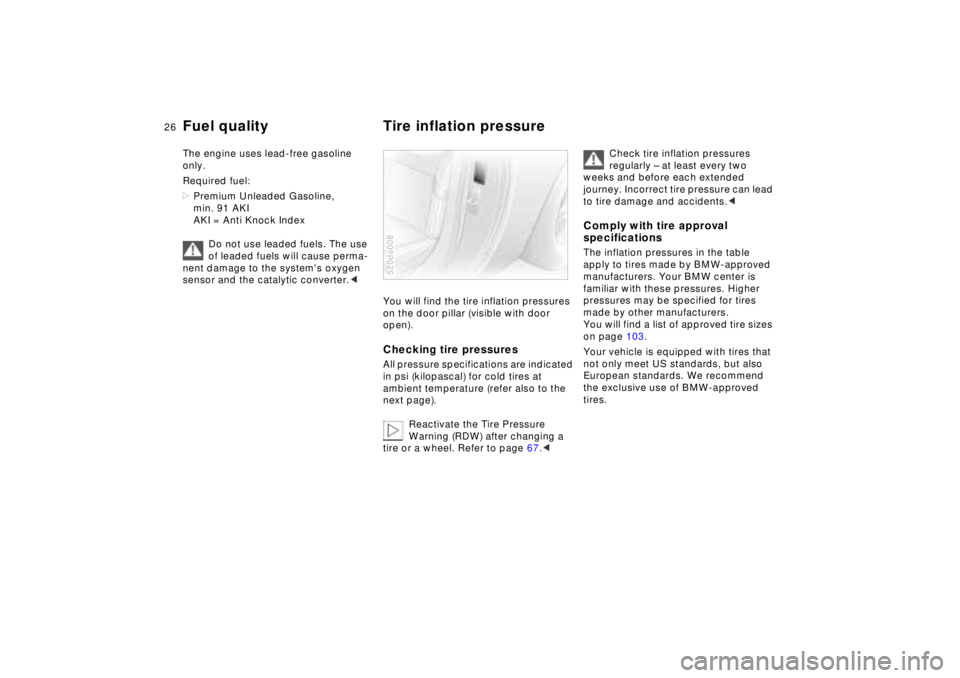
You will find the tire inflation pressures
on the door pillar (visible with door
open).Checking tire pressuresAll pressure specifications are indicated
in psi (kilopascal) for cold tires at
ambient temperature (refer also to the
next page).
Reactivate the Tire Pressure
Warning (RDW) after changing a
tire or a wheel. Refer to page 67.<520de008
Check tire inflation pressures
regularly Ð at least every two
weeks and before each extended
journey. Incorrect tire pressure can lead
to tire damage and accidents.<
Comply with tire approval
specificationsThe inflation pressures in the table
apply to tires made by BMW-approved
manufacturers. Your BMW center is
familiar with these pressures. Higher
pressures may be specified for tires
made by other manufacturers.
You will find a list of approved tire sizes
on page 103.
Your vehicle is equipped with tires that
not only meet US standards, but also
European standards. We recommend
the exclusive use of BMW-approved
tires.
Page 27 of 170
27n
IndexDataTechnologyRepairsCar careControlsOverview
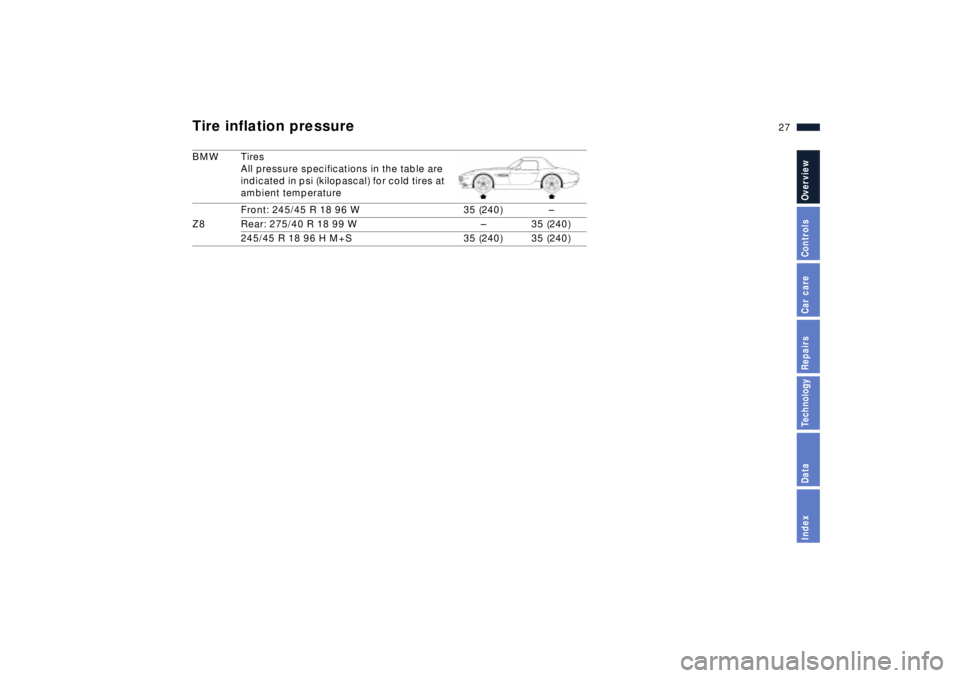
Tire inflation pressureBMW Tires
All pressure specifications in the table are
indicated in psi (kilopascal) for cold tires at
ambient temperature
Z8Front: 245/45 R 18 96 W 35 (240) Ð
Rear: 275/40 R 18 99 W Ð 35 (240)
245/45 R 18 96 H M+S 35 (240) 35 (240)
Page 67 of 170
67n
IndexDataTechnologyRepairsCar careControlsOverview
Tire Pressure Warning (RDW)The conceptRDW monitors the tire pressure in all
four wheels while driving. The system
provides an alert whenever the inflation
pressure drops significantly in one of
the tires.
For RDW to "learn" the correct tire infla-
tion pressure, check the inflation pres-
sure in all tires, comparing them with
the values in the inflation pressure table
(refer to page 27), and make correc-
tions as necessary. Then activate the
system.
The indicator lamp within the in-
strument cluster flashes to alert
you to substantial pressure loss
in any of the tires.
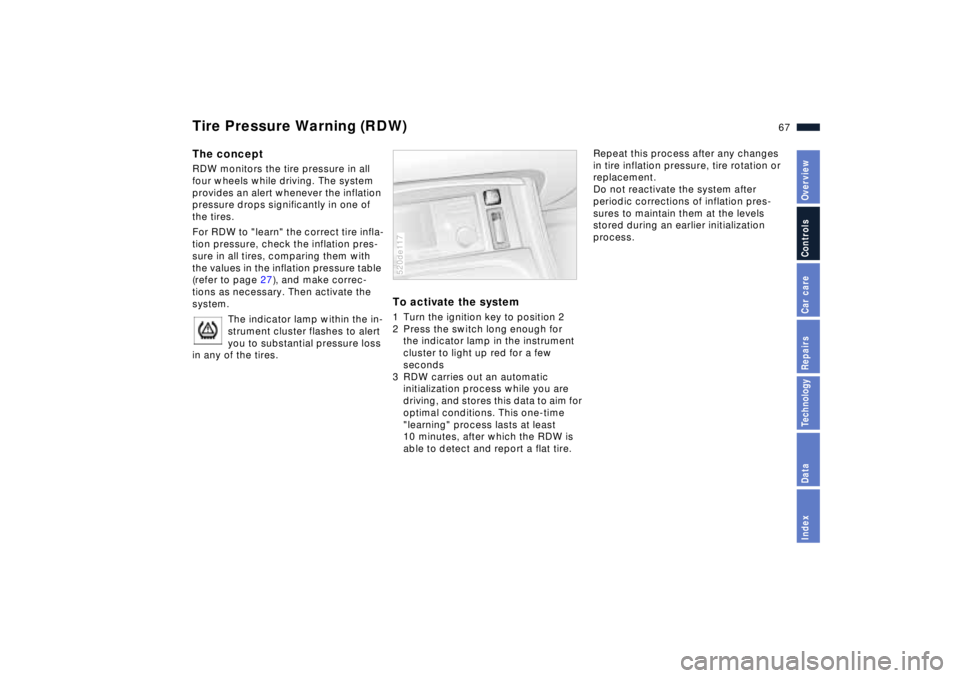
To activate the system 1 Turn the ignition key to position 2
2 Press the switch long enough for
the indicator lamp in the instrument
cluster to light up red for a few
seconds
3 RDW carries out an automatic
initialization process while you are
driving, and stores this data to aim for
optimal conditions. This one-time
"learning" process lasts at least
10 minutes, after which the RDW is
able to detect and report a flat tire.520de117
Repeat this process after any changes
in tire inflation pressure, tire rotation or
replacement.
Do not reactivate the system after
periodic corrections of inflation pres-
sures to maintain them at the levels
stored during an earlier initialization
process.
Page 68 of 170

68n
Tire Pressure Warning (RDW)Flat tire The red indicator lamp will flash in the
event of a flat tire.
A supplementary gong is also heard.
Carefully reduce speed to less than
50 mph (80 km/h), avoiding any hard
braking or steering maneuvers while
doing so.
For additional details, refer to page 135.
RDW cannot provide advance
warning of sudden and severe tire
damage caused by road hazards or
other environmental factors.
RDW is also not designed to detect the
gradual, even pressure loss that all tires
exhibit over extended periods of time.<
Check tire pressure on a regular
basis and correct it as required.
Refer to page 26.
Do not activate the system when driving
on snow chains or when operating the
vehicle on a closed racing circuit. False
alarms and undetected pressure loss
are both possible under these condi-
tions.
In certain circumstances, there could
be a delayed detection of any loss in in-
flation pressure while driving on snow-
covered or slippery road surfaces.
A performance-oriented driving style
can also cause delayed RDW alerts
(e. g. slippage in the drive wheels, high
lateral acceleration).<
System interferenceThe red indicator lamp in the instrument
cluster will stay on for as long as there
is a malfunction.
The indicator lamp will come on if the
system malfunctions.
Please contact your BMW center for
additional information.
Page 85 of 170
Overview
Controls and features
Operation, care
and maintenance
Owner service procedures
Technical data
Index Advanced technology
85n
IndexDataTechnologyRepairsCar careControlsOverview
Car care Special operating instructions:
Break-in procedures86
Driving notes87
Catalytic converter87
Antilock Brake System (ABS)88
Dynamic Brake Control
(DBC)90
Disc brakes90
Brake system91
Winter operation92
Power steering94
Cellular phone94
Radio reception94
Wind deflector95
Hardtop96
Wheels and tires:
Tire inflation pressure98
Tire condition98
Tire replacement99
Tire rotation100
Wheel and tire
combinations101
Special features of winter
tires102
Snow chains102
Approved wheel and tire
specifications103Under the hood:
Hood104
Engine compartment106
Washer fluids108
Washer nozzles108
Engine oil109
Coolant111
Brake fluid112
Vehicle Identification
Number113
Maintenance and care:
The BMW Maintenance
System114
Caring for your vehicle115
Airbags121
Vehicle storage122
Laws and regulations:
Technical modifications123
California Proposition 65
Warning123
OBD interface socket124
Page 98 of 170
98n
Information for your safetyThe factory has approved steel-belted
radials with emergency driving charac-
teristics for your vehicle. These tires
combine optimal driving safety with the
comfort you desire.
It is not merely the tire's service life, but
also driving comfort and Ð above all else
Ð driving safety that depend on the
condition of the tires and the mainte-
nance of the specified tire pressure.
Incorrect inflation pressure is a frequent
cause of tire damage. It also signifi-
cantly influences the roadholding ability
of your BMW.
Check tire inflation pressures
regularly (refer to page 26), at
least every two weeks and before
beginning a longer trip. If this is not
done, incorrect tire pressures can
cause driving instability and tire
damage, ultimately resulting in acci-
dents.<
Run-flat tiresYour BMW Z8 is equipped with run-flat
tires.
The assembly consists of self-support-
ing tires mounted on specially-designed
wheel rims. Special reinforcement
elements support the sidewalls in the
event of pressure loss. Although tire
performance is then restricted, the
vehicle can still be driven on the
deflated tire for a limited distance. Your
vehicle is equipped with a tire pressure
monitor that signals you in case of a flat
tire.
For further information, refer to
pages 67, 135.
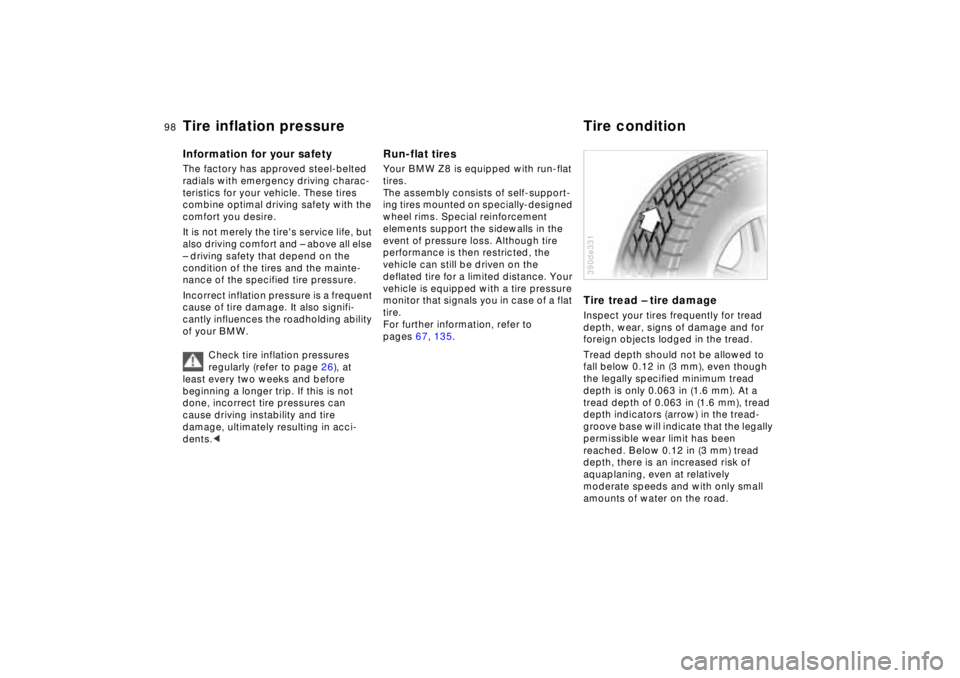
Tire tread Ð tire damageInspect your tires frequently for tread
depth, wear, signs of damage and for
foreign objects lodged in the tread.
Tread depth should not be allowed to
fall below 0.12 in (3 mm), even though
the legally specified minimum tread
depth is only 0.063 in (1.6 mm). At a
tread depth of 0.063 in (1.6 mm), tread
depth indicators (arrow) in the tread-
groove base will indicate that the legally
permissible wear limit has been
reached. Below 0.12 in (3 mm) tread
depth, there is an increased risk of
aquaplaning, even at relatively
moderate speeds and with only small
amounts of water on the road.390de331
Tire inflation pressure Tire condition
Page 100 of 170

100n
Tire replacement Tire rotation TemperatureThe temperature grades are A (the
highest), B and C, representing the
tire's resistance to the generation of
heat and its ability to dissipate heat
when tested under controlled condi-
tions on a specified indoor laboratory
test wheel.
Sustained high temperature can cause
the tire material to degenerate and
reduce tire life, and excessive tempera-
ture can lead to sudden tire failure. The
Grade C corresponds to a level of
performance which all passenger
vehicle tires must meet under the
Federal Motor Vehicle Safety Standard
No. 109. Grades B and A represent
higher levels of performance on the
laboratory test wheel than the minimum
required by law.
The temperature grade for this
tire is established for a tire that is
properly inflated and not overloaded.
Excessive speed, underinflation, or
excessive loading, either separately or
in combination, can cause heat buildup
and possibly a flat tire.<
Uniform Tire Quality GradingQuality grades can be found where
applicable on the tire sidewall between
tread shoulder and maximum section
width. For example:
Tread wear 200 Traction AA
Temperature A
Use only tires with emergency
driving characteristics as there is
no spare tire available if you get a flat
tire. For further information, refer to
page 135.
sidewall:
DOT ... 1200 indicates that the tire was
manufactured in week 12 of 2000.
Although tires may have a theoretical
service life of up to 10 years, BMW
strongly recommends that you replace
all tires after an absolute maximum of
6 years.
Between the axles
If different tire sizes are mounted
on the front and rear axles (refer to
page 103), then the tires may not be
rotated from one axle to the other.<
The tread wear patterns at the front end
differ from those at the rear Ð the actual
patterns will vary according to indi-
vidual driving conditions. In the inter-
ests of safety and maintaining optimal
handling characteristics, tire rotation is
not recommended.