tow BMW Z8 2001 Owners Manual
[x] Cancel search | Manufacturer: BMW, Model Year: 2001, Model line: Z8, Model: BMW Z8 2001Pages: 170, PDF Size: 1.64 MB
Page 12 of 170

Contents
Owner service procedures
Advanced technology
Technical data
Replacement procedures:
Onboard tool kit128
Windshield wiper blades128
Lamps and bulbs129
Changing a wheel135
Battery136
Fuses138
In case of electrical
malfunction:
Fuel filler door140
Luggage compartment lid,
storage compartment140
Passenger door141
Closing the convertible top141
Giving and receiving
assistance:
Jump starting143
Towing the vehicle144Airbags148
Radio reception148
Dynamic Stability Control
(DSC)149
Safety belt tensioner149
Interior rearview mirror with
automatic dimmer150
Xenon lamps151Engine data154
Dimensions155
Weights156
Capacities157
Electrical system158
Drive belts158
Page 38 of 170
38n
Alarm systemThe conceptThe vehicle alarm system responds
>when a door, the hood or the luggage
compartment lid is opened
>to movement inside the vehicle
(interior motion sensor)
>to variations in the vehicle's tilt angle
such as those occurring during
attempts to steal the wheels or tow
the vehicle
>to interruption of battery voltage.
The system responds to attempts of
unauthorized vehicle incursion and theft
by simultaneously activating the
following
>an alarm sounds for 30 seconds
>the hazard warning flashers are acti-
vated for approx. five minutes
>the high beams flash on and off in the
same rhythm.
To activate and deactivate the
alarm systemWhen the vehicle is locked or unlocked
via a door lock or with the remote
control, the alarm system is also simul-
taneously armed or disarmed.
The interior motion sensor and tilt alarm
sensor are activated approx.
30 seconds after you have finished
locking the vehicle.
The system indicates that it has been
correctly armed by switching on the
hazard warning flashers for a single
cycle and by emitting an acoustic
signal.
You can select the individual
confirmation signal used to indi-
cate that the alarm system has been
armed or disarmed.<
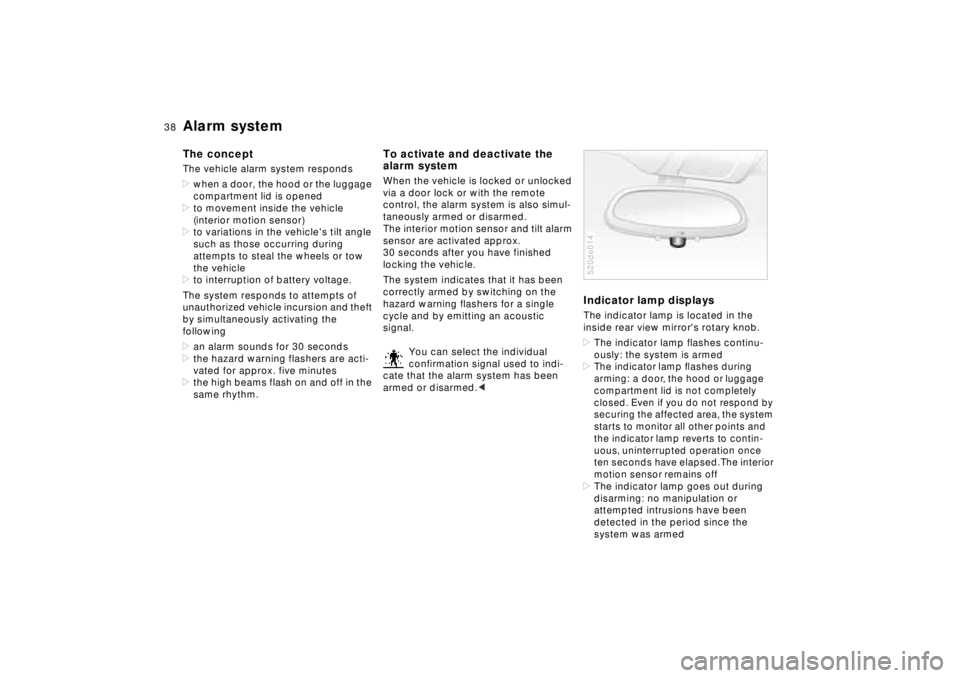
Indicator lamp displaysThe indicator lamp is located in the
inside rear view mirror's rotary knob.
>The indicator lamp flashes continu-
ously: the system is armed>The indicator lamp ßashes during
arming: a door, the hood or luggage
compartment lid is not completely
closed. Even if you do not respond by
securing the affected area, the system
starts to monitor all other points and
the indicator lamp reverts to contin-
uous, uninterrupted operation once
ten seconds have elapsed. The interior
motion sensor remains off>The indicator lamp goes out during
disarming: no manipulation or
attempted intrusions have been
detected in the period since the
system was armed520de014
Page 43 of 170
43n
IndexDataTechnologyRepairsCar careControlsOverview
The automatic convertible top4 Press on both left and right sides to
lock the cover in place
5 Pull the button to verify that the
locking mechanism is engaged
securely.
The cover lock responds by
alternately engaging and releasing
with each successive application of
pressure.<
Be sure that the cover is properly
secured on the vehicle. If it is not
firmly secured, air pressure could
loosen the cover at higher speeds.<520de038
To remove the cover panel,Follow the same steps as for assembly,
however, in reverse sequence.
After removal, slide the two outside
ends of the cover under the retaining
strap, then tilt in the middle and fold
toward the outside (leather on leather).
After folding the cover, insert it in the
protective casing for subsequent
storage in the luggage compartment.520de109
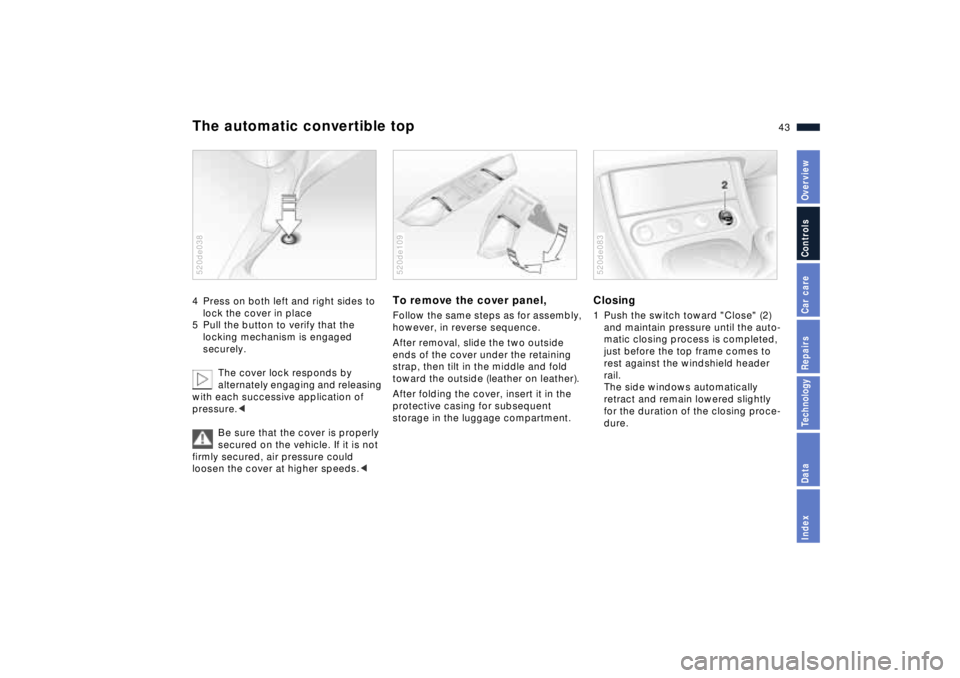
Closing1 Push the switch toward "Close" (2)
and maintain pressure until the auto-
matic closing process is completed,
just before the top frame comes to
rest against the windshield header
rail.
The side windows automatically
retract and remain lowered slightly
for the duration of the closing proce-
dure.520de083
Page 53 of 170
53n
IndexDataTechnologyRepairsCar careControlsOverview
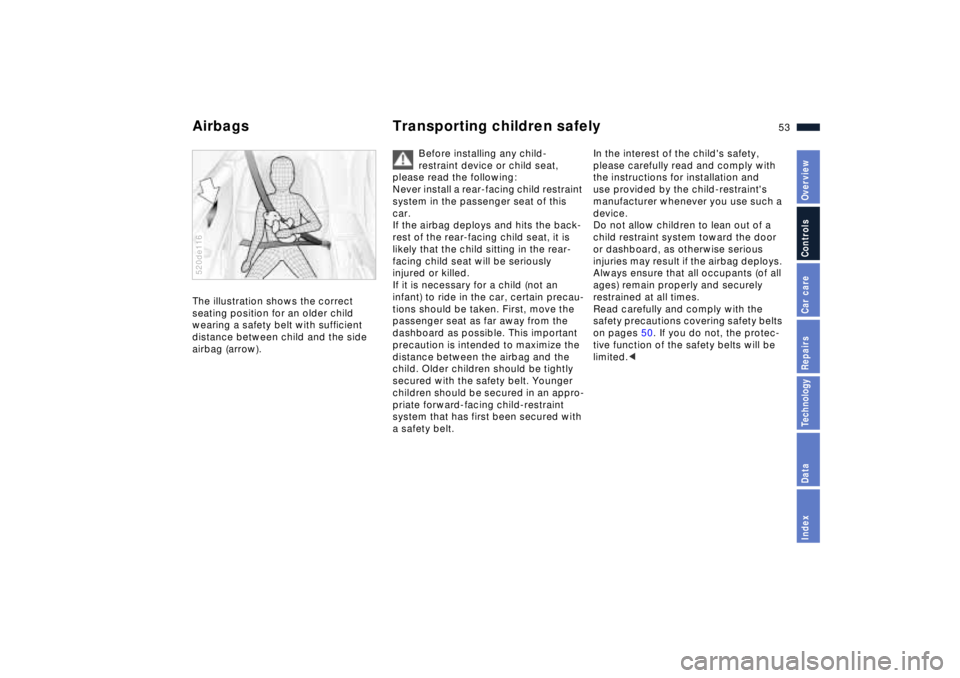
Airbags Transporting children safelyThe illustration shows the correct
seating position for an older child
wearing a safety belt with sufficient
distance between child and the side
airbag (arrow).520de116
Before installing any child-
restraint device or child seat,
please read the following:
Never install a rear-facing child restraint
system in the passenger seat of this
car.
If the airbag deploys and hits the back-
rest of the rear-facing child seat, it is
likely that the child sitting in the rear-
facing child seat will be seriously
injured or killed.
If it is necessary for a child (not an
infant) to ride in the car, certain precau-
tions should be taken. First, move the
passenger seat as far away from the
dashboard as possible. This important
precaution is intended to maximize the
distance between the airbag and the
child. Older children should be tightly
secured with the safety belt. Younger
children should be secured in an appro-
priate forward-facing child-restraint
system that has first been secured with
a safety belt.
In the interest of the child's safety,
please carefully read and comply with
the instructions for installation and
use provided by the child-restraint's
manufacturer whenever you use such a
device.
Do not allow children to lean out of a
child restraint system toward the door
or dashboard, as otherwise serious
injuries may result if the airbag deploys.
Always ensure that all occupants (of all
ages) remain properly and securely
restrained at all times.
Read carefully and comply with the
safety precautions covering safety belts
on pages 50. If you do not, the protec-
tive function of the safety belts will be
limited.<
Page 55 of 170
55n
IndexDataTechnologyRepairsCar careControlsOverview
Your vehicle is equipped with an elec-
trically powered steering lock mecha-
nism.To activate the electrical power
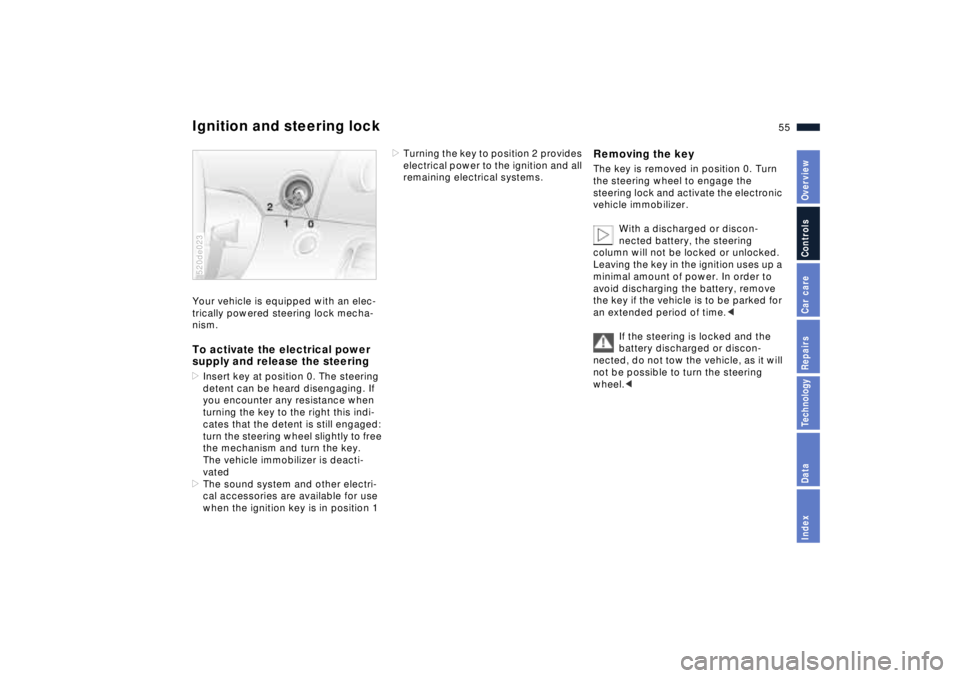
supply and release the steering>Insert key at position 0. The steering
detent can be heard disengaging. If
you encounter any resistance when
turning the key to the right this indi-
cates that the detent is still engaged:
turn the steering wheel slightly to free
the mechanism and turn the key.
The vehicle immobilizer is deacti-
vated
>The sound system and other electri-
cal accessories are available for use
when the ignition key is in position 1 520de023
>Turning the key to position 2 provides
electrical power to the ignition and all
remaining electrical systems.
Removing the keyThe key is removed in position 0. Turn
the steering wheel to engage the
steering lock and activate the electronic
vehicle immobilizer.
With a discharged or discon-
nected battery, the steering
column will not be locked or unlocked.
Leaving the key in the ignition uses up a
minimal amount of power. In order to
avoid discharging the battery, remove
the key if the vehicle is to be parked for
an extended period of time.<
If the steering is locked and the
battery discharged or discon-
nected, do not tow the vehicle, as it will
not be possible to turn the steering
wheel.<
Ignition and steering lock
Page 73 of 170

73n
IndexDataTechnologyRepairsCar careControlsOverview
Heating and ventilation/Air conditioner1 Air onto the windshield and the side
windows
2 Air flow for the upper body
The rotary dials make it possible for
you to open and close the air supply
through an infinitely-variable range,
while the levers change the air-flow
direction. Refer to page 75
3 Front footwell ventilation
4 Air supply
Both the heating and ventilation are
available from position 1 on. Refer to
page 74
5 To defrost windows and remove
condensation75
6 Temperature74
7 Air distribution toward
>the windows
>the upper body
>the footwell
An infinitely-variable range of inter-
mediate settings is also available.
Refer to page 74
8 Rear window defroster with the
hardtop in place75
9 Operating:
>Recirculated air74
>Incoming air74
>Air conditioner/Incoming air74
>Air conditioner/Recirculated air74
Page 74 of 170
74n
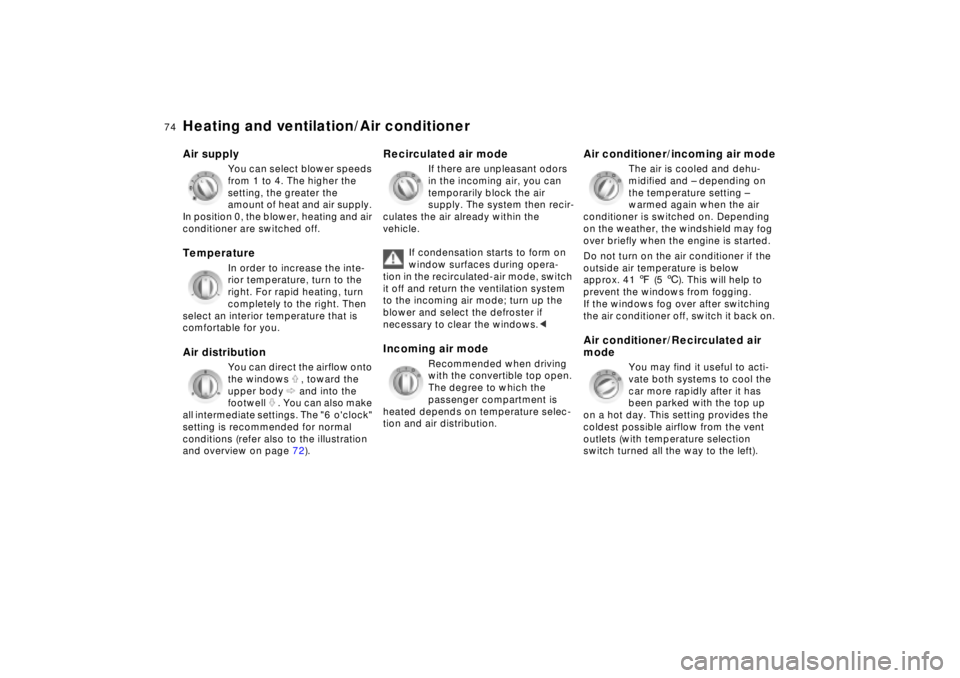
Heating and ventilation/Air conditionerAir supply
You can select blower speeds
from 1 to 4. The higher the
setting, the greater the
amount of heat and air supply.
In position 0, the blower, heating and air
conditioner are switched off.
Temperature
In order to increase the inte-
rior temperature, turn to the
right. For rapid heating, turn
completely to the right. Then
select an interior temperature that is
comfortable for you.
Air distribution
You can direct the airflow onto
the windows , toward the
upper body and into the
footwell . You can also make
all intermediate settings. The "6 o'clock"
setting is recommended for normal
conditions (refer also to the illustration
and overview on page 72).
Recirculated air mode
If there are unpleasant odors
in the incoming air, you can
temporarily block the air
supply. The system then recir-
culates the air already within the
vehicle.
If condensation starts to form on
window surfaces during opera-
tion in the recirculated-air mode, switch
it off and return the ventilation system
to the incoming air mode; turn up the
blower and select the defroster if
necessary to clear the windows.<
Incoming air mode
Recommended when driving
with the convertible top open.
The degree to which the
passenger compartment is
heated depends on temperature selec-
tion and air distribution.
Air conditioner/incoming air mode
The air is cooled and dehu-
midified and Ð depending on
the temperature setting Ð
warmed again when the air
conditioner is switched on. Depending
on the weather, the windshield may fog
over briefly when the engine is started.
Do not turn on the air conditioner if the
outside air temperature is below
approx. 41 7 (5 6). This will help to
prevent the windows from fogging.
If the windows fog over after switching
the air conditioner off, switch it back on.
Air conditioner/Recirculated air
mode
You may find it useful to acti-
vate both systems to cool the
car more rapidly after it has
been parked with the top up
on a hot day. This setting provides the
coldest possible airflow from the vent
outlets (with temperature selection
switch turned all the way to the left).
Page 83 of 170

83n
IndexDataTechnologyRepairsCar careControlsOverview
Cargo loadingStowing cargo If you are carrying cargo in the luggage
compartment of your BMW Z8 roadster:
>Load heavy cargo as far forward as
possible, directly behind the luggage
compartment partition
>Cover sharp edges and corners.
If you are stowing cargo behind the
seats in your BMW Z8 roadster:
>Stow only lightweight objects, such
as clothing
>Do not pile objects higher than the
top edge of the backrest.
Do not stow either heavy cargo or
cargo with sharp edges and
corners behind the seats, or else they
could damage the back of the seat or
the rear trim panel.
Cargo that is too big or unwieldy and
stowed behind the seats can also
prevent the seat from locking properly
into position. Therefore, check to make
sure that the seat is properly locked
into place, moving the seat forward if
necessary. Refer to page 45.
Always position and secure the load
correctly. If you do not, it can endanger
the vehicle occupants during braking or
evasive maneuvers.
Do not exceed the permissible gross
weight and axle load (refer to page 156),
otherwise the vehicle's operating safety
is no longer assured and you are in
violation of the law.
Make sure to secure heavy or hard
objects you stow in the passenger area,
otherwise, these objects could be flung
about during braking or evasive
maneuvers and possibly injure vehicle
occupants.<
Page 86 of 170

86n
To ensure that your vehicle continues to
provide maximum economy throughout
an extended service life, we request
that you devote careful attention to the
following section.
Your BMW Z8 is a masterpiece of
superlative technology. To ensure
that you derive maximum satisfaction
from its extensive array of advanced
features while simultaneously creating
the basis for many years of driving
pleasure, we urge you to observe the
following precautions during the initial
operation period.<
Engine and differentialUp to 1,200 miles (2,000 km):
Drive at varying engine and road
speeds, but do not exceed 4,500 rpm
(4,500/min), or a road speed of 106 mph
(170 km/h).
Obey your local and state maximum
speed limits.
Avoid depressing the accelerator to the
full-throttle position .
Once you have driven 1,200 miles
(2,000 km), you can begin to gradually
increase both the engine speed and
road speed.
You should also comply with these
break-in procedures if the engine or
differential is replaced later in the
course of the vehicle service life.TiresOwing to technical factors associated
with their manufacture, tires do not
achieve their full traction potential until
an initial break-in period has elapsed.
Thus, drive with extra care during the
initial 200 miles (300 km).
Obey your local and state maximum
speed limits.
When the vehicle is being driven
on wet or slushy roads, a wedge
of water may form between the tire and
the road surface. This phenomenon is
referred to as "aquaplaning" and can
lead to partial or complete loss of trac-
tion, vehicle control and braking effec-
tiveness. Reduce your speed on wet
roads.<
Brake systemApproximately 300 miles (500 km) must
elapse before the brake pads and
rotors achieve the optimal pad-surface
and wear patterns required for trouble-
free operation and long service life.
To break in the separate parking brake
drums, apply the parking brake lightly
when coasting to a standstill (at a traffic
signal, for instance), provided that
traffic conditions allow you to do so.
To avoid corrosion, repeat this proce-
dure from time to time.
The brake lamps do not come
on when the parking brake is
engaged.
Vacuum for the brake system servo unit
on your BMW is available only when the
engine is running. When you move the
vehicle with the engine shut off Ð when
towing, for instance Ð substantially
higher levels of pedal force will be
required to brake the vehicle.
Engage the gears carefully and without
high engine speeds during this break-in
period.
Break-in procedures
Page 87 of 170

87n
IndexDataTechnologyRepairsCar careControlsOverview
Brakes:
Do not rest your foot on the brake
pedal while driving. Even light but
consistent pressure on the brake pedal
could lead to high temperatures, brake
wear, and possibly, to brake system
failure.
Aquaplaning:
Reduce speed while driving on wet or
slushy roads, otherwise, a wedge of
water can form between the tires and
the road surface. This phenomenon is
referred to as "aquaplaning" or "hydro-
planing." It is characterized by a partial
or complete loss of contact between
the tires and the road surface. The ulti-
mate results are loss of steering and
braking control.
Driving through water:
When there is water on the roads, do
not drive in it if it is deeper than 1 ft
(30 cm), and even then, only at walking
speed, otherwise the vehicle can
sustain damage to the engine, the elec-
trical systems and the transmission.<
The catalytic converter reduces harmful
exhaust emissions.
It is designed for use with unleaded fuel
only. Even minute quantities of lead
would be enough to permanently
damage both the catalytic converter
and the system oxygen sensor.To ensure efficient, trouble-free engine
operation and to avoid potential damage:>Be sure to comply with the scheduled
maintenance requirements
>Fill the fuel tank well before it is empty
>Tow-start only when the engine is
cold. If you attempt to tow-start with
a warm engine, unburned residual
fuel in the catalytic converter could
ignite and cause damage. It is better
to start the vehicle with a battery
charger or assistance from another
vehicle
>Avoid other situations where the fuel
is either not burned or burns incom-
pletely, such as engaging the starter
frequently or for extended periods, or
repeated start attempts in which the
engine does not start (stopping and
restarting an engine which is running
properly does not present a pro-
blem). Never allow the engine to run
with any of the spark plug cables
disconnected.Be sure to comply with the
instructions above to prevent
unburned fuel from reaching the cata-
lytic converter. Otherwise, there is the
danger of overheating and damage to
the catalytic converter.
Extreme temperatures are present with
the catalytic converter both on this and
every catalytic converter-equipped
vehicle. Heat shields are installed adja-
cent to some sections of the exhaust
system. Never remove these shields;
do not apply undercoating to their
surfaces. When driving, standing at
idle, and parking the vehicle, take care
to avoid contact between the exhaust
system and flammable materials (grass,
hay, leaves etc.). Such contact could
start a fire, resulting in serious personal
injury and property damage.<
Driving notes Catalytic converter