warning light BMW Z8 2001 Owners Manual
[x] Cancel search | Manufacturer: BMW, Model Year: 2001, Model line: Z8, Model: BMW Z8 2001Pages: 170, PDF Size: 1.64 MB
Page 11 of 170

11n
Controls and features
Operation, care and maintenance
Lamps:
Side lamps/low beams69
Instrument panel lighting69
High beams/parking lamps70
Rear fog lamp70
Interior lamps70
Reading lamps71
Controlling the climate for
pleasant driving:
Heating and ventilation/
Air conditioner72
Seat heating77
Interior conveniences:
Glove compartment78
Storage compartments78
Drink holder80
Cellular phone81
Ashtray81
Cigarette lighter82
Loading and transporting:
Cargo loading83
Special operating instructions:
Break-in procedures86
Driving notes87
Catalytic converter87
Antilock Brake System (ABS)88
Dynamic Brake Control
(DBC)90
Disc brakes90
Brake system91
Winter operation92
Power steering94
Cellular phone94
Radio reception94
Wind deflector95
Hardtop96
Wheels and tires:
Tire inflation pressure98
Tire condition98
Tire replacement99
Tire rotation100
Wheel and tire
combinations101
Special features of winter
tires102
Snow chains102
Approved wheel and tire
specifications103
Under the hood:
Hood104
Engine compartment106
Washer fluids108
Washer nozzles108
Engine oil109
Coolant111
Brake fluid112
Vehicle Identification
Number113
Maintenance and care:
The BMW Maintenance
System114
Caring for your vehicle115
Airbags121
Vehicle storage122
Laws and regulations:
Technical modifications123
California Proposition 65
Warning123
OBD interface socket124
Page 19 of 170

19n
IndexDataTechnologyRepairsCar careControlsOverview
Instrument cluster
1 Fuel gauge with indicator lamp for
fuel reserve62
2 Speedometer with indicator and
warning lamps for
>
Dynamic Stability Control
(DSC)22
>
Engine electronics22
3 Instrument panel lighting69
4 Tachometer62
with indicator and warning lamps
for:
>
Battery charge current20
>
Convertible top operation41
>
Tire Pressure Warning (RDW)20
>
Antilock Brake System (ABS)21
>
Parking brake/Brake hydraulic
system/Cornering Brake Control
(CBC)20
>
Service Engine Soon22
>
Engine oil pressure/Engine oil
level20, 21
5 Coolant temperature gauge with
"Coolant temperature too high"
warning lamp63
6 Indicator and warning lamps for:
>
Rear fog lamp22
>
Turn signal, right23
7 Clock648 Control knob for:
>
Clock64
>
Trip odometer, reset to zero62
9 Indicator and warning lamps for:
>
Please fasten safety belts21
>
High beam23
>
Airbags21
10 Indicator for:
>
Odometer62
>
Trip odometer62
>
Service Interval63
11 Indicator and warning lamps for:
>
Turn signal, left23
>
Brake pads22
Page 20 of 170
20n
Indicator and warning lamps
Technology that monitors itself
Many of the systems for your BMW
monitor themselves automatically, both
during engine starts and while you are
driving. Indicator and warning lamps
identified by "
l
" are tested for proper
operation whenever the ignition key is
turned. They each light up once for
different periods of time.
The indicator lamps signal defects in
monitored systems either by remaining
lit after the engine is started or by
coming on in the course of normal
vehicle operation. Refer to the following
section for detailed information on how
to respond to the various types of warn-
ings.
Red: stop immediately
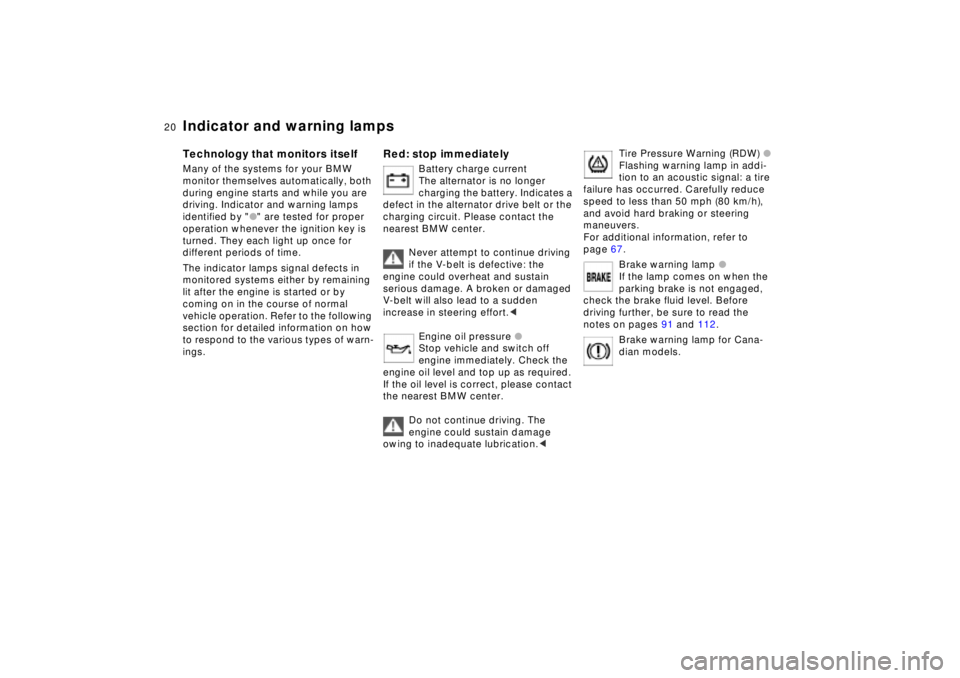
Battery charge current
The alternator is no longer
charging the battery. Indicates a
defect in the alternator drive belt or the
charging circuit. Please contact the
nearest BMW center.
Never attempt to continue driving
if the V-belt is defective: the
engine could overheat and sustain
serious damage. A broken or damaged
V-belt will also lead to a sudden
increase in steering effort.
<
Engine oil pressure
l
Stop vehicle and switch off
engine immediately. Check the
engine oil level and top up as required.
If the oil level is correct, please contact
the nearest BMW center.
Do not continue driving. The
engine could sustain damage
owing to inadequate lubrication.
<
Tire Pressure Warning (RDW)
l
Flashing warning lamp in addi-
tion to an acoustic signal: a tire
failure has occurred. Carefully reduce
speed to less than 50 mph (80 km/h),
and avoid hard braking or steering
maneuvers.
For additional information, refer to
page 67.
Brake warning lamp
l
If the lamp comes on when the
parking brake is not engaged,
check the brake fluid level. Before
driving further, be sure to read the
notes on pages 91 and 112.
Brake warning lamp for Cana-
dian models.
Page 22 of 170
22n
Indicator and warning lamps
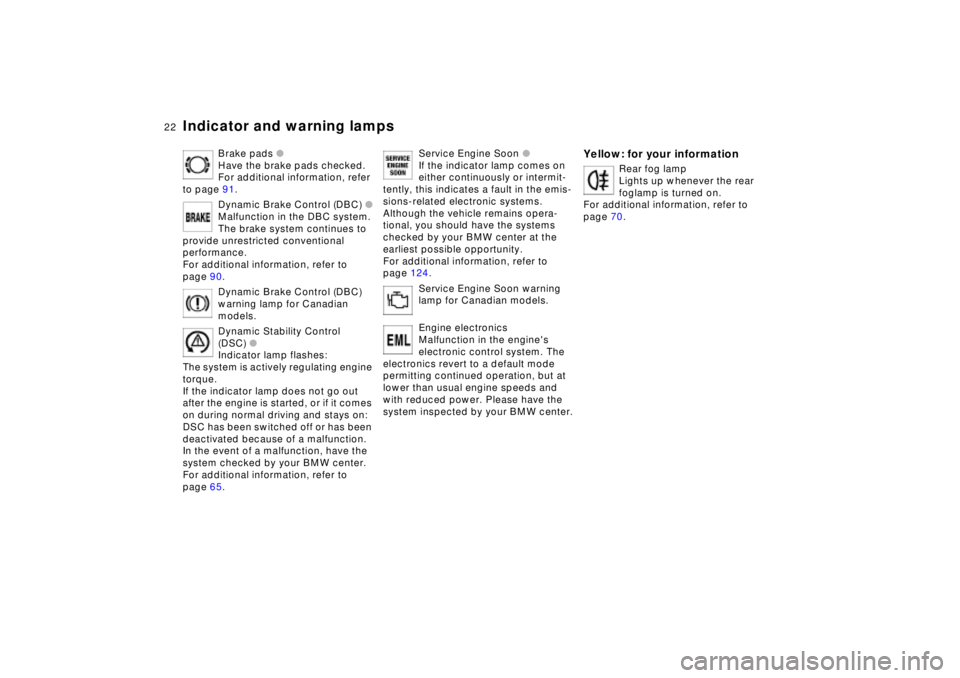
Brake pads l
Have the brake pads checked.
For additional information, refer
to page 91.
Dynamic Brake Control (DBC) l
Malfunction in the DBC system.
The brake system continues to
provide unrestricted conventional
performance.
For additional information, refer to
page 90.
Dynamic Brake Control (DBC)
warning lamp for Canadian
models.
Dynamic Stability Control
(DSC) l
Indicator lamp flashes:
The system is actively regulating engine
torque.
If the indicator lamp does not go out
after the engine is started, or if it comes
on during normal driving and stays on:
DSC has been switched off or has been
deactivated because of a malfunction.
In the event of a malfunction, have the
system checked by your BMW center.
For additional information, refer to
page 65.
Service Engine Soon l
If the indicator lamp comes on
either continuously or intermit-
tently, this indicates a fault in the emis-
sions-related electronic systems.
Although the vehicle remains opera-
tional, you should have the systems
checked by your BMW center at the
earliest possible opportunity.
For additional information, refer to
page 124.
Service Engine Soon warning
lamp for Canadian models.
Engine electronics
Malfunction in the engine's
electronic control system. The
electronics revert to a default mode
permitting continued operation, but at
lower than usual engine speeds and
with reduced power. Please have the
system inspected by your BMW center.
Yellow: for your information
Rear fog lamp
Lights up whenever the rear
foglamp is turned on.
For additional information, refer to
page 70.
Page 29 of 170
Overview
Controls and features
Operation, care
and maintenance
Owner service procedures
Technical data
Index Advanced technology
29n
IndexDataTechnologyRepairsCar careControlsOverview
Driving:
Ignition and steering lock55
Starting the engine56
Turning the engine off56
Parking brake57
Manual transmission58
Turn signal indicator/Headlamp
flasher58
Washer/Wiper system59
Rear window defroster60
Cruise control61
Everything under control:
Odometer62
Tachometer62
Fuel gauge62
Coolant temperature gauge63
Service Interval Display63
Clock64
Multi-Information Radio (MIR)64
Technology for safety and
driving convenience:
Dynamic Stability Control
(DSC)65
Dynamic Performance
Control66
Tire Pressure Warning (RDW)67Lamps:
Side lamps/Low beams69
Instrument panel lighting69
High beams/Parking lamps70
Rear fog lamp70
Interior lamps70
Reading lamps71
Controlling the climate for
pleasant driving:
Heating and ventilation/
Air conditioner72
Seat heating77
Interior conveniences:
Glove compartment78
Storage compartments78
Drink holder80
Cellular phone81
Ashtray81
Cigarette lighter82
Loading and transporting:
Cargo loading83
Page 67 of 170
67n
IndexDataTechnologyRepairsCar careControlsOverview
Tire Pressure Warning (RDW)The conceptRDW monitors the tire pressure in all
four wheels while driving. The system
provides an alert whenever the inflation
pressure drops significantly in one of
the tires.
For RDW to "learn" the correct tire infla-
tion pressure, check the inflation pres-
sure in all tires, comparing them with
the values in the inflation pressure table
(refer to page 27), and make correc-
tions as necessary. Then activate the
system.
The indicator lamp within the in-
strument cluster flashes to alert
you to substantial pressure loss
in any of the tires.
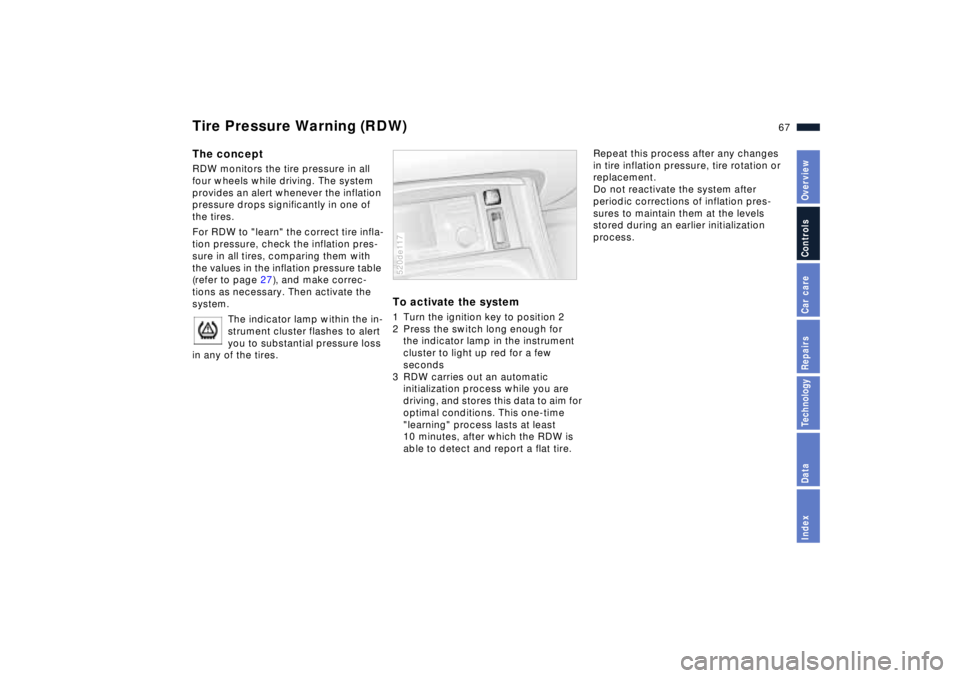
To activate the system 1 Turn the ignition key to position 2
2 Press the switch long enough for
the indicator lamp in the instrument
cluster to light up red for a few
seconds
3 RDW carries out an automatic
initialization process while you are
driving, and stores this data to aim for
optimal conditions. This one-time
"learning" process lasts at least
10 minutes, after which the RDW is
able to detect and report a flat tire.520de117
Repeat this process after any changes
in tire inflation pressure, tire rotation or
replacement.
Do not reactivate the system after
periodic corrections of inflation pres-
sures to maintain them at the levels
stored during an earlier initialization
process.
Page 69 of 170
69n
IndexDataTechnologyRepairsCar careControlsOverview
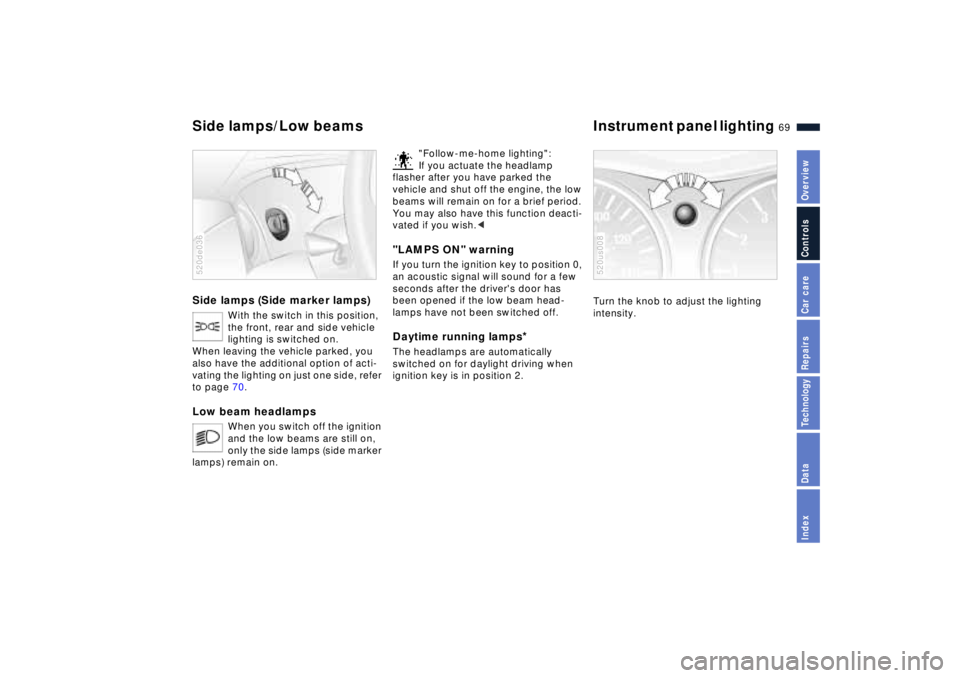
Side lamps (Side marker lamps)
With the switch in this position,
the front, rear and side vehicle
lighting is switched on.
When leaving the vehicle parked, you
also have the additional option of acti-
vating the lighting on just one side, refer
to page 70.
Low beam headlamps
When you switch off the ignition
and the low beams are still on,
only the side lamps (side marker
lamps) remain on.
520de036
"Follow-me-home lighting":
If you actuate the headlamp
flasher after you have parked the
vehicle and shut off the engine, the low
beams will remain on for a brief period.
You may also have this function deacti-
vated if you wish.<
"LAMPS ON" warningIf you turn the ignition key to position 0,
an acoustic signal will sound for a few
seconds after the driver's door has
been opened if the low beam head-
lamps have not been switched off.Daytime running lamps
*
The headlamps are automatically
switched on for daylight driving when
ignition key is in position 2.
Turn the knob to adjust the lighting
intensity.520us008
Side lamps/Low beams Instrument panel lighting
Page 91 of 170
91n
IndexDataTechnologyRepairsCar careControlsOverview
Disc brakes Brake systemDriving notesWhen driving in heavy rain and on wet
roads it is advisable to apply light pres-
sure to the brake pedal every few miles.
Monitor traffic conditions to ensure that
this maneuver does not pose a hazard
to you or to other road users. The heat
generated in this braking process helps
dry the pads and rotors.
Maximum braking force is obtained
while the wheels are not locked, but
rather when they are still barely turning
immediately prior to locking. ABS main-
tains this state automatically. If the ABS
fails, you should revert to the staggered
braking technique (refer to page 93).
When descending steep hills and
extended grades, downshift to a gear
that will allow you to continue safely
with only a minimal amount of braking.
By minimizing the loads placed on the
brake system, this strategy helps
ensure that optimal brake system
response will remain available at all
times.
You can enhance the engine's braking
effect by engaging a lower gear, down-
shifting as far as first gear when
descending extremely steep slopes. Even if engine braking fails to slow the
vehicle sufficiently, you should still
make every effort to avoid prolonged
braking with continuous application of
low to moderate pressure at the pedal.
It is better to decelerate the vehicle by
applying a higher level of force at the
pedal (watch following traffic!) and then
subsequently pausing to allow the
brakes to cool briefly before starting on
your next braking cycle. By protecting
brake system components against
overheating, the cooling phases
afforded by this staggered, or intermit-
tent braking technique help maintain
consistent availability of optimal braking
response when it is needed.
Do not coast with the clutch
depressed, the gear-shift lever in
neutral, or, above all, with the engine
off; otherwise, the engine will provide
no braking effect if the transmission is
in neutral, and there is no braking or
steering power assist if the engine is
not running. Never allow floor mats,
carpets or any other objects to obstruct
the accelerator, clutch or brake pedals
and pose a safety hazard by reducing
their available travel range.<
Brake fluid level
The brake warning lamp comes
on with the parking brake
released:
The brake fluid level in the reser-
voir is too low, refer to page 112.
If the brake fluid level is too low
and brake pedal travel has become
noticeably longer, there may be a
defect in one of the brake system's
hydraulic circuits.
Proceed to the nearest BMW
center. Higher brake application
pressure may be necessary under these
conditions, and brake pedal travel may
be significantly longer. Please
remember to adapt your driving style
accordingly.<
Page 103 of 170

103n
IndexDataTechnologyRepairsCar careControlsOverview
Approved wheel and tire specifications Snow chains
*
It is impossible to install snow chains
when using summer tires
275/40 R 18 99 W.
Do not activate the RDW system
while using snow chains.
Malfunction warnings and undetected
losses in pressure are possible when
driving with snow chains.
For further information, refer to
page 67.< BMW tests certain tire brands for each tire size, classifies them as road-safe and
approves them. Your BMW center can provide further information.
Observe any regulations applicable in the country of use, e.g. requiring entry in
the vehicle documents.
Tire specifications Light-alloy wheel
BMW Z8
Summer tires
Front: 245/45 R 18 96 W 8Jx18EH2
Rear: 275/40 R 18 99 W 9Jx18EH2
Winter tires
245/45 R 18 96 H M+S 8Jx18EH2
The use of rims and wheel bolts
that do not meet the specifications
of the original factory-installed equip-
ment will affect the safe operation of
your vehicle and may cause an accident
and personal injury.
Never mix tires of different design, such
as steel-belted radials with radial bias
belted or bias-ply tires, etc. Mixing tire
types will adversely affect roadholding
and can lead to loss of vehicle control.<
Page 112 of 170
112n
Coolant Brake fluidAdding coolant To guard against the possibility of
scalding injuries, always wait until the
engine cools (temperature gauge
needle in blue sector) before
unscrewing the cap on the expansion
tank.
1 Turn the cap slightly counterclock-
wise in order to allow accumulated
pressure to escape, then continue
turning to remove.
2 If the coolant is low, slowly add
coolant until the correct level is
reached Ð do not overfill.
The coolant is a mixture of water and
extended-duty antifreeze with corrosion
inhibitor. Always maintain the
prescribed all-season 50:50 mixture
ratio for year-round protection against
internal corrosion. No other additives
are required.
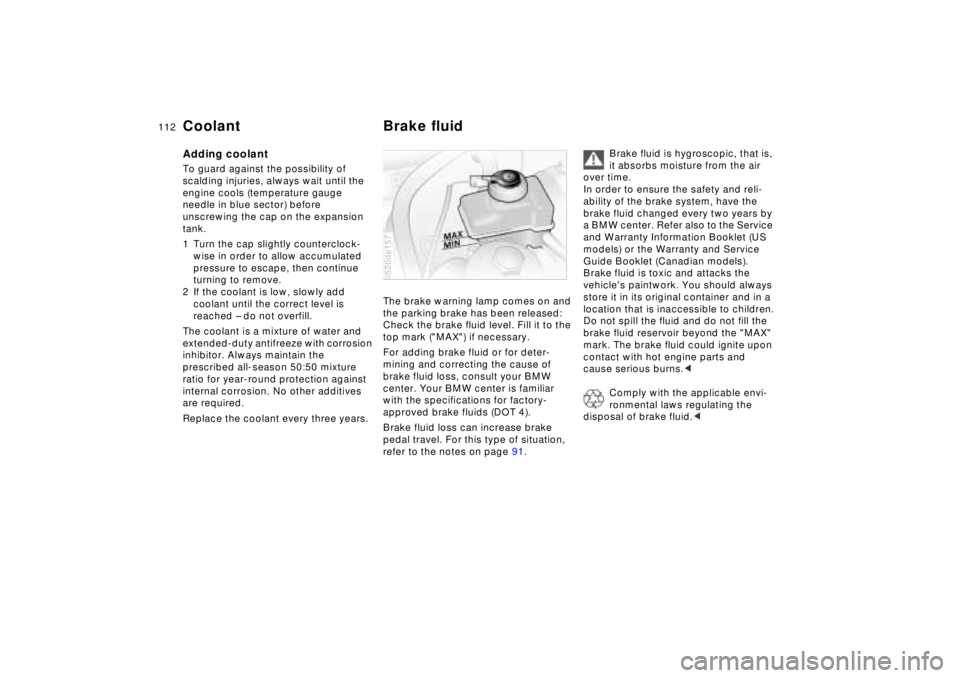
Replace the coolant every three years.The brake warning lamp comes on and
the parking brake has been released:
Check the brake fluid level. Fill it to the
top mark ("MAX") if necessary.
For adding brake fluid or for deter-
mining and correcting the cause of
brake fluid loss, consult your BMW
center. Your BMW center is familiar
with the specifications for factory-
approved brake fluids (DOT 4).
Brake fluid loss can increase brake
pedal travel. For this type of situation,
refer to the notes on page 91.
520de157
Brake fluid is hygroscopic, that is,
it absorbs moisture from the air
over time.
In order to ensure the safety and reli-
ability of the brake system, have the
brake fluid changed every two years by
a BMW center. Refer also to the Service
and Warranty Information Booklet (US
models) or the Warranty and Service
Guide Booklet (Canadian models).
Brake fluid is toxic and attacks the
vehicle's paintwork. You should always
store it in its original container and in a
location that is inaccessible to children.
Do not spill the fluid and do not fill the
brake fluid reservoir beyond the "MAX"
mark. The brake fluid could ignite upon
contact with hot engine parts and
cause serious burns.<
Comply with the applicable envi-
ronmental laws regulating the
disposal of brake fluid.<