fuel BMW Z8 2002 User Guide
[x] Cancel search | Manufacturer: BMW, Model Year: 2002, Model line: Z8, Model: BMW Z8 2002Pages: 174, PDF Size: 2.37 MB
Page 31 of 174
31n
IndexDataTechnologyRepairsCar careControlsOverview
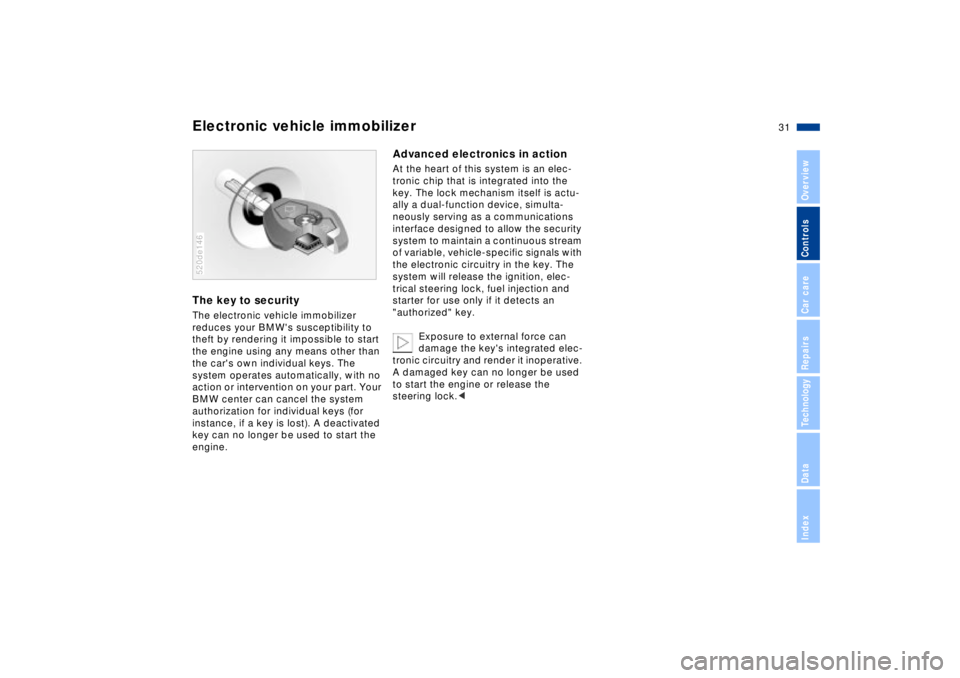
Electronic vehicle immobilizer The key to securityThe electronic vehicle immobilizer
reduces your BMW's susceptibility to
theft by rendering it impossible to start
the engine using any means other than
the car's own individual keys. The
system operates automatically, with no
action or intervention on your part. Your
BMW center can cancel the system
authorization for individual keys (for
instance, if a key is lost). A deactivated
key can no longer be used to start the
engine.520de146
Advanced electronics in actionAt the heart of this system is an elec-
tronic chip that is integrated into the
key. The lock mechanism itself is actu-
ally a dual-function device, simulta-
neously serving as a communications
interface designed to allow the security
system to maintain a continuous stream
of variable, vehicle-specific signals with
the electronic circuitry in the key. The
system will release the ignition, elec-
trical steering lock, fuel injection and
starter for use only if it detects an
"authorized" key.
Exposure to external force can
damage the key's integrated elec-
tronic circuitry and render it inoperative.
A damaged key can no longer be used
to start the engine or release the
steering lock.<
Page 32 of 174
32n
Central locking system Opening and closing Ð from the outside The conceptThe central locking system is ready for
operation whenever the driver's door is
closed. The system engages and
releases the locks on the
>doors
>luggage compartment lid
>fuel filler door
>glove compartment
>cellular phone holder.
The central locking system can be
operated
>from the outside via the driver's door
lock or by using the remote control
>from the inside by pressing a button.
If you initiate central locking from
inside, neither the fuel filler door, the
glove compartment, nor the cellular
phone holder are locked (refer to
page 36).
If you do set it from outside, the anti-
theft alarm is automatically activated as
well. This prevents the door handles
from unlocking the doors. The alarm
system is also activated or deactivated.
The central locking system unlocks
automatically in the event of an acci-
dent. In addition, the hazard warning
flashers and interior lamps come on.
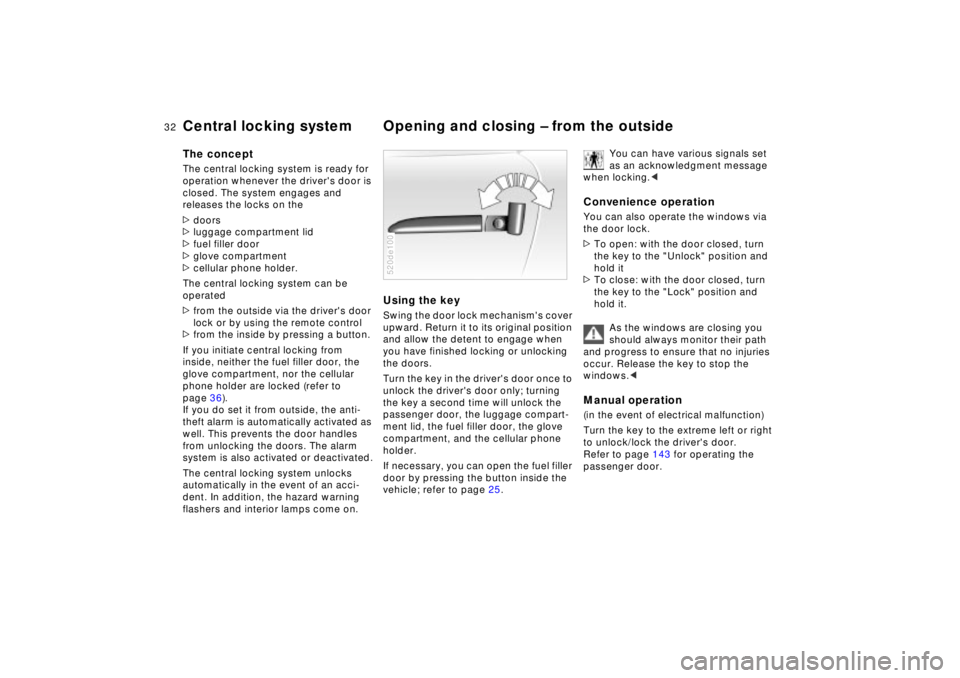
Using the keySwing the door lock mechanism's cover
upward. Return it to its original position
and allow the detent to engage when
you have finished locking or unlocking
the doors.
Turn the key in the driver's door once to
unlock the driver's door only; turning
the key a second time will unlock the
passenger door, the luggage compart-
ment lid, the fuel filler door, the glove
compartment, and the cellular phone
holder.
If necessary, you can open the fuel filler
door by pressing the button inside the
vehicle; refer to page 25.520de100
You can have various signals set
as an acknowledgment message
when locking.<
Convenience operationYou can also operate the windows via
the door lock.
>To open: with the door closed, turn
the key to the "Unlock" position and
hold it
>To close: with the door closed, turn
the key to the "Lock" position and
hold it.
As the windows are closing you
should always monitor their path
and progress to ensure that no injuries
occur. Release the key to stop the
windows.
to unlock/lock the driver's door.
Refer to page 143 for operating the
passenger door.
Page 34 of 174
34n
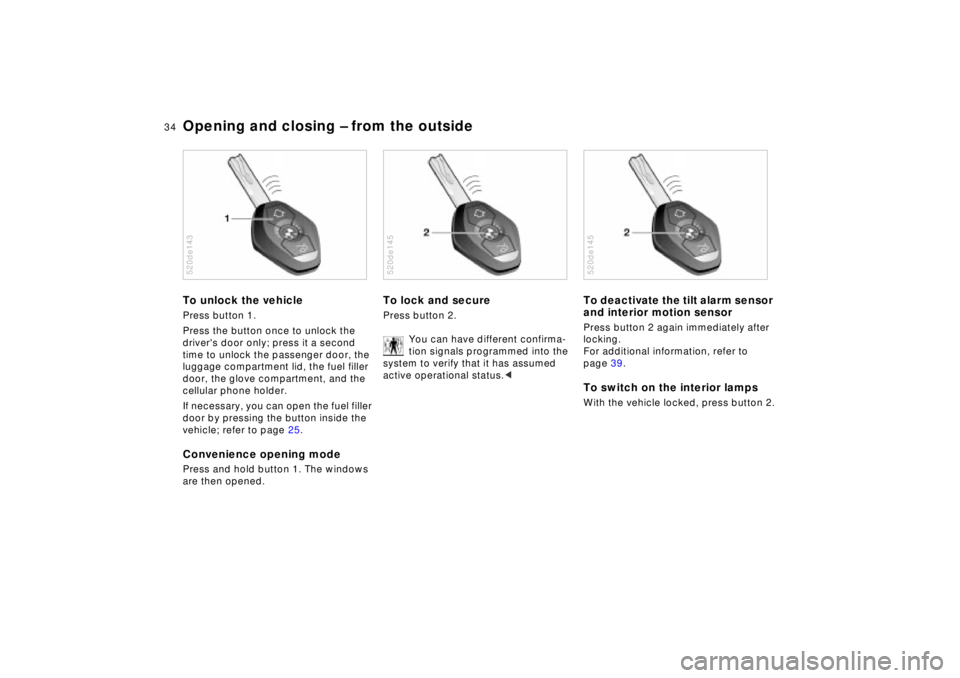
Opening and closing Ð from the outsideTo unlock the vehicle Press button 1.
Press the button once to unlock the
driver's door only; press it a second
time to unlock the passenger door, the
luggage compartment lid, the fuel filler
door, the glove compartment, and the
cellular phone holder.
If necessary, you can open the fuel filler
door by pressing the button inside the
vehicle; refer to page 25.Convenience opening modePress and hold button 1. The windows
are then opened. 520de143
To lock and secure Press button 2.
You can have different confirma-
tion signals programmed into the
system to verify that it has assumed
active operational status.<520de145
To deactivate the tilt alarm sensor
and interior motion sensor Press button 2 again immediately after
locking.
For additional information, refer to
page 39.To switch on the interior lamps With the vehicle locked, press button 2.520de145
Page 36 of 174
36n
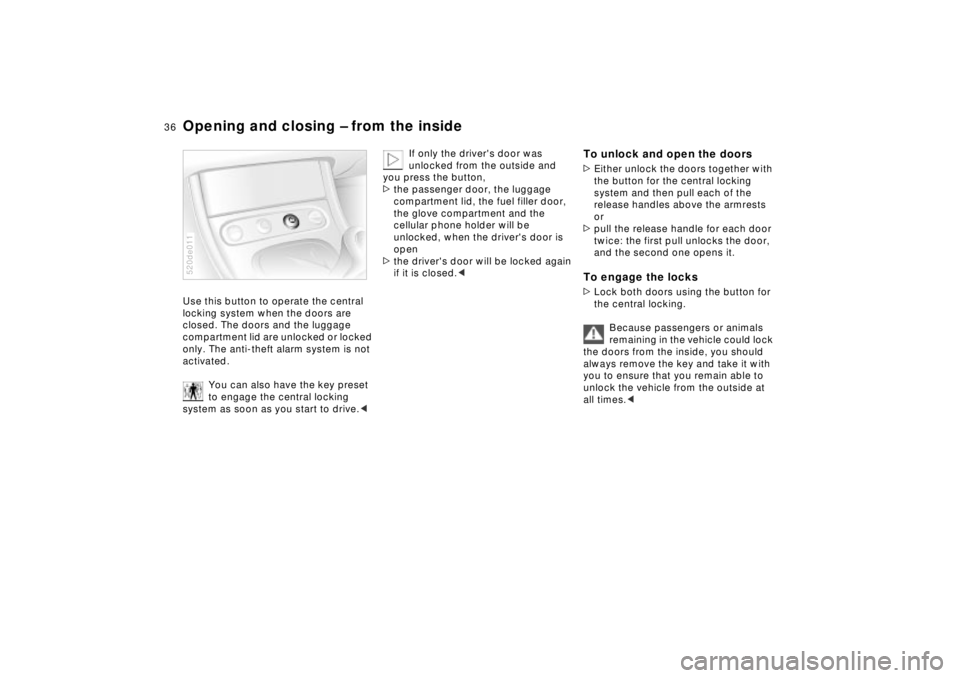
Opening and closing Ð from the inside Use this button to operate the central
locking system when the doors are
closed. The doors and the luggage
compartment lid are unlocked or locked
only. The anti-theft alarm system is not
activated.
You can also have the key preset
to engage the central locking
system as soon as you start to drive.<520de011
If only the driver's door was
unlocked from the outside and
you press the button,
>the passenger door, the luggage
compartment lid, the fuel filler door,
the glove compartment and the
cellular phone holder will be
unlocked, when the driver's door is
open
>the driver's door will be locked again
if it is closed.<
To unlock and open the doors>Either unlock the doors together with
the button for the central locking
system and then pull each of the
release handles above the armrests
or
>pull the release handle for each door
twice: the first pull unlocks the door,
and the second one opens it.To engage the locks>Lock both doors using the button for
the central locking.
Because passengers or animals
remaining in the vehicle could lock
the doors from the inside, you should
always remove the key and take it with
you to ensure that you remain able to
unlock the vehicle from the outside at
all times.<
Page 62 of 174
62n
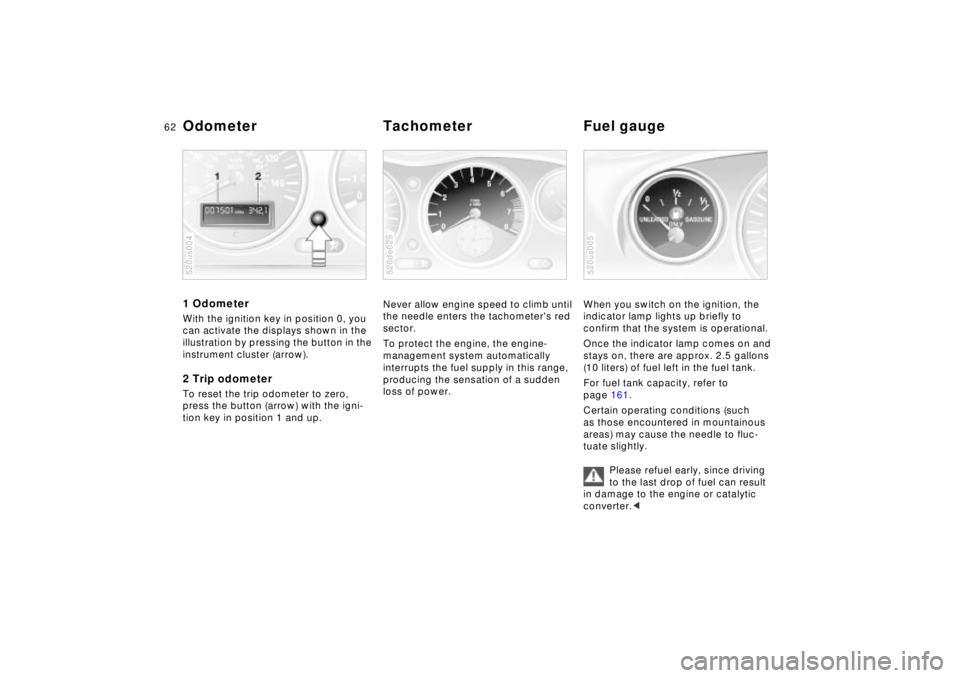
1 Odometer With the ignition key in position 0, you
can activate the displays shown in the
illustration by pressing the button in the
instrument cluster (arrow).2 Trip odometerTo reset the trip odometer to zero,
press the button (arrow) with the igni-
tion key in position 1 and up.520us004
Never allow engine speed to climb until
the needle enters the tachometer's red
sector.
To protect the engine, the engine-
management system automatically
interrupts the fuel supply in this range,
producing the sensation of a sudden
loss of power.520de029
When you switch on the ignition, the
indicator lamp lights up briefly to
confirm that the system is operational.
Once the indicator lamp comes on and
stays on, there are approx. 2.5 gallons
(10 liters) of fuel left in the fuel tank.
For fuel tank capacity, refer to
page 161.
Certain operating conditions (such
as those encountered in mountainous
areas) may cause the needle to fluc-
tuate slightly.
Please refuel early, since driving
to the last drop of fuel can result
in damage to the engine or catalytic
converter.<520us005
Odometer Tachometer Fuel gauge
Page 87 of 174

87n
IndexDataTechnologyRepairsCar careControlsOverview
Brakes:
Do not rest your foot on the brake
pedal while driving. Even light but
consistent pressure on the brake pedal
could lead to high temperatures, brake
wear, and possibly, to brake system
failure.
Aquaplaning:
Reduce speed while driving on wet or
slushy roads, otherwise, a wedge of
water can form between the tires and
the road surface. This phenomenon is
referred to as "aquaplaning" or "hydro-
planing." It is characterized by a partial
or complete loss of contact between
the tires and the road surface. The ulti-
mate results are loss of steering and
braking control.
Driving through water:
When there is water on the roads, do
not drive in it if it is deeper than 1 ft
(30 cm), and even then, only at walking
speed, otherwise the vehicle can
sustain damage to the engine, the elec-
trical systems and the transmission.<
The catalytic converter reduces harmful
exhaust emissions.
It is designed for use with unleaded fuel
only. Even minute quantities of lead
would be enough to permanently
damage both the catalytic converter
and the system's oxygen sensor.
To ensure efficient, trouble-free engine
operation and to avoid potential
damage:
>Be sure to comply with the scheduled
maintenance requirements
>Fill the fuel tank well before it is empty
>Tow-start only when the engine is
cold. If you attempt to tow-start with
a warm engine, unburned residual
fuel could ignite on the way to the
catalytic converter and cause
damage. It is better to start the
vehicle with a battery charger or
assistance from another vehicle
>Avoid other situations where the fuel
is either not burned or burns incom-
pletely, such as engaging the starter
frequently or for extended periods, or
repeated start attempts in which the
engine does not start (stopping and
restarting an engine which is running
properly does not present a problem).
Never allow the engine to run with
any of the spark plug cables discon-
nected.Be sure to comply with the
instructions above to prevent
unburned fuel from reaching the cata-
lytic converter. Otherwise, there is the
danger of overheating and damage to
the catalytic converter.
Extreme temperatures are present with
the catalytic converter both on this and
every catalyst-equipped vehicle. Heat
shields are installed adjacent to some
sections of the exhaust system. Never
remove these shields; do not apply
undercoating to their surfaces. When
driving, standing at idle, and parking
the vehicle, take care to avoid contact
between the exhaust system and flam-
mable materials (grass, hay, leaves
etc.). Such contact could start a fire,
resulting in serious personal injury and
property damage.<
Driving notes Catalytic converter
Page 102 of 174

102n
Wheel and tire combinations The right choice
Use only wheels and tires
approved by BMW for the corre-
sponding vehicle model, as otherwise
the tires may make contact with the
body as the result of tolerances despite
the same nominal size being used,
resulting in serious accidents. If non-
approved wheels and tires are used,
BMW cannot evaluate their suitability,
and therefore cannot be held liable for
driving safety.<
For wheel and tire specifications
approved by BMW, refer to page 104.
The correct wheel and tire combi-
nation affects different systems
that otherwise will not function prop-
erly, e. g. ABS, DSC and Flat Tire
Monitor.
For this reason, use only tires of the
same brand and tread pattern on the
vehicle and, for example, restore the
approved wheel and tire combination
following a flat tire as soon as
possible.<
Codes on tires and wheels The code on tires has the following
meaning.
Codes on radial tires:
The speed rating indicates the
approved maximum speed for the tire.
Summer tires:
S = up to 112 mph (180 km/h)
T = up to 118 mph (190 km/h)
H = up to 130 mph (210 km/h)
V = up to 150 mph (240 km/h)
W = up to 167 mph (270 km/h)
Y = up to 186 mph (300 km/h)
ZR = over 150 mph (240 km/h)
Winter tires:
Q M+S = up to 100 mph (160 km/h)
T M+S = up to 118 mph (190 km/h)
H M+S = up to 130 mph (210 km/h) For example:
Nominal width
in mm
Aspect ratio in X
Radial tire code
Rim diameter in inches
Load rating
(not on ZR tires)
Speed rating
(before R on ZR tires)
245/45 R
1896W
Codes on light-alloy wheels:
Protect tire valves from dirt by using
screw-on valve stem caps. Dirt in the
valves frequently leads to slow leaks.
Safety tires carry additional designation
codes; these vary according to manu-
facturer:
Bridgestone RFT
Dunlop DSST
Goodyear EMT
Michelin ZPStorageAlways store tires in a cool, dry place,
protecting them against light whenever
possible. Protect the tires against
contact with oil, grease and fuel. For example:
Rim width
in inches
Code letter for
flange type
Symbol for full-drop
center rim
Rim diameter in inches
Hump on the 2 rim shoulders
8 x 18 EH2
J
Page 111 of 174
111n
IndexDataTechnologyRepairsCar careControlsOverview
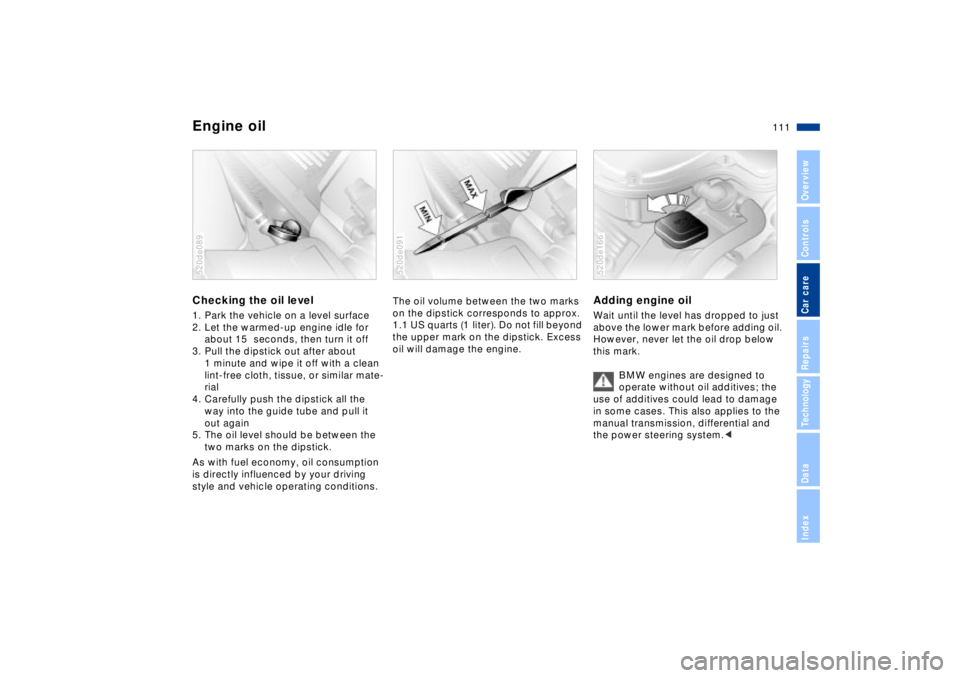
Engine oilChecking the oil level 1. Park the vehicle on a level surface
2. Let the warmed-up engine idle for
about 15 seconds, then turn it off
3. Pull the dipstick out after about
1 minute and wipe it off with a clean
lint-free cloth, tissue, or similar mate-
rial
4. Carefully push the dipstick all the
way into the guide tube and pull it
out again
5. The oil level should be between the
two marks on the dipstick.
As with fuel economy, oil consumption
is directly influenced by your driving
style and vehicle operating conditions.520de089
The oil volume between the two marks
on the dipstick corresponds to approx.
1.1 US quarts (1 liter). Do not fill beyond
the upper mark on the dipstick. Excess
oil will damage the engine.520de091
Adding engine oil Wait until the level has dropped to just
above the lower mark before adding oil.
However, never let the oil drop below
this mark.
BMW engines are designed to
operate without oil additives; the
use of additives could lead to damage
in some cases. This also applies to the
manual transmission, differential and
the power steering system.<520de166
Page 120 of 174

120n
Caring for your vehicleCaring for the vehicle finish Regular washing is a preventive
measure against long-term effects from
substances that are harmful to the
vehicle's finish, especially if you drive
your vehicle in areas with high levels of
air pollution or natural contaminants
(tree resins, pollen).
Nevertheless, you should immediately
remove especially aggressive
substances. Failure to do so can lead to
changes in the paint's chemical struc-
ture or to discoloration. Gasoline spilled
during refueling, oil, grease, brake fluid
and bird droppings should always be
cleaned up immediately.
Any contamination remaining on the
surface of the vehicle will be especially
conspicuous after washing. Use
cleaning fluid or alcohol and a clean
cloth or cotton pad to remove. Remove
tar spots with tar remover. After
cleaning, the affected areas should be
waxed to ensure continued protection.
Use the cleaning and car-care
products available at your BMW
center.<
Waxing your vehicle Protect the finish using carnauba or
synthetic-based waxes only.
The best way to determine when the
finish needs to be waxed is by noting
when water stops beading on the
surface.
You can use a glass cleaner to remove
any wax or silicone that may have been
left on the windows during waxing.
Use the cleaning and car-care
products available at your BMW
center.<
Repairing the paintYou can touch up small areas of paint
damage with a BMW spray paint or a
BMW touchup stick.
The color code of your vehicle is
provided on a tag located near the
vehicle data plate and on the first page
of the Service and Warranty Information
Booklet (US models) or the Warranty
and Service Guide Booklet (Canadian
models).
More extensive paint damage should
be repaired professionally in accor-
dance with the manufacturer's instruc-
tions. Your BMW center uses original
BMW finish materials in accordance
with approved repair procedures.
Page 121 of 174

121n
IndexDataTechnologyRepairsCar careControlsOverview
Caring for your vehicleWindow careYou can use window and glass cleaner
to clean inside window surfaces and
mirrors without smearing and streaking.
Never use polishing pastes or abrasive
(quartz) cleansers on mirror lenses.
Clean the wiper blades with soapy
water. The wiper blades should be
replaced twice a year Ð before and after
the cold season.
Use only wiper blades approved
by BMW.<
Caring for other vehicle
components and materials Light-alloy wheels should be treated
with alloy wheel cleaner, especially
during the winter months. However, do
not use aggressive products containing
acids, strong alkalis or abrasives. Do
not use steam cleaners operating at
temperatures above 140 7 (60 6).
Follow the manufacturer's instructions.
Carefully clean chrome parts such as
lamp sockets assemblies, door handles
and similar items with an ample amount
of clean water Ð and shampoo, too, if
necessary Ð especially if there is an
accumulation of road salt. Use a
chrome polish for an additional treat-
ment.
Use water to clean plastic components,
headliners, lamp lenses, and surfaces
sprayed dull black Ð adding vinyl
shampoo, if necessary. Do not allow
moisture to soak through the seats or
headliner. Never use solvents such as
lacquer thinner, heavy-duty grease
remover, fuels, or similar substances.
Use a soft, clean cloth to wipe off the
clear covers of the instruments, using
methylated spirits with distilled water as
a cleaning solvent, if necessary, at a
mixing ratio of 1:1.Rubber components should be cleaned
with water only; a rubber treatment or
silicone spray may also be applied.
The safety belts should be cleaned with
a mild soap and water solution without
being removed from the vehicle. Never
attempt chemical or dry cleaning, as
damage to the belt fabric could result.
After cleaning, never allow the inertia
reel to retract the belts until they are
completely dry. Dirty safety belts
prevent the inertia reel mechanism from
retracting the strap properly, thus
constituting a safety hazard.
Heavily soiled floor carpets and mats
*
can be cleaned with an interior cleaner.
The floor mats can be removed from
the vehicle for cleaning.
Clean aluminum surfaces with water
and, if necessary, with a mild soap.
Never use solvents such as lacquer
thinner, heavy-duty grease remover,
fuels, or similar substances.
Use only a wet cloth to clean painted
inner parts. Dry them afterwards with a
soft cloth.
Use the cleaning and car-care
products available at your BMW
center.<