ECU BMW Z8 CONVERTIBLE 2002 User Guide
[x] Cancel search | Manufacturer: BMW, Model Year: 2002, Model line: Z8 CONVERTIBLE, Model: BMW Z8 CONVERTIBLE 2002Pages: 174, PDF Size: 2.37 MB
Page 53 of 174
53n
IndexDataTechnologyRepairsCar careControlsOverview
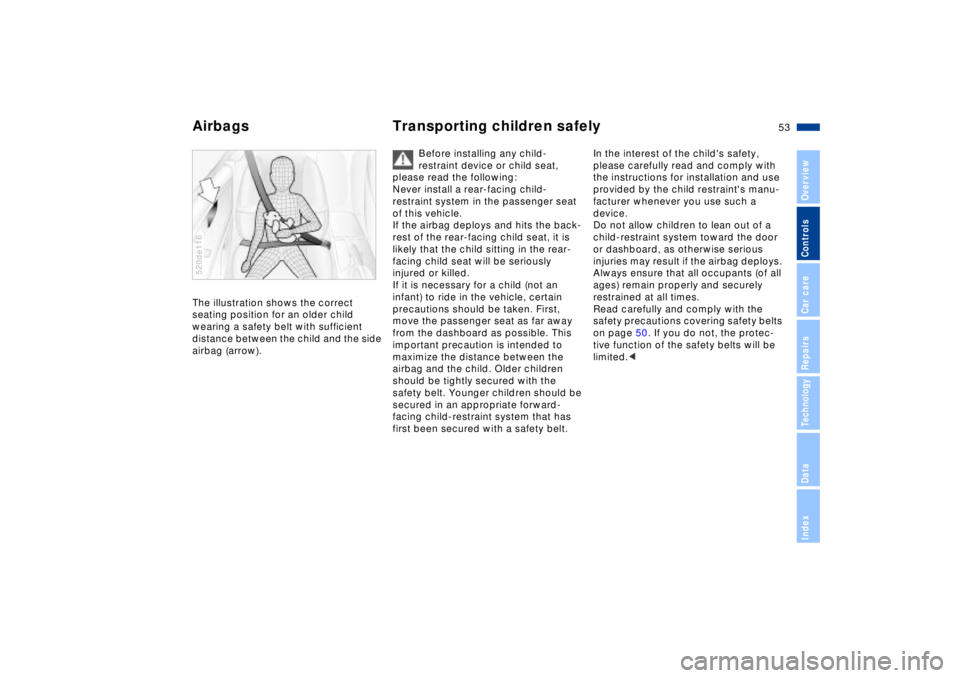
Airbags Transporting children safelyThe illustration shows the correct
seating position for an older child
wearing a safety belt with sufficient
distance between the child and the side
airbag (arrow).520de116
Before installing any child-
restraint device or child seat,
please read the following:
Never install a rear-facing child-
restraint system in the passenger seat
of this vehicle.
If the airbag deploys and hits the back-
rest of the rear-facing child seat, it is
likely that the child sitting in the rear-
facing child seat will be seriously
injured or killed.
If it is necessary for a child (not an
infant) to ride in the vehicle, certain
precautions should be taken. First,
move the passenger seat as far away
from the dashboard as possible. This
important precaution is intended to
maximize the distance between the
airbag and the child. Older children
should be tightly secured with the
safety belt. Younger children should be
secured in an appropriate forward-
facing child-restraint system that has
first been secured with a safety belt.
In the interest of the child's safety,
please carefully read and comply with
the instructions for installation and use
provided by the child restraint's manu-
facturer whenever you use such a
device.
Do not allow children to lean out of a
child-restraint system toward the door
or dashboard, as otherwise serious
injuries may result if the airbag deploys.
Always ensure that all occupants (of all
ages) remain properly and securely
restrained at all times.
Read carefully and comply with the
safety precautions covering safety belts
on page 50. If you do not, the protec-
tive function of the safety belts will be
limited.<
Page 54 of 174
54n
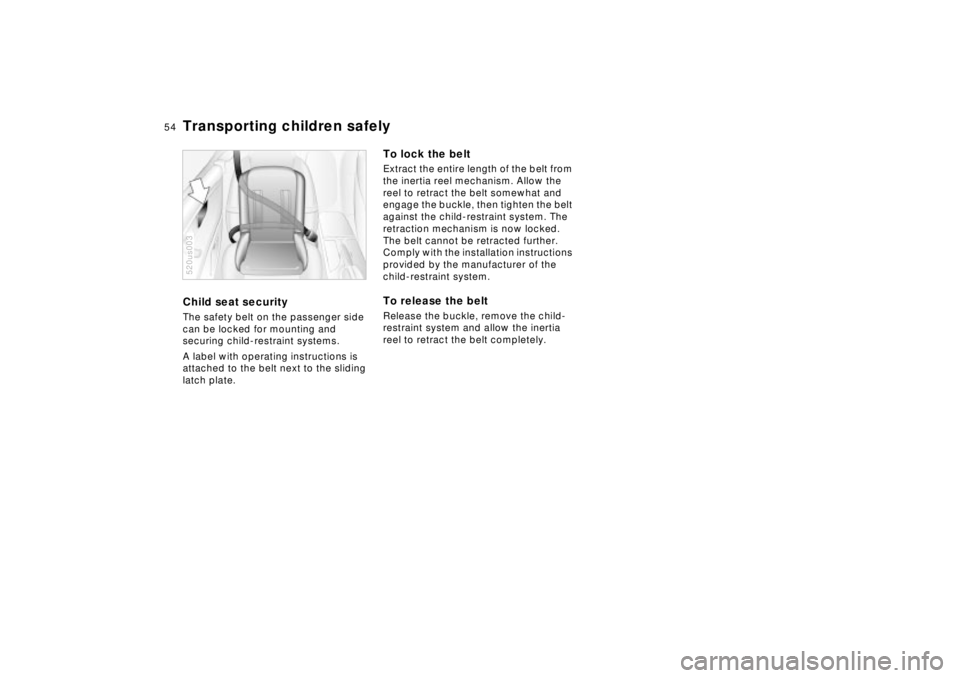
Transporting children safelyChild seat securityThe safety belt on the passenger side
can be locked for mounting and
securing child-restraint systems.
A label with operating instructions is
attached to the belt next to the sliding
latch plate.520us003
To lock the beltExtract the entire length of the belt from
the inertia reel mechanism. Allow the
reel to retract the belt somewhat and
engage the buckle, then tighten the belt
against the child-restraint system. The
retraction mechanism is now locked.
The belt cannot be retracted further.
Comply with the installation instructions
provided by the manufacturer of the
child-restraint system.To release the beltRelease the buckle, remove the child-
restraint system and allow the inertia
reel to retract the belt completely.
Page 83 of 174

83n
IndexDataTechnologyRepairsCar careControlsOverview
Cargo loadingStowing cargo If you are carrying cargo in the luggage
compartment of your BMW Z8 roadster:
>Load heavy cargo as far forward as
possible, directly behind the luggage
compartment partition
>Cover sharp edges and corners.
If you are stowing cargo behind the
seats in your BMW Z8 roadster:
>Stow only lightweight objects, such
as clothing
>Do not pile objects higher than the
top edge of the backrest.
Do not stow either heavy cargo or
cargo with sharp edges and
corners behind the seats, or else they
could damage the back of the seat or
the rear trim panel.
Cargo that is too big or unwieldy and
stowed behind the seats can also
prevent the seat from locking properly
into position. Therefore, check to make
sure that the seat is properly locked
into place, moving the seat forward if
necessary. Refer to page 45.
Always position and secure the load
correctly. If you do not, it can endanger
vehicle occupants during braking or
evasive maneuvers.
Do not exceed the approved gross
weight or the approved axle loads (refer
to page 160), otherwise the vehicle's
operating safety is no longer assured
and you are in violation of the law.
Make sure to secure heavy or hard
objects you stow in the passenger area,
otherwise, these objects could be flung
about during braking or evasive maneu-
vers and possibly injure vehicle occu-
pants.<
Page 106 of 174
106n
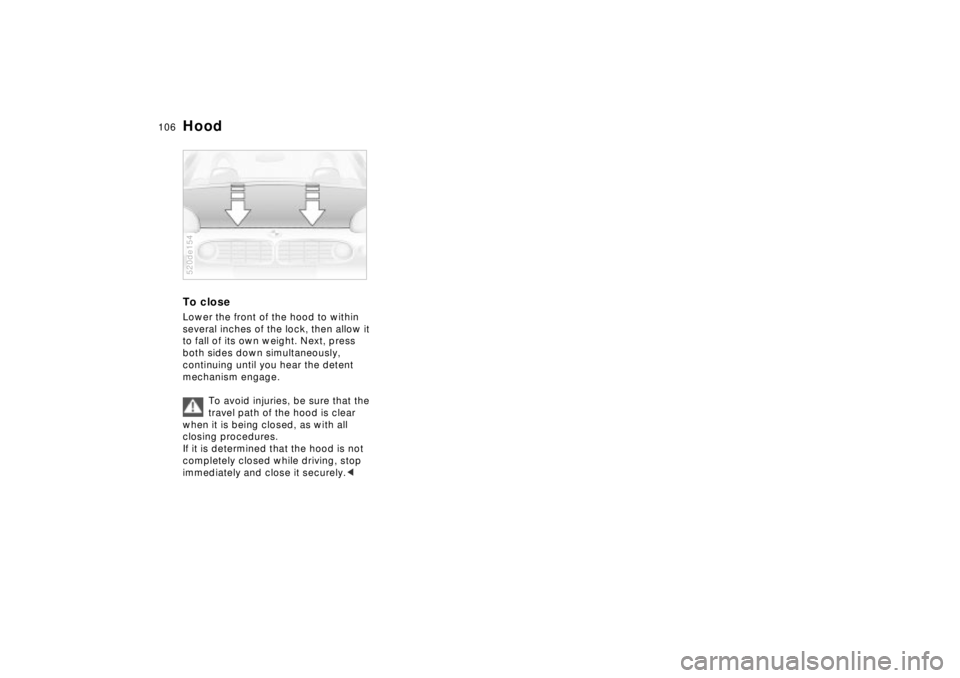
HoodTo closeLower the front of the hood to within
several inches of the lock, then allow it
to fall of its own weight. Next, press
both sides down simultaneously,
continuing until you hear the detent
mechanism engage.
To avoid injuries, be sure that the
travel path of the hood is clear
when it is being closed, as with all
closing procedures.
If it is determined that the hood is not
completely closed while driving, stop
immediately and close it securely.<520de154
Page 139 of 174
139n
IndexDataTechnologyRepairsCar careControlsOverview
Battery
A highly explosive gas is
generated when the battery is
charged.
If you happen to get acid in your
eyes, rinse thoroughly for
15 minutes with clear water.
Consult a physician immediately. If you
get acid spray on your skin or clothing,
rinse with plenty of water. If acid is
accidentally ingested, consult a physi-
cian immediately.
In order to protect the battery
case from ultraviolet radiation,
do not place it in direct sunlight.
A discharged battery can freeze. Store
the battery in areas where temperature
remains above freezing.
Removing and installing
Do not disconnect the battery
cable when the engine is running.
Disconnecting the battery cable when
the engine is running will cause a
voltage surge which will damage the
vehicle's onboard electronics.
Do not make any modifications in the
wires to the positive terminal. If you do
so, the protective function of the safety
battery terminal is no longer ensured.
Repairs and disposal may only be
performed by specially trained
personnel.<
When removing, first disconnect the
cable to the negative terminal, then
disconnect the cable to the positive
terminal. Loosen the center adjusting
screw for the battery's retaining strap
(use the screwdriver found in the
onboard tool kit) and remove the
bracket.
When installing, first connect the cable
for the positive terminal, then the cable
for the negative terminal.
When installing, make sure that
the battery is seated properly, and
that the battery bracket is installed with
the center adjusting screw. Failure to
observe these precautions could result
in an inadequately secured battery,
which could then shift in an accident.<
Charging the battery Charge the battery in the vehicle only
when the engine is not running. Use the
connections provided in the engine
compartment (for correct connections,
refer to "Jump-starting" on page 145).
Before performing any work on
the electrical system, disconnect
the cable from the negative terminal. If
you do not, short circuits can create the
risk of fire or personal injury.<
If you plan to park the vehicle for longer
than 4 weeks, disconnect the battery
from the vehicle's electrical system by
disconnecting the cable at the negative
terminal. Then recharge the battery with
an appropriate battery charger.
If you intend to store the vehicle for
longer than 12 weeks, remove the
battery, charge it and store it in a cool
and dust-free room where there is no
danger of freezing. During storage,
have the battery recharged every six
months. Also, recharge the battery
before it is reinstalled. Failure to
observe these precautions can render
the battery unsuitable for continued
use. Every time the battery is
discharged, especially over extended
periods, its service life is reduced.
Page 140 of 174
140n
Battery Fuses
Return used batteries to a recy-
cling point or your BMW center.
Maintain the battery in an upright posi-
tion for transport and storage. Secure
the battery to prevent it from tilting
during transport.<
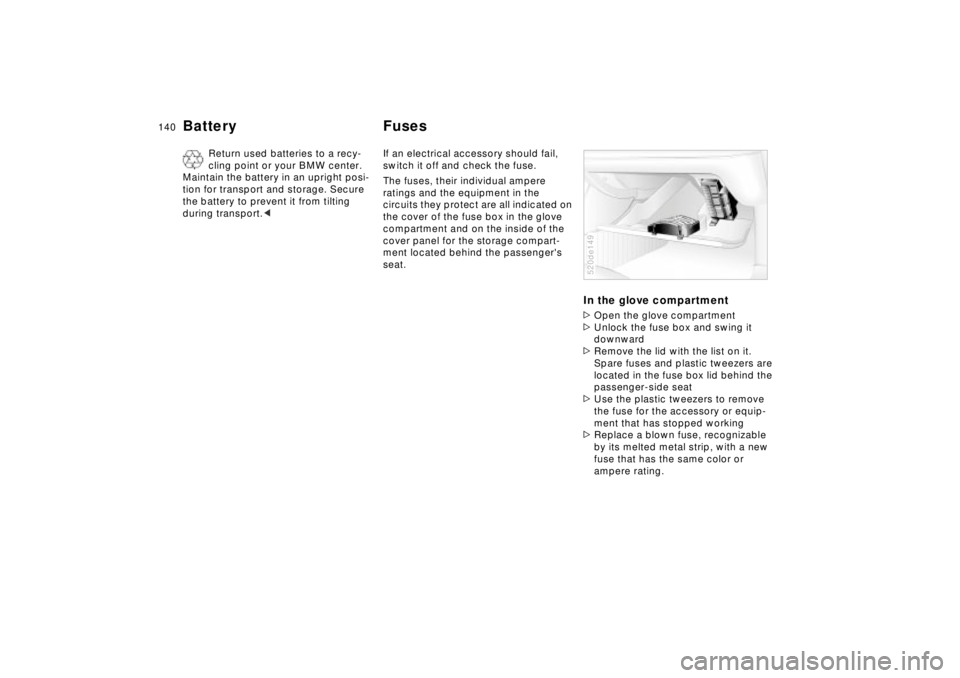
If an electrical accessory should fail,
switch it off and check the fuse.
The fuses, their individual ampere
ratings and the equipment in the
circuits they protect are all indicated on
the cover of the fuse box in the glove
compartment and on the inside of the
cover panel for the storage compart-
ment located behind the passenger's
seat.
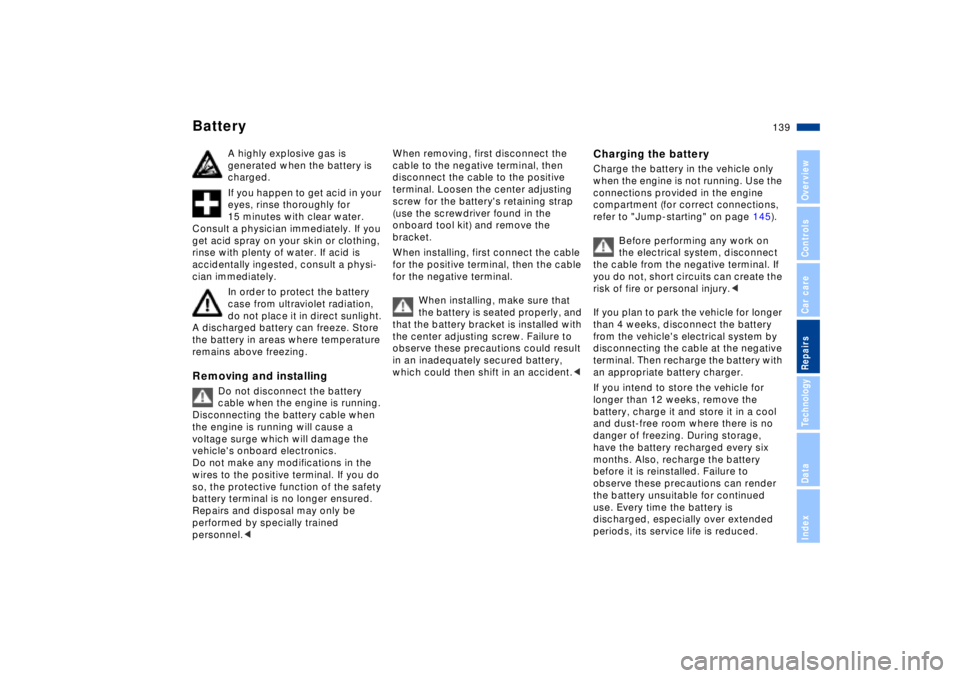
In the glove compartment>Open the glove compartment
>Unlock the fuse box and swing it
downward
>Remove the lid with the list on it.
Spare fuses and plastic tweezers are
located in the fuse box lid behind the
passenger-side seat
>Use the plastic tweezers to remove
the fuse for the accessory or equip-
ment that has stopped working
>Replace a blown fuse, recognizable
by its melted metal strip, with a new
fuse that has the same color or
ampere rating.520de149
Page 170 of 174

Everything from A to ZRestraint systems53
Return used
batteries140t
Reverse17, 58
Roof load capacity160
Rotating the tires101
Rubber parts93SSafety belt tensioners153
Safety belts50
Safety buttons36
Safety tires99
Seat adjustment45
Seat heating77
Securing cargo83
Self-defrosting mirrors48
Service Interval
Display63, 116
Shelves78, 79
Should131t
Side airbags51
Side marker lamps69
bulb
replacment131t, 132t
Skid control94
Slippery roads93
Snow chains93, 103, 104
Socket82
for flashlights82
for power supplies82
for vacuum cleaners82Sound system, refer to the
separate Owner's Manual
Spare key30
Spark plugs162
Speaker81
Specified engine oil112
Speedometer18
Starting56
problems87t, 145
Steel wheels104
Steering94
Steering wheel lock55
Stopping the vehicle57
Storage areas78, 79
Storing your vehicle124
Stroke158
Summer tires102
Switching off the engine57
Switching off the interior
motion sensor39t
Switching off the tilt alarm
sensor39t
Symbols4, 138
TTachometer62
Tail lamps132
bulb replacment132t
Tank capacity161
Technical data158
Technical
modifications6, 125Telephone81
Temperature display
outside temperature64
Temperature gauge
engine coolant63
Temperature
selection74, 75
Tilt alarm34
Tilt alarm sensor39
Tire codes102
Tire damage99t
Tire inflation
pressure26, 99
Tire pressure monitor67
Tire replacement100, 101
Tire rotation101
Tire specifications104
Tire tread99
Tools130t
Torque158
Tow fittings146t
Towing the vehicle146t
Tow-starting146t
Track159
Traction Control System
refer to DSC65
Transmission58
Transmitter key30
Tread depth, tires99
Trip odometer62
Trunk lid, refer to luggage
compartment lid37Turn signal indicator23, 59
Turning circle159
UUniform Tire Quality
Grading101
Unusually high steering
effort20, 94
Use antifreeze114t
radiator114t
Used batteries,
disposal140tVVacuum cleaner82
Vehicle battery138, 162
Vehicle care
exterior119
interior121
Vehicle equipment
options and accessories5
Vehicle Identification
Number (VIN)115
Vehicle immobilizer31
Vehicle painting119
Vehicle storage124
Vehicle weight160
Vehicle, starting56
Vehicle, stopping57
Ventilation72
draft-free75
Vinyl upholstery, care121