vent BMW Z8 CONVERTIBLE 2002 Workshop Manual
[x] Cancel search | Manufacturer: BMW, Model Year: 2002, Model line: Z8 CONVERTIBLE, Model: BMW Z8 CONVERTIBLE 2002Pages: 174, PDF Size: 2.37 MB
Page 133 of 174
133n
IndexDataTechnologyRepairsCar careControlsOverview
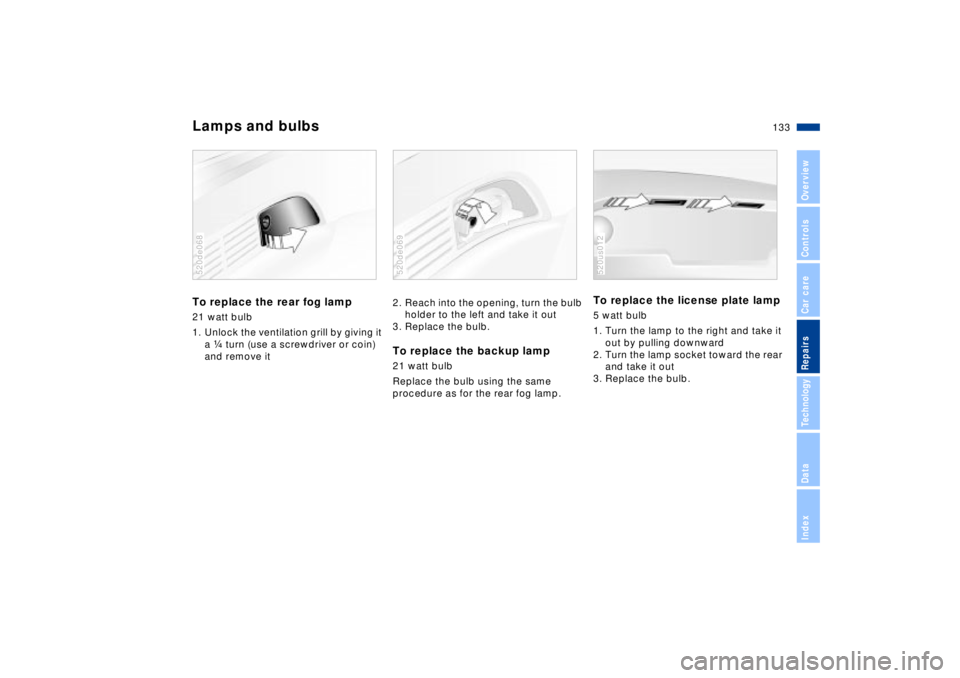
Lamps and bulbsTo replace the rear fog lamp 21 watt bulb
1. Unlock the ventilation grill by giving it
a f turn (use a screwdriver or coin)
and remove it520de068
2. Reach into the opening, turn the bulb
holder to the left and take it out
3. Replace the bulb.To replace the backup lamp21 watt bulb
Replace the bulb using the same
procedure as for the rear fog lamp. 520de069
To replace the license plate lamp5 watt bulb
1. Turn the lamp to the right and take it
out by pulling downward
2. Turn the lamp socket toward the rear
and take it out
3. Replace the bulb.520us012
Page 137 of 174

137n
IndexDataTechnologyRepairsCar careControlsOverview
Changing a wheel Safety tiresYour BMW Z8 roadster is equipped
with safety tires.
The safety tires are made of self-
supporting tires mounted on specially-
designed wheel rims. Special reinforce-
ment elements support the sidewalls in
the event of pressure loss. Although tire
performance is then restricted, the
vehicle can still be driven on the
deflated tire for a limited distance. Your
vehicle is equipped with a tire pressure
monitor that signals you in case of a flat
tire.
In the event of a flat tireThe red indicator lamp on the instru-
ment panel will flash in the event of a
flat tire. In addition, a gong will sound.
Refer to page 67.
Carefully reduce speed to less than
50 mph (80 km/h), avoiding any hard
braking or steering maneuvers while
doing so.
You will still be able to drive approx.
155 miles (250 km) on your safety tire,
until you can get to a safe place to park,
a gas station, or to your nearest BMW
center. Under minimum vehicle loading,
it could conceivably last more than
155 miles (250 km).
If you cannot immediately determine
which tire is defective just by looking
at it, then check the tire pressure in all
four tires.Have your BMW center replace
your tires. For safety reasons, do
not have safety tires repaired. Your
BMW center has been trained to work
with the safety tires and is equipped
with the necessary special tools.<
If necessary, please have your
BMW center switch the tires on
your vehicle from summer to winter
tires, or the reverse.<
Page 138 of 174
138n
Battery
Battery posts, terminals, and
related accessories contain lead
and lead compounds. Wash hands after
handling.<
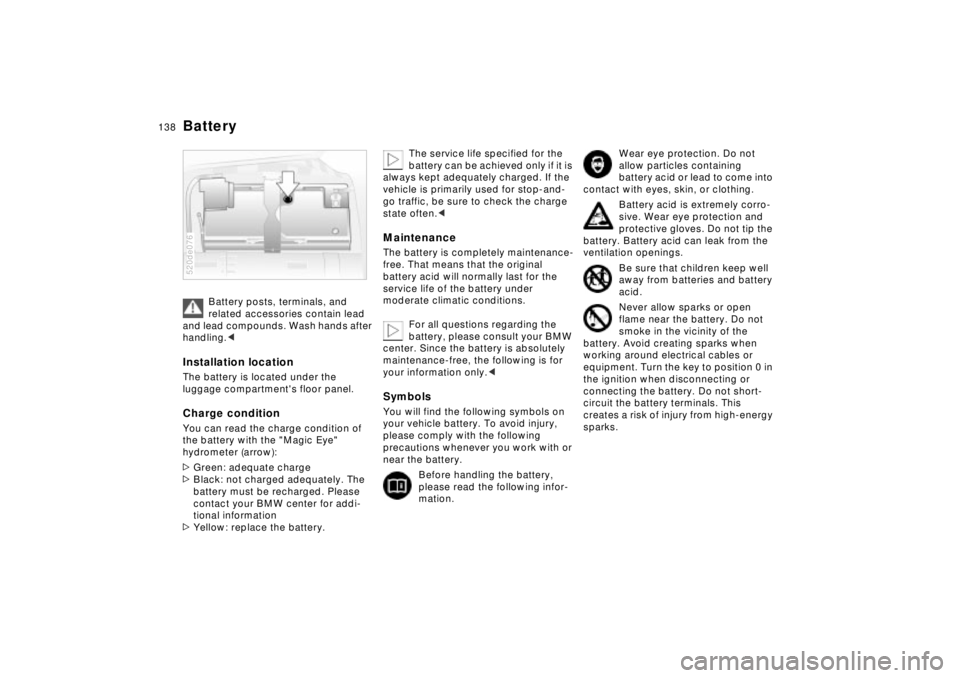
Installation location The battery is located under the
luggage compartment's floor panel. Charge conditionYou can read the charge condition of
the battery with the "Magic Eye"
hydrometer (arrow):
>Green: adequate charge
>Black: not charged adequately. The
battery must be recharged. Please
contact your BMW center for addi-
tional information
>Yellow: replace the battery.520de076
The service life specified for the
battery can be achieved only if it is
always kept adequately charged. If the
vehicle is primarily used for stop-and-
go traffic, be sure to check the charge
state often.<
MaintenanceThe battery is completely maintenance-
free. That means that the original
battery acid will normally last for the
service life of the battery under
moderate climatic conditions.
For all questions regarding the
battery, please consult your BMW
center. Since the battery is absolutely
maintenance-free, the following is for
your information only.
please comply with the following
precautions whenever you work with or
near the battery.
Before handling the battery,
please read the following infor-
mation.
Wear eye protection. Do not
allow particles containing
battery acid or lead to come into
contact with eyes, skin, or clothing.
Battery acid is extremely corro-
sive. Wear eye protection and
protective gloves. Do not tip the
battery. Battery acid can leak from the
ventilation openings.
Be sure that children keep well
away from batteries and battery
acid.
Never allow sparks or open
flame near the battery. Do not
smoke in the vicinity of the
battery. Avoid creating sparks when
working around electrical cables or
equipment. Turn the key to position 0 in
the ignition when disconnecting or
connecting the battery. Do not short-
circuit the battery terminals. This
creates a risk of injury from high-energy
sparks.
Page 140 of 174
140n
Battery Fuses
Return used batteries to a recy-
cling point or your BMW center.
Maintain the battery in an upright posi-
tion for transport and storage. Secure
the battery to prevent it from tilting
during transport.<
If an electrical accessory should fail,
switch it off and check the fuse.
The fuses, their individual ampere
ratings and the equipment in the
circuits they protect are all indicated on
the cover of the fuse box in the glove
compartment and on the inside of the
cover panel for the storage compart-
ment located behind the passenger's
seat.
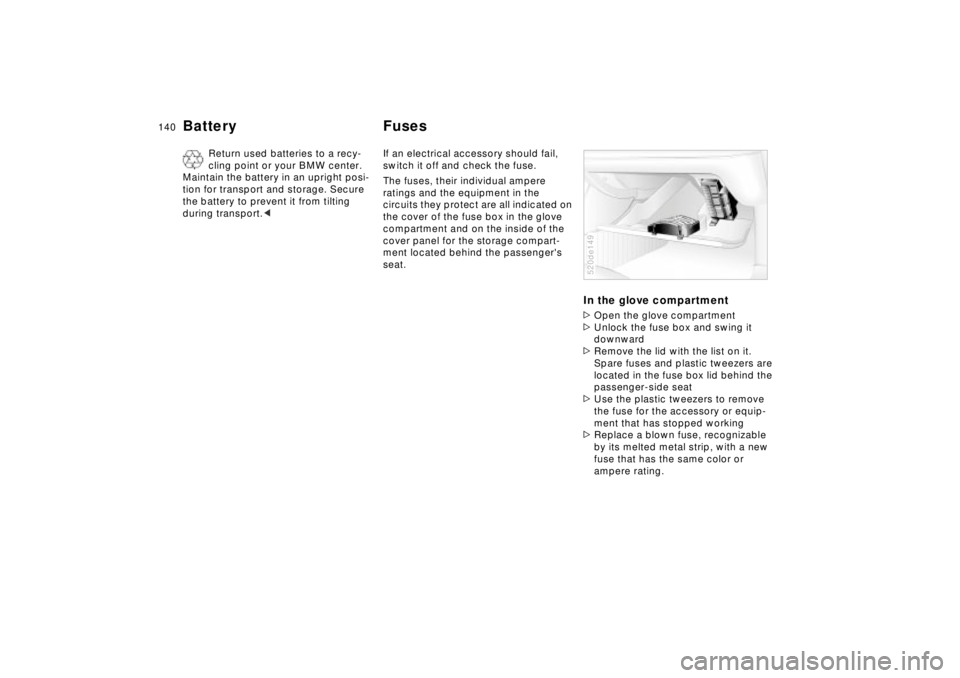
In the glove compartment>Open the glove compartment
>Unlock the fuse box and swing it
downward
>Remove the lid with the list on it.
Spare fuses and plastic tweezers are
located in the fuse box lid behind the
passenger-side seat
>Use the plastic tweezers to remove
the fuse for the accessory or equip-
ment that has stopped working
>Replace a blown fuse, recognizable
by its melted metal strip, with a new
fuse that has the same color or
ampere rating.520de149
Page 143 of 174
143n
IndexDataTechnologyRepairsCar careControlsOverview
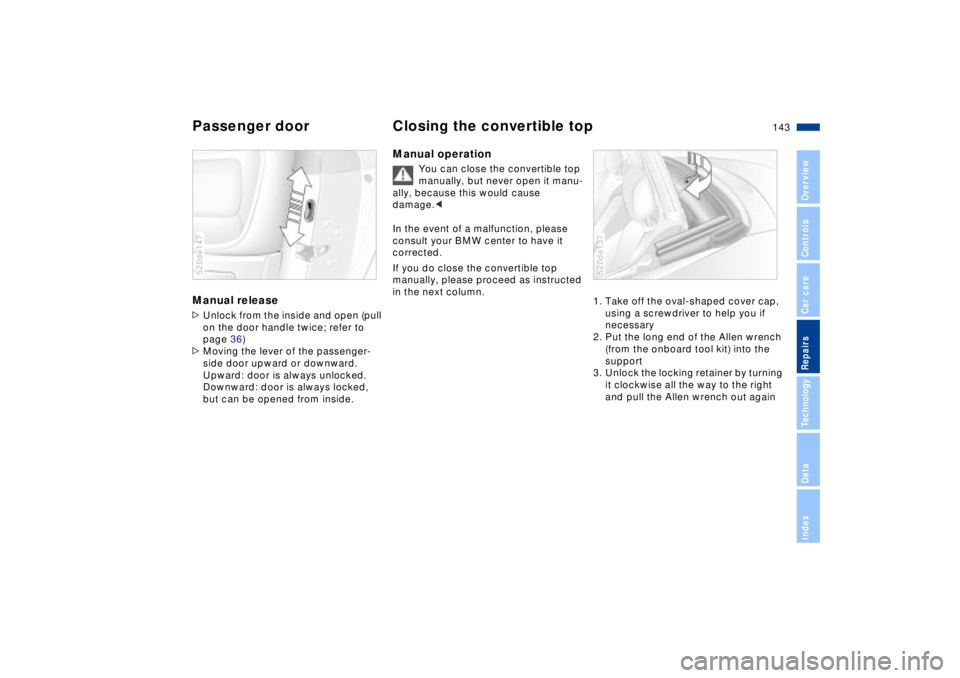
Passenger door Closing the convertible topManual release >Unlock from the inside and open (pull
on the door handle twice; refer to
page 36)
>Moving the lever of the passenger-
side door upward or downward.
Upward: door is always unlocked.
Downward: door is always locked,
but can be opened from inside.520de147
Manual operation
You can close the convertible top
manually, but never open it manu-
ally, because this would cause
damage.<
In the event of a malfunction, please
consult your BMW center to have it
corrected.
If you do close the convertible top
manually, please proceed as instructed
in the next column.
1. Take off the oval-shaped cover cap,
using a screwdriver to help you if
necessary
2. Put the long end of the Allen wrench
(from the onboard tool kit) into the
support
3. Unlock the locking retainer by turning
it clockwise all the way to the right
and pull the Allen wrench out again 520de137
Page 147 of 174
147n
IndexDataTechnologyRepairsCar careControlsOverview
Towing the vehicle
Avoid "off-center" towing. Be sure
that the tow rope is pulled tightly
when the towing vehicle begins to
move.<
The towed vehicle should always
be the lighter of the two vehicles.
If this is not the case, it is no longer
possible to control vehicle response.<
Tow-startingFor instructions on jump-starting, refer
to page 145.
Never attempt to use your vehicle to
push another vehicle, since damage to
the energy-absorbing bumpers could
result.
Towing a vehicle1. Put the shift lever in neutral
2. Towing speed:
Max. 45 mph (70 km/h)
3. Towing distance:
Max. 95 miles (150 km)
4. Leave the ignition key in position 1 to
ensure that the brake lamps, turn
signals, horn and windshield wipers
remain operative, and to prevent the
steering lock detent from engaging
5. Switch on the hazard warning system
(comply with country-specific regula-
tions).
Find some means of identifying the
vehicle in tow, e. g. place a sign or
warning triangle in the rear window.
Make sure that the ignition key
remains in position 1 even when
the electrical system has failed to
prevent the steering lock from
engaging. The steering and brakes are
without power assist when the engine is
not running. This means that increased
effort is required for steering and
braking.<
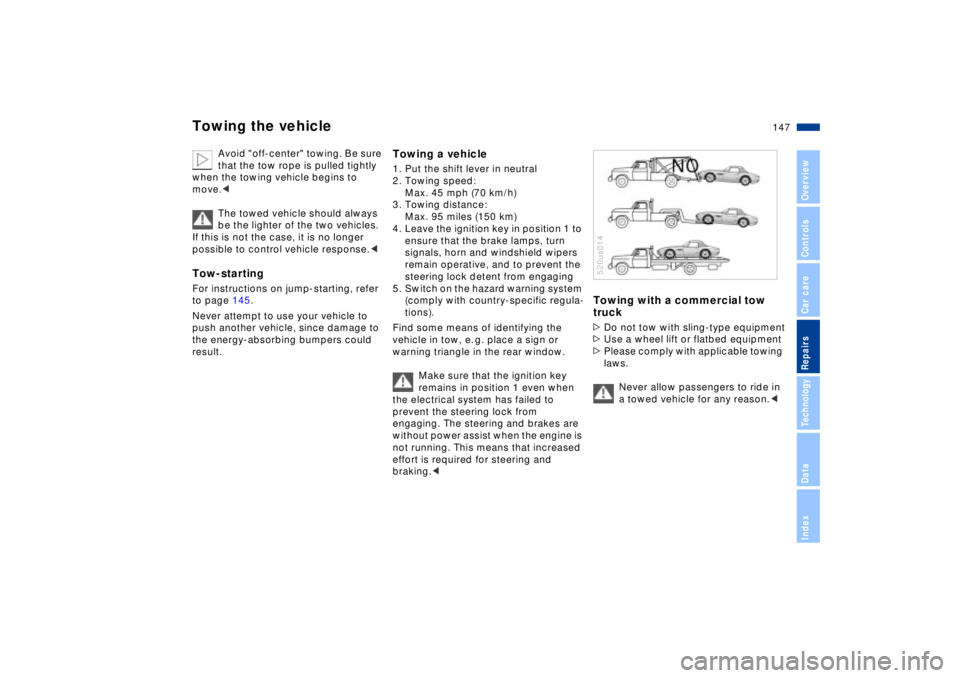
Towing with a commercial tow
truck>Do not tow with sling-type equipment
>Use a wheel lift or flatbed equipment
>Please comply with applicable towing
laws.
Never allow passengers to ride in
a towed vehicle for any reason.<520us014
Page 150 of 174
150n
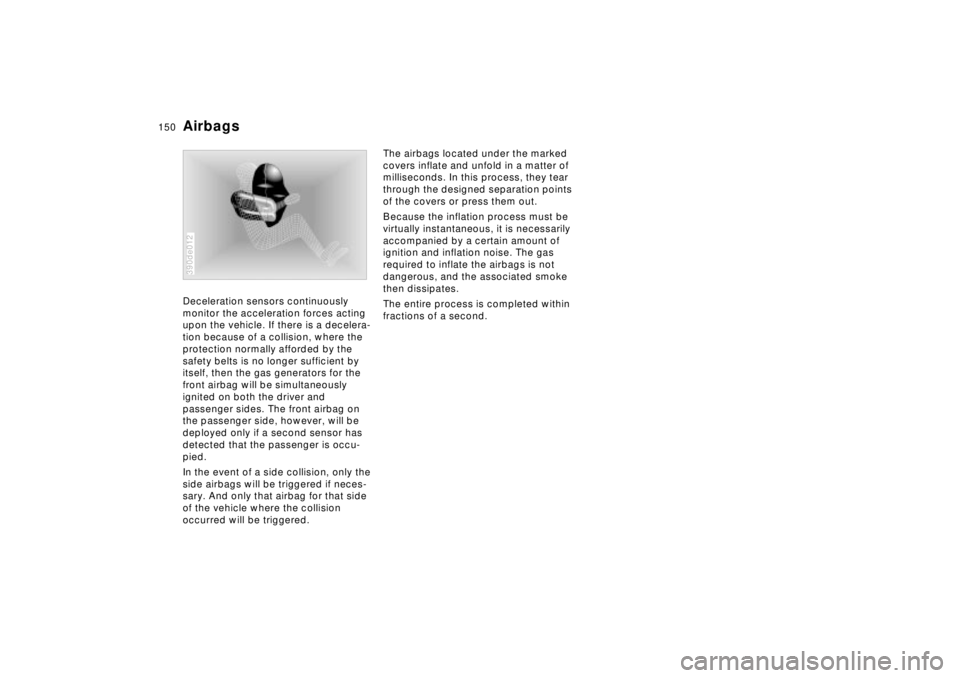
Deceleration sensors continuously
monitor the acceleration forces acting
upon the vehicle. If there is a decelera-
tion because of a collision, where the
protection normally afforded by the
safety belts is no longer sufficient by
itself, then the gas generators for the
front airbag will be simultaneously
ignited on both the driver and
passenger sides. The front airbag on
the passenger side, however, will be
deployed only if a second sensor has
detected that the passenger is occu-
pied.
In the event of a side collision, only the
side airbags will be triggered if neces-
sary. And only that airbag for that side
of the vehicle where the collision
occurred will be triggered.
390de012
The airbags located under the marked
covers inflate and unfold in a matter of
milliseconds. In this process, they tear
through the designed separation points
of the covers or press them out.
Because the inflation process must be
virtually instantaneous, it is necessarily
accompanied by a certain amount of
ignition and inflation noise. The gas
required to inflate the airbags is not
dangerous, and the associated smoke
then dissipates.
The entire process is completed within
fractions of a second.
Airbags
Page 152 of 174

152n
Dynamic Stability Control (DSC)
Highly sensitive sensors monitor the
number of revolutions of the wheels,
steering angle, lateral acceleration,
brake pressure and the movement of
the vehicle around its vertical axis.
When the system detects substantial
differences in rotation rates between
wheels, it acts to inhibit uncontrolled
wheelspin by reducing the drive torque
transmitted to the affected wheel(s),
while also initiating selective braking
intervention as needed.
In addition, DSC permanently monitors
the vehicle's current operating condi-
tion and compares it with an ideal
status calculated based on sensor
signals. DSC reacts to deviations from
this ideal status, such as incipient
understeer or oversteer, to restore the
vehicle's stability using a combination
of adjustments to engine torque and
selective braking applications at indi-
vidual wheels. Dangerous skids are
thus prevented before they can even
start, all of this is possible, of course,
only within physically possible limits.You may need some time to become
accustomed to this system's interven-
tion. However, it provides optimum
drive force and vehicle stability.
The braking intervention may be
accompanied by sounds specific to the
system.
Page 167 of 174

Everything from A to Z
167n
IndexDataTechnologyRepairsCar careControlsOverview
Connector for Onboard
Diagnostic126
Consumption display62
Controls16
Convertible top41
closing in event of
electrical
malfunction143t
manual operation143t
Coolant113, 161
Coolant temperature
gauge63
Copyright4
Cornering Brake Control
(CBC)21, 89
Cruise control61
Curb weight160
Current check indicator20DDashboard16
Data
dimensions159
engine158
technical158
weights160
Daytime driving lamps69
DBC (Dynamic Brake
Control)90
Deactivating the tilt alarm
sensor and interior motion
sensor34Deep water87
Defrosting the
windows60, 75
Difficult steering20, 94
Dimensions159
Dipstick111
Disc brakes90
Displacement158
Display lighting69
Displays18
Disposal
engine oil113
used batteries140t
Door keys30
Door warning lamp, bulb
replacement134t
Doors
emergency
actuation32t
mirrors48
remote control33
unlocking and locking32
DOT Quality Grades100
Draft-free ventilation75
Drink holder78, 80
Drive belts162
Driving in winter92
Driving notes87
DSC (Dynamic Stability
Control)22, 65, 152
Dynamic Brake Control
(DBC)90Dynamic Performance
Control66
Dynamic Stability Control
(DSC)22, 65, 152
EElectric defrosting of
mirrors48
Electric power seats45
Electric power windows40
Electrical equipment
failure140t
Electrical failure
convertible top143t
doors32t
fuel filler door142t
luggage
compartment142t
passenger-side
door143t
Electrical system162
Electronic vehicle
immobilizer31
Emergency operation
convertible top143t
doors32t
fuel filler door142t
luggage
compartment142t
passenger-side
door143tEmergency release from
luggage compartment's
interior38
Engine
coolant113, 161
data158
output158
speed158
starting56
switching off57
Engine compartment108
Engine oil111
add111t
consumption111
filling capacity161
filter change161
pressure indicator
lamp20
quality112
specifications112
viscosity112
Engine oil level
check111
Equipment
options and accessories5
Exit lamps, bulb
replacement134
Exterior finish119
Exterior mirrors48
Page 168 of 174

Everything from A to ZFFailure to start146t
Fault in ABS89
Filler cap cover25
Filling capacities161
Filling the washer
reservoir161
First-aid kit24
Fittings, tow-starting and
towing146t
Flashlight79
Flat tire137t
Flat Tire Monitor67
Fog lamp, bulb
replacement133t
"Follow me home"
lamps49, 69
Footbrake90
Footwell lamps71
bulb replacement134t
Front seat adjustment45
Frost protection,
radiator113
Fuel26
gauge62
indicator62
quality26
Fuel filler door
manual release after
electrical fault142tFuel injection system158
Fuel tank capacity161
Fuses140
GGasoline26
quality26
Glove compartment78
bulb replacement135t
Gross vehicle weight160HHand lamp79
Handbrake57
Hands-free system81
Hardtop96
Hazard warning
flashers24t
Hazard warning
triangle24t
Head restraint46
Headlamp covers,
care117t, 131t
Headlamp flasher70
Headlamp washer
system60, 110, 161
Headlamps70
Headlight glare in rearview
mirror48
Heated mirrors48
Heated seats77
Heating and ventilation72Heating, rapid77
Heavy loads83
Height159
High beams23, 58, 70
Holder for beverage
cans80
Hood release105t
Horn17
Hydraulic system88, 92
IIdentification, tires102
Ignition keys30
Ignition lock55
Imprint4
Incoming-air mode74
Indicator lamps20
Inflation pressure26t, 99
monitoring67
INSPECTION63
Instrument cluster18
Instrument panel lighting69
Instruments18
Interaxle tire rotation101
Interface socket for Onboard
Diagnostic126
Interference
cellular phone94
radio reception95
Interior lamps34, 71
bulb replacement135t
remote control34Interior motion sensor39
deactivating34
Interior rearview mirror with
automatic
dimmer48, 154
Intermittent mode of wiper
system59
JJump-starting145KKey Memory49
Key with remote control30
Keys30LLamps and bulbs131t
Leather care122
Length159
License plate lamp, bulb
replacement133t
Light switch69
Light-alloy wheels104
Lighter82
LIGHTS ON warning69
Loading83
Lock deicer92
Louvers72
Low beam headlamps69