cooling BUICK CENTURY 1993 User Guide
[x] Cancel search | Manufacturer: BUICK, Model Year: 1993, Model line: CENTURY, Model: BUICK CENTURY 1993Pages: 324, PDF Size: 17.58 MB
Page 202 of 324
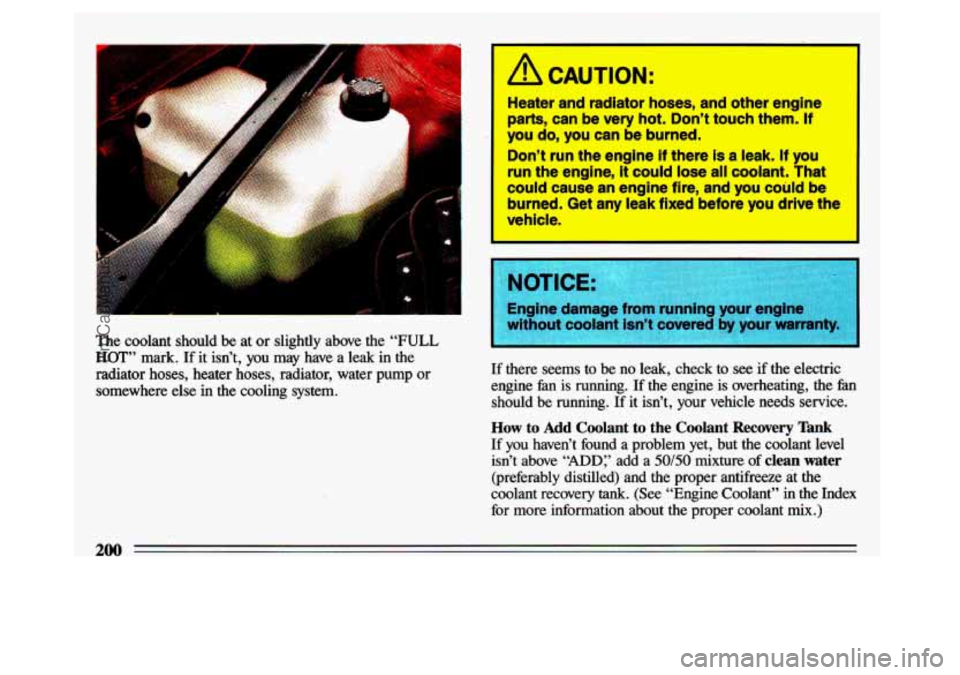
The coolant should be at or slightly above the “FULL
HOT” mark. If it isn’t, you may have a leak in the
radiator hoses, heater hoses, radiator, water pump or
somewhere else in the cooling system.
A CAUTION:
Heater and radiator hoses, and other engine
parts, can be very
hot. Don’t touch them. If
you
do, you can be burned.
Don’t
run the engine if there __ a leak. If you
run the engine, it could lose all coolant. That
could cause an engine fire, and you could be
burned. Get any leak fixed before you drive the
vehicle.
If there seems to be no leak, check to see if the electric
engine
fan is running. If the engine is overheating, the fhn
should
be running. If it isn’t, your vehicle needs service.
How to Add Coolant to the Coolant Recovery Tl[)ank
If you haven’t found a problem yet, but the coolant level
isn’t above
“ADD:’ add a 50/50 mixture of clean water
(preferably distilled) and the proper antifreeze at the
coolant recovery
tank. (See “Engine Coolant” in the Index
for more information about the proper coolant mix.)
200
ProCarManuals.com
Page 203 of 324
All Cooling Systems
A CAUTION:
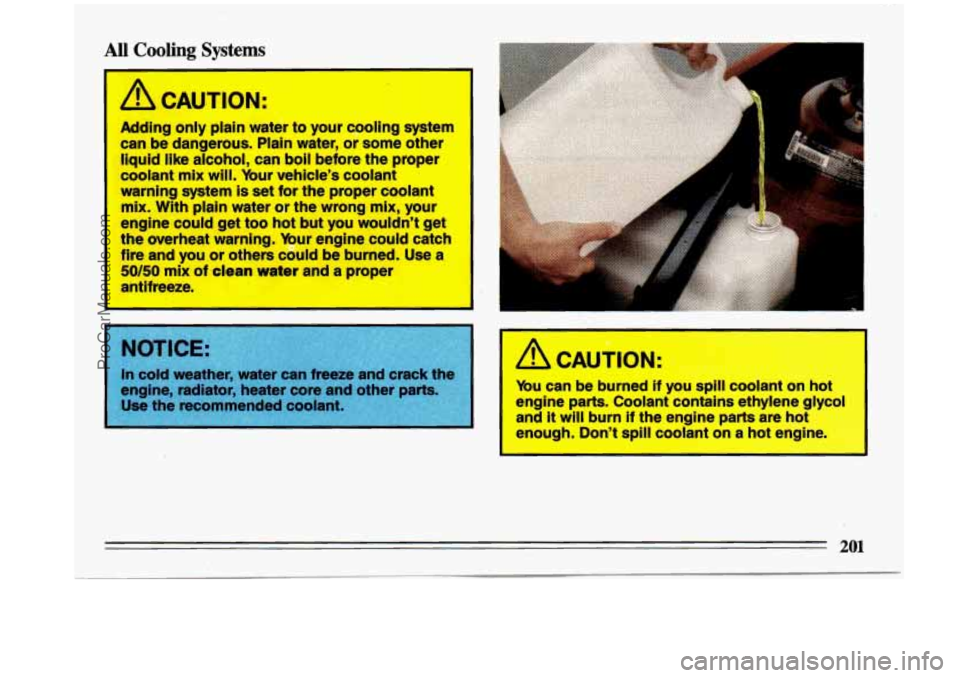
Adding only plain water to your c.ooling system
can be dangerous. Plain water, or some other
liquid like alcohol, can boil before the proper
coolant mix will. Your vehicle's coolant
warning system is set for the proper coolant
mix.
With plain water or the wrong mix, your
engine could get too hot but you wouldn't get
the overheat warning.
Your engine could catch
fire and you or others could be burned. Use a
50/50 mix of clean water and a proper
antifreeze.
I
I
A CAUTION:
You can be burned if you spill coolant on hot
engine parts. Coolant contains ethylene
glycol
and it will burn if the engine parts are hot
enough. Don't spill coolant on
a hot engine. I
201
ProCarManuals.com
Page 204 of 324
When the coolant in the coolant recovery tank is at or
above
the “FULL HOT” mark, start your vehicle. If the
overheat
warning continues, there’s one more thing you
can try. You can add the proper coolant mix directly to
the radiator, but be sure the cooling system is cool before
you do it.
I
/i CAUTION:
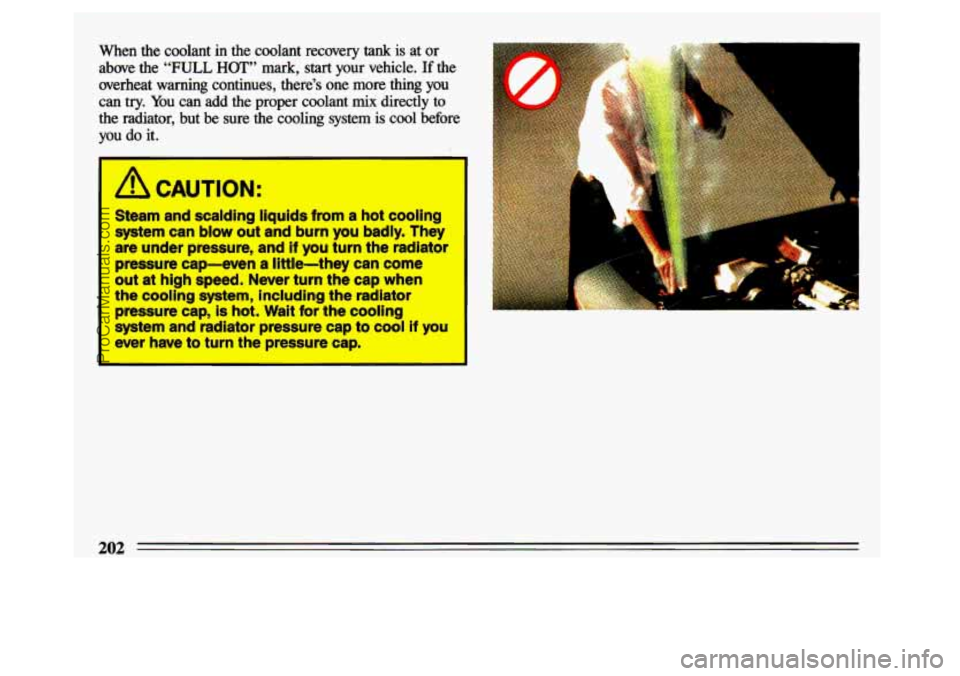
Steam and scalding liquids from a hot cooling
system can blow out and burn you badly. They
are under pressure, and if you turn the radiator
pllessure cap--even a little-they can -me
out at hlgh speed. NeAler turn the cap when
the cwllng qstern, Including the radiator
pressure
cap, is hot. Wait tor the cooling
system and radiator pressure cap to cool if you
ever have to turn the pressure cap.
202
ProCarManuals.com
Page 205 of 324
How to Add Coolant to the Radiator
F
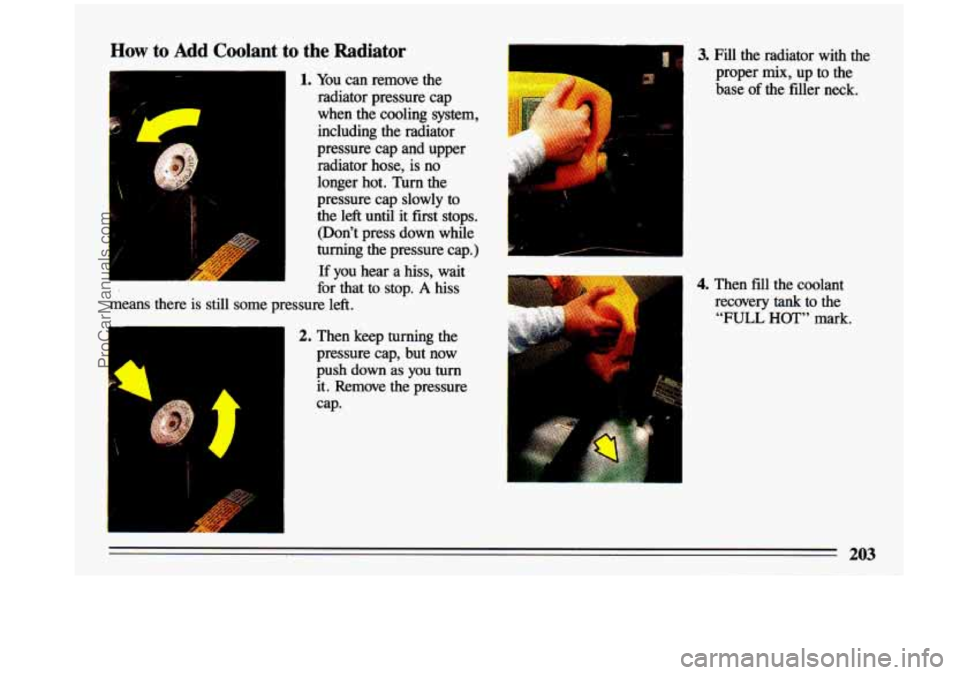
1. You can remove the
radiator pressure cap
when the cooling system,
including
the radiator
pressure cap and upper
radiator hose, is no
longer hot. Turn the
pressure cap slowly to
the left until it first stops. (Don’t press down while
turning the pressure cap.)
If you hear a hiss, wait
for that to stop.
A hiss
means there
is still some pressure left. I
I
! 1 I
A
2. Then keep turning the
pressure cap, but now
push down as you turn
it. Remove the pressure
cap.
I’d 3. Fill the radiator with the
proper
mix, up to the
base
of the filler neck.
4. Then ffl the coolant
recovery
tank to the
“FULL HOT” mark.
J
= 203
ProCarManuals.com
Page 241 of 324
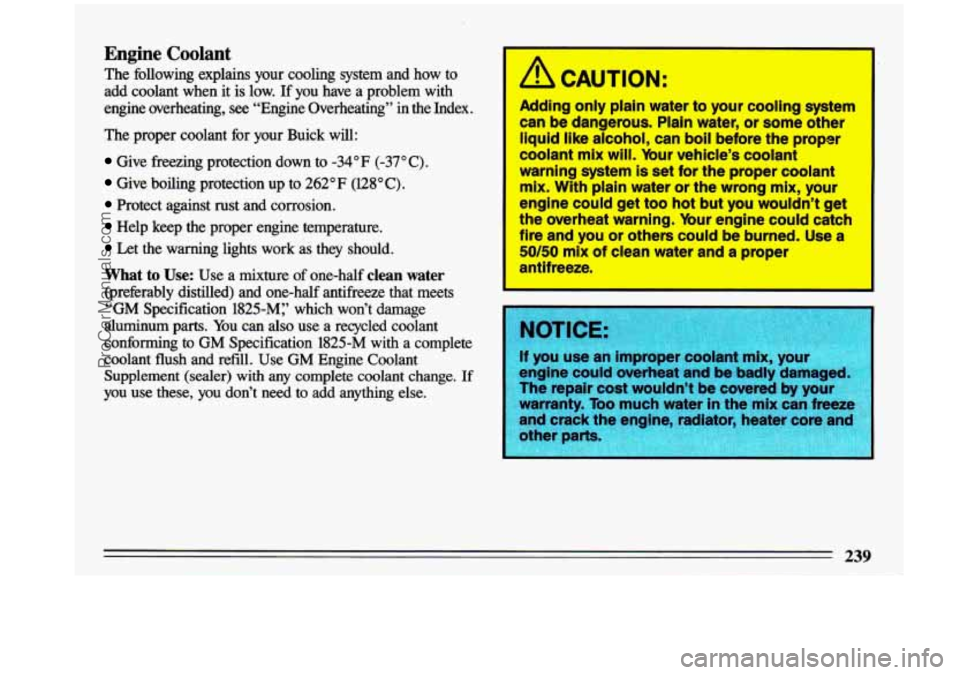
Engine Coolant
The following explains your cooling system and how to
add coolant when it is low.
If you have a problem with
engine overheating, see “Engine Overheating” in the Index. \
The proper coolant for your Buick will:
Give freezing protection down to -34°F (-37°C).
Give boiling protection up to 262” F (128” C).
Protect against rust and corrosion.
Help keep the proper engine temperature.
Let the warning lights work as they should.
What to Use: Use a mixture of one-half clean water
(preferably distilled) and one-half antifreeze that meets
“GM Specification 1825-Mi’ which won’t damage
aluminum parts. You can also use a recycled coolant
conforming to GM Specification 1825-M with a complete
coolant flush
and refill. Use GM Engine Coolant
Supplement
(sealer) with any complete coolant change. If
you use these, you don’t need to add anything else.
I
A CAUTION:
Adding only plain water to your coollng system
can
be dangerous. Plain water, or some other
liquid
like alcohol, can boil before the proper
coolant mix will. Mur vehicle’s coolant
warning system
Is set for the proper coolant
mix. With plain water or the wrong mlx, your
engine could get too hot but you wouldn’t get
the overheat warning. bur engine could catch
fire and you or others’could be burned. Use a
50/50 mPx of clean water and a proper
antifreeze.
I
: warranty. Too much
l
and crack t
other parts
239
ProCarManuals.com
Page 272 of 324
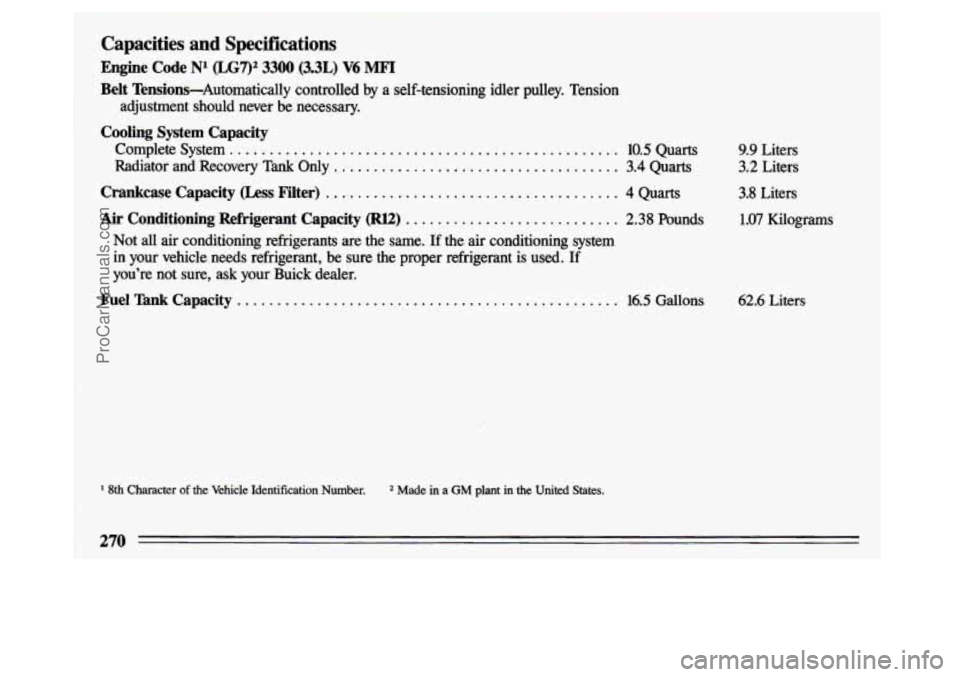
Capacities and Specifications
Engine Code N1 (LGP2 3300 (3.3L) V6 MFI
Belt Tensions-Automatically controlled by a self-tensioning idler pulley. Tension
Cooling System Capacity
adjustment should never be necessary.
Complete System
................................................. 10.5 Quarts
Radiator and Recovery
Tank Only .................................... 3.4 Quarts
crankcase Capacity
(Less Filter) ..................................... 4 Quarts
Air Conditioning Refrigerant Capacity (Rl2) ........................... 2.38 Pounds
Not all air conditioning refrigerants are the same. If the air\
conditioning system in your vehicle needs refrigerant, be sure the proper refrigera\
nt is used. If
you’re not sure, ask your Buick dealer.
Fuel Tank Capacity
................................................ 16.5 Gallons
8th Character of the Vehicle Identification Number. * Made in a GM plant in the United States.
9.9 Liters
3.2 Liters
3.8 Liters
1.07 Kilograms
62.6 Liters
270
ProCarManuals.com
Page 274 of 324
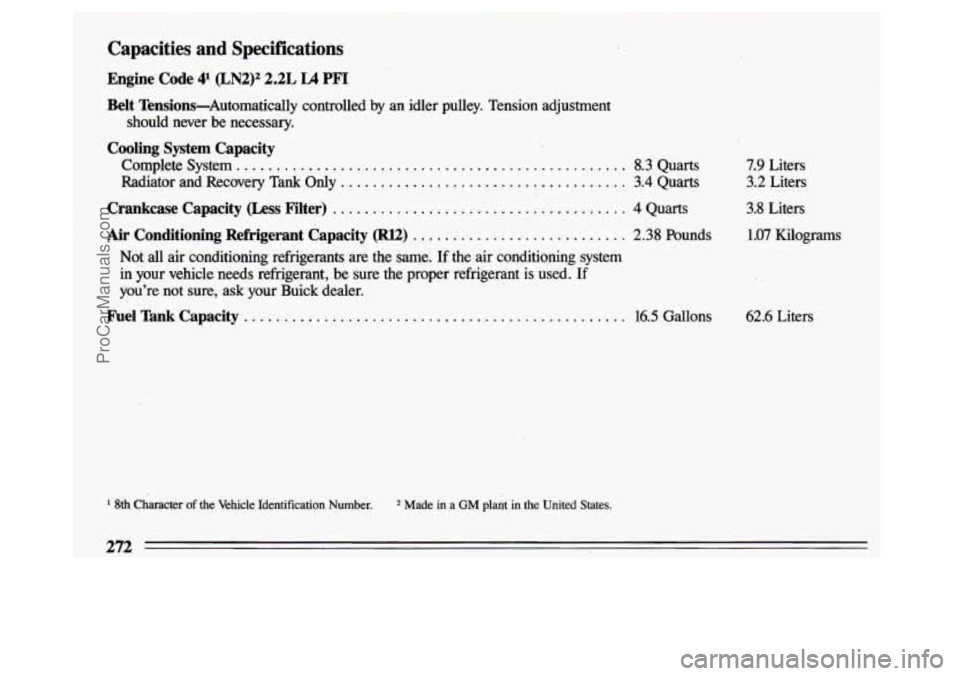
Capacities and Specifications
Engine Code 4l (LN2)2 2.2L L4 PFI
:Belt Tensions-Automatically . controlled by an idler pulley. Tension adjustment
should never be necessary.
Cooling System Capacity
Complete System.
................................................ 8.3 Quarts
Radiator and Recovery Tank Only
.................................... 3.4 Quarts
Crankcase Capacity
(Less Filter) ..................................... 4 Quarts
Air Conditioning Refrigerant Capacity (Rl2) ........................... 2.38 Pounds
Not all air conditioning refrigerants are the same. If the air\
conditioning system
in your vehicle needs refrigerant, be sure the proper refrigerant is used. If
you’re not sure, ask your Buick dealer.
Fuel Tank Capacity
................................................ 16.5 Gallons
7.9 Liters
3.2 Liters
3.8 Liters
1
.Cn Kilograms
62.6 Liters
8th Character of the Vehicle Identification Number. * Made in a GM plant in the United States.
272
ProCarManuals.com
Page 282 of 324
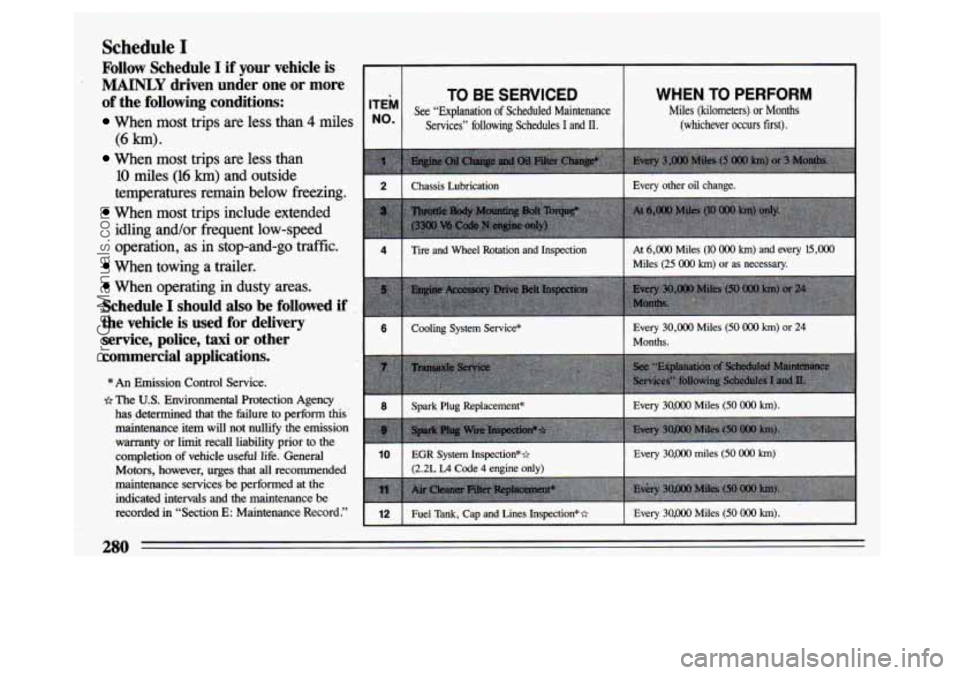
Schedule I
Follow Schedule I if your vehicle is
MAINLY driven under one or more
of the following conditions:
When most trips are less than 4 miles
When most trips are less than
10 miles (16 km) and outside
temperatures remain below freezing.
When most trips include extended
idling and/or frequent low-speed
operation, as
in stop-and-go’ traffic.
(6 km).
When towing a trailer.
When operating in dusty areas.
Schedule I should also be followed if
the vehicle
is used for delivery
service, p?lice,
taxi or other
commercial applications.
* An Emission Control Service.
z2T The U.S. Environmental Protection Agency
has.determined that the failure to perform this
maintenance item will not nullify the emission
wamty
or limit recall liability prior to the
completion of vehicle useful life. General
Motors, however, urges that all recommended
maintenance services
be performed at the
indicated intervals and the maintenance be
recorded in “Section E: Maintenance Record.”
ITEM
NO.
TO BE SERVICED WHEN TO PERFORM
See “Explanation of Scheduled Maintenance Miles (kilometers) or Months
Services” following Schedules
I and D[. (whichever occurs first).
2 I Chassis Lubrication I Every other oil change.
Tire
and Wheel Rotation and Inspection At 6,000 Miles (10 000 km) and every 15,000
Miles (25 000 km) or as necessary. I
61
Cooling System Service* Every 30,000 Miles (50 O00 km) or 24
Months. I
8 I Spark
Plug Replacement* I Every 30,000 Miles (50 000 km). I
EGR System Inspection** Every 30,000 miles (50 OOO km)
(2.2L LA Code 4 engine only)
12 I Fuel Tank, Cap and Lines Inspection** I Every 30,000 Miles (50 OOO km). I
280
ProCarManuals.com
Page 284 of 324
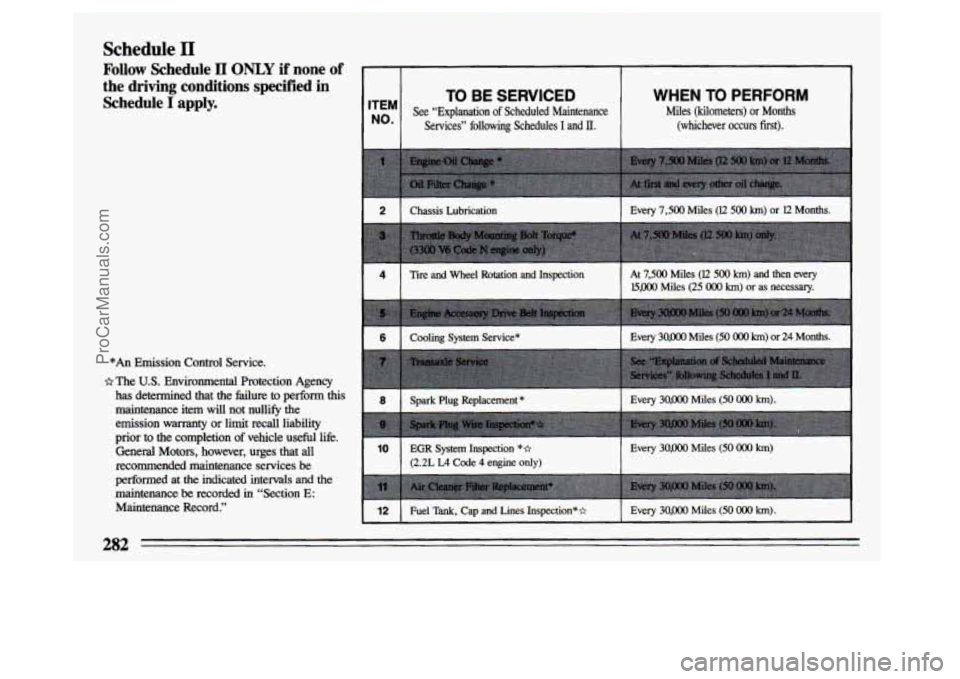
Schedule 11
Follow Schedule II ONLY if none of
the driving conditions specified in Schedule
I apply.
*An Emission Control Service.
I% The U.S. Environmental Protection Agency
has determined that the failure
to perform this
maintenance item will not nullify the
emission warranty
or limit recall liability
prior to the completion of vehicle useful life.
General
Motors, however, urges that all
recommended maintenance services be
performed at the indicated intervals
and the
maintenance be recorded in “Section E:
Maintenance Record.”
TO BE SERVICED ITEM
No’ See “Explanation of Scheduled Maintenance
Services” following Schedules
I and II.
WHEN TO PERFORM
Miles (kilometers) or Months
(whichever
occurs first).
4l
Tire and Wheel Rotation and Inspection
Cooling
System Service* Every 30,000 Miles (50 OOO km) or 24
Every 30,000 Miles (50 000 km).
lo I
Every 30,000 Miles (50 OOO km)
12 I Fuel Tank, Cap and Lines Inspection** I Every 30,000 Miles (50 000 km).
282
ProCarManuals.com
Page 287 of 324
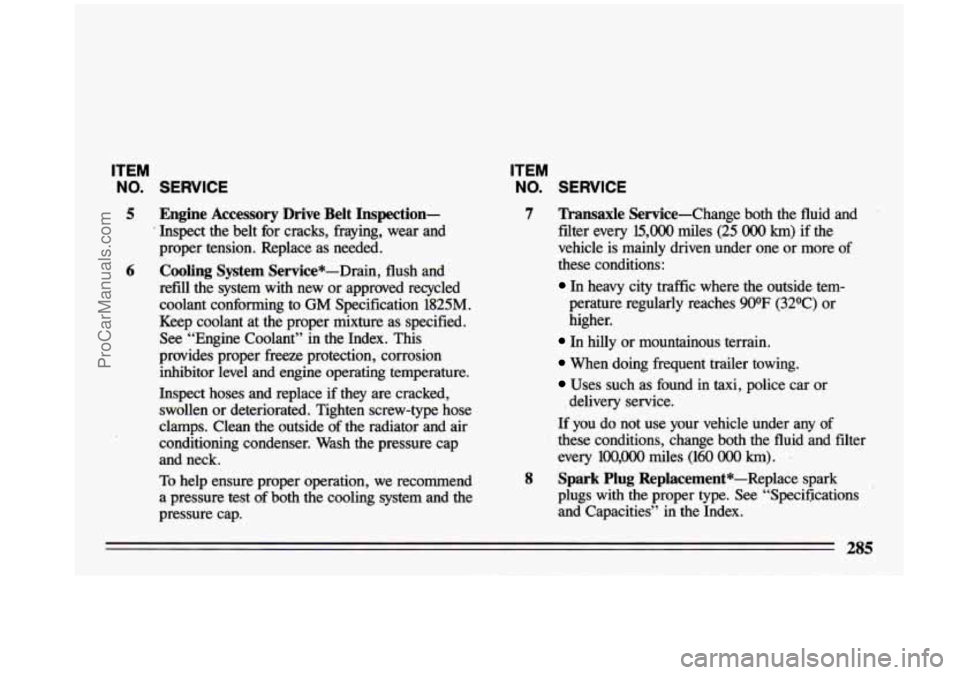
ITEM
NO. SERVICE
5 Engine Accessory Drive Belt Inspection-
* Inspect the belt for cracks, fraying, wear and
proper tension. Replace as needed.
6 Cooling System Service*-Drain, flush and
refill the system with new or approved recycled
coolant conforming to
GM Specification 1825M.
Keep coolant at the proper mixture as specified. See “Engine Coolant” in the Index. This
provides proper freeze protection, corrosion inhibitor level and engine operating temperature.
Inspect hoses and replace if they are cracked,
swollen or deteriorated. Tighten screw-type hose
clamps. Clean the outside of the radiator and air
conditioning condenser. Wash the pressure cap
and neck.
To help ensure proper operation, we recommend
a pressure test of
both the cooling system and the
pressure cap.
ITEM
NO. SERVICE
7 Transaxle Service-Change both the fluid and
filter every
l5,O00 miles (25 O00 km) if the
vehicle is mainly driven under one or more of
these conditions:
In heavy city traffic where the outside tem-
perature regularly reaches
90°F (32OC) or
higher.
In hilly or mountainous terrain.
When doing frequent trailer towing.
Uses such as found in taxi, police car or
If you do’not use your vehicle under any of
these conditions, change both the fluid and filter every
100,000 miles (160 0o0 km).
plugs with the proper type. See “Specifications
‘and Capacities” in the Index. delivery service.
8 Spark
Plug Replacement*-Replace spark
285
ProCarManuals.com