door lock BUICK CENTURY 1993 User Guide
[x] Cancel search | Manufacturer: BUICK, Model Year: 1993, Model line: CENTURY, Model: BUICK CENTURY 1993Pages: 324, PDF Size: 17.58 MB
Page 74 of 324
Parking at Night: Park in a lighted spot, close all
windows and lock your vehicle. Remember
to keep your
valuables out of sight. Put them
in a storage area, or take
them with you.
Parking Lots: If you park in a lot where someone will be
watching your vehicle, it’s best
to lock it up and take your
keys. But what if you have to leave your ignition key?
What if you have to leave something valuable in your vehicle?
1. Put your valuables in a storage area, like your trunk or
glove box, or rear storage area in the’ wagon.
2. Lock the glove box.
3. Lock all the doors except the driver’s.
4. Then take the door key with you.
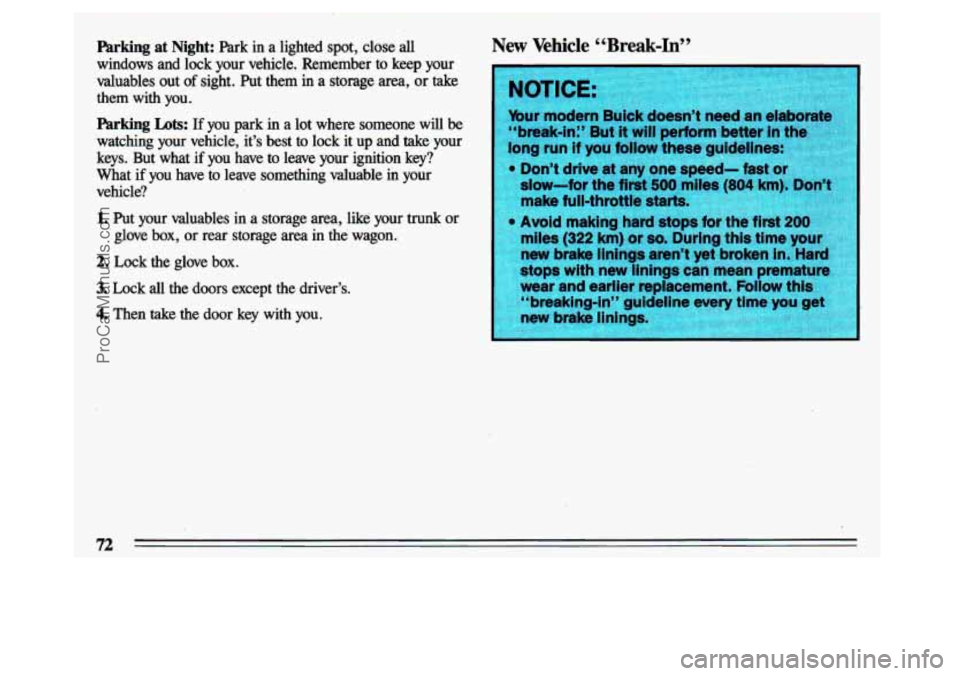
New Vehicle “Break-In”
72
ProCarManuals.com
Page 75 of 324
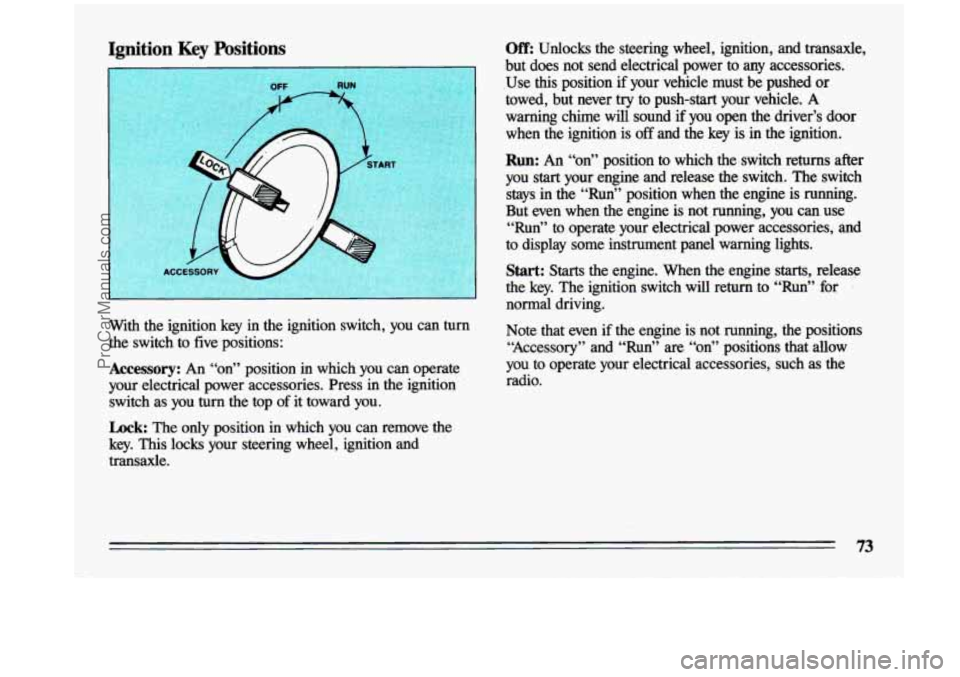
Ignition Key Positions Off: Unlocks the steering wheel, ignition, and transaxle,
but does not send electrical power to any accessories.
.Use
this position if your vehicle must be pushed or
towed, but never try to push-start your vehicle.
A
warning chime will sound if you open the driver’s door
when the ignition
is off and the key is in the ignition.
I
Run: An “on” position to which the. switch returns after
you
start your engine and release the switch. The switch
stays in the “Run” position when the engine is running.
But even when the engine is not running, you can use
“Run” to operate your electrical power accessories, and
to display some instrument panel warning lights.
Start: Starts the engine. When the engine starts, release
the key. The ignition switch will return to “Run” for
normal driving.
with the ignition key
h the ignition switch, YOU can turn Note that even if the engine is not running, the positions
the switch to five positions: “Accessory” and “Run” \
are “on” positions that allow
.Accessory: An “on” position in which you can operate you to operate your electrical accessories, such as the
your electrical power accessories. Press
in the ignition ‘ radio.
switch as you
turn the top of it toward you.
Lock: The only position in which you can remove the
key. This locks your steering wheel, ignition
and
transaxle.
ProCarManuals.com
Page 98 of 324
Headlight “On” Warning
If you open the door while leaving the lights on, you will
hear a warning chime.
Daytime Running Lights (Canada Only)
The Canadian Federal Government has decided that “Daytime Running Lights” (DRL)
are a useful feature, in
that DIU can make your vehicle more visible to
pedestrians and other drivers during daylight hours. DRL
are required on new vehicles sold in Canada.
Your DRL work with a light sensor on top
of the
instrument panel. Don’t cover it up. The low beam
headlights will come on at reduced brightness
in daylight
when:
The ignition is on
The headlight switch is off, and
The parking brake is released.
At dusk, the exterior. lights will come bn &.nomatically
and the low
beams will change to full brightness. At
dawn, the exterior lights will go out and the low beams
will change to
the reduced brightness of DRL (if the
headlight switch is off).
Of course, you may still turn on the headlights any time
you need to.
To idle your vehicle with DRL off, set the parking brake
while the ignition is in the
“Off’ or “Lock” position.
Then start the vehicle. The
DRL will stay off until you
release the parking brake.
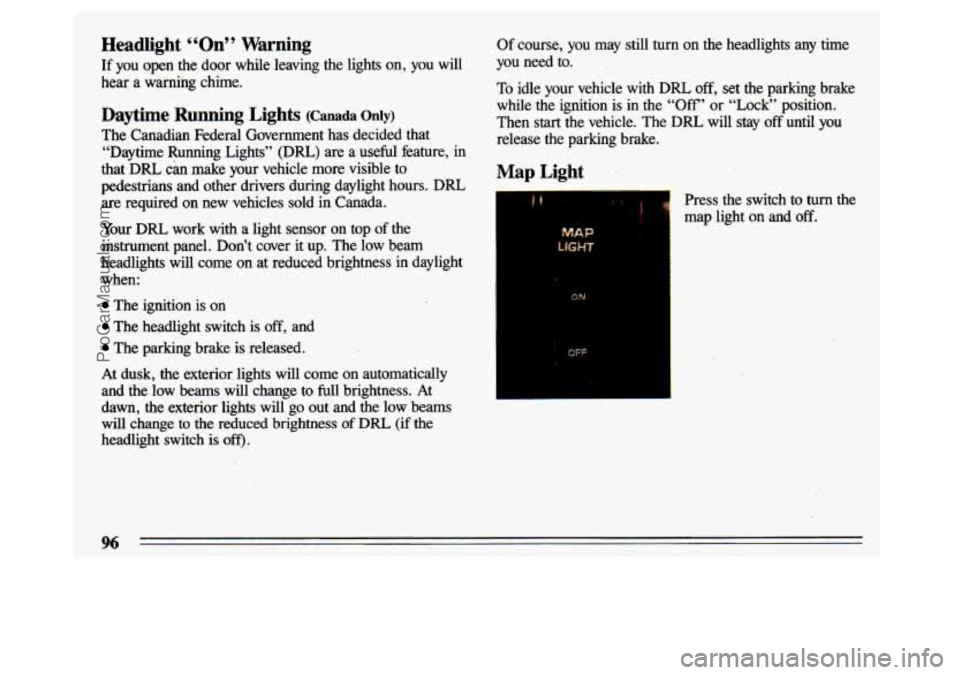
Map Light
& Press the switch to turn the
map light on and
off.
MAP
ON
OFF
96
ProCarManuals.com
Page 99 of 324
Front Seat Reading Lights (Option) Rear Reading Light (Wagon)
I
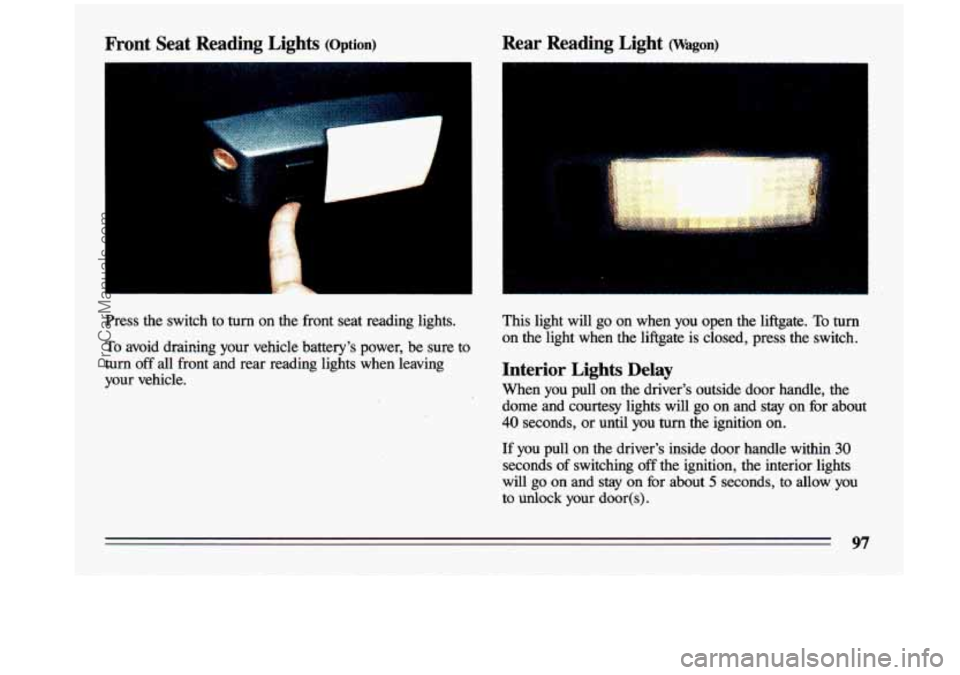
Press the switch to turn on the front seat reading lights.
To avoid drair.ing your vehicle battery's power,
be sure to
turn off all front and rear reading lights when leaving
your vehicle. This light will go
on when you open the liftgate. To turn
on
the light when the liftgate is closed, press the switch.
Interior Lights Delay
When you pull on the driver's outside door handle, the
dome and courtesy lights will go on and stay on for about
40 seconds, or until you turn the ignition on.
If you pull on the driver's inside door handle within 30
seconds of switching off the ignition, the interior lights
will go
on and stay on for about 5 seconds, to allow you
to unlock your door(s).
97
ProCarManuals.com
Page 105 of 324
$9.
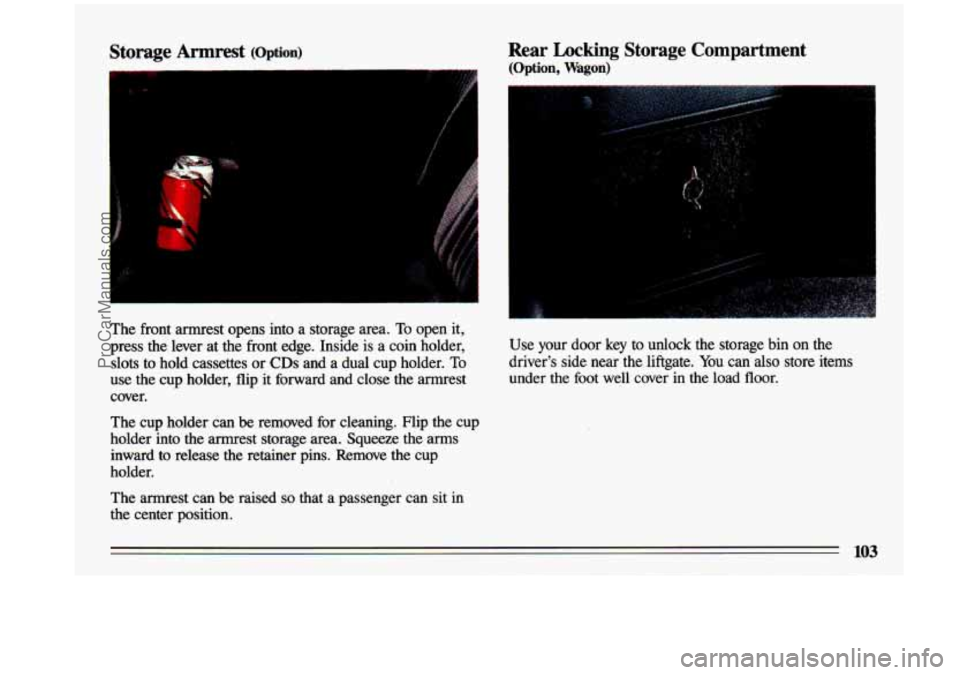
The front armrest opens into a storage area. To open it,
press the lever at the front edge. Inside is a coin holder,
slots to hold cassettes or
CDs and a dual cup holder. To
use the cup holder, flip it forward and close the armrest
cover.
The cup holder can be removed for cleaning. Flip the cup
holder into the armrest storage area. Squeeze the
arms
inward to release the retainer pins. Remove the cup
holder.
The armrest can be raised
so that a passenger can sit in
the center position.
Rear Locking Storage Compartment
(Option, Wagon)
Use your door key to unlock the storage bin on the
driver's side near the liftgate.
You can also store items
under the foot well cover in the load floor.
103
ProCarManuals.com
Page 227 of 324
Filling Your Tank
1
A CAUTION:
Gasoline vapor is highly flammable. It burns
violently, and that can cause very
bad injuries.
Don’t smoke
if you’re near gasoline or
refueling your vehicle. Keep sparks, flames,
and smoking materials away from gasoline.
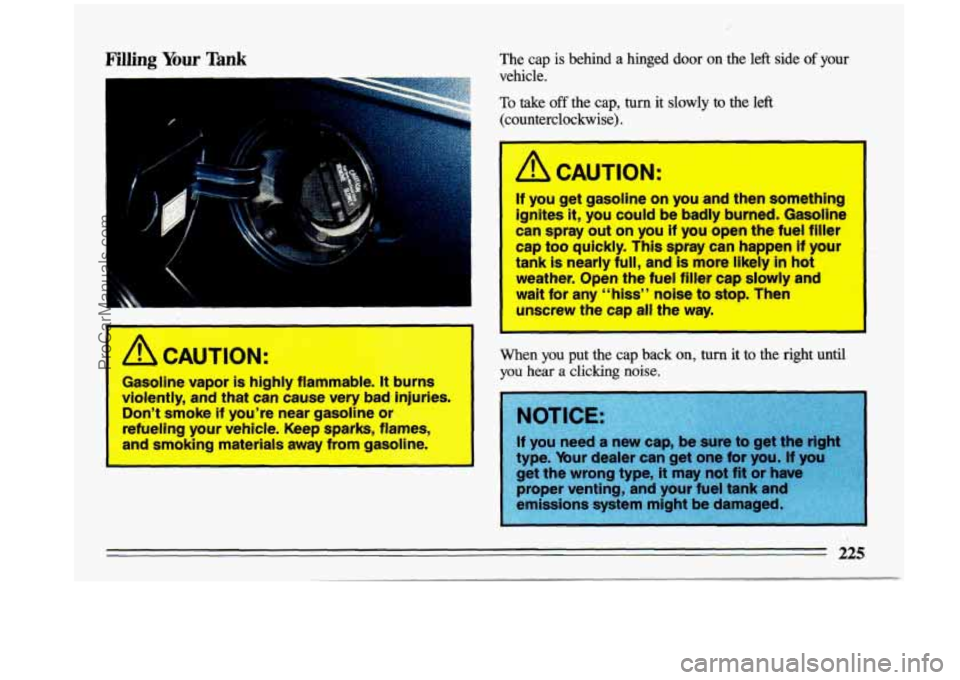
The cap is behind a hinged door on the left side of your
vehicle.
To take
off the cap, turn it slowly to the left
(counterclockwise).
If you get gasoline on you and then something
ignites
it, you could be badly burned. Gasoline
can spray out on you if you open the fuel filler
cap too quickly. This spray can happen if your
tank is nearly full, and is more likely
in hot
weather. Open the fuel filler cap slowly and
wait for any “hiss” noise to stop. Then
unscrew the cap
all the way.
When you put the cap back on, turn it to the right until
you hear a clicking
noise.
225
ProCarManuals.com
Page 234 of 324
When to Change Engine Oil: See if any one of these is
true for you:
Most trips are less than 4 miles (6 km).
It’s below freezing outside and most trips are less than
10 miles (16 km).
The engine is at low speed most of the time (as in
door-to-door delivery,
or in stop-and-go traffic).
You tow a trailer often.
Most trips are through dusty places.
If any one of these is true for your vehicle, then you need
to change your oil and filter every 3,000 miles
(5 O00 km) or 3 months-whichever comes first.
If none
of them is true, change the oil every 7,500 miles
(12 500 km) or 12 months-whichever comes first.
Change the fdter at the first oil change and at every other
oil change afier that.
Engine Block Heater: An engine block heater can be a
big help if you have to park outside
in very cold weather,
0°F (-18°C) or colder. If your vehicle has this option, see
“Engine Block Heater”
in the Index.
What to Do with Used Oil:
-
/i CAUTION:
Used engine oil contains things that have
caused skin cancer in laboratory animals.
Don’t let used oil stay on your skin for very
long. Clean your skin and nails with soap and
water or a good hand cleaner. Wash or
properly throw away clothing or rags
containing used engine oil.
Used oil can be a real threat to the environment. If you
change your own oil, be sure to drain all free-flowing oil
from the filter before disposal. Don’t ever dispose of oil
by pouring it on the ground, into sewers, or into streams
or bodies of water. Instead, recycle it ‘by taking
it to a
place that collects used
oil. If you have a problem
properly disposing of your used oil, ask your dealer, a
service station or a local recycling center for help.
232
ProCarManuals.com
Page 269 of 324
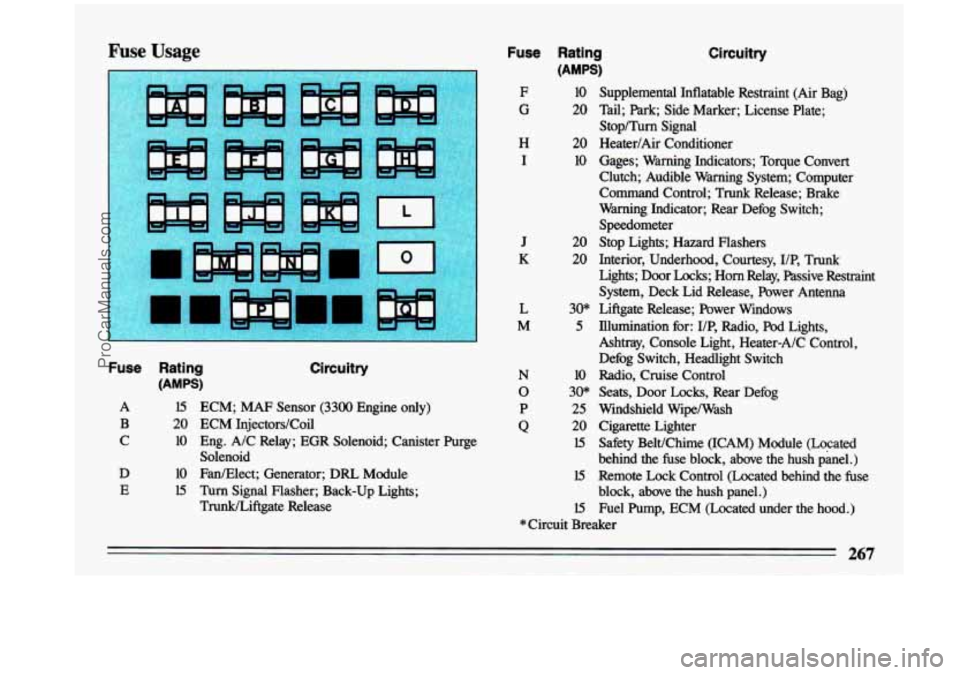
Fuse Usage
I
I
Fuse Rating
(AMPS)
A
B
C
D E
15
20
10
10
15
ECM; MAF Sensor (3300 Engine only)
ECM Injectors/Coil
Eng. A/C Relay; EGR Solenoid; Canister Purge Solenoid
Fan/Elect; Generator; DRL Module
Turn Signal Flasher; Back-up Lights;
TruWLiftgate Release
Fuse
F
G
H
I
J
K
L
M
Rating
(AMPS)
10
20
20
10
20
20
30"
5
Circuitry N
0
P
Q
10
30"
25
20
15
15
15
Circuitry
Supplemental Inflatable Restraint (Air Bagj
Tail; Park; Side Marker; License Plate; Stop/Turn Signal
Heater/Air Conditioner
Gages; Warning Indicators; Torque Convert
Clutch; Audible Warning System; Computer Command Control; Trunk Release; Brake
Warning Indicator; Rear Defog Switch;
Speedometer
Stop Lights; Hazard Flashers
Interior, Underhood, Courtesy, I/P, Trunk Lights; Door
Locks; Horn Relay, Passive Restraint
System, Deck Lid Release, Power Antenna
Liftgate Release; Power Windows
Illumination for: I/P, Radio,
Pod Lights,
Ashtray, Console Light, Heater-A/C Control,
Defog Switch, Headlight Switch
Radio, Cruise Control
Seats, Door
Locks, Rear Defog
Windshield Wipe/Wash
Cigarette Lighter
Safety Belt/Chirne (ICAM) Module (Located
behind the fuse block, above the hush panel.)
Remote Lock Control (Located behind the fuse
block, above the hush panel.) Fuel Pump, ECM (Located under the hood.)
*Circuit Breaker
267
ProCarManuals.com
Page 290 of 324
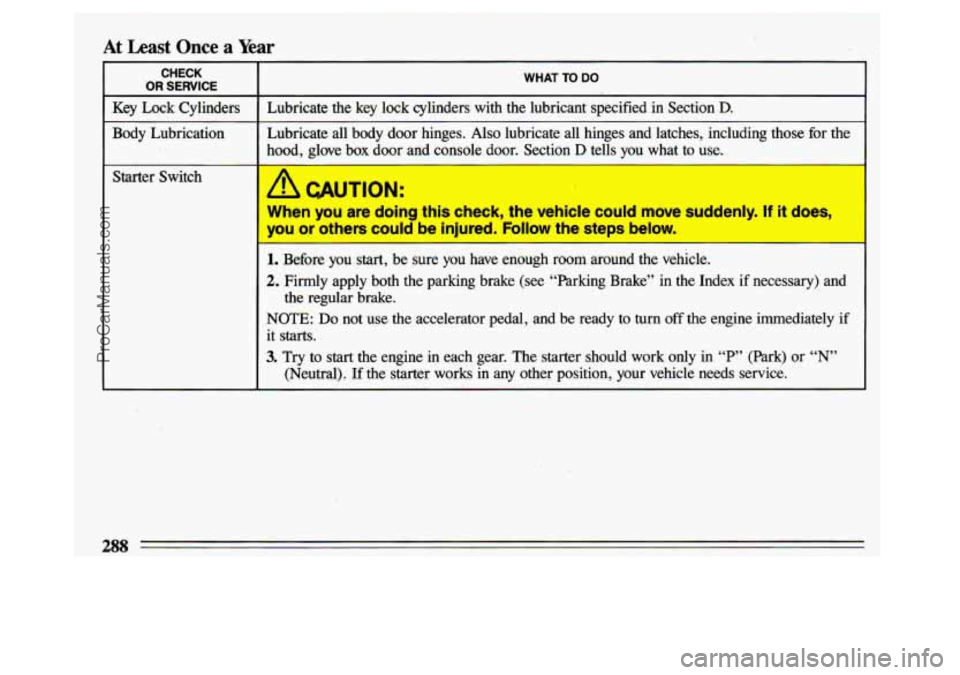
At Least Once a Year
CHECK
OR SERVICE I WHAT TO DO
I
Key Lock Cylinders I Lubricate the key lock cylinders with the lubricant specified in Section D.
Body Lubrication Lubricate all body door hinges. Also lubricate all hinges and \
latches, including those for the
hood, glove box door and console door. Section
D tells you what to use. I
Starter Switch
When you are doing this check, the vehicle could move suddenly\
. If it does,
1. Before you start, be sure you have enough room around the vehicle.
2. Firmly apply both the parking brake (see “Parking Brake” \
in the Index if necessary) and
NOTE: Do not use the accelerator pedal, and be ready to turn off the engine immediately if
it starts.
3. Try to start the engine in each gear. The starter should work onl\
y in “P” (Park) or “N”
the regular brake.
(Neutral). If the starter works in any other position, your \
vehicle needs service.
288
ProCarManuals.com
Page 309 of 324
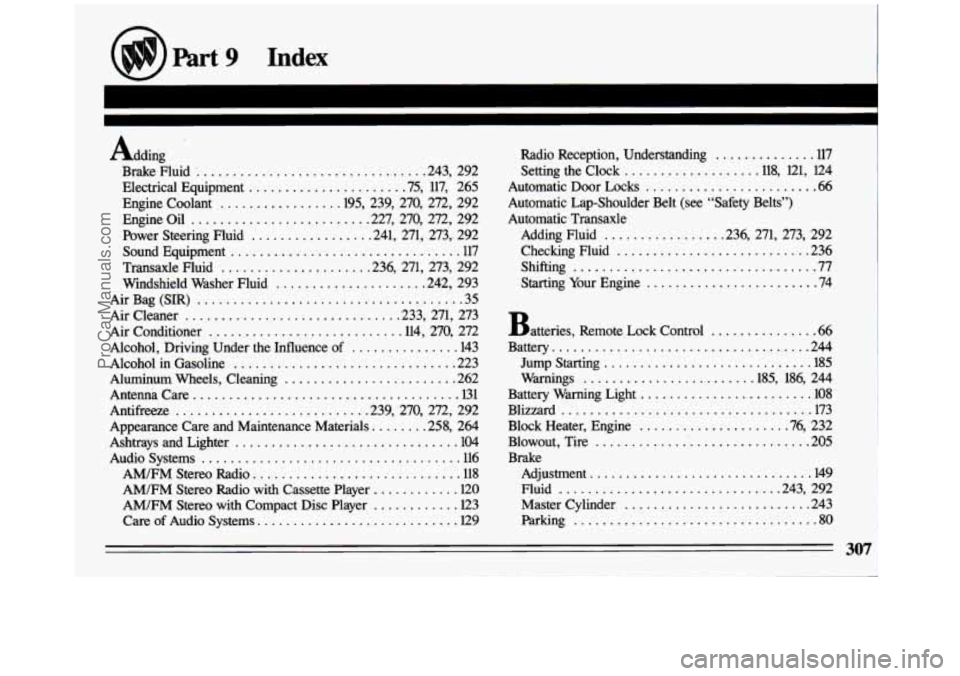
Brake Fluid ................................ .243. 292
Electrical Equipment
..................... .75. 117. 265
Engine Coolant
................ .195. 239. 270. 272. 292
Engine Oil
........................ .227. 270. 272. 292
Sound Equipment
................................ 117
Power Steering Fluid
................ .241. 271. 273. . 292
Transaxle Fluid
.................... .236. 271. 273. 292
Windshield Washer Fluid
.................... .242. 293
AirBag(S1R)
..................................... 35
Air Cleaner
............................. .233. 271. 273
Air Conditioner
.......................... .114. 270. 272
Alcohol in Gasoline
................................ 223
Aluminum Wheels. Cleaning
........................ 262
Antenna Care
..................................... 131
Antifreeze
.......................... .239. 270. 272. 292
Ashtrays and Lighter
............................... 104
Audiosystems
.................................... 116
AM/FM Stereo Radio
............................. 118
Alcohol. Driving Under the Influence
of
............... 143
Appearance Care and Maintenance Materials
....... .258. 264
AM/FM Stereo Radio with Cassette Player
............ EO
AM/FM Stereo with Compact Disc Player ............ 123
Care
of Audio Systems ............................ 129 Radio Reception. Understanding
.............. 117
Setting the Clock
.................. .118. 121. 124
Automatic Door Locks
........................ 66
Automatic Lap-Shoulder Belt (see “Safety Belts”)
Automatic Transaxle Adding Fluid
................ .236. 271. 273. 292
Checking Fluid
........................... 236
Shifting
.................................. 77
Starting Your Engine
........................ 74
Batteries. Remote Lock Control
............... 66
Battery
.................................... 244
Jump Starting
............................. 185
Warnings
....................... .185, 186, 244
Battery Warning Light
........................ 108
Blizzard
................................... 173
Block Heater, Engine
.................... .76, 232
Blowout, Tire
............................... 205
Brake Adjustment
............................... 149
Fluid ............................... 243, 292
Master Cylinder
.......................... 243
Parking
.................................. 80
307
.
ProCarManuals.com