tow BUICK CENTURY 1993 User Guide
[x] Cancel search | Manufacturer: BUICK, Model Year: 1993, Model line: CENTURY, Model: BUICK CENTURY 1993Pages: 324, PDF Size: 17.58 MB
Page 84 of 324
F- LA- 1
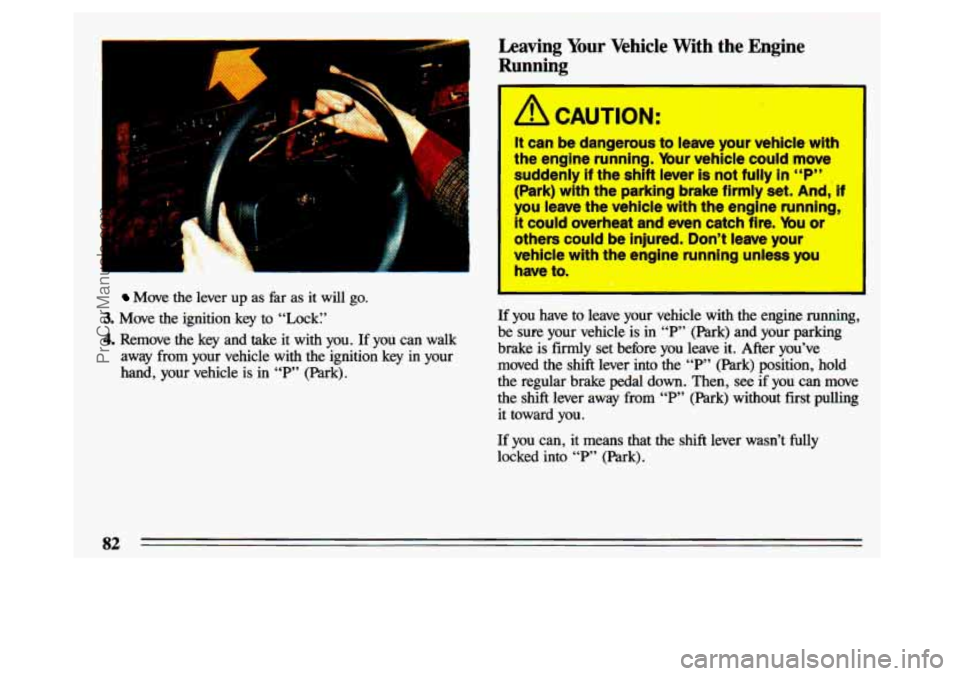
Move the lever up as far as it will go.
3. Move the ignition key to “Lock:’
4. Remove the key and take it with you. If you can walk
away from your vehicle with the ignition key in your
hand, your vehicle is
in “P” (Park).
Leaving Your Vehicle With the Engine
Running
It can be dangerous to leave your vehicle with
the engine running. Your vehicle could move
suddenly if the shift lever is not fully in
“P”
(Park) with the parking brake firmly set. And, if
you leave the vehicle with the engine running,
it could overheat and even catch fire. Ybu or
others could be injured. Don’t leave your
vehicle with the engine running unless you
have to.
If you have to leave your vehicle with the engine running,
be sure your vehicle
is in “P” (Park) and your parking
brake is firmly set before you leave it. After you’ve
moved the shift lever into
the “P” (Park) position, hold
the regular brake pedal down. Then, see if you can move
the shift lever away from
“P” (Park) without first pulling
it toward you.
If you can, it means that the shift lever wasn’t hlly
locked into
“P’ (Park).
82
ProCarManuals.com
Page 86 of 324
Running Your Engine While You’re Parked
It’s better not to park with the engine running. But if you
ever have to, here are some things to know.
1
I a CAUTION: I
Idling the engine with the air system “control
off could allow dangerous exhaust into your
vehicle (see the earlier
CAUTION under
“Engine Exhaust”).
Also, idling In a closed-in place can let deadly
carbon monoxide
(CO) into your vehicle even if
the fan switch is at the hlghest setting. One
place this can happen
is a garage. Exhaust-. -
with C0-n come in easily.’ NEVER park in a
garage wlth the engine running.
Another closed-in place can
be a blizzard.
It can be dpngeroua to get out of your vehicle
If the shift lever is not fully On “P” (Park) wlth
the parking
brake firmly set. bur vehicle can
roll. Don’t leave your vehicle when the engine
Os runnhg unless you. have to. If you’ve left the
engine running, the vehicle can move
suddenly.
Nu or others could be injured. To
I
I
I (See “Blizzard” In.the Index.)
CAUTION (Continued)
- - - -
I CAUTION (C __ ____ Jued) ..
be sureyour vehicle won’t move, even when
you’re on fairly level ground, always set your
parking
brake and move the shift lever to “P”,
(Park).
Follow the proper steps to be &re your
vehicle won’t move.
See “Shifting Into ‘P’
(Park)”.in the Index.
If you are parking on
a hill, or if you’re pulling
a trailer, also see “Parking On Hills” or
“Towing
a Thiler” in the Index.
i
Windows
On a vehicle with manual windows, use the window
crank
to open and close each window.
84
ProCarManuals.com
Page 90 of 324
Headlight Highhw Beam Windshield Wipers
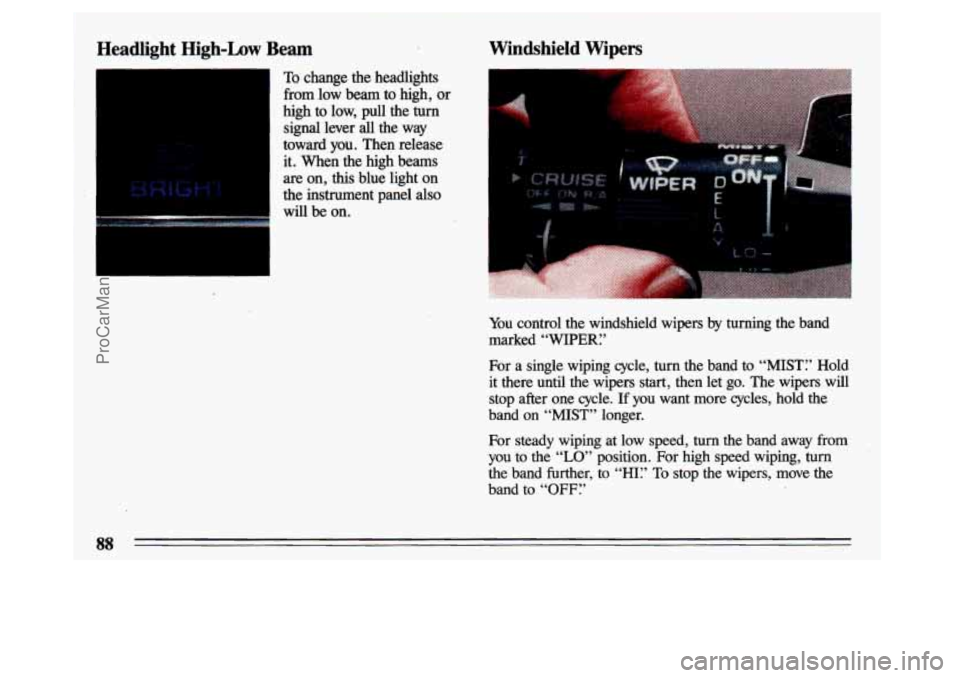
To change the headlights
from low beam to high, or
high to low, pull the
turn
signal lever all the way
toward
you. Then release
it. When the high beams
are on,
.this blue light on
the instrument panel also will be on.
i
I
You control the windshield wipers by turging the band
marked
“WIPERI’
For a single wiping cycle, turn the band to “MIST? Hold it there until the wipers
start, then let go. The wipers will
stop after one cycle.
If you want more cycles, hold the
band on “MIST” longer.
For steady wiping at low speed,
turn the band away from
YOU to the “LO” position. For high speed wiping, turn
the band further, to “HI? To stop the wipers, move the
band to “OFF?
88 .I
ProCarManuals.com
Page 100 of 324
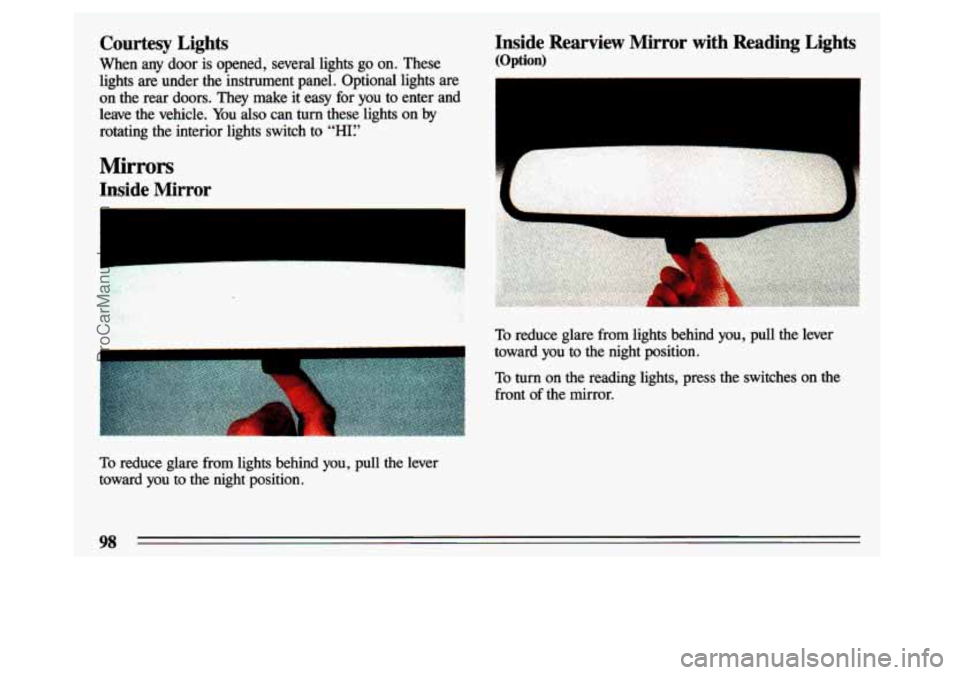
Inside Rearview Mirror with Reading Lights
(Option)
Courtesy Lights
When any door is opened, several lights go on. These
lights are under the instrument panel. Optional lights are on the rear doors. They make it easy for you to enter and
leave the vehicle.
You also can turn these lights on by
rotating the interior lights switch to
‘‘HI:’
Mirrors
Inside Mirror
--
To reduce glare from lights behind you, pull the lever
toward you to the night position.
To turn on the reading lights, press the switches on the - -_ front of the mirror.
To reduce glare from lights behind you, pull the lever
toward you to the night position.
98
ProCarManuals.com
Page 111 of 324
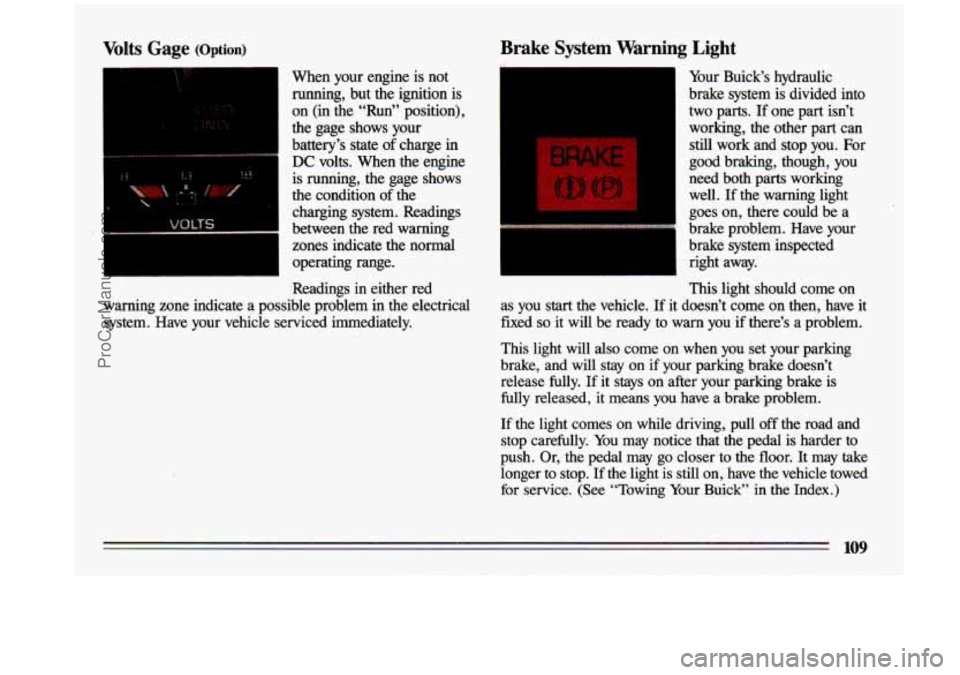
Volts Gage (Option)
When your engine is not
running, but
the ignition is
on (in the “Run” position),
the gage shows your
battery’s state of charge
in
DC volts. When the engine
is running, the gage shows
the condition of the
charging system. Readings
between the red warning
zones indicate the normal
operating range.
Readings in either red
warning zone indicate a possible problem in the electrical
system. Have your vehicle serviced immediately.
Brake System Warning Light
Your Buick‘s hydraulic
brake system is divided into
two parts. If one part isn’t working, the other part can still work and stop you. For
good braking, though, you
need both parts working
well.
If the warning light
goes on, there could be a
brake problem. Have your
brake system inspected right away.
This light should come on
as you start the vehicle. If it doesn’t come on then, have it
fixed
so it will be ready to warn you if there’s a problem.
This light will also come on when you set your parking
brake, and will stay on if your parking brake doesn’t release
fully. If it stays on after your parking brake is
fully released, it means you have a brake problem.
If the light comes on while driving, pull
off the road and
stop carefully.
You may notice that the pedal is harder to
push. Or, the pedal may go closer to -the floor. It may take
longer to stop. If the light is still on, have the vehicle towed
for service. (See “Towing Your Buick” in the Index.)
109
ProCarManuals.com
Page 112 of 324
A CAUTION:
Your brake system may not be working properly
if the brake warning light is on.
Driving with the brake warning light on can
lead to an accident.
If the light is still on after
you’ve pulled
off the road and stopped
carefully, have the vehicle towed
for service.
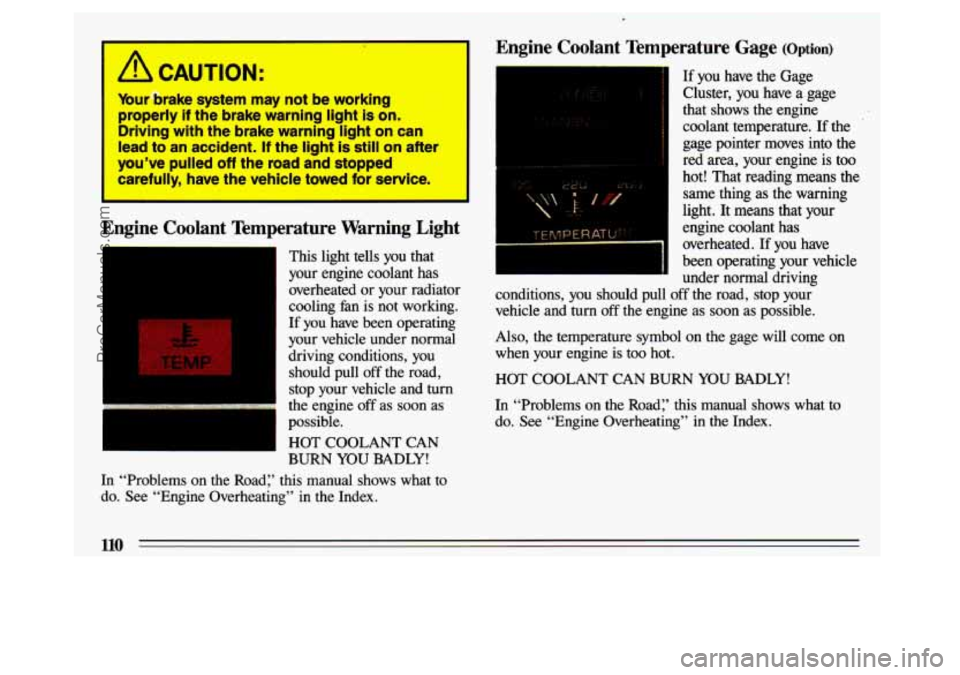
Engine Coolant Temperature Warning Light
---I
This light tells you that
your engine coolant has
overheated or your radiator
cooling
fan is not working.
If you have been operating
your vehicle under normal
driving conditions, you should pull
off the road,
stop your vehicle and
turn
the engine off as soon as
possible.
HOT COOLANT CAN
BURN YOU BADLY!
In “Problems on the Road:’ this manual shows what to
do. See “Engine Overheating” in the Index.
Engine Coolant Temperature Gage (Option)
‘1 If you have the Gage
Cluster, you have a gage
that shows the engine
coolant temperature.
If the
gage pointer moves into the red area, your engine is too
hot! That reading means the same thing as the warning
light. It means that your engine coolant has
overheated. If you have
been operating your vehicle under normal driving
conditions, you should pull off the road, stop your-
vehicle and
turn off the engine as soon as possible.
Also, the temperature symbol on the gage will come on
when your engine is too hot.
HOT COOLANT CAN BURN YOU BADLY!
In “Problems on the Road:’ this manual shows what to
do. See “Engine Overheating” in the Index.
110
ProCarManuals.com
Page 117 of 324
The air conditioner compressor operates in all AIR COND
positions, and in DEF (Defrost) when the outside
temperature is above about 40°F (4.5"
C).
Ventilation
For mild outside temperatures, when little heating or
cooling is needed, slide the upper lever to
VENT. Air
flow is through the instrument panel outlets. Rotate the
control next to the outlets to turn on, adjust or
turn off
the air flow. Adjust the lower lever on the control panel
to the temperature desired.
Heating
When outside temperatures are cold, sliding the upper
lever to
HEATER and the lower lever to HOT will send
heated air through the heater ducts, and some through the
defroster vents.
VENT and HEAmR are labeled
ECONOMY positions because the air conditioner
compressor doesn't run
in these two settings. This
reduces engine load, resulting
in improved he1 economy.
If either setting fails to keep you comfortable, or causes
your windows
to fog up, slide the upper lever to one of
the
AIR COND positions, or to DEF (Defrost).
Defrosting
The DEF setting directs most of the air through the
defroster vents, and some through the heater ducts.
Defogging Windows with Four Season
Climate Control
To quickly defog the windshield, set the upper lever to
DEF and move the hn switch to HI. Slide the lower
lever
to HOT.
In damp, cool weather (temperatures about 45"-65"F,
7"- 18" C), you can use BI-LEV to defog the side windows.
Set the upper lever to
BI-LEV and the fan switch to HI.
Aim the side vents toward the side windows. For increased
air flow to the side vents, close the center vents.
Rear Window Defogger (Option)
--
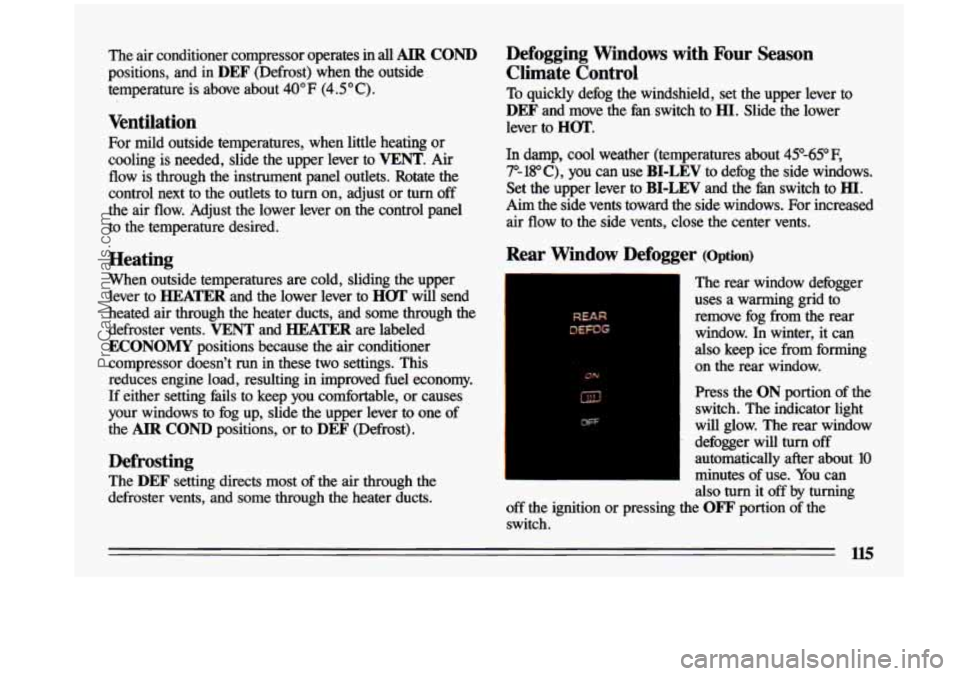
The rear window defogger
uses
a warming grid to
remove fog from the rear
window.
In winter, it can
also keep ice from forming
on the rear window.
Press the
ON portion of the
switch. The indicator light
will glow. The rear window
defogger will
turn off
automatically after about
10
minutes of use. You can
also turn
it off by turning
off the ignition or pressing the
OFF portion of the
switch.
ProCarManuals.com
Page 135 of 324
Part 4 Your Driving and the Road
~~ ~~~~ ~~ ~
Here you’ll find information about driving on different kinds of roads and in varying weather conditions . We’ve
also included many other useful tips on driving
.
Part 4 includes:
Roadsigns ........................................................................\
. 134
DefensiveDriving
.................................................................... 142
Control of a Vehicle
DrunkenDriving
.................................................................. 143
Braking
........................................................................\
.. 146
SteeringTips
...................................................................... ~0
Steering in Emergencies ............................................................. E1
Passing ........................................................................\
.. 152
LossofControl .................................................................... E4
DrivingatNight ..................................................................... E5
DrivingintheRain ................................................................... ~8
Driving in Fog, Mist and Haze .......................................................... 160
CityDriving ........................................................................\
162
FreewayDriving
..................................................................... 163
DrivingaLongDistance
.............................................................. 1~ .
HillandMountainRoads 166
ParkingonHills
..................................................................... 168
WinterDriving
...................................................................... 171
TowingaTrailer
..................................................................... 175
-
..............................................................
ProCarManuals.com
Page 144 of 324
If necessary, you can use hand signals out the window:
Left arm straight out for a left turn, down for slow or
about-to-stop, and up
for a right turn.
Slowing down. If time allows, tap the brake pedal once
or twice in advance of slowing
or stopping. This warns
the driver behind you.
Disabled. Your four-way flashers signal that your vehicle
is disabled or is a hazard.
See “Hazard Warning
Flashers’’ in the Index.
Traffic Officer
The traffic police officer is also a source of important
information. The officer’s signals govern, no matter what
the traffic lights or other signs say.
The next section discusses some
of the road conditions
you may encounter.
Defensive Driving
The best advice anyone can give about driving is: Drive
defensively.
Please
start with a very important sakty device in your Buick:
Buckle up.
(See “Safety Belts” in the Index.)
Defensive driving really means “be ready for anything:’
On city streets, rural roads, or freeways, it means
“always expect the unexpected:’ Assume that pedestrians
or other drivers are going to be
careless and make mistakes. Anticipate what they might
do. Be ready for their mistakes.
Expect children to dash out from behind parked cars,
often followed by other children. Expect occupants in
parked cars to open doors into traffic. Watch for movement
in parked cars-someone may be about to open
a door.
Expect other drivers to run stop signs when you are on a
through street. Be ready to brake
if necessary as you go
through intersections. You may not have to use the brake,
but if you do, you will be ready.
If you’re driving through a shopping center parking lot
where there are well-marked lanes, directional mows,
and designated parking areas, expect some drivers to
ignore
all these markings and dash straight toward one
part of the lot.
Pedestrians can be careless. Watch for them. In general,
you must give way to pedestrians even if you
know you
have the right of way.
Rear-end collisions
are about the most preventable of
accidents. Yet they are common. Allow enough following
distance. It’s the best defensive driving maneuver, in both
city and rural driving. You never know when the vehicle
in front of you is going
to brake or turn suddenly.
Here’s a final bit of information about defensive driving.
The most dangerous time for driving in the
U.S. is very
142
ProCarManuals.com
Page 166 of 324
If you are moving from an outside to a center lane on a
freeway, having more than two lanes, make sure another
vehicle isn’t about
to move into the same spot. Look at
the vehicles two lanes over and watch for telltale signs:
turn signals flashing, an increase in speed, or moving
toward the edge of the lane. Be prepared to delay your
move.
Once you are moving on the freeway, make certain you
allow a reasonable following distance. Expect to move slightly slower at night.
Leaving the Freeway
When you want to-leave the freeway, move to the proper
lane well in advance. Dashing across lanes at the last
minute is dangerous.
If you miss your exit do not, under
any circumstances, stop and back up. Drive
on to the
next exit.
At each exit point is a deceleration lane. Ideally it should
be long enough for you to enter it at freeway speed (after
signaling, of course) and then do your braking before
moving onto the exit ramp. Unfortunately, not all
deceleration lanes are long enough-some are too short
for
all the braking. Decide when to start braking. If you
must bkke on the through lane, and if there is traffic
close behind you, you can allow a little extra time and
flash your brake lights (in addition to your
turn signal) as
extra warning that you are about to slow down and exit. The ,exit ramp can be curved, sometimes quite sharply.
The exit
speed is usually posted. Reduce your speed
according to your speedometer, not to your sense of
motion. After driving for any distance at higher speeds,
you may tend to
think you are going slower than you
actually
are. For example, 40 mph (65 km/h) might. seem
like only
20 mph (30 ludh). Obviously, this could lead
to serious trouble on a ramp designed for
20 mph
(30 ludh)!
Driving a Long Distance
Although most long trips today are made on freeways,
there are still many made on regular highways.
Long-distance driving on freeways and regular highways
is
the same in some ways. The trip has to be planned and
the vehicle prepared, you drive at higher-than-city
speeds, and there are longer turns behind the wheel.
You’ll enjoy your trip more if you and your vehicle are in
good shape. Here are some tips for a successful long trip.
Before Leaving on a Long Trip
Make sure you’re ready. Try to be well rested. If you
must start when you’re not fresh-such as after a day’s
work-don’t plan to make too many miles that first part
of the journey. Wear comfortable clothing and shoes you
can easily drive in.
164
ProCarManuals.com