oil BUICK CENTURY 1993 Owner's Manual
[x] Cancel search | Manufacturer: BUICK, Model Year: 1993, Model line: CENTURY, Model: BUICK CENTURY 1993Pages: 324, PDF Size: 17.58 MB
Page 241 of 324
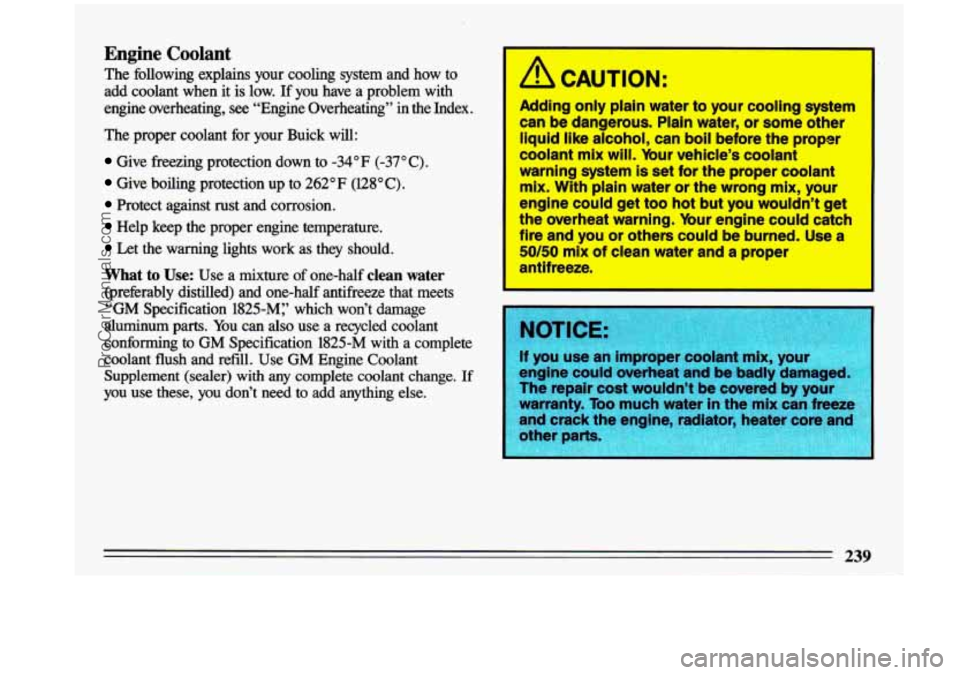
Engine Coolant
The following explains your cooling system and how to
add coolant when it is low.
If you have a problem with
engine overheating, see “Engine Overheating” in the Index. \
The proper coolant for your Buick will:
Give freezing protection down to -34°F (-37°C).
Give boiling protection up to 262” F (128” C).
Protect against rust and corrosion.
Help keep the proper engine temperature.
Let the warning lights work as they should.
What to Use: Use a mixture of one-half clean water
(preferably distilled) and one-half antifreeze that meets
“GM Specification 1825-Mi’ which won’t damage
aluminum parts. You can also use a recycled coolant
conforming to GM Specification 1825-M with a complete
coolant flush
and refill. Use GM Engine Coolant
Supplement
(sealer) with any complete coolant change. If
you use these, you don’t need to add anything else.
I
A CAUTION:
Adding only plain water to your coollng system
can
be dangerous. Plain water, or some other
liquid
like alcohol, can boil before the proper
coolant mix will. Mur vehicle’s coolant
warning system
Is set for the proper coolant
mix. With plain water or the wrong mlx, your
engine could get too hot but you wouldn’t get
the overheat warning. bur engine could catch
fire and you or others’could be burned. Use a
50/50 mPx of clean water and a proper
antifreeze.
I
: warranty. Too much
l
and crack t
other parts
239
ProCarManuals.com
Page 261 of 324
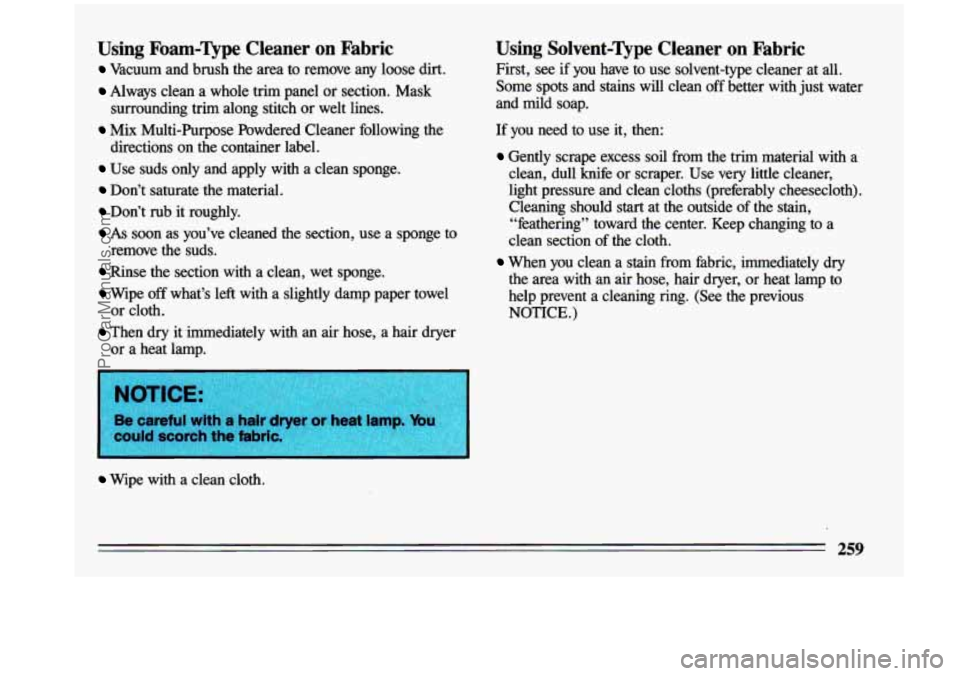
Using Foam-Qpe Cleaner on Fabric
Vacuum and brush the area to remove any loose dirt.
Always clean a whole trim panel or section. Mask
Mix Multi-Purpose Powdered Cleaner following the
Use suds only and apply with a clean sponge.
Don’t saturate the material.
Don’t rub it roughly.
As soon as you’ve cleaned the section, use a sponge to
remove the suds.
Rinse the section with a clean, wet sponge.
Wipe off what’s left with a slightly damp paper towel
Then dry it immediately with an air hose, a hair dryer
surrounding
trim along stitch or welt lines.
directions on the container label.
or cloth.
or a heat lamp.
Wipe with a clean cloth.
Using Solvent=Qpe Cleaner on Fabric
First, see if you have to use solvent-type cleaner at all.
Some
spots and stains will clean off better with just water
and mild soap.
If you need to use it, then:
Gently scrape excess soil from the trim material with a
clean, dull knife or scraper. Use very little cleaner,
light pressure and clean cloths (preferably cheesecloth).
Cleaning should start at the outside
of the stain,
“feathering” toward the center. Keep changing to a
clean section of the cloth.
When you clean a stain from fabric, immediately dry
the area with an air hose, hair dryer, or heat lamp to
help prevent a cleaning ring. (See the previous
NOTICE.)
259
ProCarManuals.com
Page 262 of 324
Special Cleaning Problems
Greasy or Oily Stains: Like grease, oil, butter,
margarine, shoe polish, coffke with cream, chewing gum, cosmetic creams, vegetable
oils, wax crayon, tar
and asphalt.
Carefully scrape off excess stain.
Then follow the solvent-type instructions above.
Shoe polish, wax crayon, tar and asphalt will stain if
left on
a vehicle seat fabric. They should be removed as
soon as possible. Be careful, because the cleaner will
dissolve them and may cause them to bleed.
Non-Greasy Stains: Like catsup, coffee (black), egg,
fruit, fruit juice,
milk, soft drinks, wine, vomit, urine
and
blood.
Carefully scrape off excess stain, then sponge the soiled
area with cool water.
If a stain remains, follow the foam-type instructions
above.
If an odor lingers after cleaning vomit or urine, treat
the area
with a watedbaking soda solution: 1 teaspoon
(5 ml) of baking soda to 1 cup (250 ml) of lukewarm
water.
Finally, if needed, clean lightly with solvent-type
cleaner.
Combination Stains: Like candy, ice cream,
mayonnaise, chili sauce and unknown
stains.
Carefully scrape off excess stain, then clean with cool
If a stain remains, clean it with solvent-type cleaner.
Cleaning Vinyl
Just use warm water and a clean cloth. water and allow to dry.
Rub with a
clean, damp cloth to remove dirt. You may
have to do it more than once.
Things like tar, asphalt and shoe polish will stain if you
don't get them
off quickly. Use a clean cloth and
solvent-type vinyl/leather cleaner.
Cleaning the Top of the Instrument Panel
Use only mild soap and water to' clean the top surfaces of
the instrument panel. Sprays containing silicones or
waxes may cause annoying reflections
in the windshield
and even make it difficult to see through the windshield
under certain conditions.
260
ProCarManuals.com
Page 265 of 324
Sheet Metal Damage
If your vehicle is damaged and requires sheet metal
repair or replacement, make sure the body repair shop
applies anti-corrosion material to the parts repaired or
replaced to restore corrosion protection.
Foreign Material
Calcium chloride and other salts, ice melting agents, road
oil and tar, tree sap, bird droppings, chemicals from
industrial chimneys, and other foreign matter can damage
your vehicle’s finish if they remain on painted surfaces. Use cleaners that are marked safe for painted surfaces for
these stains.
Finish Damage
Any stone chips, fractures or deep scratches in the finish
should be repaired right away. Bare metal will corrode
quickly and may develop into a major repair expense.
Minor chips and scratches
can be repaired with touch-up
materials available from your dealer or other service
outlets. Larger areas of finish damage can be corrected in
your dealer’s body and paint shop.
Underbody Maintenance
Chemicals used for ice and snow removal and dust
control can collect on the underbody. If these
are not
removed, accelerated corrosion (rust) can occur on the
underbody parts such as fuel lines, frame,
floor pan, and
exhaust system even though they have corrosion
protection.
At least every spring, flush these materials from the
underbody
with plain water. Clean any areas where mud
and other debris can collect. Dirt packed
in closed areas
of the frame should be loosened before being flushed.
Your dealer or an underbody vehicle washing system can
do this for you.
Chemical paint Spotting
Some weather and atmospheric conditions can create a
chemical fdlout. Airborne pollutants can
f$ll upon and
attack painted surfaces on your vehicle. This damage can
take
two forms: blotchy, ringlet-shaped discolorations,
and small irregular dark
spots etched into the paint
surhce.
Although no defect in the paint job causes
this, Buick
will repair, at no charge to the owner, the surfaces
of new
vehicles damaged by this fallout condition within 12
months or 12,OOO miles (20 OOO km) of purchase,
whichever comes first.
ProCarManuals.com
Page 266 of 324
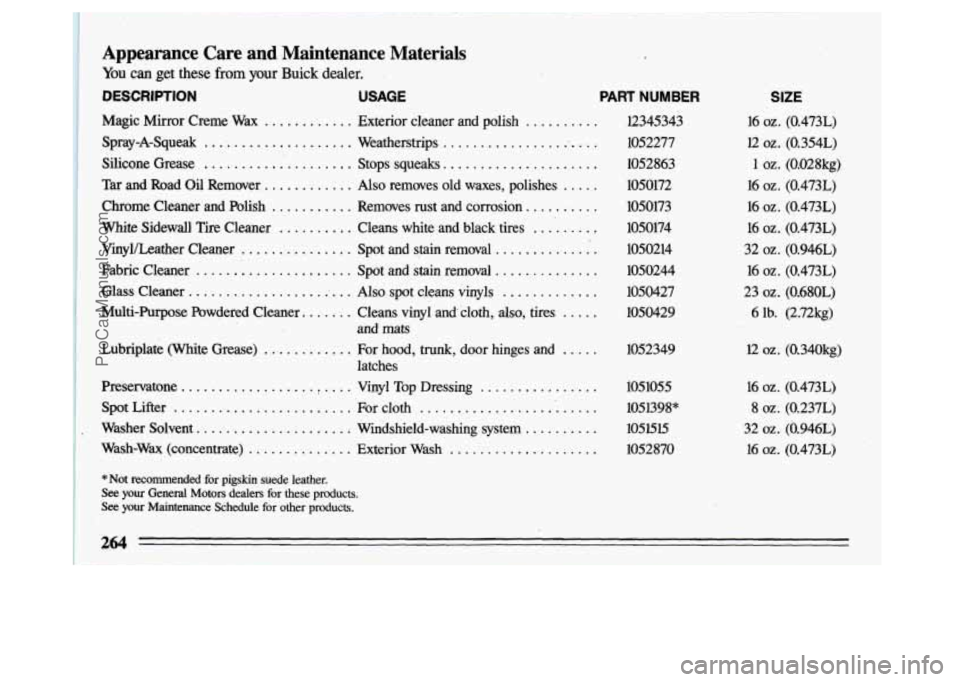
Appearance Care and Maintenance Materials
You can get these from your Buick dealer .
DESCRIPTION USAGE PAFlT NUMBER
Magic Mirror Creme Wax ............. Exterior cleaner and polish ......... 12345343
Spray-A-Squeak
..................... Weatherstrips ..................... 1052277
Silicone Grease
..................... Stops squeaks ..................... 1052863
Tar and Road
Oil Remover ............ Also removes old waxes, polishes .... 1050172
Chrome Cleaner and Polish
........... Removes rust and corrosion .......... 1050173
White Sidewall Tire Cleaner
.......... Cleans white and black tires ......... 1050174
VinyULeather Cleaner
............... Spot and stain removal .............. 1050214
Fabric Cleaner
...................... Spot and stain removal .............. 1050244
Multi-Purpose Powdered Cleaner
........ Cleans vinyl and cloth, also. tires ...... 1050429
and
mats
latches
Glass Cleaner
....................... Also spot cleans vinyls ............. 1050427
Lubriplate
(Wh~te Grease) ............ For hood. trunk, door hinges and ..... 1052349
Preservatone
.................. .... Vinyl Top Dressing ................ 1051055
Washer Solvent
..................... Windshield-washing system .......... 1051515
Spot Lifter
........................ For cloth ........................ 105l398*
Wash-Wax (concentrate)
.............. Exterior Wash ..................... 1052870
SIZE
16 oz . (0.473L)
12 oz . (0.354L)
1
oz . (0.02Skg)
16 oz . (0.473L)
16
oz . (0.473L)
16
oz . (0.473L)
32
oz . (0.946L)
16
oz . (0.473L)
23
oz . (0.680L)
6 lb
. (2.72kg)
12 oz . (0.340kg)
16
oz . (0.473L)
8 oz . (0.237L)
32
oz . (0.946L)
16
oz . (0.473L)
* Not recommended .for pigskin suede leather .
See your General Motors dealers for these products .
See your Maintenance Schedule for other products .
264
I
ProCarManuals.com
Page 269 of 324
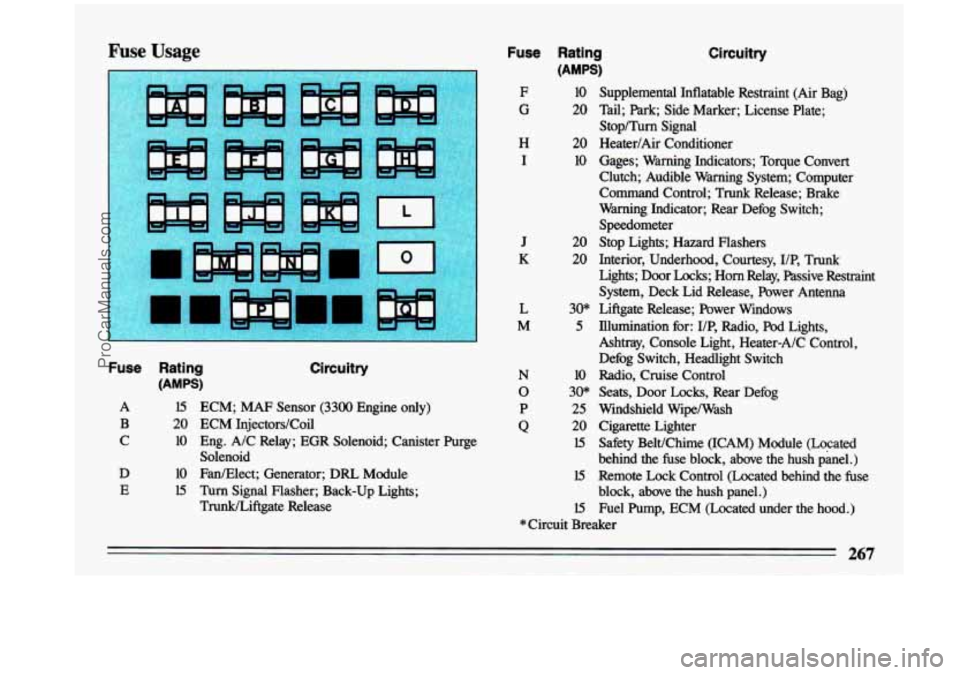
Fuse Usage
I
I
Fuse Rating
(AMPS)
A
B
C
D E
15
20
10
10
15
ECM; MAF Sensor (3300 Engine only)
ECM Injectors/Coil
Eng. A/C Relay; EGR Solenoid; Canister Purge Solenoid
Fan/Elect; Generator; DRL Module
Turn Signal Flasher; Back-up Lights;
TruWLiftgate Release
Fuse
F
G
H
I
J
K
L
M
Rating
(AMPS)
10
20
20
10
20
20
30"
5
Circuitry N
0
P
Q
10
30"
25
20
15
15
15
Circuitry
Supplemental Inflatable Restraint (Air Bagj
Tail; Park; Side Marker; License Plate; Stop/Turn Signal
Heater/Air Conditioner
Gages; Warning Indicators; Torque Convert
Clutch; Audible Warning System; Computer Command Control; Trunk Release; Brake
Warning Indicator; Rear Defog Switch;
Speedometer
Stop Lights; Hazard Flashers
Interior, Underhood, Courtesy, I/P, Trunk Lights; Door
Locks; Horn Relay, Passive Restraint
System, Deck Lid Release, Power Antenna
Liftgate Release; Power Windows
Illumination for: I/P, Radio,
Pod Lights,
Ashtray, Console Light, Heater-A/C Control,
Defog Switch, Headlight Switch
Radio, Cruise Control
Seats, Door
Locks, Rear Defog
Windshield Wipe/Wash
Cigarette Lighter
Safety Belt/Chirne (ICAM) Module (Located
behind the fuse block, above the hush panel.)
Remote Lock Control (Located behind the fuse
block, above the hush panel.) Fuel Pump, ECM (Located under the hood.)
*Circuit Breaker
267
ProCarManuals.com
Page 273 of 324
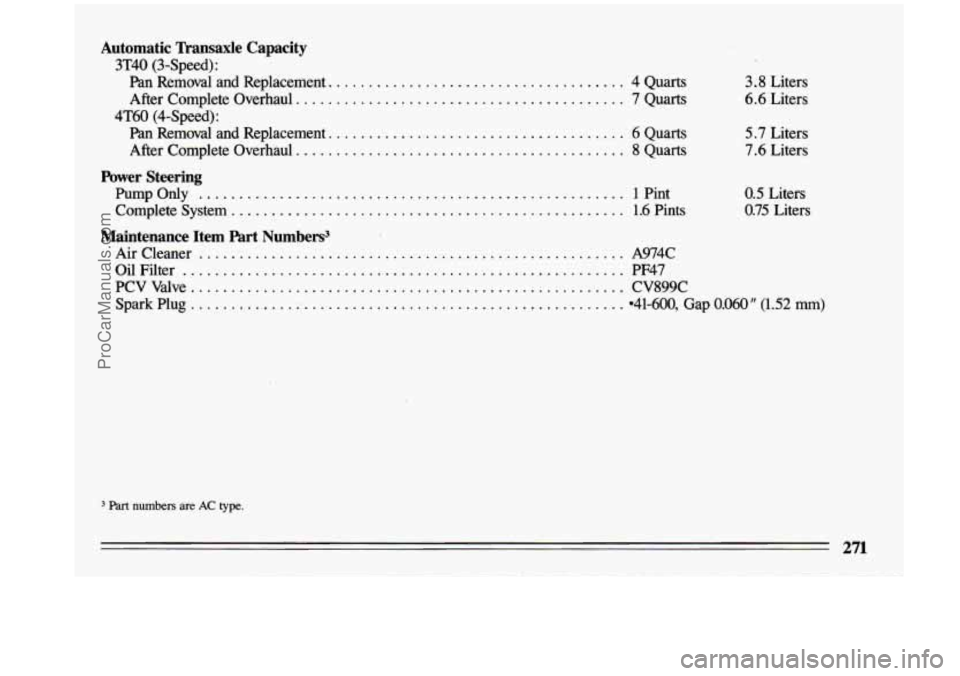
Automatic Tkansaxle Capacity
3T40 (3-Speed) :
Pan Removal and Replacement. ....................................
After Complete Overhaul. ........................................
Pan Removal and Replacement. ....................................
After Complete Overhaul. ........................................
4T60 (4-Speed):
Power Steering
PumpOnly .....................................................
Complete System. ................................................
Maintenance Item part Numbers3
Air Cleaner
Oil Filter
. .
PCV Valve .
Spark Plug .
.....................................................
.....................................................
.....................................................
.....................................................
4 Quarts
7 Quarts
6 Quarts
8 Quarts
1 Pint
1.6 Pints
3.8 Liters
6.6 Liters
5.7 Liters
7.6 Liters
0.5 Liters
0.75 Liters
M4C PF47
CV899C
041-600, Gap
0.060 It (1.52 m)
Part numbers are AC type.
271
ProCarManuals.com
Page 275 of 324
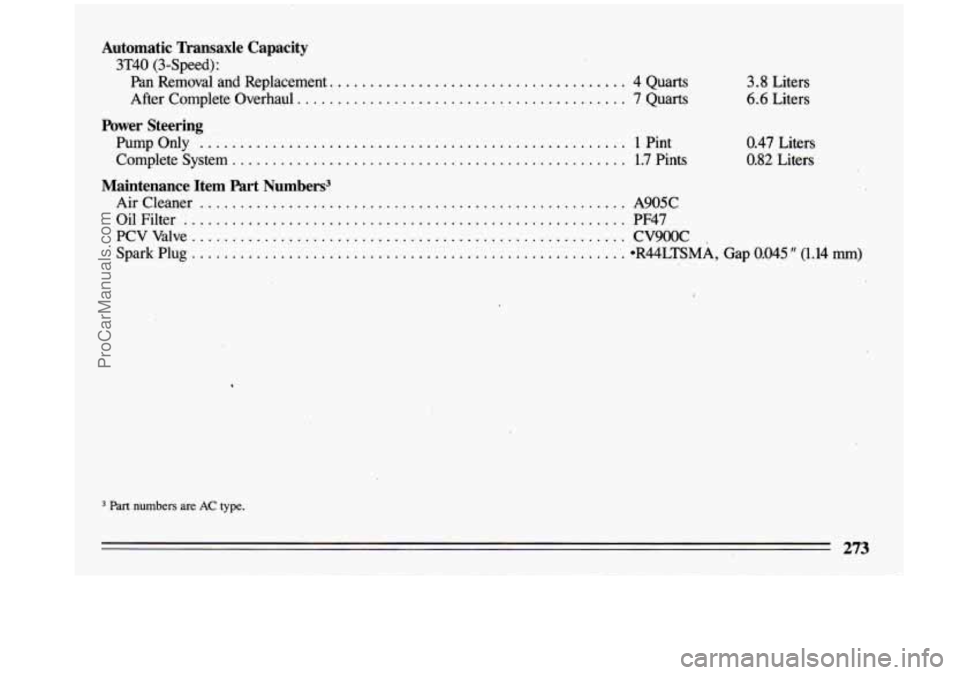
Automatic Transaxle Capacity
3T40 (3-Speed): Pan Removal and Replacement.
.................................... 4 Quarts
After Complete Overhaul.
........................................ 7 Quarts
Power Steering
PumpOnly ..................................................... 1Pint
Complete System
................................................. 1.7 Pints 3.8 Liters
6.6 Liters
0.47 Liters
0.82 Liters
Maintenance Item Part Numbers3
Aircleaner ..................................................... A905C
OilFilter
;...................................................... PF47
PCVValve
...................................................... CV9OOC .
Spark Plug ...................................................... *R44LTSMA, Gap 0.045 " (1.14 mm)
Part numbers are AC type.
273
ProCarManuals.com
Page 277 of 324
I
I
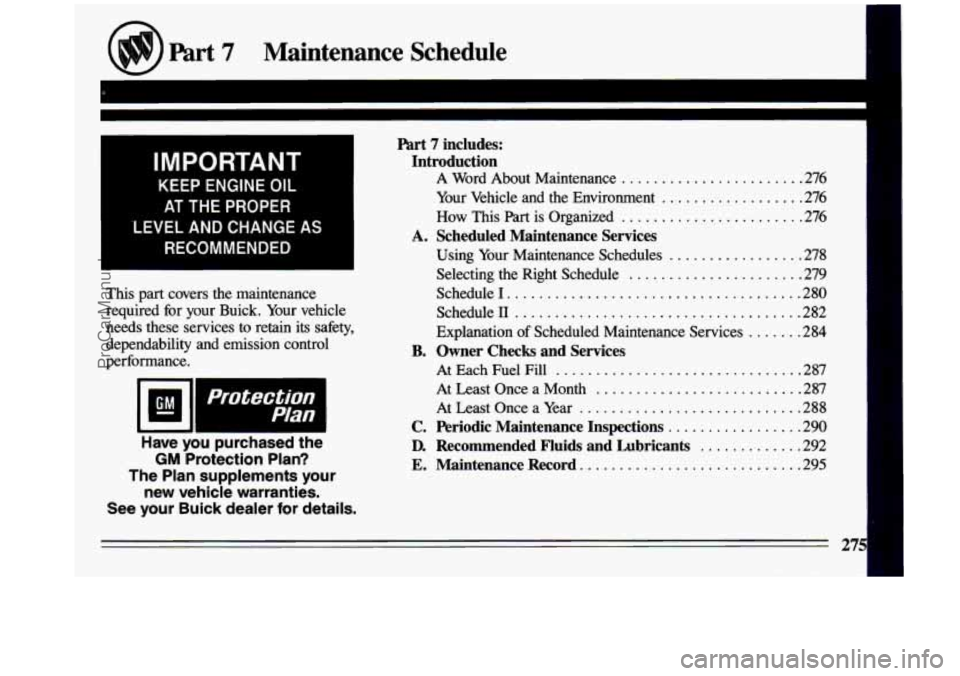
Part 7 Maintenance Schedule
IMPORTANT
KEEP ENGINE OIL
AT THE PROPER
'LEVEL AND CHANGE
AS
RECOMMENDED
This part covers the maintenance
required for your Buick. Your vehicle
needs these services to retain
its safety,
dependability and emission control
performance.
Have you purchased the
GM Protection Plan?
The Plan supplements your
new vehicle warranties.
See your Buick dealer
for details.
part 7 includes:
Introduction
A Word About Maintenance ...................... .276
Your Vehicle and the Environment ................. ,276
How This Part is Organized ...................... .276
A.. Scheduled Maintenance Services
Using Your Maintenance Schedules ................ .278
Selecting the Right Schedule ...................... ,279
Schedule1 ..................................... 280
Schedule I1 ................................... .282
Explanation of Scheduled Maintenance Services .... -284
At Each Fuel Fill .............................. .287
B. Owner Checks and Services
At Least Once a Month ......................... .287
At Least Once a Year ........................... .288
C. Periodic Maintenance Inspections ................ .290
D. Recommended Fluids and Lubricants ............ .292
E. Maintenance Record. .......................... .295
ProCarManuals.com
Page 282 of 324
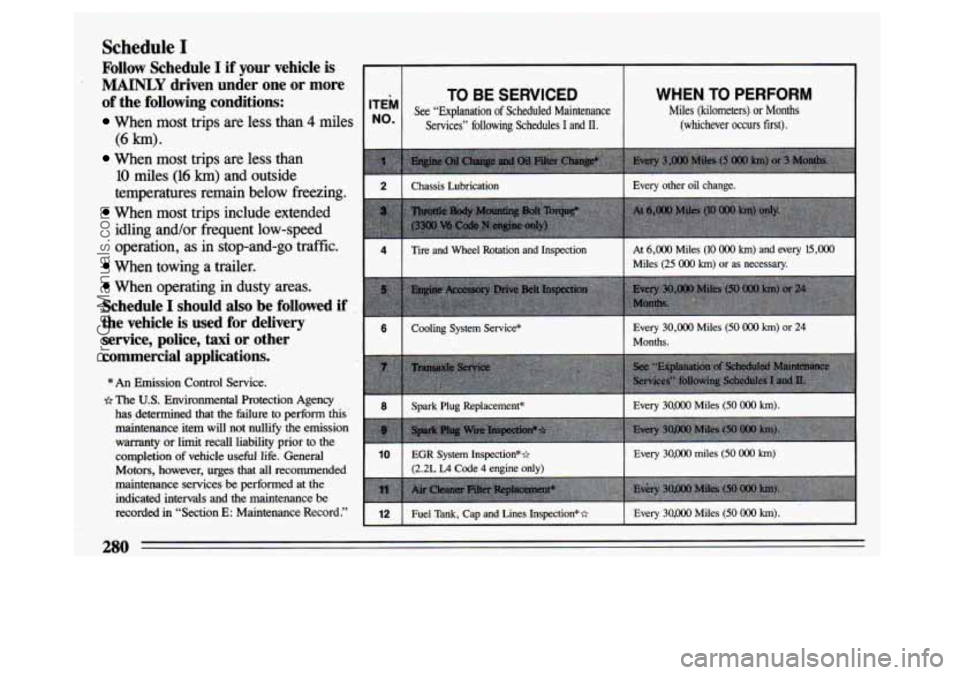
Schedule I
Follow Schedule I if your vehicle is
MAINLY driven under one or more
of the following conditions:
When most trips are less than 4 miles
When most trips are less than
10 miles (16 km) and outside
temperatures remain below freezing.
When most trips include extended
idling and/or frequent low-speed
operation, as
in stop-and-go’ traffic.
(6 km).
When towing a trailer.
When operating in dusty areas.
Schedule I should also be followed if
the vehicle
is used for delivery
service, p?lice,
taxi or other
commercial applications.
* An Emission Control Service.
z2T The U.S. Environmental Protection Agency
has.determined that the failure to perform this
maintenance item will not nullify the emission
wamty
or limit recall liability prior to the
completion of vehicle useful life. General
Motors, however, urges that all recommended
maintenance services
be performed at the
indicated intervals and the maintenance be
recorded in “Section E: Maintenance Record.”
ITEM
NO.
TO BE SERVICED WHEN TO PERFORM
See “Explanation of Scheduled Maintenance Miles (kilometers) or Months
Services” following Schedules
I and D[. (whichever occurs first).
2 I Chassis Lubrication I Every other oil change.
Tire
and Wheel Rotation and Inspection At 6,000 Miles (10 000 km) and every 15,000
Miles (25 000 km) or as necessary. I
61
Cooling System Service* Every 30,000 Miles (50 O00 km) or 24
Months. I
8 I Spark
Plug Replacement* I Every 30,000 Miles (50 000 km). I
EGR System Inspection** Every 30,000 miles (50 OOO km)
(2.2L LA Code 4 engine only)
12 I Fuel Tank, Cap and Lines Inspection** I Every 30,000 Miles (50 OOO km). I
280
ProCarManuals.com