warning BUICK CENTURY 1993 Owner's Guide
[x] Cancel search | Manufacturer: BUICK, Model Year: 1993, Model line: CENTURY, Model: BUICK CENTURY 1993Pages: 324, PDF Size: 17.58 MB
Page 204 of 324
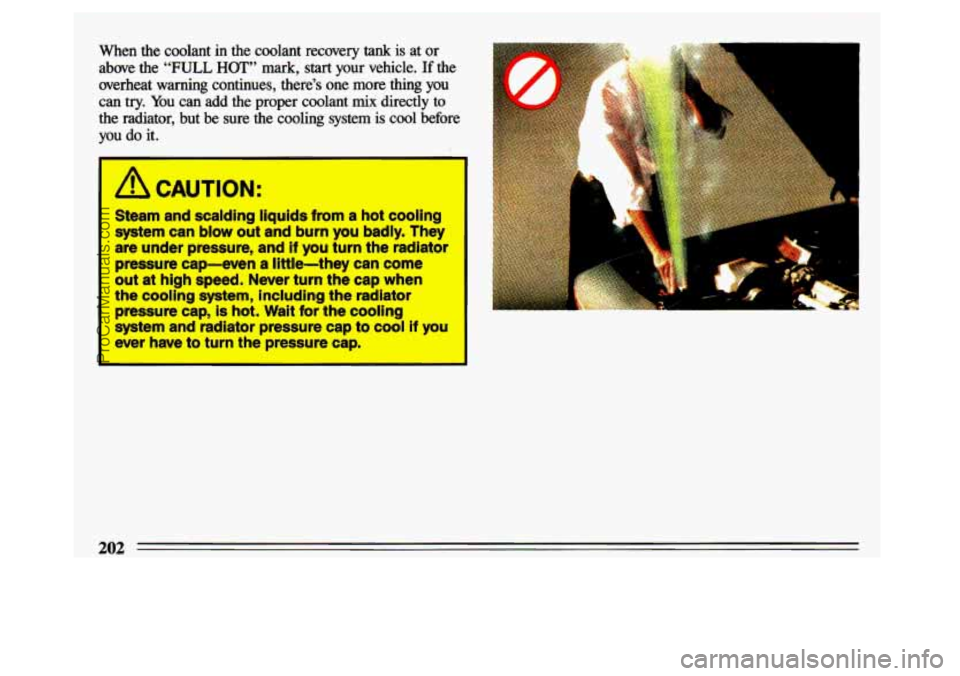
When the coolant in the coolant recovery tank is at or
above
the “FULL HOT” mark, start your vehicle. If the
overheat
warning continues, there’s one more thing you
can try. You can add the proper coolant mix directly to
the radiator, but be sure the cooling system is cool before
you do it.
I
/i CAUTION:
Steam and scalding liquids from a hot cooling
system can blow out and burn you badly. They
are under pressure, and if you turn the radiator
pllessure cap--even a little-they can -me
out at hlgh speed. NeAler turn the cap when
the cwllng qstern, Including the radiator
pressure
cap, is hot. Wait tor the cooling
system and radiator pressure cap to cool if you
ever have to turn the pressure cap.
202
ProCarManuals.com
Page 207 of 324
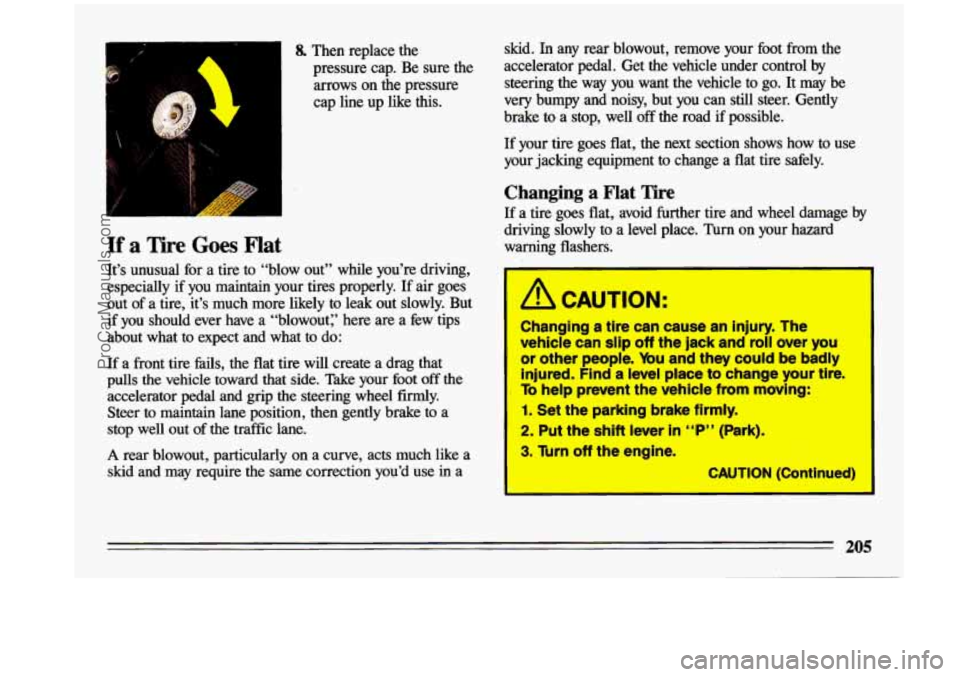
8. Then replace the pressure cap. Be sure
the
arrows on the pressure
cap line up like this.
If a Tire Goes Flat
It’s unusual for a tire to “blow out” while you’re driving,
especially if you maintain your tires properly. If air
goes
out of a tire, it’s much more likely to leak out slowly. But
if you should ever have a “blowout:’ here are a few tips
about what to expect and what to do:
If a front tire fails, the flat tire will create a drag that
pulls
the vehicle toward that side. Take your foot off the
accelerator pedal and grip
the steering wheel firmly.
Steer to maintain lane position, then gently brake to a
stop well out of the traffic lane.
A rear blowout, particularly on a curve, acts much like a
skid and may require the same correction you’d use in a skid.
In any rear blowout, remove your foot from the
accelerator pedal. Get the vehicle under control by
steering the way you want the vehicle
to go. It may be
very bumpy and noisy, but you can still steer. Gently brake
to a stop, well off the road if possible.
If your tire goes flat; the next section shows how to use
your jacking equipment to change a flat tire safely.
Changing a Flat Tire
If a tire goes flat, avoid further tire and wheel damage ~y
driving slowly to a level place. Turn on your hazard
warning flashers.
A CAUTION:
Changing a tire can cause an injury. The vehicle can slip
off the jack and roll over you
or other people. You and they could be badly injured. Find a level place to change your tire.
To help prevent the vehicle from moving:
1. Set the parking brake firmly.
2. Put the shift lever in “P” (Park).
3. Turn off the engine.
CAUTION (Continued)
205
ProCarManuals.com
Page 241 of 324
Engine Coolant
The following explains your cooling system and how to
add coolant when it is low.
If you have a problem with
engine overheating, see “Engine Overheating” in the Index. \
The proper coolant for your Buick will:
Give freezing protection down to -34°F (-37°C).
Give boiling protection up to 262” F (128” C).
Protect against rust and corrosion.
Help keep the proper engine temperature.
Let the warning lights work as they should.
What to Use: Use a mixture of one-half clean water
(preferably distilled) and one-half antifreeze that meets
“GM Specification 1825-Mi’ which won’t damage
aluminum parts. You can also use a recycled coolant
conforming to GM Specification 1825-M with a complete
coolant flush
and refill. Use GM Engine Coolant
Supplement
(sealer) with any complete coolant change. If
you use these, you don’t need to add anything else.
I
A CAUTION:
Adding only plain water to your coollng system
can
be dangerous. Plain water, or some other
liquid
like alcohol, can boil before the proper
coolant mix will. Mur vehicle’s coolant
warning system
Is set for the proper coolant
mix. With plain water or the wrong mlx, your
engine could get too hot but you wouldn’t get
the overheat warning. bur engine could catch
fire and you or others’could be burned. Use a
50/50 mPx of clean water and a proper
antifreeze.
I
: warranty. Too much
l
and crack t
other parts
239
ProCarManuals.com
Page 245 of 324
Brake Master Cylinder
I
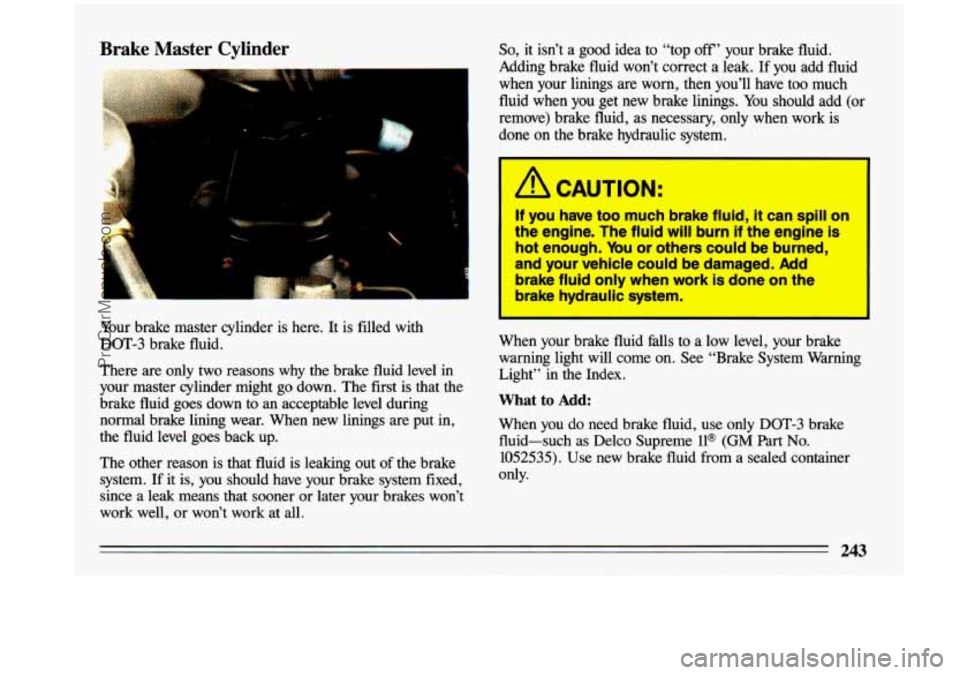
Your brake master cylinder is here. It is filled with
DOT-3 brake fluid.
There are only two reasons why the brake fluid level in
your master cylinder might go down. The first is that
the
brake fluid goes down to an acceptable level during normal brake lining wear. When new linings are put in,
the fluid level goes back
up.
The other reason is that fluid is leaking out of the brake
system.
If it is, you should have your brake system fixed,
since a leak means that sooner
or later your brakes won’t
work well, or won’t work at all.
So, it isn’t a good idea to “top off’ your brake fluid.
Adding brake fluid won’t correct a leak. If you add fluid
when your linings are worn, then you’ll have too much
fluid when you get new brake linings.
You should add (01
remove) brake fluid, as necessary, only when work is
done on the brake hydraulic system.
A CAUTION:
If you have too much brake fluid, it can spill on
the engine. The fluid
will burn if the engine is
hot enough. Mu or others could be burned,
and your vehicle could
be damaged. Add
brake fluid only when work is done on the
brake hydraulic system.
When your brake fluid falls to a low level, your brake
warning light will come on. See “Brake System Warning
Light” in the Index.
What to Add:
When you do need brake fluid, use only DOT-3 brake
fluid-such as Delco Supreme
ll@ (GM Part No.
1052535). Use new brake fluid from a sealed container
only.
ProCarManuals.com
Page 257 of 324
*
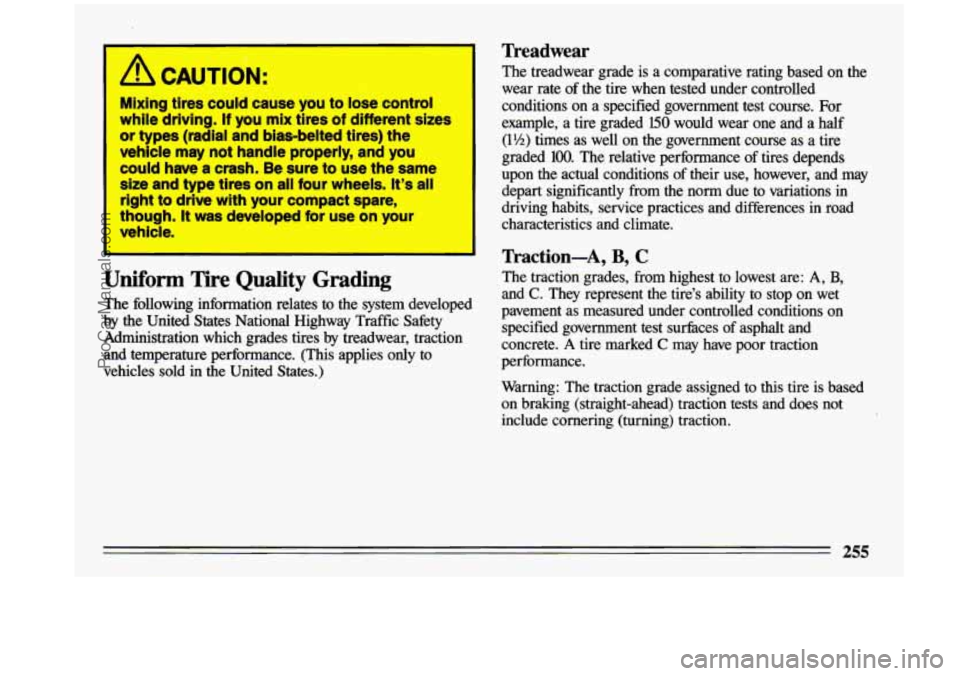
I A CAUTION:
Mlxing tires could cause you to lose control
while driving.
If you mlx tires of different sizes
or types (radial and bias-belted tires) the
vehlcle may not handle
properly, and you
could have
a crash. Be sure to use the same
size and type
tires on all four wheels. It’s all
right to drive wlth your compact spare,
though.
It was developed far use on your
vehicle.
I
Uniform Tire Quality Grading
The following information relates to the system developed
by the United States National Highway Traffic Safety
Administration which grades tires by treadwear, traction
and temperature performance. (This applies only to
vehicles
sold in the United States.)
Treadwear
The treadwear grade is a comparative rating based on the
wear rate of the tire when
tested under controlled
conditions on a specified government test course. For
example, a tire graded
150 would wear one and a half
(1%) times as well on the government course
as a tire
graded
100. The relative performance of tires depends
upon the actual conditions of their use, however, and may
depart significantly from the norm due to variations
in
driving habits, service practices and differences in road
characteristics and climate.
Traction-A, B, C
The traction grades, from highest to lowest are: A, B,
and C. They represent the tire’s ability to stop on wet
pavement as measured under controlled conditions on specified government test surfaces of asphalt and
concrete.
A tire marked C may have poor traction
performance.
Warning: The traction grade assigned to this tire is based
on braking (straight-ahead) traction tests and does not
include cornering (turning) traction.
255
ProCarManuals.com
Page 258 of 324
Temperature-A, B, C
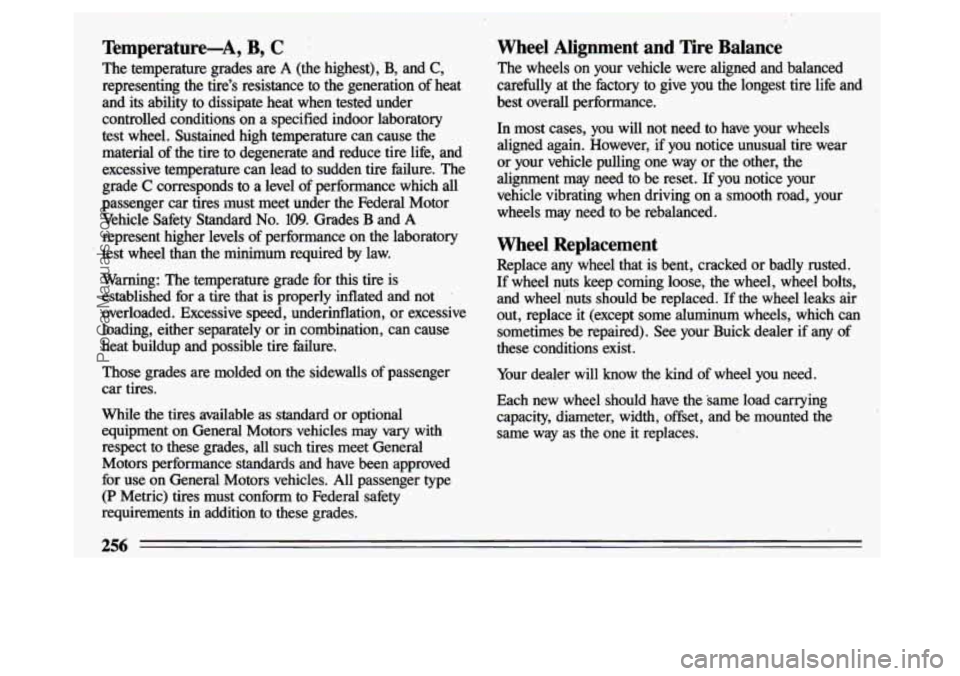
The temperature grades are A (the highest), B, and C,
representing the tire's resistance to the generation of heat
and
its ability to dissipate heat when tested under
controlled conditions on a specified indoor laboratory
test wheel. Sustained high temperature can cause the material'of the tire to degenerate and reduce tire life, and
excessive temperature can lead to sudden tire failure. The
grade
C corresponds to a level of performance which all
passenger car tires must meet under the Federal Motor
Vehicle Safety Standard
No. 109. Grades B and A
represent higher levels of performance on the laboratory
test wheel than the minimum required by law.
Warning: The temperature grade for
this tire is
established for a tire that is properly inflated and
not
overloaded. Excessive speed, underinflation, or excessive
loading, either separately or in combination, can cause
heat buildup and possible tire failure.
Those grades are molded on the sidewalls of'passenger
car tires.
While the tires available as standard or optional
equipment on General Motors vehicIes may vary with
respect to these grades, all such tires meet General
Motors performance standards and have been approved
for use
on General Motors vehicles. All passenger type
(P Metric) tires must conform to Federal safety
requirements in addition to these grades.
Wheel Alignment and Tire Balance
The wheels on your vehicle were aligned and balanced
carefully at the, factory to give you the longest tire life and
best overall performance.
In most cases, you will not need to have your wheels
aligned again. However, if you-notice unusual tire wear
or your vehicle pulling one way or the other, the
alignment may need
to be reset. If you notice your
vehicle vibrating when driving on a
smooth road, your
wheels may need to be rebalanced.
Wheel Replacement
Replace any wheel that is bent, cracked or badly rusted.
If wheel nuts keep coming loose, the wheel, wheel bolts,
and wheel'nuts should be replaced. If the wheel leaks air
out, replace it (except some aluminum wheels, which can sometimes be repaired). See your Buick dealer
if any of
these conditions exist.
Your dealer will know the kind
of wheel you need.
Each new wheel should have the same load carrying
capacity, diameter, width, offset, and be mounted the same way as the one
it replaces.
256
ProCarManuals.com
Page 269 of 324
Fuse Usage
I
I
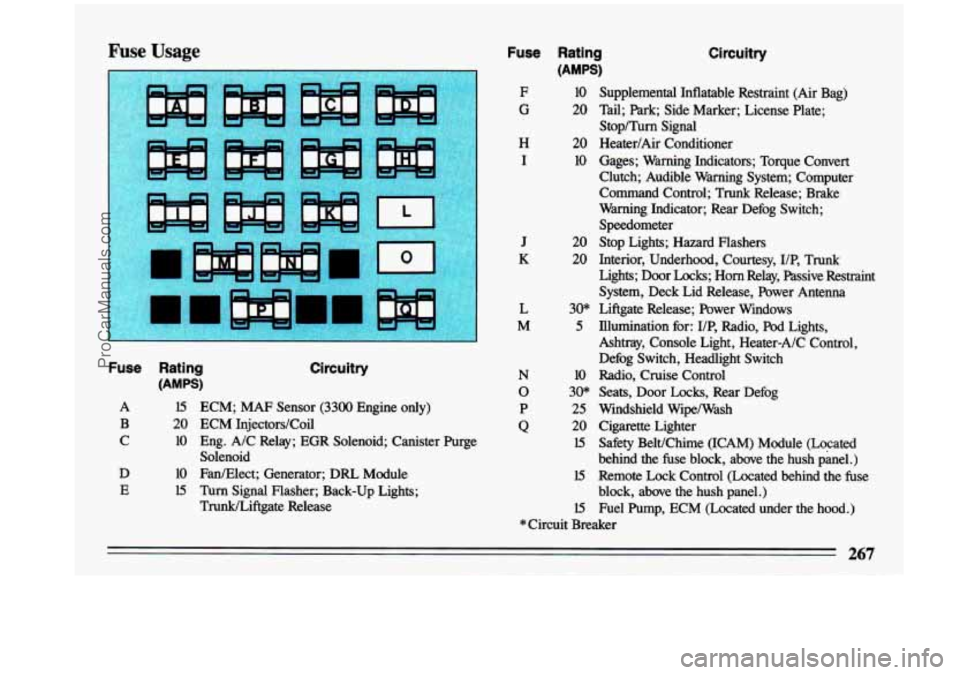
Fuse Rating
(AMPS)
A
B
C
D E
15
20
10
10
15
ECM; MAF Sensor (3300 Engine only)
ECM Injectors/Coil
Eng. A/C Relay; EGR Solenoid; Canister Purge Solenoid
Fan/Elect; Generator; DRL Module
Turn Signal Flasher; Back-up Lights;
TruWLiftgate Release
Fuse
F
G
H
I
J
K
L
M
Rating
(AMPS)
10
20
20
10
20
20
30"
5
Circuitry N
0
P
Q
10
30"
25
20
15
15
15
Circuitry
Supplemental Inflatable Restraint (Air Bagj
Tail; Park; Side Marker; License Plate; Stop/Turn Signal
Heater/Air Conditioner
Gages; Warning Indicators; Torque Convert
Clutch; Audible Warning System; Computer Command Control; Trunk Release; Brake
Warning Indicator; Rear Defog Switch;
Speedometer
Stop Lights; Hazard Flashers
Interior, Underhood, Courtesy, I/P, Trunk Lights; Door
Locks; Horn Relay, Passive Restraint
System, Deck Lid Release, Power Antenna
Liftgate Release; Power Windows
Illumination for: I/P, Radio,
Pod Lights,
Ashtray, Console Light, Heater-A/C Control,
Defog Switch, Headlight Switch
Radio, Cruise Control
Seats, Door
Locks, Rear Defog
Windshield Wipe/Wash
Cigarette Lighter
Safety Belt/Chirne (ICAM) Module (Located
behind the fuse block, above the hush panel.)
Remote Lock Control (Located behind the fuse
block, above the hush panel.) Fuel Pump, ECM (Located under the hood.)
*Circuit Breaker
267
ProCarManuals.com
Page 293 of 324

~ ~~ ~ ~ ~~~ INSPECTION
OR SERVICE
Brake System
Inspection
WHAT SHOULD BE DONE
Inspect the complete system. Inspect brake lines and hoses for \
proper hookup, binding,
leaks, cracks, chafing, etc. Inspect disc brake pads for wear \
and rotors for surface condition.
Also inspect drum brake linings for wear and cracks. Inspect o\
ther brake parts, including
drums,
wheel cylinders, calipers, parking brake, etc. Check parking bra\
ke adjustment. You
may need to have your brakes inspected more often
if your driving habits or conditions
result
in frequent braking.
NOTE: A low brake fluid level can indicate worn disc brake pads which may need to be
serviced.
Also, if the brake system warning light stays on or comes on, something may be
wrong with the brake system. See “Brake System Warning Light\
” in the Index.
ProCarManuals.com
Page 309 of 324
Brake Fluid ................................ .243. 292
Electrical Equipment
..................... .75. 117. 265
Engine Coolant
................ .195. 239. 270. 272. 292
Engine Oil
........................ .227. 270. 272. 292
Sound Equipment
................................ 117
Power Steering Fluid
................ .241. 271. 273. . 292
Transaxle Fluid
.................... .236. 271. 273. 292
Windshield Washer Fluid
.................... .242. 293
AirBag(S1R)
..................................... 35
Air Cleaner
............................. .233. 271. 273
Air Conditioner
.......................... .114. 270. 272
Alcohol in Gasoline
................................ 223
Aluminum Wheels. Cleaning
........................ 262
Antenna Care
..................................... 131
Antifreeze
.......................... .239. 270. 272. 292
Ashtrays and Lighter
............................... 104
Audiosystems
.................................... 116
AM/FM Stereo Radio
............................. 118
Alcohol. Driving Under the Influence
of
............... 143
Appearance Care and Maintenance Materials
....... .258. 264
AM/FM Stereo Radio with Cassette Player
............ EO
AM/FM Stereo with Compact Disc Player ............ 123
Care
of Audio Systems ............................ 129 Radio Reception. Understanding
.............. 117
Setting the Clock
.................. .118. 121. 124
Automatic Door Locks
........................ 66
Automatic Lap-Shoulder Belt (see “Safety Belts”)
Automatic Transaxle Adding Fluid
................ .236. 271. 273. 292
Checking Fluid
........................... 236
Shifting
.................................. 77
Starting Your Engine
........................ 74
Batteries. Remote Lock Control
............... 66
Battery
.................................... 244
Jump Starting
............................. 185
Warnings
....................... .185, 186, 244
Battery Warning Light
........................ 108
Blizzard
................................... 173
Block Heater, Engine
.................... .76, 232
Blowout, Tire
............................... 205
Brake Adjustment
............................... 149
Fluid ............................... 243, 292
Master Cylinder
.......................... 243
Parking
.................................. 80
307
.
ProCarManuals.com
Page 310 of 324
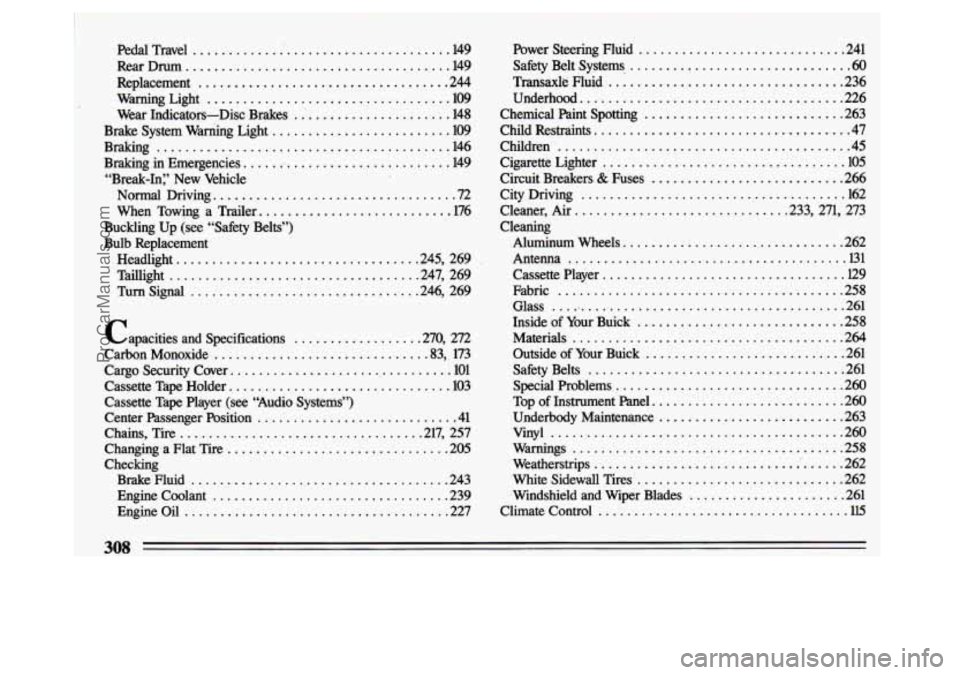
Pedal Travel ...................................... 149
RearDrum
..................................... 149
Replacement
................................... 244
Warning Light-
.................................. 109
Wear Indicators-Disc Brakes ....................... 148
Brake System Wakng Light
......................... 109
Braking in Emergencies .............................. 149
“Break-In:’ New Vehicle
Normd Driving. ................................. 72
When Towing a Trailer
........................... 176
Braking
......................................... 146
Buckling Up (see “Safety Belts”)
Bulb Replacement
Headlight
................................. .245. 269
Turn Signal ............................... .246, 269
Taillight
.................................. .247. 269
capacities and Specifications
................. .270. 272
CarbonMonoxide
.............................. 83. 173
Cargo Security Cover
................................ 101
Cassette Tape Holder
............................... 103
Cassette Tape Player
(see “Audio Systems”)
Center Passenger Position
............................ 41
Chains. Tire
................................. .217. 257
Changing a Flat Tire
............................... 205
Checking BrakeFluid
.................................... 243
Engine Coolant
................................. 239
Engine0
il ..................................... 227 Power Steering Fluid
............................. 241
Safety Belt Systems
......... ...................... 60
Transaxle Fluid .................................. 236
Underhood
..................................... 226
Chemical paint Spotting
............................ 263
ChildRestraints
.................................... 47
Children’
......................................... 45
Cigarette Lighter
.................................. 105
Circuit Breakers
& Fuses ........................... 266
Cleaner, Air
............................. .233. 271. 273
Cleaning AluminumWheels
............................... 262
Antenna
....................................... 131
Cassette Player .................................. 129
Fabric
........................................ 258
Glass
.......................................... 261
Inside of Your Buick ............................. 258
Materials ........................................ 264
Outside of Your Buick
............................ 261
Safety Belts
.................................... 261
Special Problems
................................ 260
Top of Instrument Panel
........................... 260
Underbody Maintenance
.......................... 263
Vinyl
......................................... 260
Warnings ...................................... 258
Weatherstrips
.................................... ‘262
White Sidewall Tires
............................. 262
Windshield and Wiper Blades
...................... 261
Climate Control
................................... 115
CityDriving ..................................... 162
308
ProCarManuals.com