fuel BUICK CENTURY 1993 Owners Manual
[x] Cancel search | Manufacturer: BUICK, Model Year: 1993, Model line: CENTURY, Model: BUICK CENTURY 1993Pages: 324, PDF Size: 17.58 MB
Page 14 of 324
I
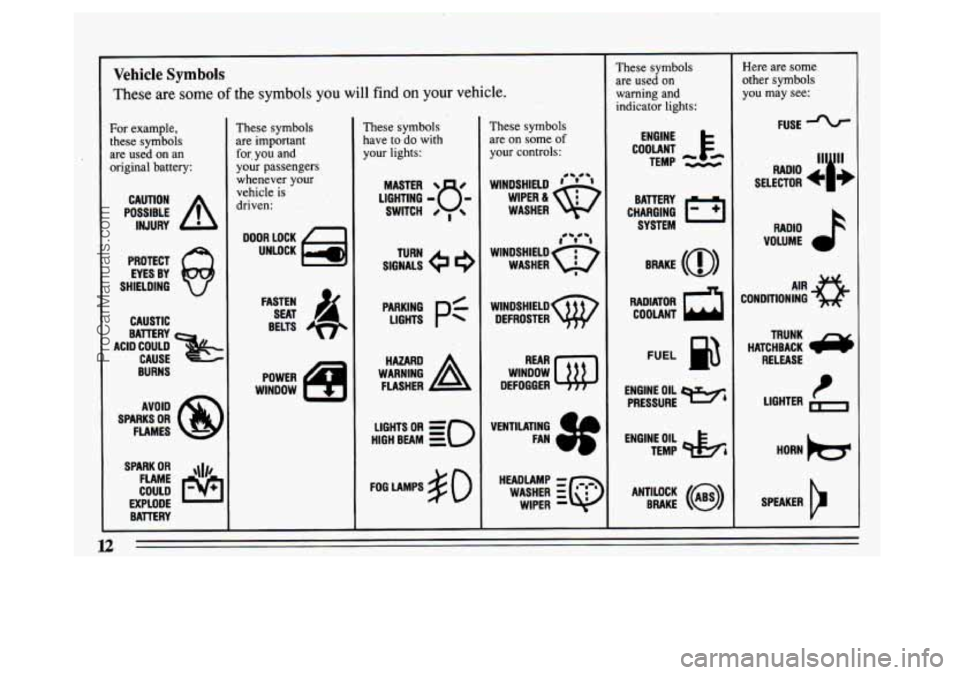
Vehicle Symbols
These are some of the symbols you will find on your vehicle.
For example,
these symbols
are used on an
original battery:
POSSIBLE A
CAUTION
INJURY
PROTECT EYES BY
SHIELDING
CAUSTIC
ACID COULD CAUSE
BATTERY
BURNS AVOID
SPARKS
OR
FLAMES
SPARK
OR ,111,
COULD FLAME
EXPLODE BATTERY
These symbols
are important
for. you and
your passengers
whenever your
vehicle
is
driven:
DOOR LOCK
UNLOCK
FASTEN SEAT
4
BELTS
POWER
WINDOW
These symbols
have
to do with
your lights:
SIGNALS e3
TURN
WARNING
A
HAZARD
FLASHER
HIGH BEAM
OR =, =o
FOG LAMPS # 0
These symbols
are on some
of
your controls:
WINDSHIELD ' ' ' 0- 0-
WIPER &
WASHER
t0 @e4 i
WINDSHIELD=
WASHER I
wlNDsHIELDw DEFROSTER
WINDOW
@
REAR
DEFOGGER
VENTILATING FAN
HEADLAMP
-
WIPER -
WASHER zQ
Thes, ,ymbols
are used on
warning and indicator lights:
COOLANT F-
ENGINE
TEMP
--
CHARGING I-1
BATTERY SYSTEM
FUEL
ENGINE OIL wb
PRESSURE
TEMP
OIL &
ANTILOCK BRAKE (i)
Here are some
other symbols
you may see:
FUSE
RADIO
k
VOLUME a
CONDITIONING AIR a
HATCHBACK e
TRUNK
RELEASE
SPEAKER
b
ProCarManuals.com
Page 78 of 324
~ Driving T -ough Deep Standing Water
orktanding
water, water can come in through
your engine’s air intake and badly damage your en ine. If ou can’t avoid dee uddles
or stan
slowly.
Engine Block Heatel lada only)
In very cold weather, 0°F (-HOC) or colder, the engine
block
heater can help. You’ll get easier starting and better
fuel economy during engine warm-up.
To use the block heater:
1. Turn off the engine.
2. Open the hood and unwrap the electrical cord.
3. Plug it into a normal, grounded UC olt outlet.
I I
Plugging the cord into an ungrounded outlet I
could cause an electrical shock. Also, the
wrong kind of extension cord could overheat
and cause a fire.
You could be seriously
injured. Plug the cord into a properly
grounded three-prong 110-volt outlet.
If the
cord won’t reach, use a heavy-duty three-
prong extension cord rated for at least 15
amps.
ProCarManuals.com
Page 81 of 324
If your automatic transaxle has Overdrive, “D” is like
“a,” but you never go into Overdrive. Here are some
times you might choose
“D” instead of “@”:
- When driving on hilly, winding roads
- When towing a trailer, so there is less shifting between
gears
- When going down a steep hill
2 (Second Gear)
This position gives you more power but lower fuel
economy. You can use
“2” on hills. It can help control
your speed as you go down steep mountain roads, but
then you would also want to use your brakes off and on.
1 (First Gear)
This position gives you even more power (but lower fuel
economy) than 2. You can use it on very steep hills, or
in deep snow or mud. If the selector lever is put in “1 i’
the transaxle won’t shift into first gear until the vehicle is
going slowly enough.
bb 99
79
ProCarManuals.com
Page 107 of 324
Cigarette Lighter
To use the lighter, push it in all the way and let go. When
it’s ready, it will pop back by itself.
The Instrument Panel:
Your Information System
L
Your instrument panel is designed to let you know at a
glance
how your vehicle is running. You’ll know how fast
you’re going,
how much fuel you’re using, and many
other things you’ll need to drive safely
and economically.
105
ProCarManuals.com
Page 109 of 324
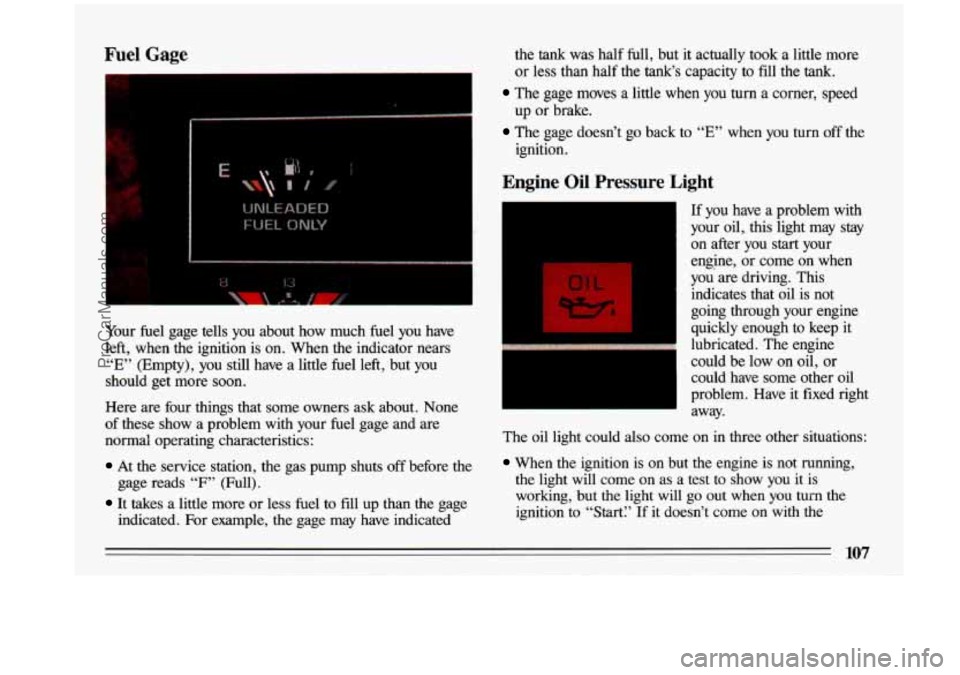
Fuel Gage
Your fuel gage tells you about how much fuel you have
left, when the ignition is on. When the indicator nears
“E” (Empty), you still have a little fuel left, but you
should get more
soon.
Here are four things that some owners ask about. None
of these show a problem with your fuel gage and are
normal operating characteristics:
At the service station, the gas pump shuts off before the
gage reads
“F” (Full).
It takes a little more or less fuel to fill up than the gage
indicated. For example, the gage may have indicated the tank was half
full, but it actually took
a little more
or less than half the
tank‘s capacity to fill the tank.
The gage moves a little when you turn a corner, speed
up or brake.
The gage doesn’t go back to “E” when you turn off the
ignition.
Engine Oil Pressure Light
If you have a problem with
your
oil, this light may stay
on after you start your
engine, or come on when
you are driving.
This
indicates that oil is not
going through your engine
quickly enough to keep it
lubricated. The engine could be low on oil, or
could have some other oil
problem. Have it fixed right
away.
The
oil light could also come on in three other situations:
When the ignition is on but the engine is not funning,
the light will come on as a test to show you it is
working, but the light will go out when
you turn the
ignition to “Start? If it doesn’t come on with the
107
ProCarManuals.com
Page 113 of 324
X"' 1 r-l
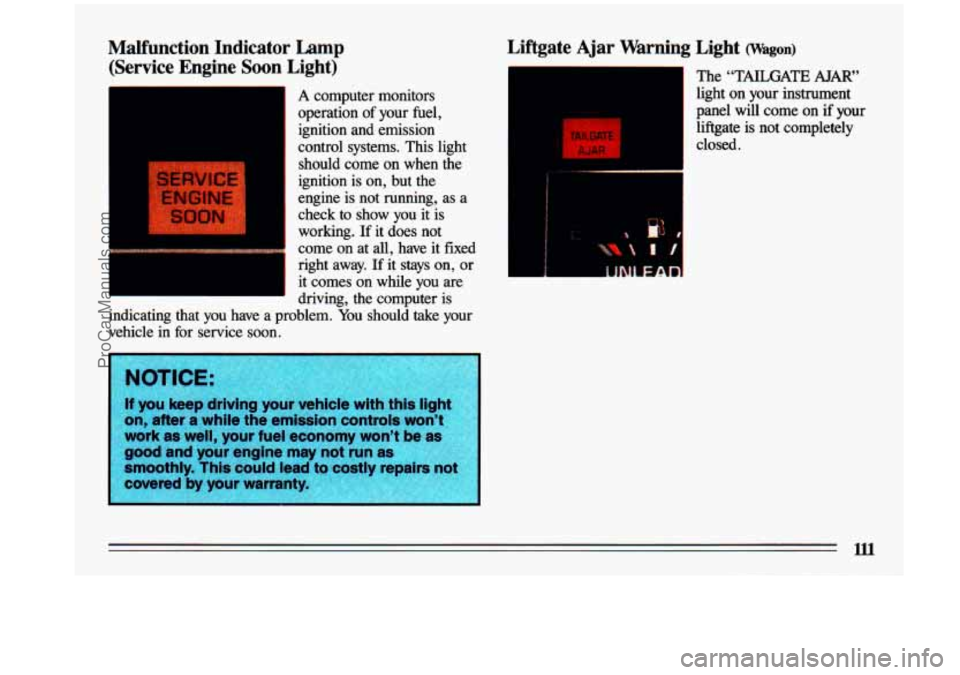
Malfunction Indicator Lamp
(Service Engine Soon Light)
A computer monitors
I operation of your fuel,
ignition and. emission
control systems. This light should come on when the
ignition is on, but the
engine is not running, as a
check to show
you it is
working.
If it does not
come on at all, have it fixed
right away.
If it stays on, or
it comes on while you are
driving, the computer is
I
indicating that you have a problem. You should take your
vehicle in
for service soon.
Liftgate Ajar Warning Light (Wagon)
.-
- The "TAILGATE AJAR"
~ light on your instrument
panel
will come on if your
I
TAI! GAY E
ALAR
liftgate is not completely
1 closed.
ProCarManuals.com
Page 116 of 324
1
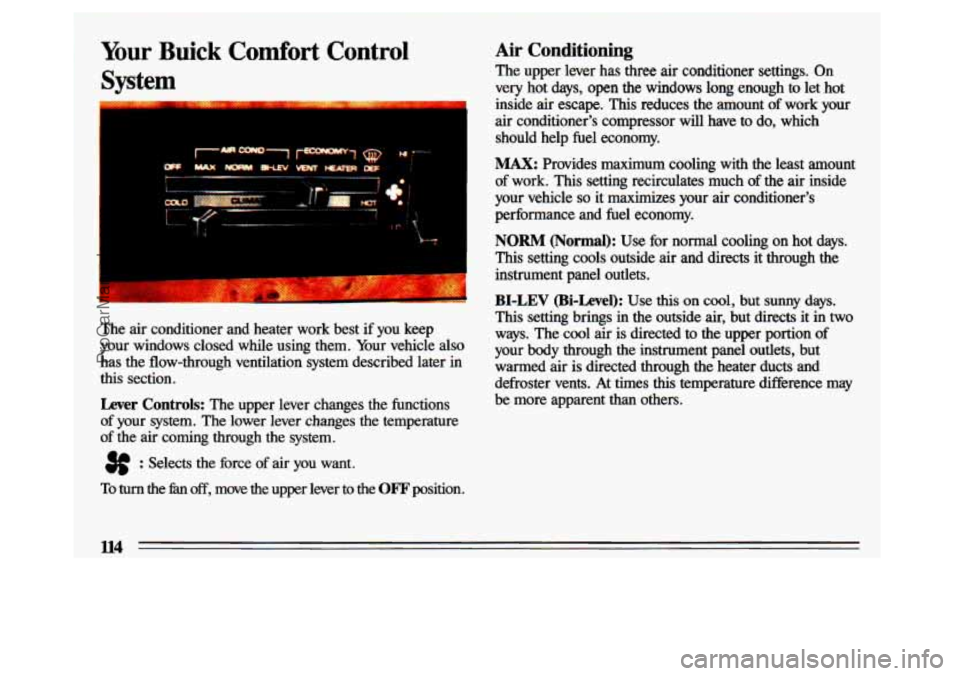
Your Buick Comfort Control
Syst m -
The air conditioner and heater work best if you keep
your windows closed while using them. Your vehicle
also
has the flow-through ventilation system described later in
this section.
Lever Controls: The upper lever changes the functions
of your system. The lower lever changes the temperature
of the air coming through the system.
3f : Selects the force of air you want.
Air Conditioning
The upper lever has three air conditioner settings. On
very hot days, open the windows long enough to let hot
inside air escape.
This reduces the amount of work your
air conditioner's compressor
will have to do, which
should help fuel economy.
MAX: Provides maximum cooling with the least amount
of work. This setting recirculates much of the air inside
your vehicle
so it maximizes your air conditioner's
performance and
fuel economy.
NORM (Normal): Use for normal cooling on hot days.
This setting cools outside air and directs it through the
instrument panel outlets.
BI-LEV (Bi-Level): Use this on cool, but sunny days.
This setting brings in the outside air, but directs it in two\
ways. The cool air
is directed to the upper portion of
your body through the instrument panel
outlets, but
warmed air is directed through the heater ducts and
defroster vents. At times
this temperature difference may
be more apparent than others.
To turn the 5x1 off, move the upper lever to the OF'F position.
ll4
ProCarManuals.com
Page 149 of 324
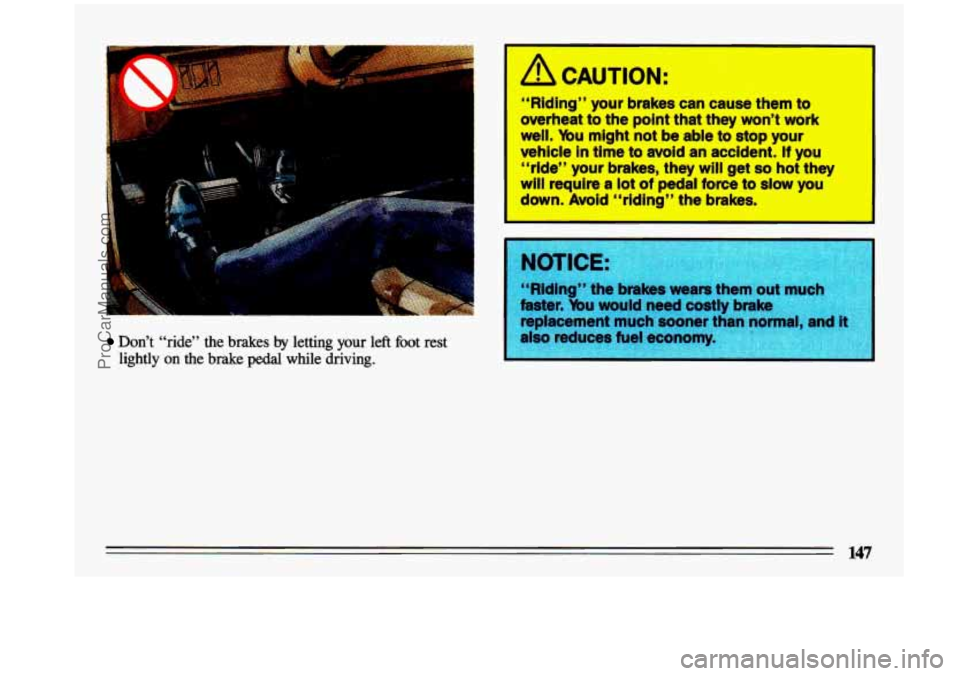
Don’t “ride” the brakes by letting your left foot rest
lightly
on the brake pedal while driving.
“Riding” your brakes can cause them to
overheat to the pointthat they won’t work
well. Mu might not be able to stop your
vehicle In tlme to avoid an accident. If you
6crlde” your brakes, they will get 80 hot they
will require a lot of pedal force to slow you
down. Avold “ridlng” the hralaas.
faster. vou would need cos
replacement
much sooner
also reduces fuel economy.
147
ProCarManuals.com
Page 176 of 324
~ CAUTION (Contlnued)
1 Opien a wlndow Just a llttle on the side of the
vehlcie that’s
away fmm the wind. Thls will
help keep CO out.
I
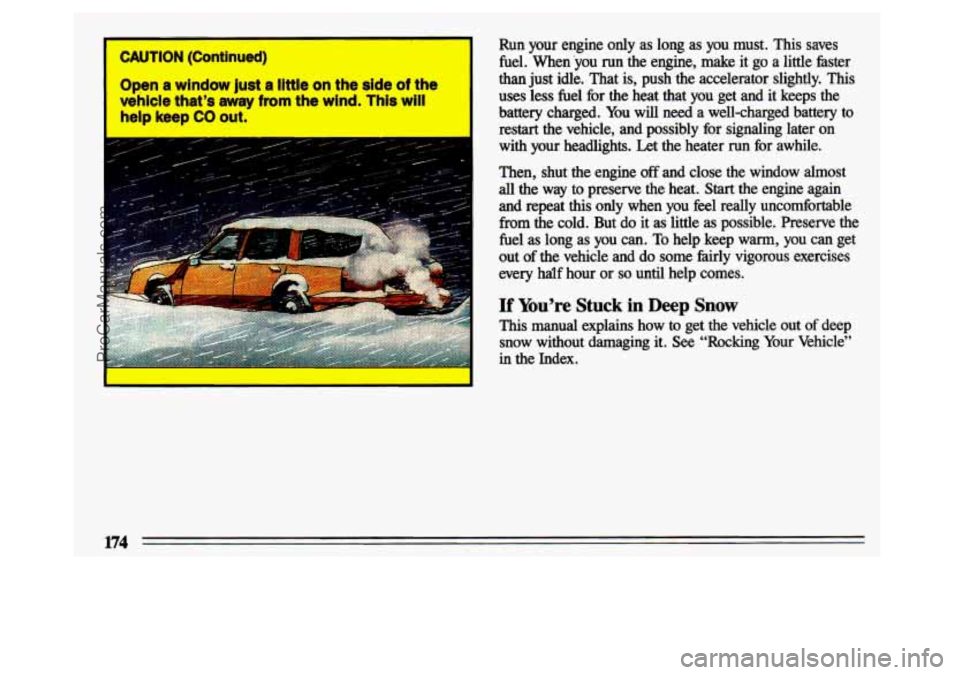
Run your engine only as long as you must. This saves
fuel. When you run the engine, make it go a little faster
than just idle. That is, push the accelerator slightly. This
uses less
fuel for the heat that you get and it keeps the
battery charged. You
will need a well-charged battery to
restart
the vehicle, and possibly for signaling later on
with your headlights. Let the heater run for awhile.
Then, shut the engine
off and close the window almost
all the way to preserve the heat. Start the engine again
and repeat
this only when you feel really uncomfortable
from the cold. But do it as little as possible. Preserve the
fuel
as long as you can. To help keep warm, you can get
out
of the vehicle and do some fhirly vigorous exercises
every half hour or
so until help comes.
If You’re Stuck in Deep Snow
This manual explains how to get the vehicle out of deep
snow without damaging
it. See “Rocking Your Vehicle”
in the Index.
174
ProCarManuals.com
Page 177 of 324
Towing a Trailer
A CAUTION:
If you don’t use the correct equipment and
drive properly, you can lose control when you
pull a traller. For example, If the trailer is too
heavy, the brakes may not work well--or wen
at all. Mu and your passengets could be
seriously Injured. Pull a trailer only if you have
followed all the steps in this section.
hicle and result
Your Buick can tow a trailer. To identify what the vehicle
trailering capacity is for your vehicle, you should read
the information in “Weight of the Trailer” that appears
later
in this section. But trailering is different than just
driving your vehicle
by itself. Trailering means changes
in handling, durability, and fuel economy. Successful,
safe trailering
takes correct equipment, and it has to be
used properly. That’s the reason for this section.
In it are many time-
tested, important trailering tips and safety rules. Many
of
these are important for your safety and that of your
passengers.
So please read this section carefully before
you pull a trailer.
Load-pulling components such as the engine, transaxle,
wheel assemblies, and tires are forced to work harder against the drag of the added weight. The engine is
required to operate at relatively higher speeds and under
greater loads, generating extra heat. What’s more, the
trailer adds considerably
to wind resistance, increasing
the pulling requirements.
All of that means changes in:
Handling
Durability
Fuel economy
175
ProCarManuals.com