overheating BUICK CENTURY 1993 Owners Manual
[x] Cancel search | Manufacturer: BUICK, Model Year: 1993, Model line: CENTURY, Model: BUICK CENTURY 1993Pages: 324, PDF Size: 17.58 MB
Page 11 of 324
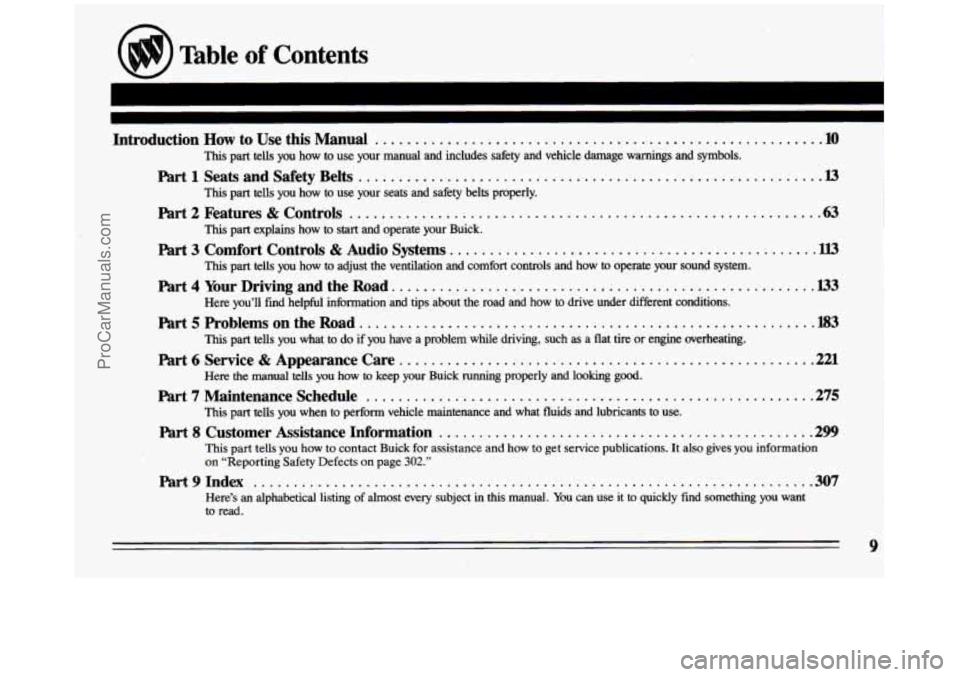
Table of Contents
Introduction How to Use this Manual ....................................................... .10
This part tells you how to use your manual and includes safety and vehicle damage warnings\
and symbols.
Part 1 Seats and Safety Belts .......................................................... I3
This part tells you how to use your seats and safety belts properly.
Part 2 Features & Controls .......................................................... .63
Part 3 Comfort Controls & Audio Systems. ............................................. W!
Part 4 Your Driving and the Road. .......................... : ........................ .I33
Part 5 Problems on the Road. ....................................................... .l83
Part 6 Service & Appearance Care .................................................... .221
Part7MaintenanceSchedule ...........................................................
Part 8 Customer .Assistance Information .............................................. .299
This part explains how to start and operate your Buick.
This part tells you how to adjust the ventilation and comfort controls and how
to operate your sound system.
Here you’ll find helpful information and tips about the road and \
how to drive under different conditions.
This part tells you what to
do if you have a problem while driving, such as a flat tire or engine overheating.
Here the manual tells you how to keep your Buick running properly and looking good.
This part tells you when
to perform vehicle maintenance and what fluids and lubricants to use.
This part tells
you how to contact Buick for assistance and how to get service publications. It also gives you information
on “Reporting Safety Defects on page 302.”
hrt9Index ......................................................~...............30\
7
Here’s an alphabetical listing of almost every subject in this manual. You can use it to quickly find something you want
to read.
ProCarManuals.com
Page 112 of 324
A CAUTION:
Your brake system may not be working properly
if the brake warning light is on.
Driving with the brake warning light on can
lead to an accident.
If the light is still on after
you’ve pulled
off the road and stopped
carefully, have the vehicle towed
for service.
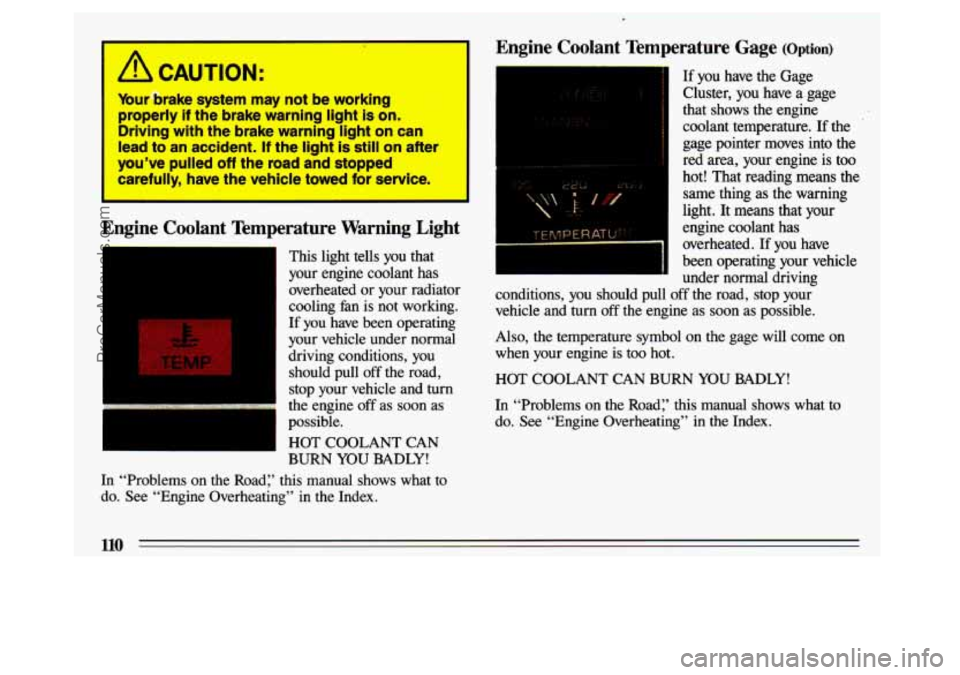
Engine Coolant Temperature Warning Light
---I
This light tells you that
your engine coolant has
overheated or your radiator
cooling
fan is not working.
If you have been operating
your vehicle under normal
driving conditions, you should pull
off the road,
stop your vehicle and
turn
the engine off as soon as
possible.
HOT COOLANT CAN
BURN YOU BADLY!
In “Problems on the Road:’ this manual shows what to
do. See “Engine Overheating” in the Index.
Engine Coolant Temperature Gage (Option)
‘1 If you have the Gage
Cluster, you have a gage
that shows the engine
coolant temperature.
If the
gage pointer moves into the red area, your engine is too
hot! That reading means the same thing as the warning
light. It means that your engine coolant has
overheated. If you have
been operating your vehicle under normal driving
conditions, you should pull off the road, stop your-
vehicle and
turn off the engine as soon as possible.
Also, the temperature symbol on the gage will come on
when your engine is too hot.
HOT COOLANT CAN BURN YOU BADLY!
In “Problems on the Road:’ this manual shows what to
do. See “Engine Overheating” in the Index.
110
ProCarManuals.com
Page 182 of 324
Driving on Grades
Reduce speed and shift to a lower gear before you start
down a long or steep downgrade. If you don’t shift down,
you might have to use your brakes
so much that they
would get hot and no longer work well.
On a long uphill grade, shift down and reduce your speed
to around
45 mph (70 Mh) to reduce the possibility of
engine and transaxle overheating.
If you are towing a trailer that weighs more than 1,OOO
pounds (450 kg) and you have an automatic transaxle
with Overdrive, you may prefer
to drive in “D” instead
of Overdrive.
Parking on Hills
You really should not park your vehicle, with a trailer
attached, on a hill.
If something goes wrong, your rig
could
start to move. People can be injured, and both your
vehicle and the trailer can be damaged.
But if you ever have to park your rig on a hill, here’s how
to do it:
1. Apply your regular brakes, but don’t shift into “P”
2. Have someone place chocks under the trailer wheels. (Park) yet.
3. When the wheel chocks
are in place, release the
regular brakes until the chocks absorb the load.
4. Reapply the regular brakes. Then, apply your parking
5. Release the regular brakes.
When You are Ready to Leave After Parking on a Hill
1. Apply your regular brakes and hold the pedal down
brake, and then shift to
“P” (Park).
while you:
Start your engine;
Shift into a gear; and
Release the parking brake.
2. Let up on the brake pedal.
3. Drive slowly until the trailer is clear of the chocks.
4. Stop and have someone pick up and store the chocks.
ProCarManuals.com
Page 185 of 324
I
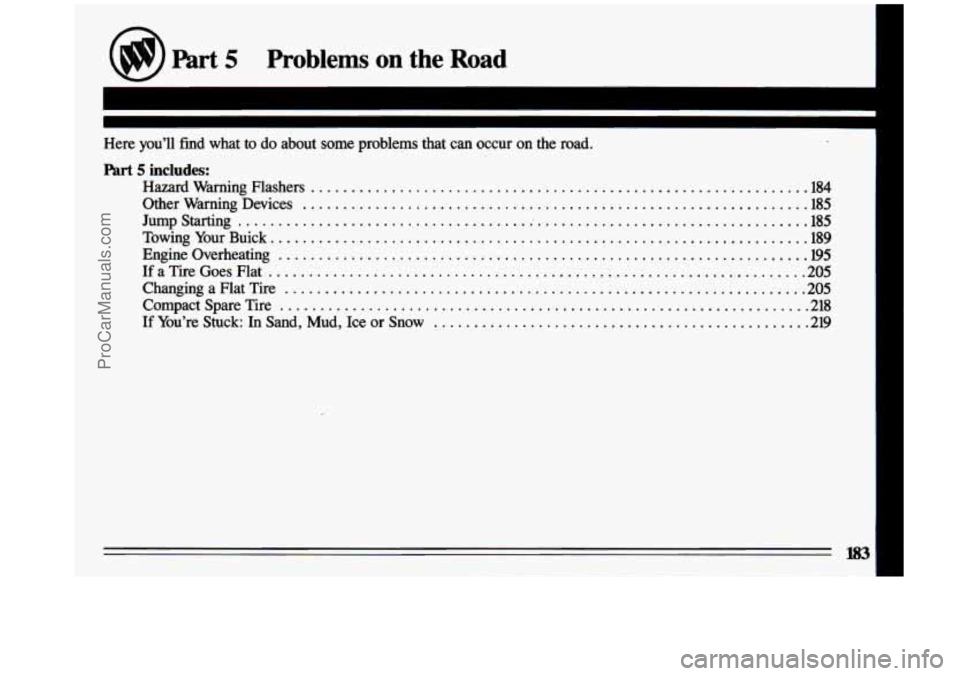
Here you’ll find what to do about some problems that can occur on the road.
Part 5 includes:
HazardWarningFlashers ..............................................................184
Other Warning Devices . . . . . . . . . . . . . . . . . . . . . . . . . . . . . . . . . . . . . . . . . . . . . . . . . . . . . . . . . . . . . . .185
Jumpstarting
........................................................................\
..
Towing Your Buick . . . . . . . . . . . . . . . . . . . . . . . . . . . . . . . . . . . . . . . . . . . . . . . . . . . . . . . . . . . . . . . . . . .189
Engine Overheating
. . . . . . . . . . . . . . . . . . . . . . . . . . . . . . . . . . . . . . . . . . . . . . . . . . . . . . . . . . . . . . . . . .195
IfaTireGoesFlat
...................................................................205
ChangingaFlatTire ........................................,........................205
CompactSpareTire ..................................................................218
If You’re Stuck: In Sand, Mud, Ice or Snow . . . . . . . . . . . . . . . . . . . . . . . . . . . . . . . . . . . . . . . . . . . . . . .219
ProCarManuals.com
Page 197 of 324
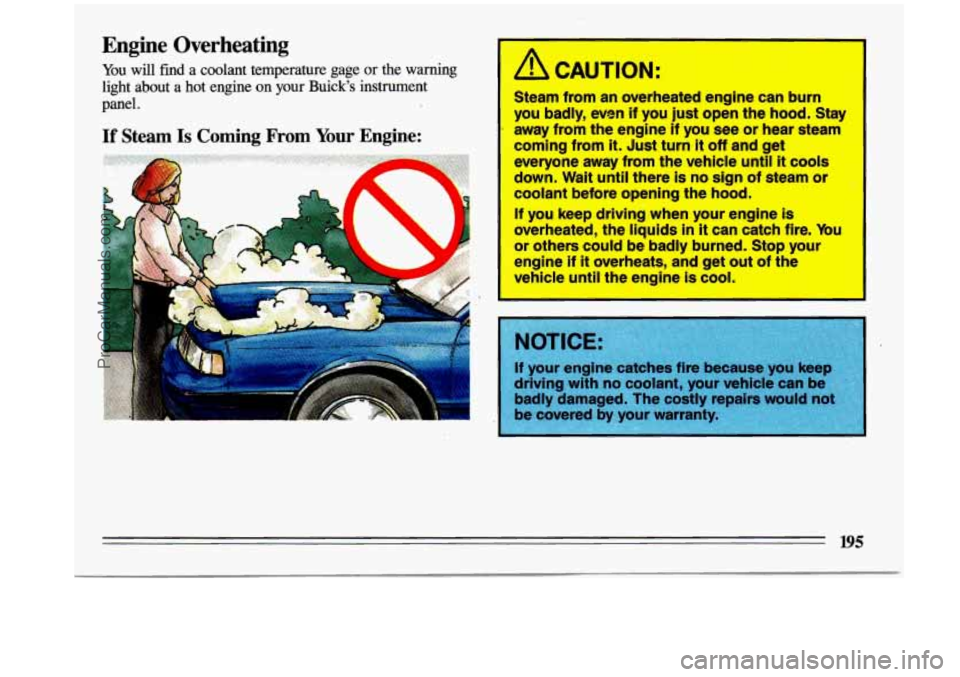
Engine Overheating
You will find a coolant temperature gage or the warning
light about a hot engine on your Buick’s instrument panel. A CAUTION:
Steam from an overheated engine can burn
you badly, even if you
just open the hood. Stay
away from the engine if you see
or hear steam
coming from
it. Just turn it off and get
everyone away from the vehicle until
it cools
down. Wait
until there is no sign of steam or
coolant before opening the hood.
If you keep driving when your engine is
overheated, the liquids
in it can catch fire. You -w others could be badly burned. Stop your
~gine if
it overheats, and get out of the
vehicle until the engine is cool.
195
ProCarManuals.com
Page 200 of 324
I
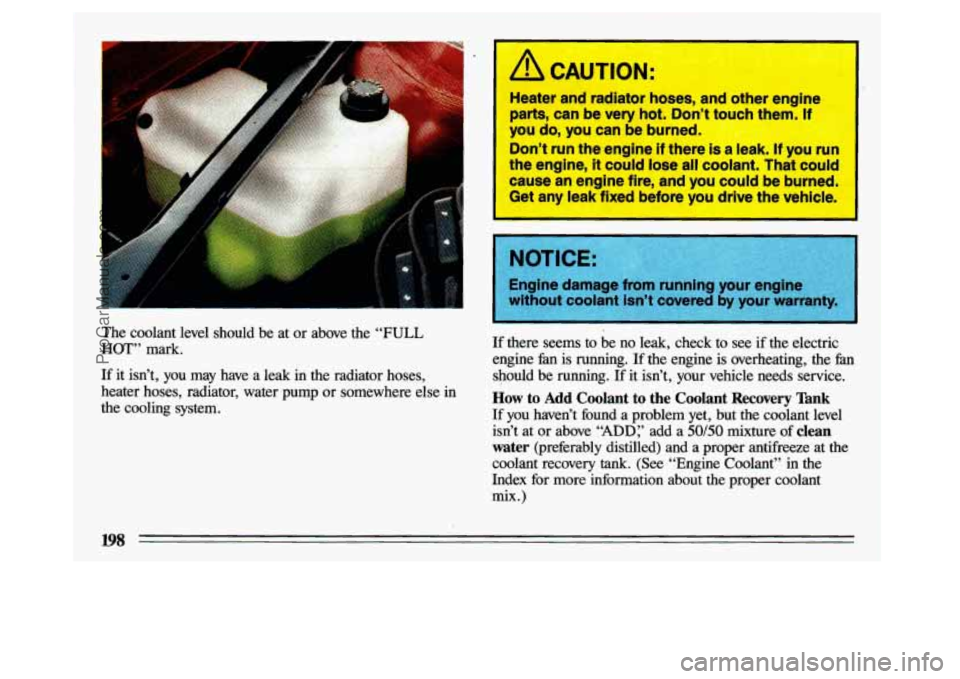
The coolant level should be at or above the “FULL
HOT” mark.
If it isn’t, you may have a leak in the radiator hoses,
heater hoses, radiator, water pump or somewhere else in
the cooling system.
1 [ CAUTION:
Heater and radiator hoses, and other engine
parts, can be very
hot. Don’t touch them. If
you
do, you can be burned.
Don’t run the engine if there
is a leak. If you run
the engine,
it could lose all coolant. That could
cause an engine fire, and you could be burned.
Get any leak fixed before you drive the vehicle.
If there seems to be no leak, check to see if the electric
engine
f8n is running. If the engine is overheating, the f8n
should be running. If it isn’t, your vehicle needs service. \
How to Add Coolant to the Coolant Recovery lhnk
If you haven’t found a problem yet, but the coolant level
isn’t at or above
“ADD:’ add a 50/50 mixture of clean
water (preferably distilled) and a proper antifreeze at the
coolant recovery
tank. (See “Engine Coolant” in the
Index for more information about the proper coolant
mix.)
i
I98
ProCarManuals.com
Page 202 of 324
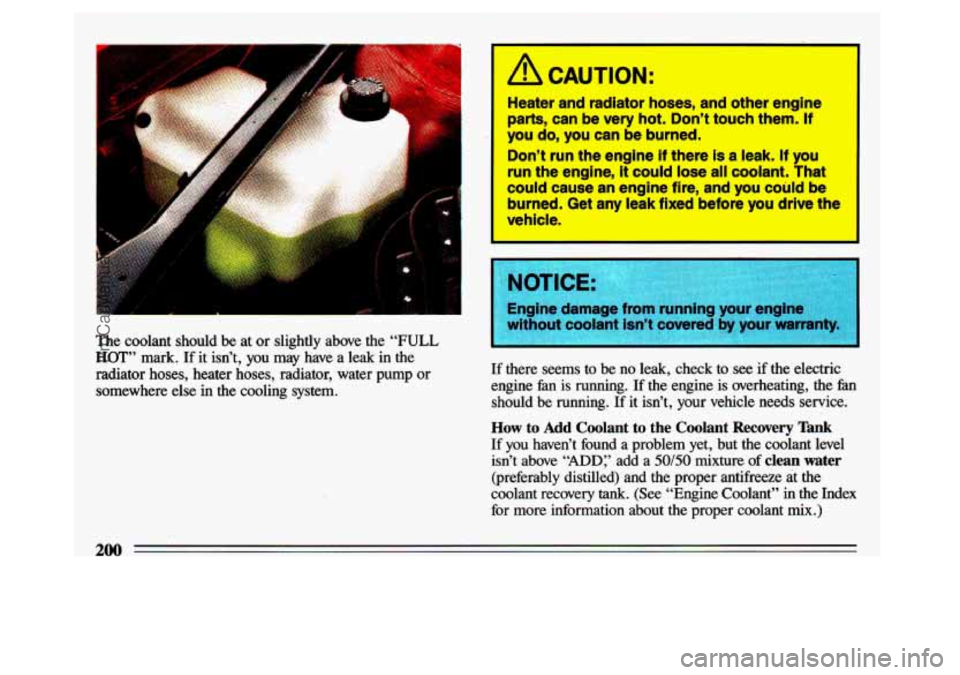
The coolant should be at or slightly above the “FULL
HOT” mark. If it isn’t, you may have a leak in the
radiator hoses, heater hoses, radiator, water pump or
somewhere else in the cooling system.
A CAUTION:
Heater and radiator hoses, and other engine
parts, can be very
hot. Don’t touch them. If
you
do, you can be burned.
Don’t
run the engine if there __ a leak. If you
run the engine, it could lose all coolant. That
could cause an engine fire, and you could be
burned. Get any leak fixed before you drive the
vehicle.
If there seems to be no leak, check to see if the electric
engine
fan is running. If the engine is overheating, the fhn
should
be running. If it isn’t, your vehicle needs service.
How to Add Coolant to the Coolant Recovery Tl[)ank
If you haven’t found a problem yet, but the coolant level
isn’t above
“ADD:’ add a 50/50 mixture of clean water
(preferably distilled) and the proper antifreeze at the
coolant recovery
tank. (See “Engine Coolant” in the Index
for more information about the proper coolant mix.)
200
ProCarManuals.com
Page 241 of 324
Engine Coolant
The following explains your cooling system and how to
add coolant when it is low.
If you have a problem with
engine overheating, see “Engine Overheating” in the Index. \
The proper coolant for your Buick will:
Give freezing protection down to -34°F (-37°C).
Give boiling protection up to 262” F (128” C).
Protect against rust and corrosion.
Help keep the proper engine temperature.
Let the warning lights work as they should.
What to Use: Use a mixture of one-half clean water
(preferably distilled) and one-half antifreeze that meets
“GM Specification 1825-Mi’ which won’t damage
aluminum parts. You can also use a recycled coolant
conforming to GM Specification 1825-M with a complete
coolant flush
and refill. Use GM Engine Coolant
Supplement
(sealer) with any complete coolant change. If
you use these, you don’t need to add anything else.
I
A CAUTION:
Adding only plain water to your coollng system
can
be dangerous. Plain water, or some other
liquid
like alcohol, can boil before the proper
coolant mix will. Mur vehicle’s coolant
warning system
Is set for the proper coolant
mix. With plain water or the wrong mlx, your
engine could get too hot but you wouldn’t get
the overheat warning. bur engine could catch
fire and you or others’could be burned. Use a
50/50 mPx of clean water and a proper
antifreeze.
I
: warranty. Too much
l
and crack t
other parts
239
ProCarManuals.com
Page 253 of 324
n
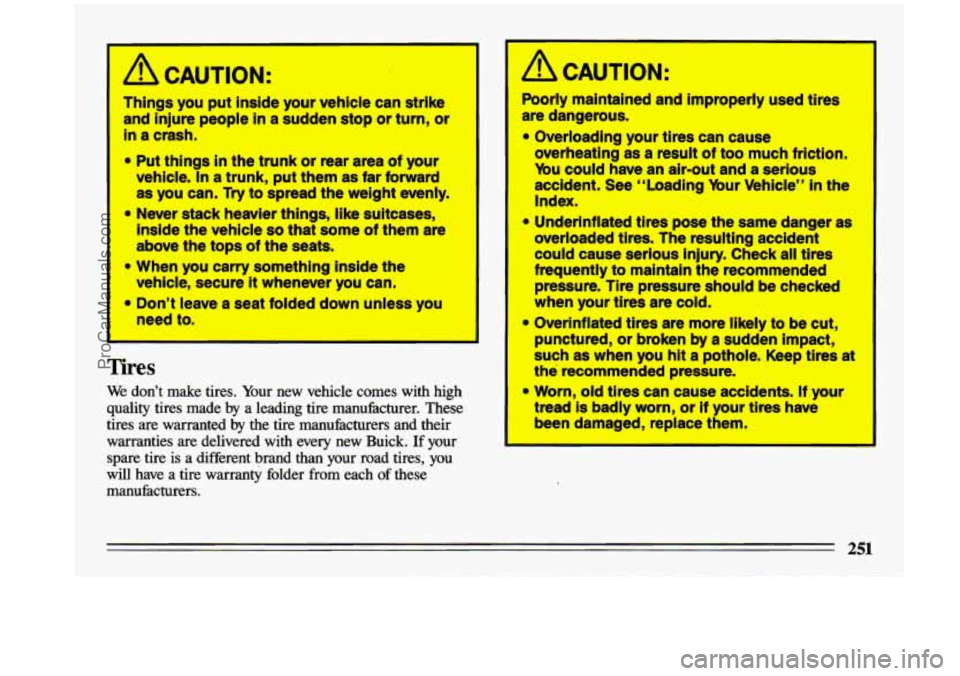
ACAUTION:
Things you put inside your vehicle can strike
and injure people
in a sudden stop or turn, or
In a crash.
* Put things In the trunk or rear area of your
vehicle. In
a trunk, put them as far forward
as you can. Try to spread the weight evenly.
* Never stack heavier things, IPke suitcases,
inside the vehicle
so that some of them are
above the tops
of the seats.
* When you carry something inside the
vehicle, secure
it whenever you can.
* Don’t leave a seat folded down unless you
need to.
Tires
We don’t make tires. Your new vehicle comes with high
quality tires made
by a leading tire manufacturer. These
tires are warranted by the tire manufacturers and their
warranties are delivered with every new Buick. If your spare tire is a different brand than your road tires, you
will have a tire warranty folder from each
of these
manufacturers.
A CAUTION:
Poorly maintained and improperly used tires
are dangerous.
0 Overloading your tires can cause
overheating as a ngsult
of too much friction.
Mu could
have an air-out and a serious
accident.
See “Loading bur Vehicle” in the
Index.
* Underlnflated tires pose the same danger as
overloaded tires. The resulting accident
could cause serious injury. Check
all tires
frequently to maintain the recornmended
pressure. Tire pressure should
be checked
when your tires are cold.
* Overinflated tires are more likely to be cut,
punctured, or broken
by a sudden Impact,
such as when you
hit a pothole. Keep tires at
the recommended pressure.
tread
Is badly worn, or If your tlps have
been damaged, replace them.
* Worn, old tires can cause accidents. If your
251
ProCarManuals.com
Page 312 of 324
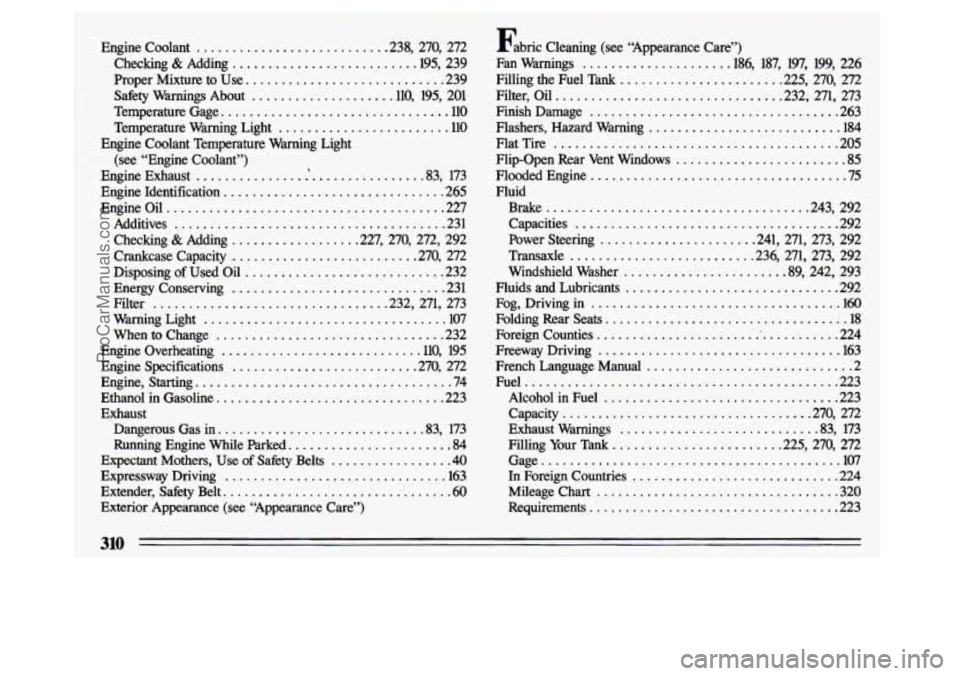
Engine Coolant .......................... .238. 270. 272
Checking
& Adding ......................... .l95. 239
Proper Mixture
to Use ............................ 239
Safety Warnings About
.................... 110. 195. 201
Temperature Gage
................................ 110
Temperature Warning Light
........................ 110
(see “Engine Coolant”)
Engine Coolant Temperature Warning Light
Engine Exhaust
................................ .83. 173
Engine Identification
.............................. -265
Engineoil
....................................... 227
Additives
...................................... 231
Checking
& Adding ................. .227. 270. 272. 292
Crankcase Capacity
.......................... .270. 272
Energy Conserving
.............................. 231
Warning Light
.................................. 107
When to Change
................................ 232
Engine Specifications
......................... .270. 272
Engine. Starting
.................................... 74
Ethanol in Gasoline.
............................... 223
Exhaust Dangerous Gas
in ............................ .83. 173’
Expectant Mothers. Use
of Safety Belts ................. 40
Expressway Driving
............................... 163
Extender. Safety Belt
................................ 60
Disposing of Used Oil ............................ 232
Filter
................................. 232.271. 273
Engine Overheating
............................ 110. 195
Running Engine While Parked
....................... 84
Exterior Appearance (see “Appearance Care”) Fabric
cleaning
(see ‘%Appearance care”)
Fan Warnings
.................... .186. 187. 197. 199. 226
Filling the Fuel Tank
...................... .225. 270. 272
Filter. Oil
................................ 232.271. 273
Finish Damage
................................... 263
Flashers. Hazard Warning
........................... 184
Flat Tire
........................................ 205
Flip-Open Rear Vent Windows
........................ 85
Flooded Engine
.................................... 75
Capacities
..................................... 292
Power Steering
..................... .241. 271. 273. 292
Transaxle
......................... .236. 271. 273. 292
Windshield Washer
...................... .89. 242. 293
Fluids and Lubricants
.............................. 292
Fog. Driving
in ................................... 160
FoldingRearSeats .................................. 18
Freeway Driving
.................................. 163
French Language Manual
............................. 2
Fluid
Brake
..................................... 243. 292
Foreign Counties
.................................... 224
Fuel
............................................ 223
AlcoholinFuel
................................. 223
Capacity
................................... 270. 272
Exhaust Warnings
........................... .83. 173
Filling Your Tank
....................... .225. 270. 272
In Foreign Countries
............................. 224
Mileage Chart
.................................. 320
Gage
.......................................... 107
Requirements . ................................... 223
310
ProCarManuals.com