turn signal BUICK CENTURY 1993 Owners Manual
[x] Cancel search | Manufacturer: BUICK, Model Year: 1993, Model line: CENTURY, Model: BUICK CENTURY 1993Pages: 324, PDF Size: 17.58 MB
Page 14 of 324
I
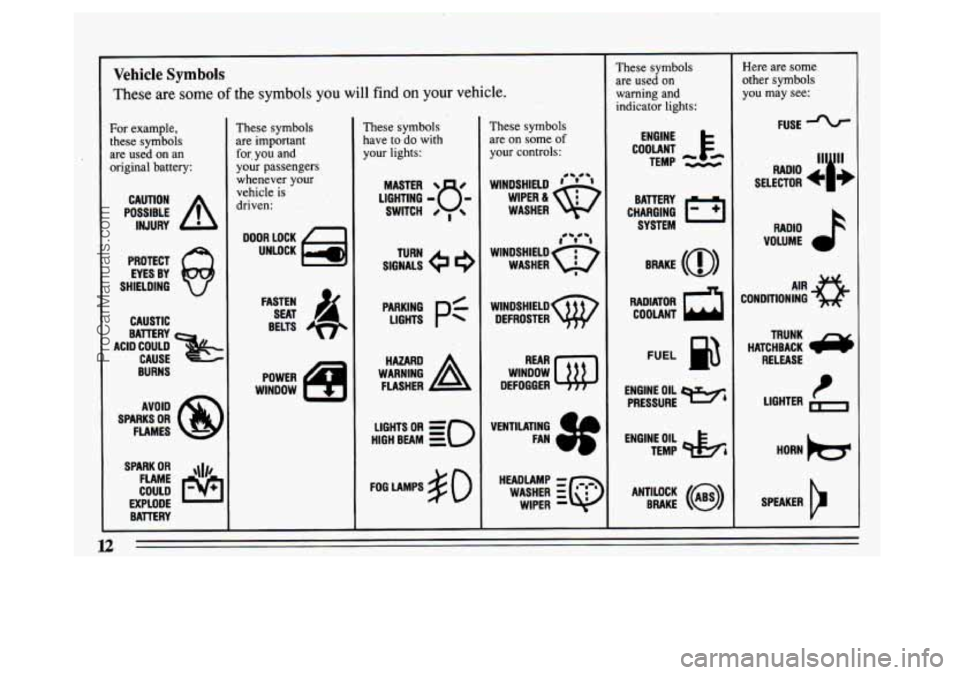
Vehicle Symbols
These are some of the symbols you will find on your vehicle.
For example,
these symbols
are used on an
original battery:
POSSIBLE A
CAUTION
INJURY
PROTECT EYES BY
SHIELDING
CAUSTIC
ACID COULD CAUSE
BATTERY
BURNS AVOID
SPARKS
OR
FLAMES
SPARK
OR ,111,
COULD FLAME
EXPLODE BATTERY
These symbols
are important
for. you and
your passengers
whenever your
vehicle
is
driven:
DOOR LOCK
UNLOCK
FASTEN SEAT
4
BELTS
POWER
WINDOW
These symbols
have
to do with
your lights:
SIGNALS e3
TURN
WARNING
A
HAZARD
FLASHER
HIGH BEAM
OR =, =o
FOG LAMPS # 0
These symbols
are on some
of
your controls:
WINDSHIELD ' ' ' 0- 0-
WIPER &
WASHER
t0 @e4 i
WINDSHIELD=
WASHER I
wlNDsHIELDw DEFROSTER
WINDOW
@
REAR
DEFOGGER
VENTILATING FAN
HEADLAMP
-
WIPER -
WASHER zQ
Thes, ,ymbols
are used on
warning and indicator lights:
COOLANT F-
ENGINE
TEMP
--
CHARGING I-1
BATTERY SYSTEM
FUEL
ENGINE OIL wb
PRESSURE
TEMP
OIL &
ANTILOCK BRAKE (i)
Here are some
other symbols
you may see:
FUSE
RADIO
k
VOLUME a
CONDITIONING AIR a
HATCHBACK e
TRUNK
RELEASE
SPEAKER
b
ProCarManuals.com
Page 65 of 324

n
part 2 Features and Controls
Here you can learn about the many standard and optional features on your Buick. and informat\
ion on starting.
shifting and braking . Also explained are the instrument panel and the warning systems that tell you if everything
is working properly-and what to do if you have a problem .
Part 2 includes:
Keys ........................................................................\
........
Locks ........................................................................\
...... 65
Remote Keyless Entry System ........................................................... 66
New Vehicle Break-In ................................................................. 72
Ignition ........................................................................\
..... 73
Starting Your Engine .................................................................. 74
Shifting the Transaxle ........................................... : ..................... 77
parking Brake ........................................................................\
80
ShiftingIntoPark ..................................................................... 81
Windows ........................................................................\
... 84
Horn ........................................................................\
....... 86
TiltSteeringWheel ................................................................... 86
Turn Signal/Headlight Beam Lever ....................................................... 86
Windshield Wipers, Washer ........................................................... 88
CruiseControl ..................................................................... 91
InteriorLights ....................................................................... \
95
Headlights ........................................................................\
.. 95
Mirrors ........................................................................\
..... 98
Instrument Panel ..................................................................... 105
Warning Lights, Gages and Indicators .................................................. 106
63
ProCarManuals.com
Page 69 of 324
Should interference to this system occur, try this:
Check to determine if battery replacement is necessary. See
the instructions on battery replacement later in this section.
Check the distance. You may be too far from your
vehicle. This product has
a maximum range.
Check the location. Other vehicles or objects may be
blocking the signal.
See your Buick dealer or a qualified technician for
service.
Changes or modifications to this system by other than an
authorized service facility could void authorization to use
this equipment.
Operation
The driver’s door will unlock and the interior lights will
go on when “UNLOCK’ is pressed. If pressed again
within five seconds, all doors will unlock. The interior
lights will
go out after 40 seconds or when you turn on
the ignition.
All doors will lock when “DOOR” is pressed.
The trunk or liftgate will unlock when the opened trunk
symbol is pressed, but only when the transaxle is in
“P”
(Park). On the wagon the ignition must also be in the
“Off” position.
Matching Transmitter(s) to Your Vehicle
Each key chain transmitter is coded to prevent another
transmitter from unlocking your vehicle.
If a transmitter
is lost or stolen, a replacement can be purchased through
your dealer. Remember to bring the remaining
transmitter with you when you
go to your dealer. When
the dealer matches the replacement transmitter to your
vehicle, the remaining transmitter must also be matched. Once the new transmitter is coded, the lost transmitter
will not unlock your vehicle.
You can match a transmitter to as many different vehicles
as you own, provided they are equipped with
exactly the
same model system.
(General Motors offers several
different models of these systems on their vehicles.) Each
vehicle can have only two transmitters matched to it. See
your dealer to match transmitters to another vehicle.
Battery Replacement
Under normal use, the batteries in your key chain
transmitter should last about
two years.
You can tell the batteries are weak if the transmitter won’t
work at the normal range in any location.
If you have to
get
close to your vehicle before the transmitter works, it’s
probably time to change the batteries.
ProCarManuals.com
Page 88 of 324
Horn
You can sound the horn by pressing the horn symbol on
your steering wheel.
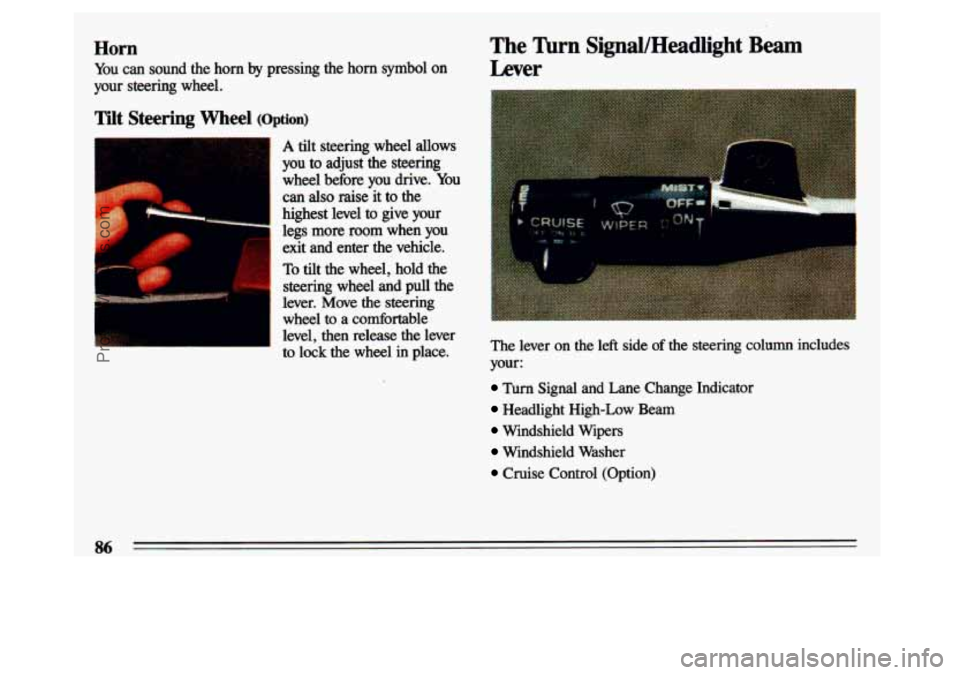
Tilt Steering Wheel (Option)
b
-.
A tilt steering wheel allows
you
to adjust the steering
wheel before you drive. You
can
also raise it to the
highest level
to give your
legs more room when you
exit and enter the vehicle.
To tilt the wheel, hold the
steering wheel and pull the
lever. Move the steering
wheel to a comfortable
level, then release the lever
to lock the wheel in place.
The I’urn SignaUHeadlight Beam
Lever
The lever on the left side of the steering column includes
your:
Turn Signal and Lane Change Indicator
Headlight High-Low Beam
Windshield Wipers
Windshield Washer
Cruise Control (Option)
86
ProCarManuals.com
Page 89 of 324
Turn Signal and Lane Change Indicator
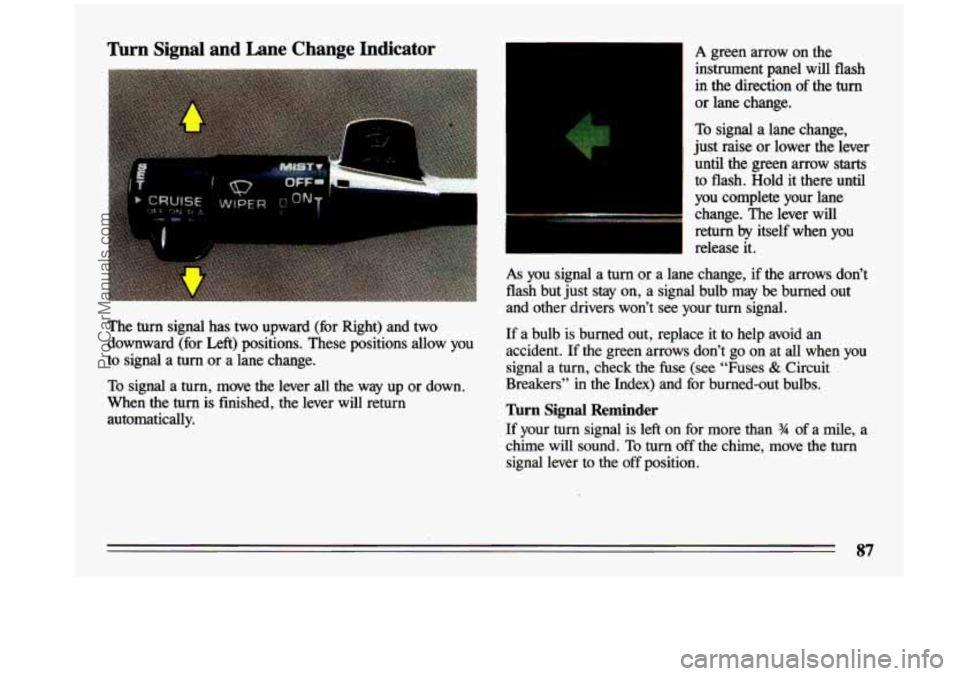
The turn signal has two upward (for Right) and two
downward (for Left) positions. These positions allow you
to signal a turn or a lane change.
To signal a turn, move the lever all the way up or down.
When the turn is finished, the lever will return
automatically.
A green arrow on the
instrument panel will flash
in the direction of the turn
or lane change.
To signal a lane change,
just raise or lower the lever
until the green arrow
starts
to flash. Hold it there until
you complete your lane
change. The lever will
return by itself when you
release it.
As you signal a turn or a lane change, if the arrows don’t
flash but just
stay on, a signal bulb may be burned out
and other drivers won’t
see your turn signal.
If a bulb
is burned out, replace it to help avoid an
accident. If the green arrows don’t go on at all when you
signal a turn, check the
fuse (see “Fuses 8z Circuit
Breakers” in the Index) and for burned-out bulbs.
Turn Signal Reminder
If your turn signal is left on for more than % of a mile, a
chime will sound.
To turn off the chime, move the turn
signal lever to the off position.
ProCarManuals.com
Page 90 of 324
Headlight Highhw Beam Windshield Wipers
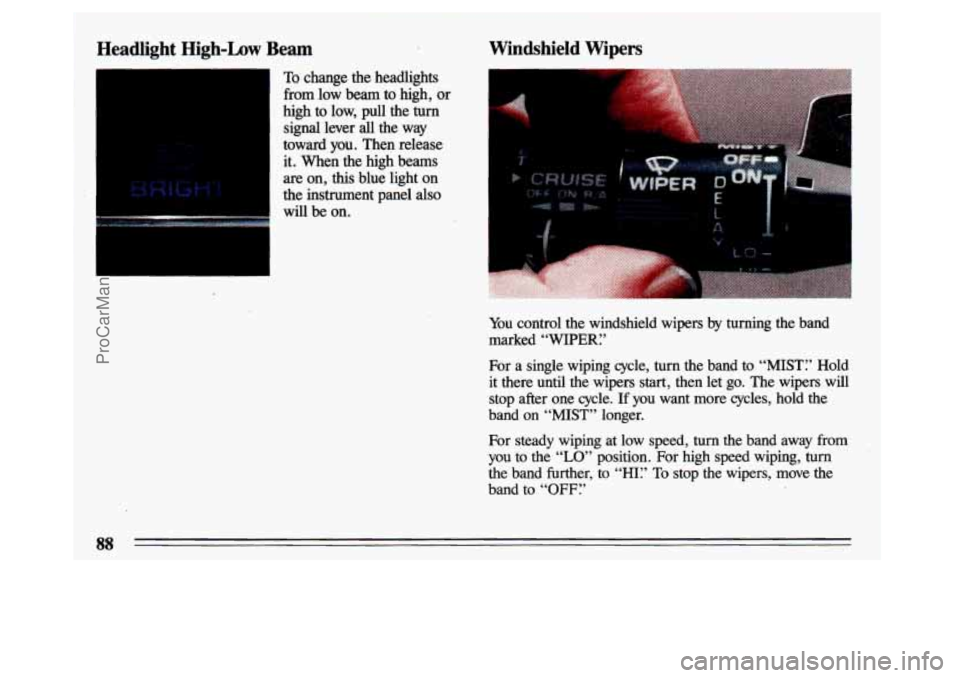
To change the headlights
from low beam to high, or
high to low, pull the
turn
signal lever all the way
toward
you. Then release
it. When the high beams
are on,
.this blue light on
the instrument panel also will be on.
i
I
You control the windshield wipers by turging the band
marked
“WIPERI’
For a single wiping cycle, turn the band to “MIST? Hold it there until the wipers
start, then let go. The wipers will
stop after one cycle.
If you want more cycles, hold the
band on “MIST” longer.
For steady wiping at low speed,
turn the band away from
YOU to the “LO” position. For high speed wiping, turn
the band further, to “HI? To stop the wipers, move the
band to “OFF?
88 .I
ProCarManuals.com
Page 91 of 324
Low Speed Delay Wipers (Option)
You can set the wiper speed for a long or short delay
between wipes.
‘ms can be very useful in light rain or
snow.
Turn the band to choose the delay time. The closer
to
“LO:’ the shorter the delay.
If you push the paddle less than one second, washer fluid
will spray three to four times while the wiper blades
cycle.
If you push the paddle longer than one second,
washer fluid will spray as long
as the paddle is held.
When you release the paddle, the wiper blades will cycle
I
- .I - three to four more times. 1
A CAUTION:
I If you have the standard wipers, the wipers will keep
going
in “LO” until you turn the wiper control to -
“OFF.” Damaged wiper blades may prevent you’irom
seeing well enough to drive safely.
To avoid If you have the optional low speed delay wipers, the
damage, be sure to clear ice and snow from wipers will clear the window and then either stop or
the wiper blades before using them. If they’re
frozen to the windshield, carefully loosen or
thaw them.
If your blades do become b 1.
-
return to your preset speed.
I damaged, gefnew blades or blade inserts.
I
Heavy snow or ice can overload your wipers. A circuit
breaker in the motor will
stop them until the motor cools.
Clear away snow or ice to prevent an overload.
Windshield Washer
At the top of the turn signal/headlight beam lever there’s
a paddle with the word “PUSH”
on it. To spray washer
fluid on the windshield, push the paddle.
a Driving without washer fluid can be dangerous.
A bad mud splash can block your vislon. ybu
could hit another vehicle or go off the mad.
Check your washer fluid level often.
* In freezing weather, don’t use your washer
untll the windshield is warmed. Otherwim
the washer fluid
can form ice on the
windshield, blocking
put vision.
ProCarManuals.com
Page 108 of 324
Speedometer and Odometer
Your speedometer lets you see your speed in both miles per
hour (mph) and kilometers per hour (ludh). Your odometer
shows how
fkr your vehicle has been driven, in either
miles (used
in the U.S.) or kilometers (used in Canada).
Your Buick has a “tamper-resistant odometer? If you can
see silver lines between the numbers, probably someone
has
tried to turn it back. The numbers may not be true.
You
may wonder what happens if a vehicle has to have a
new odometer installed. If possible, the new one has to
be set to the same reading the old one had. If it can’t \
be,
then it’s set at zero, but a label on the driver’s door\
must show the old reading and when the new one was installed.
Trip Odometer
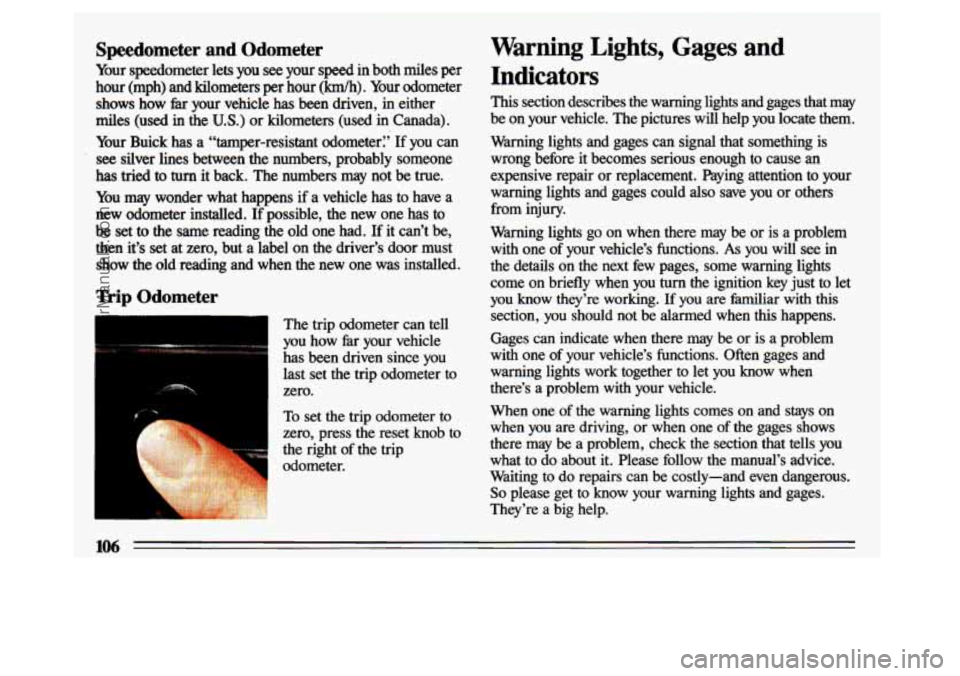
The trip odometer can tell
you how
far your vehicle
has been driven since you last set the trip odometer to
zero.
To set the trip odometer to
zero, press the reset knob to
the right of the trip
odometer.
Warning Lights, Gages and
Indicators
This section describes the warning lights and gages that may
be on your vehicle. The pictures will help you locate them.
Warning lights and gages can signal that something is
wrong before it becomes serious enough to cause an
expensive repair or replacement. Paying attention to your
warning lights and gages could
also save you or others
from injury.
Warning lights go on when there may be or is a problem
with one
of your vehicle’s functions. As you will see in
the details on the next few pages, some warning lights
come on briefly when you
turn the ignition key just to let
you know they’re working. If you are familiar with this
section, you should not be alarmed when this happens.
Gages can indicate when there may be or is a problem
with one of your vehicle’s functions. Often gages and
warning lights work together to let you know when
there’s a problem with your vehicle.
When one of the warning lights comes on and stays on
when you are driving, or when one of the gages shows
there may be a problem, check the section that tells you
what to do about it. Please follow the manual’s advice.
Waiting to do repairs can be costly-and even dangerous.
So please get to know your warning lights and gages.
They’re a big help.
ProCarManuals.com
Page 143 of 324
x
I I
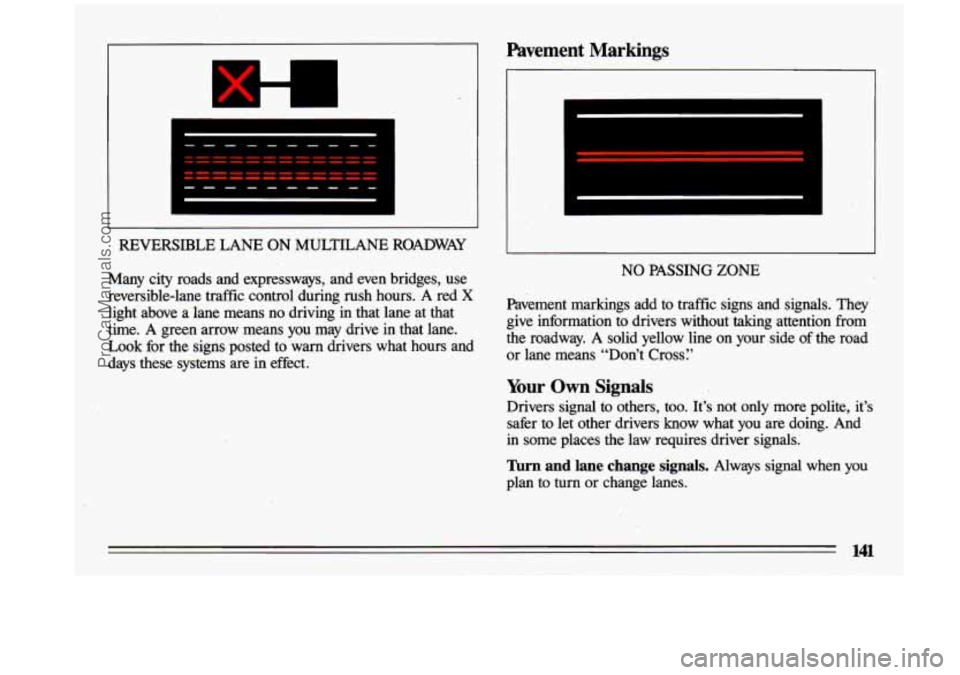
REVERSIBLE LANE ON MULTILANE ROADWAY
Many city roads and expressways, and even bridges, use
reversible-lane traffic control during rush hours. A red
X
light above a lane means no driving in that lane at that
time. A green arrow means you may drive in that lane.
Look for the signs posted to warn drivers what hours and
days these systems are in effect.
Pavement Markings
NO PASSING ZONE
Pavement markings add to traffic signs and signals. They
give information to drivers without taking attention from
the roadway. A solid yellow line on your side
of the road
or lane means “Don’t Cross:’
Your Own Signals
Drivers signal to others, too. It’s not only more polite, it’s
safer to let other drivers know what you are doing. And
in some places the law requires driver signals.
Turn and lane change signals. Always signal when you
plan to turn or change lanes.
141
ProCarManuals.com
Page 144 of 324
If necessary, you can use hand signals out the window:
Left arm straight out for a left turn, down for slow or
about-to-stop, and up
for a right turn.
Slowing down. If time allows, tap the brake pedal once
or twice in advance of slowing
or stopping. This warns
the driver behind you.
Disabled. Your four-way flashers signal that your vehicle
is disabled or is a hazard.
See “Hazard Warning
Flashers’’ in the Index.
Traffic Officer
The traffic police officer is also a source of important
information. The officer’s signals govern, no matter what
the traffic lights or other signs say.
The next section discusses some
of the road conditions
you may encounter.
Defensive Driving
The best advice anyone can give about driving is: Drive
defensively.
Please
start with a very important sakty device in your Buick:
Buckle up.
(See “Safety Belts” in the Index.)
Defensive driving really means “be ready for anything:’
On city streets, rural roads, or freeways, it means
“always expect the unexpected:’ Assume that pedestrians
or other drivers are going to be
careless and make mistakes. Anticipate what they might
do. Be ready for their mistakes.
Expect children to dash out from behind parked cars,
often followed by other children. Expect occupants in
parked cars to open doors into traffic. Watch for movement
in parked cars-someone may be about to open
a door.
Expect other drivers to run stop signs when you are on a
through street. Be ready to brake
if necessary as you go
through intersections. You may not have to use the brake,
but if you do, you will be ready.
If you’re driving through a shopping center parking lot
where there are well-marked lanes, directional mows,
and designated parking areas, expect some drivers to
ignore
all these markings and dash straight toward one
part of the lot.
Pedestrians can be careless. Watch for them. In general,
you must give way to pedestrians even if you
know you
have the right of way.
Rear-end collisions
are about the most preventable of
accidents. Yet they are common. Allow enough following
distance. It’s the best defensive driving maneuver, in both
city and rural driving. You never know when the vehicle
in front of you is going
to brake or turn suddenly.
Here’s a final bit of information about defensive driving.
The most dangerous time for driving in the
U.S. is very
142
ProCarManuals.com