steering BUICK CENTURY 1994 Owner's Manual
[x] Cancel search | Manufacturer: BUICK, Model Year: 1994, Model line: CENTURY, Model: BUICK CENTURY 1994Pages: 308, PDF Size: 16.3 MB
Page 195 of 308
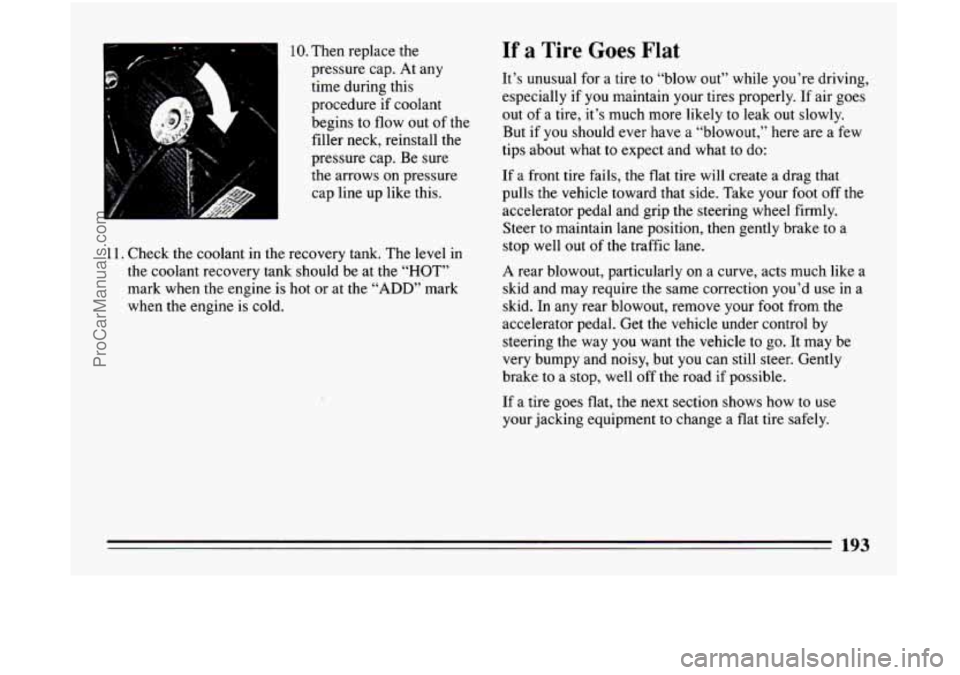
10. Then replace the
pressure cap. At any
time during this
procedure if coolant
begins to flow
out of the
filler neck, reinstall the
pressure cap. Be sure
the arrows on pressure cap line up like this.
11. Check the coolant in the recovery tank. The level in
the coolant recovery tank should be at the
“HOT”
mark when the engine is hot or at the “ADD” mark
when the engine
is cold.
If a Tire Goes Flat
It’s unusual for a tire to “blow out” while you’re driving,
especially
if you maintain your tires properly. If air goes
out
of a tire, it’s much more likely to leak out slowly.
But if you should ever have a “blowout,” here are
a few
tips about what
to expect and what to do:
If a front tire fails, the flat tire will create a drag that
pulls the vehicle toward that side. Take your
foot off the
accelerator pedal and grip the steering wheel firmly.
Steer to maintain lane position, then gently brake to a
stop well out
of the traffic lane.
A rear blowout, particularly on a curve, acts much like a
skid and may require the same correction you’d use in a
skid.
In any rear blowout, remove your foot from the
accelerator pedal. Get the vehicle under control by
steering the way
you want the vehicle to go. It may be
very bumpy and noisy, but
you can still steer. Gently
brake to
a stop, well off the road if possible.
If a tire goes flat, the next section shows how to use
your jacking equipment to change a flat tire safely.
193
ProCarManuals.com
Page 208 of 308
If You’re Stuck: In Sand, Mud, Ice or
Snow
What you don’t want to do when your vehicle is stuck is
to spin your wheels. The method known as “rocking”
can help you get out when you’re stuck, but you must
use caution.
I NOTICE:
Spinning your wheels can destroy parts of your
vehicle as well as the tires. If you spin the wheels
too fast while shifting your transaxle back and
forth, you can destroy your transaxle.
Rocking your vehicle to get it out:
First, turn your steering wheel left and right. That will
clear the area around your front wheels. Then shift back
and forth between
“R” (Reverse) and a forward gear,
spinning the wheels as little
as possible. Release the
accelerator pedal while you shift, and press lightly on
the accelerator pedal when
the transaxle is in gear. If
that doesn’t get you out after a few tries, you may need
to be towed
out. If you do need to be towed out, see
“Towing Your Buick”
in the Index.
206
ProCarManuals.com
Page 209 of 308
.
@) Part 6 Service and Appearance Care
~ ~~~~~
Here you will find information about the care of your Buick . This part begins with service and fuel information.
and then
it shows how to check important fluid and lubricant levels . There is also technical information about your
vehicle. and a section devoted to its appearance care
.
Part 6 includes:
Service ........................................................................\
..
Fuel ........................................................................\
.....
HoodRelease .....................................................................
EngineOil ....................................................................... \
Aircleaner ....................................................................... \
TransaxleFluid ....................................................................
Enginecoolant ....................................................................
Powersteering ....................................................................
Windshield Washer Fluid ............................................................
Brakes ........................................................................\
...
Battery ........................................................................\
..
BulbReplacement .................................................................
LoadingYourVehicle ...............................................................
Tires ........................................................................\
....
Appearancecare ..................................................................
Vehicle Identification Number (VIN) ..................................................
Fuses and Circuit Breakers ...........................................................
ReplacementBulbs .................................................................
Capacities and Specifications .........................................................
208
209
212
213 218
220
223
226
227
228
231
232
236 238
245
253
254 258
259
207
ProCarManuals.com
Page 228 of 308
Radiator Pressure Cap
I NOTICE:
Your radiator cap is a 15 psi (105 kPa)
pressure-type cap and must be tightly installed
to prevent coolant
loss and possible engine
damage from overheating. Be sure the arrows on
the cap line up with the overflow tube on the radiator filler neck.
When you replace your radiator pressure cap, an AC@
cap is recommended.
Thermostat
Engine coolant temperature is controlled by a thermostat
in the engine coolant system. The thermostat stops the
flow
of coolant through the radiator until the coolant
reaches a preset temperature.
When
you replace your thermostat, an AC@ thermostat
is recommended.
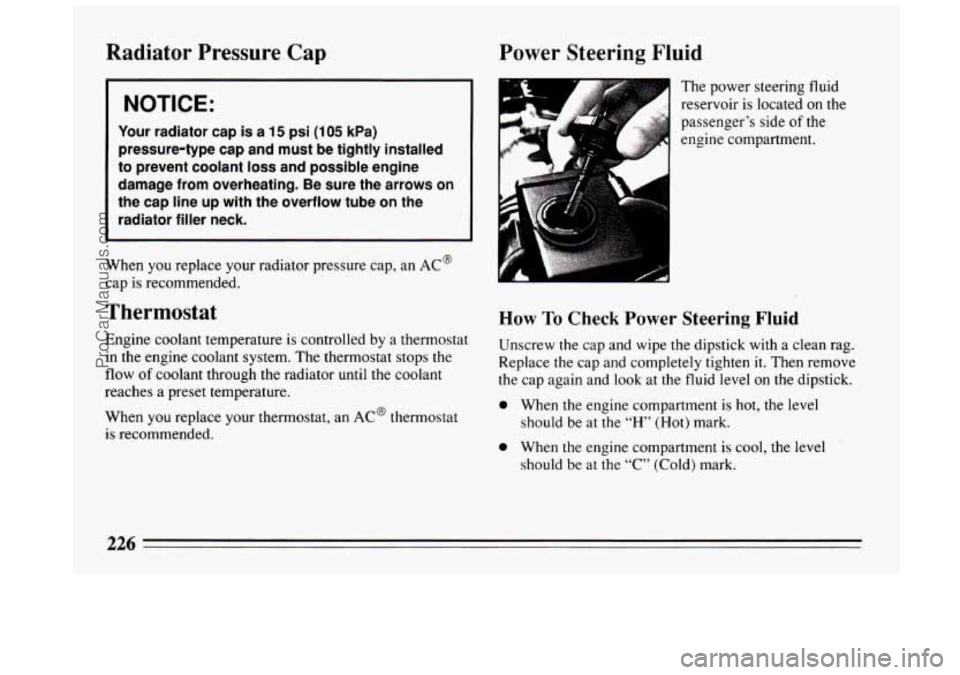
Power Steering Fluid
The power steering fluid
reservoir
is located on the
passenger’s side
of the
engine compartment.
How To Check Power Steering Fluid
Unscrew the cap and wipe the dipstick with a clean rag.
Replace the cap and completely tighten it. Then remove
the cap again and look at the fluid level
on the dipstick.
0 When the engine compartment is hot, the level
should be at the
“H” (Hot) mark.
0 When the engine compartment is cool, the level
should be at the “C” (Cold) mark.
ProCarManuals.com
Page 229 of 308
What to Add
Refer to the Maintenance Schedule to determine what
kind
of fluid to use. See “Recommended Fluids and
Lubricants” in the Index.
NOTICE:
When adding power steering fluid or making a
complete fluid change, always use the proper
fluid. Failure to use the proper fluid can cause
leaks and damage hoses and seals.
Windshield Washer Fluid
To Add
- a
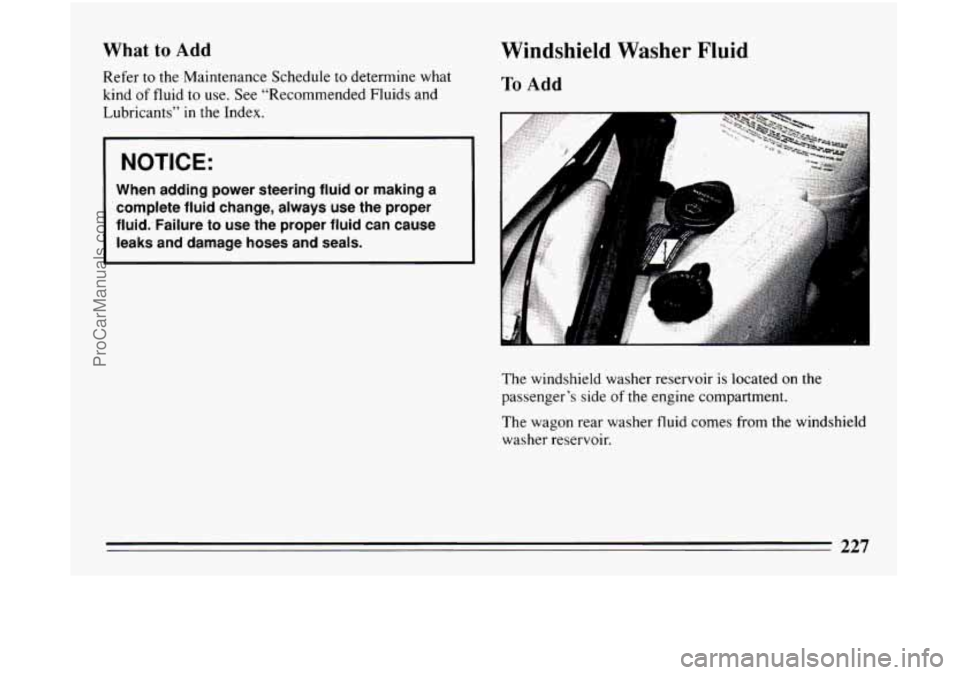
The windshield washer reservoir is located on the
passenger’s side
of the engine compartment.
The wagon rear washer fluid comes from the windshield
washer reservoir.
227
ProCarManuals.com
Page 272 of 308
Explanation of Scheduled Maintenance
Services
Below are explanations of the services listed in Schedule
I and Schedule
11.
The proper fluids and lubricants to use are listed in
Section D. Make sure whoever services your vehicle uses
these. All parts should
be replaced and all necessary
repairs done before you or anyone else drives the vehicle.
NOTE: To determine your engine’s displacement and
code, see “Engine Identification” in the Index.
1. Engine Oil and Filter Change* -- Always use SH
or SG Energy Conserving I1 oils of proper viscosity.
The
“SH or SG’ designation may be shown alone or
in combination with others, such as “SH/CD’ or
“SH, SG, CD,” “SG/CD,”etc. To determine the
preferred viscosity for your vehicle’s engine (e.g.,
SAE 5W-30 or SAE 10W-30), see “Engine Oil” in
the Index.
2. Chassis Lubrication -- Lubricate the transaxle shift
linkage, parking brake cable guides, underbody
contact points and linkage. If your vehicle is equipped with grease fittings, lubricate the suspension and steering linkage. 3.
Tire and Wheel Rotation and Inspection -- For
proper wear and maximum tire life, rotate your tires
following the instructions in this manual. See “Tires,
Inspection
& Rotation” in the Index. Check the tires
for uneven wear or damage. If you see irregular or
premature wear, check the wheel alignment. Check
for damaged wheels also.
4. Engine Accessory Drive Belt(s) Inspection --
Inspect the belt(s) for cracks, fraying, wear and
proper tension. Replace as needed.
5. Cooling System Service* -- Drain, flush and refill
the system with new or approved recycled coolant
conforming to GM Specification 1825M. Keep coolant
at the proper mixture as specified.
See “Coolant” in the
Index.
This provides proper freeze protection and boil
protection, corrosion inhibitor level and maintain
proper engine operating temperature.
Inspect hoses and replace if they are cracked,
swollen or deteriorated. Tighten screw type hose
clamps. Clean the outside of the radiator and air
conditioning condenser. Wash the pressure cap and
neck
To help ensure proper operation, we recommend a
pressure test
of both the cooling system and the
pressure cap.
270
ProCarManuals.com
Page 276 of 308
WHAT TO DO
Steering Column brake set,
try to turn the key to “LOCK”
Lock While parked,
and with the parking
in each shift lever position.
0 The key should turn to “LOCK”
only when the shift lever is
in “P’
(Park).
The key should come out only in
“LOCK.”
CHECK OR
SERVICE
Parking Brake and
Automatic
Transaxle
“P’
(Park) Mechanism
Check
WHAT TO DO
CAUTION: When you are doing this
check, your vehicle could begin to
move. You or others could be injure&
and property could be damaged.
Make sure there is room in front of
your vehide in case it begins to roll.
Be ready to apply the regular brake
at once should the vehicle begin to
move.
Park on a fairly steep hill, with the
vehicle facing downhill. Keeping your
foot on
the regular brake, set the
parking brake.
0 To check the parking brake: With the
engine running and transaxle
in “N”
(Neutral), slowly remove foot
pressure from the regular brake
pedal.
Do this until the vehicle is
held by the parking brake only.
0 To check the “P’ (Park) mechanism’s
holding ability:
Shift to “P” (Park).
Then release all brakes.
274
ProCarManuals.com
Page 278 of 308
CHECK OR SERVICE
Steering, Suspension and
Front-Wheel-
Drive Axle Boot
and Seal
Inspection
Exhaust System
Inspection
Throttle Linkage
Inspection
WHAT TO DO
Inspect the front and rear suspension and
steering system
for damaged, loose or
missing parts, signs of wear, or lack of
lubrication. Inspect the power steering
lines and hoses for proper hookup,
binding, leaks, cracks, chafing, etc.
Clean and
then inspect the drive axle
boot seals
for damage, tears or leakage.
Replace seals if necessary.
Inspect the complete exhaust system.
Inspect the body near the exhaust
system. Look for broken, damaged,
missing or out-of-position parts as
well
as open seams, holes, loose connections,
or other conditions which could cause a
heat build-up
in the floor pan or could let
exhaust fumes into the vehicle. See
“Engine Exhaust”
in the Index.
Inspect the throttle linkage for
interference
or binding, and for
damaged
or missing parts. Replace
parts as needed.
CHECK OR
SERVICE
Brake System
Inspection
WHAT TO DO
Inspect the complete system. Inspect
brake lines and hoses for proper
hookup, binding, leaks, cracks,
chafing, etc. Inspect disc brake pads for
wear and rotors for surface condition.
Also inspect drum bmke linings for
wear and cracks. Inspect other brake
parts, including drums, wheel
cylinders, calipers, parking brake, etc.
Check parking brake adjustment.
You
may need to have your brakes inspected
more often if your driving habits or
conditions result
in frequent braking.
NOTE: A low brake fluid level can
indicate worn disc brake pads which
may need
to be serviced, Also, if the
brake system warning
light stays on or
comes on, something may be wrong
with the brake system. See “Brake
System Warning Light”
in the Index. If
your anti-lock brake system warning
light stays on, comes on
or flashes,
something may be wrong with
the
anti-lock brake system. See “Anti-Lock
Brake System Warning Light”
in the
Index.
276
ProCarManuals.com
Page 279 of 308
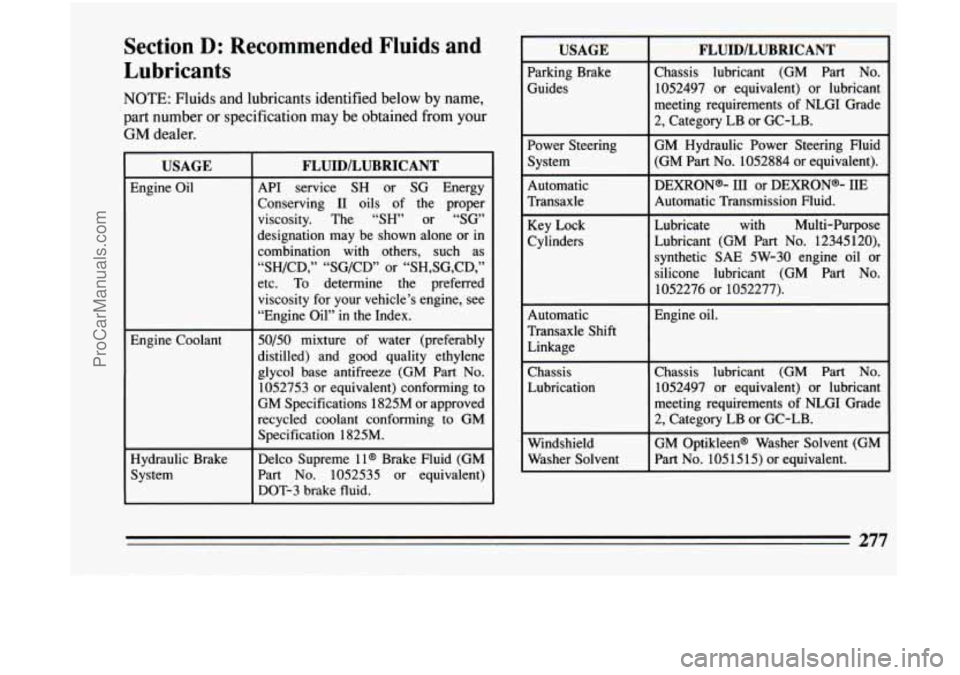
Section D: Recommended Fluids and
Lubricants
NOTE: Fluids and lubricants identified below by name,
part number
or specification may be obtained from your
GM dealer.
USAGE
Engine Oil
Engine Coolant
Hydraulic Brake
System
FLUID/LUBRICANT
API service SH or SG Energy
Conserving
I1 oils of the proper
viscosity. The
“SH” or “SG’
designation may be shown alone or in
combination with others, such as
“SH/CD,” “SG/CD’ or “SH,SG,CD,”
etc.
To determine the preferred
viscosity for your vehicle’s engine, see
“Engine Oil” in the Index.
50/50 mixture of water (preferably
distilled) and good quality ethylene
glycol base antifreeze (GM Part
No.
1052753 or equivalent) conforming to
GM Specifications 1825M or approved
recycled coolant conforming to GM
Specification 1825M.
Delco Supreme 11
Q Brake Fluid (GM
Part
No. 1052535 or equivalent)
DOT-3 brake fluid.
USAGE
Parking Brake
Guides
Power Steering
System
Automatic
Transaxle
Key Lock
Cylinders
Automatic
Transaxle Shift
Linkage
Chassis
Lubrication
Windshield
Washer Solvent
~ ~~~ - -_ - -~
FLUIDlLUBRICANT
Chassis lubricant (GM Part No.
1052497 or equivalent) or lubricant
meeting requirements of NLGI Grade
2, Category LB or GC-LB.
GM Hydraulic Power Steering Fluid
(GM Part
No. 1052884 or equivalent).
DEXRONQ- III or DEXRONB- IIE
Automatic Transmission Fluid.
Lubricate with Multi-Purpose
Lubricant (GM Part
No. 12345120),
synthetic SAE 5W-30 engine oil or
silicone lubricant (GM Part
No.
1052276 or 1052277).
Engine oil.
Chassis lubricant (GM Part
No.
1052497 or equivalent) or lubricant
meeting requirements of NLGI Grade
2, Category LB or GC-LB.
GM Optikleena Washer Solvent (GM
Part No. 1051515) or equivalent.
277
ProCarManuals.com
Page 293 of 308
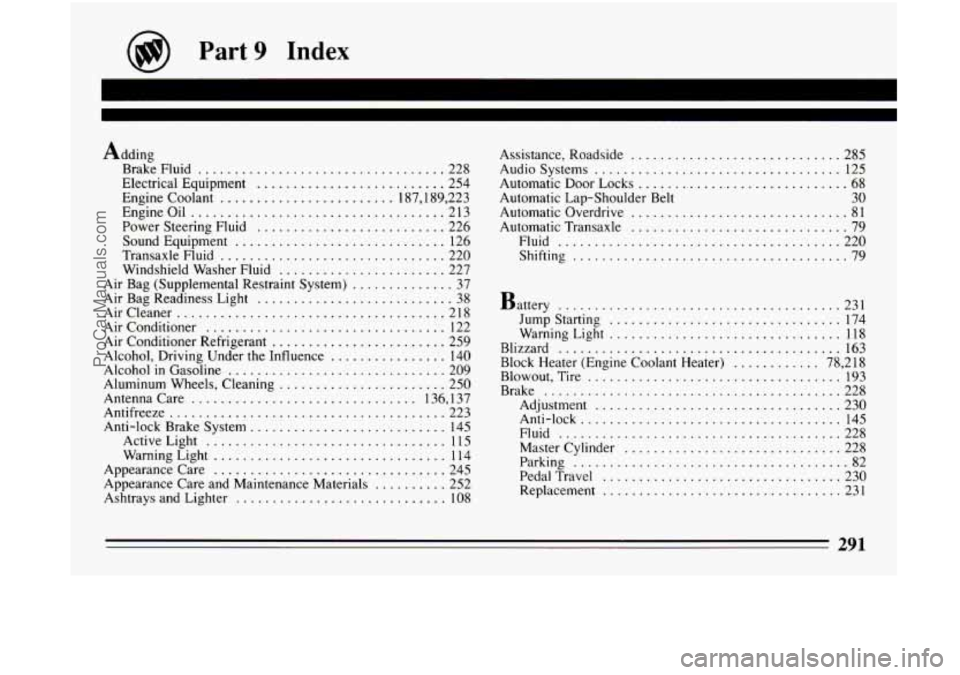
Part 9 Index
I-
.
Brake Fluid .................................. 228
Electrical Equipment
.......................... 254
Engine Coolant
........................ 187.189. 223
Engineoil
................................... 213
Power Steering Fluid
.......................... 226
Sound Equipment
............................. 126
Transaxle Fluid
............................... 220
Windshield Washer Fluid
....................... 227
Air Bag (Supplemental Restraint System)
.............. 37
Air Bag Readiness Light
........................... 38
Aircleaner
..................................... 218
Airconditioner
................................. 122
Air Conditioner Refrigerant
........................ 259
Alcohol. Driving Under the Influence
................ 140
Alcohol
in Gasoline .............................. 209
Aluminum Wheels. Cleaning
....................... 250
Antenna Care
............................... 136. 137
Antifreeze
...................................... 223
Anti-lock Brake System
........................... 145
Active Light
................................. 115
Warning Light
................................ 114
Appearance Care
............................... -245
Ashtrays and Lighter
............................. 108
Appearance Care and Maintenance Materials .......... 252 Assistance.
Roadside
............................. 285
Audio Systems
.................................. 125
Automatic Door Locks
............................. 68
Automatic Lap-Shoulder Belt
30
Automatic Overdrive .............................. 81
Automatic Transaxle
.............................. 79
Fluid
....................................... 220
Shifting
...................................... 79
Battery
....................................... 231
Jump Starting
................................ 174
Warning Light
................................ 118
Blizzard
....................................... 163
Blowout. Tire
................................... 193
Brake ......................................... 228
Adjustment
.................................. 230
Anti-lock
.................................... 145
Fluid
....................................... 228
Block
Heater (Engine Coolant Heater)
............ 78. 218
Master Cylinder
.............................. 228
Parking
...................................... 82
PedalTravel
................................. 230
Replacement
................................. 231
ProCarManuals.com