tow BUICK CENTURY 1994 Owner's Guide
[x] Cancel search | Manufacturer: BUICK, Model Year: 1994, Model line: CENTURY, Model: BUICK CENTURY 1994Pages: 308, PDF Size: 16.3 MB
Page 203 of 308
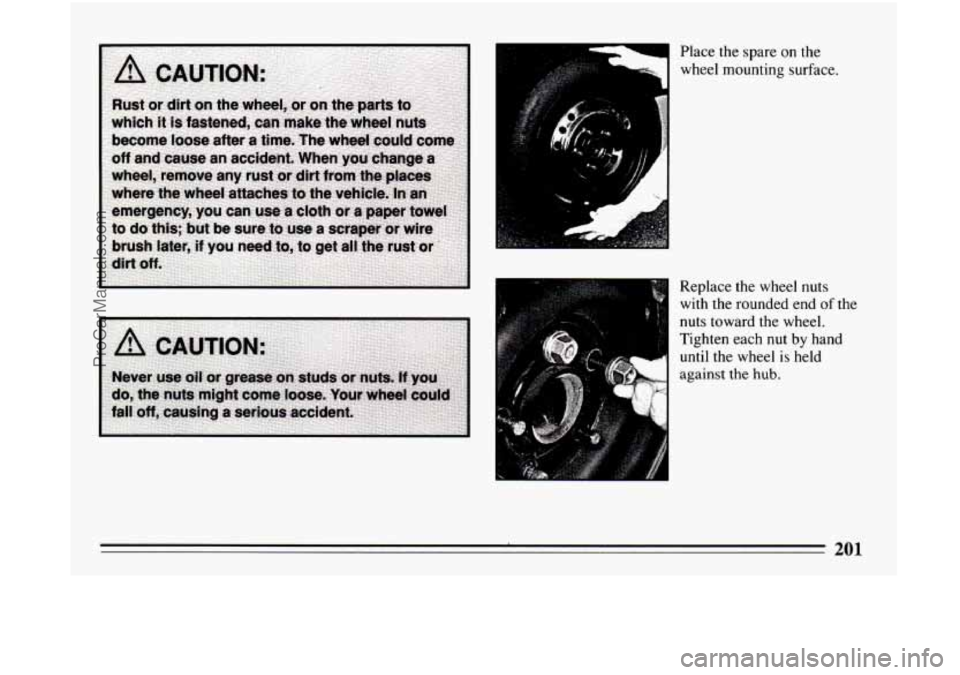
Place the spare on the
wheel mounting surface.
Replace the wheel nuts
with the rounded end
of the
nuts toward the wheel.
Tighten each
nut by hand
until the wheel
is held
against
the hub.
201
ProCarManuals.com
Page 208 of 308
If You’re Stuck: In Sand, Mud, Ice or
Snow
What you don’t want to do when your vehicle is stuck is
to spin your wheels. The method known as “rocking”
can help you get out when you’re stuck, but you must
use caution.
I NOTICE:
Spinning your wheels can destroy parts of your
vehicle as well as the tires. If you spin the wheels
too fast while shifting your transaxle back and
forth, you can destroy your transaxle.
Rocking your vehicle to get it out:
First, turn your steering wheel left and right. That will
clear the area around your front wheels. Then shift back
and forth between
“R” (Reverse) and a forward gear,
spinning the wheels as little
as possible. Release the
accelerator pedal while you shift, and press lightly on
the accelerator pedal when
the transaxle is in gear. If
that doesn’t get you out after a few tries, you may need
to be towed
out. If you do need to be towed out, see
“Towing Your Buick”
in the Index.
206
ProCarManuals.com
Page 216 of 308
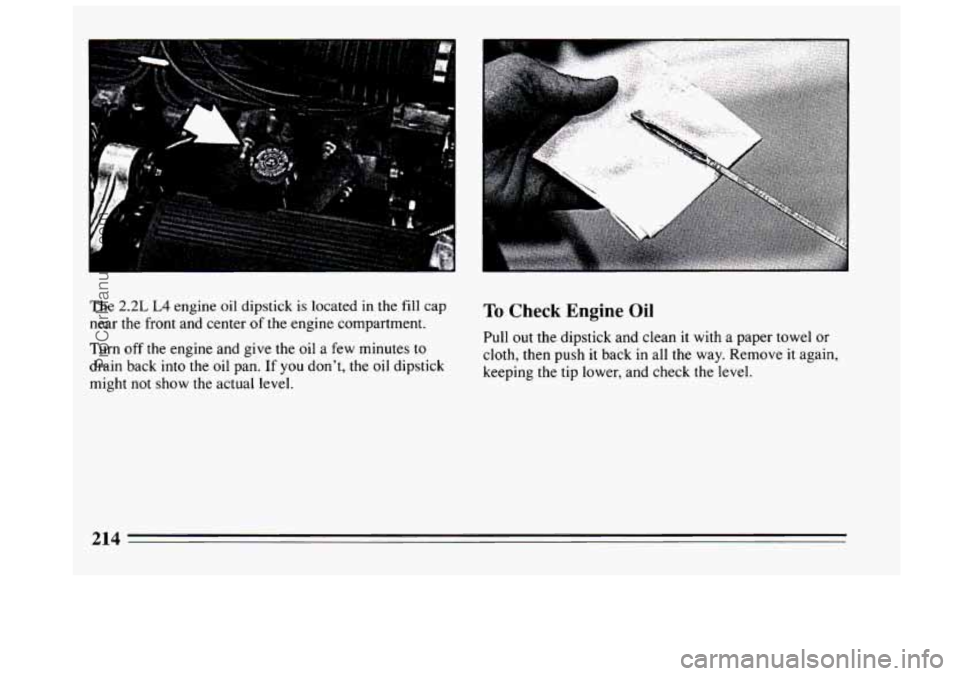
The 2.2L L4 engine oil dipstick is located in the fill cap
near the front and center of the engine compartment.
Turn off the engine and give the oil a few minutes to
drain back into the oil pan. If you don’t,
the oil dipstick
might not show the actual level.
To Check Engine Oil
Pull out the dipstick and clean it with a paper towel or
cloth, then push
it back in all the way. Remove it again,
keeping the tip lower, and check the level.
214
ProCarManuals.com
Page 219 of 308
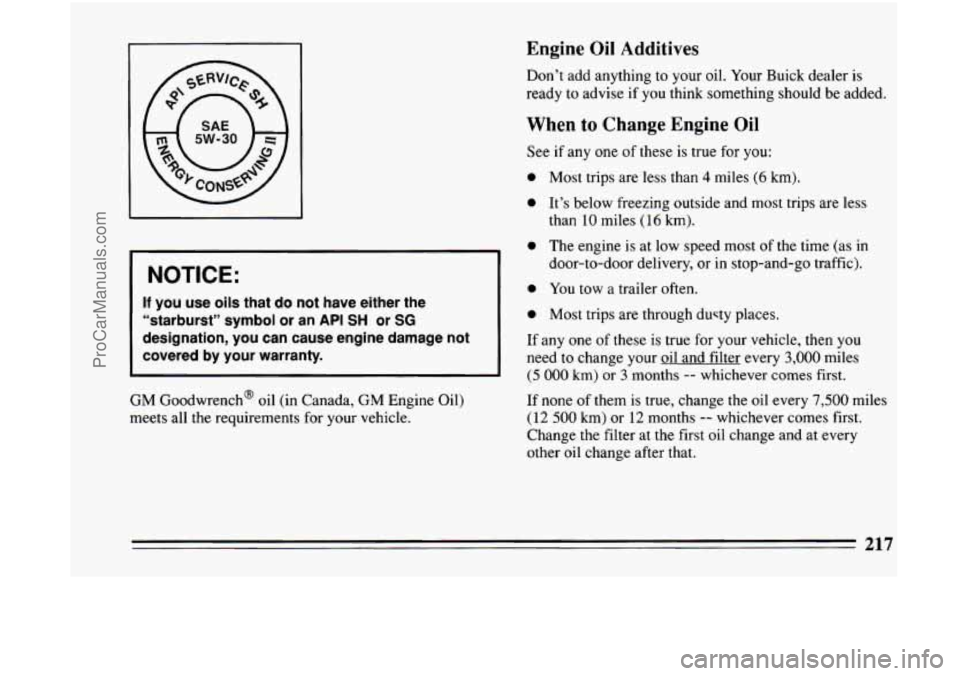
NOTICE:
If you use oils that do not have either the
“starburst” symbol or an
API SH or SG
designation, you can cause engine damage not
covered by your warranty.
GM Goodwrench@ oil (in Canada, GM Engine Oil)
meets all the requirements for your vehicle.
Engine Oil Additives
Don’t add anything to your oil. Your Buick dealer is
ready to advise if you think something should be added.
When to Change Engine Oil
See if any one of these is true for you:
0 Most trips are less than 4 miles (6 km).
0 It’s below freezing outside and most trips are less
0 The engine is at low speed most of the time (as in
0 You tow a trailer often.
0 Most trips are through dwty places.
If any one of these is true for your vehicle, then you
need to change your oil and filter every
3,000 miles
(5 000 km) or 3 months -- whichever comes first.
If none
of them is true, change the oil every 7,500 miles
(12 500 km) or 12 months -- whichever comes first.
Change the filter at the first oil change and at every
other oil change after that.
than
10 miles (1 6 km).
door-to-door delivery,
or in stop-and-go traffic).
217
ProCarManuals.com
Page 224 of 308
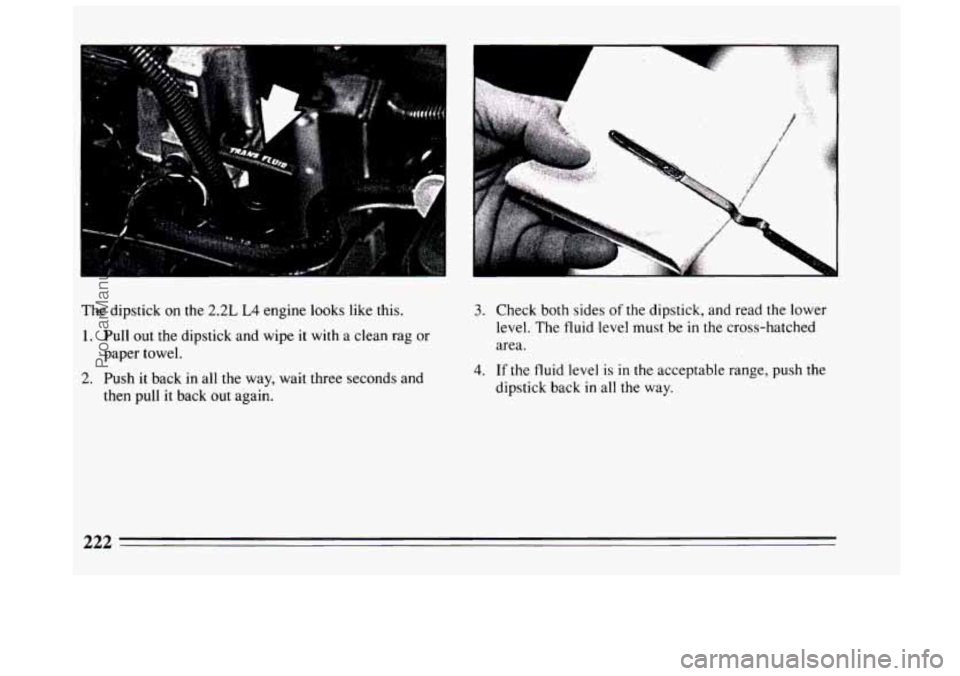
The dipstick on the 2.2L L4 engine looks like this.
1. Pull out the dipstick and wipe it with a clean rag or
paper towel.
2. Push it back in all the way, wait three seconds and
then pull
it back out again.
3. Check both sides of the dipstick, and read the lower
level. The fluid level must be
in the cross-hatched
area.
4. If the fluid level is in the acceptable range, push the
dipstick back
in all the way.
222
ProCarManuals.com
Page 235 of 308
Front Turn and Parking Bulb and/or Side
Marker Bulb Replacement
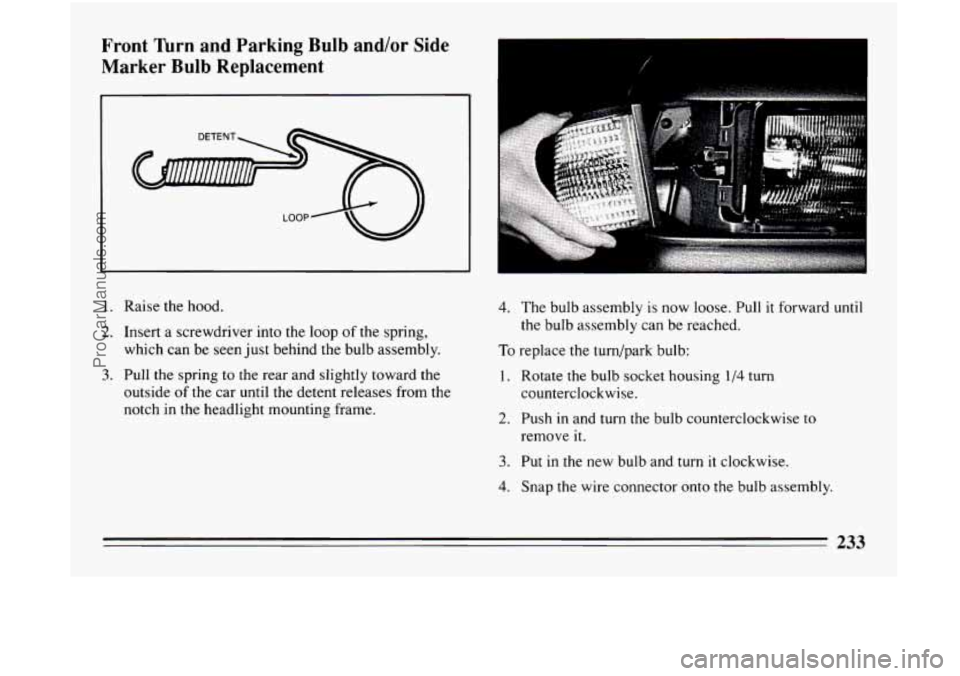
1. Raise the hood.
2. Insert a screwdriver into the loop of the spring,
which can be seen just behind the bulb assembly.
3. Pull the spring to the rear and slightly toward the
outside
of the car until the detent releases from the
notch in the headlight mounting frame.
,I'
4. The bulb assembly is now loose. Pull it forward until
the bulb assembly can be reached.
To replace the turn/park bulb:
1. Rotate the bulb socket housing 1/4 turn
counterclockwise.
2. Push in and turn the bulb counterclockwise to
remove
it.
3. Put in the new bulb and turn it clockwise.
4. Snap the wire connector onto the bulb assembly.
233
ProCarManuals.com
Page 248 of 308
I 0 Use solvent-type cleaners in a well-ventilated area
0 If a ring forms after spot cleaning, clean the entire
only.
If you use
them, don’t saturate the stained area.
area immediately or it will set.
Using Foam-Type Cleaner on Fabric
0
0
0
0
0
0
0
0
0
0
Vacuum and brush the area to remove any loose dirt.
Always clean a whole trim panel or section. Mask
surrounding trim along stitch or welt lines.
Mix Multi-Purpose Powdered Cleaner following the
directions
on the container label.
Use suds only and apply with a clean sponge.
Don’t saturate the material.
Don’t rub it roughly.
As soon as you’ve cleaned the section, use a sponge
to remove the suds.
Rinse the section with a clean, wet sponge.
Wipe off what’s left with a slightly damp paper towel
or cloth.
Then dry it immediately with a blow dryer or a heat
lamp.
I NOTICE:
I
Be careful with a hair dryer or heat lamp. You
could scorch the fabric.
0 Wipe with a clean cloth.
Using Solvent-Qpe Cleaner on Fabric
First, see if you have to use solvent-type cleaner at all.
Some spots and stains will dean
off better with just
water and mild soap.
If you need to use a solvent:
0 Gently scrape excess soil from the trim material with
a clean, dull knife or scraper. Use very little cleaner,
light pressure and clean cloths (preferably
cheesecloth). Cleaning should
start at the outside of
the stain, “feathering” toward the center. Keep
changing to a clean section of the cloth.
0 When you clean a stain from fabric, immediately dry
the area with
an air hose, hair dryer, or heat lamp to
help prevent a cleaning ring. (See the previous
NOTICE.)
246
ProCarManuals.com
Page 251 of 308
Cleaning the Outside of the
Windshield, Backglass and Wiper
Blades
If the windshield is not clear after using the windshield
washer, or if the wiper blade chatters when running, wax
or other material may be on the blade or windshield.
Clean the outside
of the windshield with GM
Windshield Cleaner, Bon-Ami Powder@ (GM Part
No.
105001 1). The windshield is clean if beads do not form
when
you rinse it with water.
Clean the blade by wiping vigorously with a cloth
soaked in full strength windshield washer solvent. Then
rinse
the blade with water.
Wiper blades should be checked on a regular basis and
replaced when worn.
Cleaning the Outside of Your Buick
The paint finish on your vehicle provides beauty, depth
of color, gloss retention and durability.
Washing Your Vehicle
The best way to preserve your vehicle’s finish is to keep
it clean by washing it often with lukewarm or cold
water.
Don’t wash your vehicle
in the direct rays of the sun.
Don’t use strong soaps or chemical detergents. Use
liquid hand, dish or car washing (mild detergent) soaps.
Don’t use cleaning agents that contain acid or abrasives.
All cleaning agents should be flushed promptly and not
allowed
to dry on the surface, or they could stain. Dry
the finish with a soft, clean chamois or a
100% cotton
towel to avoid surface scratches and water spotting.
High pressure car washes may cause water to enter your
vehicle.
Finish Care
Occasional waxing or mild polishing of your Buick may
be necessary to remove residue from the paint
finish. You
can get GM approved cleaning products from your dealer.
(See “Appearance Care and Materials” in the Index.)
Your Buick has a “basecoat/clearcoat” paint finish. The
clearcoat gives more depth and gloss to the colored
ProCarManuals.com
Page 267 of 308
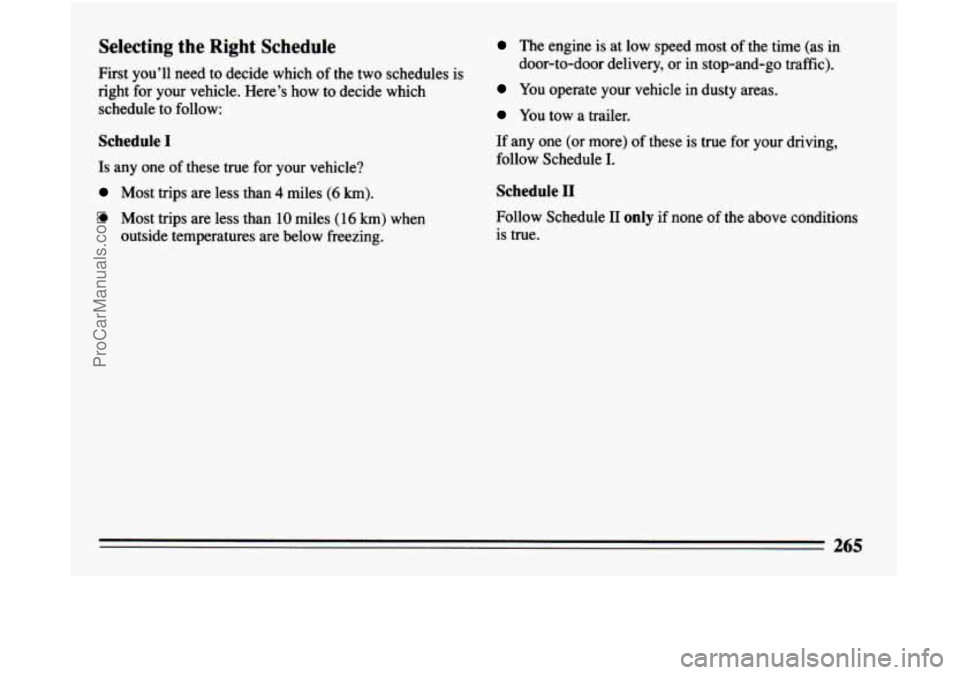
Selecting the Right Schedule
First you’ll need to decide which of the two schedules is
right for your vehicle. Here’s how to decide
which
schedule to follow:
Schedule I
Is any one of these true for your vehicle?
Most trips are less than 4 miles (6 km).
0 Most trips are less than 10 miles (16 km) when
outside temperatures are below fi-eezing.
The engine is at low speed most of the time (as in
You operate your vehicle in dusty areas.
You tow a trailer.
door-to-door delivery, or
in stop-and-go traffic).
If any one
(or more) of these is true for your driving,
follow Schedule I.
Schedule I1
Follow Schedule I1 only if none of the above conditions
is true.
ProCarManuals.com
Page 268 of 308
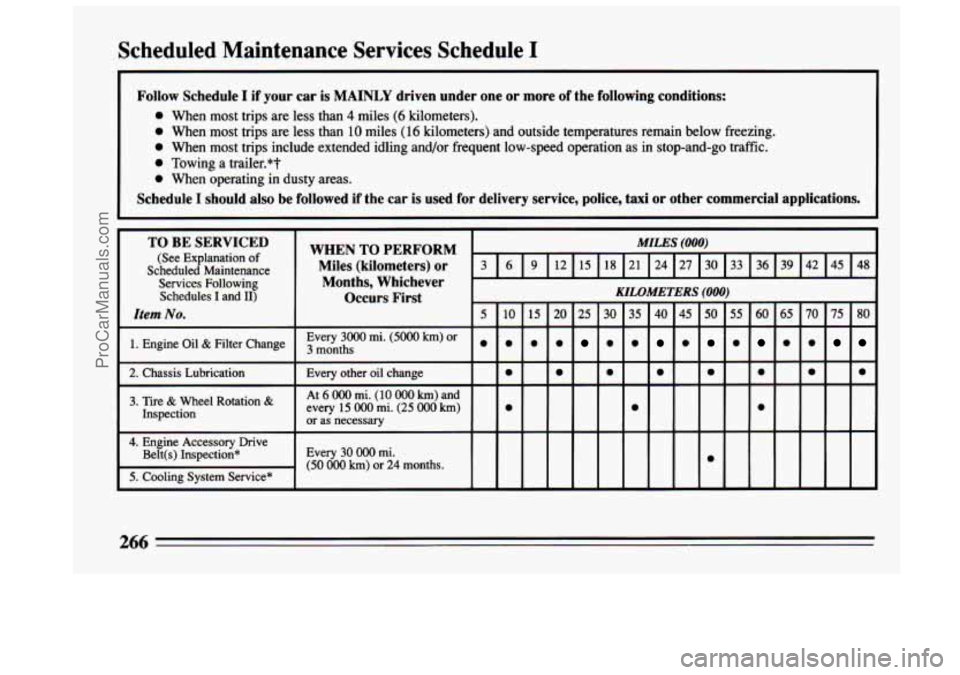
Scheduled Maintenance Services Schedule I
~
Follow Schedule I if your car is MAINLY driven under one or more of the following conditions:
0 When most trips are less than 4 miles (6 kilometers).
0 When most trips are less than 10 miles (16 kilometers) and outside temperatures remain below fr\
eezing.
0 When most trips include extended idling and/or frequent low-spee\
d operation as in stop-and-go traffic.
0 Towing a trailer.*?
0 When operating in dusty areas.
Schedule I should also be followed if the car is used for delivery service, police, taxi or other commercial applications. \
TO BE SERVICED
(See Explanation of
Scheduled Maintenance Miles (kilometers) or
Services Following Months, Whichever
Schedules I and 11) Occurs First KILOMETERS (000)
WHEN TO PERFORM MILES (000)
3
Item No.
Every30oOmi.(50@)km)or months 0 0 0 0 0 0 0 0 0 0 1. Engine oil & Filter Change
5 10 15 20 25 30 35 40 45 50 55 60 65 70 75 80
3. Tire & Wheel Rotation &
Every other oil change 0 0 0 0 0 0 0 0 2. Chassis Lubrication
every 15 ooo mi. (25 ooo km)
At 6 OOO mi. (10 000 km) and
or as necessary
4. Engine Accessory Drive
5. Cooling System Service"
Inspection
0 0 0
Belt(s)
Inspection* Every 30 OOO mi.
(50 000 km) or 24 months. 0
266
ProCarManuals.com