brake pads BUICK CENTURY 1994 Owners Manual
[x] Cancel search | Manufacturer: BUICK, Model Year: 1994, Model line: CENTURY, Model: BUICK CENTURY 1994Pages: 308, PDF Size: 16.3 MB
Page 232 of 308
Brake Wear
Your Buick has front disc brakes and rear drum brakes.
Disc brake pads have built-in wear indicators that make
a high-pitched warning sound when the brake pads are
worn and new pads are needed. The sound may come
and
go or be heard all the time your vehicle is moving
(except when
you are pushing on the brake pedal
firmly).
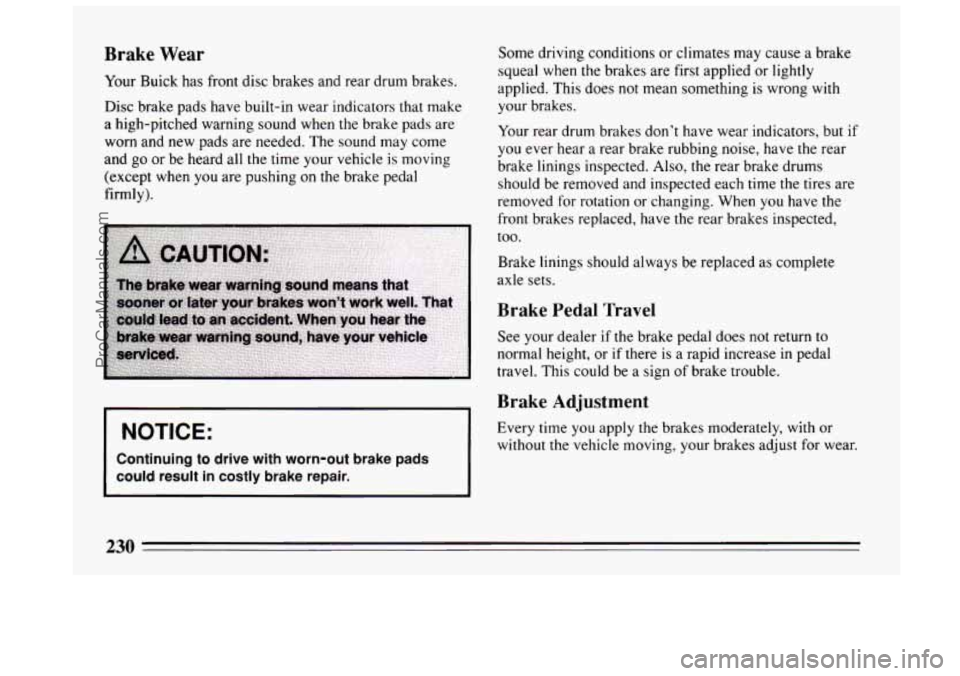
Continuing to drive with worn-out brake pads
could result in costly brake repair.
Some driving conditions or climates may cause a brake
squeal when the brakes are first applied or lightly
applied. This does not mean something
is wrong with
your brakes.
Your rear drum brakes don’t have wear indicators, but if
you ever hear a rear brake rubbing noise, have the rear
brake linings inspected. Also, the rear brake drums
should be removed and inspected each time the tires are
removed for rotation or changing. When you have the
front brakes replaced, have the rear brakes inspected,
too.
Brake linings should always be replaced as complete
axle sets.
Brake Pedal Travel
See your dealer if the brake pedal does not return to
normal height, or
if there is a rapid increase in pedal
travel. This could be a sign of brake trouble.
Brake Adjustment
Every time you apply the brakes moderately, with or
without the vehicle moving, your brakes adjust for wear.
230
ProCarManuals.com
Page 278 of 308
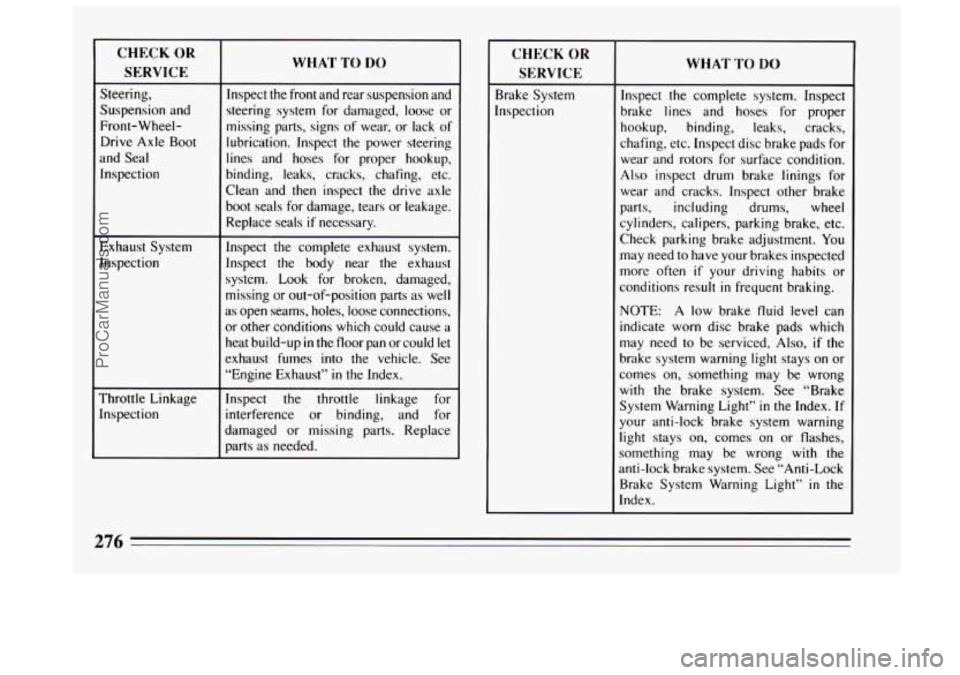
CHECK OR SERVICE
Steering, Suspension and
Front-Wheel-
Drive Axle Boot
and Seal
Inspection
Exhaust System
Inspection
Throttle Linkage
Inspection
WHAT TO DO
Inspect the front and rear suspension and
steering system
for damaged, loose or
missing parts, signs of wear, or lack of
lubrication. Inspect the power steering
lines and hoses for proper hookup,
binding, leaks, cracks, chafing, etc.
Clean and
then inspect the drive axle
boot seals
for damage, tears or leakage.
Replace seals if necessary.
Inspect the complete exhaust system.
Inspect the body near the exhaust
system. Look for broken, damaged,
missing or out-of-position parts as
well
as open seams, holes, loose connections,
or other conditions which could cause a
heat build-up
in the floor pan or could let
exhaust fumes into the vehicle. See
“Engine Exhaust”
in the Index.
Inspect the throttle linkage for
interference
or binding, and for
damaged
or missing parts. Replace
parts as needed.
CHECK OR
SERVICE
Brake System
Inspection
WHAT TO DO
Inspect the complete system. Inspect
brake lines and hoses for proper
hookup, binding, leaks, cracks,
chafing, etc. Inspect disc brake pads for
wear and rotors for surface condition.
Also inspect drum bmke linings for
wear and cracks. Inspect other brake
parts, including drums, wheel
cylinders, calipers, parking brake, etc.
Check parking brake adjustment.
You
may need to have your brakes inspected
more often if your driving habits or
conditions result
in frequent braking.
NOTE: A low brake fluid level can
indicate worn disc brake pads which
may need
to be serviced, Also, if the
brake system warning
light stays on or
comes on, something may be wrong
with the brake system. See “Brake
System Warning Light”
in the Index. If
your anti-lock brake system warning
light stays on, comes on
or flashes,
something may be wrong with
the
anti-lock brake system. See “Anti-Lock
Brake System Warning Light”
in the
Index.
276
ProCarManuals.com