ECU BUICK CENTURY 1996 User Guide
[x] Cancel search | Manufacturer: BUICK, Model Year: 1996, Model line: CENTURY, Model: BUICK CENTURY 1996Pages: 340, PDF Size: 17.61 MB
Page 53 of 340
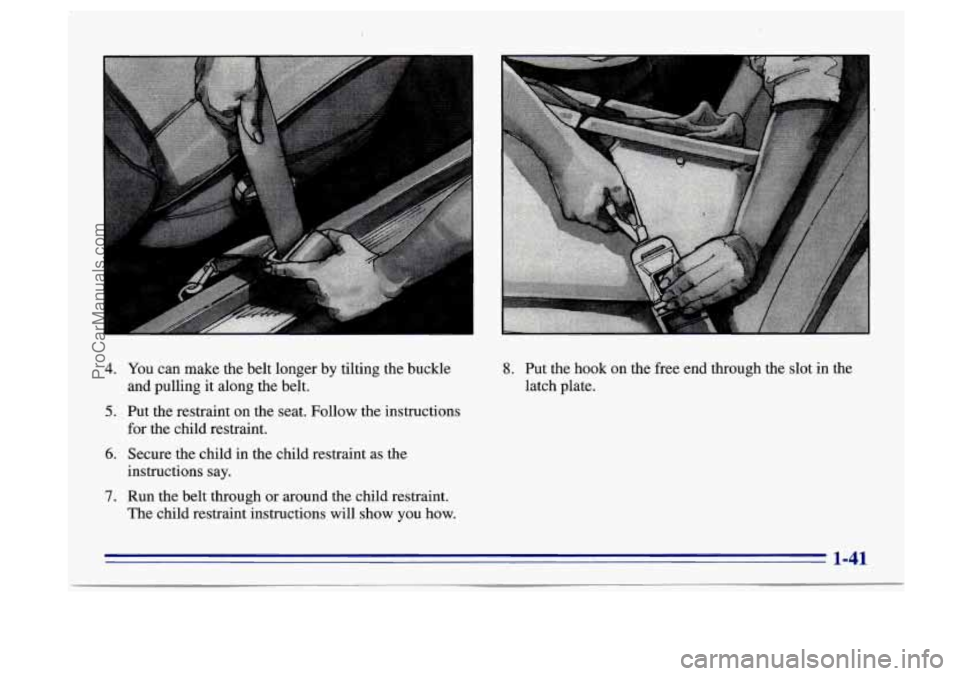
4. You can make the belt longer by tilting the buckle
5. Put the restraint on the seat. Follow the instructions
and pulling
it along the belt.
for the child restraint.
6. Secure the child in the child restraint as the
instructions say.
The child restraint instructions will show you how.
7. Run the belt through or around the child restraint.
8. Put the hook on the free end through the slot in the
latch plate.
1-41
ProCarManuals.com
Page 54 of 340
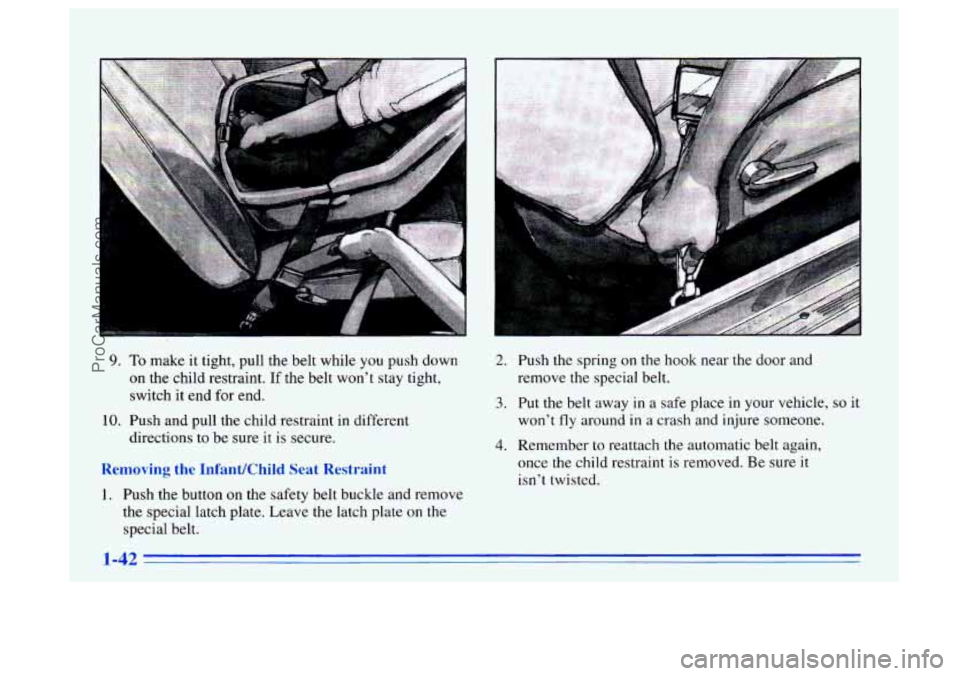
9.
10.
To make it tight, pull the belt while you push down
on the child restraint. If the belt won’t stay tight,
switch it end for end.
Push and pull the child restraint in different directions to
be sure it is secure.
Removing the InfantlChild Seat Restraint
1. Push the button on the safety belt buckle and remove
the special latch plate. Leave the latch plate on
the
special belt.
2. Push the spring on the hook near the door and
remove the special belt.
3. Put the belt away in a safe place in your vehicle, so it
won’t
fly around in a crash and injure someone.
4. Remember to reattach the automatic belt again,
once the child restraint is removed. Be sure
it
isn’t twisted.
1-42
ProCarManuals.com
Page 98 of 340
Convenience Net (Option)
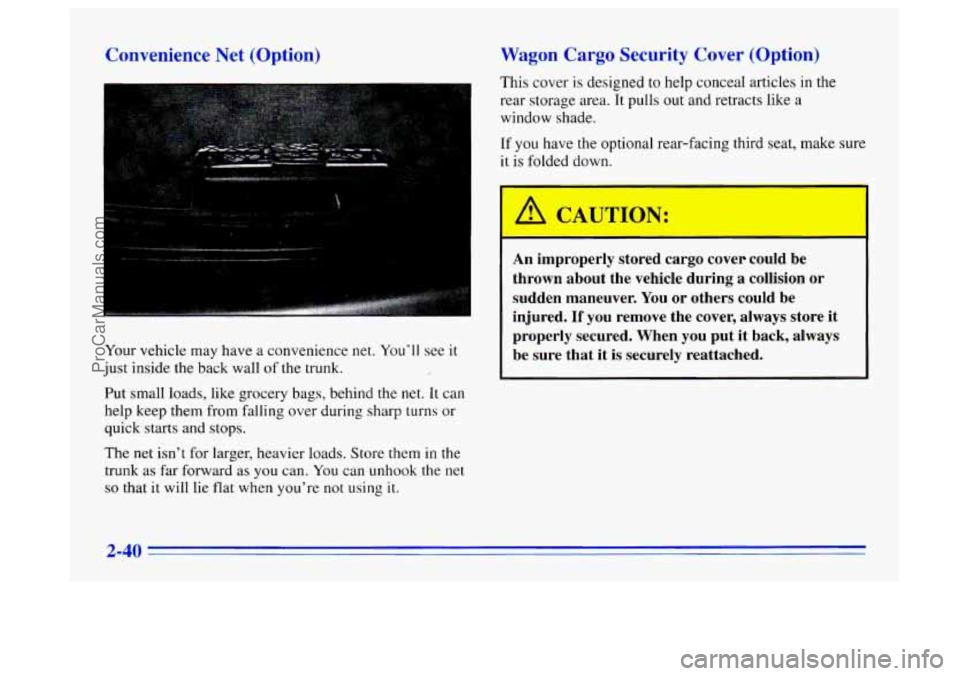
Your vehicle may have a convenience net. You'll see it
just inside the back wall of the trunk.
Put small loads, like grocery bags, behind the net.
It can
help keep them from falling over during sharp turns or
quick starts and stops.
The net isn't for larger, heavier loads. Store them
in the
trunk as far forward as
you can. You can unhook the net
so that it will lie flat when you're not using it.
Wagon Cargo Security Cover (Option)
This cover is designed to help conceal articles in the
rear storage area. It pulls out and retracts like a
window shade.
If you have the optional rear-facing third seat, make sure
it is folded down.
A CAUT7N:
An improperly stored cargo coy could be
thrown about the vehicle during a collision or
sudden maneuver. You or others could be
injured.
If you remove the cover, always store it
properly secured. When you put it back, always
be sure that
it is securely reattached.
2-40
ProCarManuals.com
Page 100 of 340
Luggage Carrier (Option)
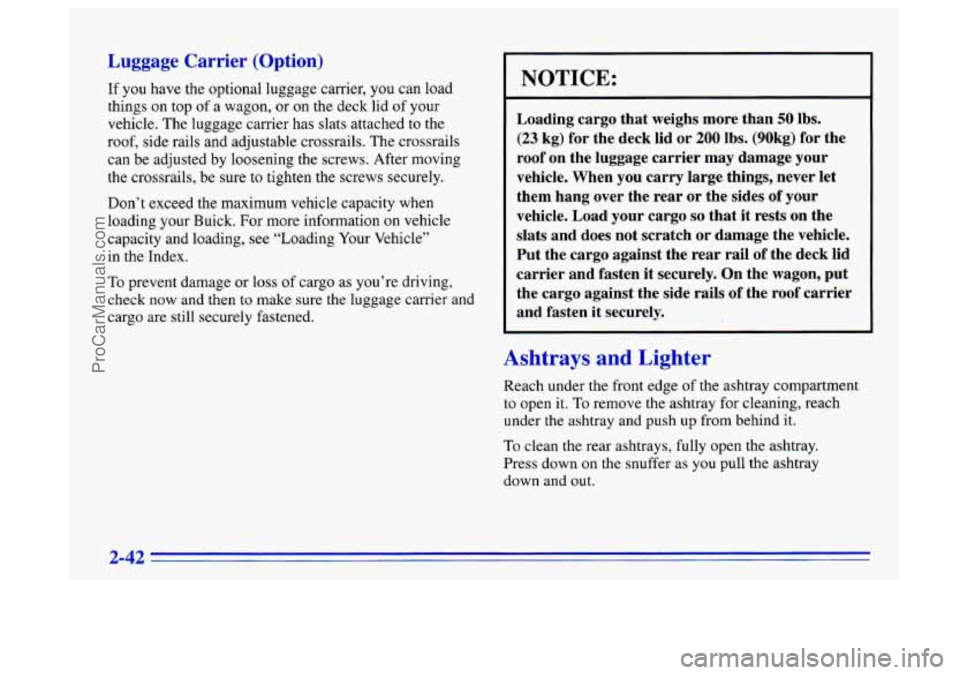
If you have the optional luggage carrier, you can load
things on top
of a wagon, or on the deck lid of your
vehicle. The luggage carrier has slats attached to the
roof, side rails and adjustable crossrails. The crossrails
can be adjusted by loosening the screws. After moving
the crossrails, be sure to tighten the screws securely.
Don’t exceed the maximum vehicle capacity when
loading your Buick. For more information on vehicle
capacity and loading,
see “Loading Your Vehicle”
in the Index.
To prevent damage or loss
of cargo as you’re driving,
check now and then to make sure the luggage carrier and
cargo are still securely fastened.
NOTICE:
Loading cargo that weighs more than 50 lbs.
(23 kg) for the deck lid or 200 lbs. (90kg) for the
roof on the luggage carrier may damage your
vehicle. When you carry large things, never let
them hang over the rear or the sides of your
vehicle. Load your cargo
so that it rests on the
slats and does not scratch or damage the vehicle.
Put the cargo against the rear rail of the deck lid
carrier and fasten it securely. On the wagon, put
the cargo against the side rails of the roof carrier
and fasten it securely.
Ashtrays and Lighter
Reach under the front edge of the ashtray compartment
to open it.
To remove the ashtray for cleaning, reach
under the ashtray and push up from behind
it.
To clean the rear ashtrays, fully open the ashtray.
Press down on the snuffer
as you pull the ashtray
down and out.
2-42
ProCarManuals.com
Page 154 of 340
W* kter Driving
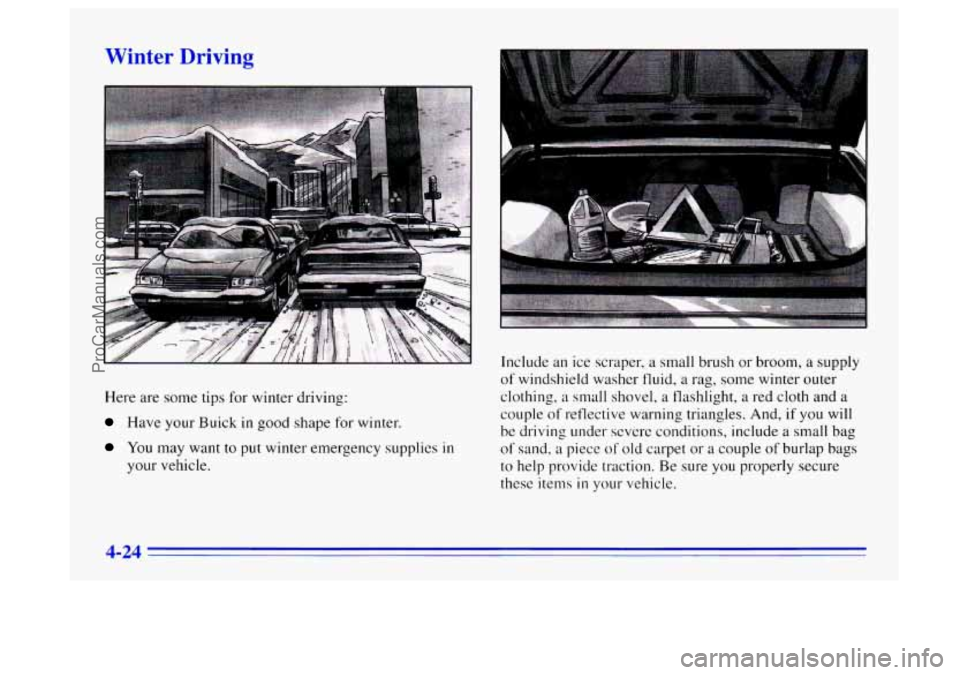
Here are some tips for winter driving:
Have your Buick in good shape for winter.
You may want to put winter emergency supplies in
your vehicle. Include
an ice scraper, a small brush or broom, a supply
of windshield washer fluid, a rag, some winter outer
clothing, a
small shovel, a flashlight, a red cloth and a
couple of reflective warning triangles. And, if you will
be driving under severe conditions, include a small bag
of sand, a piece of old carpet or a couple of burlap bags
to help provide traction. Be sure you properly secure
these item
in your vehicle.
4-24
ProCarManuals.com
Page 159 of 340
Note: If for some reason the driver’s door becomes
damaged and needs to be replaced, ask that the
information on the Tire-Loading Information label and
the Certification label be written down
so you may keep
it on file.
Do not load your vehicle any heavier than
the
GVWR, or either the maximum front or
rear
GAWR. If you do, parts on your vehicle
can break, or it can change the way your vehicle
handles. These could cause you to lose control.
Also, overloading can shorten the life of
your vehicle.
If you put things inside your vehicle -- like suitcases,
tools, packages, or anything else
-- they will go as fast
as the vehicle goes. If you have
to stop or turn quickly,
or if there is a crash, they’ll keep going.
Things you put inside your vehiclexan strike
and injure people in a sudden stop or turn, or
in a crash.
Put things in the trunk or rear area of your
vehicle.
In a trunk, put them as far forward
as you can.
Try to spread the weight evenly.
Never stack heavier things, like: suitcases,
inside the vehicle
so that some of them are
above the tops of the seats.
0 Don’t leave an unsecured child restraint in
your vehicle.
When you carry something inside the
vehicle, secure it whenever you can.
Don’t leave a seat folded down unless you
need to.
4-29
ProCarManuals.com
Page 164 of 340
Driving with a Trailer
Towing a trailer requires a certain amount of experience.
Before setting out for the open road, you’ll want to get
to know your rig. Acquaint yourself with the feel of
handling and braking with the added weight of the
trailer. And always keep in mind that the vehicle
you are
driving is now a good deal longer and
not nearly as
responsive as your vehicle
is by itself.
Before you start, check the trailer hitch and platform
(and attachments), safety chains, electrical connector,
lamps, tires and mirror adjustment. If the trailer has
electric brakes, start your vehicle and trailer moving and
then apply the trailer brake controller by hand to be sure
the brakes are working. This lets you check your
electrical connection at the same time.
During your trip, check occasionally to be sure that the
load is secure, and that the lamps and any trailer brakes
are still working.
Following Distance
Stay at least twice as far behind the vehicle ahead as you
would when driving your vehicle without a trailer. This
can help you avoid situations that require heavy braking
and sudden turns.
Passing
You’ll need more passing distance up ahead when
you’re towing a trailer. And, because you’re
a good deal
longer, you’ll need
to go much farther beyond the
passed vehicle before you can return to your lane.
Backing Up
Hold the bottom of the steering wheel with one hand.
Then, to move the trailer to the left, just move that hand
to the left.
To move the trailer to the right, move your
hand to the right. Always back up slowly and, if
possible, have someone guide you.
ProCarManuals.com
Page 174 of 340
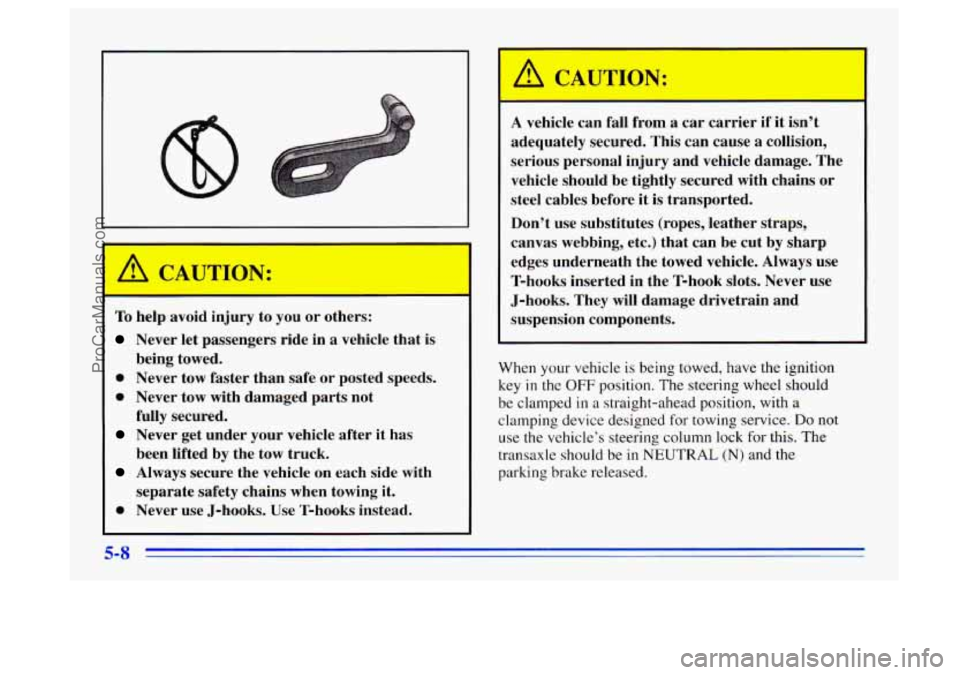
To help avoid injury to you or others:
Never let passengers ride in a vehicle that is
0 Never tow faster than safe or posted speeds.
0 Never tow with damaged parts not
fully secured.
Never get under your vehicle after it has
been lifted by the tow truck.
Always secure the vehicle on each side with
separate safety chains when towing it.
0 Never use J-hooks. Use T-hooks instead.
being
towed.
U
A vehicle can fall from a car carrier if it isn’t
adequately secured. This can cause
a collision,
serious personal injury and vehicle damage. The
vehicle should be tightly secured with chains or
steel cables before it is transported.
Don’t use substitutes (ropes, leather straps,
canvas webbing, etc.) that can be cut by sharp
edges underneath the towed vehicle.
Always use
T-hooks inserted in the
T-hook slots. Never use
J-hooks. They will damage drivetrain and
suspension components.
When your vehicle
is being towed, have the ignition
key
in the OFF position. The steering wheel should
be clamped
in a straight-ahead position, with a
clamping device designed for towing service. Do not
use the vehicle’s steering column lock for this. The
transaxle should be in NEUTRAL (N) and the
parking brake released.
5-8
ProCarManuals.com
Page 201 of 340
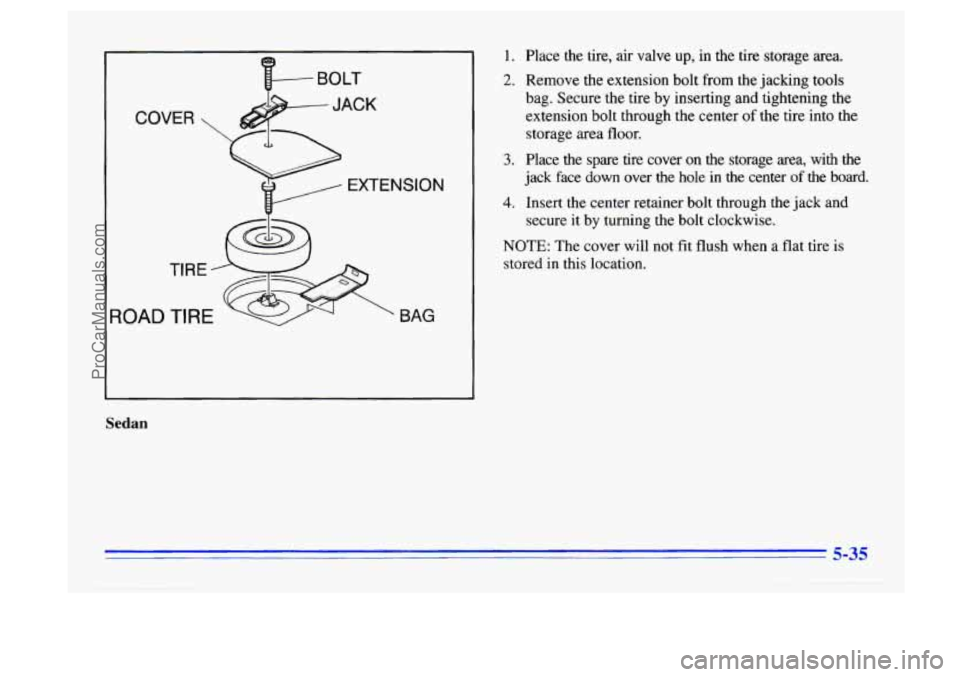
3OAD
TIRE .--
BAG
Sedan
1.
2.
3.
4.
Place the tire, air valve up, in the tire storage area.
Remove the extension bolt from the jacking tools
bag. Secure the tire by inserting and tightening the
extension bolt through the center
of the tire into the
storage area floor.
Place the spare tire cover on the storage area, with the
jack face down over
the hole in the center of the board.
Insert the center retainer bolt through the jack and
secure it
by turning the bolt clockwise.
NOTE: The cover will not
fit flush when a flat tire is
stored
in this location.
5-35
ProCarManuals.com
Page 243 of 340
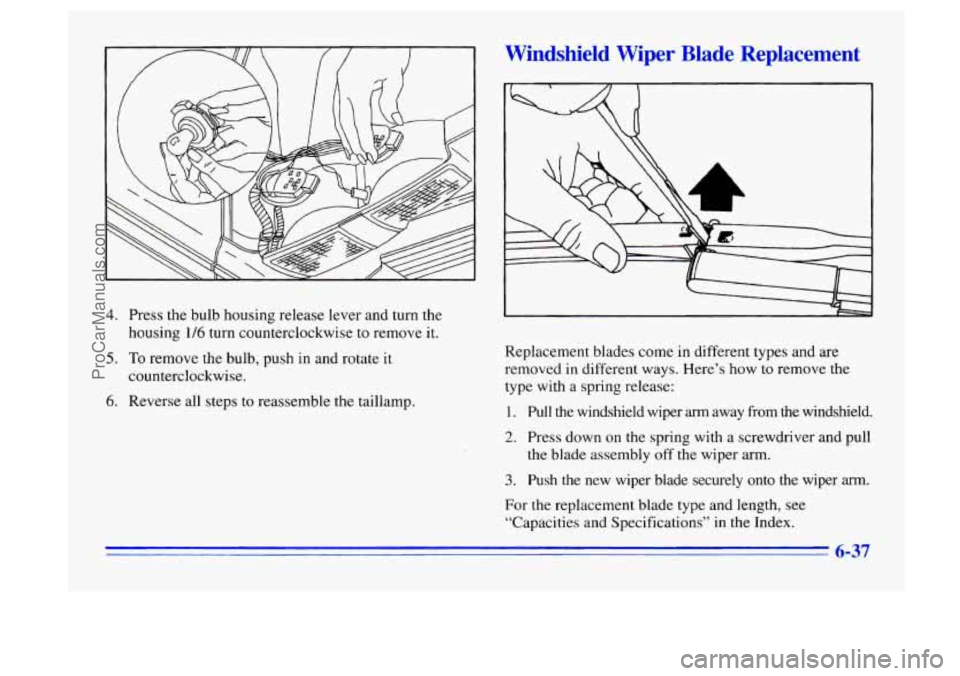
4. Press the bulb housing release lever and turn the
housing
1/6 turn counterclockwise to remove it.
5. To remove the bulb, push in and rotate it
counterclockwise.
6. Reverse all steps to reassemble the taillamp.
Windshield Wiper Blade Replacement
Replacement blades come in different types and are
removed
in different ways. Here’s how to remove the
type with a spring release:
1. Pull the windshield wiper arm away from the windshield.
2. Press down on the spring with SI screwdriver and pull
the blade assembly off the wiper arm.
3. Push the new wiper blade securely onto the wiper arm.
For the replacement blade type and length, see
“Capacities and Specifications” in the Index.
6-37
ProCarManuals.com