steering wheel BUICK CENTURY 1996 User Guide
[x] Cancel search | Manufacturer: BUICK, Model Year: 1996, Model line: CENTURY, Model: BUICK CENTURY 1996Pages: 340, PDF Size: 17.61 MB
Page 141 of 340
Off-Road Recovery Passing
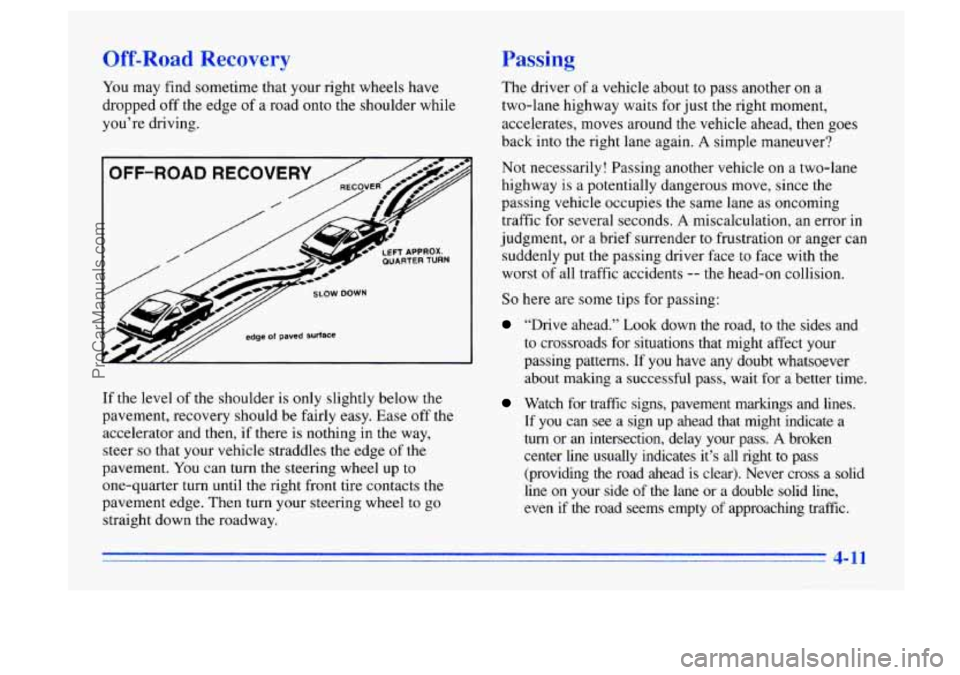
You may find sometime that your right wheels have
dropped off the edge
of a road onto the shoulder while
you’re driving.
If the level of the shoulder is only slightly below the
pavement, recovery should be fairly easy. Ease off the
accelerator and then, if there is nothing
in the way,
steer so that your vehicle straddles the edge of the
pavement. You can turn the steering wheel up to
one-quarter turn until the right front tire contacts the
pavement edge. Then turn your steering wheel
to go
straight down the roadway. The driver
of a vehicle
about to pass another on a
two-lane highway waits for just the right moment,
accelerates, moves around the vehicle ahead, then goes
back into the right lane again.
A simple maneuver?
Not necessarily! Passing another vehicle on a two-lane
highway
is a potentially dangerous move, since the
passing vehicle occupies the same lane as oncoming
traffic for several seconds.
A miscalculation, an error in
judgment, or a brief surrender
to frustration or anger can
suddenly put the passing driver face to face with the
worst of all traffic accidents
-- the head-on collision.
So here are some tips for passing:
“Drive ahead.” Look down the road, to the sides and
to crossroads for situations that might affect your
passing patterns. If you have any doubt whatsoever
about making
a successful pass, wait for a better time.
Watch for traffic signs, pavement markings and lines.
If you can see a sign up ahead that might indicate a
turn or an intersection, delay your pass. A broken
center line usually indicates it’s all right to pass
(providing the road ahead is clear). Never cross a solid
line on your side
of the lane or a double solid line,
even
if the road seems empty of approaching traffic.
4-11
ProCarManuals.com
Page 143 of 340
Let’s review what driving experts say about what
happens when the three control systems (brakes, steering
and acceleration) don’t have enough friction where the
tires meet the road to do what the driver has asked.
In any emergency, don’t give up. Keep trying to steer and
constantly seek an escape route or area of less danger.
In a skid, a driver can lose control of the vehicle.
Defensive drivers avoid most skids by taking reasonable
care suited to existing conditions, and by not
“overdriving” those conditions. But skids are always
possible.
The three types of skids correspond to your Buick’s
three control systems. In the braking skid, your wheels
aren’t rolling.
In the steering or cornering skid, too
much speed or steering in a curve causes tires to slip and
lose cornering force. And in the acceleration skid, too
much throttle causes the driving wheels
to spin.
A cornering skid and an acceleration skid are best
handled by easing your foot
off the accelerator pedal. If
your vehicle starts to slide, ease your foot
off the
accelerator pedal and quickly steer the way you want the
vehicle to go. If you start steering quickly enough, your
vehicle may straighten out. Always be ready for a
second skid if it occurs.
Of course, traction is reduced when water, snow, ice,
gravel or other material is on the road. For safety, you’ll
want to slow down and adjust your driving to these
conditions. It is important to slow down on slippery
surfaces because stopping distance will be longer and
vehicle control more limited.
While driving
on a surface with reduced traction, try
your best to avoid sudden steering, acceleration or
braking (including engine braking by shifting to a lower
gear). Any sudden changes could cause the tires to
slide.
You may not realize the surface is slippery until
your vehicle is skidding. Learn to recognize warning
clues
-- such as enough water, ice or packed snow
on the road to make a “mirrored surface”
-- and
slow down when you have any doubt.
Remember: Any anti-lock brake system (ABS) helps
avoid only the braking skid.
ProCarManuals.com
Page 155 of 340
Driving on Snow or Ice
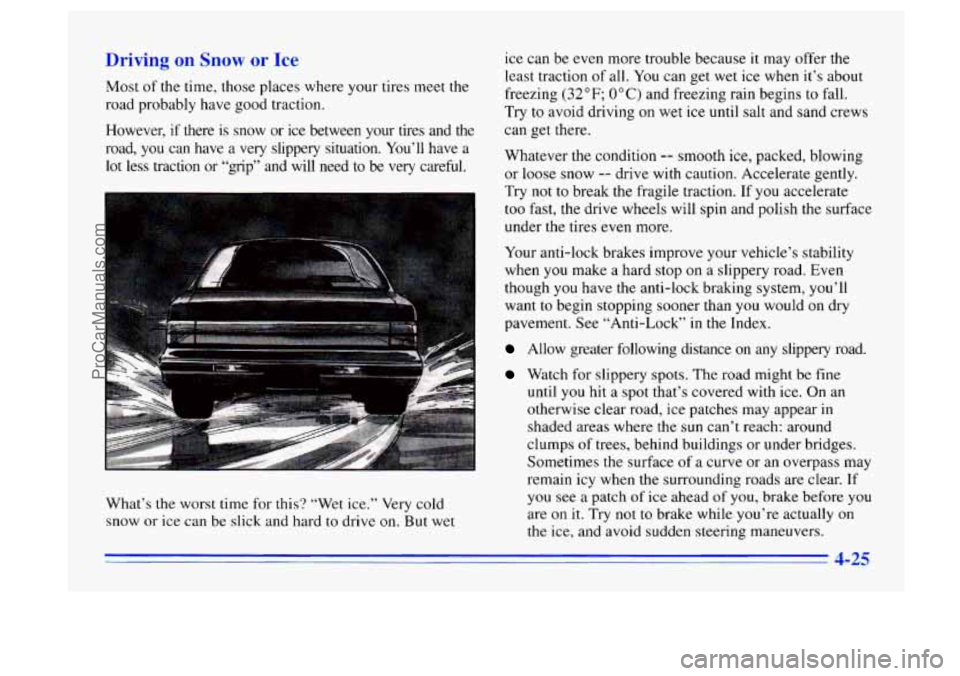
Most of the time, those places where your tires meet the
road probably have good traction.
However, if there is snow or ice between your tires and the
road, you can have a
very slippery situation. You’ll have a
lot less traction or “grip” and will need
to be very careful.
What’s
the worst time for this? “Wet ice.” Very cold
snow or ice can be slick and hard to drive on. But wet ice
can be
even more trouble because it may offer the
least traction of all. You can get wet ice when it’s about
freezing
(32°F; 0°C) and freezing rain begins to fall.
Try to avoid driving on wet ice until salt and sand crews
can get there.
Whatever the condition
-- smooth ice, packed, blowing
or loose snow
-- drive with caution. Accelerate gently.
Try not to break the fragile traction.
If you accelerate
too fast, the drive wheels will spin and polish the surface
under the tires
even more.
Your anti-lock brakes improve your vehicle’s stability
when you make
a hard stop on a slippery road. Even
though
you have the anti-lock braking system, you’ll
want to begin stopping sooner than
you would on dry
pavement. See “Anti-Lock” in the Index.
Allow greater following distance on any slippery road.
Watch for slippery spots. The road might be fine
until you hit a spot that’s covered with ice. On an
otherwise clear road, ice patches may appear in
shaded areas where the sun can’t reach: around
clumps
of trees, behind buildings or under bridges.
Sometimes the surface
of a curve or an overpass may
remain icy when the surrounding roads are clear. If
you see a patch of ice ahead of you, brake before you
are on it. Try not to brake while you’re actually on
the ice, and avoid sudden steering maneuvers.
4-25
ProCarManuals.com
Page 164 of 340
Driving with a Trailer
Towing a trailer requires a certain amount of experience.
Before setting out for the open road, you’ll want to get
to know your rig. Acquaint yourself with the feel of
handling and braking with the added weight of the
trailer. And always keep in mind that the vehicle
you are
driving is now a good deal longer and
not nearly as
responsive as your vehicle
is by itself.
Before you start, check the trailer hitch and platform
(and attachments), safety chains, electrical connector,
lamps, tires and mirror adjustment. If the trailer has
electric brakes, start your vehicle and trailer moving and
then apply the trailer brake controller by hand to be sure
the brakes are working. This lets you check your
electrical connection at the same time.
During your trip, check occasionally to be sure that the
load is secure, and that the lamps and any trailer brakes
are still working.
Following Distance
Stay at least twice as far behind the vehicle ahead as you
would when driving your vehicle without a trailer. This
can help you avoid situations that require heavy braking
and sudden turns.
Passing
You’ll need more passing distance up ahead when
you’re towing a trailer. And, because you’re
a good deal
longer, you’ll need
to go much farther beyond the
passed vehicle before you can return to your lane.
Backing Up
Hold the bottom of the steering wheel with one hand.
Then, to move the trailer to the left, just move that hand
to the left.
To move the trailer to the right, move your
hand to the right. Always back up slowly and, if
possible, have someone guide you.
ProCarManuals.com
Page 174 of 340
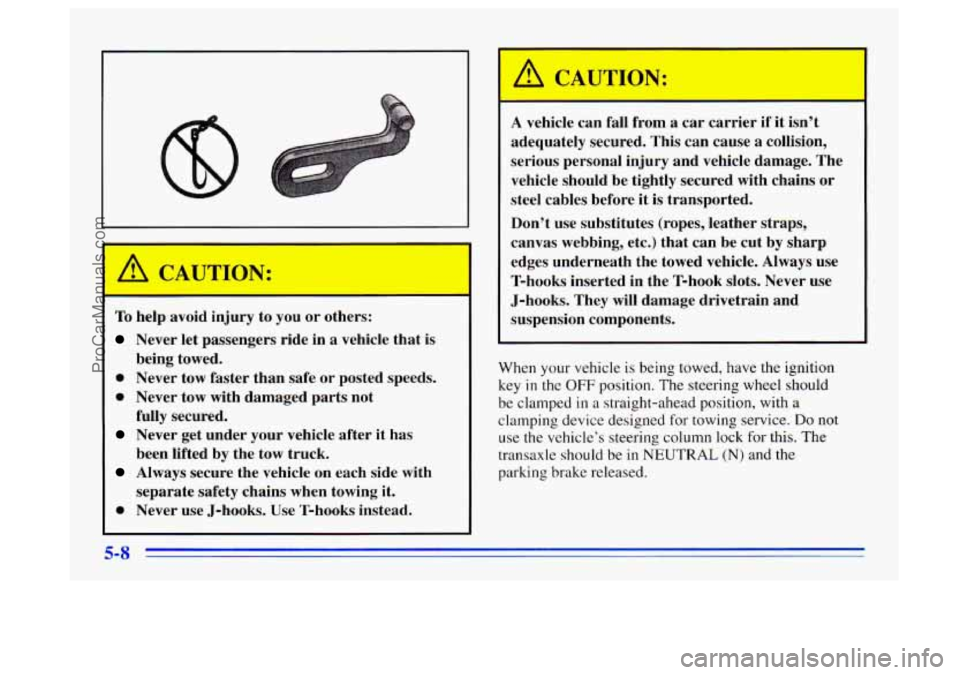
To help avoid injury to you or others:
Never let passengers ride in a vehicle that is
0 Never tow faster than safe or posted speeds.
0 Never tow with damaged parts not
fully secured.
Never get under your vehicle after it has
been lifted by the tow truck.
Always secure the vehicle on each side with
separate safety chains when towing it.
0 Never use J-hooks. Use T-hooks instead.
being
towed.
U
A vehicle can fall from a car carrier if it isn’t
adequately secured. This can cause
a collision,
serious personal injury and vehicle damage. The
vehicle should be tightly secured with chains or
steel cables before it is transported.
Don’t use substitutes (ropes, leather straps,
canvas webbing, etc.) that can be cut by sharp
edges underneath the towed vehicle.
Always use
T-hooks inserted in the
T-hook slots. Never use
J-hooks. They will damage drivetrain and
suspension components.
When your vehicle
is being towed, have the ignition
key
in the OFF position. The steering wheel should
be clamped
in a straight-ahead position, with a
clamping device designed for towing service. Do not
use the vehicle’s steering column lock for this. The
transaxle should be in NEUTRAL (N) and the
parking brake released.
5-8
ProCarManuals.com
Page 190 of 340
If a Tire Goes Flat
It’s unusual for a tire to “blow out” while you’re driving,
especially
if you maintain your tires properly. If air goes
out of a tire, it’s much more likely to leak out slowly.
But
if you should ever have a “blowout,” here are a few
tips about what to expect and what to do:
If a front tire fails, the flat tire will create a drag that
pulls the vehicle toward that,side. Take your foot
off the
accelerator pedal and grip the steering wheel fely.
Steer to maintain lane position, and then gently brake to
a stop well out of the traffic lane.
A rear blowout, particularly on a curve; acts much like a
skid and may require
the same correction you’d use in a
skid. In any rear blowout, remove your foot from the
accelerator pedal. Get the vehicle under control by
steering the way you want the vehicle to
go. It may be
very bumpy and noisy, but you can still steer. Gently
brake to a
stop -- well off ‘the road if possible.
If a tire goes flat, the next part shows how to use your
jacking equipment to change a flat tire safely.
Changing a Flat Tire
If a tire goes flat, avoid further tire and wheel damage
by driving slowly to a level place. Turn on your hazard’
warning flashers.
I
Changing a tire can cause an injury. The vehicle
can slip
off the jack and roll over you or other
‘people. You and they could be badly injured.
Find a level place to change your tire. To help
prevent the vehicle from moving:
1. Set the parking brake firmly.
2. Put the shift lever in PARK (P).
3. ”urn off the engine.
To be even more certain the vehicle won’t ‘move,
you can put blocks at the front and rear of the
tire farthest away from the one being changed.
That would be the tire on the other side of the
vehicle,
at the opposite end.
ProCarManuals.com
Page 205 of 340
I NOTICE:
Spinning your wheels can destroy parts of your
vehicle
as well as the tires. If you spin the wheels
too fast while shifting your transaxle back and
forth, you can destroy your transaxle.
For information about using tire chains on your vehicle,
see “Tire Chains’’ in the Index.
Rocking your vehicle to get it out:
First, turn your steering wheel left and right. That will
clear
the area around your front wheels. Then shift back
and forth between REVERSE
(R) and a forward gear,
spinning the wheels
as little as possible. Release the
accelerator pedal while you shift, and press lightly
on
the accelerator pedal when the transaxle is in gear. If
that doesn’t get you
out after a few tries, you may need
to be towed out.
If you do need to be towed out, see
“Towing Your Vehicle” in the Index.
5-39
ProCarManuals.com
Page 268 of 340
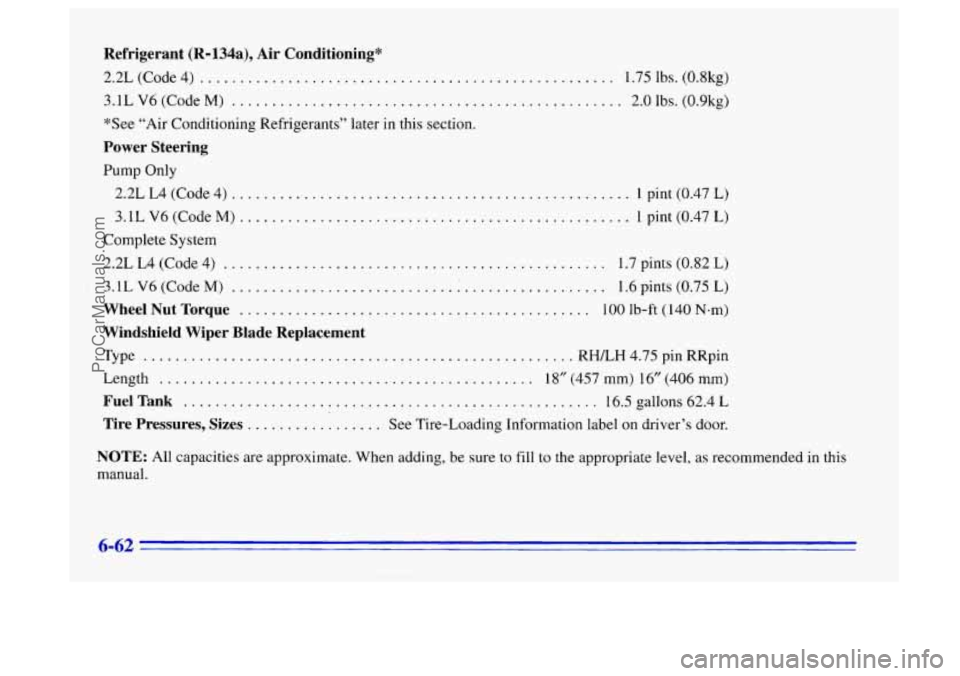
Refrigerant (R=l34a), Air Conditioning*
2.2L (Code 4) .................................................... 1.75 lbs. (0.8kg)
3.1L V6 (Code
M) ................................................. 2.0 Ibs. (0.9kg)
*See “Air Conditioning Refrigerants” later in this section.
Power Steering
Pump Only 2.2L
L4 (Code 4) .................................................. 1 pint (0.47 L)
3.1L V6 (Code M) ................................................. 1 pint (0.47 L)
2.2L L4 (Code 4) ................................................ 1.7 pints (0.82 L)
Wheel Nut Torque ............................................ 100 lb-ft (140 N-m)
Type
...................................................... RH/LH 4.75 pin RRpin
Length
............................................... 18” (457 mm) 16” (406 mm)
Complete System
3.1L V6
(Code M) ................................................ 1.6 pints (0.75 L)
Windshield Wiper Blade Replacement
Fuel Tank
................
Tire Pressures, Sizes ........
NOTE: All capacities are approx
manual. .i
................................... 16.5
gallons 62.4 L
........ See Tire-Loading Information label on driver’s door.
mate. When adding, be sure to fill to the appropriate level, as recommended in this
6-62
ProCarManuals.com
Page 310 of 340
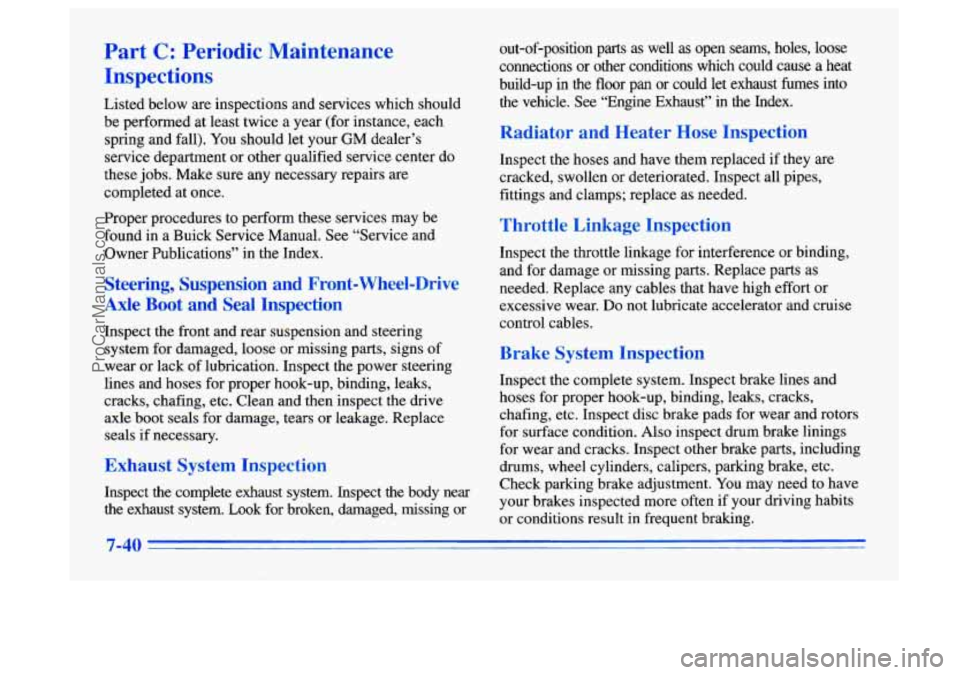
Part C: Periodic Maintenance
Inspections
Listed below are inspections and services which should
be performed
at least twice a year (for instance, each
spring and fall). You should
let your GM dealer’s
service department or other qualified service center do
these jobs. Make sure an.y necessary repairs are
completed at once.
Proper procedures to perform these services may be
found in a Buick Service Manual. See “Service and
Owner Publications” in the Index.
Steering, Suspension and Front- Wheel-Drive
Axle Boot and Seal Inspection
Inspect the front and rear suspension and steering
system for damaged, loose or missing parts, signs of
wear or lack of lubrication. Inspect the power steering
lines and hoses for proper hook-up, binding, leaks,
cracks, chafing, etc. Clean and then inspect the drive
axle boot seals for damage, tears or leakage. Replace
seals if necessary.
Exhaust System Inspection
Inspect the complete exhaust system. Inspect the body near
the exhaust system.
Look for broken, damaged, missing or out-of-position parts as well
as open seams, holes, loose
connections or other conditions which could cause a
heat
build-up in the floor pan or could let exhaust fumes into
the vehicle. See “Engine Exhaust” in the Index.
Radiator and Heater Hose Inspection
Inspect the hoses and have them replaced if they are
cracked, swollen or deteriorated. Inspect all pipes,
fittings and clamps; replace as needed.
Throttle Linkage Inspection
Inspect the throttle linkage for interference or binding,
and for damage or missing parts. Replace parts
as
needed. Replace any cables that have high effort or
excessive wear.
Do not lubricate accelerator and cruise
control cables.
Brake System Inspection
Inspect the complete system. Inspect brake lines and
hoses for proper hook-up, binding, leaks, cracks,
chafing, etc. Inspect disc brake pads for wear and rotors
for surface condition. Also inspect drum brake linings
for wear and cracks. Inspect other brake parts, including
drums, wheel cylinders, calipers, parking brake, etc.
Check parking brake adjustment. You may need to have
your brakes inspected more often if your driving habits
or conditions result in frequent braking.
7-40
ProCarManuals.com
Page 332 of 340
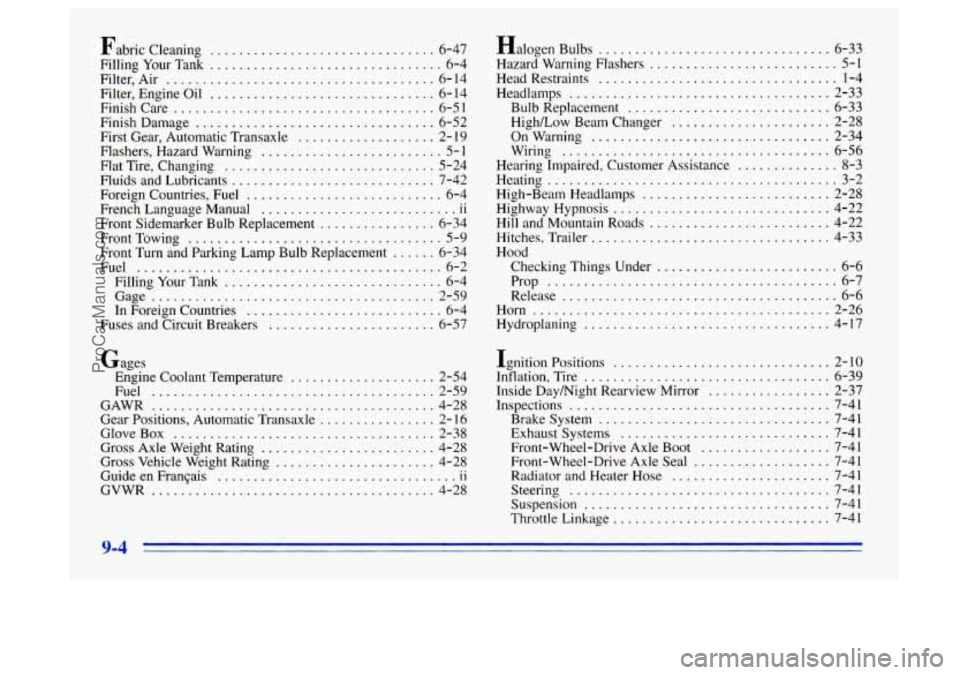
Fabric Cleaning ............................... 6-47
FillingYourTank
................................ 6-4
Filter, Air
..................................... 6-14
Filter, Engine Oil
............................... 6- 14
Finish Care
.................................... 6-5 1
Finish Damage ................................. 6-52
First Gear, Automatic Transaxle
................... 2- 19
Flashers, Hazard Warning
......................... 5-1
Flat Tire, Changing ............................. 5-24
Fluids and Lubricants
............................ 7-42
Foreign Countries, Fuel
........................... 6-4
French Language Manual
11
Front Sidemarker Bulb Replacement ................ 6-34
FrontTowing
................................... 5-9
Front Turn and Parking Lamp Bulb Replacement
...... 6-34
Fuel
.......................................... 6-2
Filling Your Tank
.............................. 6-4
Gage
....................................... 2-59
In Foreign Countries
........................... 6-4
Fuses and Circuit Breakers
....................... 6-57
.. ...........................
Gages
Engine Coolant Temperature
.................... 2-54
Fuel
....................................... 2-59
GAWR
....................................... 4-28
Gear Positions. Automatic Transaxle
................ 2- 16
GloveBox .................................... 2-38
Gross Axle Weight Rating
........................ 4-28
Gross Vehicle Weight Rating
...................... 4-28
Guide en Franpis
11 .. .................................
GVWR ....................................... 4-28 Halogen
Bulbs
................................ 6-33
Hazard Warning Flashers
.......................... 5-1
Head Restraints ................................. 1-4
Headlamps .................................... 2-33
Bulb Replacement
............................ 6-33
High/Low Beam Changer
...................... 2-28
Onwarning
................................. 2-34
Wiring
..................................... 6-56
Hearing Impaired, Customer Assistance
.............. 8-3
Heating
........................................ 3-2
High-Beam Headlamps
.......................... 2-28
Highway Hypnosis
.............................. 4-22
Hill and Mountain Roads
......................... 4-22
Hitches, Trailer
................................. 4-33
Hood
Checking Things Under
......................... 6-6
Prop
........................................ 6-7
Release
...................................... 6-6
Horn
......................................... 2-26
Hydroplaning
.................................. 4-17
Ignition Positions
.............................. 2. 1 0
Inflation. Tire .................................. 6-39
Inside Daymight Rearview Mirror
................. 2-37
Inspections
.................................... 7-41
Exhaust Systems
............................. 7-41
Front-Wheel-Drive Axle Boot
.................. 7-41
Front-Wheel-Drive Axle Seal
................... 7-41
Radiator and Heater
Hose ...................... 7-41
Steering
.................................... 7-41
Suspension
.................................. 7-41
Throttle Linkage
.............................. 7-41
Brakesystem
................................ 7-41
9-4
ProCarManuals.com